Archives for category: Education Industry

Arizona is a typical voucher state. The program started small, then grew almost every year. Vouchers for the students with special needs, vouchers for the poor, vouchers for children of the military, on and on.

Parents and teachers put a referendum on the ballot in 2019, much to the consternation of the Koch machine; the public overwhelmingly rejected vouchers. The vote was 65-35 against vouchers.

The legislature, buoyed by money from DeVos and Koch, ignored the referendum and expanded vouchers to the ultimate. Now Arizona has a universal voucher program. Every student in the state, whatever their family income, can claim a voucher. But the state is now worrying whether the cost of vouchers will plunge Arizona into bankruptcy. The Staye Superintendent, a hard-right Republican, says there’s no problem.

Public school advocates predict that the voucher program will eventually cost $1 billion a year.

Currently, 75% of those who claimed vouchers never attended public school. They are the biggest drain on the budget.

Mary Jo Pitzl of the Arizona Republic writes:

Backers of Arizona’s universal school voucher program have widely touted it as a money saver for the state. But for most potential participants, the program adds to the state’s costs, a new analysis shows.

The finding comes as legislative budget officials reported a surprising and steep decline in tax collections in May, raising questions about whether the state can sustain the booming price of the voucher program in coming years.

The analysis from the Arizona Association of School Business Officials broke down the different categories of students eligible for the Empowerment Scholarship Account program and showed savings come only when charter school students transfer into the program.

In every other situation — whether the student comes from a public school district, a private school, a homeschool or micro school environment — there is an extra cost to taxpayers for the ESA voucher, the analysis shows. The costs can range from $425 if a student leaves a district public school to $7,148 if the student already attends a private school or home school.

The idea that vouchers save the state money is based on a law that makes each universal voucher worth 90% of what the state pays for a child in a public school, presumably resulting in a 10% savings. The more children who leave the public school system for a voucher, the theory goes, the greater the savings to the education budget.

But the 90% equation isn’t so simple. That percentage is pegged to what the state pays for students in public charter schools, which is higher than for students in public district schools. For example, the basic state aid for a K-8 student in a district public school is $6,339, while it’s $7,515 in the charter system.

At 90% of the charter rate, the average ESA scholarship for an elementary-aged student this past year was $6,764. That saves the state $751 for charter students, but it adds $325 in costs for the state for each public school student who moves to the voucher program.

For high school students, the figures are higher: A $1,380 savings to the budget if a charter student transfers, but a $543 loss per each student who leaves a district public school.

Charter schools account for a minority of students in Arizona’s public school system: 19% in the last school year, according to figures from the Arizona Department of Education.

Voucher expenses are markedly more if a student was never in the public school system, or if a student transfers from one of the two dozen public school districts that get no basic state education aid, such as the Scottsdale Unified School District or Cave Creek Unified School District, because they have wealthy property-tax bases.

In both those cases, the $6,764 for an elementary school voucher (or $7,532 for a high-school voucher) is drawn entirely from the state’s general fund, creating a new education expense…

In the ESA program’s first year, those in private schools or from home-schooling environments are widely believed to have fueled most of the program’s four-fold growth to more than 61,000 students. With the families of these students eligible for state aid when previously they were paying out of pocket, lawmakers had to allocate an extra $376 million from the general fund to cover the higher-than-expected growth of the universal voucher program in its inaugural year.

In late May, state schools superintendent Tom Horne released a report estimating enrollment would climb much higher, hitting 100,000 students by June 2024, at an overall cost of $900 million.

Most of that enrollment growth will come from the district public schools, he predicted at the May news conference, arguing it will save the state money because of the 90% formula….

As the universal voucher program enters its second year, supporters and critics alike are watching to see what enrollment trends emerge and how they will affect state spending….

Some see the state barreling toward a budget crisis, given the onset of the flat income tax, which caused state revenues to drop dramatically in May. Others are less concerned, noting the ESA program takes only a fraction of the state’s K-12 budget.

Lawmakers have repeatedly noted they are obligated by the Constitution to fund education. But if there isn’t enough money to do that and keep the rest of state government running, hard choices could lay ahead.
Steven Singer describes the budget mess in Pennsylvania. The legislature is under court order to change state funding for education to make it equitable. But the Republican-dominated State Senate inserted a voucher proposal, encouraged by the support of Democratic Governor Josh Shapiro. And the State House, with a tiny Democratic majority, opposes vouchers.

Singer writes:

How do you stop the other team from making a goal when you aren’t even sure your own team’s goalie will try to block the shot?

Pennsylvania House Democrats find themselves in that uncomfortable position as they refuse to pass a Republican supported 2023-24 budget on time.

The problem? School vouchers.

Democrats generally oppose them and Republicans love them. But in the commonwealth, new Gov. Josh Shapiro, ostensibly a Democrat, has let it be known that he likes vouchers under certain conditions.

So Republicans designed a bill exactly along those lines hoping that if they can get it through both legislative bodies, the Governor will give it his signature. (Under the previous Democratic administration, Gov. Tom Wolf blocked the worst the GOP could throw at him, stopping all kinds of horrible policies from getting through.)

A budget encrusted with voucher giveaways passed the Republican-controlled Senate on Thursday, but the House – where Democrats now hold a slim majority – refused to go along with it.

So Republicans are holding the entire budget hostage. As usual.

In a time when the state is flush with cash from inflation-juiced tax collections and federal pandemic subsidies, legislators still couldn’t pass a budget on time.

And it all comes down to our schizophrenic education policies.

Fact: the Commonwealth shortchanges public school students.

The state Supreme Court said so after an 8 year legal battle.

Now lawmakers in Harrisburg are rushing to fix the problem by tearing public schools apart and giving the pieces to private and parochial schools.

It’s called the Lifeline Scholarship Program – throw a lifeline of $100 million to failing edu-businesses and religious indoctrination centers on the excuse that that will somehow help kids from impoverished neighborhoods.

You could just increase funding at the poorest public schools – but that would make too much sense.

Better to give taxpayer money to private interests with little to no accountability or track record and just hope it works!

During the election, Shapiro admitted he liked the concept of these kinds of vouchers, but back then the only other choice was Doug Mastriano, a raving MAGA insurrectionist Republican. The Democrat could have said he had developed a taste for human flesh and he would have been the better alternative.

This means only the slim Democratic majority is left to uphold public schools over this wrongheaded policy nightmare.

House Democrats swear the bill is destined to fail.

House Majority Leader Matt Bradford, D-Montgomery, put it this way:

“There are not the votes for it. It’s not coming up, and if it comes up, it will be defeated.”

This seems to be the case. Yesterday, the House Rules Committee voted against sending the tuition voucher bill to the full House for a vote. So it is not scheduled for a vote at all.

However, now that the June 30th deadline has been blown, lawmakers probably will try to use this newest school voucher bid as a bargaining chip to get a spending plan – any spending plan – passed. This could drag on for months – it certainly has in the past.

The current voucher iteration is a taxpayer funded tuition subsidy for students attending private schools.

Under this bill, students in the lowest 15% of schools in the commonwealth (as determined by standardized test scores) would be eligible.

So what’s wrong with school vouchers?

Open the link to learn what’s wrong with vouchers and also to see links that you can use to establish that vouchers are a disastrous policy. Most will be used to subsidize kids from well-off families who never attended public schools.

Justin Parmenter, NBCT teacher in North Carolina tweeted that the the state is funding Christian fundamentalist schools with vouchers. He identified on Christian school is not academics but devotion to the words of the Bible.

He tweeted:

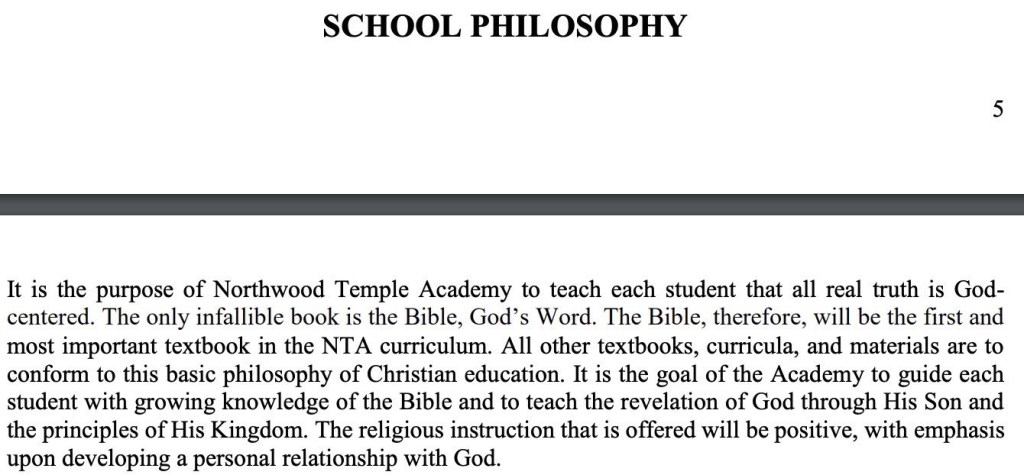
Northwood Temple Academy in Fayetteville got more than $1.1 million in NC taxpayer voucher funds this year.

Their school philosophy is “The Bible, therefore, will be the first and most important textbook in the NTA curriculum.”

They should not get public $ #nced #ncga

Governor Greg Abbott of Texas likes to say that he supports vouchers because he wants “education, not indoctrination.” This is hilarious because most vouchers are used for religious schools, whose purpose is indoctrination. They certainly do not teach students to think critically, as that might refute their mission.

Tom Ultican read the recent report by the Network for Public Education about the growth of faith-infused charter schools. The report is called “A Sharp Right Turn.” If you want your child to learn critical thinking, these schools would be the wrong choice. Critical thinking means that you are encouraged to question what you are taught.

Ultican writes:

Carol Burris and team at Network for Public Education (NPE) just published, “A Sharp Turn Right” (STR). NPE President Diane Ravitch noted there are several problems associated with charter schools’ profiteering, high closure rates, no accountability…

“This new report, A Sharp Turn Right, exposes yet one more problem — the creation of a new breed of charter schools that are imbued with the ideas of right-wing Christian nationalism. These charter schools have become weapons of the Right as they seek to destroy democratically governed public schools while turning back the clock of education and social progress by a century.” (STR Pages 3 and 4)

STR focuses on two types of charter schools. One characterizes themselves as “classical academies” and the other touts “back to basics,”without noting they also employ the same “classical” curriculum. Both provide right-wing clues on their web-sites, alerting parents of alignment with Christian nationalism. Marketing is often red, white and blue, with pictures of the American founding fathers, and discussions on patriotism and virtue. Some schools include direct references to religion like Advantage Academy’s claim of educating students in a “faith-friendly environment…”

Using keyword searches, NPE identified 273 active charter schools fitting this description and noted they surely missed more. Nearly 30% of them were for-profit; about double the rate for the charter sector in general. Almost 50% of them have opened since Donald Trump was inaugurated president in 2017… (STR Page 7)

It identifies the largest charter school systems indoctrinating students with Christian nationalist ideology and discloses where they are operating. Discussing, in some depth, Hillsdale College with its Barney charter schools and the large number of new charter affiliates, the report asserts:

“What they all have in common is teaching Hillsdale’s prescriptive 1776 curriculum, which disparages the New Deal and affirmative action while downplaying the effects of slavery. Climate change is not mentioned in the science curriculum; sixth-grade studies include a single reference to global warming.” (STR Page 15)

The reality is today’s taxpayers are forced to pay for schools teaching a form of Christianity associated with white superiority; politically indoctrinating students with specific rightist orthodoxy. What happened to the principal of separation of church and state? This charter schools for indoctrination movement must be stopped before American democracy is sundered.

Ultican reviews the long-held belief in separation of church and state, and the Supreme Court’s decisions that balanced the Constitution’s protection of freedom of religion and its prohibition of any establishment of religion.

This balancing act was disrupted by Reagan’s appointment of Justice Antonin Scalia, who saw no reason to separate church and state. The appointment of Justice Clarence Thomas gave Scalia an ally. Scalia and Thomas believed that all religious activity is religious speech and therefore protected. We saw the most recent example of this reasoning in the Court’s decision holding that discrimination against gay people was acceptable if their very existence offended the religious beliefs of the service provider, since in this case she feared she might be expected to give he assent to their wedding. The Court called its license to discriminate a vindication of free speech rights.

Ultican concludes:

Time to wake up and smell the coffee; the modern Supreme Court is corrupt and needs reformation. Instead of deciding issues based on law and precedence, they create theories designed to support a political philosophy rather than showing fidelity to the constitution. This reflects a complete degradation of jurisprudence. The poorly formed decisions regularly undermine the rights and protections the founders bestowed on citizens; all while some Justices appear to be ethically compromised.

For the first time in American history, billions of taxpayer dollars are flowing to private religious schools. The STR report shines a light on charter schools with religious agendas. Even more disturbing, these new taxpayer funded privatized schools are literally indoctrination centers, teaching a depraved political ideology.

Veteran teacher and blogger Nancy Bailey was stunned by Nicholas Kristof’s column in the New York Times describing Mississippi’s schools as a national model of success. Her reaction: Can children learn to read when they are segregateed and hungry?

Bailey points out that Kristof is praising the work of Jeb Bush, who has pioneered third grade retention and even funded the study that allegedly proves the value of holding back third graders who flunk the reading test. This helps to improve fourth grade scores but multiple other studies assert that it harms those who are held back.

Rcharvet, a retired teacher and regular commenter here, explains how the pedagogy of the Commin Core taught his students to dislike reading. They were supposed to read excerpts of books, not a complete book. They were expected to analyze the meaning of words and sentences instead of following the narrative of the story. Mr. Charvet became a subversive. He explains here.

We had to use a program called Study Sync. The kids called it, “Study Stink.” It was a canned computer program that used excerpts from stories. It drove me nuts. A lot of highly-intellectual processing for kids who were “emerging readers.” I had to “study my brains out” to figure out what the “end game” was and then how to explain/teach it to my students. Once “I” got it (not lying took a lot of study time on my part) I could teach it. It was still boring.

We had “Lord of the Flies” but only an excerpt. None of the kids got it. I found several YouTube videos that reviewed and explained the story. Once I did that, one of my students said, “I went home and read the whole book three times! It was one of my favorites.”

When I taught reading, I would read out loud so kids would HEAR the characters voices (yes I did the voices as well). For struggling readers they typically move through a sentence like they are walking on glass. But, we worked together.

One book that we started was “The Pig Man.” It started out slow (geez I was slow) but started liking the book to the point kids were saying, “Can we read The Pig Man and find out what happened?” They felt the words. They connected to the characters. We could ask questions like, “If you were Tommy what would you do in this case? What should the Pig Man do about the broken statue?” Then because I was making a connection to the book and trying to follow the curriculum I was deemed “moving too slow” and the department head said, “Just collect all the books and move on.”

What did I know?

And then the kids had to take Accelerated Reader tests. This told them what type of book they qualified to read by their AR or Lexile number. When they went to the library the librarian would tell them, “Oh, the rocket ship book is not in your Lexile number range, you cannot read about rocket ships.” I grumbled something like, “This is f-ing messed up under my breath.”

Then, I noticed their test scores all went down. I asked them, “I am curious. You were all doing so well and then I noticed that your AR scores dropped (it’s okay) but I am just curious.” They told me the test added a clock-timer that their eyes kept looking at. “We got anxious because we could tell we only had so much time to answer the question.” Some Kids decided to punch any answer just to be done. Wow, that was fun.

And when we went to distant learning, one little girl asked, “Mr. Charvet, can I read this book because it is not my Lexile number.” I told her, “You read any book you want. Just do what I told you: if you don’t understand a word, look it up or put it on your sticky note so you can keep reading. I will help you later. But if you keep stopping, you will lose the flow and that’s no fun.”

The reading was painful to the point, I wanted to skip it. But, I did find some great FREE programs online that the kids loved as long as they didn’t tell anybody — making reading fun, our little secret.

I printed out all the papers because most kids like to have something they can “feel” when they read. The computer reading hurt my eyes; it created headaches for many of my kids.

When I taught art I had a magazine cabinet for collages. I looked up one day and there were a group of middle school boys giggling and having a good time. “Hey you kids! What are you doing back there?” I reminded them there was no reading, just collecting pictures. Then I said, “Nah, what did you find?” “Mr. Charvet, check out this giant spider egg that was buried in the ground. And look at this old boat they found. And look at this…and this… and this. They had so much fun. I said, “You know I come back here to look for pictures, too. Then an hour goes by after I read all these great articles and learned so much. You know, this is the stuff (by knowing) you can win thousands of dollars on a game show!” For crying out loud, they gave away $250K for knowing that Frodo (LOTR) was not a Pokemon. We all laughed, but that kind of reading didn’t count because they could only read books. You know REAL books.

I loved reading everything from matchbook covers and especially on the back of cereal boxes — to the comics that would take me on adventures.

Nowadays, “Yes we know Spiderman saved the day. But what was the tone of his thinking? What do you think he meant by using this word? In sentence three, he used plethora. How can that be applied in other ways?” Man, we were just happy Spiderman got rid of the bad guys. Peace out.

The United States Supreme Court has been on a rightwing roll, eliminating affirmative action yesterday, now upholding discrimination against gays, and striking down Biden’s attempt to provide relief to student debtors. The five conservative justices rewarded the faith that Leonard Leo and the Federalist Society placed in them. They were chosen based on their extreme ideology.

This morning, the Court ruled that a person who objects to gays need not do business with them. Colorado bans discrimination based on sexual orientation, but the Extreme Court struck down the state law. The justices in the majority based their decision of free speech rights, upholding the view that the web designer’s free speech was impaired if she had to do work for gay people.

The Boston Globe reported:

WASHINGTON (AP) — In a defeat for gay rights, the Supreme Court’s conservative majority ruled Friday that a Christian graphic artist who wants to design wedding websites can refuse to work with same-sex couples.

The court ruled 6-3 for designer Lorie Smith despite a Colorado law that bars discrimination based on sexual orientation, race, gender and other characteristics. Smith had argued that the law violates her free speech rights.

Smith’s opponents warned that a win for her would allow a range of businesses to discriminate, refusing to serve Black, Jewish or Muslim customers, interracial or interfaith couples or immigrants. But Smith and her supporters had said that a ruling against her would force artists — from painters and photographers to writers and musicians — to do work that is against their beliefs.


“The First Amendment envisions the United States as a rich and complex place where all persons are free to think and speak as they wish, not as the government demands,” Justice Neil Gorsuch wrote for the court’s six conservative justices.

The student debt decision was also 6-3, with the conservative justices knocking out Biden’s efforts to reduce the financial burden on millions of people.

The New York Times reported:

The Supreme Court’s conservative supermajority struck down President Biden’s proposal to cancel at least some student debt for tens of millions of borrowers, saying it overstepped the powers of the Education Department.

In a 6-to-3 decision, Chief Justice John G. Roberts Jr. wrote that a mass debt cancellation program of such significance required clear congressional authorization.

Citing the same authority the Trump and Biden administrations used to pause student loan payments during the pandemic, Mr. Biden promised in August to forgive $10,000 in debt for individuals earning less than $125,000 per year, or $250,000 per household, and $20,000 for those who received Pell grants for low-income families.

Nearly 26 million borrowers have applied to have some of their student loan debt erased, with 16 million applications approved. But no debts have been forgiven or additional applications accepted in light of the legal challenges.

I hope that all 26 million indebted people vote for Biden. He tried.

Peter Greene writes here about the latest news from Pennsylvania, where he lives. The Republican-dominated state senate passed a voucher bill. Newly elected Democratic Governor Josh Shapiro has said he supports vouchers. He’s getting lots of kudos from Rightwingers. Is this why we was elected? It’s now up to House Democrats, who have a sliver majority, to stop this giveaway to private and religious schools.

Peter Greene writes:

Choicers in Pennsylvania are so close they can taste it, and everyone has come off the bench to help push this newest bill past a governor who has said he likes vouchers just fine—under certain condition. This is from my piece from Forbes.com this morning.

Democrat Josh Shapiro made no secret of his support for school vouchers when he was campaigning for the Pennsylvania governor’s seat. Now conservatives are pushing him to put that support to work.

The Senate passed the newest school voucher bill Thursday night; House Democrats say that it will not advance. Supporters are still hoping that it can be saved in the budget process.

The Lifeline Scholarship Program has been kicking around Harrisburg in a variety of bills that presented a variety of school voucher formats as voucher supporters looked for a version that would garner enough support to pass. The current iteration is a traditional school voucher, essentially a taxpayer funded tuition subsidy for students attending private schools.

Under this bill, students in the lowest 15% of schools in the commonwealth (as determined by standardized test scores) would be eligible.

The vouchers, named a top priority by Pennsylvania’s GOP, have become a key part of the current budget negotiations in the state that is already under a court order to fix its funding system for public schools.

The voucher system would be a chance for school voucher proponents to get their foot in the door, an especially tasty victory in a state with a Democratic governor. To add to the pressure to pass, a coalition of right wing voucher fans has sent Shapiro a letter arguing for the voucher program.

Open the link to the article to find the link to the entire article in Forbes.

Matt Barnum, writing in Chalkbeat, reports that the U.S. Supreme Court declined today to rule on whether charter schools are public or private.

The case at hand was a charter school in North Carolina that required girls to wear certain types of clothing. If the school were deemed “public,” its rule would be considered discriminatory. If it were deemed “private,” the school could write its own rules about student dress.

So the question remains open, and the Court of Appeals ruling that the school could not discriminate remains in place.

The U.S. Supreme Court declined Monday to hear a case that hinged on whether charter schools are considered public or private.

The decision to punt indicates the highest court won’t offer an early hint on the validity of religious charter schools. It also leaves in place a patchwork of rulings on whether charter schools are considered private or public for legal purposes.

But the legal debates are not over.

“The issue will percolate and the Supreme Court will eventually hear a case,” predicted Preston Green, a professor of educational leadership and law at the University of Connecticut.

The case, Charter Day School. v. Peltier, focused on a dispute over a charter school’s dress code. The “classical” school in southeastern North Carolina had barred girls from wearing pants, as a part of an effort to promote “chivalry,” according to its founder.

Backed by the American Civil Liberties Union, some parents sued over this policy. They argued that the dress code amounted to sex-based discrimination and is illegal under the 14th Amendment to the U.S. Constitution. The school countered that it is not a government-run institution so is not bound by the Constitution, which does not apply to private organizations. (Charter Day also maintains that the dress code is not sexist.)

Last year, a divided circuit court sided with the parents. The majority ruled that charter schools, at least in North Carolina, are bound by the Constitution and that the dress code amounted to illegal discrimination.

The charter school appealed to the Supreme Court. Attorneys for the Biden administration argued that the lower court decision was correct and urged the court to accept that ruling. A string of conservative writers and groups had urged the court to take on the case.

On Monday, though, the Supreme Court declined to grant a hearing, leaving the circuit court decision in place. This indicates that there were not four justices who wanted to take on the case. As is typical, the court did not issue any further comment.

The case turned on whether Charter Day School is a private entity or a public “state actor.” This issue is also crucial for the brewing legal dispute over religious charter schools. If charter schools are state actors then they likely cannot be religious. If they are private, though, religious entities would have a stronger case for running charter schools. These debates will likely be tested in Oklahoma, which recently approved what could be the country’s first religious charter school. Ultimately, this may end up being sorted out via years of litigation — which could end up back at the Supreme Court.

Meanwhile, the court’s decision to pass on the case is a win for the parents who sought to change the North Carolina charter school’s dress codes.