Archives for category: Education Industry

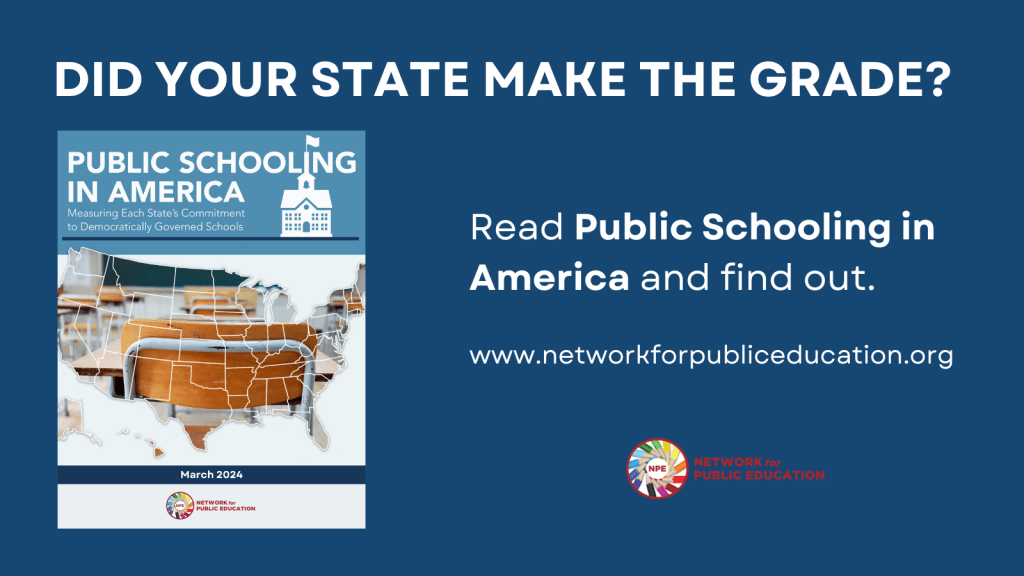
The Network for Public Education released a report card today grading the states on their support for democratically-governed public schools. Which states rank highest in supporting their public schools? Open the report to find out.

Measuring Each State’s Commitment to
Democratically Governed Schools

EXECUTIVE SUMMARY


Neighborhood public schools remain the first choice of the overwhelming majority of Ameri-
can families. Despite their popularity, schools, which are embedded in communities and gov-
erned by elected neighbors, have been the target of an unrelenting attack from the extreme
right. This has resulted in some state legislatures and governors defunding and castigating
public schools while funding alternative models of K-12 education.

This 2024 report, Public Schooling in America: Measuring Each State’s Commitment to
Democratically Governed Schools
, examines these trends, reporting on each state’s commit-
ment to supporting its public schools and the children who attend them.

What We Measure

We measure the extent of privatization in each state and whether charter and voucher laws
promote or discourage equity, responsibility, transparency, and accountability. We also rate
them on the strength of the guardrails they place on voucher and charter systems to protect
students and taxpayers from discrimination, corruption and fraud.

Recognizing that part of the anti-public school strategy is to defund public schools, we rate
states on how responsibly they finance their public schools through adequate and equitable
funding and by providing living wage salaries for teachers.

As the homeschool movement grows and becomes commercialized and publicly funded,
homeschooling laws deserve public scrutiny. Therefore, we rate states on laws that protect
children whose families homeschool.

Finally, we include a new expansive category, freedom to teach and learn, which rewards
states that reject book bans, and the use of unqualified teachers, intolerance of LGBTQ stu-
dents, corporal punishment, and other factors that impinge on teachers’ and students’ rights.

How does your state rank?

Gary Rubinstein is a teacher of mathematics and a strong proponent of evidence. Whenever a journalist or education evangelist claims to have found a “miracle school,” he goes for the data, and he digs deeper than test scores. The Success Academy Charter network, led by its founder Eva Moskowitz, has achieved national renown for its test scores. Gary has observed a winnowing of the students as they advance through the grades. He recently noticed that one of its schools had disappeared.

He wrote:

Success Academy is the largest charter school network in New York State. Starting in 2006 with one school, there are now around 40 Success Academy schools with around 20,000 students.  And with a recent $100 million grant from Bloomberg Philanthropies, it might seem that Success Academy will continue to grow at an exponential rate. But there is some evidence that growth at Success Academy is slowing down. In one case it seems that one of their schools, Fort Greene Middle School has shut down completely.

According to the New York State public data site, in 2022-2023, Success Academy Fort Greene was a middle school on Park Avenue in Brooklyn with 180 students from 5th to 8th grade. In classic Success Academy fashion, the 27 eighth graders is significantly fewer than the 55 fifth graders.

But when you look at the December 2023 enrollment data, suddenly Success Academy Fort Greene is no longer a middle school, but an elementary school located at 3000 Avenue X in Brooklyn. The enrollment of this school is 75 kindergarteners and 41 1st graders. I know that Success Academy is supposed to be capable of miracles, but turning 180 middle schoolers into 116 elementary schoolers is not one of them.

On the Success Academy website, however, there is no mention of a Fort Greene school of any type anymore, but instead there is a brand new elementary school called Success Academy Sheepshead Bay at the 3000 Avenue X address.

What happened is that Success Academy had to close down their Fort Greene middle school because of low enrollment. Why in the New York database, they let the new elementary take the name of the old middle school, maybe this is something they have to do for the charter cap, but I wouldn’t know. Still, any Success Academy school closing down is something that seems pretty newsworthy considering that they thrive on a reputation that they have cultivated that they must continually expand because of the demand for their schools…

Open the link to finish the post.

Pamela Lang, a journalist and graduate student in Arizona, wrote for The Hechinger Report about her futile search for a school that would enroll her son, who has special needs. Despite Arizona’s budget-busting voucher program, she and he were turned away again and again. It’s time for her to check out her local public school, where her son would get the services he needs and he could not be rejected.

Please read her account.

If you live in Arizona, school choice may be coming to your neighborhood soon. As someone who has had more school choice than I know what to do with, I can tell you what may feel like a shocking surprise: Private schools have the power to choose, not parents.

I live in Phoenix, where the nearby town of Paradise Valley is getting ready to offer the privatization movement’s brand of choice to families. The district has indicated that it will likely vote to close four public schools due to insufficient funds. If this happens, other districts will probably follow: The state’s recent universal voucher expansion has predictably accelerated the diversion of money from public to private schools.

Arizona approved use of school choice vouchers, called Empowerment Scholarship Accounts, or ESAs, in 2011 on the promise that they were strictly for children with special needs who were not being adequately served in the public school system. The amount of funds awarded to qualified students was based on a tiered system, according to type of disability.

Over the years, the state incrementally made more students eligible, until full expansion was finally achieved in 2022. For some students, the amount of voucher money they qualify for is only a few thousand dollars, nowhere near enough to cover tuition at a private school. Often, their parents can’t afford to supplement the balance. However, my son, who is autistic, qualified for enough to cover full tuition.

I took him out of public school in 4th grade. Every school I applied to seemed to have the capability to accommodate his intellectual disability needs but lacked the willingness. Eventually, I found a special education school willing to accept him. It was over an hour from our home, but I hoped for the best. Unfortunately, it ultimately was not a good fit.

I then thought Catholic schools would welcome my son, but none of them did. One Catholic school principal who did admit him quickly rescinded the offer after a teacher objected to having him in her class.

The long list of general, special-ed, Catholic and charter schools that turned my son away indicate how little choice actually exists, despite the marketing of ESA proponents.

There was a two-year period where I gave up and he was home without social opportunities. I was not able to homeschool, so a reading tutor and his iPad became his only access to education.

I then tried to enroll him in private schools for students with disabilities.

These schools were almost always located in former office suites in strip malls with no outdoor access. My son’s current school shares space with a dialysis center in a medical building, while a former school was located in a small second-floor suite in a Target plaza.

Once a private school admits your child, they can rescind admission without cause. Private schools are at leisure to act as virtual dictatorships, and special-ed schools in particular are notorious for keeping parents at a distance…

Education is a human right, and public schools, open to all, are the guardians of this right. What privatizers call choice does not really exist.

Please open the link and read the article in full.

In at least 20 states, the College Board collects and sells student data, despite state law forbidding it.

New York was one of those states, but activist parents led a years-long campaign to block the practice.

Recently, State Attorney General Letitia James won a judgment against the College Board for $750,000, and it agreed to stop monetizing student data in New York.

What happens in your state? Does your state protect the privacy of student data? Does it enforce the law?

Read Leonie Haimson’s account of how parents in New York pushed back and finally won. She includes a list of other states that protect student privacy.

She writes:

For decades, the College Board has been selling student names, addresses, test scores, and whatever other personal information that students have provided them,  when they sign up for a College Board account and the Student Search program. According to the AG press release, in 2019 alone, the College Board improperly shared the information of more than 237,000 New York students.  Since New York’s student privacy law, Education §2-d, calls for a fine of up to $10 per student, the penalty for selling student data during that one year alone could have equaled more than $2 million.

And yet for years, on their website and elsewhere, the College Board has also  falsely claimed they weren’t selling student data.  Instead they called  it “licensing” data, a distinction without a difference.  For years, they also claimed that they never sold student scores, though that was false as well, as they do sell student scores within a range.

The College Board urges millions of students to sign up for their Student Search program, with all sorts of unfounded and deceptive claims, including that it will help them get into better schools or receive scholarships.  The reality is that their personal data is sold to over 1,000 colleges, programs and other companies – the names of which they refuse to disclose — who use it for marketing purposes and may even resell it to even less reputable businesses.

Is your state one of them? Is the law enforced?

In the Public Interest is an excellent source of information about privatization in every sphere of life, wherever privatizers see a chance to turn a public service into private profit. Its latest post is about the citizens’ fight to overturn a new voucher plan in Nebraska.

Open the link to see the cost of vouchers in Arizona, New Hampshire, North Carolina, and Ohio. Count on costs to go up every year, as legislators expand eligibility and raise income limits.

In early 2023, the Nebraska legislature passed LB753, which created a new private school tax-credit voucher program. The bill allows a dollar-for-dollar tax credit to individuals and corporations that donate to a scholarship granting organization (SGO), which would issue the vouchers to families to pay for private school. Eligibility requirements are broad, allowing, for example, any child entering either kindergarten or 9th grade at a private school, or any student who has spent at least one semester in a public school to apply for a voucher. The bill would divert up to $25 million annually from the state, but that figure could go up to $100 million.

The bill includes a standard “hands off clause,” which prevents the state from exercising any authority over the school and how it operates.  It’s basically a license to discriminate.

Shortly after the bill was passed, public school supporters launched a referendum petition drive to put repeal of the new law on the November 2024 ballot. In fewer than 90 days, the repeal campaign gathered nearly double the number of required signatures from across the state. The effort was led by Support Our Schools Nebraska, a coalition that includes, among others, the Nebraska State Education Association, OpenSky Policy Institute, Parent-Teacher Association of Nebraska, Stand for Schools, League of Women Voters of Nebraska, Omaha NAACP, ARC of Nebraska, Nebraska Farmers Union, and the Nebraska Civic Engagement Table.

In Nebraska, 84% of private schools are religiously affiliated. Many, if not most of these schools are legally permitted to discriminate against applicants based on their gender orientation, religious affiliation, or other characteristics. The Nebraska OpenSky Policy Institute has estimated that state aid distributed to public schools could decrease by almost $12 million in response to the new voucher program.

Forces aligned against the repeal include the usual suspects, like the American Federation for Children, founded by anti-public-education zealot Betsy DeVos, which donated $583,000 along with $103,000 of in-kind services to the pro-voucher effort, on top of money DeVos spent to influence Nebraska state senate races in the last cycle. The Nebraska Catholic Conference, whose coffers stand to gain from LB753, has also thrown its weight and reach behind the anti-public education side. Jeremy Ekeler left his job as associate director of education policy at the Conference in November to become the executive director of Opportunity Scholarships of Nebraska, a state-approved scholarship granting organization helping to implement LB753. They’re not only working to defeat the ballot measure, they’re trying to keep it off the ballot entirely, following a playbook the right has used to subvert a variety of citizen-led, petition-driven initiatives around the country.

As we have pointed out before and as the chart above illustrates, vouchers bleed public school districts of needed funds, allow for discrimination, lower educational standards (by not necessarily having many), and lead to resegregation.

As if that weren’t enough, they turn out to be budget busters for states.

In the Public Interest will keep an eye on this fight because it may be the clearest indication that, while conservative politicians have thrown their support to various schemes that divert public funds from public schools, the public opposes these efforts and will show up at the polls to make their feelings felt.

Several readers told me they were unable to access my conversation with Todd Scholl of the South Carolina Center for Educatot Wellness and Learning.

We talked about attacks on public schools, standardized testing, and privatization.

Todd sent these links:

The video can be found on the CEWL website at www.cewl.us. A direct link to the video can be found at https://youtu.be/Zm0Vi3S3RLM.

I will be in conversation with Todd Scholl of the Center for Educator Wellness & Learning in South Carolina tonight February 15 at 7 pm EST.

We will talk about privatization of public schools and the attacks on public schools.

The conversation will be livestreamed on Facebook.

Tonight February 15 at 7 pm.

For years, parent advocates for student privacy have been pushing the state to stop the College Board from selling student data to colleges. See Reuters story here. The state Attorney General Letitia James and Board of Regents Chair Betty Rosa sued the College Board and won.

FOR IMMEDIATE RELEASE    
February 13, 2024

Attorney General’s Press Office/212-416-8060nyag.pressoffice@ag.ny.gov

Attorney General James and NYSED Commissioner Rosa
Secure $750,000 from College Board for Violating Students’ Privacy

NEW YORK – New York Attorney General Letitia James and New York State Education Department (NYSED) Commissioner Betty A. Rosa announced a $750,000 settlement with College Board for violating students’ privacy and unlawfully selling their personal data. For years, College Board collected students’ personal information when they took the PSAT, SAT, and AP exams in school, and then licensed this data to colleges, scholarship programs, and other customers who used it to solicit students to participate in their programs. In 2019 alone, College Board improperly licensed the information of more than 237,000 New York students who took their exams. In addition, College Board improperly sent promotional materials to students who signed up for College Board accounts in connection with exams or AP courses. As a result of today’s agreement, College Board must pay $750,000 in penalties and will be prohibited from monetizing New York students’ data that it acquires through its contracts with New York schools and school districts.

“Students have more than enough to be stressed about when they take college entrance exams, and shouldn’t have to worry about their personal information being bought and sold,” said Attorney General James. “New York law requires organizations like College Board to protect the data they collect from students when they take their exams in school, not sell it to customers for a profit. I want to thank Commissioner Rosa for her work on this investigation to ensure we hold College Board accountable and protect New York students’ privacy.”  

“When the organizations we trust to provide meaningful services to our students exploit student information for profit, it violates privacy laws as well as the public trust,” said Commissioner Betty A. Rosa. “We will continue to ensure that every student’s information is appropriately utilized and protected. We are grateful to the Attorney General for her collaboration in protecting the interests of the students and families of New York.”

College Board is a New York-based non-profit institution that develops and administers standardized tests, primarily to high school students who take them as part of the college admissions process. It also develops other college readiness programs, such as AP courses, and has a contract with NYSED to subsidize AP exam fees for low-income students. In addition, College Board operates the Student Search Service (Search), in which it licenses data it collects from students — including their names, contact information, ethnicity, GPAs, and test scores — to customers like colleges and scholarship programs to use for recruiting students. 

Beginning in 2010, College Board contracted with New York schools and school districts to allow schools to offer the PSAT and SAT exams during the school day and to pay for the students’ exam fees. In the past five years, approximately 20 New York schools or school districts, including the New York City Department of Education, which operates more than 500 high schools, have entered into such contracts. Schools across New York have also consistently signed agreements with College Board to offer AP courses and exams.

An investigation led by the Office of the Attorney General (OAG) revealed that prior to June 2022, College Board solicited students to provide information, such as their GPA, anticipated course of study, interest in a religiously affiliated college and religious activities, and parents’ level of income, during the administration of PSAT, SAT, and AP exams, as well as when students signed up for a College Board online account. Although providing this data for participation in Search was optional, students were solicited to participate in the urgent context of an important exam and were encouraged to sign up because it would connect them with scholarship and college opportunities. From 2018-2022, College Board licensed New York student data to over 1,000 institutions through Search and received significant revenue from data related to New York students who took PSAT, SAT, or AP exams during the school day.    

The investigation further found that College Board improperly used student data for its own marketing. Until fall 2022, College Board used student data collected in connection with PSAT and SAT exams administered during the school day to send marketing communications. In addition, until 2023, when New York students registered for the AP program, they were solicited to opt in to receiving College Board marketing materials. 

Under New York law, it is illegal to use student data obtained under a contract with a New York educational agency for commercial or marketing purposes. The investigation found College Board improperly used student data obtained in connection with PSAT and SAT exams administered during the school day and the AP program by licensing student data to Search clients and using student data to send its own marketing materials.  

Under the settlement announced today, College Board must pay $750,000 in penalties, disgorgement, and costs to the state. College Board is also prohibited from using New York student data it collects or receives in connection with a contract with a New York educational agency for any marketing or commercial purposes. This includes data obtained from administering PSAT, SAT, or AP exams during the school day. In addition, College Board cannot solicit students to participate in Search or similar programs during these exams.

This matter was handled for OAG by Assistant Attorneys General Laura Mumm, Jina John, and Hanna Baek of the Bureau of Internet and Technology, under the supervision of Bureau Chief Kim Berger and Deputy Bureau Chief Clark Russell, with special assistance from former Special Advisor and Senior Counsel for Economic Justice Zephyr Teachout. The Bureau of Internet and Technology is part of the Division for Economic Justice, which is overseen by Chief Deputy Attorney General Chris D’Angelo and First Deputy Attorney General Jennifer Levy.

This matter was handled for NYSED by Chief Privacy Officer Louise De Candia and Counsel & Deputy Commissioner for Legal Affairs Daniel Morton-Bentley.
By a vote of 4-3, the Los Angeles Unified Schiol District Board adopted a policy barring charter schools from co-locating in public schools with high-needs students. The charter lobby immediately threatened to sue the district. Currently one of every five students in the LAUSD district attends a charter school. For years, billionaires such as Eli Broad, Reed Hastings, Bill Bloomfield, the Walton family, and Michael Bloomberg have poured millions into school board races on behalf of privatization. But for the moment, the anti-privatization supporters of public schools have a slim majority.

The seats of two of the four-person majority—Scott Schmerelson and George McKenna—are up for election next month. Both are veteran educators and pro-public schools. Schmerelson is running for re-election; McKenna is retiring and has endorsed veteran educator Sherlett Hendy Newbill. I endorsed both Scott Schmerelson and Sherlett Hendy Newbill.

The new policy could be ditched by pro-charter replacements or by a legal challenge from the charter lobby.

Howard Blume wrote in the Los Angeles Times:

The struggle between traditional and charter schools intensified Tuesday when a narrow Los Angeles school board majority passed a sweeping policy that will limit when charters can operate on district-owned campuses. 

Access to public school campuses for charter schools is guaranteed under state law — and charter advocates immediately threatened to sue over the new restrictions.

The policy, passed 4 to 3, prohibits the new location of charters at an unspecified number of campuses with special space needs or programs. One early staff estimate put the number close to 350, but there’s uncertainty over how the policy will be interpreted. The school system has about 850 campuses, but advocates are concerned that charters could be pushed out of areas where they currently operate, making it difficult for them to remain viable.

Under the policy, district-operated campuses are exempt from new space-sharing arrangements when a school has a designatedprogram to help Black students or when a school is among the most “fragile” because of low student achievement. Also exempt would be community schools — which incorporate services for the broader health, counseling and other needs of students and their families. 

The district argued these programs need space beyond the normal allotments for classrooms, counselors, health staff and administrators — for example, rooms for tutoring, enrichment or parent centers. Such spaces had frequently been tabulated as unused or underutilized — and then made available to charters…

In the current school year 52 independent charters operate on 50 campuses, according to L.A. Unified. The number is expected to be smaller for next year and down significantly from a peak of more than 100. But even 50 schools would make for one of the larger school systems in California.

In all, there are 221 district-authorized charters and 25 other local charters approved by the county or state, serving about 1 in 5 public school students within the boundaries of L.A. Unified — about 535,000 students total. Most charters operate in their own or leased private buildings.

The L.A. school system has more charters than any other district in the nation. Most were approved under charter-friendly school boards and under state laws — since changed — that made it difficult for school districts to reject charters.

For many years, I was a staunch advocate of standardized testing. But I lost my enthusiasm for standardized testing after spending seven years on the governing board of NAEP (the National Assessment of Educational Progress). NAEP is the federal test administered every two years to measure academic progress in reading and math, as well as testing other subjects. The test takers are randomly selected; not every student answers the questions on any test. There are no stakes attached to NAEP scores for any student, teacher, or school. The scores are reported nationally and by state and for nearly two dozen urban districts. NAEP is useful for gauging trends.

Why did I lose faith in the value of standardized testing?

First, over the course of my term, I saw questions that had more than one right answer. A thoughtful student might easily select the “wrong” answer. I also saw questions where the “right” answer was wrong.

Second, it troubled me that test scores were so highly correlated with socioeconomic status. Invariably, the students from families with the highest income had the highest scores. Those from the poorest families had the lowest scores.

Third, the latter observation spurred me to look at this correlation between family wealth and test scores. I saw it on the results of every standardized test, be it the SAT, the ACT, or international tests. I wondered why we were spending so much money to tell us what we already knew: rich kids have better medical care, fewer absences, better nutrition, more secure and stable housing, and are less likely to be exposed to vermin, violence, and other health hazards.

Fourth, when I read books like Daniel Koretz’s “Measuring Up” and “The Testing Charade” and Todd Farley’s “Making the Grades: My Misadventures in the Standardized Testing Industry,” my faith in the tests dissipated to the vanishing point.

Fifth, when I realized that the results of the tests are not available until the late summer or fall when the student has a new teacher, and that the tests offer no diagnostic information because the questions and answers are top-secret, I concluded that the tests had no value. They were akin to a medical test whose result is available four months after you see the doctor, and whose result is a rating comparing you to others but utterly lacking in diagnostic information about what needs medication.

So, all of this is background to presenting a recent study that you might find useful in assessing the value of standardized tests:

Jamil Maroun and Christopher Tienken have written a paper that will help you understand why standardized tested is fatally flawed. The paper is on the web and its title is:

The Pernicious Predictability of State-Mandated Tests of Academic Achievement in the United States

Here is the abstract:

The purpose of this study was to determine the predictiveness of community and family demographic variables related to the development of student academic background knowledge on the percentage of students who pass a state-mandated, commercially prepared, standardized Algebra 1 test in the state of New Jersey, USA. This explanatory, cross-sectional study utilized quantitative methods through hierarchical regression analysis. The results suggest that family demographic variables found in the United States Census data related to the development of student academic background knowledge predicted 75 percent of schools in which students achieved a passing score on a state standardized high school assessment of Algebra 1. We can conclude that construct-irrelevant variance, influenced in part by student background knowledge, can be used to predict standardized test results. The results call into question the use of standardized tests as tools for policy makers and educational leaders to accurately judge student learning or school quality.

The paper was peer-reviewed. It was published last week.