Archives for category: Education Industry

Bob Shepherd is a regular reader and commenter who has been an assessment developer, a textbook writer and editor, and a teacher, among other things.

In the following post, he reviews the Hillsdale College “1776 Curriculum,” which took its name from Donald Trump’s short-lived “1776 Commission.”

He writes:

According to the Nashville Tennessean, Governor Bill Lee, a proponent of charter schools, is planning a partnership with fundamentalist Christian Hillsdale College to open 50 new charter schools in the state. These would use the Hillsdale 1776 Curriculum. Hillsdale bills itself as promoting Classical education.

I’ve just been reading through this stuff from Hillsdale, which is supposed to be a combination American History and Civics curriculum. It’s basically a guide to fundamentalist, nationalist indoctrination.

The first thing to notice about this curriculum, in comparison to existing K-12 American History and Civics programs, is that it is quite short. You can read through it in an afternoon. If your goal is to use history to indoctrinate students in a Christian fundamentalist nationalist mythology, it’s best to keep the discussion at the 50,000-foot level and deal mostly in abstract jingoism, with a few exempla thrown in. This is the sermon as textbook. If you get too much into the details, you are going to run into all kinds of messy events that don’t exemplify the mythology you are promulgating–the Mystic Massacre; the disenfranchisement at the dawn of the country of all but propertied white males; the Fort Pillow Massacre; slave auctions where trade in girls and young women was saved to the end of the day because such human property was particularly prized (guess why?) by good Christian white, male slaveowners; the Wounded Knee Massacre; a century of lynchings and Jim Crow and voter suppression and white citizens councils and the KKK and U.S. federal housing policy designed to keep black people from home ownership, the primary means by which ordinary people build generational wealth; the Eugenics and Nazi Bund movements in America; Trump furious that he couldn’t order to military to fight BLM protestors and the Border Patrol to shoot innocent asylum seekers; and so on ad nauseam.

One of the reasons why Fascism appeals to semiliterate mobs is that it makes everything simple. All complexity is burned away. And that’s just what the Hillsdale American Exceptionalism Curriculum does. (The successor to the 1930s pro-Nazi German American Bund called itself The America First Party, using the America First phrase that Dog-whistle Donald picked up for repetition at his rallies. Where was Leni Riefenstahl to film these?) This need to keep things simpler than they are is why, soon after seizing power, all Fascist governments establish complete control over publishing, the media, and schools and find pretexts for exterminating intellectuals and burning books and artwork.

The President of Hillsdale College, Larry Aarn, introduces his curriculum by saying that the purpose of education is to produce citizens, from the Latin civitas, or city, who can use language to distinguish the good from the bad, and that in history instruction, the way to do that is to concentrate on the lives of great persons. So, at the outset, everything is cleaved into “the good” on the one hand and “the bad” on the other (in other words, this is going to be a curriculum that deals in absolutes), and an avowed program of hero worship is advanced.

When you get into the heart of this comic book curriculum, you find that what its authors have done is choose a few “great” men and carefully excerpt from their writings short selections that support tenets of fundamentalist nationalism (manifest destiny, Christian religious belief, opposition to immigration, states’ rights, supply side trickle-down Laissez-faire economics, opposition to a big, bad federal government, etc.), and these become the subjects of lessons, the takeaways from which are rightwing doctrines and dogmas. So, the history of immigration becomes a few paragraphs from Alexander Hamilton saying that he is against it and accusing Jefferson, via quotations from Jefferson’s own writings, of having flip-flopped on the issue. (NB: Right-wingers only hate big government when it’s not their big government; if it’s Trump trying to bar people who practice a particular religion from the U.S., they are fine with that.)

So, this is all about replacing History and Civics education with comic book/Cub Scout-style mythologized, simplified indoctrination. (The Scouts were created by Robert Baden-Powell for the overtly stated purpose of producing young men willing to fight and die in British imperialist wars. It caught on in a big way in the United States.) Btw, for most of its history, Romans used the noun urbs to refer to the city and civis to refer to a citizen of an urbs. It was only late in Roman history, when Rome was falling apart, that a derivative of the word for citizen started being used to refer to a city itself. But if you are a proponent of education as propaganda, like Aarn, then you want to keep things simple: America good. Foreigners bad. Rome good. Barbarians bad. Classics education = learning to emulate being a true citizen of the Empire.

Doubtless, the Fascist government that the Republicans will put in place should they win both houses in the midterms and the presidency in 2024, will appropriate, in the manner presciently described by Orwell, traditional American concepts and iconography, distorted in a funhouse mirror and presented as a New, Stronger, Tougher, Truer American Exceptionalism.

Remember George Bush, Jr., aka Shrub, who ran on what he called a “kinder, gentler Conservativism” and then gave us 200,000+ Iraqi civilians dead in his illegal war, perpetrated on a false pretext and in violation of the UN Charter? In a similar manner, the Nazis appropriated ancient pictographs, used by cultures worldwide to represent the sun and lightning, and made of these abominations, and the pigs in Orwell’s Animal Farm proclaimed that “All animals are equal, but some animals are more equal than others [are].”

When Fascism comes to America, it will be wrapped in the flag and carrying a cross” goes the observation falsely attributed to Sinclair Lewis but very much in keeping with Lewis’s themes. Yup. Got that right.

He added an example:

Let me give one example of the general 1776 curriculum approach: The treatment of the disagreement about slavery between Abraham Lincoln and Stephan Douglas is presented as one against absolute moral principles attributed to Lincoln) versus the “moral relativism” attributed to Douglas. This is completely anachronistic. Lincoln, of course, famously disliked slavery but asserted that the important thing was preserving the Union, with or without slavery. Sounds pretty relativistic, doesn’t it? The takeaway from the Hillsdale treatment of this topic is that those who do not support absolute principles (e.g., like those of Christian fundamentalists) are “moral relativists,” bad people who are akin to Stephen Douglas, with his support of slavery.

This is using American history classes to teach that there is an absolute moral order in the universe, established by God, that should be enforced by the state. Note that this is in keeping with the earlier teaching, in this curriculum, that the founding principles were about natural law deriving from God. But, of course, the philosophical Deism of many of the founders was a far cry from absolutist Christian fundamentalism and is, in itself, highly debatable.

And again and again, this is how the Hillsdale Curriculum works. It takes events in American history as occasions for advancing right-wing principles–economic libertarianism, nationalism, fundamentalist religious belief, states’ rights, restrictions on immigration, etc.

High school students in several districts in Iowa have staged walkouts to protest legislation that affects their education. Students want their teachers to have the freedom to teach, and they want the freedom to learn. Iowa legislators don’t want either.

In light of recent education bills at the Iowa Legislature, whether it’s promoting vouchers for private schools or restricting what teachers are allowed to mention in class, many Iowa students are getting fed up. And they’re standing up.

Friday afternoon in Johnston, a group of close to 100 students walked out of class and stood on school grounds to talk about those bills, explain how they’re impacting Iowa students and teachers, and encourage their peers to register to vote and to elect different legislators.

“I think the biggest thing now is putting people in positions of power that actually will do the work and will care and represent the student voices that are speaking out about this,” said Waverly Zhao, a junior at Johnston High School who helped lead the walkout.

The walkout was organized by students and two student organizations, Johnston Community of Racial Equity (CORE) Club and Iowa WTF.

And Johnston was only one of several with recent walkouts. Thursday, students walked out at Ankeny and other events have been planned for public and private high schools in Ames, West Des Moines, Des Moines, and possibly Waukee. All are organized by student groups, and generally around the same issue of not having their voices heard about their educations. Students have also held walkouts in recent months in Iowa City, Cedar Rapids and Waterloo.

Specifically, students are calling out House File 2577, the bill that requires teachers to post every single piece of classroom material online, and Senate File 2369, the bill which allows vouchers for private schools and includes a parents’ bill of rights. Both have only passed in their chambers.

Students are also calling out House File 802, the law that prohibits so-called “divisive concepts” being taught in school, which passed last year…

HF 802 prohibited teachers from teaching “divisive concepts” and targets ideas such as systemic or institutionalized racism and sexism, and how those have shaped the way the country was built and how it functions now. Students say they’ve already seen it cause a chilling effect in their classrooms.

“As a student of color, it’s been hard enough in the district, and with the recent legislation, it’s harder to discuss racism and harder for us to combat that in schools,” said Anita Danakar, a Johnston high schooler.

For example, she said her history teacher made sure to tell students they weren’t trying to make student feel guilty when they talked about redlining in class.

Zhao said in her history and social studies classes teachers are talking less about racism and sexism so they don’t cross any lines. A history lesson she had about the 3/5ths compromise in the Constitution left most of the class confused, Zhao said, because the teacher was never quite able to explain why it existed….

Overall, the students said they want to learn about these topics in school, from a trusted source and in an environment where they can ask questions.

“This entire attitude that [says] these students are not mature enough to learn and have mature conversations in the classroom about race, gender, sexuality, to say we can’t even talk about that in an educational environment is disgusting,” said Nicholas Arick, a 17-year-old student who plans to vote in the next presidential election. “It’s saying these students don’t deserve to learn about these things, and eventually when they get out of high school, they’re be ignorant and they won’t know what they’re voting for.”

Only one publisher met all of Florida’s requirements for K-5 math textbooks.

The winner was Houston-based Accelerate Learning.

The Carlyle Group, a global investment firm, acquired Accelerate Learning on Dec. 20, 2018, according to the firm’s website.

During that time, Virginia Gov. Glenn Youngkin was the co-CEO of the firm. After 25 years with the company, Youngkin resigned in 2020 to run for office in Virginia.

The first thing Youngkin did as governor of Virginia was sign an executive order to “end the use of inherently divisive concepts, including critical race theory, and restoring excellence in K-12 public education in the commonwealth,” a measure that’s comparable to DeSantis’ “Stop WOKE Act.”

The story reviewed Accelerate’s website and learned the following:

Accelerate Learning’s website includes an undated diversity statement which says the company commits to hold more diversity training, examine current business and recruitment practices and continue to be inclusive in all levels of the company.

“Our nation’s black communities have long faced the repeated, harmful effects of systemic racism within the justice and education systems,” the statement said.

The company also matched all employee donations to the NAACP, Black Lives Matter and Equal Justice organizations.

“Accelerate Learning, Inc. is committed to supporting diversity in all its manifestations, which requires a consequent commitment to equity and inclusivity,” the statement said.

Sounds like the winner of the math textbook competition is woke and espouses critical race theory.

Allie Pitchon of The Miami Herald reported that state officials told some publishers of math textbooks why the state would not buy their books. The initial announcement said that some math books were too “woke,” contained “critical race theory,” or included concepts from Common Core, which Governor Ron DeSantis turned against because former President Obama endorsed it. Former Florida Governor Jeb Bush, the conservative education guru, also championed Common Core, but that did not mollify DeSantis’s rejection of it.

Publishers were left in the dark about why their math books offended DeSantis, and yesterday the state provided some details. The state informed publishers what had to make changed to get on the state approved list and gave them two weeks to resubmit.

The state posted a few examples on its website.

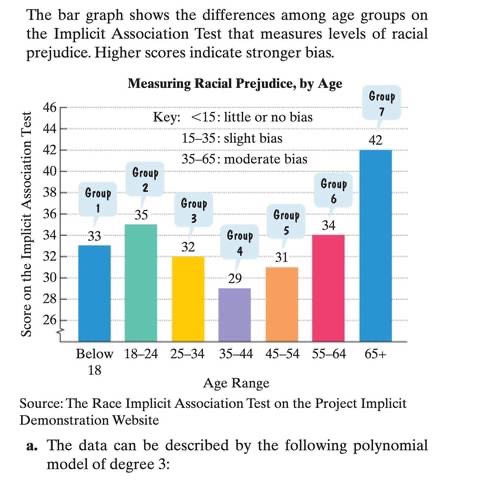
One example: A colored bar chart showing how levels of racial bias can vary by age group. It is part of a mathematical brain teaser involving polynomial models and is nestled on the bottom right-hand corner of page 56 in a pre-calculus online textbook consisting of more than 1,000 pages. The book is not identified on the state’s website

Two other examples that originated with public complaints make reference to Social Emotional Learning (SEL), a methodology wherein students try to get in touch with their emotions and demonstrate empathy for others.

Here is the woke bar graph:

Publishers were well aware, the Department of Education said, that their books would be rejected if they had even a trace of “critical race theory” or “social-emotional learning” or Common Core.

The press release provided a withering quote from Gov. Ron DeSantis: “It seems some publishers attempted to slap a coat of paint on an old house built on the foundation of Common Core, and indoctrinating concepts like race essentialism, especially, bizarrely, for elementary school students.”

Education Secretary Richard Corcoran chimed in, stating Florida was “focusing on providing … children with a world-class education without the fear of indoctrination or exposure to dangerous and divisive concepts in our classrooms.”

In a tweet, Christina Pushaw, the governor’s press secretary, went further, while addressing those who take issue with “book banning”: “The state declining to purchase certain textbooks isn’t banning them. If you want to teach your kid Woke Math, where “2+2=4” is white supremacy, you’re free to buy any CRT math textbook you want. You just cannot force Florida taxpayers to subsidize this indoctrination.” She’s right that local school districts can allocate at least part of their book buying budget toward textbooks not on the state’s approved list.

Read more at: https://www.miamiherald.com/news/local/education/article260639257.html#storylink=cpy

The Miami Herald says that districts have the final say over which textbooks are used in their classrooms. However, Governor Ron DeSantis is trying to compel all districts to adopt only the textbooks approved by the state.

Sommer Brugal writes that under current law, the districts will decide.

Despite the chatter among district leaders about the announcement, and confusion about why certain titles were omitted from the state’s approved list, however, Florida’s law remains clear: Individual school boards — not state officials — ultimately have the responsibility for selecting instructional materials. Furthermore, a district may spend up to 50% of its state funds for books that are not on the department’s list of recommended titles.

Rachel Thomas, a spokesperson for the U.S. Department of Education, on Wednesday doubled-down on the notion: “The department does not dictate curriculum decisions,” she said in a statement. “But we hope those decisions are made by all states and districts in consultation with parents around the issues their children are actually facing.”

In other words, regardless if a book or curriculum is on or off the state’s list of approved materials, a school board still has the authority to purchase it for the district. (The list is the “initial adoption list,” according to the state education department, and has yet to be finalized.)

Earlier this month, district staff presented to the School Board the recommended textbooks, which a review committee had selected. The list included K-5 math books from publishers such as Big Ideas Learning and Savaas Learning Company, neither of which are included on the state’s approved list…

In other counties, such as Orange and Pinellas counties, the list of unapproved texts is important because they’ve already selected their new math books for the 2022-23 school year. None of the books either district picked for elementary math classes were on the state-approved list.

Read more at: https://www.miamiherald.com/news/local/education/article260563017.html#storylink=cpy

The American Federation of Teachers released the following statement about the U.S. Department of Education’s proposals to reform the federal Charter Schools Program, which grants $440 million annually to open or expand charter schools. Authorized in 1994, when there were a small number of charter schools, the CSP has never been reformed in its nearly three decade history. The industry captured the program and glossed over widespread waste, fraud, and abuse in federally-funded charter schools.

The AFT wrote:

For Immediate Release
Wednesday, April 20

Contact:
Andrew Crook
607/280-6603
acrook@aft.org
AFT Responds to Department of Education on Charter School Regulations

WASHINGTON—American Federation of Teachers President Randi Weingarten sent the following letter to the U.S. Department of Education responding to proposed regulations on Charter Schools Program grants.

The text of the letter follows, and it can be read online with additional footnoting and formatting here.

~April 11, 2022

Ms. Porscheoy Brice

U.S. Department of Education

400 Maryland Avenue SW

Washington, DC 20202-5970

Dear Ms. Brice,

The American Federation of Teachers welcomes the opportunity to comment on the U.S. Department of Education’s proposed regulations to the Charter Schools Program grant programs. These proposed regulations represent a positive development for America’s children, and if fully implemented, these improvements to the Charter Schools Program grant applications will not only advance equity, but also move to restore charter schools to their original purpose by integrating them into the broader education community.

We applaud the department’s proposed regulations, which seek to improve community integration of charter schools. We also applaud the department for taking steps to prevent for-profit charter schools—which studies have shown underperform, compared with both public schools and their nonprofit counterparts—from receiving charter school grants. These steps will undoubtedly improve educational outcomes for children in both charter and traditional public schools. As a union of 1.7 million educators, healthcare workers and public service workers, including educators at more than 250 charter schools, we appreciate that the department is seeking to increase collaboration between charters schools and traditional public schools

The AFT strongly supports the department’s collaboration priority:

We appreciate that the department is recognizing the need for collaboration between charter schools and district schools. Charter schools were originally intended to be vehicles for experimentation and collaboration, not walled gardens within our education system, and these proposed regulations reflect that the charter industry has strayed from that original intent. As a union of education professionals, we have concerns over the pervasiveness of noncompete and nondisclosure agreement practices in charter schools and the chilling effect that such agreements are already having on charter-district collaboration. 

We recommend that the Charter Schools Program grant applications be modified to have applicants certify that they will void all such noncompete/nondisclosure provisions, if they exist, during the life of the grant.

Noncompete clauses, which prevent charter teachers from taking jobs in traditional public schools for a set period of time (or within a geographic region proximate to the charter school), are obvious barriers to the department’s proposed priority of fostering district-charter collaboration. For example, according to Donald Cohen and Allen Mikaelian’s recently released book The Privatization of Everything, Summit Academy Schools of Ohio sued 50 teachers in three years for violating noncompete clauses.

There have been repeated suggestions that, beyond chilling collaboration, nondisclosure agreements prevented charter school teachers from blowing the whistle on fraud and malfeasance occurring at their schools.

We would ask that, in support of this priority, the CSP grant application be modified to include a certification by applicants that they either 1) do not utilize nondisclosure agreements and/or noncompete agreements at their schools, or 2) will void all such agreements for the life of the grant.

Collaboration between district schools and charter schools would be enhanced by putting district schools and charters on the same footing with respect to enrollment requirements:

Practices at certain charter schools have the effect of filtering out some subpopulations of students, leading to the concentration of higher-needs students in district schools. This behavior includes the counseling out of special education students; the use of entrance barriers that disincentivize enrollments of English language learners, low-income students and students with disabilities; and a reluctance to backfill when students leave the charter school. Charter schools that create enrollment barriers for ELLs, students with disabilities and low-income students are often already doing so in violation of federal law, but other disparate policies are not currently unlawful. The interests of district-charter collaboration would be furthered by asking applicants to disclose whether they engage in discriminatory enrollment practices.

Practices that exclude certain students from charter schools create divisions between district and charter teachers and administrators. In our experience, the prevalence of these practices varies significantly across the country and is unfortunately common in some states. The ACLU examined charter school enrollment barriers statewide in both Arizona and California, finding that more than 20 percent of California charter schools and 50 percent of surveyed Arizona charter schools utilized exclusionary enrollment practices.

These practices included denying applicants on the basis of prior academic performance, requiring application fees, capping special education enrollments, discouraging immigrant applicants and requiring parent volunteer hours.

While many exclusionary charter application practices amount to violations of the letter or spirit of the law (or both), charter schools are permitted under federal law to decline to backfill student vacancies created as a result of a student withdrawal or expulsion. When charter schools refuse to backfill vacancies, it both compounds existing student population disparities between district and charter schools and creates new ones. Student mobility is associated with lower student performance, so limiting midyear entrants gives charter schools an advantage that comes at the expense of the district schools that are required to accept all enrollments.

To preserve the department’s proposed priority of fostering district-charter collaboration, we suggest amending the proposed regulations to request that charter school applicants disclose information about their application, selection, turnover and backfilling practices. Specifically, applicants should certify that application materials are available in all languages spoken in the community; that they do not cap the number of students with a disability (or the type of students with a disability they accept); and that they do not charge a fee for applicants. If applicants currently operate charter schools, they should disclose annual student turnover figures for the past five years. The regulations should also be modified so that charter school applicants disclose whether they use admissions tests, consider past academic or behavioral issues during admissions, and backfill vacancies either midyear or between school years, and they should require applicants to disclose how they have recruited students from diverse populations across their catchment areas.

Unions can help facilitate a collaborative school atmosphere, and regulations should be modified to reward applicants who pledge to support their workers’ right to organize:

Collaboration between district school and charter school teachers would be easier if both groups were on the same professional footing. Unfortunately charter school teachers are often underpaid, and turnover in the industry is alarmingly high. Some charter schools operate with teaching staffs that are largely uncredentialed. Many operators in the charter school industry seem to have abandoned any attempt at employee retention, choosing instead to focus on building recruitment “pipelines” to solve the rapid turnover of their teaching force. The department’s laudable goal of fostering collaboration between district and charter schools will be difficult in high-turnover conditions and where significant disparities exist between district school and charter school staff.

We have seen, however, how beneficial it can be when charter and district teachers belong to the same union. In Chicago, several charter schools in the city are organized with the Chicago Teachers Union, with charter and district teachers belonging to the same union. The Chicago Teachers Union QUEST Center brings together both charter and district teachers for professional development courses. Unions can be the space where collaboration across district schools and charter schools can occur—but when charter teachers want to organize a union, their school management often stands in the way. In furtherance of the department’s stated goal of district-charter collaboration, as envisioned within these proposed regulations, we submit that the proposed regulations should be modified to reward schools that pledge not to interfere with teachers who wish to exercise their rights to organize and bargain collectively.

The AFT respectfully requests that language be inserted into the grant application to allow applicants to make a good-faith certification that they will remain neutral in any union organizing effort for the term of the grant award.

We applaud the department on the introduction of a community impact analysis and recommend a few minor improvements:

The AFT supports provisions that would have applicants analyze the impact of charter expansion on the schools that the applicant is, or would be, drawing students from. The focus on preventing charter school expansion from undermining district desegregation efforts is a welcome metric, and we are pleased to see it included in the impact analysis. We would suggest that the regulations be expanded to include an analysis on the fiscal impact of proposed charter growth.

Charter school growth is universally understood to negatively affect the financial condition of the sending districts. Credit ratings agencies and academia have reached a consensus on this point. The ratings agency Moody’s has opined that charter school growth can drag down the finances of their host districts, writing that “charter schools can pull students and revenues away from districts faster than the districts can reduce their costs.” Districts, being unable to reduce costs as quickly as they lose funding for charter schools, are left with diminished resources for students in their public schools. That finding has been bolstered by academic research, which has endeavored to estimate the net fiscal impact of charter school growth on district finances.

While charter school proponents have suggested that charter competition will improve district resources, academic and credit rating agency opinion has coalesced around the opposite conclusion.

Moody’s has said that “A city that begins to lose students to a charter school can be forced to weaken educational programs because funding is tighter, which then begins to encourage more students to leave which then results in additional losses.’’ University of Michigan researcher David Arsen has conducted research in Michigan that supports this conclusion, noting that “contrary to expectations, Michigan school districts respond to charter competition by devoting a smaller share of their spending to instructional services.”6 Faced with decreased revenues, which “decline more rapidly than costs in districts losing students to charter schools,” school districts are simply unable to free up the resources needed to improve education for the students remaining in traditional public schools.

For far too long, the Charter Schools Programs grant programs have ignored the economic reality of charter school growth and its impact on the resources available to traditional public school students. When charter schools expand, traditional public school students are left with fewer resources. We urge the department to amend its community impact analysis guidelines to ask applicants whether a credit rating agency has identified charter school growth as a credit negative for the sending district(s) from which the proposed (or current) school intends to draw its students.

We appreciate the proposed regulations’ increased attention to the problems of the for-profit charter school industry: The proposed regulations’ focus on tightening disclosure regulations around education management organization contracts is well-warranted and consistent with ensuring that CSP funds are allocated to high-performing charter schools. The for-profit charter school industry is disgraceful, and charter operators should not be able to evade the eligibility requirements of the Charter Schools Program by utilizing complex organizational structures and service contracts.

Research shows that for-profit virtual charter schools—which comprise a significant portion of all for-profit schools—are poorly serving America’s students. Additionally, a recent National Education Policy Center study found that for-profit virtual charter schools underperform compared with their nonprofit and publicly run counterparts, suggesting that profit-seeking itself undermines educational success.

We appreciate the department’s proposed regulations:

We thank the Department of Education for these proposed regulations, which will significantly improve outcomes for students in both charter and traditional public schools. While this comment contains some minor suggestions we feel would make these proposed regulations more robust, the substance and spirit of the proposed regulations are a welcome indication that the department is serious about unifying a fractured education system and improving educational outcomes for all children, regardless of the type of public school they attend.

Sincerely,

Randi Weingarten

President, American Federation of Teachers

 ######


The American Federation of Teachers is a union of 1.7 million professionals that champions fairness; democracy; economic opportunity; and high-quality public education, healthcare and public services for our students, their families and our communities. We are committed to advancing these principles through community engagement, organizing, collective bargaining and political activism, and especially through the work our members do.

Randi Weingarten Fedrick C. Ingram Evelyn DeJesus
PRESIDENT SECRETARY-TREASURER EXECUTIVE VICE PRESIDENT

American Federation of Teachers, AFL-CIO
Communications Department • 555 New Jersey Ave. N.W. • Washington, DC 20001 • T: 202-879-4458 • F: 202-879-4580 •  www.aft.org

Frank Adamson, an assistant professor of educational leadership and policy studies at California State University in Sacramento, wrote this paper for UNESCO.

He asks: Who wins? who chooses?

State responsibility in the United States

This third issue, state responsibility, starts with the acknowledgement that the pursuit of market-based approaches in the United States has exacerbated inequity and segregation in many contexts. A different course for public education provision could include investing in full-service community schools. According to J4J Alliance, these schools would have engaging, culturally relevant and challenging curriculum, educator roles in professional development and assessment design and use, and wrap around supports such as health and other care for students needing those services. Overall, the U.S. case provides an important and instructive example that other countries should examine before scaling up similar education approaches.

This brings us to a final international point about policy, politics, and influence. While the GEM Report does call attention to the myriad actors and political acrimony that divides opinion on the role of markets and governments in education, the report does not go far enough in naming the power asymmetries in terms of finance and access of different constituencies (e.g., technology companies and venture capital funds having orders of magnitude more resources and policy influence than civil society). To that end, I would add a third question to the report – Who chooses? Who loses? And who benefits? – to interrogate how non-state actors derive profit from the education sector and to help us remember that students should remain the recipients of our education expenditures and resources.

And, of course, who benefits?

Kris Nordstrom of the NC Policy Watch notes the loud whining by charter advocates who are outraged by the common sense reforms proposed b6 the Biden administration’s Department of Education. They are whining, writes Nordstrom, because they are guilty of every malpractice that the reforms aim to cure.

Nordstrom begins:

Advocates for charter schools have long justified the existence of charters by claiming they serve as laboratories of innovation for traditional schools. They have claimed that operational flexibility and exemption from regulation allows them to operate more efficiently than traditional public schools. And they have claimed that they are not only willing – but better suited – to serve students from families with low incomes.

These premises have been disproven over the course of North Carolina’s nearly 30-year-long experiment with charter schools. There are no examples of charter school innovations that have offered new approaches for traditional schools (after all, traditional schools can’t follow the example of “successful” charters that garner high test scores by pushing out struggling students). Nor have charters delivered efficiency gains. Charters spend substantially more on administration than their traditional school counterparts. Most North Carolina charters outspend their neighboring traditional schools while serving a more advantaged student population and delivering weaker academic outcomes. Meanwhile, North Carolina charters continue to exacerbate racial segregation and raise costs for traditional inclusive public schools.

Charter advocates have long disputed the overwhelming evidence of their ineffectiveness. But now, they are making the case themselves.

At issue are recent changes to the terms of the federal Charter School Program (CSP) grant programs. The CSP provides money to states to run grant programs, “to open and prepare for the operation of new charter schools and to replicate and expand high-quality charter schools.” North Carolina was awarded these federal grant funds specifically to support charters, “focused on meeting the needs of educationally disadvantaged students.”

Unfortunately, the program run by North Carolina’s Department of Public Instruction has failed to meet these goals. Much of the federal funding has been awarded to schools with a history of serving as white flight charter schools and that enroll substantially fewer students from families with low incomes than nearby inclusive public schools. Incredibly, Torchlight Academy was awarded a $500,000 grant in 2020. Just two years later, this school has had its charter revoked for rampant corruption and poor student results

Are high-quality charters unwilling to operate if they can no longer divert as much money as possible into the pockets of corporations? Are charters unwilling to serve as laboratories for innovation that work with traditional public schools to expand promising practices? Are charters unable to craft community impact statements because they are unable to demonstrate community benefits? Are they unwilling to commit to greater school integration efforts because they’d rather effectively pick and choose who their students are?

By opposing the CSP rule changes, charter supporters are implicitly answering the above questions in the affirmative. Their protests affirm the arguments made by charter critics that such schools are overly focused on profit-hoarding, unable to serve as collaborative partners in developing and scaling instructional innovation, exacerbate budget challenges, and contribute to segregation.

The proposed CSP rule changes do not in any way undermine charter schools. They simply ask charters seeking supplemental federal funds to try to live up to the promises made by charter advocates. The protests of charter advocates indicate that – as many of us have been arguing for years – charter schools are largely unable to live up to these promises.

And if charters are – as they now admit – unable to meet these promises, then policymakers should question not just whether they deserve supplemental federal funding through the CSP…but whether such schools are deserving of public funding at all.

The subject of vouchers—public money for religious and private schools—has been proposed in every legislative session since 1995. Vouchers have gone down to defeat every time.

Dr. Charles Luke of Pastors for Texas Children wonders whether the voucher lobby—led by Lt. Gov. Dan Patrick—wants another showdown. How many times do you have to fail before you get the message?

Dr. Luke writes:

Vouchers have never fared well in Texas, failing each legislative session since 1995. Conversations with a variety of state legislators and Austin-based politicos indicate that while, vouchers will likely pass the Senate in the next legislative session in 2023, it is still unlikely that they will pass the House. In the regular session of the 87th Texas Legislature, the Texas House of Representatives voted overwhelmingly to prohibit state funds from being used on school voucher programs.

On top of vouchers consistently failing in the Texas Legislature, three other states have recently voted against vouchers. Oklahoma, Georgia, and Utah recently rejected private school vouchers aimed at providing state dollars to private schools.

In Oklahoma, a voucher bill that would have provided $128.5 million taxpayer dollars for private schools failed in the Senate by a narrow margin in March of this year. Senate Bill 1647, called the Oklahoma Empowerment Act, was defeated by a 24-22 vote against the bill. The bill, authored by Senate Pro Tem Greg Treat was also supported by Governor Kevin Stitt who pledged to sign the bill if it passed. Had the bill passed the Senate, it likely would have failed in the House as Speaker Charles McCall had said he would not give the bill a hearing.

Opponents of the bill cited multiple problems. Rev. Clark Frailey, the Lead Pastor of Coffee Creek Church in Edmond and the Executive Director of Pastors for Oklahoma Kids said, “In Oklahoma, there are many reasons to oppose private school vouchers that are funded by taking resources away from public schools. There are religious liberty problems, constitutional issues, and practical implications for parents. In this session, it was made quite clear by parents in rural, urban, and suburban Oklahoma communities that they want well-resourced schools in their own communities. They are not interested in being forced to transit hours a day just to have access to good schools.”

Likewise, Georgia Senators refused to pass a voucher bill supported by their Senate Pro Tem, Butch Miller. Senate Bill 601, which would have given private schools up to $6,000 per student, failed by a vote of 29-20. While supporters of the bill argued that it would give some parents more educational options, opponents pointed out that the voucher would likely be used by wealthier parents that are able to supplement tuition from their disposable income. “If you were really going to try to allow lower income families to exercise school choice, this bill would be means-tested,” said Sen. Elena Parent, an Atlanta Democrat. “Instead, it’s going to be used a lot more by individuals who already have the means.”

In February, Utah lawmakers overwhelmingly rejected a $36 million voucher bill which would have provided leveled funding for private schools based on the parents’ income. House Bill 331 was struck down by a vote of 22-53. Critics noted that, even at the highest funding level, the amount of the voucher would not have covered private school tuition for many schools in Utah. Others questioned the accountability of private schools’ use of public taxpayer dollars, pointing out that private schools are not held to the same transparency standards as public schools. “I don’t see strong accountability measures here,” said Rep. Joel Briscoe of Salt Lake City. “There’s very minimal accountability measures here and then with an opportunity to opt out.”

All the issues cited in these cases have been raised in Texas for nearly 30 years since vouchers were first proposed in the Texas Legislature.

Vouchers do not typically provide enough money to cover private school tuition, so they are often used by parents wealthy enough to send their children to private schools already. They normally do not cover transportation costs so poor parents who are often working more than one job may not be able to get their kids to a private school, even if they could afford to supplement the voucher. Many private schools are religious in nature. Should taxpayer funds be used to provide a religious education in violation of the Establishment Clause of the First Amendment?

Finally, vouchers are a redistribution of taxpayer funds to private citizens that divert funds from the common good of public education. Is it even right or just that such a thing occurs?

While some state leaders and voucher proponents claim that Texas citizens want vouchers, a recent poll has shown that parents overwhelmingly approve of Texas public schools and that 80% of them would keep their kids in their current school even if other options were available.

Have you lost faith in our elected officials? Let me introduce you to my personal hero. Rosa DeLauro. I have met with her several times, and she was always attentive and thoughtful. I love her values, and I love her too. It’s a very small tribute to this great woman, but I take this opportunity to add her to the blog’s honor roll for standing up forcefully to the bullying of the charter lobby.

Congresswoman Rosa DeLauro is one of the most powerful members of Congress. She is a Democrat from Connecticut. She is an outstanding liberal who fights for children and working people.

Please read her bio.

Rosa DeLauro is the Congresswoman from Connecticut’s Third Congressional District, which stretches from the Long Island Sound and New Haven, to the Naugatuck Valley and Waterbury. Rosa serves as the Chair of the House Appropriations Committee and sits on the Democratic Steering and Policy Committee, and she is the Chair of the Labor, Health and Human Services, and Education Appropriations Subcommittee, where she oversees our nation’s investments in education, health, and employment.

At the core of Rosa’s work is her fight for America’s working families. Rosa believes that we must raise the nation’s minimum wage, give all employees access to paid sick days, allow employees to take paid family and medical leave, and ensure equal pay for equal work. Every day, Rosa fights for legislation that would give all working families an opportunity to succeed.

Rosa believes that our first priority must be to strengthen the economy and create good middle class jobs. She supports tax cuts for working and middle class families, fought to expand the Child Tax Credit to provide tax relief to millions of families, and introduced the Young Child Tax Credit to give families with young children an economic lift.

Rosa has also fought to stop trade agreements that lower wages and ships jobs overseas, while also protecting the rights of employees and unions. She believes that we need to grow our economy by making smart innovative investments in our infrastructure, which is why she introduced legislation to create a National Infrastructure bank.

Rosa is a leader in fighting to improve and expand federal support for child nutrition and for modernizing our food safety system. She believes that the U.S. should have one agency assigned the responsibility for food safety, rather than the 15 different agencies that lay claim to different parts of our food system. Rosa fights against special interests, like tobacco and e-cigarettes, which seek to skirt our public health and safety rules.

As the Chair dealing with appropriations for Labor, Health, Human Services, and Education, Rosa is determined to increase support for education and make college more affordable for more American students and their families. She is also fighting to protect the Affordable Care Act so that all Americans have access to affordable care. Rosa strongly believes in the power of biomedical research and she is working to increase funding so that we can make lifesaving breakthroughs in science and medicine.

Rosa believes that we have a moral obligation to our nation’s veterans and their families, and her concern for these heroes extends to both their physical and mental well-being. Rosa supports a transformation in how the Department of Veterans Affairs is funded, including advanced appropriations for health services, to ensure its fiscal soundness; and she successfully championed legislation to guarantee that troops deploying to combat theaters get the mental health screening they need both before and after deployment, as well as championed legislation that now provides assistance to today’s Post-9/11 veterans choosing to pursue on-the-job training and apprenticeship programs.

Rosa belongs to 62 House caucus groups and is the co-chair of the Baby Caucus, the Long Island Sound Caucus, and the Food Safety Caucus.

Soon after earning degrees from Marymount College and Columbia University, Rosa followed her parents’ footsteps into public service, serving as the first Executive Director of EMILY’s List, a national organization dedicated to increasing the number of women in elected office; Executive Director of Countdown ’87, the national campaign that successfully stopped U.S. military aid to the Nicaraguan Contras; and as Chief of Staff to U.S. Senator Christopher Dodd. In 1990, Rosa was elected to the House of Representatives, and she has served as the Congresswoman from Connecticut’s Third Congressional District ever since.

Rosa is married to Stanley Greenberg. Their children—Anna, Kathryn, and Jonathan Greenberg—all are grown and pursuing careers. Rosa and Stan have six grandchildren, Rigby, Teo, Sadie, Jasper, Paola and Gus.

Download Congresswoman DeLauro’s Biography

Download Congresswoman DeLauro’s Official Photo

Congresswoman Rosa DeLauro and I in 2018: My hero.