Archives for category: Education Industry

Governor Bill Lee of Tennessee is working overtime to destroy public schools in his state with charters and vouchers.

Pastors for Tennessee Children has stood up to him and the legislature, mobilizing public opinion against privatization.

PTC needs our help!

It’s a tumultuous time for public education in Tennessee. There are currently over 130 school privatization lobbyists working the legislature. Their intent is to replace public schools with charters, vouchers and homeschools. The Tennessee Public Education Coalition and Pastors for Tennessee Children have been actively working together to protect our students and teachers. These organizations blocked dangerous legislation including bills to expand vouchers, to allow charter schools to buy publicly owned properties for only one dollar, and to allow the mayoral takeover of elected school boards.

Pastors for Tennessee Children filed an amicus brief in the voucher lawsuit, which is still pending. They have shared our message in op-eds that have run in newspapers statewide and in live news interviews. They met with legislators and became active on social media. In short, They have done outsized work for an organization composed of a small number of committed volunteers who care about our public schools.

They cannot continue without your help.

Please make a donation here.

Or send a check to the following address:

Pastors for Tennessee Children to 7237 Riverfront Drive, Nashville, TN 37221

Mike Deshotels is a retired educator in Louisiana, who blogs at “Louisiana Educator.” He wrote the following post about the now well-established all-charter district.

The state of Louisiana took over most public schools in New Orleans after the devastation caused by Hurricane Katrina in 2005. It turned them over to charter operators, who were expected to get better academic results than the underfunded public schools. The city’s experienced teachers, mostly African-American, like their students, were fired and replaced by inexperienced Teach for America recruits. Philanthropies and the federal government poured billions into the district to help privatization succeed.

Other states, impressed by the promises of privatization, pushed for more charter schools, and some for vouchers, like Arizona, North Carolina, Florida, and Ohio. Michigan created the Education Achievement Authority (which failed), Tennessee created the Achievement School District, which boldly promised dramatic increases in test scores. It failed too. Still others, like Oklahoma, Nevada, and Texas, encouraged privatization and rapid expansion of charter schools.

Billionaires like Michael Bloomberg, Bill Gates, Charles Koch, Betsy DeVos, and the Waltons continue to fund the charter idea, as does the federal government, whose Charter Schools Program doles out $440 million annually to open or expand charter schools (many of which will fail or never open).

For the billionaires and the charter lobby, New Orleans was the shining star of the corporate reform movement, promising huge academic gains by firing teachers, closing public schools, and privatizing low-performing schools. New Orleans is the foundational myth of the charter movement.

Mike Deshotels shows here that the New Orleans “miracle” was and is a vast mirage. Fully a decade ago, in a dissent to a report by the Council on Foreign Relations that endorsed privatization of public schools, Linda Darling-Hammond wrote that “New Orleans remains the lowest-ranked district in the low-performing state of Louisiana.” Billions of dollars later, New Orleans continues to be the lowest performing school district in the lowest performing state.

Here is an excerpt from Mike Deshotels’ post:

This recently released report by the Louisiana Pelican Policy Institute, a business funded “good government” group has produced a dashboard that compares the most recent data on all public-school systems in Louisiana. It provides a way for us to compare expenditures and results in public schools. We can now get a good idea about whether the school reforms in New Orleans have lived up to their promises.

It is important to note that not all public schools in New Orleans at the time of takeover had been deemed to be failures. Even though the Orleans public school system, as a whole, fell into the bottom quartile of public school systems in the state based on academic achievement, there was a group of public schools in New Orleans that were performing well, even before 2006. Several highly selective schools had been producing high academic achievement and great college prep results. So approximately one-fourth of the Orleans schools were left intact because of acceptable results. Those schools, even though now converted into charters, continue to be selective in the students they serve and continue to produce exemplary results. But there is still a major problem with the state test scores of the other three-fourths – the reformed takeover schools.

The recent study shows that taken as a whole, the New Orleans all charter system is still ranking in the bottom quartile of all public-school systems in the state. This is in a state that performs near the bottom of all states on national testing and college preparedness. For example, the new dashboard reveals that for the four academic subjects of math, reading, science and social studies, only 18% of all New Orleans public school students are now rated proficient or better. (I averaged the results of the 4 academic subjects)

In the key subjects of math and reading, Orleans performs at the 24th percentile compared to all other state school systems. This is approximately the same as the Orleans school system performed before Katrina!

What about efficiency in the use of per pupil dollars? Has the new business-oriented model resulted in more efficient use of tax and grant dollars?

One thing that the all-charter system has been successful in doing is attracting a generous flow of charitable foundation money to these new experimental schools. A sizable portion of per pupil dollars in the reformed Orleans public system come from charitable and foundation grants. So the reformed all charter school system is certainly well funded.

The Pelican Policy Institute study has provided a rough measure of how the school money in Orleans is now allocated. Total per pupil funding of the New Orleans system now adds up to $24,434 per student. For Louisiana, this is lavish funding by any measure. The state average per pupil funding is now $11,755, less than half the per pupil amount for New Orleans. How do the New Orleans schools allocate their per pupil funding compared to all other public schools? According to the Pelican Policy dashboard, New Orleans now spends 23% of all its funding on administration and 36% on classroom instruction. (Salaries of the Charter managers are not published as far as I know) The state average for other systems in Louisiana is 8% for administration and 56% for the classrooms. (All non-charter public-school administrators and teacher salary schedules are public records)

Did the increased funding allow the reformed Orleans school system to hire a better quality of teachers? The state auditor recently found that more than half of the Orleans teachers are not certified as teachers. In addition, most of the teachers now employed in Orleans are Caucasian while 90% of the students are African American. This ignores studies that show that children learn better from real role models of their own ethnic type. So much for the new business approach.

Finally, on average, the other school systems in the state have 31% of students achieving proficiency in the 4 basic subjects tested. This compares to 18% achieving proficiency in the new reformed Orleans system.


Talk about cheesy! Talk about hypocrisy! Talk about weasels! Talk about betrayal of the public! Talk about disdain for democracy!

The people of Arizona voted overwhelmingly against vouchers, but the Koch-controlled GOP majority in the legislature is promoting a dramatic expansion of vouchers. Voters be damned!

To buy the support of public school parents, the legislators added a big increase in public school funding, but the new funding is available only if the vouchers are enacted.

Arizona has 1.1 million students, but only 11,775 have used vouchers to leave public schools. Now the Republicans want to fund vouchers for every student in the state. Does it matter that multiple academic studies have found that vouchers do not improve education? Of course not.

Do you think these guys know how repellent they are?

Four years after voters rejected a similar move, Republican lawmakers are pushing ahead with a plan to let any of the 1.1 million students in public schools get vouchers to attend private and parochial schools.

And they are holding a plan to boost aid to public schools hostage until they get what they want.

HB 2853, approved Wednesday by the House Ways and Means Committee on a 6-4 party-line vote, would remove all restrictions on who can get what are called Empowerment Scholarship Accounts. Backers say this ensures that parents get to decide what is the best option for their youngsters.

That assertion was disputed by Beth Lewis, executive director of Save Our Schools.

She said that unlike public schools, private schools can pick and choose who they want to accept. Lewis said those schools, many of which are for-profit corporations, accept those who will cost them the least, meaning the highest achievers and students who do not have special needs.

Republicans said they are not ignoring the needs of public schools, voting Wednesday for HB 2854, which would increase state aid to schools by $400 million, above another $250 million additional already planned.

But there’s less there than meets the eye.

First, only half of that additional cash is permanent. And it is weighted so the districts with the most students in financial need would get more.

Beyond that, schools would have to wait until the 2023-24 school year for the one-time $200 million infusion.

And there’s something else.

House Majority Leader Ben Toma, R-Peoria, who crafted both measures, included a “poison pill” of sorts: It says that if the vouchers do not become law, the public schools don’t get any of that $400 million.

That is designed to deter the education community from doing to HB 2853 what they did to a similar voucher expansion measure approved by GOP lawmakers in 2017.

They collected sufficient signatures to put the expansion on the 2018 ballot. And voters overruled the legislation by a margin of close to 2 to 1…

And Lewis told Capitol Media Services that supporters of public education won’t be deterred, vowing to go to the ballot once again if the Republican-controlled legislature approves universal vouchers. She said while that would mean the loss of $400 million — or, really, $200 million of ongoing funds — that is nowhere near the amount that public schools need in Arizona.

She pointed out that voters in 2020 approved Proposition 208 to infuse another nearly $1 billion into public education. That was sidelined after the Arizona Supreme Court ruled the tax could not be levied because it bumped up against a constitutional limit on education spending.

Lewis, the education community and their Democratic allies are not alone in saying schools need more than HB 2854 is offering.

Sen. Paul Boyer, R-Glendale, said he is holding out for an amount close to that $1 billion figure. And with only 16 Republicans in the 30-member Senate, the plan cannot get final approval without his vote.

Wednesday’s votes come as school districts won a significant legal victory, with a judge saying they are entitled to pursue claims that the legislature shorted them billions of dollars.

Jitu Brown, civil rights leader and director of Journey for Justice, joins here with Randi Weingarten, president of the American Federation of Teachers, to support the Biden administration’s modest proposals to reform the federal Charter Schools Program. The charter lobby has vigorously opposed any reform of the program. Their article appeared in Education Week.

Charter schools have been part of the fabric of public education in the United States for decades. Like a patchwork quilt, there is a great deal of variation among them. Some have a history of improvements to student achievement, while others have been ineffective or even harmful. Some charter operators are fiscally responsible, while others have been deemed incompetent or fraudulent.

As with every public school, and every expenditure of taxpayer funds, reasonable oversight enhances the quality and accountability of charter schools. This is the goal of the Biden administration’s proposed modest changes to the federal Charter Schools Program. But some charter school proponents have responded to the proposed changes with a fierce and well-funded opposition campaign.

The charter lobby is pushing back with big TV ad buys and op-ed campaigns, claiming that the proposed regulations would “halt innovation in its tracks,” “gut the federal Charter Schools Program,” and impose a “needlessly restrictive regulatory scheme.”

In fact, President Joe Biden’s fiscal 2023 budget proposes a $440 million investment in the federal grant program for charter schools. The Biden administration is right to seek more oversight of this program. As with all federal funding, there are rules to ensure proper use of the money. One study from the advocacy group Network for Public Education found that between 2006 and 2014, $45.5 million was handed out to charter schools that never even opened.

The charter lobby is chafing at one provision in particular—the requirement for applicants for Charter Schools Program startup funds to provide a community-impact statement. For the first time, the program requires charter operators to state how their new school would impact the surrounding community. The intent is to ensure that the applicant has engaged with residents in planning for the school, that there is a need for a new charter school in the community, and that the school won’t promote racial segregation…

Every school system in America, when it considers where to build a new school, considers the proposed school’s impact on the surrounding community from which it will draw students. Charter schools should not be islands unto themselves, nor should they thrust themselves onto communities that do not want them there.

Charters that function as centers for innovation and best practices for public schools should be welcome in every community. A charter industry that advocates and benefits from the closing of traditional public schools is not welcome.

Take the example of Detroit, where between 1995 and 2016, 152 charter schools opened, contributing to the closure of 195 traditional public schools in a city that already had a declining student population. This left some neighborhoods with no public schools—traditional or charter

Responding to parents’ and communities’ needs is what many charter school operators say they are all about. Yet, this responsiveness happens less than it should. In 2017, students at Hirsch Metropolitan High School on the South Side of Chicago held a walkout protesting a proposed charter school that would be sited at their building. Parents of students at the high school complained about a lack of community engagement from the proposed charter operator. The charter school eventually found a new, nearby location and promptly obtained $840,000 in grant money from the U.S. Department of Education.

We are lifelong advocates of high-quality public schools for all students, whether those schools are charters or traditional. Schools that aspire to serve our children and communities should embrace their accountability to the public. Schools are community institutions and should not seek to destabilize other institutions in our communities. One must wonder why those seeking to open charter schools are afraid of or resistant to this reasonable transparency and engagement proposal. The proposed rules would give more students access to high-quality schools, which is what we all—charter boosters and traditional public school champions—really want for America’s children.

North Carolina has a problem. The public consistently chooses to put its children in public schools, but the Tea Party-dominated General Assembly (legislature) favors privatization. No matter how poorly the charter schools and voucher schools perform, the General Assembly wants more of them. I wonder why? Is is campaign contributions or just hostility to anything public?

Tripster Travels

publicschoolsfirstnc.org

June 18, 2022

Time to Reconsider Virtual 

Charter Schools? 

After strong criticism of remote learning during the pandemic by the NC General Assembly and repeated legislative efforts to encourage districts to return to in-class instruction, it would be natural to think that the NC virtual charter schools, which are 100% remote, should come under increased scrutiny. 

Instead, the opposite happened. Last week, SB671, Edition 3 (Virtual Educ./Remote Acad./Virtual Charters) was introduced, which if passed into law, would allow NC’s two virtual charter schools to be upgraded to full charter status with NO REVIEW. The bill passed through the House with little discussion. As part of SB671, the “two pilot virtual charter schools…shall be deemed to be approved as charter schools by the State Board of Education.” In addition, they are allowed to increase enrollment by 20% each year based on their 2021-22 enrollment for the next five years, when their charter may be renewed for 10 more years.

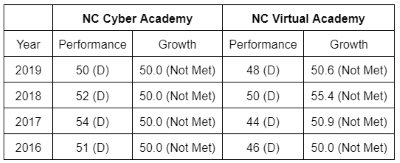
In the 2017-18 SY, two virtual charter schools, North Carolina Cyber Academy (formerly NC Connections Academy) and NC Virtual Academy opened as pilot projects. Because similar virtual charter schools had seen poor outcomes in other states, NC did not want to grant full charter status until the schools had proven themselves. The experiment has not gone well. In the years for which there is performance data (see NC School Report Cards), neither school achieved above a D performance grade or higher than 55 in growth. The NC Cyber Academy earned the lowest possible growth score (50) all four years. 

In addition, both schools currently serve a lower percentage of economically disadvantaged students than the state overall and have much lower four-year graduation rates.

2020-21 Economically Disadvantaged Students

  • State: 38.9% 
  • NC Cyber Academy: 31.5%
  • NC Virtual Academy: 32.4%

2020-21 Four-Year Graduation Rate

  • State: 87.0%
  • NC Cyber Academy: 54.9%
  • NC Virtual Academy: 77.5%

In a classic example of the privatization of public education, The NC Virtual Academy is powered by Stride K-12, an online learning company traded on the NY stock exchange. While the company’s investors may be getting good returns on their investment, the NC taxpayers are not. 

SB671 also introduces an option for public school districts to apply to the State Board of Education for approval to operate small virtual academies enrolling no more than 15% of their students. The bill lists seven required elements for a district’s plan including (#3) Hardware, software, and learning mgmt. platforms that support online learning, (#5) The professional development that will be provided to those teaching in the remote academy related to the pedagogy of providing remote instruction, and (#6) The identified characteristics for successful remote learning…. In addition, clear evaluation guidelines are set out to ensure that the remote academies do not provide a sub-standard education. These and other elements of SB671 are steps that could allow public schools flexibility to meet the needs of their students.

When SB671 went to the Senate for a vote this week, members found too many differences between their original version of SB671 – Edition 2 (Changes to the K-12 Scholarship Programs) and the House’s Edition 3. On a vote of 0-42, members sent the bill to a Conference Committee to iron out the differences. This delay provides an opportunity for NC citizens to reach out to committee members to voice their opinion on the various elements of the bill and what to keep or remove. House members have not yet been identified. The Senate members are 

The past few years have given NC educators, students, and parents plenty of opportunities to see the positive and negative aspects of virtual instruction. Implementing lessons learned and evaluating results as we move forward are critical next steps. SB671 does the NC virtual charter schools a disservice by excluding them from an evaluation of their pilot stage performance

A former Republican State Senator and the former State Auditor, a Democrat, wrote to argue on behalf of reforming the charter school law.

Bernie O’Neill (R-29, Bucks) is a former special education teacher for more than 25 years and a 16-year former member of the Pennsylvania House of Representatives.

Eugene DePasquale is former Auditor General of Pennsylvania and former member of the state General Assembly, (D-95, York). He presently serves as a Resident for the Keystone Center for Charter Change at the Pennsylvania School Boards Association.

They wrote:

Our roles as former elected officials from both of the major political parties have given us unique perspectives into not only Pennsylvania’s political process, but also its public education system, particularly charter schools.

Charter schools in the state have grown tremendously in the 24+ years in which they have existed. It is estimated that nearly 170,000 children will attend a brick and mortar or cyber charter school in the current school year and that Pennsylvania taxpayers will spend an estimated $3 billion to fund charter schools.

Despite being in operation for more than two decades, Pennsylvania’s Charter School Law (CSL) has never undergone any significant revision, other than allowing the creation of cyber charter schools in 2002, even though there are numerous glaring problems with the law. That’s not because the General Assembly hasn’t studied and introduced a myriad of legislative proposals each year to enact meaningful reforms. However, the state’s legislative body seems to be unwilling or unable to fix the problems.

Reforming the CSL should be a bipartisan issue. At its core, charter school reform would 1) ensure that public education funds are spent efficiently and appropriately; 2) that charter schools are as accountable and transparent as other public schools; and 3) preserve and strengthen educational choice by bolstering the law to ensure only quality charter school options are available to students and families.

Choice in public education is well-established in Pennsylvania. However, the status quo results in taxpayers sending hundreds of millions of public education dollars more than what charter schools need to provide an education. This is especially true for cyber charter schools, which do not maintain a physical school building and for all charter schools when it comes to well-documented overpayments for special education services. There’s a word for this type of spending – wasteful. And residents across the state feel the impact of these overpayments when their local school districts are forced to raise property taxes because of these costs.

Charter schools are supposed to be public schools. However, the boards that operate charter schools are not elected and are not required to include any representation from the community which they serve. Further, charter schools can contract with for-profit companies to run virtually all operations of the school. Once a charter school enters into one of these contracts, the public loses the ability to see how their money is being spent.

For years, proficiency on state assessments and graduations rates at charter schools have, on average, been substantially lower than those of traditional local public schools. While there are many high-performing charter schools, the current CSL makes it very difficult to close poor performers. Look no further than the fact that every cyber charter school has been identified by the state Department of Education as being in need of improvement for many years.

The bottom line is this: we owe it to our children and to the taxpayers to make sure that we are doing everything possible so that students are getting the best education available and that we are getting the best return on investment for our tax dollars. That’s something that all legislators should be able to support no matter which side of the aisle they’re on.

It is time to end the paralysis in Harrisburg, stop the practice of passing off charter school expansion proposals that fail to address serious funding flaws and contain little accountability as real reform, and finally work in a bipartisan manner to fix the law.

Nora De La Cour is a high school social worker and former teacher in Massachusetts. She writes frequently about the attacks on public schools. In this brilliant article, which appeared in Jacobin, she shows how the privatizatizers have exploited the culture wars to promote their own agenda. They are not interested in better education or students. Their agenda is to destroy the public square.

In a nutshell: “A billionaire-backed network of free-market fundamentalists is ginning up controversy over “wokeness” in American schools with an ulterior motive: to demolish public education.”

Please open the link to read the article in full.

She begins:

In a Massachusetts school district neighboring the one where I work, four parents, backed by a conservative Christian organization, are suing the school committee and multiple district employees for calling students by their preferred names and pronouns without informing home. Because one of the defendants is a counselor, some of my counselor peers in the area are now on guard, afraid we could become the targets of litigation if we allow students to broach sensitive topics in our presence.

Setting aside the very real harm that kids and educators are exposed to as a result of the Right’s eagerness to linkacknowledgement of gay and trans people to sexual predation, there’s another problem here. It’s incredibly difficult to teach or counsel someone if you can’t call them what they wish to be called. Addressing students by their chosen names is a basic sign of respect that says, “I see you and I’m here to work with you.” If you need to call home to get permission first — potentially outing kids to their parents and inviting distressing blowback — you might miss the chance to form the human connection that undergirds collaborative scholarship.

Pandemic school closures reminded us that the social aspects of schooling are among the most vital for young people’s development and for society at large. Specific facts and figures (the what of school learning) can be easily forgotten and recalled with a few keystrokes. But the ability to establish a base level of trust with heterogeneous others in order to solve shared problems (the how of school learning) is absolutely essential for both a fulfilling personal life and engagement in the public square. It’s critical that educators be allowed to build that trust without fear of reprisal.

The Koch-backed parents’ rightsmovement aims to make that trust impossible. By pitting parents against schools, libertarian billionaires and Republican strategists intend to motivate voters in the short term and fully privatize K-12 education in the long term. As Christopher Rufo, the self-styled architect of the so-called war on critical race theory (CRT), has argued, “To create universal school choice [i.e., privatization], you really need to operate from a premise of universal school distrust.” Those poweringthe campaign against classroom “wokeness” are trying to hinder our ability to establish common ground from which to defend our last remaining public goods.

The illiberalism that dominates the Right can best be understood as the advanced stage of a long billionaire-funded plot to undo democracy in order to relieve capitalists of any constraints the rest of us might wish to place on them. This understanding clarifies why classrooms, the training grounds for democratic participation, are primary targets of radical right activism. If liberals are to have any hope of countering this coordinated attack, they need to remember the collective, public value of education.

Laying Siege to the Common Good

It makes sense to focus on the reactionary nature of all of this: the commitment to American exceptionalism animating the so-called CRT bans, the fresh fixation on classical education rife with chauvinist dog whistles, and the shockingly overt bigotry of the anti-LGBT “grooming” discourse. Ron DeSantis’s Florida, as some have observed, is looking more and more like Viktor Orbán’s Hungary. But while these efforts to reverse cultural change are incredibly alarming, we come up short when we try to understand what’s happening purely in terms of identity-based hatred. Intolerance has always been a feature of American politics. Why does it suddenly seem so viciously well-organized?…

Despite attention-grabbing campaigns to terrify them, a majority of public school parents remain satisfied with their children’s schooling. And massive amounts of outside funding notwithstanding, local parents’ rights candidates have in numerous cases failedto deliver decisive wins for the privatization movement. As in segregated Virginia, US families are not quite prepared to sign away their children’s right to publicly funded, democratically controlled schools. It’s the perfect time, in other words, for those looking to contest the radical right to offer a full-throated defense of public education and all public goods.

But Democrats, by and large, have been unwilling to mount that, scarcely standing up even against the horrific attacks on kids, families, and educators that we are seeing across the United States. And when you look at their record on education, it’s pretty clear why: for the past three decades of education reform, Democrats have ignored the social role that schools play in preparing children for engagement in the public square. Alongside Republicans, they have enabled the privatization of public schools. They have also privatized the ideaof schooling down to the individual level. In the view of the Democratic establishment, the sole remit of schools should be to boost “human capital.” Guided by this view, they have yoked the vision of education ever closer to the needs of employers — a kind of corporate indoctrination eerily similar to the “woke” indoctrination Rufo and his cohort tell tales about.

But Bill Clinton’s assertion that “what you earn depends on what you learn” has proven to be a dangerous oversimplification: Americans are more educated than ever before, and yet economic insecurity is rampant and rising. When public schooling is only justifiable insofar as it increases individual earning power, the case for it is wholly dependent on its utility to capitalist markets. Without acknowledging the higher collective purpose that education serves, we won’t be able to defend public schools ordemocratic governance.

Democracy or Capitalism

“Republican politicians and their strategists,” Nancy MacLean told Jacobin,

have seen . . . culture-war tactics help Jair Bolsonaro get elected in Brazil and Viktor Orbán get reelected in Hungary this spring. And, lo, the CPAC (the Conservative Political Action Committee) is traveling to Hungary . . . to learn from Orbán how to use the tools of democracy to rig the rules to achieve autocracy.

The long plot is reaching maturity.

The Right’s appeals to “the family” resonate in part because our oligarchic political system leaves families in the cold, allowing child poverty to soar even as parents spend long and exhausting hours working outside the home. Any effort to save our commons and restore a sense of public spiritedness must include a material response to the significant challenges that parents face.

We need to work fast to reclaim the places where we give one another the benefit of the doubt and collaborate in spite of our differences. Democrats can still enter the battlefield and expose the Right’s deceitful efforts to turn the public against itself. As MacLean argues, the movement Buchanan authored wants to save capitalism from democracy. We can counter it if we are willing to fight to save democracy — beginning with schools — from capitalism.

For several years, I have sponsored an annual lecture series about education policy at Wellesley College, my alma mater. We have had a number of distinguished speakers, including Pasi Sahlberg, Yong Zhao, Andy Hargreaves, and Eve Ewing.

This year, the invited speaker was Dr. Helen Ladd, one of the nation’s most eminent economists of education. Dr. Ladd is the Susan B. King Professor Emerita of Public Policy and Economics at Duke University. She graduated from Wellesley in 1967, earned her M.A. at the London School of Economics and her Ph.D. from Harvard University. She has written extensively about school finance, equity, choice, and accountability.

Dr. Ladd discussed how charter schools disrupt good education policy.

Civil society groups from around the world expressed their opposition to the funding of for-profit schools. Three months ago, in response to protests from these groups, the World Bank withdrew its funding from Bridge International Academies, which operates for-profit schools in Africa.

Civil society groups applaud IFC’s decision to stop investing in fee-charging private schools, call on other investors to follow its lead


14 June 2022


Civil society organizations welcome the announcement from the World Bank’s International Finance Corporation (IFC) that it will not resume its investments in K-12 private schools, following the release of an independent evaluation by the World Bank Independent Evaluation Group (IEG) on the IFC’s investments in this area. In 2020, the IFC instituted a temporary freeze on all direct and indirect investments in for-profit fee-charging K-12 private schools. Following this announcement, the freeze has been extended indefinitely.


This decision reinforces the work of civil society organizations that, for years, have been monitoring and raising awareness about the negative impact of for-profit commercial schools on the achievement of the right to quality, inclusive education for all, in particular the most disadvantaged and vulnerable groups – including girls, children and youth with disabilities, and all traditionally marginalized groups. It also reinforces concerns regarding the operations of some of the transnational corporations who benefit from these investments.


In reaction, Salima Namusobya, Executive Director for the Initiative for Social and Economic Rights (ISER) in Uganda, said: “Education is a human right, it should not be treated as a commodity or a means for generating financial returns on investment in private provision of education. All children deserve to benefit from a good quality education. We celebrate this decision to cease financing for-profit education and hope that the World Bank will instead prioritize financing public education.”


Johnstone Shisanya, Programme Manager for the Education Support Programme at the East African Centre for Human Rights (EACHRights) said: “We applaud this bold action by the IFC and call on other investors to do the same. We continue to champion states’ fulfillment of quality public education for all, and we hope this decision is a sign of increased commitment by the World Bank towards supporting Kenya and other states to provide quality public education to the most marginalized and vulnerable groups as a way of guaranteeing inclusive education.”


Katie Malouf Bous, Senior Policy Advisor for Oxfam, said: “This is a massive step in the right direction for development finance. This evaluation acknowledges the potentially harmful impacts of investments in profit-oriented schools, which risk increasing inequalities in education and negatively impact public school systems. We are pleased the IEG has taken the time to do this evaluation, and we applaud the IFC for taking the findings seriously and demonstrating leadership on this issue among development finance institutions.”


Magdalena Sepúlveda, Executive Director of the Global Initiative for Economic, Social and Cultural Rights, said: “Now it’s time for other development finance institutions to consider the IEG’s findings, step up and follow the IFC’s lead. We also want to see the World Bank Group pivot to increased support to governments to build stronger and more equitable public education systems, through its public sector support.”


The IFC’s announcement was posted on the World Bank IEG’s website on Wednesday, June 8, 2022, alongside the release of the IEG’s evaluation report of IFC’s direct and indirect investments in kindergarten through grade 12 (K–12) private schools. In its response to the evaluation, IFC noted that most private K–12 schools are difficult to invest in directly, and cited a number of challenges with such investments including weak financial results and the “potential for investments in private K–12 schools to exacerbate inequalities and have unintended, undesirable spillovers into the public sector school system”.


The announcement comes less than three months after the IFC indicated that it had divested from Bridge International Academies, also known as NewGlobe Schools, a chain of for-profit schools operating in five African countries and India, after a number of complaints about the company’s operations in Kenya were filed with the IFC’s accountability mechanism, the Compliance Advisor Ombudsman (CAO).


The decision is also in line with findings from UNESCO’s Global Education Monitoring (GEM) Report 2021, which states that “profit making is inconsistent with the commitment to guarantee free pre-primary, primary and secondary education.” The IFC’s move is also consistent with previous decisions from the Global Partnership for Education (GPE) in 2019 and the European Parliament in 2018, both of which prohibited funding to for-profit commercial private schools.

Notes to editors


In 2019, more than 170 civil society organizations from 64 countries called on the World Bank Group to end support to for-profit private education.
In 2020, the IFC committed to freeze investments in for-profit K-12 schools, responding to concerns from civil society and leadership from U.S. Congresswoman Maxine Waters.


As explained in the IFC management response to the new IEG evaluation report, “this decision will encompass any new (i) direct investments or advisory services related to the provision of education in fee-charging (for-profit and not-for-profit) K–12 schools; (ii) public-private partnerships related to school privatization or the provision of education in fee-charging K–12 schools; (iii) indirect investments in fee-charging K–12 schools through private equity fund clients. IFC also does not plan to resume investment in Risk-Sharing Facilities with local banks to support their financing of K–12 private schools.”


The IFC’s accountability body, the Compliance Advisor Ombudsman (CAO), has received a series of complaints about the IFC’s investment in the commercial school chain Bridge International Academies (BIA). These include a complaint filed in April 2018 by EACHRights in Kenya on behalf of parents, students and teachers, raising valid concerns about the company’s health, safety, and labor conditions as well as economic discrimination, lack of parental inclusion, and transparency. In October 2019, CAO’s compliance appraisal report found “substantial concerns regarding the Environmental & Social outcomes of IFC’s investment in Bridge”. The final investigation report is still forthcoming.Three other cases have been filed since then, 02, 03, 04, all of which have yet to be resolved and involve the health and safety of students.


Contacts


• Annie Thériault in Lima (Oxfam) | annie.theriault@oxfam.org | +51 936 307 990
• Johnstone Shisanya in Nairobi (EACHRights) | johnstone@eachrights.or.ke | +255 735 798306 • Salima Namusobya in Kampala (ISER) | snamusobya@gmail.com | +256 772 473929
• Zsuzsanna Nyitray in Budapest (GI-ESCR) | zsuzsanna@gi-escr.org | +36 20 911 8018
Endorsements

  1. ActionAid
  2. Asociación Civil por la Igualdad y la Justicia (ACIJ Argentina)
  3. Brazilian Campaign for the Right to Education (Brazil)
  4. Centre d’Entrainement aux Méthodes d’Education Active de Côte d’Ivoire (CEMEA-CI
    Côte d’Ivoire)
  5. Coalition Éducation (France)
  6. Coalition for Transparency and Accountability in Education (COTAE Liberia)
  7. Corporate Accountability and Public Participation Africa (CAPPA Nigeria)
  8. East African Centre for Human Rights (EACHRights Kenya)
  9. Education For All Sierra Leone Coalition (EFA-SL Sierra Leone)
  10. Eurodad
  11. Global Campaign for Education (GCE)
  12. Global Campaign for Education-US
  13. Global Initiative for Economic, Social and Cultural Rights (GI-ESCR)
  14. Initiative for Social and Economic Rights (ISER Uganda)
  15. Latin American Campaign for the Right to Education (CLADE)
  16. National Campaign for Education Nepal (NCE-NEPAL)
  17. OMEP World Organization for Early Childhood Education
  18. Organisation pour la Démocratie le Développement Économique et Social (ODDES) 19. Oxfam
  19. Platform for the Defense of the Basque Public School
  20. Right to Education Initiative
  21. RTE Forum (India)
  22. Solidarité Laïque (France)

An economics and business writer at the New York Times named Peter Coy wrote an article titled “This Company Knows How to Increase Test Scores.” The article celebrates a study of a for-profit company called Bridge International Academies (renamed NewGlobe) that operates a large number of schools in Africa. Coy says the study by various American economists finds that the NewGlobe schools produce remarkable test score gains. What he doesn’t say is even more important. Civil society groups from across Africa and elsewhere urged the World Bank to stop investing in for-profit schools. The World Bank announced three months ago that it would no longer invest in the company praised in this article.

Coy begins:

Some of the world’s most successful educational techniques are being applied today in Kenya, Uganda, Liberia, Nigeria, Rwanda and India, in schools serving poor children that are run or advised by NewGlobe Schools, a company founded by Americans with headquarters in Nairobi, Kenya. These techniques deserve to be applied more widely, including in wealthy nations such as the United States.

A new study led by a Nobel laureate economist, Michael Kremer of the University of Chicago, found that in Kenya, enrolling in schools run by NewGlobe for two years increased test scores by an amount equal to being in school for an additional 0.89 year for primary school pupils, and to being in school an extra 1.48 years for pre-primary pupils. The poorest children improved the most.

The secret of NewGlobe’s success? Standardization. Every lesson is completely scripted and standardized. The teachers are told what to say and they say it. Most of the teachers are not high school graduates; they are not certified. They are paid less than union teachers. Yet the students get higher test scores! A reformer’s dream!

Coy compares these privately-run schools to the large KIPP chain (which, as I understand it, having visited KIPP schools, is not standardized, and whose results are not always as good as regular public schools) and to New York City’s Success Academy, a chain that has very high test scores but also very high student attrition and very high teacher turnover.

Coy writes:

“The test score effects in this study are among the largest observed in the international education literature, particularly for a program that was already operating at scale, exceeding the 99th percentile of treatment effects of large-scale education interventions,” Kremer and his colleagues found.

NewGlobe clearly has built a better mousetrap, but it has taken a while for the world to beat a path to its door. It has encountered multiple obstacles, including from the U.S. Congress, although it is gradually winning followers.

One reason for the slow uptake in the early going was resistance from teacher unions, including the Kenyan National Union of Teachers. During the period studied, NewGlobe paid teachers only one-third to one-fifth of what Kenyan public school teachers were earning. Many of its initial recruits didn’t have teaching certificates. (NewGlobe says it adapted to the government requirements as they changed over time.)

Here is the study. The title: “Can Education Be Standardized?” The authors believe it can and should be.

Here is the abstract:

We examine the impact of enrolling in schools that employ a highly-standardized approach to education, using random variation from a large nationwide scholarship program. Bridge International Academies not only delivers highly detailed lesson guides to teachers using tablet computers, it also standardizes systems for daily teacher monitoring and feedback, school construction, and financial management. At the time of the study, Bridge operated over 400 private schools serving more than 100,000 pupils. It hired teachers with less formal education and ex- perience than public school teachers, paid them less, and had more working hours per week. Enrolling at Bridge for two years increased test scores by 0.89 additional equivalent years of schooling (EYS) for primary school pupils and by 1.48 EYS for pre-primary pupils. These effects are in the 99th percentile of effects found for at-scale programs studied in a recent survey. Enrolling at Bridge reduced both dispersion in test scores and grade repetition. Test score results do not seem to be driven by rote memorization or by income effects of the scholarship.

Here are a few quotes from the Kremer et al study:

Three-quarters of teachers in public and private schools had acquired more than a secondary school education compared to just under one-quarter of teachers in Bridge schools. Relative to public school teachers, Bridge teachers were younger, less experienced, and more likely to be novice (first-year) teachers. On average, their total compensation amounted to between one fifth and one third of the average public school teachers total compensation and approximately the same as teachers in other private schools serving this population. They worked longer hours, including Saturdays...

Subsequent to the period analyzed in our study, Bridge’s parent company NewGlobe reduced the number of private schools operated by Bridge from 405 to 112, and launched a new model in which it primarily acts as a service provider to governments. Under this model, which now accounts for the bulk of students reached by NewGlobe, teacher qualification, compensation, and working conditions follow standard public sector guidelines; governments similarly set curricular, school infrastructure, and child safety standards, and costs of standardization are covered by the state rather than through fees to parents.

Note that Bridge has changed its main model, the one lauded by the Kremer study and Peter Coy. Why is Coy waxing enthusiastic about a model that has been downsized? Bridge dramatically reduced the number of for-profit private schools (where families had trouble paying $5 or more a month, and students were suspended for non-payment of fees). Instead it now has inserted its standardized model into the public sector, where its costs are paid by the government, not families, and it has to meet standards set by the government. But its costs are far beyond what these governments can afford to pay. Coy missed that detail.

Another study of Bridge schools in Liberia was discouraging for Bridge. The condition of the free public schools in Liberia was dismal, which paved the way for outsourcing of schools to private management. About 25% of students in fifth grade could not read a single word in the public schools. It should not be hard to beat that low bar. The study found:

Outsourcing the management of 23 randomly-selected government primary schools in Liberia to Bridge International Academies led to learning gains of 0.35σ after three years, equivalent to reading roughly 2.2 additional words per minute. Beyond learning gains, Bridge increased dropout by more than half and reduced transition to secondary school (overall, Bridge had a -6.53 percentage point effect on the probability of being enrolled in any school after three years). Bridge had no statistically significant impact on corporal punishment and failed to reduced sexual abuse. Overall, any assessment of outsourcing public schools to Bridge must weigh its modest learning gains against its high operating costs and negative effects on access to education via increased dropout.

Bridge raised test scores, but the dropout rate was high, which probably increased test scores. Bridge was too expensive for the Liberian government: in its first year, it cost $640 per year. By year three, the Bridge cost was down to $161 per pupil. The Liberian government’s goal is $50 per pupil per year. This model does not look like the money-maker that its sponsors envisioned.

I first learned about Bridge International Academies when I read an article in the New York Times Magazine called “Can a Tech Start-Up Successfully Educate Children in the Developing World?” An American couple, Shannon May and her husband Jay Kimmelman, along with a third partner, had the audacious idea that a company that provided $5 a month private schools could dramatically disrupt education in Africa while creating a billion-dollar corporation. What was not to like?

Just as titans in Silicon Valley were remaking communication and commerce, Bridge founders promised to revolutionize primary-school education. ‘‘It’s the Tesla of education companies,’’ says Whitney Tilson, a Bridge investor and hedge-fund manager in New York who helped found Teach for America and is a vocal supporter of charter schools.

The Bridge concept — low-cost private schools for the world’s poorest children — has galvanized many of the Western investors and Silicon Valley moguls who learn about the project. Bill Gates, the Omidyar Network, the Chan Zuckerberg Initiative and the World Bank have all invested in the company; Pearson, the multinational textbook-and-assessment company, has done so through a venture-capital fund.

The company’s pitch was tailor-made for the new generation of tech-industry philanthropists, who are impatient to solve the world’s problems and who see unleashing the free market as the best way to create enduring social change.

The basic idea of the Bridge Schools was standardization. The lessons were written by charter school teachers in Cambridge, Massachusetts, then read out loud by Bridge teachers on an e-reader in their classroom. Every teacher taught the same lesson at the same time in the same way, as instructed.

The new study says the concept works. However, it has run into political obstacles. The Bridge idea is opposed not only by teachers’ unions but by every civil society organization in Africa, which opposed the concept of privatizing African public schools. No matter how poorly resourced they are now, they will be destroyed by privatization. If the private companies can”t make money, how long will they stay?

I shared the new Kremer paper with an eminent economist, who responded, in part:

This approach seems crazy to me. Read section 9 of the paper which describes and explains the dramatic downsizing of the endeavor. That section confirms my initial response that the Bridge approach is ultimately likely to do far more harm than good. Shouldn’t young children have an opportunity to learn through play and personal engagement? Moreover, how does the approach deal with the fact that children develop at different rates and have different talents? And why would anyone who cares about children want to teach in such an environment? This is all very scary and disturbing.

Bill Gates and Mark Zuckerberg can’t be pleased to see that the model they funded has been reduced from 405 schools to 112 schools. The pupils it is supposed to serve can’t afford the fees. Nor can the governments in the nations where they are located.

Peter Coy should read more carefully before he touts an experiment that has already failed.

We are told again and again by libertarians that the free market solves all problems.

In Africa, it failed to provide better education at a price that families or governments can afford. Africa desperately needs more money for education, not for profits.

Bridge (NewGlobe) is not a model for American schools or the schools of any other nation.

Standardization is for electrical outlets and machines, not for children, teachers and education.