Archives for category: Economy

This is one of the best summaries I have seen of what Republicans will do if they are elected and gain control. It’s about two minutes. Please watch and share.

She leaves out one salient point, made by Kevin McCarthy. The Republicans will cut aid to Ukraine and use the money to finish building Trump’s Great Wall (that Mexico was supposed to pay for).

Elon Musk, the nation’s richest man, is heavily subsidized by taxpayers, according to an article in the Los Angeles Times. Musk’s net worth is somewhere about $210 billion. Yet he goes where the government money is.

Los Angeles entrepreneur Elon Musk has built a multibillion-dollar fortune running companies that make electric cars, sell solar panels and launch rockets into space.

And he’s built those companies with the help of billions in government subsidies.

Tesla Motors Inc., SolarCity Corp. and Space Exploration Technologies Corp., known as SpaceX, together have benefited from an estimated $4.9 billion in government support, according to data compiled by The Times. The figure underscores a common theme running through his emerging empire: a public-private financing model underpinning long-shot start-ups.

“He definitely goes where there is government money,” said Dan Dolev, an analyst at Jefferies Equity Research. “That’s a great strategy, but the government will cut you off one day.”

The figure compiled by The Times comprises a variety of government incentives, including grants, tax breaks, factory construction, discounted loans and environmental credits that Tesla can sell. It also includes tax credits and rebates to buyers of solar panels and electric cars.

A looming question is whether the companies are moving toward self-sufficiency — as Dolev believes — and whether they can slash development costs before the public largesse ends.

Tesla and SolarCity continue to report net losses after a decade in business, but the stocks of both companies have soared on their potential; Musk’s stake in the firms alone is worth about $10 billion. (SpaceX, a private company, does not publicly report financial performance.)

Musk and his companies’ investors enjoy most of the financial upside of the government support, while taxpayers shoulder the cost.

The payoff for the public would come in the form of major pollution reductions, but only if solar panels and electric cars break through as viable mass-market products. For now, both remain niche products for mostly well-heeled customers.

Musk declined repeated requests for an interview through Tesla spokespeople, and officials at all three companies declined to comment.

Thanks to our reader Joel for directing me to this story.

President Biden announced this morning that the rail industry and the workers’ unions had struck a tentative deal to avert a national rail strike. Such a strike would have crippled the economy and snarled supply chains.

Biden wanted to demonstrate that unions and management could work together, and they did.


“This agreement is validation of what I’ve always believed: Unions and management can work together, can work together, for the benefit of everyone,” he said in remarks in the Rose Garden.

Biden hosted the negotiators who brokered the railway labor agreement before his remarks.

“The negotiators here today. I don’t think they’ve been to bed yet,” Biden said.

The president called into the talks, which were being led by Labor Secretary Marty Walsh, around 9 p.m. Wednesday. Biden said on the call that a shutdown of railways was unacceptable, according to a White House official.

Biden, in his remarks, called the deal a win for America, as well as a win for rail workers and the dignity of work.“This agreement allows us to continue to rebuild a better America, with an economy that truly works for working people and their families. Today is a win, and I mean this sincerely, a win for America,” he said, thanking both business and labor for getting it done

Big business has been trying to get rid of unions since the first union was created. Corporations don’t want workers to have collective power. They prefer a workplace where they make all the decisions and don’t have to listen to workers’ voices. The share of unionized workers in the private sector is near an all-time low, but that may change. Recently there have been inklings of a rebirth of unionism. We see it in the growing number of Starbucks and Amazon workers who have voted to unionize. But their numbers remain small. Happily, public opinion is trending in favor of unions.

Someone recently asked me why there was so much hostility to teachers’ unions, and I answered, “Because they are the largest unions.” Teachers’ unions are blamed for whatever critics don’t like in schools, even though they fight for adequate school funding and decent working conditions. Those who have wanted to crush all unions focus their wrath on the NEA and the AFT, while overlooking the police union and the firefighters unions.

My view: if you want to reduce poverty and build a robust middle-class, support unions.

The Economic Policy Institute reports:

It’s been nearly 60 years since approval for unions in the U.S. has been this high.

More than 70% of Americans now approve of labor unions. Those are the findings of a Gallup poll released this morning, and they shouldn’t be surprising.

Why? U.S. workers see unions as critical to fixing our nation’s broken workplace—where most workers have little power or agency at work.

The pandemic revealed much about work in this country. We saw countless examples of workers performing essential jobs—such as health care and food service. They were forced to work without appropriate health and safety gear and certainly without pay commensurate with the critical nature of the work they were doing.

Those conditions, however, pre-dated the pandemic. The pandemic merely exposed these decades old anti-worker dynamics. Clearly, as the new poll and recent data on strikes and union organizing shows, workers today are rejecting these dynamics and awakening to the benefits of unions.

Nonunion workers are forced to take their jobs—accept their employer’s terms as is—or leave them. Unions enable workers to have a voice in those terms and set them through collective bargaining.

We know the powerful impact unions have on workers’ lives, and broader effects on communities and on our democracy.

Here’s a run-down based on the Economic Policy Institute’s extensive research on unions:

Pay and benefits 

  • Unionized workers (workers covered by a union contract) earn on average 10.2% more in wages than nonunionized peers (workers in the same industry and occupation with similar education and experience).
  • Unions don’t just help union workers—they help all of us. When union density is high, nonunion workers benefit, because unions effectively set broader standards—including higher wages.
  • Union workers are more likely to be covered by employer-provided health insurance. More than 9 in 10 workers covered by a union contract (95%) have access to employer-sponsored health benefits, compared with just 69% of nonunion workers.
  • Union workers have greater access to paid vacation days. 90% of workers covered by a union contract received paid holidays off compared to 78% of nonunion workers.
  • Union workers also have greater access to paid sick days. 9 in 10 workers covered by a union contract (92%) have access to paid sick days, compared with 77% of nonunion workers.

The 17 U.S. states with the highest union densities:

  • Have state minimum wages that are on average 19% higher than the national average and 40% higher than those in low-union-density states.
  • Have median annual incomes $6,000 higher than the national average.
  • Have higher-than-average unemployment insurance recipiency rates (that is, a higher share of those who are unemployed actually receive unemployment insurance).

Equity and Equality

  • Black and Hispanic workers get a larger boost from unionization. Black workers represented by a union are paid 13.1% more than their nonunionized peers. Hispanic workers represented by unions are paid 18.8% more than their nonunionized peers.
  • Unions help raise women’s pay. Hourly wages for women represented by a union are 4.7% higher on average than for nonunionized women with comparable characteristics.
  • Research shows that deunionization accounts for a sizable share of the growth in inequality between typical (median) workers and workers at the high end of the wage distribution in recent decades—on the order of 13–20% for women and 33–37% for men.

Democracy 

  • Significantly fewer restrictive voting laws have been passed in the 17 highest-union-density states than in the middle 17 states (including D.C.) and the 17 lowest-union-density states.
  • Over 70% of low-union-density states passed at least one voter suppression law between 2011 and 2019.

The growing approval of unions is playing out on the ground with more workers seeking to exercise their collective bargaining rights.

Data from the National Labor Relations Board recently analyzed by Bloomberg Law show the exponential increase in election petitions being filed. While the Gallup poll states that most nonunion workers do not respond that they want to join a union, clearly workers are petitioning for union election at elevated rates.

And workers have increasingly felt empowered to fight for what they want.

We were already seeing signs of workers being willing to strike to demand better wages and working conditions. Data from the Bureau of Labor Statistics showed an upsurge in major strike activity in 2018 and 2019, marking a 35-year high.

We are experiencing a labor enlightenment of sorts in this country, one in which workers are fed up with an economy and workplace that does not work for them. With approval for unions at the highest since 1965, there is a growing realization that unions can potentially make both work better for all.

Senator Joe Manchin of West Virginia and Senator Krysten Sinema held the power to block the Democrats’s ambitious bill to reduce carbon emissions and improve healthcare. Each of them extracted a hefty price in exchange for their vote, one that benefited either their state, their campaign donors, or themselves personally.

This analysis by the New York Times shows that Manchin got a trifecta: a win for the coal industry (big in his state), a win for his campaign donors, and a win for himself. Sinema demanded the removal of taxes on private equity firms..

Plenty of West Virginians are angry at Manchin. They are environmentalists. Senator Manchin takes care of the fossil fuel industry, not them.

BLACKSBURG, Va. — After years of spirited opposition from environmental activists, the Mountain Valley Pipeline — a 304-mile gas pipeline cutting through the Appalachian Mountains — was behind schedule, over budget and beset with lawsuits. As recently as February, one of its developers, NextEra Energy, warned that the many legal and regulatory obstacles meant there was “a very low probability of pipeline completion.”

Then came Senator Joe Manchin III of West Virginia and his hold on the Democrats’ climate agenda.

Mr. Manchin’s recent surprise agreement to back the Biden administration’s historic climate legislation came about in part because the senator was promised something in return: not only support for the pipeline in his home state, but also expedited approval for pipelines and other infrastructure nationwide, as part of a wider set of concessions to fossil fuels.

It was a big win for a pipeline industry that, in recent years, has quietly become one of Mr. Manchin’s biggest financial supporters.

Natural gas pipeline companies have dramatically increased their contributions to Mr. Manchin, from just $20,000 in 2020 to more than $331,000 so far this election cycle, according to campaign finance disclosures filed with the Federal Election Commission and tallied by the Center for Responsive Politics. Mr. Manchin has been by far Congress’s largest recipient of money from natural gas pipeline companies this cycle, raising three times as much from the industry than any other lawmaker.

NextEra Energy, a utility giant and stakeholder in the Mountain Valley Pipeline, is a top donor to both Mr. Manchinand Senator Chuck Schumer, Democrat of New York, who negotiated the pipeline side deal with Mr. Manchin. Mr. Schumer has received more than $281,000 from NextEra this election cycle, the data shows. Equitrans Midstream, which owns the largest stake in the pipeline, has given more than $10,000 to Mr. Manchin. The pipeline and its owners have also spent heavily to lobby Congress.

The disclosures point to the extraordinary behind-the-scenes spending and deal-making by the fossil fuel industry that have shaped a climate bill that nevertheless stands to be transformational. The final reconciliation package, which cleared the Senate on Sunday, would allocate almost $400 billion to climate and energy policies, including support for cleaner technologies like wind turbines, solar panels and electric vehicles, and put the United States on track to reduce its emissions of planet-warming gases by roughly 40 percent below 2005 levels by the decade’s end.

Read the rest of the story in the New York Times.

The Economic Policy Institute is one of the very few think tanks in Washington, D.C. that cares about the status of working people. When one of its reports gets attention, critics are fast to point out that it is funded by unions. The same critics are silent when a think tank is funded by one or more billionaires, who like low taxes.


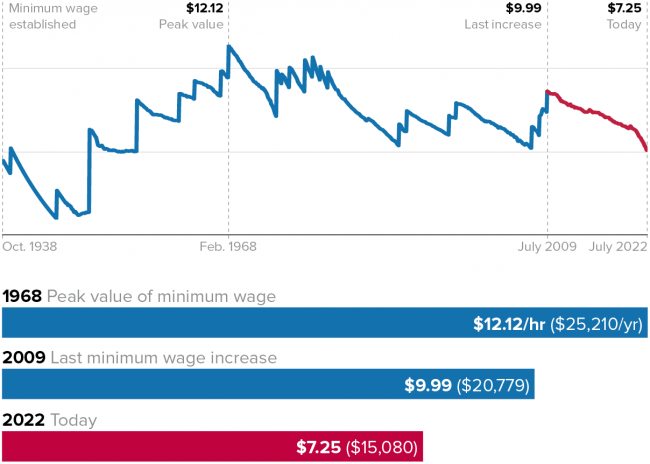
The value of the federal minimum wage has reached its lowest point in 66 years, according to an EPI analysis of recently released Consumer Price Index (CPI) data. Accounting for price increases in June, the current federal minimum wage of $7.25 per hour is now worth less than at any point since February 1956. At that time, the federal minimum wage was 75 cents per hour, or $7.19 in June 2022 dollars.

We are currently in the longest period without a minimum wage increase since Congress established the federal minimum wage in 1938.

As shown in the chart below, a worker paid the current $7.25 federal minimum wage earns 27.4% less in inflation-adjusted terms than what their counterpart was paid in July 2009 when the minimum wage was last increased. They earn 40.2% less than a minimum wage worker in February 1968, the historical high point of the minimum wage’s value.

After the longest period in history without an increase, the federal minimum wage today is worth 27% less than 13 years ago—and 40% less than in 1968

Real value of the minimum wage (adjusted for inflation)

Note: All values in June 2022 dollars, adjusted using the CPI-U in 2022 chained to the CPI-U-RS (1978–2021) and CPI-U-X1 (1967–1977) and CPI-U (1966 and before).

Source: Fair Labor Standards Act and amendments.

Economic Policy Institute

For several years, I have sponsored an annual lecture series about education policy at Wellesley College, my alma mater. We have had a number of distinguished speakers, including Pasi Sahlberg, Yong Zhao, Andy Hargreaves, and Eve Ewing.

This year, the invited speaker was Dr. Helen Ladd, one of the nation’s most eminent economists of education. Dr. Ladd is the Susan B. King Professor Emerita of Public Policy and Economics at Duke University. She graduated from Wellesley in 1967, earned her M.A. at the London School of Economics and her Ph.D. from Harvard University. She has written extensively about school finance, equity, choice, and accountability.

Dr. Ladd discussed how charter schools disrupt good education policy.

The Washington Post reports that Putin feels increasingly confident that he can win a long war of attrition in Ukraine because public opinion in the West will turn against support for Ukraine due to inflation and the high cost of gasoline. By contrast, he controls public opinion in Russia and continues to enjoy the economic security provided by oil and gas exports.

We can expect that Russian propaganda will exacerbate divisions in the U.S. and Europe.

Russian President Vladimir Putin is digging in for a long war of attrition over Ukraine and will be relentless in trying to use economic weapons, such as a blockade of Ukrainian grain exports, to whittle away Western support for Kyiv, according to members of Russia’s economic elite.

The Kremlin has seized on recent signs of hesitancy by some European governments as an indication the West could lose focus in seeking to counter Russia’s invasion of Ukraine, especially as global energy costs surge following the imposition of sanctions on Moscow.

Putin “believes the West will become exhausted,” said one well-connected Russian billionaire, speaking on the condition of anonymity for fear of retribution. Putin had not expected the West’s initially strong and united response, “but now he is trying to reshape the situation and he believes that in the longer term he will win,” the billionaire said. Western leaders are vulnerable to election cycles, and “he believes public opinion can flip in one day.”

The embargo on Russia’s seaborne oil exports announced by the European Union this week — hailed by Charles Michel, president of the European Council, as putting maximum “pressure on Russia to end the war” — would “have little influence over the short term,” said one Russian official close to Moscow diplomatic circles, also speaking on the condition of anonymity for fear of retribution. “The Kremlin mood is that we can’t lose — no matter what the price…”

The populations of E.U. countries “are feeling the impact of these sanctions more than we are,” Kremlin spokesman Dmitry Peskov said in an interview with The Washington Post. “The West has made mistake after mistake, which has led to growing crises, and to say that this is all because of what is going on in Ukraine and what Putin is doing is incorrect.”

This posture suggests that the Kremlin believes it can outlast the West in weathering the impact of economic sanctions. Putin has little choice but to continue the war in hopes the Ukraine grain blockade will “lead to instability in the Middle East and provoke a new flood of refugees,” said Sergei Guriev, former chief economist at the European Bank for Reconstruction and Development.

The Kremlin’s aggressive stance seems to reflect the thinking of Nikolai Patrushev, the hawkish head of Russia’s Security Council, who served with Putin in the Leningrad KGB and is increasingly seen as a hard-line ideologue driving Russia’s war in Ukraine. He is one of a handful of close security advisers believed by Moscow insiders to have access to Putin. In three vehemently anti-Western interviews given to Russian newspapers since the invasion, the previously publicity-shy Patrushev has declared Europe is on the brink of “a deep economic and political crisis” in which rising inflation and falling living standards were already impacting the mood of Europeans, while a fresh migrant crisis would create new security threats.
“The world is gradually falling into an unprecedented food crisis. Tens of millions of people in Africa or in the Middle East will turn out to be on the brink of starvation — because of the West. In order to survive, they will flee to Europe. I’m not sure Europe will survive the crisis,” Patrushev told Russian state newspaper Rossiiskaya Gazeta in one of the interviews…

With risks growing for all sides, “it is going to be a war of attrition from the economic, political and moral point of view,” the Russian official said. “Everyone is waiting for autumn,” when the impact of sanctions will hit the hardest, he said.


So far, however, with Ukrainian President Volodymyr Zelensky estimating Kyiv needs $7 billion in aid a month just to keep the country running, Putin appears to be betting on the West blinking first, the former U.S. government official said. Putin’s “goal of subjugating Ukraine and eventually placing a Russian flag in Kyiv has not changed.”

A regular reader who identifies himself as Joel wrote the following critique of the media’s negative narrative about the economy and crime. He was responding to the Robert Hubbell post about “the Media Doomsday Machine.”

So back in September the BLS [the federal Bureau of Labor Statistics] released the monthly Jobs number. A terribly disappointing 234,000 Jobs +- . It was disappointing because the same economic analysts who could not see a Housing Bubble bigger than the Stay Puff Marshmallow man had predicted 300,000 + . The fact that it was as high or higher than all but a handful of the previous 120 months never seemed to dawn on the talking heads. In October there were 677,000 Jobs added. And at the same time the number for October was adjusted 200,000 higher. It took the media all of 10 seconds to shift the narrative to “oh but inflation”
As stated by some CNBC talking head that day, inflation is an expectations game. If workers expect inflation they will ask for higher wages. If employers expect inflation they will charge more for goods and services. Inflation in September was all of 4.4 ,% high but not earth shaking. Then the (respectable) media ran stories of almost $6 dollar a gallon gas as if that was the norm. Of a Tex-ass couple who goes through 9 gallons of milk a week and was bankrupted by the cost (don’t ask about birth control). Of a Station owner in NJ who spends $1000s a week on gas for his 1970 muscle car and his 2000 Escalade.

Well the message was received, the expectation of inflation was created. Wages now contribute 8.5% of the inflationary spike. Raw materials and supply chain issues 27% of the inflation we see. And excess profits contribute 53% of the price hikes we are seeing. (EPI). It would seem the right people got the right message but it was not the American worker who in spite of all the hype does not have the power to demand wage increases on a broad based scale as they did in the past. In previous inflationary spikes inflation was driven 70% by wage increases . The media hype on inflation prior to the Ukraine war enabled corporations to profit vastly. The expectation was there. Corporate America hopped right on the band wagon. Don’t expect the corporate media to hop on board calling for an excess profits tax, or even to harp on those excess profits. Instead we will hear nonsense about low wage workers holding out for a living wage.

Was it a conscious conspiracy ? Probably not . Is it a combination of of group think and inferior reporting (IMHO) absolutely.

Moving on to Crime in NYC . In a nut shell if NYC was the safest big city in America in 2010 (according to Bloomberg) than how did it get unsafe in 2021 when every Crime Stat released by the NYPD is lower than 2010, when people felt the City was safe.

My favorite NYC crime category is rape. In 2021 there were 1491 reported rapes in NYC up from 1427 in 2020. Women be afraid be very afraid!!!. But wait there were 1755 in 2019 and 1791 rapes in 2018, when everyone thought the City was very safe.

The Right wing media generates a narrative and instead of countering it, the supposedly Liberal MSM run with the story. . Cowardly Democratic politicians who call themselves moderates hop right on board not wanting to seem like they are ignoring an issue.

If Trump was President every Republican would be calling inflation fake news and their Ivermectin downing base would be swallowing it hook line and sinker.

The stores in small towns and rural areas across America have been devastated by the arrival of Walmarts, whose low prices and foreign imports drive the small stores out of business. Main streets across the nation are marked by empty stores.

This is a story of a near century-old store in Moundsville, West Virginia, that managed to survive. The story explains how Ruttenberg’s has withstood the competition.

It is a reminder that competition can make you stronger, or, if the competition is a mega-giant, it can kill you and wipe out your town’s Main Street.