Archives for category: Economy

DeSantis is rolling out one hard-right proposal after another to make news and price he is meaner and badder than Trump. Undocumented people come here to work, and he wants to be certain that no one will hire them, not even to pick crops, clean hotel rooms or do the dishes in restaurants.

Gov. Ron DeSantis on Thursday revived a push to adopt more stringent hiring protocols to prevent the employment of undocumented workers, acknowledging that a state law he championed during his first term in office has been ineffective.

Florida law currently requires all government employers and their contractors to use a federal electronic system, known as E-Verify, to check the immigration status of new hires.

DeSantis, however, says the mandate should be expanded to include all private employers in the state, saying the current law was a “compromise” reached by the Legislature following pushback from Florida’s agriculture, tourism and construction industries.

“We ended up with a compromise version that was inadequate,” DeSantis said at a press conference in Jacksonville. Now, DeSantis wants the Republican-led Legislature to help him deliver on the promise he made to voters when he first ran for governor in 2018.

After overwhelming Republican victories in 2022, DeSantis argued, the “political context” is working in his favor this time around.

“Now, we have super majorities in the Legislature,” DeSantis said. “We have, I think, a strong mandate to be able to implement the policies that we ran on and these are policies that I’ve been for since the day I became governor over four years ago.”

The E-Verify proposal is part of a larger immigration package that DeSantis is building ahead of a possible run for the Republican nomination for president in 2024, and that he is expected to use to attack President Joe Biden’s immigration policy to reach conservative voters not just in Florida, but on a national level.

To further bolster his immigration platform, DeSantis wants, among other things, to ban out-of-state tuition waivers at colleges and universities for undocumented students and prohibit local governments from issuing identification cards to migrants.

Read more at: https://www.miamiherald.com/news/politics-government/state-politics/article272581361.html#storylink=cpy

George Scialabba wrote this essay in Commonweal. It is worth your while to read it and think about it. It might help explain why so many red states are unwilling to fund public schools and prefer to spend public money subsidizing the tuition of children already attending private schools, transferring public funds to private and religious schools.

Unless we have reached the end point of humankind’s moral development, it is pretty certain that the average educated human of the twenty-third century will look back at the average educated human of the twenty-first century and ask incredulously about a considerable number of our most cherished moral and political axioms, “How could they have believed that?” We do it every time a movie like Twelve Years a Slave or a novel like The Handmaid’s Tale or a play like Angels in America or a work of history like Bury My Heart at Wounded Knee or of journalism like Michael Harrington’s The Other America prompts us to ask, “How could decent, intelligent people have believed they were entitled to treat other human beings like that?”

So let’s interrogate some of our beliefs about political morality with the eyes of our descendants. Two four-letter words lie at the heart of contemporary America’s public morality: “free” and “fair.” “It’s a free country” is every American’s boast; “I only want a fair shake” is every American’s plea. I doubt I need to remind many Commonweal readers of the more flagrant forms of unfairness in our national life—that one American child in five lives below or near the poverty line; that somewhere between 80 and 90 percent of our economy’s productivity gains since 1980 have gone to the top 10 percent of the income distribution; that the top twenty-five hedge-fund managers earn more than all the nation’s kindergarten teachers combined; that 100,000 Americans will die for lack of health care over the next ten years in order to give a large tax cut to Americans with incomes above a half-million dollars; and so on and so on, down the long and shameful catalog. You all read the newspapers. Our twenty-third-century descendants may ask—they will ask—how we could have tolerated such unfairness; but they won’t ask how we could have believed such inequalities to be fair, because we don’t, most of us, believe them to be fair. Let’s instead consider a different question: whether our present-day ideals of fairness and freedom, even if we lived up to them, would satisfy our descendants.

The average CEO now earns around three hundred times as much as his or her average employee. Many people are dismayed at the contrast with the good old days of the Eisenhower administration, when CEOs earned only thirty times as much as their average employees and paid a far higher tax rate, and yet the country didn’t exactly seem to be going to the dogs. But let’s put aside our reaction to this striking change and ask more generally whether and why some people ought to earn more than others.

The usual answer, I suppose, is that people deserve whatever they get through the operation of supply and demand. The competitive marketplace quantifies the value that one’s efforts have for others. Some people (like doctors) employ vital skills; some people (like baseball players) give exceptional enjoyment; some people (like corporate executives) assume extra responsibilities; some people (like investors) forego luxury consumption. All such people are rewarded in proportion to the satisfaction they furnish others, as measured by others’ willingness to pay, directly or indirectly, for those satisfactions. No payment, no service. As Adam Smith wrote: “It is not from the benevolence of the butcher, the brewer, or the baker that we expect our dinner, but from their regard to their own interest.”

Of course, it’s not that simple. Consider those doctors, baseball players, and executives I used as examples of economic agents who exchange services for money. In fact, they—like you, like me—live with only one foot in a market economy and the other in a gift economy. Any doctor or scientist or athlete or nurse or teacher or carpenter worth her salt feels at least occasionally that she is making a gift of her best efforts; and as with all such gifts, the chief reward is internal: the pleasures of giving and of exercising one’s faculties at their highest pitch.

Nowadays, the gift economy leads a precarious existence, appearing mostly in commencement-day addresses in which graduates are exhorted to follow their dreams, while most of the poor things are worrying frantically about how to pay their debts. The family is a gift economy, and so is culture, including both the arts and the sciences, as well as the shrinking public and nonprofit spheres. Ever since that most fateful of innovations, industrial mass production, has become virtually universal, the market economy has progressively squeezed out the gift economy. In a mature capitalist society, competition grows in both extent and intensity—that is, both between and within economic units. Creativity and generosity are not forbidden but they are no longer self-justifying; they are, on the contrary, subordinated, like all activity in the non-public sphere, to the goal of increasing shareholder value. In the private economy, you can do whatever you like—create beauty, pursue truth, help others—as long as what you like to do makes someone a profit.

I said earlier that people in a market economy are rewarded in proportion to others’ willingness to pay. That willingness to pay is the measure of value in a market economy; and so, to say that a person deserves what she earns is to say that there is at least a rough correspondence between the value of what she produces and the value of what she receives. As Milton Friedman, the high priest of American capitalism, put it: “The ethical principle [underlying] the distribution of income in a free-market society is, ‘To each according to what he and the instruments he owns produces.’”

This notion of desert rests on the assumption that two distinctions can be made rigorously: first, that one person’s input—to any output or outcome at all—can be sharply distinguished from all other inputs; second, that merit can be distinguished from luck—that is, that diligence, good judgment, talent, and other productive qualities and character traits are not fully attributable to biological endowment, early environment, education, and other contingent and therefore morally arbitrary sources. I don’t believe those distinctions hold up.

Let’s take that CEO, and let’s assume we know somehow that she produces thirty or three hundred times as much as her average employee. Causation is a transitive relation, and production is a kind of causation. If A is a cause of B, and B is a cause of C, then A is a cause of C. If A contributes to the production of B, and B contributes to the production of C, then A has contributed to the production of C. Now, who has contributed to the production of our CEO and, therefore, to the production of whatever she produces? Clearly, her parents, spouse, teachers, fellow students, predecessors, colleagues, rivals, and friends, along with all their parents, spouses, teachers, fellow students, predecessors, colleagues, rivals, and friends, along with all those who created the physical, organizational, and cultural resources employed in the production of whatever our CEO produces, along with all their parents, spouses, teachers, fellow students, predecessors, colleagues, rivals, and friends, and, it goes without saying, all their parents, spouses, teachers, and so on through what is, if one wants to insist on the point, an infinite chain of causes.

I do want to insist on the point. Einstein famously wrote: “I have all along been standing on the shoulders of giants.” So has our CEO. Exceptional contributions, whether to art, science, or the Gross National Product, are prepared for by the whole previous development of the field. People who make brilliant, courageous, and illuminating mistakes, which may be indispensable to the ultimate success of a rich and famous artist, scientist, or entrepreneur, are not, in a competitive market system, retrospectively and proportionately rewarded for their contributions, even though Friedman’s definition of justice would seem to require it.

My point is that all production is social production. The productive assets of every age are the joint product of all preceding ages, and all those born into the present are legitimately joint heirs of those assets. And the same arguments for joint rather than individual inheritance of wealth created in the past apply to the distribution of income in the present. If this seems counterintuitive, it is perhaps because there persists a deep and ancient distinction between luck and merit, according to which we deserve praise and reward for our good actions, though not for our good fortune. But what if our good actions are the results of our good fortune?

Philosophy assimilates scientific discoveries slowly. As a result, it is always riddled with archaic concepts and images, survivals from an earlier scientific epoch. One such survival, it seems to me, is the concept of merit. It has always been partly recognized (it is, indeed, implicit in the word “gifted”) that talents and aptitudes come under the heading of luck rather than merit. But the inescapable implication of modern genetics, neurobiology, and psychiatry is that character, no less than talent, is inherited or else formed by very early experiences. Diligence, decisiveness, initiative, coolness under pressure—all these entrepreneurial virtues—are, no less than intellectual or manual abilities, part of one’s natural endowment. And from a strictly moral point of view, no one deserves a reward for being born luckier than someone else. I imagine the twenty-third century will ask: “Why did you make talent and character the measure of an individual’s desert rather than of her obligations? How could you have overlooked what is to us the obvious and elementary principle of fairness: from each according to her abilities, to each according to her need?…”

If we could speak with our nineteenth-century counterparts, we might ask questions like: “Why did you believe it legitimate for one person to own another? Why did women seem to you incapable of self-determination? Why did you consider that political authority could be inherited, for example by monarchs or aristocrats?” If they defended their morality against ours, we might learn a good deal by trying to rebut them and vindicate our own moral intuitions.

Similarly, we should try to imagine which of our current beliefs might seem benighted to our twenty-third century descendants. I suspect they will want to ask us questions like: “Why did you base desert on performance, which can’t be measured and is in any case a function of one’s endowments? After all, no one deserves her endowments. Why did you make that strangely artificial distinction between the political and the economic? It looks as though your only purpose was to prevent economic democracy. Why did you define freedom so narrowly, as the absence of constraints on one person’s right to employ her capital but not on another person’s right to realize her capacities? Why did you assume that contracts between parties with radically unequal resources could be free?”

You should read it all and ask yourself: Why do we tolerate such radical inequalities?

Timothy Snyder, the noted historian of democracy and tyranny at Yale University, wrote a post listing fifteen reasons why the world needs Ukraine to win and defeat Russian aggression against its very existence as a nation. Most important is to stop the genocidal slaughter of Ukrainians. The New York Times documented 339 significant cultural sites—museums, performing arts centers for theater, music, and dance, historical sites, and other cultural treasures—that have been destroyed in the Russian effort to eliminate Ukrainian existence as a nation.

He writes:

Why does the world need a Ukrainian victory?

1. To halt atrocity. Russia’s occupation is genocidal. Wherever the Ukrainians recover territory, they save lives, and re-establish the principle that people have a right not to be tortured, deported, and murdered.

2. To preserve the international legal order. Its basis is that one country may not invade another and annex its territory, as Russia seeks to do. Russia’s war of aggression is obviously illegal, but the legal order does not defend itself.

3. To end an era of empire. This could be the last war fought on the colonial logic that another state and people do not exist. But this turning point is reached only if Russia loses.

4. To defend the peace project of the European Union. Russia’s war is not directed only against Ukraine, but against the larger idea that European states can peacefully cooperate. If empire prevails, integration fails.

5. To give the rule of law a chance in Russia. So long as Russia fights imperial wars, it is trapped in repressive domestic politics. Coming generations of Russians could live better and freer lives, but only if Russia loses this war.

6. To weaken the prestige of tyrants. In this century, the trend has been towards authoritarianism, with Putinism as a force and a model. Its defeat by a democracy reverses that trend. Fascism is about force, and is discredited by defeat.

7. To remind us that democracy is the better system. Ukrainians have internalized the idea that they choose their own leaders. In taking risks to protect their democracy, they remind us that we all must act to protect ours.

8. To lift the threat of major war in Europe. For decades, a confrontation with the USSR and then Russia was the scenario for regional war. A Ukrainian victory removes this scenario by making another Russian offensive implausible.

9. To lift the threat of major war in Asia. In recent years, a Chinese invasion of Taiwan has been the leading scenario for a global war. A Ukrainian victory teaches Beijing that such an offensive operation is costly and likely to fail.

10. To prevent the spread of nuclear weapons. Ukraine gave up nuclear weapons. Russia, a nuclear power, then invaded. If Ukraine loses, countries that can build nuclear weapons will feel that they need to do so to protect themselves.

11. To reduce the risk of nuclear war. A Ukrainian victory makes two major war scenarios involving nuclear powers less likely, and works against nuclear proliferation generally. Nothing would reduce the risk of nuclear war more than Ukrainian victory.

12. To head off future resource wars. Aside from being a consistent perpetrator of war crimes, Russia’s Wagner group seizes mineral resources by violence wherever it can. This is why it is fighting in Bakhmut.

13. To guarantee food supplies and prevent future starvation. Ukraine feeds much of the world. Russia threatens to use that food as a weapon. As one Russian propagandist put it, “starvation is our only hope.”

14. To accelerate the shift from fossil fuels. Putin shows the threat that hydrocarbon oligarchy poses to the future. His weaponization of energy supplies has accelerated the turn towards renewables. This will continue, if Russia loses.

15. To affirm the value of freedom. Even as they have every reason to define freedom as against something — Russian occupation –, Ukrainians remind us that freedom is actually for something, the right to be the people they wish to be, in a future they can help shape.

I am a historian of political atrocity, and for me personally number 1 — defeating an ongoing genocidal project — would be more than enough reason to want Ukrainian victory. But every single one of the other fourteen is hugely significant. Each presents the kind of opportunity that generations of policy planners wish for, but almost never get. Much has been done, we have not yet seen and seized the moment.

This is a once-in-lifetime conjuncture, not to be wasted. The Ukrainians have given us a chance to turn this century around, a chance for freedom and security that we could not have achieved by our own efforts, no matter who we happen to be. All we have to do is help them win.

23 January 2023

PS What can you do personally? Keep in touch with your elected representatives. Support military and humanitarian assistance. Make your views known. Write a letter to the editor. Share this post widely. Fly a Ukrainian flag. Put a sticker on your computer. Buy and wear Ukrainian merch. In great causes, small gestures matter.

If you want to keep Ukrainian soldiers alive, consider supporting this Ukrainian NGO and this international NGO (a 501(c)3). Here is a way to keep Ukrainians warm during winter (a 501(c)3). One of my commitments, with wonderful colleagues, has been Documenting Ukraine, a project that supports those in Ukraine who are chronicling the war (also a 501(c)3, “Partners” here). Thank you for reading, thinking, caring, and doing.

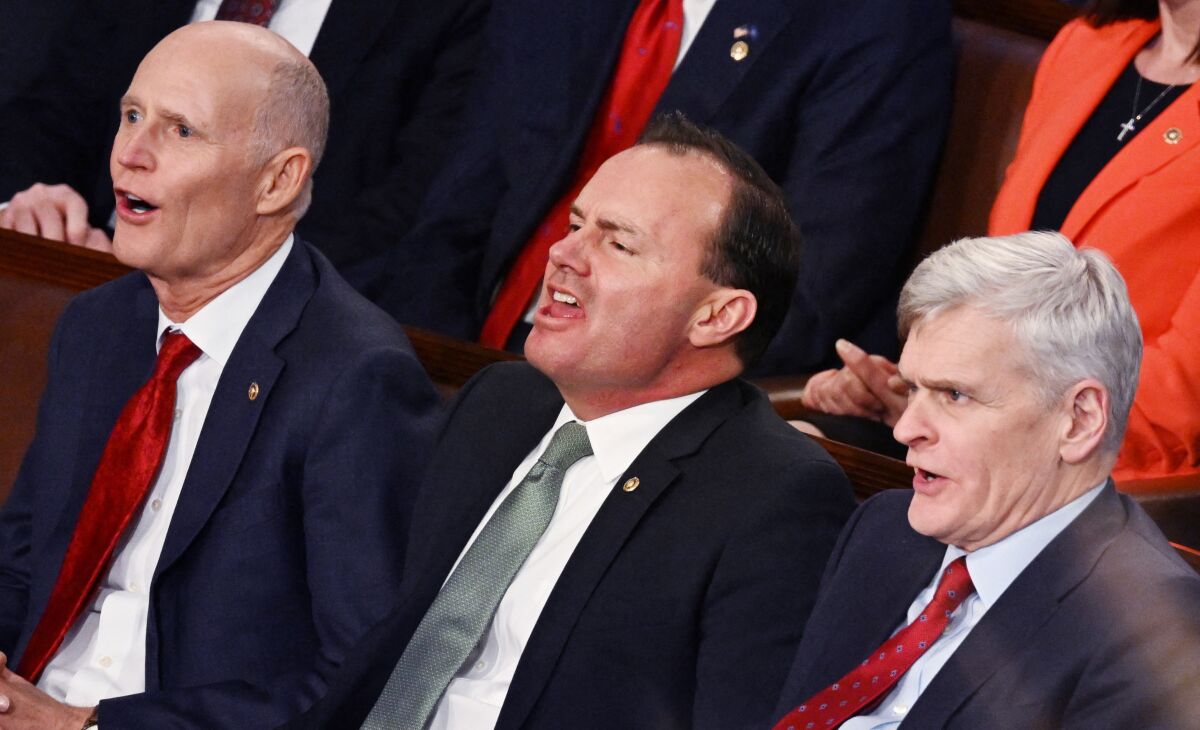
During President Biden’s State of the Union address, he said that Republicans want to cut Social Security and Medicare, and the Republican side of the chamber erupted in jeers and shouts of “liar!” Two of those loudly jeering—Senators Rick Scott of Florida and Mike Lee of Utah—had explicitly made those proposals. Biden then masterfully got the Republican caucuses in both Houses to declare their support for both big entitlement programs.

Michael Hiltzik, business columnist for the Los Angeles, sets the record straight about the Republican stance on Social Security.

From left, U.S. Sens. Rick Scott and Mike Lee jeer.

From left, GOP Sens. Rick Scott of Florida and Mike Lee of Utah jeer during the State of the Union address when President Biden accused Republicans of wanting to cut Social Security. Both senators have proposed exactly that.

(Andrew Caballero-Reynolds / AFP/Getty Images)

Hiltzik writes:

President Biden has congressional Republicans all asquirm as he conducts a post-State of the Union speech national tour.

Why? Because Biden has doubled down — or as Fox News has it, “tripled down” — on his assertion during the speech that the GOP has been planning to cut Social Security.

Not so, they say. Never happened. Sens. Mike Lee (R-Utah) and Rick Scott (R-Fla.) were even caught on camera during the speech wearing “Who, me?” expressions of injured innocence.

It will be my objective to phase out Social Security, to pull it out by the roots.

— Sen. Mike Lee (R-Utah), during his 2010 campaign for the Senate

Unfortunately for them, we have the evidence, as does Biden. Cutting Social Security along with Medicare has been part of the Republican platform for decades.

As I’ve reported before, they often hide their intentions behind a scrim of impenetrable jargon, plainly hoping that Americans won’t do the necessary math to penetrate their subterfuge.

Let’s take a jaunt through the GOP approach to Social Security and Medicare.

Start with their description of these programs as “entitlements,” which they’ve tried to turn into a dirty word. The truth is that they are entitlements, in the sense that most Americans have been paying into these programs for all their working lives, mostly through the payroll tax. So, yes, they’re “entitled” to receive benefits in return.

Republicans, including former Senate Majority Leader Mitch McConnell (R-Ky.), have consistently blamed the federal debt on “entitlements” — never mind that their 2017 tax cut for the wealthy has blown a multitrillion-dollar hole in the budget.

They know they’re on thin ice with the public when they talk about benefit cuts, which is why Sen. Joni Ernst (R-Iowa) once recommended discussing their ideas only “behind closed doors.”

Now we can turn to the specifics of Lee’s and Scott’s plans. In widely circulated videos from Lee’s first successful Senate campaign in 2010 he can be seen and heard stating as follows: “It will be my objective to phase out Social Security, to pull it out by the roots.” He said that was why he was running for the Senate, and added, “Medicare and Medicaid are of the same sort. They need to be pulled up.”

As for Scott, his 12-point “Rescue America” plan, issued last year, included a proposal to sunset all federal legislation after five years. “If a law is worth keeping, Congress can pass it again.” The implications for Social Security and Medicare, which were created by federal legislation, were unmistakable — so much so that the proposal made Republican officeholders’ skin crawl.

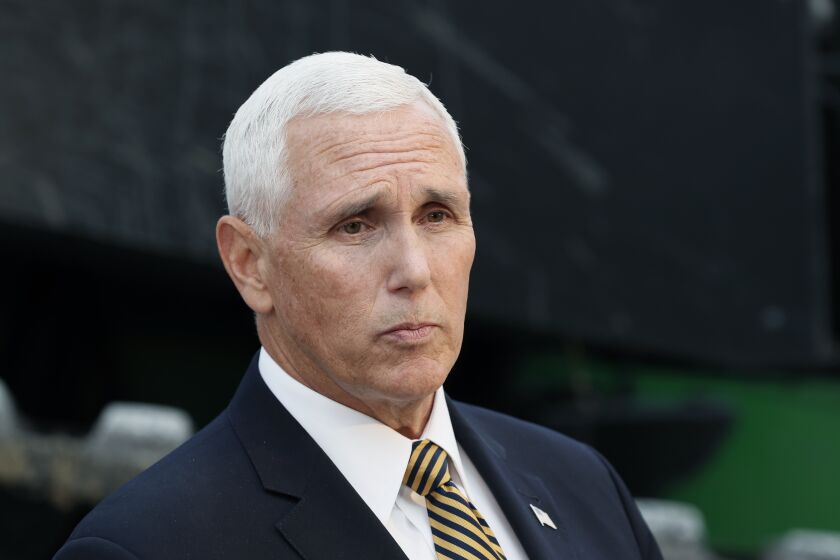
Vice President Mike Pence speaks to reporters during a visit to the Manning Farms, Wednesday, Oct. 9, 2019, in Waukee, Iowa. (AP Photo/Charlie Neibergall)

Column: Mike Pence, would-be president, has a plan to kill Social Security. It will cost you

McConnell disavowed the proposal on the spot and has continued to do so, telling a home-state radio host after the Biden speech that the sunset provision is “not a Republican plan.That was the Rick Scott plan.”

That said, it’s a priceless foil for Biden. When Republicans brayed during his speech that he was lying about it, he offered to make Scott’s manifesto available to anyone who called his office for it. At one of his subsequent appearances, a copy of Scott’s plan was placed on every seat.

The GOP can’t easily wriggle away from its intentions. Let’s examine the fiscal 2023 budget proposal issued by the Republican Study Committee, a key policy body, last June under the title “Blueprint to Save America.”

This plan would increase the Social Security full retirement age, which today is 66 or 67 (depending on one’s year of birth), to 70 by 2040. According to Kathleen Romig, the Social Security expert at the Center on Budget and Policy Priorities, this would translate into a 20% cut in lifetime benefits compared with current law.

As I’ve reported before, raising the full retirement age is a Trojan horse that would affect all retirees across the board, but harm Black workers, lower-income workers and those in physically demanding jobs the most.

It would create particular hardships for those choosing to retire early and collect their benefits prior to their full retirement age.

Doing so exacts a lifetime reduction in monthly benefits, based on a formula aimed at equalizing the lifetime benefit among those who retire early, those who wait until their full retirement age, and those who defer collecting until that age (they receive a bump-up in benefits for every year they delay, topping out at age 70).

Raising the full retirement age to 70, Romig calculates, would mean that retirees who start collecting at the minimum age of 62 would receive only 57% of their full benefit….

The Republican Study Committee also would make it harder for disabled workers to qualify for benefits, and would lengthen the period before those who are disabled and younger than 65 qualify for Medicare to five years from two. This falls into the category of balancing the budget on the backs of the most vulnerable members of society.


As for Medicare, the Republican Study Committee proposes raising the eligibility age, currently 65, so it matches the Social Security retirement age. It also would transfer many more Medicare accounts to private insurance. The committee claims this would save money.

The rest of his incisive analysis is behind a paywall, unfortunately. He demonstrates beyond doubt that Republicans have wanted for years to put these big programs on the chopping block, which are lifelines for senior citizens. They have no objections, however, to cutting the taxes of the wealthiest. That was Trump’s biggest accomplishment: tax cuts for those with the most.

David Dayen writes in The American Prospect about President Biden’s efforts to limit corporate power and spur competition.

Dayen begins:

On July 9, 2021, President Joe Biden signed one of the most sweeping changes to domestic policy since FDR. It was not legislation: His signature climate and health law would take another year to gestate. This was a request that the government get into the business of fostering competition in the U.S. economy again.

Flanked by Cabinet officials and agency heads, Biden condemned Robert Bork’s pro-corporate legal revolution in the 1980s, which destroyed antitrust, leading to concentrated markets, raised prices, suppressed wages, stifled innovation, weakened growth, and robbing citizens of the liberty to pursue their talents. Competition policy, Biden said, “is how we ensure that our economy isn’t about people working for capitalism; it’s about capitalism working for people.”null

The executive order outlines a whopping 72 different actions, but with a coherent objective. It seeks to revert government’s role back to that of the Progressive and New Deal eras. Breaking up monopolies was a priority then, complemented by numerous other initiatives—smarter military procurement, common-carrier requirements, banking regulations, public options—that centered competition as a counterweight to the industrial leviathan.

It’s been a year and a half since Biden signed the executive order; its architect, Tim Wu, has since rotated out of government. Not all of the 72 actions have been completed, though many have. Some were instituted rapidly; others have been agonizing. Some agencies have taken the president’s urging to heart; others haven’t. But the new mindset is apparent.

Seventeen federal agencies are named specifically, tasked with writing rules, tightening guidelines, and ramping up enforcement. I wrote to each agency, asking how they have complied with the order; all of them answered but one (the Federal Deposit Insurance Corporation, whose role is admittedly tangential). Even Cabinet departments that weren’t mentioned wrote in to explain their approach to competition. Clearly, agencies are aware of the emphasis being put on reorienting their mission.

Bringing change to large bureaucracies is often likened to turning around a battleship. One way to get things moving is to have the captain inform every crew member of the intention to turn the battleship around, counseling them to take every action from now on with that battleship-turning goal in mind. The small team that envisioned and executed the competition order put the weight of the presidency behind it, delivering a loud message to return to the fight against concentrations of power. It’s alarming and maybe a little disconcerting that you have to use a high-level form of peer pressure to flip the ship of state. But that battleship is starting to change course.

TIM WU WAS THE FIRST OF THE TRIUMVIRATE of Wu, Khan, and Kanter (a motto emblazoned on mugs by advocates) to actually get appointed in the Biden administration, joining the National Economic Council (NEC) to work on competition policy in early March 2021. Hiring the author of The Curse of Bigness signaled the administration’s strong anti-monopoly thrust. Khan (Lina, chair of the Federal Trade Commission) and Kanter (Jonathan, heading the Justice Department’s Antitrust Division) would arrive later.

The competition order was released four months after Wu’s appointment, but in reality, it was laid out over the previous five years. In that time, a collection of policymakers, journalists, lawyers, politicians, and experts, sometimes known as the New Brandeis movement, warned of the dangers of economic concentration. Wu, Khan, and Kanter were part of this crusade, and prior to the 2020 election, they and others strategized about how to reinvigorate competition policy if Democrats took the presidency.

This is an unusual story about an accomplishment or series of accomplishments that have gone unnoticed. Read on to the end.

An organization called Good Jobs First released a study about the economic impact of corporate tax breaks on public schools. They are working with state legislators to stop this harmful practice. Investing in better schools is key to economic development and social capital. Unfortunately, politicians get campaign contributions when they give generous corporate tax breaks.

Contact: Ron Deutsch at 518-469-6769 or rdeutschnyff@gmail.com

Greg LeRoy at goodjobs@goodjobsfirst.org or 202-494-0888

NYS Schools Lose $1.8 Billion Per Year to Corporate Tax Abatements, Far More than Any Other State

Economic Development Committee Chairs Senator Sean Ryan and 

Assemblyman Harry Bronson Introduce Legislation to Stop Such Abatements 


Washington, DC — Schools in New York State lost at least $1.8 billion in fiscal year 2021 to corporate tax abatements. That makes New York schools by far the biggest known losers to abatements, more than three times second-place South Carolina.

The study arrives as NYS legislators introduce a bill(S.89/A.351) that would prohibit Industrial Development Agencies (IDAs) from abating the school share of property taxes.

This study’s findings were enabled by a new government accounting rule that requires — for the first time ever — that most school districts, cities and counties disclose how much revenue they lose to such corporate tax breaks.

The study was released today by Good Jobs First, a Washington-based non-profit group focusing on economic development tax policy. The new reporting rule is Governmental Accounting Standards Board (GASB) Statement 77 on Tax Abatement Disclosures.

The $1.8 billion in revenue losses are spread among 318 of the state’s 685 public school districts. In all but five of those 318 districts, the losses are reported directly by the independent school district. In the “Big Five” cities (New York, Buffalo, Rochester, Syracuse and Yonkers), the school losses are computed as a share of overall city losses.

Tax abatements cost an average of $541 per pupil per year among the affected school districts, which puts New York in the country’s top five. But that average masks a wide range. For example, losses are just $3 per student per year in West Genesee, where the student body is 85% white, but over $5,000 for Peekskill, where nearly nine out of ten students are of color and over three-quarters qualify for free or reduced-price lunches. And from $5 per student per year in Hoosick Falls, which is almost all-white, to $2,000 per student for Uniondale where almost all attendees are of color.


“Our findings are the latest evidence of New York State’s failed economic development system,” said Greg LeRoy, executive director of Good Jobs First, which led the campaign to win the accounting reform. “When governments disinvest education in the name of economic development, they actually harm their business climates. If New York aspires to be a ‘sticky’ place for promising companies in the 21st century, it must have a highly educated workforce.”

State Senator Sean Ryan, Chair of the Senate Committee on Commerce, Economic Development and Small Business, said, “We all know that our state’s schools are engaged in a constant battle for the resources they need to provide our children the quality education they deserve. What most people would be surprised to learn is that property taxes are their primary source of revenue. When IDAs promise to waive a corporation’s property taxes, they are stealing money meant for school districts and exacerbating budget gaps. This forces us to increase school funding to close those gaps and sticks taxpayers with the bill. Prohibiting IDAs from waiving school taxes will support education, lower New Yorkers’ tax bills, and prevent corporations like Amazon from playing IDAs around the state against one another to get the best deal.”

Assemblymember Harry Bronson, Chair of the Assembly Standing Committee on Economic Development, Job Creation, Commerce and Industry, said: “Public education is key to opening opportunities; that is why I have fought so hard to secure funding for our schools and for our children. Public education is largely funded through real property taxes. Schools rely on this revenue, yet they lose it when IDA’s reduce business property tax obligations. These deals made by the IDAs may benefit business, but any supposed benefit is on the backs of our students, and all too often students of color. The report from Good Jobs First shows the damage to school funding and the educational process when school districts are excluded from the IDA negotiating process. The report is a clarion call to action, and I am pleased to sponsor this vital legislation introduced with Senator Ryan.”


“Our students, communities and educators deserve to receive the funds that are due to them so we can focus on what is our most important goal: educating the next generation,” said Andy Pallotta, president of New York State United Teachers, a statewide union with more than 600,000 members in education, human services, and health care. “As pointed out by Good Jobs First’s research, this is an issue of equity and we support efforts to make sure all of New York’s students have the opportunity for a world-class education. Education is not only the great equalizer, it is the real economic driver into New York’s future.”

“We strongly support the Ryan/Bronson bill. IDA tax breaks are a triple whammy of terrible tax policy. They do not work, they are unfair to other taxpayers, and they take funding away from public schools. IDA tax breaks aren’t free money. Economists call them ‘tax expenditures’ because they are a form of off-budget spending that takes public funding away from schools and other basic services,” said Dr. Elizabeth Marcello, Senior Research Analyst for Reinvent Albany.


Ron Deutsch, director of New Yorkers for Fiscal Fairness noted, “This groundbreaking report from Good Jobs First should be a wake-up call for legislators and parents alike. Nearly $2 billion in property tax revenue is being diverted from our schools and provided to wealthy corporations with highly dubious outcomes and benefits to the community. Kudos to Senator Ryan and Assemblymember Bronson for introducing legislation that would prevent IDA’s from doling out school revenue like candy and giving away our kids future.”


“State lawmakers need to take action: it’s time to stop wasteful giveaways by local IDAs that defund our local schools and drive-up property taxes,” said Michael Kink, executive director of the Strong Economy For All Coalition. “We call on the Senate and Assembly to include the Ryan-Bronson legislation in their one-house budget bills and make them a top priority for this year’s state budget, due April 1.”

“The State is finally fully funding Foundation Aid to conclude a 30-year legal and legislative fight. It’s rather unfortunate that all this time, it’s been giving billions away in the form of unnecessary local IDAs. All this money could be better spent in our public schools, to expand early childhood education, not as giveaways that return nothing to the local community,” said Jasmine Gripper, Executive Director of Alliance for Quality Education. “Senator Ryan and Assemblymember Bronson’s bill will ensure schools and teachers have the public funds necessary to support every student’s well-being. It’s time for New York’s long history of prioritizing corporations over communities to end.”

“There are far more beneficial ways to foster economic development than giving 1.8 billion away from our public schools for corporate tax breaks. A better approach is to keep our public schools strong and well-funded so that communities are more attractive to corporations wanting to relocate or remain in the community. Our children should not become unwitting philanthropists for ill-conceived economic development projects. Moreover, homeowners, who pay the highest property taxes in the nation, expect municipalities to be good stewards of the tax dollars they receive and do not look kindly on the upward pressure placed on their tax bills from unwarranted corporate tax breaks,” said the Reverend Peter Cook, Executive Director, New York State Council of Churches.

Note: Good Jobs First is a non-profit, non-partisan policy research center founded in 1998. See more about GASB Statement 77 at https://goodjobsfirst.org/tax-abatement-disclosures/ .


###


1380 Monroe St NW 405, Washington, DC 20010 ·202.232.1616 · goodjobsfirst.org

Thom Hartmann looks back to the Ronald Reagan presidency to explain how Republicans seized the strategy of tax cuts and spending to counter the Democrats’ winning formula of social welfare spending. Now Republicans are threatening to force the federal government to default on the national debt, which would plunge the global economy into chaos, unless Democrats make deep cuts in social programs like Social Security and Medicare.

Hartmann writes:

The media refers to it as a debate around the debt ceiling, but it’s actually far simpler than that. And entirely political.

Back in November, a few weeks after House Republicans won the election and seized control of that body, I wrote to you warning that the House Republicans would try the same scam that Ronald Reagan first rolled out in the 1980s. I wrapped the article up with the “hope that Democratic politicians and our media will, finally, call the GOP out on Wanniski’s and Reagan’s Two Santa Clauses scam.”

So far, no soap. I haven’t heard a single mention of Two Santas in the mainstream media, and I’ll bet you haven’t, either. That’s the bad news.

The good news — perhaps — is that the scam has lost its sting after working so well for them for 42 years. President Biden and House Democrats are standing firm, saying they have no intention of negotiating around the debt ceiling with terrorists threatening to destroy our economy.

But even if it’s the last gasp of this scam, it appears House Republicans plan to go out with a bang. So let’s quickly review how Two Santas works.

Back in 1976 the Republican Party was a smoking ruin. Nixon had resigned after being busted for lying about his “secret plan to end the Vietnam War,” his involvement in the Watergate burglary, and his taking bribes from Jimmy Hoffa and the Milk Lobby. He only avoided prosecution because Gerald Ford pardoned him. 

His first Vice President, Spiro Agnew, had also resigned to avoid prosecution for taking bribes.

Newspaper and television editorialists were openly speculating the GOP might implode. The Party hadn’t held the House of Representatives for more than two consecutive years since 1930(and wouldn’t until 1994), Jerry Ford had ended the War the year before in a national humiliation, the unemployment rate was over 7 percent, as was inflation after hovering around 11 percent the year before.

The Republican Party had little to offer the American people beyond anti-communism, their mainstay since the 1950s.

Americans knew it was Democrats who’d brought them Social Security, Medicare, Medicaid, unemployment insurance, subsidized college, the right to unionize, antipoverty programs, and sent men to the moon. And they knew Republicans had opposed the “big government spending” associated with every single one of them.

But one man — a Republican strategist and editorial writer for The Wall Street Journal named Jude Wanniski — thought he saw a way out. It was, he argued, a strategy that could eventually bring about a permanent Republican governing majority.

In a WSJ op-ed that year, Wanniski pointed outthat Americans thought of Democrats as the “Party of Santa” and Republicans as, essentially, Scrooge. Republicans, he noted, hadn’t even proposed a tax cut in 22 years!

The solution, Wanniski proposed, was for Republicans to start pushing tax cuts whenever the GOP held the White House. This would establish their Santa bona fides, particularly if Democrats objected. It would flip the script so Democrats would fill the role of Scrooge.

To make it even easier for Republicans to cut taxes, Wanniski invented and publicized a new economic theory called Supply-Side Economics. When taxes went down, he said, government revenue would magically go up!

Four years later, when Reagan came into the White House with the election of 1980, he picked up Wanniski’s strategy and doubled down on it. (In the primary of 1980, he’d even run on it: his primary opponent, George Herbert Walker Bush, derided it as “Voodoo Economics.”)

Reagan not only cut taxes on the rich: he also radically increased government spending, goosing the economy into a sugar high while throwing the nation deeply into debt.

Citing Supply-Side Economics, in eight short years Reagan ran up greater deficits than every president from George Washington to Jerry Ford combined, taking our national debt from around $800 billion all the way up to around $2.6 trillion when he left office.

By 1992, when Bill Clinton won the presidency, Reagan and Bush’s debt had climbed to over $4.2 trillion, giving Republicans a chance to double down on Two Santas. Bill Clinton would be their test case.

House Republicans loudly demanded that Clinton “do something!” about the national debt, waving the debt ceiling like a cudgel. Over the next eight years they repeatedly wielded the debt ceiling, shutting down the government twice. The battles lifted Newt Gingrich to the speakership. 

Clinton caved, making massive cuts to the social safety net to get a balanced budget, a gut-shot to the Democratic Santa programs.

By the end of the Clinton presidency the formula was set. When Republicans held the White House, they’d spend like drunken Santas and cut taxes to the bone to drive up the national debt.

When Democrats come into the presidency, Republicans would use the debt ceiling to force them to cut their own social programs and shoot the Democratic Santa. 

As I noted last November, when Clinton shot Santa Claus the result was an explosion of Republican wins across the country as GOP politicians campaigned on a “Republican Santa” platform of supply-side tax cuts and pork-rich spending increases.

Democrats had controlled the House of Representatives in almost every single year since the Republican Great Depression of the 1930s, but with Newt Gingrich rigorously enforcing Wanniski’s Two Santa Claus strategy, they used the debt ceiling as a weapon.

State after state turned red and the Republican Party rose to take over, in less than a decade, every single lever of power in the federal government from the Supreme Court to the White House.

Looking at the wreckage of the Democratic Party all around Clinton in 1999Wanniski wrote a gloating memo that said, in part:

“We of course should be indebted to Art Laffer for all time for his Curve… But as the primary political theoretician of the supply-side camp, I began arguing for the ‘Two Santa Claus Theory’ in 1974. If the Democrats are going to play Santa Claus by promoting more spending, the Republicans can never beat them by promoting less spending. They have to promise tax cuts…”

Ed Crane, then-president of the Koch-funded Libertarian CATO Institute, noted in a memo that year:

“When Jack Kemp, Newt Gingrich, Vin Weber, Connie Mack and the rest discovered Jude Wanniski and Art Laffer, they thought they’d died and gone to heaven. In supply-side economics they found a philosophy that gave them a free pass out of the debate over the proper role of government. … That’s why you rarely, if ever, heard Kemp or Gingrich call for spending cuts, much less the elimination of programs and departments.”

Two Santa Clauses had fully seized the GOP mainstream.

Never again would Republicans worry about the debt or deficit when they were in office, and they knew well how to scream hysterically about it and hook in the economically naïve media as soon as Democrats again took power….

Please open the link and read the rest of the article.

Heather Cox Richardson writes a blog about national affairs, often drawing upon her background as a historian. In this post, she writes that Biden is not getting credit for his successful legislation. In the excitement about the Georgia race, I didn’t see any mention of what happened in Arizona, which she describes here.

Today, President Joe Biden traveled to Arizona to highlight how the CHIPS & Science Act is bringing innovation and jobs to the country. He visited a facility that Taiwan Semiconductor Manufacturing Company (TSMC) is building north of Phoenix, where he met with chief executive officers from several companies and with lawmakers. TSMC has recently committed to investing $40 billion in Arizona to produce advanced semiconductors, the very sort of investment the CHIPS & Science Act was designed to attract.

Biden noted that this investment will bring more than 10,000 construction jobs and 10,000 jobs in high tech, and he emphasized that the Democrats’ investment in the nation’s economy is paying off. The country has added jobs in every month of Biden’s administration—10.5 million of them—and exports are up, helping the economy to grow at 2.9% last quarter. And Walmart’s chief executive officer yesterday said that prices are coming down for toys, clothing, and sports equipment, while the chief executive officer of Kroger says prices for fresh food products are also easing.

But, Biden said, he is “most excited” about the fact that “people are starting to feel a sense of optimism as they see the impact of the achievements in their own lives. It’s going to accelerate in months ahead, and it’s part of the broad story about the economy we’re building that works for everyone: one… that positions Americans to win the economic competition of the 21st century.”

“Where is it written that America can’t lead the world once again in manufacturing?” Biden said. “We’re proving it can.”

Biden has apparently tried to undercut the radical right by ignoring its demands and demonstrating an America in which everyone works together to solve our biggest problems. His trip to Arizona was in keeping with that program, with White House press secretary Karine Jean-Pierre telling reporters that his trip was about “the American manufacturing boom we’re seeing all across the country thanks to, again, his economic policies… [and] in large part thanks to the CHIPS and Science Act the President signed into law—and a historic—let’s not forget—a bipartisan piece of legislation.”

But reporters immediately asked if President Biden would visit the border in Arizona, bowing to a right-wing talking point. Jean-Pierre responded that Biden would not engage in a political “stunt,” as the Republicans have been doing, and was instead going to Arizona “to talk about an important initiative that’s going to change Americans’ lives, specifically in Arizona.”

The follow-up? “If the President is not going to make time to visit the border during [this] trip…, will he do it… in the new year?”

The news from the right-wing faction in the nation often seems to steal the oxygen from the sober, stable politicians trying to address real issues and doing so with more than a little success.

In an impressive achievement for families and children, New Mexico passed an amendment to its state constitution guaranteeing free childcare to families that need it most. New Mexico is one of the poorest states in the nation. Free childcare will enable mothers to work to support their children. Unlike “reform” programs that emphasize standardized testing, New Mexico’s pioneering emphasis on child wellbeing really does put children first.

New Mexico in May became the first state to offer free child care to most of its residents. Now, after a November referendum, it’s also the first state to enshrine child care funding in its constitution, effectively making the service a universal right – and perhaps offering a model for how other states could serve their youngest residents and working parents.

Nationwide, the average cost of child care for families outpaced the rate of inflation in 2021, according to analysis from Child Care Aware of America. A low-income family should have to spend only 7% of its income on child care, per a federal benchmark based on an average of census data. But the national average cost of child care – $10,600 annually – is roughly 10% of a married-couple family’s average annual income and 35% of a single parent’s income, the analysis found…

The scheme – hatched by a willing governor, state lawmakers and determined child advocates – effectively makes child care free to families making up to 400% of the federal poverty level, or about $111,000 for a family of four. The state’s median household income is $51,243.

At its core, the program aims to provide a safe environment for children at a stage of critical brain growth and development. Further, saving caregivers money on child care lets them invest more in their families, from putting healthy food on the table to home ownership, a key official said….

More than 70% of state voters approved the proposition, which will be funded by oil and gas revenues.

There has been a strong will in New Mexico to improve its slice of the widely broken US child care system, mainly because it is one of the poorest states and consistently ranks among the worst for child well-being, state officials and child advocates say.

Child advocates some 12 years ago sparked the movement to get a permanent funding source for child care enshrined in the state’s constitution. It was a long-game strategy for a coalition of non-profit, grassroots groups, including New Mexico Voices For Children.

That organization in 2010 first brainstormed using funds from oil and gas production revenue to fund child care and early education, said Amber Wallin, its executive director….

Under Democratic Gov. Michelle Lujan Grisham, New Mexico has established a minimum wage for child care workers: Entry-level employees now earn $15 dollars an hour, and more experienced lead teachers earn $20 dollars an hour. The pay raises aim to help improve workforce retention; before the raises, workers could earn a higher wage working at a fast-food restaurant than providing child care, child advocates told CNN.

New Mexico also created the first state agency and cabinet post focused on early childhood education and care. Also, “we were the first state to set our cost of what we reimburse child providers for child care at the actual cost of delivering care, and we were the first state to make child care free for most families,” said Elizabeth Groginsky, the state’s first secretary for early childhood education.

Ryan Cooper writes at The American Prospect that Elon Musk is a walking, talking demonstration of the problem that affects billionaires and oligarchs. His extreme wealth, which at one point, was $300 billion, was about the same as the GDP of Finland. His bid for Twitter far exceeded its actual stock value, which is why he tried to back out of his offer.

He writes:

Elon Musk’s purchase of Twitter does not seem to be going well. Just three weeks after buying the company, Musk has fired the entire executive suite and half the staff, fired dozens more for insufficiently slavish devotion, and most recently has apparently driven off something like 40 percent of those who remain with an abrupt demand to submit to a “hardcore” new contract without most of the relevant details.

Though Twitter is still functioning at time of writing, in my experience it has become notably more glitchy and is swarming with bots. Informed observers are predicting that absent a major change of course, serious technical instability, major security breaches, or even total collapse are just a matter of time. “I know of six critical systems (like ‘serving tweets’ levels of critical) which no longer have any engineers,” one former employee told The Washington Post. “There is no longer even a skeleton crew manning the system.”

We can conclude one thing from this mess for sure: The oligarch class has entirely too much money.

One of Musk’s bad ideas was to change the verification system. Previously, if you established your identity, you got a blue check mark next to your name. Musk decided that anyone could buy the blue check mark for $8 a month, and a large number of fake accounts were created and used to insult or mock others. Someone opened a Pepsi account and advised people to drink Coca-Cola.

Musk promptly obliterated the company’s business model. He drove out the head of ad sales, alarming the companies that account for nine-tenths of Twitter revenue. He implemented a new verification system where anyone can pay for a blue check, which (of course) led thousands of people to impersonate celebrities, politicians, and huge companies. Eli Lilly and Lockheed Martin lost billions of dollars in market capitalization because two jokers spent $8. Advertisers, logically fearing Twitter would turn into a cesspit of abuse, racist slurs, and child porn, and turned off by Musk’s erratic behavior, started shunning the company….

Strictly speaking, an individual’s net worth is not the same as national GDP; one is a stock and the other is a flow. But it gets at the important point, which is that Elon Musk and his fellow ultra-oligarchs command resources comparable to those produced by a small wealthy nation over an entire year. Economists assume wacky stuff like “hugely overpaying for a company and immediately driving into a ditch” won’t happen, because all the monetary incentives are against it. But while Musk has lost nearly half his net worth since its peak, and probably will lose a lot more once all this is finished, he will almost certainly still be a multibillionaire at the end. Guys like him can lose more money than any single person has ever lost in history, in less than a month, and still have enough to live 10,000 lifetimes in resplendent luxury.

The odds of such a thing happening increase when one considers the social effects of extreme wealth. Being that rich tends to both convince people that they are heroic geniuses far beyond the capabilities of ordinary mortals, and isolate them from any normal social interaction or criticism. It is exceptionally easy to attract a coterie of yes-men and toadies who will indulge your every whim and bad habit. Substance abuse problems and delusions of grandeur are frequent. Sound familiar?

Non-rich people can be erratic weirdos too, and ordinary businesses without megalomaniac oligarch CEOs have destroyed themselves in the past. But allowing wealth to concentrate to such a degree greatly increases the chance of the kind of completely pointless disaster that has befallen Twitter.

During the New Deal, the oligarch class was cut down to size with confiscatory income taxes on the very rich, which topped out at 94 percent for the top bracket. We could go one better by adding a wealth tax to the largest fortunes, as economists Thomas Piketty and Gabriel Zucman suggest, perhaps even plowing the proceeds into an Alaska-style social wealth fund for the benefit of all.

The solutions are readily available. The larger point is this: The existence of major companies shouldn’t hinge on the behavior of loopy, Reddit-poisoned crackpots.