It is time for the Trump-appointed members of the Board of the John F. Kennedy Center for the Performing Arts to be fired by Congress or to resign.
They have failed in their most fundamental duty, the duty to protect the function and reputation of the institution they serve.
Being a board member is not a perk. It’s a responsibility.
Above all, board members are responsible to safeguard the institution.
Before Trump, the Center had a bipartisan board and a nonpartisan reputation. It was dedicated to celebrating the best of American art and culture.
One doesn’t become a board member to destroy the reputation of an institution.
One doesn’t become a board member to destroy the finances of an institution.
The Kennedy Center was built as a living memorial to President John F. Kennedy. He had a singular interest in the arts. He frequently invited artists and poets to speak and perform in the White House.
The board of the Kennedy Center appointed by Trump has been slavishly devoted to turning the memorial into a center honoring both Trump and Kennedy.
They violated their oath and their fiduciary duty from the beginning.
Their rank politicization of the Center drove artists and performers away. It drove away the Washington National Opera. It drove the National Symphony Orchestra to financial ruin.
It drove away the audiences who loved the Center and never thought of it as a partisan performance space. Ticket sales plummeted.
The board fought in the courts to keep Trump’s name on memorial, where it did not belong.
The Trump board repeatedly lost in court; a federal judge concluded that Congress named the Center and only Congress could change its name.
So the board has now decided to close the Center, and Trump has said he will block funding for the Center’s renovation unless his name is put on the facade. He wants to share the Kennedy memorial.
It is not his to share, anymore than the Lincoln Memorial or the Jefferson Memorial.
The board has joined Trump in desecrating the Kennedy Center.
The members of the board appointed by Trump are responsible for this mess.
Heather Cox Richardson writes about an important and devastating turn in Trump’s disastrous war on Iran. The Houthis have captured a key port that enables them to target the transit of oil from the Red Sea. This could drive the cost of oil even higher than it is today, which inflates the cost of most other products.
Think about it: Trump is unqualified to lead the nation into war. He never served, and he has no relevant knowledge or experience. He doesn’t trust American intelligence services, and he has fired top advisors. Pete Hegseth is totally unqualified for his position. He served, but his head is full of nonsense about “manliness” and “the warrior ethic.” He has fired the military’s top generals and admirals.
These two incompetents have dragged us into a war without end.
Heather Cox Richardson describes an ominous development:
We woke up today to news that Yemen’s Iran-backed Houthi militants have taken control of the city and seaport of Mocha and much of the shoreline of the Red Sea near the Bab el-Mandeb strait, another chokepoint for world trade including trade in oil. With the Strait of Hormuz largely closed, Saudi Arabia has relied for seagoing transport on the Red Sea route that empties into the Arabian Sea and the Indian Ocean.
As Diana Roy of the Council on Foreign Relations wrote in July, the Red Sea is one of the most important routes for global shipping. It carries twelve to fifteen percent of the global maritime trade every year, worth about $1 trillion. The waterway extends about 1,400 miles from the Suez Canal—which connects it to the Mediterranean Sea—at the northern end to the Bab El-Mandeb strait in the south.
The Iran-backed Houthis are in a struggle against the Saudi Arabia–backed Yemeni government. A fragile truce has been in place since 2022, but clashes between the two forces have escalated for weeks, and on Tuesday, September 8, Houthi attacks on Saudi targets started fires at oil facilities and wounded more than 70 people.
The Yemeni government told Reuters that Iran’s Revolutionary Guard Corps (IRGC) have guided the Houthi advance, and according to Zachary Cohen, Katie Bo Lillis, and Kylie Atwood of CNN, U.S. officials think that hundreds of IRGC officers are currently in Yemen working with the Houthis to shut down the Bab el-Mandeb. The journalists note that CNN has previously reported that in case U.S. negotiations were unsuccessful, Iran had planned an economic “nuclear option”: closing the Bab el-Mandeb.
Cohen, Lillis, and Atwood reported this afternoon that more than 100 U.S. military advisors are in Saudi Arabia as part of a new joint forces command, providing the Saudis with intelligence and helping them find Houthi targets.
The sources who told the journalists about the joint effort emphasized that the U.S. routinely shares intelligence with the Saudis and that it is neither participating directly in the strikes nor providing operational support. Still, U.S. airstrikes on the Houthis in 2025 killed 153 civilians and wounded 243 others in Yemen in 2025.
The price of oil jumped to $109 a barrel, and U.S. gasoline rose to an average of about $4.28 a gallon. GasBuddy said the national average price of diesel had hit $6.00 for the first time in history. Just a year ago, the national average was about $3.70.
GasBuddy issued a statement, saying: “While gasoline gets the headlines, diesel is the fuel that moves the economy, powering the freight trucks, trains, agricultural equipment, and construction machinery behind nearly everything Americans buy. That means its impact reaches far beyond the transportation sector. As diesel climbs, higher supply chain costs work their way into the price of groceries, household goods, deliveries, and countless other products families rely on every day, even for households that never fuel a diesel vehicle.”
GasBuddy’s head of petroleum analysis, Patrick De Haan, said the new record “will be a particularly painful one for the economy” and is “likely to reignite inflation up and down the supply chain.” He continued: “I suggest Americans anticipate a costlier holiday season, as it appears diesel prices could continue climbing as geopolitical tensions continue to remain a main factor.”
While all this was going on, tonight President Trump attended the second day of his Dallas rally to fire up his base before the midterm elections. There, a video from the Republican National Committee intoned: “And on June 14th, 1946, God looked down on his planned paradise and said, ‘I need a caretaker,’ so God gave us Trump.”
Trump is obsessed with stopping mail-in Voting, although he votes by mail. He has spent his time in office sowing doubt in our elections, which are the basis of our democracy. The very fact that this crooked con man was returned to the Presidency makes me doubt the security of our elections.
Nonetheless, a whistleblower at the United States Postal Service leaked a complaint claiming that the USPS is planning to take measures that will throw the midterms into chaos, thus giving Trump a reason to discredit the expected Blue Wave, which will sweep away Republican majorities in the House and possibly the Senate. In brief, Trump intends to use the USPS to determine which votes count. Bear in mind that the Cinstututuin explicitly assigns responsibility to the states, not the federal government.
The actions Trump is taking to discredit the midterm elections are unprecedented. But then so was his demolition of the East Wing of the White House, so are his efforts to control the media, universities, and law firms. So are his efforts to overturn civil rights laws. So is his defunding of medical and scientific research. So are his attacks on freedom of the press. So are his efforts to control the curriculum of the nation’s schools.
Yesterday, by a vote of 5–4, the United States Supreme Court allowed Trump to continue to build his ballroom. The five right-wing justices concluded that the National Trust for Historic Preservation, which had sued to stop the construction of the ballroom, did not have legal standing to sue and that national security considerations came down on the side of construction.
The majority said it was not resolving the issue of whether the project is legal.
It was Chief Justice John Roberts who covered that aspect of the controversy. He wrote in dissent that the project is “likely unlawful.” “The White House is an iconic American building whose symbolism and history are wrapped up in its architecture,” Roberts wrote. He wrote that it is critical to “ensure that those responsible follow the rules in deciding what to tear down and what to build up at the People’s House.”
Nonetheless, as Josh Gerstein of Politico reported, the project will likely be completed before the question of its legality is resolved.
Trump’s behavior in his second term is a logical outcome of the theory of the “unitary executive.” Under President Ronald Reagan in the 1980s, those eager to stop Congress from passing legislation that benefited the American people at the expense of businessmen began to argue for the idea that because the president was the head of one of the three branches of the U.S. government, he could not be checked by either of the other two branches: the legislative branch (Congress) or the judicial branch (the courts).
On July 1, 2024, the United States Supreme Court, stacked with Trump’s appointees, took this theory to a conclusion that overturned the central premise of American democracy: that no one is above the law.
It decided that the president of the United States has “absolute immunity” from criminal prosecution for crimes committed as part of the official acts at the core of presidential powers. The court also said it should be presumed that the president also has immunity for other official acts as well, unless that prosecution would not intrude on the authority of the executive branch.
Writing for the majority, Chief Justice Roberts said that a president needs such immunity to make sure the president is willing to take “bold and unhesitating action” and make unpopular decisions, although no previous president ever asserted that he was above the law or that he needed such immunity to fulfill his role. Roberts’s decision didn’t focus at all on the interest of the American people in guaranteeing that presidents carry out their duties within the guardrails of the law.
This permission structure appears to have convinced Trump he can do whatever he wishes, including rigging elections so he cannot lose.
Yesterday Senator Richard Blumenthal (D-CT) of the Senate Committee on Homeland Security and Governmental Affairs, who is the top-ranking Democrat on the Permanent Subcommittee on Investigations, exposed what appears to be a plot to steal the 2026 midterm elections.
Blumenthal released a letter he had written to Postmaster General David Steiner calling attention to an official whistleblower report, which he attached to the letter.
It’s eye-popping.
The whistleblower warns that there are “potentially catastrophic problems in the development of the United States Postal Service’s…new system for handling federal election ballot mail.” According to the whistleblower, the “process for the creation and implementation of an entirely new and untested set of IT systems” for delivering ballots to voters for the midterm election has been “secretive, rushed, chaotic, and fundamentally flawed.”
The whistleblower says “the administration has hidden the high likelihood that the new ballot mail verification processes will result in major disruptions in mail ballots ever getting delivered to voters. As presently designed, if even one bar code on one single ballot in a bulk-mailing of 10,000 ballots fails to properly scan during the verification process, the entire batch is rejected and sent back to the state—effectively stopping the ballots from being mailed to voters.”
The complaint continues: “Even under ordinary circumstances this would be problematic because of predictable errors in any barcode scanning process.” But the rushed IT development of the new system means it “will almost certainly have significant operating problems when released to the public.” The whistleblower notes that multiple officials from the USPS have described the development process for the system as “a sh*t show.”
The whistleblower said that work on the “USPS election ballot mail IT project” began in June 2026 and has continued despite an injunction from a federal court ordering work on it to stop. Normally, it would take “nine months to a year or more” to roll out a project “of this complexity, magnitude, and importance.” Considering the rush and the consequences, the whistleblower wondered “whether catastrophic failure would be a feature rather than a bug.”
The complaint says: “The apparently sloppy and rushed manner in which the Federal Ballot Mail Portal and supporting IT systems are being built poses significant risk. Potentially millions of American voters may not receive their mail-in ballot this election cycle in a timely manner, or at all.”
Blumenthal noted that the USPS has a restrained role as a mail carrier. It has never before played a gatekeeping function and yet is now building an entirely new system to put itself “in a position to refuse to mail ballots that state election officials have determined should be sent out.” He called for Postmaster General Steiner to “to abandon this ill-conceived, unconscionable plan and ensure that all Americans can exercise their constitutional right to vote, including by mail, without interference by USPS.”
Blumenthal demanded Steiner answer no later than Friday whether the USPS has stopped work on the project as ordered by the courts, as well as provide the names of those who worked on the project and the dates they were active. By September 8, he wants to see all records about the project.
Blumenthal told reporters: “The main takeaway for me is that the Postal Service has designed a system to disenfranchise millions of Americans. One third of all Americans cast their ballots by mail, and the USPS puts all of their votes at risk.”
The administration’s attack on elections is especially concerning considering the recent suggestions that Trump is spending most of his time on his legacy projects like the ballroom, leaving him largely unaware of what is going on in the administration. Nancy A. Youssef, Missy Ryan, and Michael Scherer of The Atlantic reported yesterday that when Army Secretary Dan Driscoll went directly to Trump with his concerns about what Hegseth is doing to the Army, Trump was surprised to learn “how many generals and other top officers had been fired, pushed out, or passed over for promotion under Hegseth” and “expressed concern about the deep cuts to the Army’s senior leadership.”
Driscoll resigned yesterday.
As for the plan to sabotage mail-in voting? Representative Joe Morelle (D-NY), the top-ranking Democrat on the House Committee on House Administration, which oversees the administration of federal elections, posted: “These whistleblower allegations are extraordinary. If Trump Administration officials knowingly built a system designed to prevent Americans from receiving their ballots, that is not election security. It is a betrayal of our Constitution and the American people.”
Neuroscience confirms what many of us long suspected: Fiction is more powerful for developing the mind, social skills, empathy, and imagination than non-fiction. And yet for nearly two decades, American schools have been encouraged to downplay fiction. Teachers have been told to downplay novels, fewer novels are assigned, and fewer students read whole books.
Instead of reading stories, students read excerpts in preparation for the format of standardized tests. There, students are asked questions about extracts without a beginning, a middle or an end.
Why?
Seventeen years ago, the Common Core State Standards were introduced to the public as the salvation of education. Its sponsors claimed that they would raise scores and close or narrow achieve gaps.
The Common Core standards were funded almost entirely by the Gates Foundation and enthusiastically endorsed by Obama’s Secretary of Education Arne Duncan. The Obama administration gave states a huge incentive to adopt the Common Core standards. States were required to endorse the Common Core to qualify to compete for a large chunk of the $5 billion Race to the Top fund.
Most states adopted the Common Core standards, sometimes without actually reading or reviewing them. Behind the Common Core was the dubious belief that standardization of standards, tests, textbooks, and teacher training would have a dramatic positive effect on student test scores. That turned out not to be true.
But even worse, David Coleman, the architect of the Common Core (and now the President of the College Board, which publishes the SAT tests, the AP tests, and other standardized tests) believed that “informational text” was more valuable than fictional works.
The Common Core recommended that the curriculum be weighted 50-50 between literary and informational texts in fourth grade; 45-55 in eighth grade; and 30-70 in twelfth grade. That is, only 30 percent of reading in twelfth grade would be fiction.
Tom Loveless, then at the Brookings Institution, showed how these ratios, which were literally based on nothing, no research, led to a decline in the assignment of fiction in schools.
In response to the widespread adoption of the Common Core, textbook publishers and test publishing companies de-emphasized fiction. The National Assessment Governing Board, which administers the federal test called NAEP, downgraded fiction in its national tests for fourth, eighth, and twelfth grades.
According to an article by Richard Sima in the The Washington Post, the theory that fiction was of lesser value was wrong.
Sima, a neuroscientist and science journalist, writes that fiction is better for the growing mind than informational text.
He writes:
Reading in general — newspapers, magazines, nonfiction books — has been linked to slower rates of cognitive decline in older adults and even longer lives.
But reading fiction may have unique benefits. For example, the amount of fiction people read seems to be a better predictor of language ability than nonfiction, research finds. And, perhaps even more importantly, research has found that fiction is linked to better social cognition — our ability to think about and interact with other people — and an increased understanding of the world as a complex place.
Why? Fiction forces you to imagine a story’s world and characters. It makes you grapple with different perspectives, mentally inhabiting distinct points of view, according to Nick Buttrick, an assistant professor of psychology at the University of Wisconsin at Madison.
This can help us find “better insight into our own experiences, insight into the experiences of others who are very different from us,” said Raymond Mar, a professor of psychology at York University in Toronto, who recently wrote a review on the benefits of reading narrative fiction. “It just tends to evoke a form of reflection and contemplation, which can only be good for us.”
Why reading is actually social
Social health is important for overall health. And it turns out that reading, though often thought of as a solitary activity, can boost our social abilities.
To understand why, it helps to look at how reading shapes us as we grow.
Between ages 4 and 6, children develop a theory of mind — the ability to understand that others have different beliefs, perspectives and feelings. Studies find that children exposed to more storybooks are further along this developmental milestone than those exposed to fewer ones, Mar said.
A 2025 meta-analysis of 21 studies found that children who read more storybooks had more empathy. And there is evidence that empathy and reading go both ways. Better reading comprehension was a predictor of empathy later in life, while empathy also was a predictor of better reading ability, according to a 2024 study of more than 900 children. And adolescents who read more for fun became more social adults, a 2023 study found…
Reading fiction “presents to us a complex cognitive and emotional simulation of the social world,” which is useful in the real world, Mar said.
The power of storytelling
These benefits may be due, in part, to the power of storytelling.
Neuroimaging studies find that brain networks involved in understanding stories overlap with brain networks needed for theory of mind. This suggests that “while engaging with stories, we’re also pulling online the same kinds of brain networks that we use to understand other people,” said Mar, who wrote a review about these studies.
Other forms of storytelling, such as television and movies, may provide similar benefits, but “one of the things that you do when you read is you have to construct the world” in your head, Buttrick said. “The world is not given to you. You have to do the work of imagining.”
The article goes on in greater detail about why fiction is more important for young people than non-fiction, the exact opposite of the premises of the Common Core.
Indiana once took pride in its public schools. Not any more. Since the Republican Party took charge of state government, public schools have been neglected and underfunded.
Sixteen years ago, Republicans assumed full control of Indiana’s state government, holding the governor’s office and winning majorities in the House and the Senate. Since achieving this trifecta, the Republican supermajority has systematically cut funding and programs that made this state work for the people who live here.
Nowhere has this been more apparent than the state’s complete neglect of public schools for nearly two decades. Since taking power, the Republican supermajority has done everything in its power to undermine public education, and Indiana’s children are worse off for it.
Let me explain where years of Republican education policy have gotten us. Last month, the Network for Public Education released a report revealing Indiana ranks 45th out of 50 states in support of public education. Last year, only 31.2% of students showed proficiency on both the math and ELA sections of the ILEARN test. More than half of fourth graders can’t read proficiently, and nearly seven-in-ten eighth graders aren’t proficient in math.
A record number of school districts across the state — nearly 40 — have turned to ballot referenda to secure the money they need this year because the state won’t properly fund them and has cut their local funding sources. These are the results of Republicans chipping away at Indiana’s public school funding for years.
Consider where their priorities lie. More than 87% of Hoosier children attend traditional public schools. Yet year after year, the supermajority pours its energy and political capital into expanding charter schools and private school vouchers for the children of families who were, in most cases, never going to need the state’s help in the first place. The legislature has made it clear: they have no issue abandoning working-class Hoosiers in favor of giving an extra leg up to the most fortunate among us.
When Indiana first opened the door to charter schools and voucher programs, lawmakers sold it as a lifeline for children of color and children in poverty whose assigned schools were failing them. But once the door was propped open, my Republican colleagues expanded it year after year, extending vouchers to families making well over six figures. If this were truly about rescuing kids who’d been failed by the system, it would have stayed targeted at the kids who needed rescuing. Instead, it grew into a subsidy for everyone but the working-class families the program was designed to serve.
None of this is by accident. The supermajority was warned by Democrats, education professionals and concerned Hoosiers of the consequences that their policies would inflict on our schools. It is the direct, foreseeable and self-inflicted result of almost two decades of choices made by men and women who have mistaken their own supermajority for a mandate to neglect the children they were elected to serve.
Districts across the state are being forced to ask voters to approve referenda to raise their own local property taxes just so schools can keep the lights on and pay their teachers. Let’s not pretend this educational belt-tightening is born of necessity. Indiana has nearly $4 billion in surplus and reserve funds, which is more than enough to return to our previous, robust support of public education. Our schools and the children attending them are being asked to make do with less while the state sits on more money than it knows what to do with.
null
I do not say this lightly, and I do not say it out of partisan loyalty. I say it as a man who spent nearly 20 years as a school principal and six years as a teacher before I ever spent a day in the Statehouse. I have seen firsthand what happens when a school has what it needs, and I have seen what happens when it doesn’t.
I am telling you, plainly: Indiana’s Republican supermajority has had 16 years to prove it knows the difference too. It does not. If it did, we would not rank 45th in the nation for public school support. We would not be watching our children fall further behind their peers in other states while the people entrusted with fixing it offer nothing but superficial, special-interest-backed policies that don’t address the underlying issues.
This is where years of unchecked Republican domination have gotten us: two decades of failure and of backs turned on the generation that makes up the future of this state, this nation and the world beyond.
For 16 years, they have stood before us and promised that this would finally be the year public education in Indiana gets fixed. And for 16 years, they have failed to deliver on that promise. The only question left is how much longer Hoosiers are willing to take their word for it and allow more children to fail academically
The story of the John F.Kennedy Center for the Performing Arts is tragic. It was one of the nation’s finest venues for the arts. It contained an opera company, an orchestra, performances of all kind, and a beautiful art collection.
Soon after he was elected, Trump decided to impose his ideas, his board, his leadership on the Kennedy Center.
He quickly replaced the board, his board made him its president, and installed his own people. He fired the professional arts administrators and named Richard Grennell as its executive director, despite his lack of any experience in arts management.
Grennell laid off hundreds of employees. The board voted to add Trump ‘s name to the facade of the Center. Overnight, it became the Donald J. Trump and John F. Kennedy Center for the Performing Arts.
The rank politicization of the Center’s programming was deeply polarizing. Ticket sales plummeted. Artists cancelled their performances.
Where once the Kennedy Center was proudly nonpartisan, Trump purged anyone not aligned with his views and his cult.
Faced with a dwindling audience and boycotts by artists, the board announced that the Center would close for two years for”renovations.” Observers worried that Trump intended to tear the building down.
In response to a lawsuit followed by a Congressionally appointed member of the board, a federal judge ordered the board to remove Trump’s name from the facade, the signage, and everything else.
Today, the once vibrant Kennedy Center is mostly empty. The opera left. The symphony has no schedule. Few people visit.
Trump gutted the Kennedy Center. Did he do it on purpose or was it the result of incompetence? Was he envious of John F. Kennedy? Or did he miscalculate his ability to manage a performing arts center?
This article is an interview with long-serving volunteer tour guide. After it appeared, the Kennedy Center suspended the tours.
I posted the link to Carol Burris’s terrific article about school choice yesterday but was unable to copy the text. Carol sent the text to me.
Here it is:
Advocates of a rightwing, billionaire-funded campaign to replace public education with a privatized education marketplace have been candid about their goals and disciplined in pursuing them. A new reportfrom the organization I lead, the Network for Public Education, provides an accounting of how far state lawmakers across the nation, in both red and blue states, have advanced this campaign and have put at grave risk access to the current system of education that is free and available to all families.
For nearly a decade, the Network for Public Education has issued statehouse-by-statehouse report cards holding legislators accountable for how they treat public schools and the children who depend on them. And over the years, we have seen a ramp up in school privatization and continuous neglect of public school students and teachers.
This 2026 Report Card is our most expansive to date, evaluating all fifty states and the District of Columbia across four categories: privatization of public education, protections for homeschooled students, school funding, and conditions for teaching and learning based on thirty-nine factors. Some of those factors include charter school expansion, discrimination, and student-to-teacher ratio.
In 2022, when we issued our second report card, ten states achieved 80 percent or more of a possible 102 points. By 2024, the number of states achieving 80 percent of all possible points had dropped to four. Two years later, only two states, Nebraska and Vermont, hit the 80 percent mark.
Over the past four years, privatization efforts have seen heightened success across the country. Voucher programs (which began in the mid-1990s) have expanded from twenty-seven programs in 2022 to seventy-three programs in thirty-four states as of 2026, with multiple programs in several states. Vouchers pay for tuition at both secular and religious schools, and in some states, the purchase of goods and services by homeschoolers and microschoolers. Schools accepting vouchers also typically face little of the academic, financial, or civil rights accountability required of public schools, and many can reject or expel students based on disability, religion, sexual orientation, or academic record. And because voucher amounts frequently fall short of full private school tuition, the benefits flow disproportionately to families who could already afford private school without public dollars.
Charter schools, which began in 1992 as experimental schools controlled by school districts, have been privatized to include large chains of schools, some of which span across multiple states. Nearly one in five charter school students attends a charter run by a for-profit corporation. It is an unstable sector of schooling, with more than one in four closing by year five.
Only Nebraska and Kentucky are now the only remaining states free of both charter schools and state voucher programs. But the 2026 report card reveals a troubling and consistent pattern beyond the expansion of school privatization. The states most aggressively redirecting public funds toward private alternatives—charter schools, voucher programs, and home schools—are the same states that fund privatization at the direct expense of investment in public schools.
In fact, our analysis found a strong and statistically significant negative relationship between the expansion of privatization and other indicators of public school support. Privatization and public school disinvestment, it turns out, go hand in hand.
Seventeen states earned a grade of F, meaning they failed to meet even 40 percent of the thirty-nine standards we set for responsible stewardship of public schools. Standards that included equitable school funding, teacher satisfaction, protections for homeschooled students, and class size. Florida ranked dead last, scoring just fourteen out of 102 possible points, with Arizona following closely behind. These are not struggling states making hard choices with thin budgets. They are states that have made deliberate decisions to defund neighborhood schools while directing public money toward private alternatives with minimal oversight, weak accountability, and documented records of fraud and mismanagement.
The appeal of “school choice,” in which families are permitted to use state funds that would’ve been otherwise spent on public education on non-traditional programs like charter or private schools, is easy to understand. The promise of options and tailored education sounds reasonable in the abstract. But in practice, choice works best for families with the time, information, and flexibility to navigate it, and whose children the private school is willing to choose. For a family in rural Florida or a child with complex disabilities whose needs most private schools won’t accommodate, the marketplace of options is theoretical. The public school is the only institution legally required to educate every child who walks through the door. When it is weakened through funding cuts, the diversion of students and dollars, or a hollowed-out teaching workforce, the consequences fall hardest on the children least able to find alternatives.
Meanwhile, many of these states that have expanded privatization are the same states that fail to uphold school policies that support teaching and learning.
You cannot systematically eliminate teachers’ job protections, freeze wages, and inject heavy political pressure into classrooms, then be surprised when talented people leave the profession. States like Arizona and Florida, which we rank at the bottom for teacher working conditions, are the same states reporting severe shortages of teachers and the highest rates of underqualified instructors. That is a direct consequence of policy choices, not a demographic inevitability.
The top of the rankings offers a useful counterpoint. States like Nebraska and Vermont demonstrate that it is possible to adequately fund public schools, support teachers as professionals, and resist privatization pressure. The distance between them and the bottom-ranked states reflects not differences in wealth or circumstance, but differences in political priorities.
None of this means public school systems are beyond criticism. They have real failures and persistent inequities worth addressing. But the solution is not to defund the institution and redirect money to private alternatives that face no equivalent accountability. Charter schools limit enrollment. Voucher schools can turn away students. Education savings accounts, which give taxpayer funds to parents to buy private services in lieu of public schooling, can be misused with little consequence. Public schools cannot do any of these things—and that constraint is precisely what makes them worth protecting.
What happens next depends on whether parents, teachers, and the communities built around our public schools engage with the same urgency as forces on the right wing who work to dismantle them.
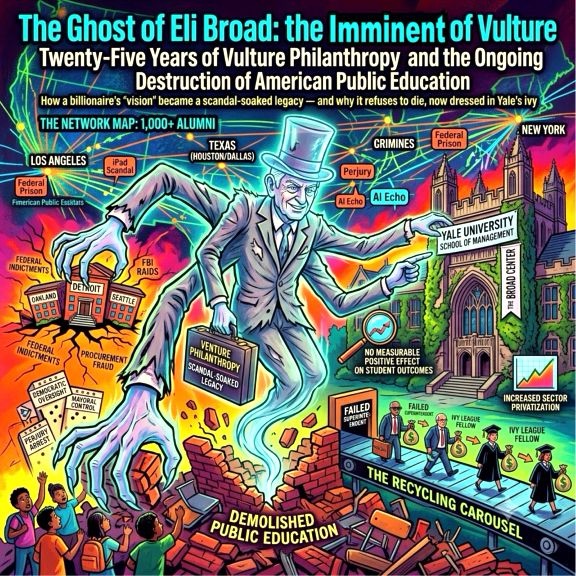
Mike Simpson posts amazing memes on Twitter and BlueSky. He calls himself “Big Education Ape.” He makes the point with his illustrations.
Here is one of his best: THE GHOST OF ELI BROAD: TWENTY-FIVE YEARS OF VULTURE PHILANTHROPY AND THE ONGOING DESTRUCTION OF AMERICAN PUBLIC EDUCATION.
I wasn’t able to copy some tables and graphics. Please open the link to read the post in full.
Eli Broad was one of the billionaires who was eager to tear apart public education and remake it. I referred to him, the Waltons, and the Gates Foundation as “the Billionaires Boys Club,” which was chapter 10 of my book The Death and Life of the Great American School System: How Testing and Choice Are Undermining Education.
Eli Broad’s distinctive contribution to the corporate reform movement was his Broad Academy, where aspiring superintendents were “trained” with his ideas. All expenses were paid, and trainees got to hobnob with others. They also had the Academy’s help in job placement; many “graduates” of the Broad Academy were placed as superintendents in big-city districts, imbued with the ideology that schooling was a business, that low-performing schools should be closed and replaced by charter schools. Eli and his wife Edythe were both graduates of the Detroit Public Schools, but they were not grateful for what they learned.
In 2009, when I was writing the book, I was not aware that the Billionaire Boys Club had many more members and that some were women. There was Alice Walton, Betsy DeVos, the Koch brothers, John Arnold, Joel Greenberg, Daniel Loeb, Jeff Yass, and many more. I posted a far longer list of the super-rich underwriting the privatization of public money in my book Slaying Goliath.
I once was invited by Eli Broad to meet at his gorgeous apartment in New York City, overlooking Central Park. He wanted to know why I was critical of his efforts. He told me that he knew nothing about teaching or curriculum, but he knew a lot about business management and organization. His belief was that public schools could improve by better management.
Mike Simpson performs a public service here by updating the legacy of Eli Broad.
He writes:
How a billionaire’s “vision” became a scandal-soaked legacy — and why it refuses to die, now dressed in Yale’s ivy
There’s a particular kind of audacity required to spend a quarter-century systematically dismantling public education, leave a trail of federal indictments, billion-dollar procurement disasters, and devastated communities in your wake — and then get your name engraved on a building at Yale University. That, in essence, is the story of Eli Broad, the Broad Academy, and its reincarnation as The Broad Center at Yale School of Management. If you were hoping the death of Eli Broad in 2021 would finally close this chapter of American education history, well — ghosts don’t follow rules. And this one has a $100 million endowment.
Part I: Venture Philanthropy — When Billionaires Play School
Let’s start with the concept that makes all of this possible: “venture philanthropy.” It sounds benign — even noble. In practice, it means a billionaire who made his fortune in housing construction (KB Home) and insurance (SunAmerica) decided he understood public education better than educators, parents, communities, or — heaven forbid — children.
Eli Broad’s core thesis, launched formally in 2002 with the Broad Superintendents Academy (BSA), was elegantly simple and catastrophically wrong: public school systems are just badly managed corporations, and what they need is corporate managers.
Not teachers. Not child psychologists. Not community leaders. Corporate managers. Preferably ones with MBAs, military command experience, or backgrounds in supply-chain logistics. Because nothing says “I understand the developmental needs of a seven-year-old” quite like a background in restructuring defense procurement contracts.
The curriculum reflected this philosophy with almost comedic precision:
10% — Actual education: pedagogy, curriculum, child development
90% — Corporate operational reform: fiscal optimization, data-driven accountability, labor relations, and what the Academy euphemistically called “reform accelerators” — which, translated from the original MBA-speak, meant privatization strategies
The program was free to participants — tuition, travel, lodging, all covered. Because when you’re deploying an ideological army, you don’t charge the soldiers.
Part II: Yale Said “Yes” — And Charged It to Prestige
In 2019, the Eli and Edythe Broad Foundation committed $100 million to Yale University to transform the independent, unaccredited Los Angeles operation into The Broad Center at Yale School of Management. The transition was completed in 2020, and the unaccredited LA entity was quietly sunsetted — like a getaway car abandoned after the heist.
The rebranding was masterful. Suddenly, the same ideological pipeline that had produced federal convicts, FBI raid subjects, and a generation of “disruptors” who disrupted primarily the educational lives of low-income children of color was now operating under the imprimatur of one of the world’s most prestigious universities.
The center today operates two flagship tracks, both tuition-free:
The 2026–27 MMS cohort is already being assembled, per the center’s own Instagram, described as “leaders committed to reimagining” public education — which, given the network’s history, should be read as a threat as much as a promise.
Beyond the programs themselves, the center has launched an aggressive data aggregation initiative — a centralized repository hosted on GitHub tracking superintendents across more than 10,000 of the nation’s 13,000 public school districts, aggregating over 180,000 data points across 23 states. The stated goal is academic research. The unstated goal, critics argue, is mapping the vacancy pipeline for the next generation of Broad placements.
Part III: The Damage Ledger — Twenty-Five Years of “Disruption”
Let’s be precise about what the word “disruption” meant in practice. A landmark 2022 longitudinal study published in Educational Evaluation and Policy Analysis tracked two full decades of Broad Academy graduates and delivered findings that would be devastating — if anyone in the venture philanthropy world were capable of embarrassment:
No statistically significant positive effects on district spending, student completion rates, or test scores
Broad-trained superintendents had 18% shorter tenures than non-Broad peers in equivalent districts
The only statistically significant footprint left behind? A sustained, measurable trend toward increased charter school enrollment and sector privatization
In other words, after 25 years and hundreds of millions of philanthropic dollars, the Broad Academy’s measurable legacy in public education was: more charter schools and shorter superintendent tenures. That’s it. That’s the product.
The Human Cost
The abstract numbers become concrete when you look at specific communities:
Oakland & Detroit saw aggressive charter expansion and centralized fiscal management that critics argued deepened structural deficits and fractured community trust for generations.
Chicago experienced the largest single wave of school closures in modern U.S. history — 50 neighborhood schools shuttered in 2013 under Broad-network-affiliated Barbara Byrd-Bennett — triggering federal civil rights complaints alleging the closures disproportionately harmed low-income students of color.
Seattle watched Broad graduate Maria Goodloe-Johnson (BSA Class of 2003) get fired in 2011 following a state audit revealing $1.8 million in public funds funneled into a contracting program that provided little to no actual services — with investigators concluding she exercised a “severe lack of oversight” despite early warnings.
Part IV: The Scandal Hall of Fame — From Procurement Fraud to Federal Prison
Here is where the story transitions from ideologically troubling to criminally spectacular.
John Deasy — The iPad That Broke LAUSD
Deasy (BSA Class of 2006) championed a $1.3 billion initiative to put Apple iPads loaded with Pearson software into the hands of every LAUSD student. The rollout failed within days — students bypassed security filters almost immediately — but the procurement scandal was far worse than the technical failure.
Internal records revealed that Deasy and his deputies had close personal and professional ties to Apple and Pearson executives prior to the bidding process, raising serious allegations of a rigged procurement cycle. The FBI seized boxes of district records. Deasy resigned in 2014. The district eventually abandoned the program and settled for millions in refunds.
His post-resignation career? He was immediately hired by the Broad Center as a Superintendent-in-Residence — coaching the next generation of urban leaders. Because in this ecosystem, failure is a credential.
Barbara Byrd-Bennett — The Federal Prison Graduate
Byrd-Bennett’s career arc is the Broad model in miniature: leave Cleveland in fiscal distress, leave Detroit in structural chaos, get hired as a “turnaround expert” in Chicago, execute the largest school closure wave in American history, then get indicted on 20 counts of federal mail and wire fraud.
Federal investigators proved she steered $23 million in no-bid contracts to SUPES Academy and Synesi Associates — the very consulting firms she had worked for immediately before taking the CPS helm. Internal emails laid bare her motive with a candor that would be almost admirable if it weren’t so brazen: she needed the money because she had “tuitions to pay and casinos to visit.”
In exchange, she was promised a 10% kickback disguised as future consulting fees funneled into trust funds for her twin grandsons. She pleaded guilty and was sentenced to four and a half years in federal prison.
Robert Runcie — The Perjury Arrest
Runcie (BSA Class of 2009) took over Broward County Public Schools — the nation’s sixth-largest district — and oversaw a culture of severe administrative bid-rigging around an $800 million capital bond program, with independent investigations revealing contracts steered to pre-selected corporate entities.
Following the 2018 Parkland school shooting, which exposed deep systemic lapses in district safety infrastructure, a statewide grand jury investigation led to Runcie’s arrest by the Florida Department of Law Enforcement on felony perjury charges in April 2021 — prosecutors proving he lied under oath about communications regarding procurement contracts.
He resigned in exchange for a $743,000 separation agreement. Paid by taxpayers.
Alberto Carvalho — The AI Echo of the iPad Disaster
If the Deasy iPad scandal was the defining Broad-era procurement catastrophe of the 2010s, Alberto Carvalho’s LAUSD tenure became its 2020s technological sequel — almost as if the universe decided one billion-dollar tech procurement disaster per decade wasn’t sufficient.
Carvalho, a celebrated figure on the corporate-reform speaking circuit who regularly headlined Broad Center leadership panels, aggressively championed a contract with “AllHere,” a tech startup contracted to build a multi-million dollar AI student-chatbot tool for LAUSD. The project collapsed into total insolvency. The startup’s founder was indicted for fraud. Federal investigators traced systemic steering of contracts that bypassed traditional public bidding protections.
In early 2026, FBI agents raided Carvalho’s personal residence and district offices. He was placed on paid administrative leave and subsequently resigned — a modern, tech-era echo of the Deasy iPad scandal, separated by exactly one decade and approximately zero lessons learned.
Part V: The Carousel — How Failed Superintendents Get Recycled
One of the most structurally revealing features of the Broad model is what happens after a superintendent fails. In a normal accountability framework, catastrophic failure — federal indictment, FBI raids, mass community protests, historic labor strikes — would end careers.
In the Broad ecosystem, it typically accelerates them.
The recycling mechanism operates in three predictable stages:
Stage 1 — The Soft Landing: Departing executives are caught by the philanthropic safety net. Foundations like Broad, Walton, or Gates place them into well-funded “fellow,” “executive coach,” or “senior advisor” roles at charter management organizations or policy think tanks. The local political dust settles. The national network maintains their status.
Stage 2 — The Headhunter Buffer: National executive search firms — operating with screening frameworks that prioritize corporate operational metrics over community approval or longevity — present the executive to a new school board in another state as a “courageous, battle-tested change agent.” The fact that the “battle” was largely against the parents and teachers of the previous district is presented as a résumé enhancement.
Stage 3 — The Next Major District: Re-hired at a higher salary, with stronger contractual protections, and a golden parachute clause ensuring that the next failure will also be financially comfortable.
Mike Miles left Dallas ISD under multiple internal investigations and extreme executive turnover, founded a charter network, and was then directly appointed by the Texas Education Agency — which had dissolved Houston ISD’s elected school board — to run the entire Houston district with even fewer democratic constraints than before.
Jean-Claude Brizard left Rochester under a 95% teacher vote of no confidence, was immediately recruited to lead Chicago Public Schools (the nation’s third-largest system), triggered the historic 2012 Chicago Teachers Strike within 17 months, was pushed out with a $250,000 buyout, and transitioned smoothly into senior advisory roles at national education foundations.
The pattern is not a bug. It is the feature.
Part VI: Buying the Boardroom — How Venture Philanthropy Captured School Governance
The Broad playbook cannot function under genuine democratic oversight. A superintendent who closes 50 neighborhood schools, eliminates teacher tenure protections, and converts public schools into privately managed charter networks will be fired by an elected school board that answers to the community — unless that school board has been pre-selected to not do that.
The solution was elegant and corrosive: buy the school board elections.
Because local school board races historically required minimal campaign capital, the injection of billionaire wealth fundamentally altered the political landscape. The money flows not directly to candidates (which faces statutory limits) but through Independent Expenditure Committees and Super PACs — allowing unlimited spending on sophisticated polling, negative television ads, and targeted digital saturation.
In Los Angeles, Eli Broad, the Walton family, and allied donors regularly poured $5 million to $10 million per election cycle into LAUSD board races — specifically to achieve a “pro-reform majority” that would protect executives like John Deasy and later Austin Beutner (a former investment banker with no education background whatsoever) from community accountability.
In Oakland, independent groups funded by the California Charter Schools Association outspent local parent-teacher associations 10-to-1, successfully seating board members who routinely approved charter petitions and fiscal consolidation plans drafted by Broad Residency staff embedded in the central office.
When even this proved insufficient — when local civic resistance made winning democratic elections too expensive or unpredictable — the network pivoted to eliminating the elections entirely:
Chicago: Mayoral control legislation allowed Mayor Rahm Emanuel to single-handedly install Broad executives without board confirmation.
Houston: The Texas Education Agency dissolved the elected school board entirely and replaced it with a state-appointed body, allowing direct installation of Mike Miles.
Detroit: The short-lived Education Achievement Authority bypassed the traditional school board to implement a centralized, non-unionized reform experiment under Broad graduate John Covington.
The structural message is unambiguous: the corporate management model and democratic accountability are incompatible. When democracy gets in the way, the solution is to remove democracy.
Part VII: The Network Map — 1,000 Alumni and Counting
The Broad Network now comprises more than 1,000 alumni spanning major urban school districts, charter management organizations, state education agencies, and venture philanthropy foundations — with its heaviest concentrations precisely where the playbook finds the most fertile ground:
California remains the densest hub, with alumni embedded throughout LAUSD, Oakland Unified, and San Diego Unified central offices, as well as major CMOs like KIPP SoCal, Aspire Public Schools, and Green Dot.
Texas has become the fastest-growing hub, with Houston ISD under state-appointed Miles serving as the current flagship experiment, alongside significant placement within Dallas ISD, Fort Worth ISD, the Texas Education Agency, and massive charter entities like KIPP Texas and IDEA Public Schools.
New York serves as the “soft landing” capital of the network — hundreds of alumni operating within Wall Street-adjacent education foundations, charter advocacy groups, and elite national search firms headquartered in Manhattan.
Illinois and Pennsylvania — Chicago and Philadelphia specifically — remain high-density environments where teams of Broad Residents are embedded in central operations managing financial stabilization, facilities restructuring, and school assignment data systems.
Meanwhile, the network has largely migrated out of direct superintendencies — where the political friction is high and the tenure is short — and into the broader ecosystem where influence is durable and accountability is minimal: senior director roles at the Gates Foundation, the Walton Family Foundation, and the Chan Zuckerberg Initiative; high-level education consultancies like Watershed Advisors and Instruction Partners; and, of course, The Broad Center at Yale SOM itself, where the current MMS cohort is being trained to carry the philosophy forward.
Part VIII: Yale — Laundering a Legacy in Ivy
Let us be direct about what the Yale partnership accomplishes that the standalone Los Angeles operation never could: institutional legitimacy laundering.
The Broad Academy, operating independently, was unaccredited, ideologically transparent, and easy to critique. Its graduates were called “Broadies” — a term used by both allies and critics — and the pipeline was visible enough that parent groups, teachers’ unions, and education researchers could track, document, and organize against it.
The Broad Center at Yale SOM is something different. It is now embedded within one of the world’s most prestigious academic institutions, granting an Ivy League master’s degree, hosting fellows in New Haven, and publishing peer-reviewed research. The same corporate management philosophy that produced federal convictions and FBI raids now arrives in urban school districts wearing a Yale credential.
The center’s new data aggregation initiative — tracking superintendents across more than 10,000 districts, aggregating 180,000+ data points — is framed as academic research. Critics see it as something more operational: a comprehensive national vacancy map for the next generation of Broad placements, now with the algorithmic sophistication that the original Los Angeles operation could only dream of.
The 2025-26 Fellowship cohort of 17 fellows is already gathering in New Haven for weeklong modules at Yale SOM. The 2026-27 MMS cohort is being assembled. The pipeline flows.
The Synthesis: What Twenty-Five Years Actually Taught Us
Here is what a quarter-century of Broad-style education reform has empirically demonstrated:
The Promise: The Reality
Corporate management improves district outcomes/No measurable positive effect on test scores, graduation rates, or spending efficiency”
Disruptors” bring needed change/18% shorter tenures; accelerated community fracture
Charter expansion improves options/Statistically significant increase in privatization; no demonstrated academic gains
Data-driven accountability improves teaching/Curriculum narrowing; teaching to the test
Free consulting support helps districts/Permanent embedding of private ideology on public payroll
School board reform improves governance/Systematic dismantling of democratic accountability
The most damning verdict is not the federal indictments — though those are damning. It is not the FBI raids — though those are spectacular. It is not even the $23 million in no-bid kickback contracts or the billion-dollar iPad disasters.
It is this: after 25 years, hundreds of millions in philanthropic investment, and the placement of Broad-trained executives in over 160 school systems, there is no credible empirical evidence that any of it helped a single child learn to read better.
What it did produce — measurably, statistically, reproducibly — was more charter schools, shorter superintendent tenures, and a revolving door of well-compensated executives cycling between urban districts, consulting firms, and Ivy League fellowship programs while the communities they “disrupted” rebuilt themselves from the wreckage.
Epilogue: The Ghost That Won’t Be Exorcised
Eli Broad died in April 2021. His foundation subsequently announced it would spend down its assets and close. The Los Angeles operation was already gone, folded into Yale two years prior.
And yet — the ghost persists. It persists in the 2026-27 MMS cohort assembling in New Haven. It persists in the 180,000 data points tracking superintendent vacancies across 10,000 districts. It persists in the career of Mike Miles, currently running Houston ISD under state protection from democratic accountability. It persists in the aftermath of Alberto Carvalho’s FBI-raided departure from LAUSD — a scandal so structurally identical to the Deasy iPad disaster of 2014 that it reads less like history repeating and more like history plagiarizing itself.
The Broad Center at Yale SOM is not a reformed version of the Broad Academy. It is the Broad Academy with better branding, an Ivy League address, and a GitHub repository. The philosophy is identical. The network is intact. The pipeline flows.
The only thing that has genuinely changed is the zip code — from Los Angeles to New Haven — and the price tag of the credential being handed to the next generation of disruptors preparing to be deployed into the public schools of America.
Eli Broad may be gone. But his ghost has tenure.
And unlike the superintendents he trained, it shows no signs of an early exit.
Sources:
: The Broad Center institutional history, curriculum breakdowns, alumni scandal documentation, EEPA 2022 longitudinal study findings, and school board funding mechanics — as documented in comprehensive public education policy research and investigative reporting compiled in the source brief above.
: EdSource — “FBI raid of Los Angeles Superintendent Carvalho’s home, office may be linked to student AI chatbot” (2026) — edsource.org
: Los Angeles Times — “How probe into failed startup led to LAUSD superintendent investigation” (March 1, 2026) — latimes.com
: Yale School of Management — “The Broad Center Announces 2025-26 Cohort of the Fellowship for Public Education Leadership” — som.yale.edu
Master Source List: The Ghost of Eli Broad & The Broad Center at Yale
🏛️ The Broad Center at Yale SOM — Official Sources
$CITETitleSourceLinkThe Case of Broad Superintendents— Full EEPA Longitudinal Study (2022) Educational Evaluation and Policy Analysis / Tom Dee tom-dee.github.io — EEPA-Broad.pdf New Study: Broad Supes Made No Difference, Other Than Increasing Charter Schools Diane Ravitch’s Blogdianeravitch.net
🗞️ Investigative Journalism & Policy Criticism
$CITETitleSourceLink Critics Target Growing Army of Broad Leaders Education Week edweek.org The Broad Foundation’s Impact on Public Schools Facebook — Oakland Parent Sharon Higgins Analysis facebook.com — Broad Foundation Analysis
⚖️ Barbara Byrd-Bennett — Federal Conviction (Chicago)
$CITETitleSourceLink Former Chief Executive of Chicago Public Schools Sentenced to More Than Four Years in Prison U.S. Department of Justice — Official Press Release justice.govBarbara Byrd-Bennett — Full Coverage Archive WTTW Chicago Public Media news.wttw.com Barbara Byrd-Bennett — Wikipedia Overview Wikipediaen.wikipedia.org
⚖️ Robert Runcie — Broward County Perjury Arrest
$CITETitleSourceLinkFDLE Arrests Broward County Schools Superintendent Robert Runcie for Perjury Florida Department of Law Enforcement — Official Release fdle.state.fl.us Former Broward Superintendent Robert Runcie Avoids Trial — Perjury Charge Dropped CBS News Miami cbsnews.com/miami State Drops Perjury Charge Against Former Broward Schools Superintendent Miami Herald miamiherald.comPerjury Charge Dropped Against Ex-Broward Schools Superintendent NBC Miami nbcmiami.com
🤖 Alberto Carvalho — LAUSD FBI Raid & AllHere AI Scandal
$CITETitleSourceLinkFBI Raid of Los Angeles Superintendent Carvalho’s Home and Office May Be Linked to Student AI ChatbotEdSource edsource.org How Probe Into Failed Startup Led to LAUSD Superintendent Investigation Los Angeles Times latimes.com
📌 Quick Citation Reference Guide
For the article sections, citations map as follows:
Broad Center Yale programs → , , ,
EEPA 2022 empirical study → ,
General Broad criticism & history → ,
Byrd-Bennett federal conviction → , ,
Runcie perjury arrest → , , ,
Carvalho FBI raid / AllHere AI → ,
⚠️ Research Note: Several additional primary sources — including the original EEPA journal publication, the Jeffrey Hubbard California Supreme Court ruling, the Maria Goodloe-Johnson state audit, and the Jean-Claude Brizard Chicago strike documentation — are recommended for deeper verification. Additional searches can be run to surface those specific primary documents on request.
The person who is elected President usually says on election night that he will govern on behalf of the American people. He makes a point of obligation to be respectful for all Governors, to send FEMA to any state that has suffered from natural disasters, regardless of whether they vote for him or his rival.
Trump has said frankly that he hates his enemies. He sometimes doesn’t pretend to care about states that did not vote for him.
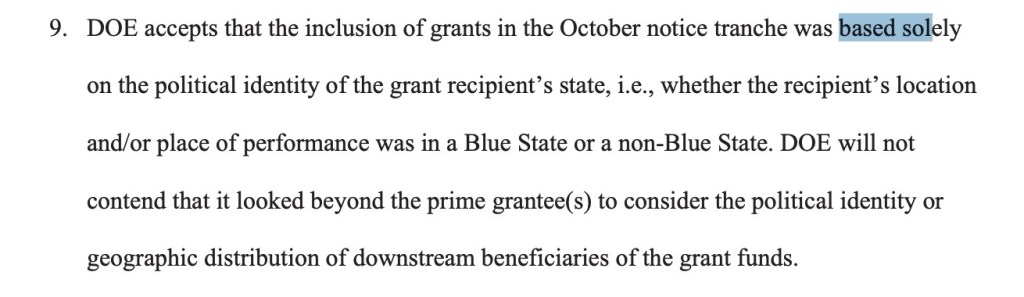
Aaron Parnas of the Parnas Perspective points outthat the Trump administrative made decisions about environmental grants based solely on whether the states supported him in the 2024 elections. This involved billions of dollars in grants.
Parnas wrote:
A major constitutional violation, confirmed in court. The Trump administration admitted in court filings this month that it canceled 284 Biden era clean energy grants worth billions of dollars based solely on whether the recipient state voted for Kamala Harris in 2024 and had two Democratic senators. A lawyer for the Energy Department conceded that none of the terminations were based on any programmatic, statutory, cost reduction, or performance related factor, directly contradicting Energy Secretary Chris Wright’s June congressional testimony that no decisions were made on politics. The Energy Department disputes any contradiction, saying Wright was distinguishing between the review process and the timing of the cancellations, but hundreds of additional grants the department had itself recommended for cancellation were left untouched simply because they sat in states that backed Trump.
Real projects and real money were caught in the fallout. The politically targeted cancellations halted funding for hundreds of energy projects, including electrical grid upgrades in California and Oregon, methane leak reduction efforts in Colorado, and clean hydrogen fuel hubs in California and the Pacific Northwest. The cuts came in October alongside a broader White House push to pressure Democratic lawmakers during a government funding standoff, with Trump publicly threatening to slash what he called Democrat agencies. Some grant recipients have since sued to try to recover their funding, and this is not the first time the Energy Department has admitted politics played a role, since a federal judge already ruled in two earlier cases that more than a dozen grants were improperly canceled for political reasons, though this latest admission is far broader and more detailed.
Democrats say it exposes a dangerous pattern with more to come. Senator Patty Murray and Representative Marcy Kaptur called the cancellations an outright un-American weaponization of government and accused the administration of corruptly abusing its power to punish states over how they voted. The controversy lands as the administration finalizes new rules, expected by October, that would give Trump’s political appointees direct control to review, block, or revoke federal grants across the entire government, worth more than a trillion dollars annually. Budget office director Russell Vought has defended the changes as necessary to ensure democratic control of spending, but critics, including antipoverty groups, scientists, and city leaders, have flooded the government with comments warning the rules would let the administration extend this kind of political targeting far beyond energy grants. Center on Budget and Policy Priorities fellow Devin O’Connor said the willingness to be this blatant in court should be taken as a serious warning about what the new framework could enable nationwide.
This is a thoughtful essay on a crucial problem: shrinking enrollments in higher education and the budget cuts to meet them. Julian Vasquez Heilig lays out the problem and the typical response. He thinks there is a better way and he describes it.
Heilig is on the faculty of Michigan State University and is a national expert on topics such as diversity, equity and inclusion.
He writes:
The warning signs are no longer theoretical. Schools are closing. Colleges are preparing layoffs. Faculty buyouts are spreading. Academic programs are disappearing. Dorm beds are sitting empty. Classrooms are thinning out. Tax revenue is weakening. State appropriations are uncertain. Consultants are being hired and paid millions to identify “efficiencies.” Boards are quietly discussing mergers and closures. American education is entering a period of deep instability.
This is not only a crisis for presidents and superintendents. It is a crisis for communities. When a school closes, a neighborhood loses more than a building. When a college cuts faculty and staff, a region loses jobs and opportunity. When families question whether education is worth the price, the consequences ripple through local economies and democracy itself.
In this article, I first define the problem. Enrollment pressure, funding instability, demographic change, and political attacks are converging across K-12 and higher education. These pressures are already producing closures and painful restructuring. But this is not only a warning. At the end, I turn to what communities can do through politics, public pressure, local organizing, accountability, and leadership selection before the choices become narrower.
The Warning Signs Are Already Here
At my own institution, public projections suggest new student enrollment could decline somewhere between 3 and 5 percent this year. If those projections hold, that would mark a return to consecutive enrollment declines after the gains achieved during my years as provost. During that period, we reversed an almost decade-long enrollment slide.
That is alarming because this moment was supposed to be the “high water mark” before the demographic cliff. WICHE projects that the total number of high school graduates will peak around 2026 and then decline steadily through 2041. Universities were supposed to be maximizing enrollment now. Instead, some are struggling while the student pool remains historically large.
In many ways, education is being pushed into an arena where resources are shrinking and the odds are being rewritten before many institutions understand the rules.
The Old Survival Strategies Are Running Out
Much of higher education survived the past several years through strategies that are becoming unsustainable. Institutions poured millions into financial aid discounting. They leaned harder into full-pay families. They expanded retention offices and predictive analytics systems. They built student success centers and advising infrastructure. They spent heavily on marketing and enrollment staff.
Ironically, retention and enrollment strategy helped save some institutions from earlier financial pressure. During my time in executive leadership, we understood that higher education had entered a new era of competition. Universities were no longer competing only over prestige. They were competing over affordability and survival.
Financial aid, student success infrastructure, and community partnerships became essential tools. Institutions that moved aggressively like Arizona State and Georgia State often stabilized themselves. Institutions that remained complacent fell further behind.
But even enrollment growth stories now face new threats. Federal research funding is unstable. State appropriations remain uncertain. Inflation is pressuring budgets. Some states like Michigan have seen stronger FAFSA activity. Yet many families are questioning the value of higher education. Political attacks have also weakened public trust while threatening research capacity and institutional autonomy.
Please open the link to read Heilig’s creative proposals for meeting the crisis.