Archives for category: Disruption


Every year since 2014, Democrats who fervently support the privatization of public schools have gathered at a conference they pretentiously call “Camp Philos.”

https://campphilos.org/

Check the agenda of meetings present and past.

There you will see the lineup of Democrats who sneer at public schools and look on public school teachers with contempt.

These are the Democrats who support the DeVos agenda of disrupting and privatizing public schools.

They are meeting again this year, and they will slap each other on the back for supporting school closures, charter schools, high-stakes testing, evaluating teachers by the test scores of their students, and hiring inexperienced teachers.

They have the chutzpah to call themselves “stakeholders,” although none of them are teachers, parents of public school students, or have any stake in the public schools that enroll 85-90% of all American students. Exactly what do they have a “stake” in?


William J. Gumbert has prepared statistical analyses of charter performance in Texas, based on state data.

Charters boast of their “success,” but the reality is far different from their claims. They don’t enroll similar demographics, their attrition rate is staggering, and their “wait lists” are unverified.

Their claims are a marketing tool.

They are not better than public schools.

They undermine and disrupt communities without producing better results.

Yet Texas is plunging headlong into this strategy that creates a dual system but benefits few students.


Texas Charter Schools – Perception May Not Be Reality

Part 5: The State’s Efforts to “Privatize” Public Education in Local Communities is “Simply Indefensible”

By: William J. Gumbert

If you are a parent residing in an urban or suburban area of Texas, it is likely that you have received promotional materials recruiting your child to enroll at a privately operated, charter school (“charters”). Charters are taxpayer funded, private organizations that the State approves to independently operate schools in community-based school districts. Despite it being your students, schools, tax dollars and communities, the State has unilaterally decided that a “dual education system”, consisting of locally governed, community-based school districts and State approved, privately governed charters, is best for local communities. The State has also conveniently and unilaterally decided to share the public education funding of local communities with privately governed charters.

To conclude this series on Texas charter schools, Part 5 uses the lyrics of Robert Palmer’s hit song “Simply Irresistible” to demonstrate that the State’s politically driven and orchestrated efforts to “privatize” public education in local communities is “Simply Indefensible”. Since the song was a hit in 1988, feel free to click on the YouTube video of the “Donnie and Marie Show” below to remember the vibe.

Screen Shot 2019-09-03 at 10.26.40 PM

“How Can It Be Permissible”:

Without the approval of taxpayers and local communities: State approved charters:

  • Transfer the control and governance of public schools from local communities to privately-operated charters;
  • Divert funding from community-based school districts to privately-operated charters. The State has already provided charters with over $22.5 billion of taxpayer funding;
  • Increase the debt burden of taxpayers as charters are free to incur long-term bond debt without taxpayer approval;
  • Increase the segregation of students attending public schools in certain communities; and
  • Reduce the quality of schools in many community-based school districts as 20.4% of all charter campuses are rated as “low performing” (rated equivalent of “D” or “F”) by the State’s 2018 Academic Accountability Ratings.

    “She Compromise My Principle – Yeah, Yeah”:

    Every community has a fundamental responsibility to provide a quality public education that equally serves the unique needs of every student. As public servants, community-based school districts embrace this responsibility as all students are welcome and no student is turned away. If there is not room, community-based school districts hire more teachers and make room. In comparison, the State’s deliberate intervention in local communities allows privately-operated charters to:

    • Serve a limited number of students and NOT enroll all students;
    • Recruit the targeted students and families they desire to serve;
    • Deny enrollment to students with “discipline histories”;
    • ▪ Serve a lower percentage of “students with disabilities”;
    • Serve a lower percentage of students “at risk” of dropping out; and
    • Disrupt the education of over 12,800 “economically-disadvantaged” students due to charter closures in the last 5-years.

    “That Kind of Love is Mythical”:

    The promotion of charters is primarily coordinated by charter advocacy organizations that are intended to support and grow the charter school movement. Although not all-inclusive, these organizations train charter administrators, teachers and parents to be advocates, they assist organizations to start new charters, and they coordinate the political strategy to secure favorable support from the Legislature. But it is not publicized that these advocacy organizations are funded by private donors and fueled by privately funded “public policy” organizations that desire to “privatize” public education across Texas.

    To demonstrate parent demand and to garner political support, charter advocacy organizations have notoriously publicized a “wait list” of students. But charters do not publicize the alarming 33.8% attrition rate of students in grades 7-12 that decided to transfer to another Texas public school to start year 2017/18. Charters also do not publicize that the desires of families on “wait lists” are a lower priority than the desire of charters to expand in other regions of the State. By charters expanding in other regions, without expanding current schools to serve students on “wait lists”, charters are choosing to have families “stuck” on the wait list”. In addition, charters strategically attempt to maintain a “wait list” to ensure that their taxpayer funding is preserved as existing students transfer to community-based school districts or another Texas public school in the future.

    In Texas, the promoted (unverified) “wait list” is 141,000 students. However, taking a deeper dive, a more realistic estimate is closer to 75,000 students or an amount that is very similar to the 73,713 disciplinary students that are intentionally denied service by charters. This estimate was derived from certain enrollment statistics in a study funded by the KLE Foundation entitled: “An Analysis of Austin area Charter School Waitlists and Enrollment”. It is important to note that the KLE Foundation is also funding the expansion of charters in Austin.

    “She’s Anything But Typical”:

    In comparison to community-based school districts, charters serve the unique needs of students by:

    • Employing teachers with lower experience;
    • Deploying higher class sizes;
    • ▪ Having higher teacher turnover
    • Spending less on “student instruction”;
    • Offering fewer co/extra-curricular activities;
    • ▪ Having limited career and technical training; and
    • Closing 108 charters

    .

    “She’s a Craze You’d Endorse, She’s a Powerful Force”:

  • The charter movement is coordinated by “public policy” and “education reform” organizations that circumvent the voice of local taxpayers by strategically controlling our elected officials at the State and Federal levels. In politics, money is power and the rich and powerful support the charter school movement. As a result, many elected officials are politically motivated to endorse and support the “charter craze”. The following quote from the Texas Charter Schools Association, an advocacy organization to support and expand charters, provides an indication of the movement’s focus on political patronage:

    “Generally speaking, we have a broad enough bipartisan coalition in the House and Senate that largely will prevent anything existential happening to charters” – CEO of TCSA

    “You’re Obliged to Conform, When There’s No Other Course”:

    It is interesting that the Legislature continues to increase the transparency requirements of community-based school districts to enhance the involvement of taxpayers, but at the same time, the State forces charters upon taxpayers by unilaterally controlling the expansion and taxpayer funding of charters. In this regard, taxpayers do not receive public notice of the charters that the State approves to operate in local communities. The State does not notify taxpayers of the public funding it provides to charters and the State has ensured that taxpayers cannot prohibit or limit the bond debt incurred by charters to finance the construction of new charter schools in local communities (charters are granted the ability to incur bond debt without voter approval). Lastly, with charters having “privately appointed boards”, the State has also ensured that taxpayers cannot democratically elect the governing boards of charters and in fact, the State does not even require charters to meet in the communities they serve.

    “She Used to Look Good to Me, But Now I Find Her”:

    The original purpose of charters was to improve the educational opportunities of “economically-disadvantaged” students in urban areas and to develop and share instructional innovations to enhance the education of all students. However, the charter school movement has evolved into an aggressive, strategic and “non-cooperative” movement that is coordinated by “special interests” to “privatize” and “control” the public education system in local communities. Since charters have introduced “private business practices” into public education, the charter movement could be characterized as a “hostile takeover” of public schools and the tax dollars of Texas communities.

    “Simply Indefensible” … “There’s No Tellin Where the Money Went”:

    The charter facts are “irrefutable”;

    Charter expenditures are “inscrutable”;

    Special interests have made charters politically “irresistible”; and

    By the State providing privately governed charters with taxpayer funding, “there’s no tellin where the money went”.

    With the education of children and taxpayer funding at stake, the State’s deliberate and politically-motivated actions to “privatize” public education in local communities is:

    “Simply Indefensible”

    DISCLOSURES: The author is a voluntary advocate for public education and this material solely reflects the opinions of the author. The author has not been compensated in any manner for the preparation of this material. The material is based upon various sources, including but not limited to, the Texas Education Agency, Txschools.org; Texas Academic Performance Reports, tpeir-Texas Education Reports, Texas Higher Education Coordinating Board, KXAN and other publicly available information. While the author believes these sources to be reliable, the author has not independently verified the information. All readers are encouraged to complete their own review of the charter school movement in Texas, including the material referenced herein and make their own independent conclusions.

This is a curious article about the makeover of Tulsa Public Schools, where the superintendent is Broadie and former Rhode Island Superintendent Deborah Gist.

https://www.tulsaworld.com/opinion/columnists/ginnie-graham-tulsa-public-schools-has-gone-through-major-reforms/article_4bc36885-c247-5858-99f1-7387c48b4fab.html

Under the previous superintendent, a plan called “Project Schoolhouse” resulted in school closings and consolidations. The leaders persuaded the public to accept these “reforms.” In the background was a management consultant brought in by the Gates Foundation; he had no education experience but understood how to use data analytics to persuade the public to go along with his ideas.

When the fate of Rogers High School was on the table, the superintendent was stunned that people cared whether the school remained open.

About nine years ago, a public meeting in the Rogers High School library was so packed that former Tulsa Public Schools Superintendent Keith Ballard had to shoulder his way to the front.

Alumni drove from out of state to attend. Neighborhood residents, students, parents and community leaders joined.

The outpouring didn’t line up with other measures that showed a waning interest in the school. It made a difference in the reforms being planned.

You couldn’t fit one more person in there. I was stunned to see so many people,” Ballard said. “A person stopped me and said, ‘We want our high school to be great again.’ We did, too. This was an opportunity to hear what people had to say and for us to talk about changes in the high schools.”

That was just one evening in a year of developing the last TPS district-wide reform, known as Project Schoolhouse.

A similar process is beginning. TPS will be cutting $20 million from its budget in the next school year. School leaders say this is a chance for the public to shape how TPS serves students moving forward.

This is a massive undertaking in a short amount of time. The board is expected to approved a modified budget by Dec. 16.

So the next job is to persuade the public that a budget cut of $20 million will make the public schools great again.

Oklahoma is notorious for tax cuts for corporations and the fossil fuel industry and underfunded public schools.

In an insightful article in the Washington City Paper, Rachel Cohen describes how the charter industry in the District of Columbia has organized campaigns to prevent any accountability, and has arranged that taxpayers fund their lobbying efforts, with the help of a few billionaires.

It takes money to persuade politicians to vote your way, and the charter industry has figured out how to get the public to foot the bill.

She writes:

Lobbyists mobilized quickly when they learned the D.C. Council would be proposing legislation to subject the city’s charter schools to freedom-of-information laws. The day before the bill was released in mid-March, charter leaders were armed with a list of talking points divided into two categories: “soft response” and “harder-edge messaging.”

The “soft response” included points like: “this bill cares more about paperwork than school performance” and “devoting schools’ resources to yet even more compliance will divert from more important student needs, such as mental health counseling.” The “harder-edge messaging” went further, charging the legislation with “bureaucracy-building and political playback masquerading as watchdogging.”

The legislation is intended to let parents, teachers, and journalists access more information about the schools’ internal operations, and it comes on the heels of a series of scandals that fomented public distrust. But the talking points encouraged charter advocates to tell their councilmembers that it’s insulting to suggest that the schools need additional oversight. “We resent the implication that the hundreds of community and parent volunteers who serve on charter schools’ boards are not putting students’ needs first,” the talking points read. “The real agenda that needs uncovering is the union strategy to force charter schools to behave exactly like the school district bureaucracy.”

This coordinated pushback didn’t come out of thin air. In fact, D.C. taxpayers might be surprised to learn they helped fund the lobbying themselves. Every year D.C. charter schools collectively funnel hundreds of thousands of dollars from their budgets to private organizations that then lobby government agencies against efforts to regulate the schools. Between 2011 and 2017, for example, local charters paid the DC Association of Chartered Public Schools, which calls itself “the collective voice of DC’s Chartered Public School Leaders,” more than $1.2 million in membership dues for its advocacy services, at a rate of $8 per student annually.

While most D.C. charters contribute to the Association, nearly all also pay $8 per student annually to a second group called Friends of Choice in Urban Schools, better known as FOCUS. Last year all but three charters kicked over FOCUS’ “voluntary student payments,” totaling more than $340,000…

For those who envision public-school politics as frazzled parents huddled in middle school gymnasiums, the world of D.C. charter advocacy might come as a strange sight. It’s a place where philanthropic money, revolving political doors, high-dollar galas, and a bevy of well heeled organizations have all been deployed to help charter schools shape their own regulations—or, more preferably, keep regulation away. Now, in the face of questions and community frustration, lawmakers are again under pressure to act. But if city leaders are going to bring newfound transparency to the charter world, they’re going to have to overcome a formidable influence machine with a long history of winning fights in D.C.

Cohen explains that the initial push for charter schools began with Newt Gingrich.

Many D.C. residents balked at Congress’ actions. When Clinton signed the School Reform Act into law in the spring of 1996, it was over the strong objection of D.C.’s non-voting Congressional delegate, Eleanor Holmes Norton, who protested Congress’ interference in the city’s local affairs.

Josephine Baker, board chair and executive director for the city’s charter authorizer, the DC Public Charter School Board, from 1996 through 2011, reflected on this process in her 2014 memoir: “The way [D.C. charters were established] left a terrible taste in the mouths of many life-long and civically engaged Washingtonians. It also represented a selling out of sorts to some community members who felt Republicans in Congress were acting as political imperialists.”

These misgivings over home rule did not stop charters from claiming legal independence, however. Professional advocates worked for years to convince the public and elected officials that D.C. lawmakers were legally unable to regulate their city’s charter sector if doing so conflicted in any way with the letter or spirit of Congress’ law. As Baker put it, “We used the charter law, deemed one of the best in the nation by the Center for Education Reform, as our shield.”

FOCUS, the charter advocacy group, has been the driving force behind these efforts. FOCUS was founded in 1996 by Malcolm Peabody, a Republican real estate developer who had strong political relationships in Congress and the local business community. A quarter-century earlier, Peabody helped pioneer the very idea of housing vouchers for low-income renters, when he served a stint under his brother, the governor of Massachusetts, and then later at HUD under President Richard Nixon. Peabody’s belief in vouchers for housing paved the way to supporting vouchers for schooling, but he understood the lack of political support for the concept in D.C., so limited FOCUS’ focus to charters.

FOCUS insisted that charters should not be regulated and that the District had no authority to hold them accountable.

FOCUS’ lobbying efforts were enhanced by millions contributed by the Walton Family Foundation. Other players included Democrats for Education Reform, Education Reform Now, and City Bridge. Money was plentiful, and the goal was to make sure that charters remained unregulated and unaccountable. Cohen is surprised that many of the charter lobbyists never bother to register as lobbyists. They operate in a zone where laws do not apply.

Advocates for public schools have been underfunded and lack the infrastructure of the charter lobby.

Now a new battle is brewing. D.C. charter schools are not subject to public records laws. They are not transparent and zealously defend their lack of transparency. They claim that transparency equals bureaucracy, and they need freedom from oversight.

Imagine if any public school made such a ridiculous claim!

This past spring, Education Reform Now, DFER-DC’s affiliate, funded a text-message campaign against the proposed transparency bill, using the same internal talking points endorsed by FOCUS and the Association. “The D.C Council is considering legislation that would divert resources in quality public charter schools away from helping students achieve to completing onerous paperwork and bureaucracy,” one text read. Another encouraged recipients to click on a link, which provided them with a pre-drafted email to send to their local representatives opposing the legislation. “I am writing to express disappointment in your recently introduced bill to unfairly target public charter schools,” the form email read. “Our kids need teachers and resources not more legal burdens.” DFER-DC did not answer City Paper’s inquiries regarding how many residents received the texts.

At the June hearing some charter leaders made similar points against additional oversight.

“I see this Council and others moving in a direction that troubles me, treating public charter schools as public agencies,” testified Shannon Hodge, the executive director of Kingsman Academy, a charter located in Ward 6. “We are not public agencies and we are not intended to be.”

Royston Lyttle, an Eagle Academy principal, agreed. “We don’t need more bureaucracy and red tape.”

Interesting that the executive director of Kingsman Academy insists that her charter is “not a public agency.” She is right.

Any organization that receives public funds should be subject to public oversight. Clearly the charters are private schools that use their powerful friends to get public money.

No oversight, no transparency, no public funding.
Nina Turner of the Bernie Sanders campaign speaks out against charter school expansion.

Watch this.

Every Democratic Presidential Candidate should follow Bernie’s lead. He has the pulse of the people on this issue.

Betsy DeVos was sad to see that Alabama had only four charter schools. So she awarded $25 million to an organization tasked with generating more private charters to drain money away from the state’s underfunded public schools.

The state charter commission has been mired in controversy since giving its approval to a Gulen charter school in a rural district where it was not wanted.

The rationale for charters is that they have more flexibility than public schools, but if flexibility from state regulations is needed, why doesn’t the state grant flexibility to its real public schools? Why doesn’t it abolish burdensome regulations and mandates for community public schools?

Next time you hear a pundit say that DeVos doesn’t have the power to do damage, think of her unilateral control of $440 million in the federal Charter Schools Program, which has become her personal slush fund.

The Education Research Alliance at Tulane University has accomplished a spectacular feat with its latest report about the “academic progress” (or lack thereof) of the all-charter district in New Orleans. The report claims that the disruption strategy of school takeovers and closures is responsible for the academic improvements in the district, but at the same time admits “The average school improved from the first to the second year after it opened, but school performance remained mostly flat afterwards. Schools starting off above the state average saw slightly declining performance in later years.” Furthermore, “quality peaked around 2013 and has either stagnated or started to decline during 2014-2016.”

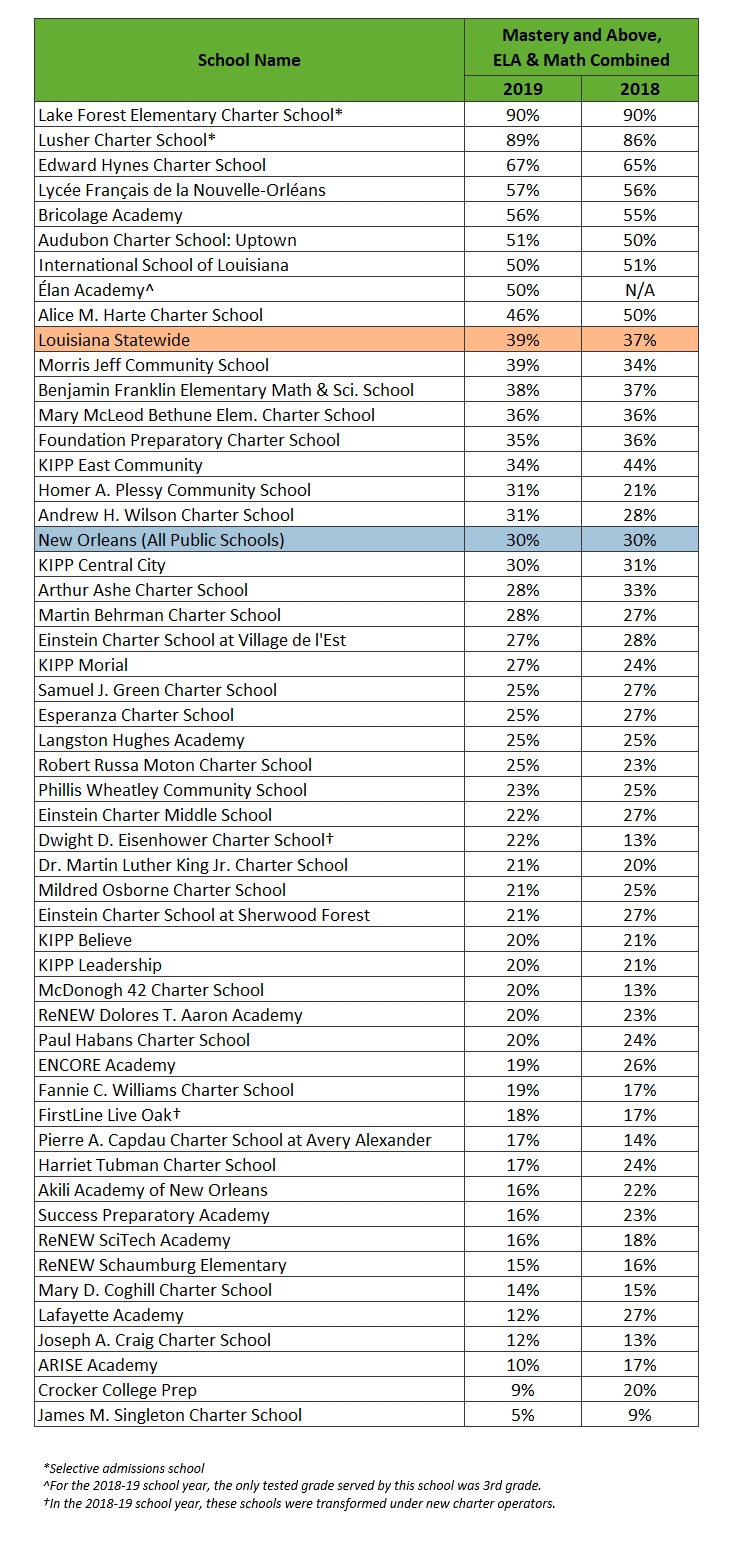
So, here is the New Orleans model: Close almost all public schools. Replace them with private charters. Fire all the teachers. Replace most of the teachers with inexperienced, ill-trained TFA recruits. Close low-performing charters and replace them with other charters. Keep disrupting and churning. In the first two years, scores will go up, then stall. By year eight, “quality” will stagnate or decline. The schools will be highly stratified and racially segregated. The few high-performing schools will have selective admissions.

Here is the report, released this morning.

This report should be read in tandem with the latest state scores, which shows the all-charter district lagging far below state average scores, actually declining. Most charter schools in New Orleans, as detailed in this link prepared by a pro-charter organization, are very low-performing. The high-scoring schools have selective admissions.

New Orleans is one of the lowest performing districts in one of the lowest-performing states.It is a model of how privatization increases stratification and segregation. It should not be copied elsewhere.

But the report claims the success of the venture in school closings and privatization! Remember that the Education Research Alliance won a $10 million grant from Betsy DeVos after its report last year claiming the success of the privatization experiment.

Here is the press release for today’s report:

Study shows average public school quality has increased in New Orleans since Hurricane Katrina as a result of school closures, takeovers, and charter openings

New Orleans – The quality of New Orleans’ public schools improved considerably after Hurricane Katrina as a result of performance-based closures and takeovers, as well as charter openings, according to a new study from Education Research Alliance for New Orleans (ERA-New Orleans) at Tulane University. The study also found that variation in school quality has decreased, which means fewer students are in very low-performing schools.

Now an all-charter district, New Orleans public schools have returned to the control of the local school board. The city’s education leaders face challenging decisions about the district’s role in in school improvement, especially when and how the district should help support low-performing schools or take over these schools. This study provides insight into how these decisions can affect school quality.

“There are two main paths to improving the city’s schools: improving the ones we have or replacing them,” said ERA-New Orleans Director and lead author Douglas Harris. “Our findings suggest that we’ve been more successful with closing and taking over low-performing schools.”

The study’s authors analyzed data from 2002-2016 and found that the average New Orleans public school improved from the first to the second year after opening, but school performance remained mostly flat after the second year.

The study also examined factors beyond academic achievement to better understand how the city’s schools have evolved.

“The number of extracurricular activities that schools say they offer has increased over time,” co-author and ERA-New Orleans research analyst Alica Gerry said. “Also, there may have been a slight upward trend in the variety of school options in the city after the reforms, though this could just reflect school marketing rather than actual program offerings.”

“Students now have access to a wider range of higher quality schools than they did before, even in the first few years of reform,” Harris said. “School closures and takeovers should be a last resort, but they also show some promise when schools are consistently low-performing.”

The study’s authors are Douglas Harris (Tulane University), Lihan Liu (Tulane University), Alica Gerry (Tulane University), and Paula Arce-Trigatti (Rice University).

The novice journalist is likely to read the claims made about New Orleans—that outcomes improved because of charters and closing schools with low scores—and assume that this strategy of disruption is the key to good results. But unless they read the report closely, they may not notice that gains ended after the first or second year of an experiment now in its 15th year.

Expect more headlines about the New Orleans “miracle,” about the stagnation of market-based reforms in a city where most schools “perform” far below state averages.


Jan Resseger describes the after-effects of former Kansas Governor Sam Brownback’s crash program to cut corporate and income taxes and expect an economic boom. The boom never came, but public services were strained to the breaking point.

Jan quotes liberally from Governing magazine:

Governing Magazine just published an extraordinary profile of Kansas state government—what was left of it after Sam Brownback’s tenure.  Last November when a Democrat, Laura Kelly, took office, the new governor found herself assessing the damage from two terms of total austerity. Reporter, Alan Greenblatt describes a state unable to serve the public:

“To students of state politics, the failed Kansas experiment with deep cuts to corporate and income tax rates—which GOP Gov. Sam Brownback promised would lead to an economic flowering, and which instead led to anemic growth and crippling deficits—is well known.  What is not as well understood, even within Kansas, is the degree to which years of underfunding and neglect have left many state departments and facilities hollowed out…. All around Kansas government, there are stories about inadequate staffing…. Staff turnover in social services in general and at the state prisons has led to dozens of missing foster children and a series of prison uprisings… During the Brownback administration, from 2011 to 2018, prison staff turnover doubled, to more than 40 percent per year, while the prison population increased by 1,400 inmates, or 15 percent.  Guards have been burned out by mandatory over time and by pay scales that have failed to keep pace with increased insurance premiums and copays, let alone inflation. With inadequate and inexperienced staff, the prisons began employing a technique known as ‘collapsing posts,’ meaning some areas were simply left unguarded.”

The consequences for other states that tried to cut their way to prosperity were equally calamitous.

The reason that parents and teachers are giving Nick Melvoin a rating on YELP is in response to his plan to rate teachers, mainly by the test scores of their students.

Jeb Bush invented the template for grading schools from A-F, based mainly on their test scores. It became a convenient way to close public schools and turn them over to charter operators. It is an dumb idea for many reasons, because schools are complex institutions with many staff and many functions. Students are not randomly assigned.

In state after state, school grades reflect the proportion of needy kids enrolled. The lowest scores go to schools with high proportions of students who are poor, don’t speak English, and have special needs. Schools with the greatest challenges are wrongly labeled an stigmatized as “failing schools.”

So now Los Angeles is considering a school grading scheme in which most of the grades will depend on standardized test scores.

https://www.latimes.com/california/story/2019-08-13/lausd-schools-ranked

Even the Los Angeles Times ridiculed this bad idea.

https://www.latimes.com/opinion/story/2019-08-16/grading-los-angeles-schools

According to documents obtained by Times reporters, the proposed measurement system, which hasn’t come before the board yet, would include a rating for each school on a scale of 1 to 5, based mostly on test scores. In the case of elementary and middle schools, the scores themselves and students’ improvement on them would make up 80% of the ranking. In high schools, it would be 65%, and since the state’s annual standardized test is given in only one grade in high school, it would show nothing about whether any particular cohort of students is improving on the tests as they move from 9th to 12th grade….

But what’s wrong might not be the quality of the teaching or the running of the school. The reality is that students in some neighborhoods face considerably more challenges of poverty, family disruption and the like, and those issues often affect their academic performance and test results.

Charter schools and magnet schools draw their enrollment from parents who go out of their way to find out about different schools and who have the time and ability to sign up their children for possible acceptance. Even if those students are poor and enter school not yet knowing English, they tend to have a leg up on students whose parents are less involved, perhaps because they’re ill or working too many jobs. Neighborhood schools shouldn’t be made to look comparatively bad over factors they can’t control.

Why is Los Angeles copying Jeb Bush’s bad ideas?


Clifford Wallace and Leigh Wallace, a father-daughter team of professional educators, lambaste state officials for their relentless attacks on the state’s public school teachers. 

They begin:

Leadership matters. It has the potential to influence student outcomes. Clearly, there is a lack of leadership in Frankfort. Kentucky State Education Commissioner Wayne Lewis is taking pages from the flawed and unsuccessful playbooks of his neoliberal, pro-privatization counterparts in Louisiana, Indiana, Ohio, and Wisconsin. From no longer requiring master’s degrees for teachers to maintain certification to promoting privatized for profit “charter schools” as the panacea to save the “failing public schools” – our “commissioner” is helping dismantle our public schools – and the teaching profession – in Kentucky.

Lewis continues to disparage professionally prepared – and experienced – educators through diminishing the significance of the complex work they do on a daily basis, insulting their commitment and expertise, threatening their pensions, and cutting programs and budgets. Recently, in addition to painting a negative narrative around our public schools and the professionals that work in them, he proposed a “pay for performance” incentive for Kentucky Public School teachers as a means to motivate them to “work harder” and ensure every student has access to a “quality public school.” While this may sound promising on the surface – especially if you have not read the numerous studies conducted by scholars on this practice over the past 30+ years – it is a failed solution.

Lewis’s proposal for merit pay or performance bonuses is absurd. It has been tried repeatedly and failed everywhere. It was tried in Nashville, with a bonus of $15,000 for middle school math teachers who raised test scores. It failed. It has been tried again and again over the past 100 years and has NEVER worked.
Lewis is no “Reformer.” He is being paid to demoralize professional educators and find excuses to privatize public schools. This is not “leadership.” This is Disruption.
The teachers and students of Kentucky deserve better leaders who are dedicated to improving conditionsof teaching and learning.