Archives for category: Democrats

We recently learned that Josh Shapiro, Democratic candidate for Governor of Pennnsylvania, has endorsed vouchers.

One of our readers supplied an email for this “Democrat” who has embraced the Republican agenda for education. Josh Shapiro is a hypocrite. Real Democrats support public goods. Real Democrats care about the common good. Real Democrats fight privatization of what belongs to the public.

Here’s his email: contact@joshshapiro.org, As a union public school teacher and a member of the democratic party I am absolutely outraged by your decision to endorse charter schools.

If you don’t know why you should not be supporting the same education policies as Donald Trump and Betsy Devos, then you have no business holding public office for the democratic party.

In a shocking development, Josh Shapiro, the Democratic candidate for Governor, has endorsed a school choice bill that was barely passed by the Republican House.

Shapiro is currently the state’s attorney general. He is running against an extreme Trumper who participated in the January 6 insurrection.

On Saturday, Shapiro told supporters that he favors the “Lifeline Scholarship Program,” which passed the Republican House in April by a vote of 104-98. That was the first time that a voucher bill ever passed the State House. It also was passed by the Senate Education Committee in June.

The bill is supported by the Trump-endorsed Republican candidate and puts Shapiro in the same boat with Betsy DeVos and Charles Koch. Shapiro joins the tiny number of Democrats, like Senator Cory Booker of New Jersey, who supports school choice.

You can bet that many parent advocates and teachers are shocked. The research is clear that school choice does not improve student’s educational outcomes. What’s up?

Tom Ultican is one of the very best chroniclers of the “Destroy Public Education” movement. He was thrilled to discover a new book that explains the origins of the attack on public schools and calls out its founding figures. Lily Geismar’s Left Behind is a book you should read and share. It helps explain how Democrats got on board with policies that conservative Republicans like Charles Koch, the Waltons, and Betsy DeVos loved. This bipartisan agreement that public schools needed to be reinvented and disrupted brought havoc to the schools, demoralized teachers, and glorified flawed standardized tests, making them the goal of schooling.

Ultican writes:

Lily Geismer has performed a great service to America. The Claremont McKenna College associate professor of history has documented the neoliberal takeover of the Democratic Party in the 1980’s and 1990’s. In her book, Left Behind: The Democrats Failed Attempt to Solve Inequalityshe demonstrates how Bill Clinton “ultimately did more to sell free-market thinking than even Friedman and his acolytes.” (Left Behind Page 13)

When in the 1970’s, Gary Hart, Bill Bradley, Michael Dukakis, Al Gore, Paul Tsongas, and Tim Wirth arrived on the scene in Washington DC they were dubbed “Watergate Babies.” By the 1980’s Tip O’Neill’s aid Chris Mathews labeled them “Atari Democrats” an illusion to the popular video game company because of their relentless hi-tech focus. Geismer reports.

“Journalist Charles Peters averred that ‘neoliberal’ was a better descriptor. Peters meant it not as a pejorative but as a positive. … Neoliberals, he observed, ‘still believe in liberty and justice and a fair chance for all, in mercy for the afflicted and help for the down and out,’ but ‘no longer automatically favor unions and big government.’” (Left Behind Pages 17-18) [Emphasis added]

Democrats in search of a “third way” formed the Democratic Leadership Council to formulate policies that moved them away from unions, “big government,” and traditional liberalism.

Historian Arthur Schlesinger labeled the DLC “a quasi-Reaganite formation” and accused them of “worshiping at the shrine of the free market.”

Union pollster Victor Fingerhut called them “crypto-Republicans.”

Douglas Wilder a black Virginia politician criticized their “demeaning appeal to Southern white males.”

Others called them the “conservative white caucus” or the “southern white boys’ caucus.”

Jesse Jackson said its members “didn’t march in the ‘60s and won’t stand up in the ‘80s.” (Left Behind Pages 46-47)

In 1989, From convinced Bill Clinton to become the chairman of the DLC. That same year the DLC founded the Progressive Policy Institute to be their think tank competing with the Heritage Foundation and the CATO Institute. Today, it still spreads the neoliberal gospel.

This is an important book that explains how the Democratic Party lost its way.

Sarasota, where DeSantis candidates won the school board, is a very conservative district.

Polk County went for Trump in the past; 52% of its voters are Republicans. But Ron DeSantis’ conservative slate lost.

Billy Townsend explains the surprising outcome.

And he concludes that if DeSantis can’t win Polk County, he’s in trouble.

To recap: Chief crank Ron DeSantis and his Polk GOP hench-cranks succeeded completely in making the Polk School Board elections partisan. In doing so, they lost basically every geographical engine of growth, commerce, creativity, and civic life in Polk County. And they added some functional chunk of Republican primary voters to the generic Polk County Democratic political coalition, at least for a night. Well played, GOP.

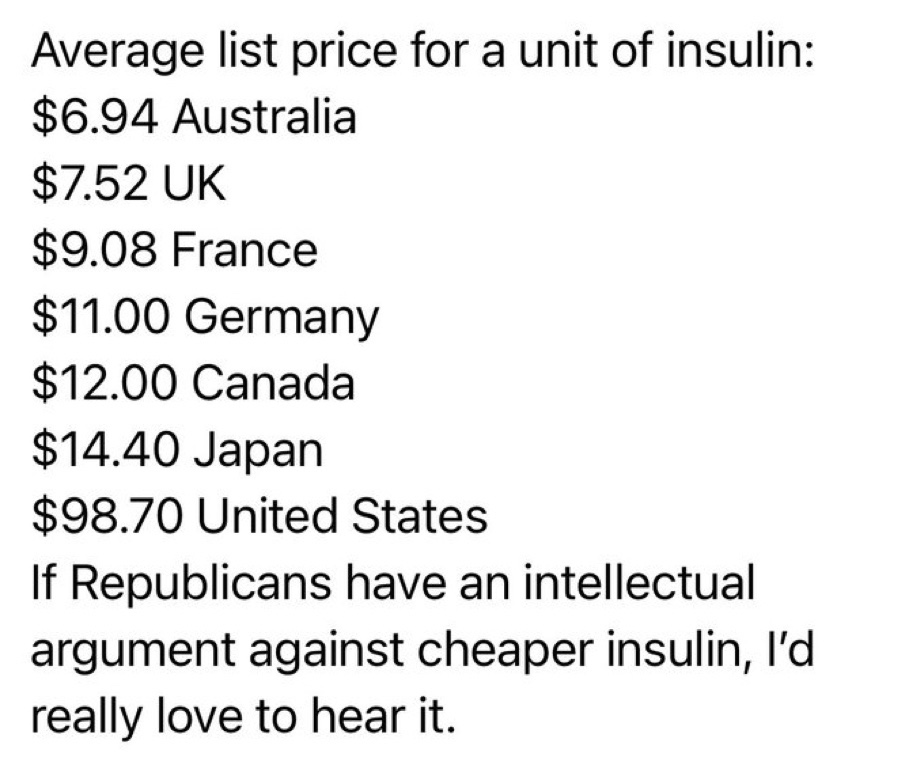
Democrats needed 60 votes to pass a $35 monthly cap on the price of insulin. Republicans, led by Senator Lindsey Graham, made sure that there would not be 10 Republican votes for the measure.

The Washington Post reported:

Republican lawmakers on Sunday successfully stripped a $35 price cap on the cost of insulin for many patients from the ambitious legislative package Democrats are moving through Congress this weekend, invoking arcane Senate rules to jettison the measure.

The insulin cap is a long-running ambition of Democrats, who want it to apply to patients on Medicare and private insurance. Republicans left the portion that applies to Medicare patients untouched but stripped the insulin cap for other patients. Bipartisan talks on a broader insulin pricing bill faltered earlier this year.

The Senate parliamentarian earlier in the weekend ruled that part of the Democrats’ cap, included in the Inflation Reduction Act, did not comply with the rules that allow them to advance a bill under the process known as reconciliation — a tactic that helps them avert a GOP filibuster. That gave the Republicans an opening to jettison it.


“Republicans have just gone on the record in favor of expensive insulin,” said Sen. Ron Wyden (D-Ore.). “After years of tough talk about taking on insulin makers, Republicans have once against wilted in the face of heat from Big Pharma.”


Some Republicans did support the price cap in the 57-43 vote for the measure, but not enough joined Democrats in support of it to meet the threshold for passage.


More than 1 in 5 insulin users on private medical insurance pay more than $35 per month for the medicine, according to a recent analysis from the Kaiser Family Foundation.


Some 7 million Americans require insulin daily. A Yale University study found that 14 percent of those insulin users are spending more than 40 percent of their income after food and housing costs on the medicine.

The seven Republicans who voted with the Democrats were: Senators Susan Collins of Maine, Josh Hawley of Missouri, Cindy Hyde-Smith of Mississippi, Lisa Murkowski and Dan Sullivan of Alaska, and John Kennedy and Bill Cassidy of Louisiana.

Mary Trump tweeted that Josh Hawley, a fierce partisan, must have a relative with diabetes. Or maybe the Republicans drew straws to see who would cast a futile vote against a popular measure.

Tweet by @toylsome

Question: Will Republican voters remember in November?

Senators Joe Manchin and Kyrsten Sinema were the two Democrats whose support for the Inflation Reduction Act was in doubt until the very end. Manchin won protection for the fossil fuel industry. Sinema killed taxes that would hit the hedge fund industry. The Washington Post explains here:

Senate Democrats agreed Sunday to protect firms owned by the private equity industry from a new minimum tax on billion-dollar corporations, bowing to pressure from Sen. Kyrsten Sinema (D-Ariz.), who insisted on making the change to the Democrats’ sprawling climate, health-care and tax package.

The decision came as Democrats tried to hold their caucus together through nearly 19 hours of debate over the Inflation Reduction Act of 2022, which the 50-50 Senate approved Sunday with the help of a tiebreaking vote from Vice President Harris.


The package proposes hundreds of billions of dollars in fresh spending, financed in part through new taxes, including a corporate minimum tax that would require firms with more than $1 billion in annual profits to pay a tax rate of at least 15 percent. As originally written, the provision would have required private equity firms to tally profits from their various holdings and pay the tax if the total exceeded the $1 billion threshold.


Sinema, who for over a year has blocked Democratic ambitions to raise taxes, raised objections on Saturday, according to two people with knowledge of the matter, who spoke on the condition of anonymity to discuss private talks.

The senator argued that, without changes to the bill, small and medium-sized businesses that happen to be owned by private equity firms would be exposed to the tax, violating a Democratic pledge to hike taxes only on the largest firms. A Sinema spokeswoman said several Arizona small businesses, including a plant nursery, had raised concerns.

The senator’s objections came days after she persuaded Democrats to abandon a different effort to raise taxes on private equity managers by closing the so-called “carried interest loophole,” which permits investment managers to pay lower rates on certain portions of their income.
In a statement, Sinema’s office said her goal is to “target tax avoidance, make the tax code more efficient, and support Arizona’s economic growth and competitiveness.”


“At a time of record inflation, rising interest rates, and slowing economic growth, Senator Sinema knows that disincentivizing investments in Arizona businesses would hurt Arizona’s economy’s ability to create jobs, and she ensured the Inflation Reduction Act helps Arizona’s economy grow,” the statement said.


The last-minute changes mark a significant victory for the private equity industry and an estimated savings of $35 billion over the next decade. Private equity represents a roughly $4 trillion industry in the United States, and as the sector has grown markedly over the past decade, it has flexed its considerable political muscle repeatedly in Washington.


From the start, the unusual way private equity businesses are structured posed a challenge for Democrats crafting the new minimum tax. Typically, large conglomerates are formed as “C corporations” under the tax code and pay corporate taxes. The new minimum tax would clearly apply to them. But private equity firms are legally formed as partnerships, which typically pay taxes on the individual returns of their owners. Senate Democrats say they crafted the legislation to ensure that wealthy investment managers who own numerous C corporations and other business entities collectively worth more than $1 billion would be subject to the tax.

But the tax was never intended to hit the smaller subsidiaries that make up private equity portfolios, said Ashley Schapitl, a spokeswoman for Senate Finance Committee Chairman Ron Wyden (D-Ore.), who called industry claims to that effect “nonsense.”


Independent analysts largely agreed with that reading of the provision. “The language in the bill was intended to make sure they are treated the same way,” said Steve Wamhoff, a tax expert at the Institute on Taxation and Economic Policy, a left-leaning think tank. “The idea that billion-dollar private equity funds must be protected to save small businesses is absolutely absurd.”

Senator Joe Manchin of West Virginia and Senator Krysten Sinema held the power to block the Democrats’s ambitious bill to reduce carbon emissions and improve healthcare. Each of them extracted a hefty price in exchange for their vote, one that benefited either their state, their campaign donors, or themselves personally.

This analysis by the New York Times shows that Manchin got a trifecta: a win for the coal industry (big in his state), a win for his campaign donors, and a win for himself. Sinema demanded the removal of taxes on private equity firms..

Plenty of West Virginians are angry at Manchin. They are environmentalists. Senator Manchin takes care of the fossil fuel industry, not them.

BLACKSBURG, Va. — After years of spirited opposition from environmental activists, the Mountain Valley Pipeline — a 304-mile gas pipeline cutting through the Appalachian Mountains — was behind schedule, over budget and beset with lawsuits. As recently as February, one of its developers, NextEra Energy, warned that the many legal and regulatory obstacles meant there was “a very low probability of pipeline completion.”

Then came Senator Joe Manchin III of West Virginia and his hold on the Democrats’ climate agenda.

Mr. Manchin’s recent surprise agreement to back the Biden administration’s historic climate legislation came about in part because the senator was promised something in return: not only support for the pipeline in his home state, but also expedited approval for pipelines and other infrastructure nationwide, as part of a wider set of concessions to fossil fuels.

It was a big win for a pipeline industry that, in recent years, has quietly become one of Mr. Manchin’s biggest financial supporters.

Natural gas pipeline companies have dramatically increased their contributions to Mr. Manchin, from just $20,000 in 2020 to more than $331,000 so far this election cycle, according to campaign finance disclosures filed with the Federal Election Commission and tallied by the Center for Responsive Politics. Mr. Manchin has been by far Congress’s largest recipient of money from natural gas pipeline companies this cycle, raising three times as much from the industry than any other lawmaker.

NextEra Energy, a utility giant and stakeholder in the Mountain Valley Pipeline, is a top donor to both Mr. Manchinand Senator Chuck Schumer, Democrat of New York, who negotiated the pipeline side deal with Mr. Manchin. Mr. Schumer has received more than $281,000 from NextEra this election cycle, the data shows. Equitrans Midstream, which owns the largest stake in the pipeline, has given more than $10,000 to Mr. Manchin. The pipeline and its owners have also spent heavily to lobby Congress.

The disclosures point to the extraordinary behind-the-scenes spending and deal-making by the fossil fuel industry that have shaped a climate bill that nevertheless stands to be transformational. The final reconciliation package, which cleared the Senate on Sunday, would allocate almost $400 billion to climate and energy policies, including support for cleaner technologies like wind turbines, solar panels and electric vehicles, and put the United States on track to reduce its emissions of planet-warming gases by roughly 40 percent below 2005 levels by the decade’s end.

Read the rest of the story in the New York Times.

President Biden proposed a $2.2 trillion investment in stopping climate change, expanding health care, and other ambitious goals. But Democrats hold only 50 seats in the Senate, and the defection of only one vote would kill any bill. As it happened, the Democrats had two Senators who blocked Biden’s plans: Joe Manchin of West Virginia and Kyrsten Sinema of Arizona. Both demanded and won concessions. The bill that passed over the weekend is still a dramatic improvement over doing nothing, but the holdouts watered it down.

Except for Manchin and Sinema, every Democrat supported the bill; the two holdouts required concessions. Every single Republican opposed every part of the bill, except for the part lowering the monthly cost of insulin, supported by 7 Republicans, not enough to save the proposal.

As a general proposition, the vote on the bill shows that Republicans are staunchly opposed to any legislation to slow the devastating effects of climate change and overwhelmingly opposed to lowering the cost of prescription drugs. The seven Republicans who voted with the Democrats were probably given permission by Leader McConnell to break ranks, since their seven votes were insufficient to pass the provision.

WASHINGTON — After months of painstaking negotiations, Democrats are set to push through a climate, tax and health care package that would salvage key elements of President Biden’s domestic agenda.

The legislation, while falling far short of the ambitious $2.2 trillion Build Back Better Act that the House passed in November, fulfills multiple longstanding Democratic goals, including countering the toll of climate change on a rapidly warming planet, taking steps to lower the cost of prescription drugs and to revamping portions of the tax code in a bid to make it more equitable.

Here’s what’s in the final package:

It is the largest single American investment to slow global warming.

The bill includes the largest expenditures ever made by the federal government to slow global warming and to reduce demand for the fossil fuels that are primarily responsible for causing climate change.

Energy experts said the measure would help the United States to cut greenhouse gas emissions about 40 percent below 2005 levels by the end of this decade. That puts the Biden administration in striking distance of meeting its goal of cutting emissions roughly in half by 2030. Far more will be needed to help keep the planet from warming to dangerously high global temperatures, scientists said, but Democrats considered it a momentous first step after decades of inaction.

It would invest nearly $400 billion over 10 years in tax credits aimed at steering consumers to electric vehicles and prodding electric utilities toward renewable energy sources like wind or solar power.

A number of fossil fuel and drilling provisions as concessions to Senator Joe Manchin III of West Virginia, a holdout from a conservative state that is heavily dependent on coal and gas.

The measure would assure new oil drilling leases in the Gulf of Mexico and Alaska’s Cook Inlet. It would expand tax credits for carbon capture technology that could allow coal or gas-burning power plants to keep operating with lower emissions. And it would mandate that the Interior Department continue to hold auctions for fossil fuel leases if it plans to approve new wind or solar projects on federal lands.

The tax credits include $30 billion to speed the production of solar panels, wind turbines, batteries and critical minerals processing; $10 billion to build facilities to manufacture things like electric vehicles and solar panels; and $500 million through the Defense Production Act for heat pumps and critical minerals processing.

There is $60 billion to help disadvantaged areas that are disproportionately affected by climate change, including $27 billion for the creation of what would be the first national “green bank” to help drive investments in clean energy projects — particularly in poor communities. The bill would also force oil and gas companies to pay fees as high as $1,500 a ton to address excess leaks of methane, a powerful greenhouse gas, and it would undo a 10-year moratorium on offshore wind leasing established by President Donald J. Trump.

Medicare could directly negotiate the price of prescription drugs, pushing down costs.

For the first time, Medicare would be allowed to negotiate with drugmakers on the price of prescription medicines, a proposal projected to save the federal government billions of dollars. That would apply to 10 drugs initially, beginning in 2026, and then expand to include more drugs in the following years.

Opponents argue that the plan would stifle innovation and the development of new treatments by cutting into the profits that drug companies can plow into their business, while some liberals expressed frustration that the policy would be too slow to take hold. Should the package become law, as expected, it would be the largest expansion of federal health policy since passage of the Affordable Care Act.

The package would cap the out-of-pocket costs that seniors pay annually for prescription drugs at $2,000, and would ensure that seniors have access to free vaccines. Lawmakers also included a rebate should price increases outpace the rate of inflation. (Top Senate rules officials, however, said that penalty could apply only to Medicare, not private insurers.)

Republicans successfully challenged the inclusion of a $35 price cap on insulin for patients on private insurance during a rapid-fire series of amendment votes early Sunday morning, forcing its removal. But a separate proposal that caps the price of insulin at $35 per month for Medicare patients remained intact….

The tax proposals were shaped by Senator Kyrsten Sinema, Democrat of Arizona, who resisted her party’s push to increase tax rates on the country’s wealthiest corporations and individuals.

To avoid the rate increase Ms. Sinema opposed, Democrats instead settled on a far more complex change to the tax code: a new 15 percent corporate minimum tax on the profits companies report to shareholders. It would apply to companies that report more than $1 billion in annual income on their financial statements but that are also able to use credits, deductions and other tax treatments to lower their effective tax rates.

Ms. Sinema did protect a deduction that would benefit manufacturers, a change she successfully demanded before committing on Thursday to moving forward with the legislation. And she joined six other Democrats and all Republicans in narrowing the scope of that corporate minimum tax by backing an amendment in the final hours of the vote-a-rama Sunday afternoon.

Democrats, to make up for the loss of revenue forced by that amendment, extended a limit on tax deductions for business losses that was enacted as part of the Trump tax cuts in 2017.

She also forced the removal of a proposalsupported by Democrats and Republicans that would have narrowed a tax break used by both hedge fund and private equity industries to secure lower tax rates than their entry-level employees. And she committed to pursuing separate legislation outside of the budget package, but that would require at least 10 Republicans to support it.
Robert Hubbell blogs about the frightening new face of the GOP and an important reason for the surprising victory of reproductive rights forces in Kansas.

He writes:

The GOP is rapidly embracing autocracy and white Christian nationalism as its rallying cry. That rightward drift is anxiety-producing and creates the understandable urge to look away. We cannot do so. However painful or revolting it is to watch the descent of the GOP into madness and hate, if we hope to defeat the anti-democratic forces animating the Republican Party, we must be clear-eyed about the threat the party poses to American democracy.

We must be explicit in naming and describing the threat. We must identify and defeat every foot-solider and sympathizer who promotes or excuses tyranny and white nationalism. If we do so, we will preserve democracy. We can win. We will win. But only if we fight from a position firmly rooted in reality. From that vantage, let’s look at the GOP’s latest flirtations with white nationalism and despotism.

The influential and ultraconservative Conservative Political Action Conference is holding its latest meeting in Dallas, Texas. (Where else?) CPAC’s two keynote speakers are Hungarian Prime Minister Viktor Orbán and Donald Trump. Both are wannabe dictators, though Orbán has made more progress towards that goal than Trump.

Orbán promotes an ugly brand of politics based on hate and racial superiority (for whites, of course). He has recently saidthat Hungarians “do not want to become peoples of mixed race,” causing one of his cabinet members to resign, saying Orbán’s remarks were “a pure Nazi speech worthy of Goebbels.” He blames much of the world’s troubles on George Soros—an attack line that is a dog-whistle for antisemites. Indeed, he went so far at the CPAC conference to claim that “a Christian politician cannot be racist” because . . . well, because they are Christian. And like the Nazis, Orbán has led a national crusade of discrimination against LGBTQ people.

In most of the world, an audience would recoil in horror at remarks that explicitly invoked the Nazi ideologies of antisemitism, racial superiority, and discrimination against LGBTQ people. Not at the CPAC convention in Texas. Orbán received multiple standing ovations as he delivered remarks that could have easily been delivered in Nazi Germany in 1935. See The Independent, Fresh from furor over ‘Nazi’ speech, Hungarian PM Viktor Orban welcomed by American conservatives.

Notably, no Republican politician has condemned Orbán’s remarks. Instead, they are lining up to speak at CPAC. Other speakers comfortable sharing the podium with a “Nazi-curious” dictator include Trump, Ted Cruz, Marjorie Taylor Greene, Jim Jordan, and Sean Hannity. No surprises there.

The despotic yearnings of CPAC are not an aberration. They have become part of the GOP DNA. Charles M. Blow addresses this trend in his column in the NYTimes on Thursday: Opinion | The Republican Party Is the Anti-Democracy Party. Blow notes that The Heritage Foundation (self-described as “the most influential conservative group in America) is actively promoting the idea that “America is not a democracy,” but a “republic.”

While that statement is a truism (there are no pure democracies in the world), The Heritage Foundation uses the term “republic” to mean “white nationalist patriarchy.” Strong words, I know, but here is what The Heritage Foundation wrote in 2020:

America is threatened by an egalitarianism that undermines the social, familial, religious, and economic distinctions and inequalities that undergird our political liberty.

That passage deserves re-reading. The Heritage Foundation claims that America is threatened by “egalitarianism.” What?! Egalitarianism is defined as “the doctrine that all people are equal and deserve equal rights and opportunities.” So, the Heritage Foundation is against “equal rights and opportunities for all??

Yes, it is! The Heritage Foundation goes on to say that “inequalities undergird ourpolitical liberty.” Re-read the preceding phrase—twice! It is breathtaking. In that phrase, “our” can only refer to the privileged, white elite that has ruled America since its founding. For The Heritage Foundation, “our political liberty” is based on “inequality.” Unbelievable.

So, the two leading Republican advocacy groups are actively promoting a white, Christian nationalism that is antithetical to the declaration that created America: We hold these truths to be self-evident, that all men are created equal . . . .

If we can get past the grievance mentality that Trump manipulates to his advantage, the positions embraced by CPAC and The Heritage Foundation are repugnant to most Americans. We need only articulate that truth in a way that resonates with their inherent belief in the American promise of equality. If we can do that, we have a fighting chance to turn the GOP’s message of hate against its most ardent promoters. The victory in Kansas points the way. Read on!

Messaging in Kansas.

With the benefit of 48 hours hindsight, it is becoming clear that a critical component of the victory in Kansas was messaging (a fact noted by dozens of readers in Comments and emails today). Charlie Sykes does an excellent job of reviewing the commentary on this issue in his Morning Shots newsletter. From WaPo,

Abortion rights supporters used conservative-sounding language about government mandates and personal freedom in their pitch to voters, and made a point of reaching out to independents, Libertarians and moderate Republicans.

And check out this television ad that describes the anti-abortion effort as an attempt to impose “a strict government mandate” that was “a slippery slope that would put more of your individual rights at risk.”

Messaging wasn’t the only reason that reproductive choice won in Kansas on Tuesday, but it was undoubtedly one of the reasons that a majority of persuadable Independents and some Republicans voted “No” on the anti-choice measure.

It will not require an advertising genius to draft ads demonstrating that the ugly ideologies of CPAC and The Heritage Group are antithetical to America’s founding ideals.

We can do that. We did it. In Kansas.

The Washington Post reports that Arizona Senator Kyrsten Sinema signed on to the “Inflation Reduction Act”—which provides funding for climate change/health care. Her demand? She blocked taxes on the wealthiest and on corporations that pay nothing. Why is she a Democrat?

Sen. Kyrsten Sinema (D-Ariz.) said she would “move forward” on a revised version of Senate Democrats’ health care, climate and deficit-reduction package, after party leaders agreed to scale back some of their original tax proposals.
The new approach — along with other changes to the proposal known as the Inflation Reduction Act of 2022 — satisfied Sinema’s chief concerns and helped set in motion a plan to approve it as soon as this weekend.

In a statement, Sinema said Democrats had “agreed to remove” a key tax targeting wealthy investors and had made changes to a second provision that aims to impose a new minimum tax on corporations that currently pay nothing to the U.S. government. From here, Sinema said she would await a final review from the chamber’s parliamentarian — a critical step in the process that allows Democrats to move their spending bill — at which point she would “move forward.”