Archives for category: Democracy

Politico reporters Liz Crampton and Andrew Atterbury report on Governor Greg Abbott’s determination to purge the Republican Party in Texas of any elected official who opposes vouchers. He managed to defeat some rural Republicans who put the needs of their communities over the demands of the governors. He has driven the state party to the extremist right by targeting moderate Republicans. He is fighting for a voucher program that will cost the state $2 billion a year by 2028 and serve mainly students already in private schools. In effect, the state would transfer billions to the mostly white, affluent kids in private schools while underfunding the public schools that enroll five million children, mostly black and brown.

Today are the runoffs that will determine whether Abbott has enough votes to pass a voucher bill. If he wins, he can deliver a plum to his wealthy and upper-middle-class supporters who send their kids to private schools.

Crampton and Atterbury write:

When nearly two dozen Republican state lawmakers defied Texas Gov. Greg Abbott to oppose a centerpiece of his agenda — the creation of a school voucher program — they knew they’d face political payback. 

But Abbott’s vengeance has been ferocious, even by Texas standards.

He helped knock off seven incumbents in the Republican primary in March and is targeting a handful more contests at the end of the month by handpicking conservative challengers and collecting millions of dollars from donors in Texas and beyond. Another two anti-voucher incumbents lost even though they weren’t specifically blacklisted by Abbott.

The enormous amount of money pouring into Texas Republican primaries from national pro-school-choice groups sets a new precedent as national interests become increasingly intertwined in state legislatures. Abbott’s targeting of former allies has escalated a Republican civil war that is defining Texas politics today, all in pursuit of enacting a voucher law that stands to remake K-12 education in the nation’s second biggest state.

“It’s just so unusual for an incumbent governor to campaign against members of his own party,” John Colyandro, a Texas lobbyist and former top aide to Abbott, said in an interview. “He was the pivot around which everything turned here.”

Texas Gov. Greg Abbott arrives to speak at the State Capitol during a rally in support of school vouchers.
Gov. Greg Abbott’s targeting of former allies has escalated a Republican civil war that is defining Texas politics today. | Ricardo B. Brazziell/Austin American-Statesman via AP

Backed by deep-pocketed conservative figures like former Education Secretary Betsy DeVos, and Republican megadonor Jeff Yass, the school-choice movement has leveraged Republican majorities in state legislatures across the country to pass laws that provide families with lump sums to spend on private school tuition. The efforts, according to supporters, are meant to bolster parental rights by giving families the financial freedom to choose a different option for schooling their children.

Anti-voucher Republicans “thought they had a stronghold,” said Hillary Hickland, a candidate who was backed by Abbott and won her race in March. “They had this elitist air, that they know better for a community than the taxpayers, or the parents. And they were wrong.”

[Of course, it’s the height of irony to refer to the supporters of public schools as “elitists.” Abbott could not have knocked off his critics without the millions sent by out-of-state billionaires DeVos and Yass and in-state billionaires Dunn and Wilks.]

Ten states passed or expanded school-choice laws in 2023 alone. There are now 18 states that have education savings accounts, which allow parents to spend state funding on a variety of choices including private schools. Students are flocking to these programs, yet data shows that the majority of scholarships or vouchers are going to wealthier families already enrolled in private schools — not students leaving their traditional public schools.

But despite all the momentum across the country, voucher bills have repeatedly failed in Texas. That’s why Abbott and pro-school-choice advocates are continuing their big money push as early voting is underway for the primary runoffs next week. Even after knocking out a number of party defectors in March, Abbott and aligned Republicans are teetering on securing enough votes to pass school-choice when the Legislature returns with a new class in January 2025.

“We’re not counting our chickens, not stopping, not laying off,” said David Carney, a consultant with Abbott’s campaign, in an interview.

Abbott’s vendetta comes as other GOP figures are also going after fellow Republicans for perceived crimes against the party, notably Attorney General Ken Paxton’s targeting of incumbents for voting to impeach him. House Speaker Dade Phelan is among those under siege as he fights to defend his own hold on power in the runoffs next Tuesday.

In prior years, state legislature races in Texas typically cost about $250,000. But spending in some of these primaries has been upwards of $1 million, thanks to the involvement of pro-voucher interests attacking Republicans.

“We are outgunned here big time,” said Rep. DeWayne Burns, a Republican lawmaker fighting to keep in his seat representing a district encompassing Cleburne, Texas, a town on the outskirts of Dallas-Fort Worth. “This is a true David v. Goliath situation and I’m the David here.”

The negative attacks on anti-voucher Republicans financed by PACs have gone beyond school-choice and targeted the incumbents for lacking conservative bona fides on issues like guns and the border — often in false or misleading mailers, texts and advertisements.

In one example, residents of Mineral Wells, Texas received mailers paid for by Libertarian PAC Make Liberty Win going after incumbent Rep. Glenn Rogers, who lost his primary in March to an Abbott-backed challenger. That mailer accused him of being “anti-gun” and warned that “if we don’t vote Rogers out, he will only drift further left.”

Rogers, a fifth-generation rancher and veterinarian who was first elected in 2021, said that he was also accused of being soft on the border, an attack line he believes Abbott chose because that issue resonates more with voters than vouchers.

“If you tell a lie often enough, it becomes truth to a low-information voter,” Rogers said. “Unfortunately we have a lot of low-information voters. That doesn’t have anything to do with their mental ability, it has to do with them keeping up. Eventually it becomes truth in their minds.”

Although Republicans boast big majorities in both chambers and control the governorship, school-choice proposals were repeatedly swatted down in 2023, even after Abbott made them a top priority and called special sessions to address the issue. The latest proposal would have given around 40,000 students access to about $10,500 in vouchers for private schooling or $1,000 toward homeschooling.

Republicans, many from rural areas, who have long been opposed to vouchers over concerns that it would jeopardize public education funding, banded with Democrats for an unlikely alliance that proved to be a thorn in Abbott’s side. Those lawmakers were spooked by an estimate that the vouchers program would cost the state more than $2 billion annually by 2028.

“I voted for my district and I have no regrets,” said San Antonio Rep. Steve Allison, who lost his primary. “What the governor did is extremely wrong. Me and the others that he came after have been with him 100 percent of the time on every issue except this one.”

Abbott has major money on his side. Among the constellation of PACs and donations from wealthy political players dumping money into Texas elections this year, there’s Pennsylvania billionaire Yass. A major school-choice supporter, Yass personally cut a check to Abbott for $6 million last year, which the governor called the largest single donation in Texas history.

Yass has also given to PACs backing pro-voucher candidates, like the School Freedom Fund, which is affiliated with the Club for Growth and has run multi-million-dollar TV blitzes.

DeVos’ PAC, the American Federation for Children Victory Fund, has pumped $4.5 million into the races — nearly half of what the PAC has promised to spend nationwide this cycle. Of the 13 anti-school-choice lawmakers zeroed in on by the PAC, 10 candidates either lost their race or were forced into an upcoming runoff.

“If you’re a candidate or lawmaker who opposes school-choice and freedom in education — you’re a target,” Tommy Schultz, CEO of AFC, said when the fundraising organization was createdin 2023. “If you’re a champion for parents — we’ll be your shield.”

Another group, the Family Empowerment Coalition PAC, launched in June 2023 with the singular goal of defending incumbents from both parties who voted for school-choice. But the organization expanded its mission a few months later to include supporting primary challengers to incumbents who voted against the measure — and has spent at least $1.4 million this election cycle, according to data from Transparency USA, a political spending database.

Texas is just one state where the groups are getting involved. Make Liberty Win is also singling out anti-voucher Republicans in Tennessee and Ohio.

All that outside money comes on top of typical spending from big-name conservative donors in Texas, like Tim Dunn and Farris Wilks who each have donated at least $1.7 million to various lawmakers since July 2023, according to data from the Texas Ethics Commission compiled by Chrisopher Tackett, a campaign finance watchdog.

Abbott’s own PAC has donated hundreds of thousands of dollars this cycle to candidates seeking to unseat incumbents who opposed vouchers. He has handed out endorsements to challengers and shown up for appearances to back them on the campaign trail.

The Abbott campaign is projected to spend some $11 million during the primary races, including $4 million on the runoffs alone, Carney said. That’s a massive jump from the $500,000 he would typically spend for primaries, he said.

The governor touts school-choice as a means for parents to leave struggling campuses, often using districts in Houston and Dallas as punching bags. He recently pointed to Dallas schools having a resource guide about students identifying with a different gender and a Lewisville teacher dressing in drag as examples of why vouchers are needed — demonstrating how Republicans are leveraging the culture war to bolster support for vouchers.

“If you’re a parent in that situation, should you be trapped within a school district that’s focusing on issues like that?” Abbott said during a keynote address to the Texas Public Policy Foundation in March. “Of course not.”

By Abbott’s math, the Texas House is sitting at 74 votes in favor of school-choice considering who won their primary race and the candidates that reached a runoff. That count, though, would still put the House two votes shy of passing the landmark policy — upping the stakes for the runoffs.

“I came out with no ambiguity about where I stood or what I expected,” Abbott said. “If the governor puts something on the emergency item list, that means this is something that must pass. And if it doesn’t pass, there’s going to be challenges to deal with.”

Today is a day to remember and honor those who gave their lives and suffered for the sake of our nation. Young men and women enlist in the military to serve their country, and we owe them our gratitude.

We honor their sacrifice but not war itself. War represents a failure of reason, a failure of negotiations. In the face of aggression, war becomes necessary to preserve life and liberty. In the face of greedy and power-hungry fascists like Hitler and Putin, democracies go to war to avoid being conquered and subdued by them.

We have fought just wars, and we have fought unjust wars. It’s usually easier to know which is which when it’s over. Hindsight is 20/20 vision.

In honoring those who fought for our country, we honor them, not war.

I am tired and sick of war. Its glory is all moonshine. It is only those who have neither fired a shot nor heard the shrieks and groans of the wounded who cry aloud for blood, for vengeance, for desolation. War is hell.

William Tecumseh Sherman

Go to the parades, fly the flag of our nation (not the flag of insurrectionists), read the Constitution and its amendments. Do your part as a citizen to strengthen our democracy and protect our freedoms in your community, your city, your state, and our nation.

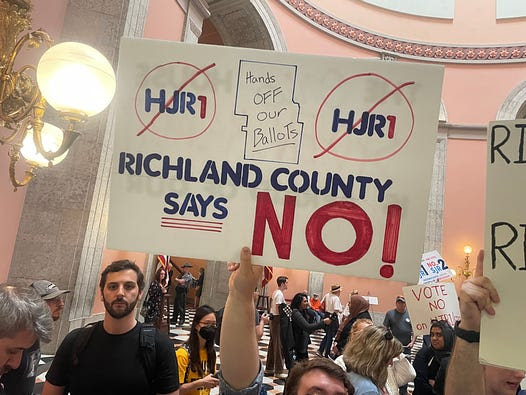
David Pepper describes a stunning victory for democracy in Missouri for outnumbered Democrats. Remember how the Republican-controlled Ohio legislature promoted a referendum called Issue 1 to require all future referenda to get 60% of the vote to pass? They were trying to defeat a referendum on abortion by raising the bar. Voters got wise and defeated the measure. Voters then protected abortion rights with 58% of the vote. Democracy means majority rule, not tampering with the process to defeat majority rule.

On May 18, David Pepper posted this good news on his blog Pepperspectives:

Yesterday proved once again why you never stop fighting for democracy. 

Anywhere. Ever!

For months, Missouri Republicans have been scheming to bring an Issue 1-style attack on direct democracy to their state, where voters have a tradition of using ballot initiatives to exercise their will—including recently expanding Medicaid and legalizing marijuana. And the GOP plan was to sneak the attack through this August, right before a November referendum on reproductive freedom.

You remember Issue 1, right? Where they tried to raise the threshold for constitutional amendments in Ohio to 60%?

Our amazing campaign to crush that monstrosity heated up about a year ago. (Yes, time flies):

Well, as I wrote in “Laboratories of Autocracy,”GOP statehouses always learn from their failures. And adjust. 

And in Missouri, the GOP response was a more sneaky version of Issue 1—where they would’ve required that in addition to a simple up or down vote across the state, a majority of voters in 50% of House districts (you know, highly gerrymandered districts) would have been required for any referendum to gain approval. And that essentially would have locked in a severe form of minority rule even more onerous than a 60% threshold. One study found that as few as 20% of Missouri voters could block an effort under such rules. 

Still, the GOP would’ve falsely insisted that majority rule was still protected. They even tried to add “ballot candy”—such as a ban on non-citizens voting even though they already can’t vote in Missouri—to fool voters into supporting an attack on their own rights. And this could’ve been voted on in August, months before Missouri voters would be voting on an amendment on reproductive freedom in November. 

Overall, it felt like stopping this would be an uphill battle. Downright scary. 

But… 

…Democrats, although outnumbered in Missouri, resisted at every turn. Many more are running this year, bringing accountability to far more sitting incumbents. And current Democratic state senators held the Senate floor in a more than two-day filibuster (the longest in state history) earlier this week.

And yesterday? The Missouri GOP ran out of time. 

The awful, anti-democracy bill died. 

As my friend Jess Piper told me:

“The Freedom Caucus was dead set on stealing one person, one vote. They were beaten by a 50 hour filibuster by Senate Dems and by reading the room. This is the first in their defeats…we’ll also win on the abortion question in November.”

Amazing. Keep going!

We learned recently that Supreme Court Justice Sam Alito flew an upside-down America flag in front of his home, a flag carried by January 6 insurrectionists to protest the 2024 election. He blamed his wife.

Now we learn that Justice Alito flew another seditious flag in front of his vacation home. It’s called “Appeal to Heaven,” and it’s closely tied to white Christian nationalism.

Justice Alito’s arrogance and disregard for judicial ethics is staggering. He has a lifetime appointment on a Court with a 6-3 conservative majority. He thinks he is above the law.

Sarah Posner wrote on the MSNBC site:

News that an Appeal to Heaven flag was seen flying outside the beach house of Supreme Court Justice Samuel Alito marks the second report in the space of a week that a symbol used by Jan. 6 insurrectionists was seen outside one of his residences. According to the report from The New York Times, which has not been independently verified by MSNBC or NBC News, the flag was photographed flying at the home on multiple occasions between July and September 2023. Alito has remained silent about how and why the flag came to be flying at his property, but the more one knows about the background of the flag, the more chilling its presence at his house becomes.

This flag, which bears the words “Appeal to Heaven” and an image of a green pine tree, is an unmistakable emblem for an influential segment of Christian nationalists who claim the 2020 election was stolen from Donald Trump, contrary to God’s will, and that believers’ spiritual warfare is essential to restoring God’s anointed leader to his rightful office. It was one of numerous Christian nationalist flags and other iconography carried by Trump supporters Jan. 6 and at the Jericho March, a series of prayer rallies that were like jet fuel for the insurrection. The Jericho March featured right-wing evangelical and Catholic speakers alongside militants such as conspiracist Alex Jones, Trump’s disgraced national security adviser Michael Flynn, and Oathkeepers founder Stewart Rhodes, now serving an 18-year prison sentence for seditious conspiracy and other crimes.

After years as a historical relic, in 2015 the flag was popularized by Dutch Sheets, an influential figure in the New Apostolic Reformation.

The Appeal to Heaven flag originated in Revolutionary times as a call to take up arms against unjust rulers who ignored the pleas of their citizens. But after years as a historical relic, in 2015 the flag was popularized by Dutch Sheets, an influential figure in the New Apostolic Reformation. The NAR’s founder, C. Peter Wagner, drew on existing strands and trends in charismatic Christianity to create a powerful network of self-proclaimed apostles and prophets who claimed to be leading a revolution in Christianity. NAR’s adherents, as religion scholar and MSNBC columnist Anthea Butler has written, believe “the government should be run by Christians in order to cleanse the world for Christ’s coming.” They promote spiritual warfare, including spiritual “mappings” to identify demonic forces in communities, and “power encounters” like exorcisms “to cleanse not only people, but cities and communities.” They envision not only a Christian nation, but also a new Christianity at the head of it.

Sheets is a prominent “prophet” in the world of the NAR. He claims to receive dreams and visions from God about world events, including the 2020 election and its aftermath. According to the Times, in his 2015 book Sheets maintained that God had “resurrected” the Appeal to Heaven flag and urged his readers to “Wave it outwardly: wear it inwardly. Appeal to heaven daily for a spiritual revolution that will knock out the Goliaths of our day.” Sheets made multiple appearances in Christian media after the 2020 election, claiming that the election was stolen and that demonic forces were behind this supposed fraud. Christian nationalist support for Trump’s attempts to overturn the election results was suffused with themes of spiritual battles against mighty, seemingly unbeatable forces. The Jericho March’s overriding message was that the participants were brave warriors against forces of “corruption,” whose prayers were going to cause the “walls” of the “deep state” to fall, like the walls of Jericho in the Bible.

Matthew D. Taylor, Protestant scholar at the Institute for Islamic, Christian, and Jewish Studies in Baltimore, and the author of a forthcoming book about the New Apostolic Reformation, told me that Sheets “believes he has a special anointing on his life, and a special anointing to bring the American government into alignment with his interpretation of Christianity, including, especially, the Supreme Court.” Sheets has claimed, for example, that his “apostolic decrees” helped swing the 2000 election to George W. Bush and that he prophesied changes at the Supreme Court after the retirement of Justice Sandra Day O’Connor and the death of Chief Justice William Rehnquist (who were replaced by Alito and John Roberts, respectively).

“Christian supremacists,” as Taylor describes Sheets and his allies, “would like to see the Supreme Court rule according to his interpretation of the Bible, that the law of God would become the supreme law of the land.” The court’s 2015 decision legalizing marriage equality dismayed Sheets, like many on the right, and he took a particular interest in the 2016 election. “They are praying for total changeover in American culture to restore America to its original covenantal purposes and covenantal arrangement with God,” Taylor said. “Abortion and same-sex marriage are seen as impediments to this.” While Sheets claims to be calling for a spiritual revolution, Taylor said, the Appeal to Heaven flag nonetheless signals “an implied threat of violence.”

After Sheets’ book, the flag’s use skyrocketed in evangelical communities connected to the NAR. It even received a boost from former GOP vice presidential nominee Sarah Palin, who said Sheets gave her one of her own. In 2020, the flag increasingly became highly associated with Trump and then the insurrection. Taylor said neo-Nazi and other extremist groups have since adopted it, as well.

According to Taylor, the flag’s use and significance spread like wildfire in some evangelical communities, even as other Americans were unaware of its popularity or meaning. But Alito is not just an ordinary citizen; he’s one of the nine most powerful jurists in the country. The leading proponent of the flag has very specifically taken an interest in the actions of the high court, and we already know from previous reporting that Alito is cozy enough with some evangelical activists to dine with them. 

Legitimate questions need to be answered about who else had access to the justice. And Americans cannot be kept in the dark about how this radical antidemocratic symbol came to fly outside his house. The public particularly needs to know before the court decides, in the coming weeks, Trump’s claim that he is immune from prosecution for Jan. 6. If Alito acquired the flag on his own and chose to fly it, the public needs to know why. The flag’s proponents want a Christian supremacist revolution against the government. Does Alito?

From the beginning of the pro-Palestinian campus protests, I have objected to the students’ one-sided support of one side—Hamas. Their chant of “from the river to the sea” implicitly endorses Hamas’ demand to eliminate the state of Israel and to “Islamicize” all the land that includes Israel. With a better knowledge of history, the students would have condemned Hamas’ terrorism and Israel’s Prime Minister Netanyahu, who has launched a campaign of intimidation and terror against the civilian population of Gaza, who have been victims of not only mass bombing but famine.

The Washington Post reported that the campus protests have failed to win the support of the American public. Perhaps they remember 9/11 or the USS Cole or any number of other terrorist attacks where the victims were Americans.

Multiple polls in recent weeks have shown relatively little sympathy for the protesters or approval of their actions. And notably, large numbers of Americans have attached the “antisemitic” label to them.

The most recent data on this come in the form of a striking poll in New York, a hotbed of the protests at Columbia University, in particular.
The Siena College poll shows residents even of that blue-leaning state — Democrats tend to sympathize more with the Palestinian cause — agreed 70 percent to 22 percent that the protests “went too far, and I support the police being called in to shut them down.”

Public sentiment has encouraged Republicans to politicize the issue by harassing university presidents for their failure to close down the student protests. There is something richly ironic about the new-found Republican interest in anti-Semitism. If they really cared about Jew-hatred, they would ask Trump to testify about his relationships to known anti-Semites and neo-Nazis.

But no. Their audiences want to see them pillory the presidents of elite universities, to please their base. The most aggressive of the questioners, Rep. Elise Stefanik, is a graduate of Harvard University. Her low tactics are a disgrace to her university.

Yesterday, members of Congress, mostly Republicans, harangued three university presidents for ignoring anti-Semitism displayed by campus protestors who support Palestinians, and in some cases, the terrorist group Hamas.

Three university leaders were accused on Thursday, during a congressional hearing, of turning a blind eye to antisemitism on their campuses, while capitulating to “pro-Hamas” and “pro-terror” student groups.

During more than three hours of grueling questioning, Northwestern University President Michael Schill, Rutgers University Jonathan Holloway and UCLA Chancellor Gene Block were often bullied and taunted by members of the House Committee on Education & the Workforce for not cracking down more forcefully on anti-Israel protesters who had set up unauthorized encampments on their campuses.

“Each of you should be ashamed of your decisions that allowed antisemitic encampments to endanger Jewish students,” said Chairwoman Virginia Foxx, a Republican from North Carolina.

Schill and Holloway bore the brunt of the wrath of the Republican-controlled committee for also cutting deals with the protesters rather than calling in police to clear the encampments. Seven Jewish members of a committee tasked with fighting antisemitism at Northwestern resigned in protest at the concessions made by their university president to the protesters.

Neither university agreed to an academic boycott of Israel, but they promised to hold discussions in the future on the possibility of divesting from companies with ties to Israel. As part of its agreement, Northwestern also promised to take in students from Gaza displaced by the war, while Rutgers agreed to form a partnership with Birzeit University in the West Bank.

“I think your performance here has been very embarrassing to your school,” U.S. Representative Jim Banks, a Republican from Indiana, told Schill after the president of Northwestern refused to answer questions about a journalism professor at his university who had participated in the protests and scuffled with police.

When asked by Banks whether he allows professors at Northwestern to praise Hamas, Schill, who is Jewish, responded: “They have all the rights of free speech.”

Banks retorted: “Four billion dollars have gone to your university. We should not give you another taxpayers’ dollar for the joke your university has become.”

Elise Stefanik, the Republican congresswoman from New York, was especially hostile, accusing Schill of “unilateral capitulation to the pro-Hamas, anti-Israel, antisemitic encampment.

When he tried to clarify a point, Stefanik – who has been fashioning herself as a leading voice against the pro-Palestinian student protests – cut him off. “I’m asking the questions here,” she said angrily.

When asked by Stefanik if it was true that he had asked the director of the Hillel chapter at Northwestern whether it was possible to hire an ant-Zionist rabbi as university chaplain, Schill responded emphatically that he had never made such an inquiry.

“That’s not true according to the whistleblowers who’ve come forth to this committee,” retorted Stefanik.

Holloway was interrogated by Congressman Bob Good, a Republican from Virginia, about a think tank at Rutgers that has referred to Israel’s government as genocidal, among other anti-Israel statements it has issued in recent months. When asked, Holloway said he had no intention of closing down this Center for Security, Race and Rights.

Good: “Do you think Israel’s government is genocidal?

Holloway: “Sir, I don’t have an opinion about Israel in terms of that phrase.”

Good: “You do not have an opinion as to whether or not Israel’s government is genocidal?”

Holloway: “No, sir. I think Israel has a right to exist and protect itself.”

Good: “Do you think Israel’s government is genocidal?”

Holloway: “I think Israel has a right to exist and protect itself, sir.”

Good: “But you will not say that Israel’s government is not genocidal? You can’t say that?”

Holloway: “Sir, I believe the government . . . “

Good: “Are you in a position to answer any questions? Do you have an opinion on anything?

Later on in the hearing, Holloway was given a second chance to address the question, phrased somewhat differently. When asked by Congressman Eric Burlison, a Republican from Missouri, whether they believed Israel was genocidal, all three university leaders responded that they did not.

Politico published a fascinating article about Idaho’s extremist Republican politics. The story focused on one former Republican state legislator, Jim Woodward, who is anti-abortion and pro-gun in a state where Democrats are a tiny minority, only 12.6% of registered voters.

Idaho has one of the strictest abortion laws in the nation.

Woodward was elected in 2018 and re-elected in 2020. But he lost in 2022 to Scott Herndon, an extremist who wants to criminalize abortion and codify it as murder; who wants vouchers for religious schools; and who wants guns everywhere.

This year Woodward is running as a moderate Republican, still anti-abortion but supporting exceptions like the health of the mother.

Idaho’s ban, which automatically took effect when Roe v. Wade was overturned in 2022, begins at conception and doesn’t make an exception for the future health of the mother. In 2020, Woodward, a Republican, voted yes on a law that requires physicians to prove that a mother’s life is at risk before performing an abortion or face fines, lawsuits, jail time and revoked medical licenses. In March of 2022, Woodward voted yes on another law that allows family members, including those of rapists (although not rapists themselves), to sue providers for performing abortions.

But Woodward is now running to moderate the law, having realized belatedly that physicians are fleeing the states and the hospital in his own district has closed its labor and delivery service, leaving 50,000 women without access to OB-GYN health services. Democrats can’t vote in the Republican primary. So Woodward must reach out to moderate Republicans.

His opponent Scott Herndon opposes any exceptions to the ban on abortion. Herndon believes that there should be no abortion allowed even for a child who has been raped. Instead, the child should view her pregnancy as “an opportunity.”

Woodward beat Herndon in a close election by 52-48%. But in the same election, other moderate Republicans lost their seats to extremists, who picked up two Senate seats and five House seats.

The Politico article uses the contest between Woodward and Herndon to illustrate the close link between extremist views on abortion and on vouchers. They want to ban all abortions and destroy public schools.

The Recall Replace Rebuild West Bonner County School District (RRR) group was started by a group of Priest River moms — both Republicans and Democrats — when their school board was infiltrated by far-right culture warriors in the 2022 election. In June 2023, those members, who held a majority as three of the five trustees on the board, elected a superintendent, Brendan Durst, with zero state-required education certifications and ties to the Idaho Freedom Foundation, a far-right political activist organization that aims “to defeat Marxism and socialism”; it has called public schools “the most virulent form of socialism.” Militia members began showing up at school board meetings, the school levy that funds basic operations failed to pass as residents became divided into camps “for” or “against” public education, curriculum slipped out of state compliance, and Durst began working to have intelligent design taught in biology classes and offer an Old Testament course (neither came to pass). The resulting chaos, social and political division, and lack of resources sent nearly 50 teachers, counselors and a principal fleeing the district. Many families left as well. Durst told one reporter that “his takeover was a ‘pilot’ others could learn from.”

Less than three months after Durst was hired, RRR gathered enough signatures to hold a recall election — framed not along party lines, but as those who cared about a functioning school district for their children against those embracing extremism. An astonishing 60.9 percent of voters turned out, and two of the three far-right board members were voted off. Durst resigned the following month when the State Board of Education blocked his certification.

“Eight hundred people voted in the 2022 election where those three board members were elected, and they won by a handful of votes, literally single digits,” Woodward says as we pull up to the community center. “But when 2,100 people showed up to vote in the recall election, then two of those same people were told to pack their bags. When you get a bigger slice of the population showing up, you get a decision that really reflects the values of the community.”

The RRR meeting tonight is attended by at least 50 people, in a town of only 1,700 on a rainy Monday night; there’s a lot of work to be done still to pass a levy to fund the school district. It’s clear that there’s no love in the room for Herndon. People say he escorted Durst into the first school board meeting where Durst was considered as superintendent, which was packed with militia members (Herndon says he was at the meeting, but did not escort Durst). After finishing the meeting agenda, Dana Douglas, one of the group leaders and a self-described conservative Christian, introduces Woodward with a reminder to the group that in the 2022 election, “only a third of Priest River turned out to vote. And of those votes, 75 percent went to Herndon and 25 percent went to Woodward. We want to flip that this time, and we need your help.”

Even if Woodward does win this race, it’s doubtful how much he can accomplish in a legislature with a far-right caucus bullying legislators into voting in lockstep. But he’s optimistic that a stronger moderate showing in the election will empower more moderate lawmaking.

“It takes leadership and a few strong individuals to do the right thing,” he says. “If the voters are supportive of a more moderate position, then legislators can step forward and do that. The party’s controlled by the minority position, so that silent majority needs to step up and let people know that they want to be represented.”

The article is a stark reminder of the deep divide that splits the nation and the rise of extremist politics in the Republican Party.

In my meanderings through the Internet, I discovered Greg Olear’s blog. He is wise, insightful, always informative. In his most recent post, Greg announces a new book.

He writes:

Two months or so ago, it occurred to me that I should write a new Trump book: or, to be more accurate, that I should distill the hundreds of thousands of words I’ve produced about Donald Trump and his despotic plans for a second term, organize them into a coherent narrative, and produce a book-length argument for why this corrupt and hateful human being should never again set foot in the Oval Office—and what ugly future we should expect if he does. 

The result is Rough Beast: Who Donald Trump Really Is, What He’ll Do if Re-Elected, and Why Democracy Must Prevail, which is, as of today, available in paperback and e-book format on Amazon, with an audiobook in the works, via Four Sticks Press. (Later this week, it will be available for bookstores to order directly, via Ingram Spark.)

As with Dirty Rubles: An Introduction to Trump/Russia, which came out six years ago this month, Rough Beast is a short, easy-to-consume volume intended for readers who are not in the know, to alert them to the danger. It is, as I write in the sub-sub-title, “An Urgent Appeal to Independents, Undecideds, Fiscal Republicans, Third Party People, Voters Who ‘Don’t Like Politics,’ and the Biden-Hating Left.”

The most important—and, if Trump wins, the last—election in U.S. history is six short months away, and the polls show a dead heat. Rough Beast is my attempt to help the good guys prevail.


Rough Beast: Introduction, Slouching Towards Dictatorship by Greg Olear

Greg Olear

Donald Trump’s term in office can be summed up in four words: pandemic, protest, impeachment, and insurrection. He left the White House with 392,428 Americans dead of a plague he exacerbated; with Washington recovering from a coup attempt he instigated; with the economy teetering towards recession; with our standing around the world at its lowest point in a century; and with the U.S. an additional $8 trillion in debt. He had, by far, the lowest average presidential approval rating since Gallop started keeping track in 1938, and was widely reviled abroad. Four of the five largest protests in the history of the country happened on his watch. He was impeached twice. He could have been impeached a third time, in 2019, after the release of the Mueller Report—which, contrary to what Trump and the mendacious Bill Barr told us, did not exonerate him. Even his much-ballyhooed campaign promises fell flat: He failed to build the wall, and he failed to drain the swamp. He did, however, watch a lot of television and play a lot of golf.

In the various presidential surveys taken since Donald left office, historians have consistently ranked Trump dead last, behind even the contemptible white supremacist Andrew Johnson and the hapless James Buchanan. This is not recency bias. By any metric, Trump was a catastrophic failure: corrupt, sociopathic, cruel, venal, disruptive, artless, dumb, and pathologically inept—a terrible president and an even worse human being. He threw paper towels at hurricane victims! He called veterans of our armed forces “suckers and losers!” He invited the Taliban to Camp David! He banked $2.4 billion in emoluments during his four years in office! He characterized the neo-Nazis at Charlottesville as “very fine people!” He nominated an(other) alleged sexual assailant to the Supreme Court! He sat on his ass watching TV as his besiegers stormed the Capitol! He humped a flag! And that’s just off the top of my head.

We have never had a monster like this in the White House. No one comes close. That the country managed to survive four years of Trump suggests that Otto von Bismarck was on to something when he remarked that God seems to have a special providence for the United States of America. With Donald, we dodged a big orange bullet.

In a word, we were spared.

And yet as I write this, Donald John Trump is the presumptive nominee of one of our two major political parties. Only two individuals have a legitimate chance at winning the White House in November—I’ll talk about the myth of third parties and the perils of voting for the nihilistic likes of Robert F. Kennedy, Jr. in Chapter 9—and Trump is one of them. And he’s not just that political party’s nominee. Donald Trump has subverted the entire GOP, purged it of the disloyal, and taken total command. He installed his daughter-in-law—Lara Trump, desecrator of Tom Petty’s memory and wife of Eric Trump (Donald’s son who ripped off his own cancer charity)— as co-chair at the RNC, and changed the organization’s rules there so that the lion’s share of donations will be used to cover his mounting legal bills. As I explore further in Chapter 8, the conventional, old-school Republicans of yesteryear have either retired, lost, died, or kissed the ring. Don’t be fooled by the cute elephant logo. Whatever the branding, this is no longer the Party of Lincoln. There is no GOP anymore, only MAGA. It is an entire party built around a demagogue with dictatorial ambitions.

If the polls are to believed, that demagogue has a coin flip’s chance of retaking the White House. Like, this might actually happen! People in my family are going to vote for him. People in your family are probably going to vote for him, too. And if, God forbid, he succeeds, there are—as I explain in Chapter 7—a rabid battalion of religious zealots, Christian nationalists, and reactionary monarchists poised to make so many drastic changes to the country so quickly that the United States won’t be recognizable by the Fourth of July 2025. The threat is real. The situation is dire.

This isn’t me, a known “TRUMP HATER,” trying to frame the narrative to make Donald look bad. All of what I’m saying here is objectively true, as this book will make abundantly clear. As the kids say: #Facts…

Description

Who is the real Donald Trump? A serial liar with long ties to both organized crime and the Kremlin. A corrupt demagogue whom most historians consider the worst U.S. president of all time. And, most urgently, a vengeful wannabe dictator whose re-election would end American democracy. In this short and necessary volume, Dirty Rubles author Greg Olear presents the facts about FPOTUS: who he is, what he plans to do, and why the country cannot survive a second Trump term. Donald Trump is a Rough Beast. America is slouching towards dictatorship.

Table of Contents

  1. Trump is a serial liar
  2. Trump is a lifelong criminal and a longtime Kremlin stooge
  3. Trump is corrupt
  4. Trump was an awful president
  5. Trump wants to be a dictator
  6. The far right wants a dictator—a Red Caesar
  7. Project 2025 is a despotic roadmap for Trump’s second term
  8. The old GOP is dead and gone
  9. Voting for a third party candidate helps re-elect Trump
  10. Life of the real Donald Trump

Please open the link to finish reading Greg’s summary of the book.

Thom Hartmann is convinced that We, the People, must find a way to restrict the Supreme Court’s devotion to the financial interests of the wealthiest Americans. There is a way, he writes, but note that it will require Democratic control of both houses of Congress. Another reason to vote and make sure your friends and family vote.

Hartmann writes in The Daily Kos:

Is there a way to reverse the decision by five Republicans on the Supreme Court that it’s OK for billionaires and big corporations to bribe politicians?

Americans are watching with increasing shock and dismay:

— President Biden tried to knock up to $20,000 off the debt of every person in the country with a student loan. Republicans decided this might somehow, someday mean fewer profits for banks — who financially support the GOP — so they sued at the Supreme Court. The Republican appointees on the Court, over the objections of the three Democratic appointees, killed the president’s effort without providing any cogent constitutional rationalization.  

— Scientists have developed lab-grown meat that is healthier, easier on the planet, and, when manufactured at scale, cheaper than beef, pork, or chicken. The animal ag industry freaked out and threw a bunch of cash at Republican members of Congress, who are now trying to outlaw the product before the companies developing it can get to scale. Even the buggywhip makers back in the day didn’t think the way to protect their industry was to buy off politicians (of course that was before five corrupt Republicans on the Supreme Court legalized political bribery).  

— Climate change is devastating our planet and fine particle emissions from trucks cause hundreds of thousands of deaths and illnesses from heart disease, COPD, asthma, and cancer every year. To solve the problem, the EPA put forward new truck emission standards that will phase in between 2027 and 2032. This week, twenty-seven Republican-controlled states whose politicians take money from the fossil fuel industry sued to block the rules and protect the profits of the trucking and petroleum industries.

— Title IX of the federal code, which forbids gender-based discrimination in education, is being extended by the Department of Education to protect members of the queer community. Rightwing Christian groups, which provide billions of dollars and millions of votes to Republicans, pinged state-level politicians, so now Texas, Louisiana, Alabama, Tennessee, and Oklahoma have filed suit before hand-picked rightwing judges to allow schools to legally trash LGBTQ+ students.

— The Consumer Finance Protection Bureau (CFPB) promulgated a new rule limiting credit card late fees to $8 each, protecting America’s most vulnerable families. The banks pulled the GOP’s chain and Republican senators Tim Scott, John Thune, John Barrasso, Jerry Moran, John Boozman, Steve Daines, Mike Rounds, Thom Tillis, Marsha Blackburn, Kevin Cramer, Mike Braun, Bill Hagerty, and Katie Britt introduced legislation to reverse the policy and allow banks to again screw low-income people.

— In 2003, George W. Bush signed legislation to privatize Medicare through the so-called Medicare Advantage scam, which last year overcharged our government more than $140 billion while denying millions of claims from Americans unfortunate enough to have signed up for it. Republicans on the take from the insurance industry are now pushing a plan to gut or even shut down real Medicare, leaving all seniors to the tender mercies of this predatory industry.

— Ultra-processed foods are accused of causing obesity, diabetes, cancer, and host of other illnesses both physical and mental: American children, who consume as much as two-thirds of their calories from these products, are experiencing an epidemic of obesity and diseases associated with it. With Republican politicians running interference for them, the processed food industry has now succeeded in getting their ultra-processed “food” products placed in thousands of school lunch programs, paid for with our tax dollars. As The Washington Post noteda few months ago, “Republicans have continued to fight stricter standards” and, “Some Republicans are now threatening to block the USDA from further limiting sodium and reducing added sugar in milk…”  

Increasingly, Americans are realizing the cancer eating our democracy is the power of great wealth and Supreme Court-legalized political bribery. And Sam Alito flying his flag upside-down in support of Trump’s coup and Clarence Thomas openly taking bribes are their ways of saying they think they’re completely immune from accountability. 

In a 1978 Republican-only decision written by Lewis Powell (author of the notorious “Powell Memo” which told rich people how to take over our politics, schools, media, and courts), five corrupt members of the Supreme Court ruled that corporations are “persons” with full access to the Bill of Rights, including the First Amendment right of free speech. They added that money is the same thing as “free speech,” legalizing political bribery by both billionaires and giant corporations.

In 2010, five other Republicans on the Court doubled down on that Bellottidecision with Citizens United, which overturned hundreds of good government and anti-bribery laws, some dating all the way back to the 19th century. As a result, it’s almost impossible to prosecute any but the most obvious and egregious examples of bribery (see: Menendez) of both American politicians and judges, including billionaires and religious corporations blatantly bribing Supreme Court justices.

Clarence Thomas and Sam Alito openly flaunt the gifts they receive from wealthy interests with business before the Court, as Trump fangirl Aileen Cannon and hundreds of other federal and state court judges are routinely wined and dined at luxury resorts. As long as they continue to rule the way the morbidly rich want and bribery continues to be legal, it appears the gravy train will never end.

Unless we do something about it.

Every single one of these problems — and hundreds more — continue to exist in the face of overwhelming public disapproval because one or another industry or group of rightwing billionaires has been empowered by the Supreme Court’s Bellotti and Citizens United decisions to bribe politicians and judges.

Democrats in Congress must reverse those bizarre, democracy-destroying decisions with a new law declaring an end to this American political crime spree. If they retake the House and hold the Senate and White House this fall, it’ll be their opportunity to re-criminalize bribery of elected officials.  

To do that, they need to defy the Court’s declaration that money is “free speech” and corporations are “persons.” That defiance requires something called “court-stripping.”

Republicans understand exactly what I’m talking about: Since the 1950s, they’ve introduced hundreds of pieces of court-stripping legislation. They tried to do the same thing most recently in 2005 with the Marriage Protection Act, which passed the House of Representatives on July 22, 2004.  

That law, designed to override Supreme Court protections of LGBTQ+ people, contained the following court-stripping paragraph:

“No court created by Act of Congress shall have any jurisdiction, and the Supreme Court shall have no appellate jurisdiction, to hear or decide any question pertaining to the interpretation of, or the validity under the Constitution of, section 1738C or this section.”

In other words, Congress wrote, the Supreme Court has no say in the matter of this particular legislation.

The Marriage Protection Act died in the Senate, but it’s one of hundreds of pieces of court-stripping legislation introduced — almost all by Republicans (House Whip Tom Delay was the master of this) — in the wake of the Supreme Court’s decisions in Brown v Board and Roe v Wade.

This process of “court-stripping” is based in Article 3, Section 2 of the US Constitution, which says:

“[T]he supreme Court shall have appellate Jurisdiction, both as to Law and Fact, with such Exceptions, and under such Regulations as the Congress shall make.”

Regulations? Exceptions?!?

Turns out, the Constitution says Congress can regulate the Court by, for example, expanding the number of its members, determining if Court hearings must be public/televised, or if they must live by a Judicial Code of Conduct (among other things).

Congress should be doing all these things as soon as possible.

Additionally, Congress can create what the Constitution calls “Exceptions” to the things the Court can rule on. 

In today’s crisis, Congress could say, “Supreme Court, you may no longer rule on whether money in politics is ‘free speech.’ We’re taking that power from you because the Constitution gives it to us and you have screwed it up so badly.”

And, it turns out, Congress has already gone there, most recently creating exceptions to what our courts may do in a law that waspassed and signed by President Bush the very next year: The Detainee Treatment Act of 2005

That law explicitly strips from federal courts — including the Supreme Court — their power to hear appeals against the Bush administration detaining, torturing, imprisoning in Guantanamo, or even killing suspected Muslim terrorists. It says:

“[N]o court, justice, or judge shall have jurisdiction to hear or consider an application for a writ of habeas corpus filed by or on behalf of an alien detained by the Department of Defense at Guantanamo Bay, Cuba…”

And that’s just the beginning.  There’s even, as the Brennan Center notes, a court-stripping provision in the PATRIOT act of 2001. I lay out dozens of other examples and a history of court-stripping that extends back to the presidency of Thomas Jefferson — an outspoken advocate or reducing the power of the Supreme Court — in The Hidden History of the Supreme Court and the Betrayal of America.

As House Speaker Tom Delay said back in the days of his court-stripping Marriage Protection Act: “Judges need to be intimidated” and “Congress should take no prisoners in dealing with the courts.”

Putting forward such a law would highlight how Citizen United’s SCOTUS-legalized political bribery is at the core of our political dysfunction, even if it doesn’t pass Congress or even if the Court itself strikes it down. 

Rightwing oligarchs and giant corporations have now taken total control of the entire GOP and corrupted more than a few Democrats, all while polluting our public discourse with their think tanks and media outlets: such legislation would, at the very least, highlight this and pressure the Court to change their policies. “Intimidate” the Court, to quote Tom Delay.

Congress must stand up for what’s right and is consistent with American values: Legally bribed politicians and judges aren’t that.

It’s high time to end the bribery and get something done for We the People.

Jan Resseger can always be counted on to add the voice of reason into heated issues, relying on research and calm discussion.

She writes:

In a thoughtful commentary, the Economic Policy Institute’s Hilary Wething and Josh Bivens deride as bad public policy today’s state-by-state wave of new and expanded private school tuition vouchers:

“Public education is worth preserving—it should be seen as one of the most important achievements in our c0untry’s history and crucial for the social and economic welfare of future generations… In the 21st century, unfortunately, too many policymakers seem determined to squander this legacy by starving public education of money and legitimacy, often in the name of  ‘school choice.’  Their central claim (when they bother to make one with any clarity) is that public provision of goods or services is ineffective by definition and that a dose of private market-like competition will lead to better schooling outcomes for the nation’s children.”

Wething and Bivens explore the basic economic flaws in pro-voucher ideology and argue that “conditions needed for market competition to lead to better outcomes clearly do not exist in the educational realm.”  In the first place, our nation benefits  from educating all children, and the marketplace can’t be counted on to fill that role: “In other markets, if the private sector is doing a poor job at offering attractive options for a good or service, people can just consume other things.” “Second, competition works well when the cost of switching providers is small,” but “switching schools is an extraordinarily costly decision in time, administrative burden, and severed social networks.”  Third, markets work when the choice of product affects only the buyer and seller, but, “Universal schooling generates positive spillovers to society at large, meaning that individuals would be inclined to underinvest in education relative to the full benefits it provides.”

Wething and Bivins describe voucher supporters presuming that diversion of dollars to vouchers will not harm the essential institution of public schools. In fact, however, public schools in most places are underfunded in terms of the actual cost of needed services: “Newer research with better methods confirms that more money for public schools does improve educational outcomes… In short, the evidence indicates that public schooling in the United States simply needs more resources to deliver even better student achievement—not some radical disruption in how it is delivered and by what institutions.”

Not only does more money improve schooling outcomes for children, but recent academic research demonstrates that by investing more public resources in their public schools, states and localities can “improve schooling outcomes for children… (with) the largest beneficial effects on the performance of particularly disadvantaged students.” Wething and Bivins cite peer-reviewed, 2016, research by Kirabo Jackson, Rucker Johnson, and Claudia Persico on the impact of statewide school finance reforms that increased public school spending between 1972 and 2010: “(A) 10% increase in school spending for 12 years led to increases in high school graduation rates, 7% higher wages, and 10% higher family incomes in adulthood for children from districts that saw the spending increase.”

New research also confirms that vouchers are ineffective as an educational investment. Dollars diverted from public schools often flow to private schools with inferior academics: “Several high-quality studies have investigated the impact of recent voucher programs and have found notably worse outcomes for student achievement… In Ohio, under the EdChoice program, students who went to private schools with a voucher performed worse than they would have had they remained in public schools. In Indiana, students that used the Indiana Choice Scholarship voucher program experienced an average achievement loss of 0.15 standard deviations in mathematics.”

The expansion of vouchers inevitably sets up a long term drain on public resources: “Vouchers reduce public school resources, but introduce large new fiscal obligations overall… Where significant voucher programs have been instituted, the resources available to public school children have decreased…  The failure to increase per-pupil (public school) funding leads to the erosion of public education services in all forms: everything from school meals, extracurricular activities, mental health and counseling services, vocational and technical programs and investments in teacher quality and pay. It is worth noting that flat per-pupil educational spending—even in inflation-adjusted terms—is effectively a decline in the quality of education over time.”

Wething and Bivens sum up the evidence: “Vouchers are not a cost-free policy that simply adds on another education option for children—they are instead an intentional attack on universal public education… Vouchers make no coherent economic sense, and the evidence shows that vouchers harm student achievement and expose state budgets to large future obligations that are hard to forecast, even while they divert spending away from public education.”

The new brief from Wething and Bivens describes in concrete economic terms,what the late political theorist Benjamin Barber formulates as a basic principle of good public policy: “Privatization is a kind of reverse social contract: it dissolves the bonds that tie us together into free communities and democratic republics… Public choices rest on civic rights and common responsibilities, and presume equal rights for all. Public liberty is what the power of common endeavor establishes, and hence presupposes that we have constituted ourselves as public citizens by opting into the social contract. With privatization, we are seduced back into the state of nature by the lure of private liberty and particular interest; but what we experience in the end is an environment in which the strong dominate the weak… the very dilemma which the original social contract was intended to address.” (Consumed, pp. 143-144)

For more than 50 years, New York City recruited new employees with an offer that included strong healthcare benefits in retirement. Recently, the City government decided that it could save money by forcing some 250,000 retirees to abandon Medicare and enroll in a for-profit Medicare Advantage Plan administered by Aetna. Retirees had no choice, and most of their unions sided with the City, not their own members.

One incredibly persistent, bold, fearless retiree refused to accept the deal that took away her Medicare and supplementary plan. Marianne Pizzitola, a retired Emergency Medical Technician with the Fire Department, created a group called the NYC Organization of Public Service Retirees. The City had promised her those benefits, like other city employees, and she was not going to let the City take them away without her consent.

Pizzitola began to organize. She gathered research, allies, and funds to fight the City and some of its biggest unions, including the United Federation of Teachers. She set up a Facebook account and used social media to recruit other retirees and to explain why the deal was a sell-out. She frequently gave ZOOM briefings to members of her group, whose numbers continued to grow. MA plans, unlike Medicare, require patients to get prior authorizations before allowing major procedures; members of MA plans must use in-network doctors. MA plans have overbilled the federal government by billions of dollars.

The Chief-Leader, a publication for city employees, wrote about her battle with the City in April:

Pizzitola’s enterprise began on Aug. 13, 2021, a Friday, the city still under a Covid cloud, when 17 of the 40 people she had invited to hone opposition to the city’s proposed plan joined a Zoom call. Five would volunteer to mount a challenge to the city’s proposal. At the conclusion of the two-hour call, the New York City Organization of Public Service Retirees was launched, and Pizzitola was chosen to lead it as president. 

“In a few hours, we had a name, a mission, an attorney, a bank. And then that weekend, I started a PayPal, a YouTube, a Facebook, and I drafted our first website,” she said. 

The organization, funded by donations, most of $25, has since grown to include a board of directors and an administrative board along with advisors and volunteers, some of them former city and union officials.  

Since that August day, over hundreds of emails, at rallies, on YouTube, Threads, Twitter and TikTok, in strategy sessions with attorneys, at gatherings with retirees, and during court hearings, Pizzitola has parlayed her passion, belief and deep knowledge of sometimes opaque policy points and obscure legislation to, so far, preserve what she adamantly believes the retirees, herself among them, are due.

The NYC retirees’ group sued the City, on the grounds that the City was withdrawing benefits that were promised to its members when they were hired. Many had accepted lower pay because of the excellent benefits, especially the healthcare. The group won in the first court that heard the case. The City appealed, and yesterday the State Court of Appeals unanimously ruled in favor of the retirees and “permanently” barred the City from reneging on its promises to retirees.

Marianne Pizzitola proved that one person can win in the face of overwhelming power and money by recruiting allies, gathering sound research, and communicating effectively. Google her name and you will find numerous videos on YouTube where she explains why Medicare is better than Medicare Advantage and why other retirees should support the fight.

Yesterday, the NYC Organization of Public Service Retirees issued the following press release. The full decision is attached.

Retiree Update

WE WON!!!

On March 21, 2024 we had oral arguments and today, May 21, we were given a unanimous decision.  We thank all of you for believing in us and our legal team.  Without all of you, we would never have got this far.  The Court said, the City cannot take away our Medicare Supplement.

This is the exact decision, 
“Accordingly, the judgment (denominated an order) of the Supreme Court, New York County (Lyle E. Frank, J.), entered September 19, 2023, which, in this hybrid proceeding-class action brought pursuant to CPLR article 78, granted the petition complaint to the extent of permanently enjoining the City respondents/defendants from eliminating petitioner/plaintiff retirees’ existing health insurance, automatically enrolling them in a new Aetna Medicare Advantage Plan, enforcing a June 30, 2023 deadline for retirees to opt out of the new plan, and implementing any other aspect of the City’s new retiree healthcare policy, should be affirmed, without costs.”

You can read it here

CELEBRATE.   YOU EARNED THIS!