Archives for category: Democracy

Jan Resseger, stalwart champion of public schools, is alarmed by the damage that privatization inflicts on public schools, attended by the vast majority of children. She describes the erosion of public schools as “a national wave of educational injustice that has reached crisis proportions.”

Resseger writes:

On Monday, the Network for Public Education (NPE) released an urgently important report, Public Schooling in America: Measuring Each State’s Commitment to Democratically Governed Schools. The report ranks the states on their protection of the institution of public schools that serve the mass of our children and adolescents and the degree to which school privatization is undermining that promise.

In what I found to be the report’s most shocking statistic, 19 states now provide Education Savings Account (ESA) vouchers and ten of those states give ESA vouchers to “virtually every family regardless of income or need.” An ESA is a virtual debit card that parents whose children do not attend public schools can use to pay for any kind of privatized education or for materials and services the parents claim to be using to homeschool their children. What this really means is that many of these states are basically just giving money away to parents to use as they please without appreciable regulations or oversight.

The Network for Public Education (NPE) confirms “a troubling and consistent pattern.  The states most aggressively redirecting public funds toward private alternatives—charter schools, voucher programs, and education savings accounts—are the same states most neglectful of their public schools, their teachers, and their students.  Our analysis found a strong, statistically negative relationship between the expansion of privatization and public school support…. Privatization and disinvestment, it turns out, go hand in hand.”

What is the scale of the problem? “Thirty-four states and the District of Columbia now fund one or more private school voucher programs, and nineteen states operate Education Savings Account (ESA) programs… The charter school sector presents parallel concerns. Forty-seven states have charter school laws, and in the majority of them, private unelected boards govern schools with no term limits and no formal accountability to the communities they serve… The consequences fall hardest on the children least able to seek alternatives: those in poverty, those with disabilities, those in rural communities, and those whose families lack the time or resources to navigate a fragmented marketplace of educational options. Public schools remain the only institutions in American life constitutionally obligated to welcome every child, regardless of circumstance. They are governed by elected boards, funded by public taxes and accountable to the communities they serve…”

The report examines four related threats.

Privatization     Vouchers are one form of school privatization.  The Network for Public Education reminds readers that vouchers trace back to the combination of racism and libertarian ideology. The first voucher schools supported segregation academies in the years immediately following Brown v. Board of Education, and NPE’s report explains that even today, “Study after study has found that school choice programs generally increase segregation,” with vouchers “enabling outright discrimination with public money.” Thirty-four states have at least one voucher program; in total states operate 73 voucher programs, “including some that allow families to double-dip, applying for funding from multiple programs.” Besides their traditional school voucher programs, some states have education savings accounts (“the most damaging and irresponsible of all voucher programs”). Some states have tuition tax credit ‘scholarship’ programs with tax credits for parents and others who contribute to scholarship granting organizations (SGOs) which are tapped by parents to pay for private schools and other educational expenses.  “(S)ome states also give individual tax credits (TTCs) for educational expenses at private schools or homeschools.” Thirty-one states have now also opted in to the federal tuition tax credit program created in the “One Big Beautiful” Bill.

What about the effects of the vast growth of private school vouchers? Because few states set income limits on the families who can qualify for the vouchers, they primarily benefit children from wealthy families. The vouchers “result in the defunding of public schools,” fail to protect the rights of disabled students, often fail to admit LGBTQ students, fail to provide any proof that students are thriving academically, fail require teachers to be certified, and fail to require background checks for teachers. Many states are spending on each voucher a large percentage of what they spend per-pupil on each public school student, and many vouchers are going to children who were always enrolled in the private school where the voucher will reimburse the families who have been paying tuition.

Publicly funded, privately operated charter schools are the second primary form of school privatization. Kentucky’s supreme court recently found that state’s charter school funding unconstitutional, and Nebraska, South Dakota, and Vermont have never had charters. Forty-seven states and the District of Columbia all have passed laws that enable the operation of charter schools.  Additionally, “a growing sector operates entirely online—and is largely run by for-profit corporations”—often displaying flagrant “financial opportunism” and “fraud.” And, “Like voucher schools, charter schools are subject to fewer regulations and less oversight than neighborhood public schools. As with voucher schools, this has resulted in significant concerns regarding accountability, accessibility, fiscal responsibility, and academic quality… In 39 states, for-profit companies are permitted to manage nonprofit charter schools. One common arrangement—known as a ‘sweeps’ contract—allows a for-profit management company to handle a school’s day-to-day operations while receiving the bulk of its public funding in return… This practice is especially prevalent in six states—Arizona, Florida, Michigan, Nevada, Ohio, and West Virginia….”

Protections for Homeschooled Children     “Homeschooling… is now the fastest-growing education sector,” fed by Education Savings Account vouchers.  However, “even as homeschooling growth has accelerated, laws to protect the homeschooled child have not. Through the relentless pressure exerted by the Homeschool Legal Defense Associations… even the most modest legislation designed to protect homeschooled children from educational or physical neglect and abuse has been opposed with breathtaking ferocity.”  The report details how states fail to require that parents let states know they are homeschooling children; fail to protect students from sexual abuse or violence; and fail to demand some kind of evidence that students are progressing academically.

Conditions that Promote Teaching and Learning     Along with the massive growth of  privatization, “Right-wing political forces have mounted a coordinated campaign against public education—eroding trust in neighborhood schools, creating hostile working conditions for teachers, and withdrawing support from the students who depend on them….  (N)umerous states have enacted laws that make the lives of transgender students significantly more difficult, while not fully protecting… LGBTQ students from bullying and discrimination.  Nearly half of all states still permit corporal punishment in schools.”  Class size has been increased, collective bargaining to ensure adequate teachers’ salaries has been undermined, and other conditions to attract highly qualified teachers have been undermined.

School Funding     NPE declares: “Research has firmly established a positive correlation between per-pupil (public school) spending and student learning.”  “This report tells a clear and troubling story.  Across the country, statehouses are making deliberate choices—choices that defund neighborhood schools, strip teachers of dignity and professional standing, leave vulnerable children without protection, and redirect billions of public dollars to private alternatives that are too often beyond public control… They are the predictable results of an ideological campaign decades in the making, whose architects have been candid about their ultimate goal: the elimination of public education as Americans have known it… States that most aggressively expand vouchers and charter schools are the same states that underfund their public schools, underpay their teachers, and provide the weakest protections for students… States with the most expansive ESA programs have produced the most egregious fraud… States that strip teachers of collective bargaining rights are the same states with the lowest teacher attractiveness ratings…the overlap is not coincidental.  Privatization and disinvestment are two sides of the same coin.”

The report grades each of the states overall for their protection of the public schools.”Seventeen states earned an F for their lack of support of public schools, students and educators while embracing privatization.” A second privatization grade identifies the states where schooling has been most damaged by privatization.  In both categories, Florida earns the lowest “F” grade, while Arizona’s grade is almost as bad.

NPE’s new report traces the impact of today’s national wave of school privation and the overall impact on our nation’s largest institution—a fifty-state system of public education. It cannot trace the convoluted history of any one state’s legislative and sometimes legal battle around school finance. It cannot examine the specific politics in any particular state that have contributed to the spread of today’s wave of privatization—of the role of gerrymandering, of particular regional funders of  state legislators’ political campaigns or the lobbyists who surround the statehouse. And it cannot examine the role of disparities caused by racial and economic injustice any particular state’s school funding.

The fact that such a report cannot possibly explore state-by-state detail, however, does not reduce the report’s significance. The Network for Public Education accomplishes an urgently important goal: identifying a national wave of educational injustice that has reached crisis proportions.  NPE concludes:

“Public schools are not merely institutions that deliver academic instruction. They are the places where children of every background, ability, faith, language, and circumstance are welcomed—not as paying customers, but as members of a community with an equal right to learn. They are governed by publicly elected boards, funded by public taxes, and accountable to the public in ways that no charter management company, no ESA vendor, and no private religious school is required to be… When public schools are weakened—through funding cuts, through the diversion of students and dollars, through the erosion of the teaching profession—the consequences fall hardest on the children least able to seek alternatives…  For those left behind in underfunded, understaffed public schools… (there) is no choice at all.”
I remember from my childhood in Houston the annual celebration of Juneteenth. It was entirely a Black event, not acknowledged by whites.

Now it is a federal holiday, signed into law by President Biden. The timing was fortuitous. Such a law would not likely be passed by the current Congress and would never be signed by Trump.

Heather Cox Richardson posted this history of Juneteenth yesterday. I enjoyed reading it (a day late), and I think you will too. I learned lots that I did not know about the history of this day.

She writes:

Today is the federal holiday honoring Juneteenth, the celebration of the announcement in Texas on June 19th, 1865, that enslaved Americans were free.

That announcement came as late as it did because while General Robert E. Lee surrendered his Army of Northern Virginia to General Ulysses S. Grant of the U.S. Army on April 9, 1865, it was not until June 2 that General Edmund Kirby Smith surrendered the Trans-Mississippi Department, the last major army of the Confederacy, to the United States, in Galveston, Texas. Smith then fled to Mexico.

Seventeen days later, Major General Gordon Granger of the U.S. Army arrived to take charge of the soldiers stationed in Texas. On that day, June 19, he issued General Order Number 3. It read:

“The people of Texas are informed that, in accordance with a proclamation from the Executive of the United States, all slaves are free. This involves an absolute equality of personal rights and rights of property between former masters and slaves, and the connection heretofore existing between them becomes that between employer and hired labor.”

Granger’s order referred to the Emancipation Proclamation of January 1, 1863, which declared that Americans enslaved in states that were in rebellion against the United States “shall be then, thenceforward, and forever free; and the Executive Government of the United States, including the military and naval authority thereof, will recognize and maintain the freedom of such persons.” Granger was informing the people of Galveston that, Texas having been in rebellion on January 1, 1863, their world had changed. The federal government would see to it that, going forward, white people and Black people would be equal.

Black people in Galveston met the news Order No. 3 brought with celebrations in the streets, but emancipation was not a gift from white Americans. Black Americans had fought and died for the United States. They had worked as soldiers, as nurses, and as day laborers in the Union army. Those who could had demonstrated their hatred of enslavement and the Confederacy by leaving their homes for the northern lines, sometimes delivering valuable information or matériel to the Union, while those unable to leave had hidden wounded U.S. soldiers and helped them get back to Union lines.

But white former Confederates in Texas were demoralized and angered by the changes in their circumstances. “It looked like everything worth living for was gone,” Texas cattleman Charles Goodnight later recalled.

In summer 1865, white legislators in the states of the former Confederacy grudgingly ratified the Thirteenth Amendment, which abolished enslavement except as punishment for a crime. But they also passed laws to keep freedpeople subservient to their white neighbors. These laws, known as the Black Codes, varied by state, but they generally bound Black Americans to yearlong contracts working in fields owned by white men; prohibited Black people from meeting in groups, owning guns or property, or testifying in court; outlawed interracial marriage; and permitted white men to buy out the jail terms of Black people convicted of a wide swath of petty crimes and then to force those former prisoners into labor to pay off their debt.

Congress refused to readmit the southern states with the Black Codes in place, and in December 1865, Americans added the Thirteenth Amendment to the Constitution. Six months later, Texas freedpeople gathered on June 19, 1866, to celebrate the anniversary of the coming of their freedom with prayers, speeches, food, and socializing.

By then, congressmen had turned to guaranteeing that states could not pass discriminatory laws against citizens who lived in them, laws like the Black Codes. In 1866 they wrote and passed the Fourteenth Amendment to the Constitution. Its first section established that “All persons born or naturalized in the United States, and subject to the jurisdiction thereof, are citizens of the United States and of the State wherein they reside.” It went on: “No State shall make or enforce any law which shall abridge the privileges or immunities of citizens of the United States; nor shall any State deprive any person of life, liberty, or property, without due process of law; nor deny to any person within its jurisdiction the equal protection of the laws.”

That was the whole ball game, the one that would put teeth behind the principles in the Emancipation Proclamation. The federal government had declared that a state legislature—no matter who elected it or what voters called for—could not discriminate against any of its citizens or arbitrarily take away any of a citizen’s rights. Then, like the Thirteenth Amendment before it, the Fourteenth declared that “Congress shall have the power to enforce, by appropriate legislation, the provisions of this article,” strengthening the federal government.

Rather than accept this new state of affairs, leading white southerners decided they would rather remain under military rule. So in March 1867, Congress passed the Military Reconstruction Act, calling for southern voters to elect delegates to new state constitutional conventions. And, for the first time in U.S. history, they mandated that Black men could vote in those elections.

Three months later the federal government, eager to explain to Black citizens their new voting rights, encouraged “Juneteenth” celebrations, and the tradition of Juneteenth began to spread to Black communities across the nation. The next year, the addition of the Fourteenth Amendment to the Constitution remade the United States of America.

In 1865, Juneteenth was a celebration of freedom and the war’s end. In 1866 it was a celebration of the enshrinement of freedom in the U.S. Constitution after the Thirteenth Amendment had been ratified. In 1867, Juneteenth was a celebration of the freedom of Black men to vote, the very real power of having a say in the government under which they lived.

Celebrations of Juneteenth declined during the Jim Crow years of the late nineteenth and early twentieth centuries, but as Black Americans from the South spread across the country during and after World War II, they brought Juneteenth with them. By the 1980s, Texas had established Juneteenth as a state holiday. Other states followed, and in 2021, thanks in part to pressure from activist Opal Lee, Congress made Juneteenth a federal holiday and President Joe Biden signed the measure into law.

But throughout our history, those determined to preserve a government that discriminates between Americans according to race, gender, religion, ability, and so on, have embraced the idea that true democracy requires skewing the vote toward the wealthy and white men. They have also insisted, as former Confederates did in the late 1860s, that any laws protecting the equal rights of minorities discriminate against the white majority.

Today, those voices are, once again, gaining traction. One hundred and sixty-one years after Juneteenth was established, we are in danger of losing the new nation that it celebrated—one that would honor the equality of all Americans.

The Network for Public Education, which I co-founded with science teacher Anthony Cody in 2012-2013, supports the improvement of public schools and opposes privatization of public funding for schooling. Nearly 90% of children in the U.S. are enrolled in public schools. Their schools should be staffed by qualified teachers and fully funded. NPE works with state organizations that share our commitment to the principle: Public funds for public schools.

The following report was produced by NPE Executive Director Carol Burris and staff. Burris retired as a career teacher and award-winning high school principal.

NEW REPORT GIVES 17 STATES FAILING GRADES FOR ABANDONING PUBLIC SCHOOLS

Network for Public Education’s Most Comprehensive Report Card Finds Privatization and Disinvestment Go Hand in Hand

New York, New York

The Network for Public Education (NPE) released Public Schooling in America: Measuring Each State’s Commitment to Public Schools (2026), an expansive state-by-state assessment of support for public education. The report evaluates all 50 states and the District of Columbia across four categories: Privatization, Protections for Homeschooled Students, School Funding, and Conditions for Teaching and Learning. It documents a troubling national pattern: the statehouses most aggressively redirecting public money toward private alternatives are the most neglectful of their public schools, teachers, and students. NPE’s analysis found a strong, statistically significant negative relationship between privatization and policies that support public schools (p < 0.0001).

Only two states — Nebraska and Vermont — earned an A. Seventeen states received an F, failing to meet even 40% of the points allocated across NPE’s 39 standards. Florida ranked last, scoring 14 out of 102 possible points, with Arizona close behind. “The data confirm what we have long suspected: privatization and disinvestment go hand in hand,” said Carol Burris, Executive Director of NPE and the report’s author. “These are not states struggling with limited resources. They have made deliberate choices to abandon their public schools while directing billions in public dollars to private alternatives.”

The report draws on original research in addition to research from other organizations — including the Education Law Center, the Learning Policy Institute, and EdChoice — to deliver a comprehensive assessment of public education and privatization across 39 distinct factors. These include teacher-to-student ratios, teacher satisfaction, school funding levels, and the degree to which laws governing vouchers, charter schools, and homeschools protect both taxpayers and students.

Public Schooling in America also provides a roadmap for reform, showing policymakers and advocates exactly where laws and policies must change to better serve students and rein in the serious, well-documented problems created by privatized alternatives.

“Public schools are the only institutions in American life obligated to welcome every child, regardless of circumstance,” NPE President Diane Ravitch added. “They build community and democracy. They are as American as apple pie.”

The full report is available here

About the Network for Public Education

The Network for Public Education is a nonprofit advocacy organization dedicated to protecting, preserving, and strengthening public schools for every child in America.

At the Harvard commencement, a new graduate gave a remarkable speech about the importance of talking in a civil manner to those with whom you disagree.

Noah Eckstein began his speech to his fellow graduates and faculty with the familiar opening to a joke: “A Christian, a Muslim, and a Jew walk into a bar…”

Everyone waited for the story and the punchline, but it was not what they expected. Eckstein explained that one grandparent was Christian and the other was Muslim. They had a daughter who was raised as a Christian. She married a Jew. They had a child, and that is me, a proud Jew.

He described how his family disagrees without hatred, how they have taught him to respect that other people have other views.

One of his central messages: “Listen before you speak.”

This is a message for our times.

Timothy Snyder is an expert on European history. He taught for many years at Yale University and held a prestigious chair in European history. In 2025, he accepted a chair at the University of Toronto. His Substack blog is titled “Thinking About…” This important essay appeared in May 9. Nothing Snyder says here has changed.

He wrote:

The United States has just spent billions of dollars to lose a war that enriches its oligarchs, impoverishes the citizenry, sabotages its alliances, and strengthens its enemies. As justification for the self-destructive mindlessness, the White House gestures towards Jesus and genocide.

On April 20th I was asked to speak in New York about ethics and power. My thinking, which I expressed in a conversation at the Council on Foreign Relations, on this little video, and in the media, was that our utterly unethical war was also utterly self-destructive. The war, a catastrophe in itself, suggests the guiding principle of Trump foreign policy: superpower suicide. The term was since come into more general use, and readers have been asking me to spell it out.

Empires have risen and failed before, but to my knowledge no state has ever chosen to kill its own power, and succeeded with such rapidity.

It is hard to see this clearly. Even as we oppose individual Trump adventures, we hope that in some way they are based on some understanding of the national interest. They are not. To get the perspective we need to see the nature of this anti-strategic self-slaughter, it will help to consider thirteen traditional bases of state power.

1. Statehood. A superpower must, at a minimum, be a modern state. This means that it must be an arrangement that includes, via law and other institutions, a larger body of citizens within a common endeavor. There is no sign that the Trump administration regards the United States of America as a state. It treats the existence of the United States as a commercial opportunity for a select few people, American and otherwise.

2. National interest. Another minimal requirement of superpower would be a sense of why that power must be used. The Trump administration exhibits no interest in the good of the people. Theorists of international relations have differed as to how leaders understand national interests; we are intellectually unprepared, however, for a situation in which the leader simply does not care about either the state or the nation.

3. Succession. Again, for a state to maintain itself as a superpower, it must maintain itself over time. The basic requirement of such continuity is a succession principle, a means by which authority is transferred from some people to other people while institutions continue to function. In the United States, democracy enables succession. Historically, there are means of succession, for example by dynasty (or dynastic adoption, as in second-century Rome) or by the decision of a politburo, as in China or the USSR (in the US this would be a capitalist politburo, the sort of oligarchical coven that got us JD Vance). Getting from democracy to such different arrangements would end the American republic. Trump aspires to stay in power indefinitely, and says so. By putting the vote in question, he puts America in question, and thus American power.

4. Elites. For states to thrive and to accumulate and maintain power, the right people have to be in charge. There is no perfect means to achieve this, and there is the inevitable tension, as the Roman Stoics and others have noted, between the skills needed to rise to the top and those suited to serving some general interest. And those who rise to a position of authority will try to pass it on to their children; the Roman Catholic Church went to the extreme of insisting on priestly celibacy to block this tendency. Historically, powerful states seek ways to enable qualified people to serve in positions of authority, regardless of birth. Ancient China had an examination system. Napoleon established the principle of merit in both civilian and military life. The United States had a civil service that was the envy of the world as well as a military that was its most meritocratic institution. The Trump administration has chosen to disable the civil service and to purge the military command of people of quality. This process has been carried out by people who are themselves wildly unqualified to hold any sort of office, let along cabinet positions. To see where we are, we must understand that people such as Tulsi Gabbard, Kash Patel, and Pete Hegseth, about whom one might raise other objections, had no business accepting their nominations, since they lack any qualifications. The fact that such people could be considered, let alone appointed, is a marker of superpower suicide.

5. Education. In a deeper sense, a superpower must have a mechanism to refresh its society, and thus its politics and administration, by preparing its population to understand the challenges of the world. This administration has done the contrary. University students are forbidden to gather and to speak their minds; university administrations are threatened with retaliation if they allow their faculty to teach freely; libraries around the country, including in military academies, are purged of useful books; public education generally is replaced with scams whereby tax money is transferred from the poorer to the richer while schools themselves are starved; an unregulated internet is allowed and indeed encouraged to transform the public sphere into a realm of emotions and recriminations.

6. Science. The rise of great powers often involves an alliance between politics and science. The ancient Mesopotamians were astronomers whose systems of describing the heavens still mark our ways of thought; so were the Mayans. The Romans managed to operationalize Greek science to build, defend, and cure. The Renaissance was, by no coincidence, also the age of exploration. Modern imperial powers built state institutions to fund science and attract scientists; the United States from the 1940s was the outstanding example of this trend, and science (often as practiced by immigrants) was the most important basis of American superpower. Current American policy is to fund science on the basis of primitive ideological taboos, and to discourage young scientists from immigrating to the United States. Senior scientists are also leaving; a colleague in a central position in US science just told me that he is leaving the country in part because the overall environment is better in other places. It is also US policy to cast doubt on basic scientific observations, such as that of human-caused climate change.

7. Energy. Human groups that pioneer new forms of energy technology rise; those that do not fall. This might be the most profound truth of our history; a magnificent forthcoming bookdemonstrates the significance of energy transitions at the most profound level, that of the history of life on earth itself. Humans who mastered fire could consume more energy themselves. Humans who domesticated dogs could use their energy to hunt mammoths. Humans who domesticated plants could turn solar energy to their own purposes. Humans who understood weather and climate could turn wind energy to the purpose of exploration and conquest, as did the Vikings. The United States was established on the cusp of a transition to hydrocarbon energy: coal, oil, natural gas. These forms of energy are now becoming obsolete, not only in ecological but also in economic terms. And yet this administration has chosen to cancel America’s energy transition and subsidize technologies that have no future. This is superpower suicide in perhaps the most basic form. And nothing could benefit America’s chief rival, China, more than this choice.

8. Technology. It requires little effort to associate technology with the rise of great powers. Military achievement is associated intimately with innovation; from the spur to the machine gun, the causal relationship is not really contestable. While the United States spends gigantic amounts of money on weaponry, the Trump administration has chosen to focus on weapons from the past rather than of the future. Trump’s idea is battleships named after himself based on what he remembers of a movie. The plans for “Trump-class” battleships are a mixture of the fictional and the vulnerable, which does reflect the man. The notion is to invest untold amounts of money into a kind of weapon has been understood to be obsolete since 1943, and which if somehow built would be highly vulnerable to weapons other countries now have. This strategic atavism draws the United States away from national security in its most basic sense. The shape of modern warfare is revealed by the high-tech war between Russia and Ukraine, especially in Ukraine’s successful self-defense. The Trump administration chose to ignore the lessons of that war and to demean and defund America’s Ukrainian ally, to the detriment of American interests and American warfighting.

9. Diplomacy. This art, celebrated by great powers, has been trashed by the United States. It cannot be practiced without understanding other countries, as the most focused American diplomats have stressed (for example, Henry Kissinger, who can hardly be excused of softheartedness). It has rested, in the American and other cases, on the deliberate construction of a diplomatic corps where people train in languages and trade in knowledge. Under the Trump administration, the foreign service has been trashed. The principle of diplomacy, such as it is, is that other countries will do what we want because we are big and bad. This has not worked. The bizarre notion that the president can himself “make deals” is the sign of a religious cult; like most cults, its activity is the generation of ever more creative excuses for the lack of performance. There is no evidence that Trump knows how to negotiate, and abundant evidence that he does not: for example, defeat in trade wars with China; personal vulnerability to the preferences of Russian leaders, and the disaster of Iranian nuclear enrichment, of which Trump himself is the chief sponsor. In practice, critical negotiations, with Iran and elsewhere, have been put in the hands of two people, Steve Witkoff and Jared Kushner, with close personal relationships with the president and obvious economic stakes in the relevant conflicts. The diplomacy of the Huns was far more sophisticated than this. It is hard to overstate how primitive the current American approach is, and how much joy it brings to America’s enemies.

10. Alliances. Great powers have allies. To be sure, they might change these alliances rapidly for reasons of interest, as the East Roman (Byzantine) Empire famously did. The whole history of the Roman Empire, for that matter, was one of active diplomacy with neighboring barbarians (as the Romans saw matters); archaeology bears witness to the arrangements that were made. The history of modern European empires was also one considered alliances, as the architects of American superpower understood. Under the Trump administration, useful allies are mocked and marginalized for no reason other than personal whimsy and a sense of grievance. Because there is no sense of state or national interest, there can be no understanding that alliances are of service. Trump feels annoyed because he is losing a war and removes US troops from Germany; those troops are there to enable the United States to win wars. I personally cannot think of any other example in which the leaders of a great power behaved in this way, presumably because these kinds of choices are inconsistent with the maintenance of power. The United States now seems to be treating as “allies” middle eastern countries that have nothing to offer except their own interests in the use of American armed forces in their own region, permanent engagement in the disastrous politics of oil, and financial opportunities for people personally close to Trump.

11. The international system. Postwar America did something far more impressive than build a system of alliances; it essentially created a set of laws, rules, and norms that allowed American power to maintain itself and to expand. The European Union and NATO, so abused by the Trump people today, were indirect and direct results of American policies intelligently designed to maximize American trade and security interests. But the achievement was far broader than that, and indeed historically unprecedented: the construction of laws and conventions that kept one country in the center of the world. Today, the Trump people make themselves at the World Economic Forum, the Munich Security Conference and similar gatherings and complaining that the rules are against them — the exact opposite was the case, because America made the rules. In deliberately destroying its own international system, this American government is improving the position of its rivals China and Russia, who have been calling for exactly this to happen, but who lacked the ability to make it happen.

12. The idea of victory. A superpower wins in confrontations, at least some of the time. This administration loses again and again, and is seen to lose by others. Trump announced that his main weapon of influence would be tariffs, but then lost his trade war with China, leaving Beijing more powerful and more emboldened. The Russo-Ukrainian war is a curious case. It would serve the interests of the United States in prosperity and stability for Ukraine to win; but under Trump the United States has switched its policy to one of support for Ukraine to support for Russia. So it has lost in that way. But since the United States has made that pivot, Ukraine has performed ever better in the war, and Russia has performed worse. And so the United States, amazingly, has managed to be the loser in the same war a double sense: by failing to see its own interests, and then by failing to fail. The Iranian war is an obvious strategic defeat in every traditional sense; insofar as there were any American objectives, they were not achieved. Trump’s policies have left Iran with more enriched uranium in the hands of a more radical regime which holds new sources of economic power in the world. In the current situation, in which military options have been self-humiliatingly exhausted, the useful instruments would be those that involved communicating with the Iranian people or influencing Iranian society. Those institutions existed until very recently; they were willfully demolished, to great fanfare, in early 2026.

The United States is now governed by people who celebrate defeat in symbolic terms characteristic of states in disastrous decline. Consider Defense Secretary Hegseth’s description of the rescue of a US pilot as the resurrection of Jesus. The screaming blasphemy of this might distract us from its strategic helplessness. Christological images of this sort are used as propaganda to transform defeat in the real world into victory in some imaginary one. The US lost the war in Iran. Among other things it was not able to sustain an air campaign. The downing of a US fighter meant than an individual mission failed. It is happy news, of course, that the pilot survived. But the notion that this was a “literal miracle,” as Hegseth claimed, brings the United States, sadly, into the tradition of losers who use Jesus to claim to be winners. An historical example of this was Polish Romanticism, with its idea that the collapse of a republic (chiefly due to wealth inequality) made of Poland the “Christ of Nations.” Donald Trump’s own self-deification has to be seen in similar terms: a president who could assert power in this world would not have to claim that his real authority comes from another one. His fantasies of the total destruction of Iranian civilization are part of an apocalyptic panorama that is inconsistent with decent politics.

13. Finances. Though not the most interesting historical subject, budget disaster stands behind many of the most notable collapses of state power, ancient and modern. Under Trump our national debt now approaches $40 trillion. National debt is higher than GDP of the country for the first time since the end of the Second World War. That is a notable point of comparison: it is normal to run big deficits when facing the challenge of the scale of a world war. We are running huge deficits for an entirely different reason: because we decline to tax wealthy individuals and corporations. That is not an approach that is consistent with fighting and winning wars, nor with maintaining the social services that allow a modern society to function. More profoundly: it reflects an approach to politics — government as customer service to the very wealthy — that leads us from power to ethics.

The war can lead us to a diagnosis of superpower suicide. Wars cannot be won by people who have no idea what they are doing, because they have no frame of reference (such as the nation or the state) beyond their own feelings. They cannot be fought well when the wrong people are making the daily decisions and the wrong weapons are being deployed. They cannot be reasonably brought to an end when there is no practice of diplomacy and no notion of the value of alliances and no concern about corruption.

But even a strict focus on power will lead us back to justice. But just as the war is only a symptom of superpower suicide, so superpower suicide is only a symptom of a still deeper condition, the one that must be addressed.

Even if all we cared about were American power, we would have to ask ourselves how to undo the distortions of democracy and the drastic inequalities of that enabled world-historical levels of strategic buffoonery. After a year of Trump, we face a situation where reform and repair are not the relevant categories. And, in a certain sense, this is useful. The fact that we reached this point, the fact that just a year of Trump could bring superpower suicide, shows us that the prior status quo was unsustainable.

The systems that made the United States a superpower cannot be rebuilt as they were, nor should they be: they involved structural injustices that made the present attempt at self-annihilation possible. From where we stand now there are two ways forward: one is the self-induced downfall of the American republic; the other is to reconsider American ideals and to restructure American politics so as to bring the people greater power over a more just future.

*****

PS. If you would like to help Ukrainians defend themselves from Russia’s criminal war of aggression, please consider contributing to the Sky Defense campaign. For worse but also for better, as the Ukrainians have shown us, this is a time when civil society campaigns can contribute to general security.

The U.S. Supreme Court was designed to be a separate branch of government, the one that monitored the adherence to the Constitution by the other two branches. The Court disappoints sometimes, but it has never been as nakedly partisan as it is under Chief Justice John Roberts. The far-right wing of the Republican Party has a reliable friend at the Court.

It’s hard to say which of their decisions is the worst.

Some might say it was their recent decision to overturn the Voting Rights Act, which will sharply reduce the number of Black members of Congress.

Some might say it was their decision to overturn Roe v. Wade, despite promises by most of them not to do so.

Some would say it is their decisions that tear down the wall of separation between church and state.

I say it was their decision in Trump v. United States, in which the majority decided that the president was above the law and could not be charged for anything he did while in office as part of his official duties. We can be certain that the same court would claim that whatever he did was part of his official duties, including tearing down the East Wing of the White House without seeking anyone’s approval.

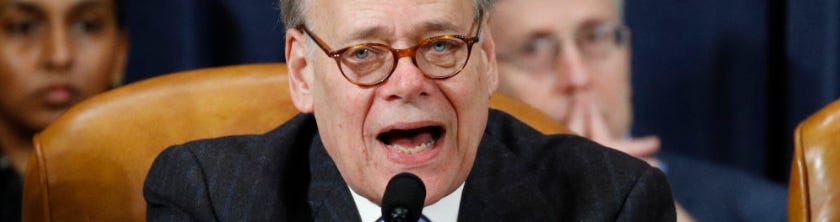
Representative Steve Cohen of Tennessee has had enough. He introduced six articles of impeachment of Chief Justice John Roberts. Good for him!

Scott Dworkin reported on his blog:

Rep. Steve Cohen

Rep. Steve Cohen has represented Memphis, Tennessee, for 19 years. Republicans cut his district into pieces, and he decided to retire—but not without a fight.

Cohen told The Dworkin Report in 2019: “[Trump’s] life has been one crime after another. One misdeed after another. One lie after another.” Now he’s applied that same standard to the man who put Trump above the law.

On May 21, Cohen introduced six articles of impeachment against Chief Justice John Roberts. Charges include allowing the Court to become a partisan weapon, placing the president above the law, endorsing a corrupt campaign finance system, and failing to recuse himself while his wife collected millions recruiting attorneys for law firms with cases before the Court.

Cohen was direct: “Under Chief Justice Roberts’ stewardship, [The Supreme Court] is now understood as biased: with decisions designed to benefit Republicans at the expense of representative government.”

They gerrymandered Cohen’s district to silence him. John Roberts now has six articles of impeachment to his name—an award no other Chief Justice has ever received in US history.

What’s the best antidote to the MAGA claim that America was made by white Christians for white Christians? Here is her answer.

For a while now, I’ve been hinting that my team was up to something. And tonight, at last, I have an announcement.

Last August, during one of my Politics Chat webcasts, at a time when those trying to impose white nationalism, Christian nationalism, or authoritarianism on our country insisted they were embracing American values, I urged people instead to see those who care about the preservation of democracy and who have worked to expand its values as the people who truly represent America.

That idea appealed strongly, apparently, to the two young women we had recently hired to manage my social media accounts and to produce the historical videos we’ve been putting up. As we kicked around ideas for our own celebration of the nation’s 250th anniversary, they kept coming back to the idea from that Politics Chat: that “we…are America.”

So, to honor the 250th anniversary of the Declaration of Independence, we decided to launch a series of one-minute videos that highlight the people, places, and events that have helped to move us toward a more perfect Union.

We designed the videos to emphasize the agency of Americans—mostly everyday Americans—to change the country. Each falls into a category that defines what it means to be an American, including community, democracy, innovation, mobility, civil rights, education, conservation, and creativity.

When we floated the plan, lots of wonderful people all over the country understood the idea immediately and jumped in to help, suggesting topics, writing scripts, offering images, narrating.

We’re launching the project tomorrow with the stories of the Battles of Lexington and Concord, narrated by Massachusetts Governor Maura Healey; the Women’s Armed Services Integration Act, narrated by Representative Chrissy Houlahan of Pennsylvania; the Constitutional Convention (I narrated that one); Ruben Salazar, narrated by journalist Sylvia Salazar; Yellowstone, narrated by former senator Jon Tester of Montana; the AIDS Quilt, narrated by originator Cleve Jones; the Acadians, narrated by historian Jason Herbert; the Erie Canal, narrated by former secretary of transportation Pete Buttigieg; John Peter Zenger and the First Amendment, narrated by journalist Jelani Cobb; the Charter Oak, narrated by Senator Chris Murphy of Connecticut; Thomas Paine’s Common Sense, narrated by Representative Jamie Raskin of Maryland; and the story of actress and dancer Rita Moreno, narrated by Academy Award winner Ariana DeBose.

For the next several weeks, we will be telling these stories and hundreds more. We hope that you will share them widely to flood social media with the real story of how Americans have always worked, often against seemingly insurmountable odds, to create a more perfect Union.

What has made America great has always been the American people.

Now, as for the past 250 years, “We Are America.”

Jamelle Bouie, columnist for The New York Times, wrote several columns (see here) about the decision by the U.S. Supreme Court to eviscerate the Voting Rights Act in its Callais decision. This one is titled “The Law They Hate Was a High Point of Our History.” The high court majority, six hard-right Republicans, decided that partisan redistricting is just fine, but redistricting that takes account of race is not. Thus, a state legislature dominated by one party can justly produce a voting map that gives every seat to its own party, but it may not permit districts created to encourage representation of racial minorities.

In the wake of the Callais decision, some states of the Confederacy quickly carved up districts to eliminate seats held by Democrats and by Blacks. Some of these states will have only white Republicans in Congress.

Bouie wrote:

The Voting Rights Act of 1965 wasn’t the top-down dictate of a rogue, liberal Supreme Court — if such a thing has ever existed.

It wasn’t the brainchild of out-of-touch bureaucrats in Washington, nor was it some kind of martial settlement imposed on the states of the former Confederacy.

It was, instead, an achievement of the most effective social movement of the postwar United States. The Voting Rights Act revitalized American democracy and stands as one of its great achievements.

This, somehow, has been lost in the discourse around the Supreme Court’s decision in Louisiana v. Callais. The court’s clear hostility to the law, as well as the glee with which conservative Republicans have dismantled the South’s majority-minority congressional districts in its wake, makes it seem as if the V.R.A. was a handcuff placed on American politics by some outside force.

The truth is that the Voting Rights Act was conceived, crafted and passed in order to further realize American democracy. And it was, itself, the product of an explosion of democratic energy.

The V.R.A. was forced onto the national agenda by the tireless work of the grass roots activists in the Civil Rights Movement, who struggled, bled and put their lives on the line in a fierce fight to secure their fundamental rights as Americans. It was signed into law by a president who had won election in one of the largest landslides in American history. It was subsequently reauthorized by Congress, after Congress, after Congress, after Congress.

The most recent reauthorization in 2006 was nearly unanimous, and there was broad support from the public — so much that to justify the Supreme Court’s attack on the law in Shelby County v. Holder, Chief Justice John Roberts had to fabricate a constitutional doctrine about the “equal sovereignty” of states, and Justice Antonin Scalia had to characterize the reauthorization as an unfair “racial entitlement” that politicians would never remove for fear of backlash.

If there is any single law that you could plausibly say represents the general will of the American people, it might be one that was reaffirmed nearly every decade for 40 years by the people’s representatives.

This isn’t just a historical point or a piece of idle trivia. It is essential. And it gets to what is so egregious about the court’s campaign against the law.

The Voting Rights Act was an attempt by the people of the United States, affirmed across two generations of voters and lawmakers, to make good the 15th Amendment to the Constitution — itself the hard fought product of war and reconstruction. It was an attempt to wield the authority of the federal government to secure the fundamental right to vote as well as the fundamental right to representation. It stood for substantive equal protection — the chance to make democracy real.

The V.R.A. was not, contra John Roberts and the rest, an expression of colorblindness, indifferent to the social realities of the United States. It did not pretend to treat supposed neutrality as truly neutral, nor did it place racial inequality outside the remit of the Constitution. And it was not, as this court would have it, the bland expression of a bloodless commitment to anti-discrimination. In fact, it was the most significant attempt in this country’s history to realize the promise of political equality.

The Voting Rights Act has more — much more — democratic legitimacy than this Supreme Court has ever enjoyed. After all, most of this court’s conservative majority was appointed by presidents who entered office as winners of the Electoral College but not the popular vote.

It is that relative difference in democratic legitimacy that makes this court’s voting rights jurisprudence so offensive.

Those voting rights rulings, from Shelby County v. Holder in 2013 to Callais in 2026, come from a court that has placed itself above the people at large. It is a court that will, according to its whims, ignore the clear commands, directions and intent of Congress. It is a court that treats voters and legislators as errant children to be corralled and disciplined by wise jurists. It is a court that doesn’t answer hard constitutional questions as they arise as much as it imposes constitutional meaning based on its narrow interests and ideological preoccupations.

It is a court that is trying to shape the political system to its liking, despite the claims of the chief justice, with no limits other than its partisan preferences. It is a court, in other words, that is wielding a cramped and parochial vision of the Constitution against American democracy, rather than treating the Constitution as a tool for realizing our democratic aspirations.

There have been many frustrating decisions from this Supreme Court. Louisiana v. Callais may not even be its worst decision — that prize might still go to Trump v. United States, where the chief justice conjured, out of thin air, an anti-constitutional doctrine of criminal immunity for the president.

Callais, however, might be the most emblematic of this court’s decisions: a flashing warning that our democracy is being crushed underneath the imperial authority of an arrogant and reactionary juristocracy. We can either discipline that court — and put it in its place — or accept our fate as its subjects.

Dan Froomkin writes “Press Watch,” a blog that covers the media. In this post, he criticizes the mainstream media for treating the U.S. Supreme Court’s Callais decision as a partisan issue. It is that, but it is at bottom a decision that destroys Black political power. It allows states to divvy up districts in ways that eliminates Black representation. And former Confederate states wasted no time in breaking up districts that elect Blacks to Congress.

He writes:

States across the South are redrawing election maps to eliminate majority-Black congressional districts.

Much of the major-media coverage is casting this in purely political terms – as just another part of the partisan battle for the House in November.

So for example, a May 9 Associated Press article headlined “What to know about the latest wave of changes to congressional districts,” started off this way:

The remaking of the U.S. political map accelerated this week in courts and legislatures, all of it in this round expected to boost Republicans in their attempt to keep control of Congress in November’s elections.

May 13 New York Times article started off like this:

Gov. Brian Kemp of Georgia on Wednesday called lawmakers back to the capital next month to redraw the state’s legislative districts for the 2028 election cycle, and to work on changes to the state’s voting system.

The call for a special session, which will begin on June 17, comes as Southern lawmakers have been rushing to reconfigure congressional maps to be more favorable to Republicans for this year’s midterms in response to the recent Supreme Court decision that weakened the Voting Rights Act of 1965.

But in the South, the significance of redistricting goes far beyond any partisan issue.

So let me rewrite that for you:

In a stunning display of racism, white Republican leaders throughout the South are stripping Black people of their franchise in order to retain political power.

The catalyst was a 6-3 Supreme Court decision on April 29 that gutted the Voting Rights Act of 1965, landmark legislation that gave Black people the opportunity to elect candidates of their choice.

Six right-wing justices insisted that intentional voting discrimination is a thing of the past. Southern legislators immediately responded by redrawing election boundaries to dilute the Black vote, in many cases making it virtually impossible for Black people to be elected to Congress.

What has happened in a matter of days amounts to a wrenching reversal of 60 years of racial progress — a revival of the Jim Crow era when Black people had no political power, no matter their number.

On a personal level, Black voters in the South are struggling with the repercussions of having one of their essential rights being brutally ripped away from them.

In states like Georgia, Louisiana, and Mississippi, where they make up more than 30 percent of the population, Black Americans will have little to no say in who is elected to Congress. And as the effects of the court decision trickle down to the local level, they may get shut out of some of those elections as well.

Meanwhile, the leaders of the white nationalist movement known as MAGA are celebrating. In some cases, their racism is expressed openly. “For too long, Tennessee politics has been dominated by cosmopolitan communists and race hustlers imposing their corrupt will on a deeply rural and conservative state,” Representative Andy Ogles of Tennessee posted on social media.

For the authoritarian leaders of MAGA, the dilution and nullification of Black votes is a crucial step in their quest to remain in power — even as most voters have turned against them.

MAGA’s future depends on suppressing the votes of groups that don’t support its white-male dominated Christian nationalist ideology. Reducing minority representation, to them, is essential to destroying majority rule. Destroying Majority rule is how they win.

Gerrymandering that leads to Southern states being almost entirely represented by white, right-wing elected officials dramatically improves MAGA’s political calculus. In the short run, it improves the odds of retaining Congress in November. MAGA’ strategy to keep the White House in 2028 includes yet more Black disenfranchisement, through voter intimidation, deception and disruption.

So far, MAGA’s plan is working, raising the prospect that Trump and his successors may remain in power for the foreseeable future.

But another way to characterize the current drive to disenfranchise Black voters is that it is the desperate – and maybe final — act of a white nationalist party that is being rejected by increasing number of voters.

For American journalists, this ought to be epic, tectonic stuff, worth aggressive and ongoing coverage.

And keep in mind that in the mid- to late-20th century, the struggle for civil rights was the dominant story in American politics, the subject of vast amount of journalism, some of it heroic. Ultimately it was journalism that brought the civil rights marchers into the American public’s breakfast nooks and living rooms, forcing the country to reckon with a brutal and sordid history of racism, and, eventually, try to move beyond it.

But today, as in the early days of the civil rights movement, too much of the media is averting its eyes from the experience of Black people. Too much coverage treats this extraordinary and consequential display of racism and societal regression as if it were just an ordinary political battle.

Some Reporters Get It

Some mainstream journalists have recognized the racial element of redistricting, and their work provides models of better, more appropriate coverage.

As evidence that you can address both the racial and political nature of the Republican moves in a news article, consider Emily Cochrane’s reporting in the Times about a new Tennessee map “that slices up Memphis to scatter Black voters into neighboring districts, a move intended to eliminate the state’s last Democratic House seat.” After several paragraphs of partisan framing, she wrote:

Democrats, noting that about two-thirds of Memphis voters are Black, said it was a blatant attack on hard-won gains for fair representation in a state shaped by slavery, segregation and the civil rights movement.

She described the scene in the state capitol in Nashville during the special session to pass the new map:

Black lawmakers delivered emotional speeches about family members, friends and colleagues who endured segregation or struggled with barriers to voting in the 1960s. State Senator Charlane Oliver of Nashville, a Democrat, stood on her desk right before the vote, holding a banner reading “No Jim Crow 2.”

And she quoted an attendee:

“My race is who I am and it informs my politics,” said Danyelle Norment, 30, who woke up early to drive in from Memphis. “It’s not something that’s separate or can be left behind.”

She added, “it’s really, really important to have folks who can understand our lived experience.”

In the Washington PostJustin Jouvenal profiled Press Robinson, an 88-year-old civil rights pioneer. “That law passed in 1965 was the bedrock of improvement of life in America for people of color,” Robinson told Jouvenal.

Now, Robinson fears a wipeout of Black political power, much like the one that occurred after Reconstruction.

“History is now repeating itself,” he said.

On PBS Newshour, Liz Landers covered the story as part of the network’s “Race Matters” series, bringing us the voice of Leona Tate, a civil rights activist:

So now we move backwards with the Supreme Court decision that will go down as one of the most racist rulings in our nation’s history.

Tate was 6 years old when she became one of the first students to desegregate a New Orleans school, Landers noted. Then Tate continued:

I had no idea what racism was at that time, but I knew by third grade that it was the color of my skin that made a difference. I just can’t believe that it’s still happening 66 years later. It’s cheating, to me. That’s how I feel. It’s really cheating. And it’s really illegal.

It does bring back that feeling from a long time ago, and it’s not a good feeling.

Read the Black Press

As in the 1950s and 60s, the Black press is revealing what the white press is slow to acknowledge.

Brandon Tensley, writing for Capital B, explained “How One Supreme Court Ruling Is Rewriting 60 Years of Voting Protections.” “Most Black Americans reside in the South,” he wrote. Lawmakers in former slaveholding states dismantling majority-Black districts “could change the balance of power and the complexion of leadership in this country.”

Gerren Keith Gaynor, writing for TheGrio, headlined the fact that “Black legislators lead the resistance as Republicans rush to redraw maps after gutting of Voting Rights Act.” “It’s disturbing and disgusting to see how this administration and the white leadership here are trying to codify white supremacy and dilute Black political voting power because that’s what’s happening,” Tennessee State Rep. Justin J. Pearson told Gaynor. “I think none of us should make any mistake about what is going on. The attempt to remove Black representation and our ability to elect representatives of our choice is one of the most significant attacks on Black voter participation and Black voter representation since the end of Reconstruction.”

TheRoot published a viral video of Louisiana resident Marshan Camese delivering a powerful speech at a state Senate hearing over redistricting. “I believe the country as a whole is rebuking your party. Y’all are in a death spiral,” he said. “That’s why y’all have to redistrict. That’s why y’all have to cheat.” MAGA, he said, “is the last breath of the Confederacy.”

Civil rights leaders are headed to Alabama tomorrow for a rally they’re calling “All Roads Lead to the South.” As I wrote in my Heads Up News newsletter this week, this could be the birth of a movement that combines the battle for voting rights with the battle for democracy.

“Black folks from across the country are gonna be busing in, flying in, to show up and to really begin organizing to turn out in the November election,” Wisdom Cole, the Senior National Director of Advocacy for the NAACP, told TheRoot. “This is such an important moment to activate all of us.”

Note: the rally in Alabama was held last Saturday.

Today is primary day in Georgia. Jack Hassard offers as good an analysis of the Republican primary as you will see anywhere. Actually, better. Four men are running for the Republican nomination. They all rely on culture war issues, the red meat that gets voters excited, like immigration, crime, and low taxes. Most certainly, they are all conservative Christians. Sadly, none of them addresses the issues that matter most: the closing of hospitals, healthcare, education, the environment. They all embrace Trump, of course.

He blogs as “Citizen Jack.” He is a professor Emeritus of Science Education at Georgia State University.

Citizen Jack writes:

The Georgia primary is today, Tuesday, May 19. The three weeks of advance voting ended on Friday. Although  I didn’t vote on the Republican ticket, I’ve suffered through the continuous bombardment of TV ads by four white Christian pro-Trump men running to be on the November ballot for governor. 

No Limit on Spending

The Republican primary for governor in Georgia has become one of the most expensive and combative races in state history. Right now, according to AJC’s Greg Bluestein, the quad has spent over $100 million in the primary.  Attorney General Chris Carr, Secretary of State Brad Raffensperger, Lt. Gov. Burt Jones, and billionaire businessman Rick Jackson are flooding television screens with nearly identical messages: they are Christian conservatives, loyal to Donald Trump, committed to cutting taxes, and determined to crack down on undocumented immigrants.  Here is what they’ve pored into the local TV stations. 

  • Chris Carr: Put in $4 million, raised $400,000, 2 million on hand
  • Bert Jones: Put in $16 million, raised &200,000, $2.1 million on hand
  • Rick Jackson: Put in $80 million, raised only $200,000, $7. million on hand. 
  • Brad Raffensperger: Put in $6 million, raised $217,000, $2.5 million on hand.

What They Avoid Saying

What is striking is not merely what these candidates say, but what they avoid discussing. 

Education funding, hospital closures, rising health-care costs, retirement insecurity, environmental threats, public transportation, affordable housing, and gun violence barely appear in their ads or debate rhetoric. 

Instead, the Republican field has narrowed Georgia’s future to culture-war symbolism and tax-cut promises.

That narrowing says a great deal about the current direction of Georgia Republican politics.

Chris Carr

Carr presents himself as the polished establishment conservative. As attorney general, he has aligned himself closely with national Republican priorities and emphasized law enforcement and conservative social policies. His campaign argues that lower taxes and a pro-business climate will keep Georgia economically strong. But Carr rarely discusses the deep inequalities beneath the state’s economic growth. 

Georgia continues to rank poorly in maternal mortality, rural health access, and educational equity. Thousands of Georgians live in counties with limited medical services, and many public schools remain underfunded. Carr’s campaign offers little indication that those issues are central to his agenda.

Brad Raffensperger

Raffensperger occupies a more complicated position. Nationally, he became known for refusing Donald Trump’s efforts to overturn Georgia’s 2020 election results. Yet in the governor’s race, Raffensperger has attempted to reposition himself as a conventional conservative Republican emphasizing tax cuts, Christian values, and public safety.   His strategy appears designed to reassure Republican primary voters who still distrust him for defying Trump. Disappointingly he claimed he blocked Joe Biden and Stacey Abrams from trying to make it legal for illegal immigrants to vote. Simply not true, Brad. And he borrowed a campaign strategy used by Governor Kemp–a shotgun. 

Among the four major candidates, Raffensperger is perhaps the least inflammatory rhetorically. Yet even he has largely avoided bold proposals on expanding health care, addressing climate risks, or improving public education. 

His campaign reflects the reality that Republican primaries increasingly punish policy moderation and reward ideological conformity. Rather than using his independent reputation to broaden the debate, Raffensperger has mostly adapted himself to the same narrow framework as his rivals.

Bert Jones

Jones has campaigned as the most openly Trump-aligned candidate. Backed by Trump himself, Jones emphasizes immigration enforcement, conservative cultural themes, and tax elimination.   His ads frame politics as a battle between “real Georgians” and threatening outsiders. Yet Georgia’s economy depends heavily on immigrant labor in agriculture, construction, hospitality, and logistics. Harsh anti-immigrant rhetoric may energize parts of the Republican base, but it risks deepening division while ignoring practical economic realities.

Jones also promotes eliminating the state income tax, a popular Republican talking point. But candidates rarely explain what services would be reduced to compensate for the lost revenue. Georgia relies on income tax revenue to fund schools, universities, transportation, and public safety. Promising massive tax cuts without explaining the consequences may be politically effective, but it is fiscally evasive.

Rick Jackson

Jackson, the billionaire outsider, has poured enormous sums of personal wealth into the race and attempted to position himself as a businessman who can “fix” government.   Like the others, he stresses deportation policies, conservative Christianity, and tax reductions. 

Yet Jackson’s campaign has already been shadowed by reports that undocumented workers were employed at his property despite his hardline immigration message.   The contradiction highlights a larger pattern in modern Republican politics: immigrants are politically useful as targets even while the economy quietly depends on their labor. Jackson has the most offensive immigrant ad of the four candidates. He uses one case to demonize and lie about immigrants. 

More broadly, Jackson’s candidacy reflects the growing influence of billionaire self-financed campaigns. When wealthy candidates can spend tens of millions of dollars on advertising, elections risk becoming less about democratic participation and more about financial saturation. That trend distances politics from the everyday concerns of working Georgians struggling with housing costs, child care, medical debt, and stagnant wages.

“Across all four campaigns, one theme dominates: symbolic politics over practical governance.”

There Are Real Issues 

Georgia faces serious long-term challenges. Rural hospitals continue to close. Teachers leave the profession because of burnout and low pay. Metro Atlanta struggles with traffic congestion and housing affordability. Climate change threatens coastal communities and increases severe weather risks. Yet these issues receive little sustained attention in the Republican primary.

Instead, voters are offered simplified narratives centered on religion, fear of immigrants, tax reduction, and loyalty to Trump. Christianity itself becomes less a moral framework than a campaign brand. Faith is invoked constantly, yet there is little discussion of poverty, health care access, or social responsibility — concerns traditionally associated with religious ethics.

The candidates’ silence on environmental issues is particularly revealing. Georgia’s coastline, water systems, and urban air quality face increasing pressure from development and climate change. Younger voters increasingly care about sustainability and clean energy, yet Republican candidates seldom mention these topics except to criticize federal regulations.

The same absence exists around retirement and aging. Georgia’s population is growing older, and many retirees face rising housing and medical costs. None of the leading Republican campaigns have made retirement security a central issue.

In the end, the Republican primary reveals a party focused more on ideological signaling than comprehensive governance. The candidates compete aggressively over who is most conservative, most pro-Trump, and toughest on immigration. But governing a complex and rapidly changing state requires more than slogans and tax pledges.

Georgia’s future will depend on schools, hospitals, infrastructure, environmental stewardship, and economic fairness as much as partisan identity. A campaign that neglects those realities risks serving political ambition more than the long-term interests of Georgians.