Today is the fourth anniversary of the worst act of insurrection in our nation’s history. Urged on by President Donald Trump, who insisted that he actually won the election of 2020, a large mob stormed the United States Capitol in hopes of stopping the certification of the election of Joe Biden.
To be clear, Trump is a world-class liar and a very sore loser. He simply refused to admit that he lost the election, fair and square. Biden won the electoral vote and the popular vote. Trump’s lawyer challenged the voting results in multiple states. They filed more than 60 lawsuits, appealed twice to the U.S. Supreme Court, and lost every time. They lost in courts where the judge was appointed by Trump, as well as by other Presidents.
Still, he refused to concede his loss. He spent the past four years claiming that he had been cheated, even though he never produced a scintilla of evidence to support his lies. Several of his lawyers were disciplined or disbarred. His personal lawyer Rudy Giuliani was disbarred and also fined $148 million for defaming two election workers in Georgia. Although he had declared that he is bankrupt, Giuliani continues to turn over his assets to the women he defamed. Trump cannot pardon civil judgments, so Giuliani is likely to lose not only his law license but all of his assets.
Yet Trump survived, having persuaded his faithful base that he had been cheated in 2020, despite his lack of evidence and multiple indictments and convictions.
History will say this about Trump:
He was the first President who refused to participate in the peaceful transfer of power to the winner of the election.
He was the first President to inspire an insurrection against the government.
He will be the first convicted felon ever to serve as President.
His insurrection and his name will live forever in infamy.
Quite an ignominious legacy.
To read an excellent article by Robert Reich on the same topic, open this link.
In a recent issue of The New Yorker, physician Dhruv Khullar writes about what happened to the practice of medicine when private equity began buying up hospitals and group practices. The result of privatization of healthcare was not surprising: the desire for profit became more important that the drive to improve patients’ health. Private equity was very successful in squeezing handsome profits out of community hospitals, but all too often those hospitals went bankrupt, leaving the communities without a hospital. Dr. Khullar says we are now in “the Gilded Age” of medicine, where wealth and corporate power are in charge.
Dr. Khullar is a physician and associate professor of health policy and economics at Weill Cornell Medical College.
Dr. Khullar wrote:
In 2010, a private-equity firm called Cerberus Capital Management, which is named for the three-headed dog that is said to guard the underworld, bought six Catholic hospitals in Massachusetts and christened the chain Steward Health Care. The state’s attorney general blessed the deal on multiple conditions, including that, during a five-year review period, the hospitals stayed open and their workers stayed employed. A few months after the period ended, however, Steward started selling the land on which the hospitals stood. A $1.25-billion-dollar deal, in 2016, helped to finance more acquisitions. Many facilities, asked to pay rent on land they’d previously owned, struggled.
According to a recent report published by Massachusetts Senator Ed Markey’s office, which covers the period between 2017 and 2024, some Steward facilities had to forgo key investments in staffing, surgical equipment, elevator repairs, and even clean linens. Patients increasingly languished in emergency rooms; many left without receiving care; and mortality rates for common conditions climbed sharply. (Steward has argued that its death rates were better than expected, given the underlying health status of the patients it cared for.) A hospital in Florida developed a bat infestation, and another, in Texas, was cited for placing potentially suicidal patients in rooms with materials with which they could hang themselves. Employees at Steward’s Carney Hospital, in Massachusetts, began calling their workplace “Carnage” hospital. (Cerberus’s ownership ended in 2020, and the firm claims that the quality issues at Steward are “overwhelmingly related to the post-Cerberus ownership period.”)
In May, Steward filed for bankruptcy. It has closed two hospitals and plans to sell thirty-one others. Steward’s C.E.O., Ralph de la Torre, who in 2011 purchased a forty-million-dollar superyacht, was subpoenaed by a Senate committee but failed to show up; he was held in contempt of Congress and resigned from his position. (De la Torre, in turn, sued the committee for violating his right against self-incrimination.) Nonetheless, Cerberus realized a profit of seven hundred and ninety million dollars from its investment in Steward. Meanwhile, in some places in the U.S., private-equity firms now own more than half of all medical practices within certain specialties. “We are being picked clean by private equity,” a New Jersey-based radiologist said at a recent meeting of the American Medical Association. “There are people who don’t know where their next paycheck is even going to come from because their groups have been flipped so often.”
2024 was arguably the year that the mortal dangers of corporate medicine finally became undeniable and inescapable. A study published in JAMA found that, after hospitals were acquired by private-equity firms, Medicare patients were more likely to suffer falls and contract bloodstream infections; another study found that if private equity acquired a nursing home its residents became eleven per cent more likely to die. Although private-equity firms often argue that they infuse hospitals with capital, a recent analysis found that hospital assets tend to decrease after acquisition. Yet P.E. now oversees nearly a third of staffing in U.S. emergency departments and owns more than four hundred and fifty hospitals. In some of them, patients were “forced to sleep in hallways, and doctors who spoke out were threatened with termination,” according to Jonathan Jones, a former president of the American Academy of Emergency Medicine.
Erin Fuse Brown, a professor at the Brown University School of Public Health, told me that private-equity firms have learned that they “don’t have to make things better or make them more efficient. You can just change one small thing and make a ton more money.” They are hardly the only corporations to learn this lesson. Increasingly, health insurers, private hospitals, and even nonprofits are behaving as though they aim first to extract revenue, and only second to care for people. Patients often are viewed less as humans in need of care than consumers who generate profit.
In 1873, Mark Twain co-wrote the novel “The Gilded Age: A Tale of Today,” which satirized an era that was marked by inequality, greed, and moral decay but was painted in a veneer of abundance and progress. Industrialists made fortunes in oil, steel, and shipping even as millions suffered poverty and exploitation. Today, health care is where the money is. New technologies and treatments sustain the impression that patients have never been healthier, but corporations and conglomerates wield immense power at the expense of the people they’re meant to serve. Welcome to the Gilded Age of medicine.
In recent years, health-care corporations have embraced an approach that can only be described as gamification. In the U.S., all seniors over sixty-five are entitled to health insurance through Medicare, and, for several decades, private companies have offered plans through programs such as Medicare Advantage. The government pays insurance companies a fixed sum based partly on how sick those patients are. The sicker the patients, the bigger the potential payments. But who’s to say, really, how sick a patient is? Let the games begin.
This year, the health-news site STAT revealed that UnitedHealth, the country’s largest private insurer, had set up dashboards for practices to compete on how many conditions they could diagnose in patients. Doctors who completed the most appointments with seniors in Medicare Advantage were eligible for ten-thousand-dollar bonuses, and patients were offered seventy-five-dollar gift cards for getting checkups at which their medical histories could be recorded. At the height of the covid-19 pandemic, an e-mail sent to one practice told clinicians that documenting chronic illnesses was the “#1 priority.”
Insurance companies have even started to scour medical records for possible diagnoses, and to send nurses to patients’ homes to perform “health-risk assessments.” These strategies rack up so many additional diagnoses that, in 2023 alone, the federal government made $7.5 billion in “overpayments” to insurers, according to the U.S. Office of the Inspector General. Insurers are “pouring tremendous resources into developing the capacity to code patients in a way that nets more money from Medicare,” Donald Berwick, a former head of the Center for Medicare & Medicaid Services, told me. “That’s taxpayer money being siphoned away from people who need it.”
Berwick said that his own physician’s practice had recently been acquired by UnitedHealth. One day, he asked his doctor, “Anything different now?”
“Two things,” the doctor replied. “I have to see more patients each day. And my patients have new diagnoses that I didn’t put there.” Many patients with atrial fibrillation, for example, were now coded as having another condition known as “hypercoagulable state”—which was technically accurate, but didn’t change patients’ care in any way. It did, however, generate higher payments from Medicare. Ask not what your insurer can do for you—ask how much revenue you can generate for your insurer.
The insurance companies in Medicare Advantage tend to argue that they’re simply recording diagnoses, not making them up; that they offer vision and dental benefits that traditional Medicare doesn’t offer; and that they rein in unnecessary care, such as by requiring prior authorization for certain tests and procedures. But according to the Medicare Payment Advisory Commission, a nonpartisan agency that counsels Congress, private Medicare Advantage plans will cost the federal government eighty billion dollars more per year than if those patients had been in the traditional Medicare program. “You might as well flush most of that eighty billion dollars down the toilet,” Berwick told me.
On December 4th, after I drafted this piece, Brian Thompson, the C.E.O. of UnitedHealthcare, was fatally shot in midtown Manhattan. In the days that followed, the public response was not just one of shock but also of frustration and even rage against the health-insurance industry. Someone posted in a subreddit for nurses, “Honestly, I’m not wishing anyone harm, but when you’ve spent so much time and made so much money by increasing the suffering of the humanity around you, it’s hard for me to summon empathy that you died.” The comedian Bill Burr compared C.E.O.s like Thompson to gangsters. “It’s a dirty game,” he said. “Health care—dirty game.” I was saddened by the callousness of these comments. Thompson had become a symbol of a broken system; people who devalued his life, it seemed to me, were engaging in a version of the dehumanizing behavior that they found objectionable within the health-care industry.
Please open the link to finish reading the article.
Heather Cox Richardson recalls the days of bipartisan consensus around the goals of liberal democracy, in which government protected the rights of individuals. By today’s MAGA standards, President Dwight D. Eisenhower would be considered a dangerous leftwinger.
Cas Mudde, a political scientist who specializes in extremism and democracy, observed yesterday on Bluesky that “the fight against the far right is secondary to the fight to strengthen liberal democracy.” That’s a smart observation.
During World War II, when the United States led the defense of democracy against fascism, and after it, when the U.S. stood against communism, members of both major political parties celebrated American liberal democracy. Democratic presidents Franklin Delano Roosevelt and Harry Truman and Republican president Dwight D. Eisenhower made it a point to emphasize the importance of the rule of law and people’s right to choose their government, as well as how much more effectively democracies managed their economies and how much fairer those economies were than those in which authoritarians and their cronies pocketed most of a country’s wealth.
Those mid-twentieth-century presidents helped to construct a “liberal consensus” in which Americans rallied behind a democratic government that regulated business, provided a basic social safety net, promoted infrastructure, and protected civil rights. That government was so widely popular that political scientists in the 1960s posited that politicians should stop trying to court voters by defending its broadly accepted principles. Instead, they should put together coalitions of interest groups that could win elections.
As traditional Republicans and Democrats moved away from a defense of democracy, the power to define the U.S. government fell to a small faction of “Movement Conservatives” who were determined to undermine the liberal consensus. Big-business Republicans who hated regulations and taxes joined with racist former Democrats and patriarchal white evangelicals who wanted to reinforce traditional race and gender hierarchies to insist that the government had grown far too big and was crushing individual Americans.
In their telling, a government that prevented businessmen from abusing their workers, made sure widows and orphans didn’t have to eat from garbage cans, built the interstate highways, and enforced equal rights was destroying the individualism that made America great, and they argued that such a government was a small step from communism. They looked at government protection of equal rights for racial, ethnic, gender, and religious minorities, as well as women, and argued that those protections both cost tax dollars to pay for the bureaucrats who enforced equal rights and undermined a man’s ability to act as he wished in his place of business, in society, and in his home. The government of the liberal consensus was, they claimed, a redistribution of wealth from hardworking taxpayers—usually white and male—to undeserving marginalized Americans.
When voters elected Ronald Reagan in 1980, the Movement Conservatives’ image of the American government became more and more prevalent, although Americans never stopped liking the reality of the post–World War II government that served the needs of ordinary Americans. That image fed forty years of cuts to the post–World War II government, including sweeping cuts to regulations and to taxes on the wealthy and on corporations, always with the argument that a large government was destroying American individualism.
It was this image of government as a behemoth undermining individual Americans that Donald Trump rode to the presidency in 2016 with his promises to “drain the swamp” of Washington, D.C., and it is this image that is leading Trump voters to cheer on billionaires Elon Musk and Vivek Ramaswamy as they vow to cut services on which Americans depend in order to cut regulations and taxes once again for the very wealthy and corporations.
But that image of the American government is not the one on which the nation was founded.
Liberal democracy was the product of a moment in the 1600s in which European thinkers rethought old ideas about human society to emphasize the importance of the individual and his (it was almost always a “him” in those days) rights. Men like John Locke rejected the idea that God had appointed kings and noblemen to rule over subjects by virtue of their family lineage, and began to explore the idea that since government was a social compact to enable men to live together in peace, it should rest not on birth or wealth or religion, all of which were arbitrary, but on natural laws that men could figure out through their own experiences.
The Founders of what would become the United States rested their philosophy on an idea that came from Locke’s observations: that individuals had the right to freedom, or “liberty,” including the right to consent to the government under which they lived. “We hold these truths to be self-evident,” Thomas Jefferson wrote, “that all men are created equal, that they are endowed by their Creator with certain unalienable Rights, that among these are Life, Liberty and the pursuit of Happiness,” and that “to secure these rights, governments are instituted among men, deriving their just powers from the consent of the governed.”
In the early years of the American nation, defending the rights of individuals meant keeping the government small so that it could not crush a man through taxation or involuntary service to the government or arbitrary restrictions. The Bill of Rights—the first ten amendments to the Constitution—explicitly prohibited the government from engaging in actions that would hamper individual freedom.
But in the middle of the nineteenth century, Republican president Abraham Lincoln began the process of adjusting American liberalism to the conditions of the modern world. While the Founders had focused on protecting individual rights from an overreaching government, Lincoln realized that maintaining the rights of individuals required government action.
To protect individual opportunity, Lincoln argued, the government must work to guarantee that all men—not just rich white men—were equal before the law and had equal access to resources, including education. To keep the rich from taking over the nation, he said, the government must keep the economic playing field between rich and poor level, dramatically expand opportunity, and develop the economy.
Under Lincoln, Republicans reenvisioned liberalism. They reworked the Founders’ initial stand against a strong government, memorialized by the Framers in the Bill of Rights, into an active government designed to protect individuals by guaranteeing equal access to resources and equality before the law for white men and Black men alike. They enlisted the power of the federal government to turn the ideas of the Declaration of Independence into reality.
Under Republican president Theodore Roosevelt, progressives at the turn of the twentieth century would continue this reworking of American liberalism to address the extraordinary concentrations of wealth and power made possible by industrialization. In that era, corrupt industrialists increased their profits by abusing their workers, adulterating milk with formaldehyde and painting candies with lead paint, dumping toxic waste into neighborhoods, and paying legislators to let them do whatever they wished.
Those concerned about the survival of liberal democracy worried that individuals were not actually free when their lives were controlled by the corporations that poisoned their food and water while making it impossible for individuals to get an education or make enough money ever to become independent.
To restore the rights of individuals, progressives of both parties reversed the idea that liberalism required a small government. They insisted that individuals needed a big government to protect them from the excesses and powerful industrialists of the modern world. Under the new governmental system that Theodore Roosevelt pioneered, the government cleaned up the sewage systems and tenements in cities, protected public lands, invested in public health and education, raised taxes, and called for universal health insurance, all to protect the ability of individuals to live freely without being crushed by outside influences.
Reformers sought, as Roosevelt said, to return to “an economic system under which each man shall be guaranteed the opportunity to show the best that there is in him.”
It is that system of government’s protection of the individual in the face of the stresses of the modern world that Franklin Delano Roosevelt, Harry Truman, Dwight Eisenhower, and the presidents who followed them until 1981 embraced. The post–World War II liberal consensus was the American recognition that protecting the rights of individuals in the modern era required not a weak government but a strong one.
When Movement Conservatives convinced followers to redefine “liberal” as an epithet rather than a reflection of the nation’s quest to defend the rights of individuals—which was quite deliberate—they undermined the central principle of the United States of America. In its place, they resurrected the ideology of the world the American Founders rejected, a world in which an impoverished majority suffers under the rule of a powerful few.
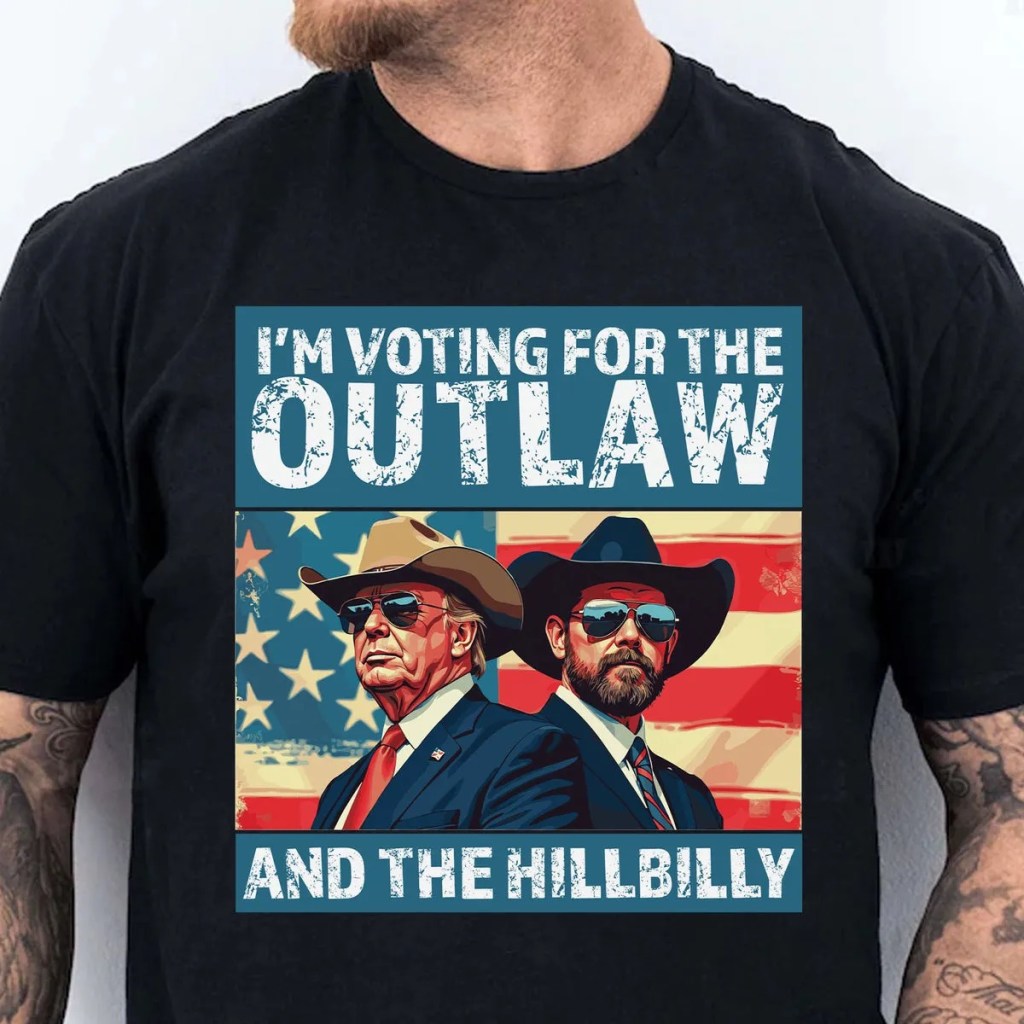
In the post at 9 a.m today, Joyce Vance included a photo of a T-shirt of Trump and Vance, billed as “the Outlaw and the Hillbilly.” Now, that’s clever marketing!
An Outlaw is often an admirable figure in westerns. He’s a folk hero. He’s the guy who goes up against the Establishment. He’s the Sundance Kid, he’s Robin Hood, he’s the handsome guy who gets the girl, he’s a lot of characters who live on the fringes of society and stand up for the little guy.
This is not Donald Trump. He is reverse Robin Hood. He steals from the poor and fattens the bank accounts of the rich. He doesn’t defend the helpless damsel, he sexually asssults her, then laughs about it and defames her. He does not stand outside society on its fringes, he owns the biggest, gaudiest mansion and installs solid gold toilet seats. Far from being handsome and buff, he is an obese old man with thinning hair and sagging jowls. He is a coward who dodged the draft five times yet pretends to be a tough guy.
As for J.D. Vance, he was once a hillbilly but that was long, long ago. Now he plays a hillbilly. He is a graduate of Yale Law School who made millions of dollars in the financial sector, where his patron was Peter Thiel, the woman-hating billionaire.
Not an Outlaw! Just a womanizing convicted felon who is a superb liar, braggart, and bully.
Not a Hillbilly! Just another far-cat who attached himself to super-rich patrons.
Trump passed one piece of legislation in his first term: a big tax cut for his billionaire buddies, corporations, and himself.
We know what his priorities are. Ego. Money. Power. Control.
He’s already forgotten about the people who voted for him. They can’t do anything for him any more. He won’t lower the price of food or gasoline or home insurance. He might take away their Social Security or Medicaid. He might cut programs they rely on.
He will take care of the people rich enough to belong to Mar-a-Lago.
As Donald Trump’s nominee to run the U.S. Department of Housing and Urban Development, Scott Turner may soon oversee the nation’s efforts to build affordable apartments, protect poor tenants and aid the homeless. As a lawmaker in the Texas House of Representatives, Turner voted against those very initiatives.
Turner supported a bill ensuring landlords could refuse apartments to applicants because they received federal housing assistance. He opposed a bill to expand affordable rental housing. He voted against funding public-private partnerships to support the homeless and against twobills that called merely to study homelessness among young people and veterans.
Behind those votes lay a deep-seated skepticism about the value of government efforts to alleviate poverty, a skepticism that Turner has voiced again and again. He has called welfare “dangerous, harmful” and “one of the most destructive things for the family.” When one interviewer said receiving government assistance was keeping recipients in “bondage” of “a worse form to find oneself in than slavery,” Turner agreed.
Such views would seemingly place Turner at odds with the core work of HUD, a sprawling federal agency that serves as a backstop against homelessness for millions of the nation’s poor, elderly and disabled. With an annual discretionary budget of $72 billion, the department provides rental assistance to 2 million families, oversees the country’s 800,000 public housing units, fights housing discrimination and segregation and provides support to the nation’s 650,000 homeless. If Turner’s record indicates how he will direct the agency’s agenda, it is those clinging to the bottom of the housing market who have the most to lose, researchers and advocates said.
Several days ago, Elon Musk tweeted his endorsement of an extremist political party in Germany, the AfD, which is known for its xenophobic and hateful views. A number of pundits said he had thrown his support to a Neo-Nazi party. J.D. Vance soon added his praise of the extremist party.
Cynthia Miller-Idriss, a scholar of extremism, wrote at the MSNBC website, about the alarm bells that Musk and Vance set off.
“Only the AfD can save Germany,” Musk posted on X, prompting backlash from conservative and mainstream German leaders and the global Jewish community about a key Trump adviser’s endorsement of a party that has flirted with Nazi and white supremacist slogans and espoused dehumanizing and hateful rhetoric against immigrants and Muslims. In the wake of the criticism, Musk doubled down, writing the next day that “AfD is the only hope for Germany.”
Make no mistake: It is extremely dangerous to have an American vice president-elect and a core Trump adviser voice support for the AfD, therefore normalizing very extreme political positions.
Vance’s more tacit endorsement for AfD came in the form of a post responding to claims that AfD is dangerous. “It’s so dangerous for people to control their borders,” Vance tweeted sarcastically Saturday, implying support for the party’s anti-immigration positions. “So so dangerous. The dangerous level is off the charts.”
Make no mistake: It is extremely dangerous to have an American vice president-elect and a core Trump adviser voice support for the AfD, therefore normalizing very extreme political positions. The AfD has called for mass deportations, argued that children with disabilities should be removed from regular schools, and runs social media ads blaming immigrants for crimeand sexual violence. One anti-immigrant ad run by the AfD showed the belly of a pregnant white woman with the phrase “New Germans? We’ll make them ourselves.” Another campaign billboard used a 19th century painting of a slave market — depicting a nude, white woman having her teeth inspected by turban-clad, brown men — to warn that Europe could become “Eurabia,” a reference to a conspiracy theory favored by white supremacists.
To finish reading, open the link.
Trump’s advisers are showing their hand awfully early. Know them by those they admire.
I frequently get comments by people who are very angry. They are hateful, and their comments are hateful. They say horrible things about anyone who dusagreees with their worldview.
I try to block them but they sometimes slip through. Life is too short to argue with people who wish you were dead.
Andru Volinsky lives in New Hampshire, where he has been active in politics and protecting public schools. He served on the state’s Executive Council, he successfully litigated a challenge to the state’s system for funding public schoools. He ran for Governor in 2020 and unfortunately was not elected. He writes here about the risks that America’s immigrant children face today.
His article was posted on the blog of the Network for Public Education.
Andru Volinsky alerts us to one of the other threats to education that may be coming for immigrant children.
School children who cannot prove they are legally in the US may soon be threatened with exclusion from public schools. Since 1982, when the Supreme Court decided the case of Plyler v. Doe, public schools have been required to accept children who immigrate to the US, regardless of their legal status. The Plyer opinion, however, was issued by a deeply divided court (five different justices wrote opinions) with only a bare majority deciding in favor of the school children. And now, much like the Roe v. Wade abortion decision, the Plyler decision is under attack by right-wing extremists. Texas governor Gregg Abbott has publicly challenged the decision and it appears there is an organized effort to overturn the right of immigrant children to attend public schools.
Earlier this year, the Saugus, MA School Committee adopted stringent proof of legal residency requirements for its school children shortly after Massachusetts governor Maura Healey announced a state of emergency concerning Massachusetts’ over 5000 recent immigrants, many of whom were from Haiti, Nicaragua and Venezuela. Saugus is a town of about 30,000 residents located just outside of Boston. The immigrants from these three nations were legally admitted to the US under a Biden administration special humanitarian parole program adopted in 2023.
Legislators in Oklahoma, Tennessee and Texas recently also considered legislation to either explicitly bar children from attending public school if they cannot prove they are legally in the US or to require extensive proof of legal residency that can then give local officials excuse not to admit students. The Saugus School Committee is reported to have deployed this tactic to delay admission of a six-year-old girl from Nicaragua for six months.
According to a Pew study released in July 2024, the unauthorized immigrant population in the United States was 11.0 million in 2022, the most recent year available. About 850,000 of these immigrants were children under 18.
About 4.4 million U.S.-born children under 18 live with an unauthorized immigrant parent. More than eight million workers in the US are unauthorized immigrants. Only 5 percent of these unauthorized workers are single persons without children. The remainder are heads of families most of which are of mixed legality of their immigration status.
If we exclude children from public schools because of their immigration status, how can we expect them to become “good citizens?”
Ashton Pittman is the news editor of the Mississippi Free Press and a fine writer. I get my news about Mississippi by reading MFT, reported by people who live there. Pittman describes in this article why he debated whether to leave Twitter. When Musk bought Twitter, he knew it was going to be bad. He had spent years building up a following there and didn’t want to give it up. He investigated other social media platforms, but they weren’t right.
Then came the 2024 election, and Twitter turned into a political platform that favored Trump, where nasty trolls and bots created a toxic atmosphere.
For a long time, it seemed like nothing was going to replace Twitter, even as it further devolved into a hellscape that seemed as if it were overrun by the trolls of 4chan, the neo-Nazis of Stormfront and the dullest AI bots Chat GPT ever powered. Twitter transformed into X, a place where racism, misogyny, homophobia and especially transphobia run rampant under the guise of “free speech,” but where using the word “cisgender” can get your account restrictedbecause Musk (who has described his very-much-alive transgender daughter as “dead”) considers it a slur.
I had really wanted one of the Twitter alternatives to take off, but one of the biggest impediments was the lack of buy-in from major journalists, publications, celebrities and other figures who could draw audiences away. A familiar pattern developed: People would leave X in hopes of joining another platform, then come back.
Then came the election. Twitter turned into a Trump propaganda site. And Ashton was done.
But you know what I really enjoy about BlueSky? It doesn’t pigeonhole me. On other platforms, particularly X, you choose one facet of yourself and that’s the following you get, and the algorithm recommends you based on that. On BlueSky, I get to be a Mississippi journalist whose news stories draw engagement from people who care about news, but I also get to be a film photographer whose posts about my black-and-white film adventures spark conversations, too. None of us is just one thing, no matter what some lousy algorithm thinks, and it’s affirming to be able to build communities around shared interests beyond just news and politics. Social media should be social, not anti-social….
My experience as a journalist on BlueSky has reminded me that my job is to provide good information to those who want it, not to argue with trolls and validate attention-seeking behavior from the worst people on the internet. My desire to reach a diverse audience does not have to entail subjecting myself to constant abuse. I am not obligated to stay on a platform where Nazi trolls with 1488 in their usernames and cartoon frogs as their profile images regularly hurl the word “fagg-t” at me and issue veiled threats. I do not have to entertain the endless stream of incels who think “soy boy” is some sort of profound insult. I do not have to accept being under the thumb of an algorithm that prioritizes crypto scams, AI bots and conspiracy theorists over my voice.
And you know what? You don’t either.
Some of the smarter people among us have said that BlueSky is an echo chamber. Well, right now, it’s a place where I hear the echoes of artists, writers, cinephiles, scientists and neighbors caring about their neighbors. And that’s a hell of a lot better than being trapped in a chamber that’s increasingly filled with the echoes of Adolf Hitler.
For five days, the public was obsessed with the search for the man who murdered the CEO of United Healthcare. For a while, he seemed to be a mastermind, evading the surveillance state that so closely monitored his movements. But then he was caught while eating breakfast at a McDonald’s in Altoona, PA.
There is no excuse for murder. None, unless you are acting in self-defense, which Luigi Mangione was not. He has ended the life of Brian Thompson, the CEO of UHC, and simultaneously destroyed his own life. He is likely to spend the rest of his life in prison. Couldn’t he have thrown a bucket of red paint in protest? Or a cream pie?
The health insurance industry in this country is a mess. Most insurance companies operate for profit, and their actions seem to based on the prospect of profit, not the well-being of their customers. The industry makes obscene profits, based on its frequent denials of reimbursement.
This post was written by Qasid Rashid. When he learned that his child had a deadly disease, he sought help from his insurance company but was repeatedly denied any help. Read the story. It shows how repellent privatized for-profit insurance is. The insurance company was willing to let the child die rather than pay the cost of her desperately needed treatment.
He and his wife wrote:
This article is a deeply personal and vulnerable piece about our daughter Hannah Noor. It is primarily written by my wife Ayesha Noor. We are sharing this not because our daughter’s story is special, but sadly, because her story is all too common. Every year thousands of children and adults suffer incomprehensible pain, suffering, and even death. They suffer not because we lack the means to treat them, but because exploitative insurance companies, incompetent bureaucrats, and apathetic politicians deny them access to the life saving care they need. In light of recent events [See: America’s Violent Health System], we are sharing this story to bear witness to the preventable suffering of so many, the deadly violence imposed upon them, and to give hope that even in the darkest of times things can get better if we demand it. Let’s Address This.
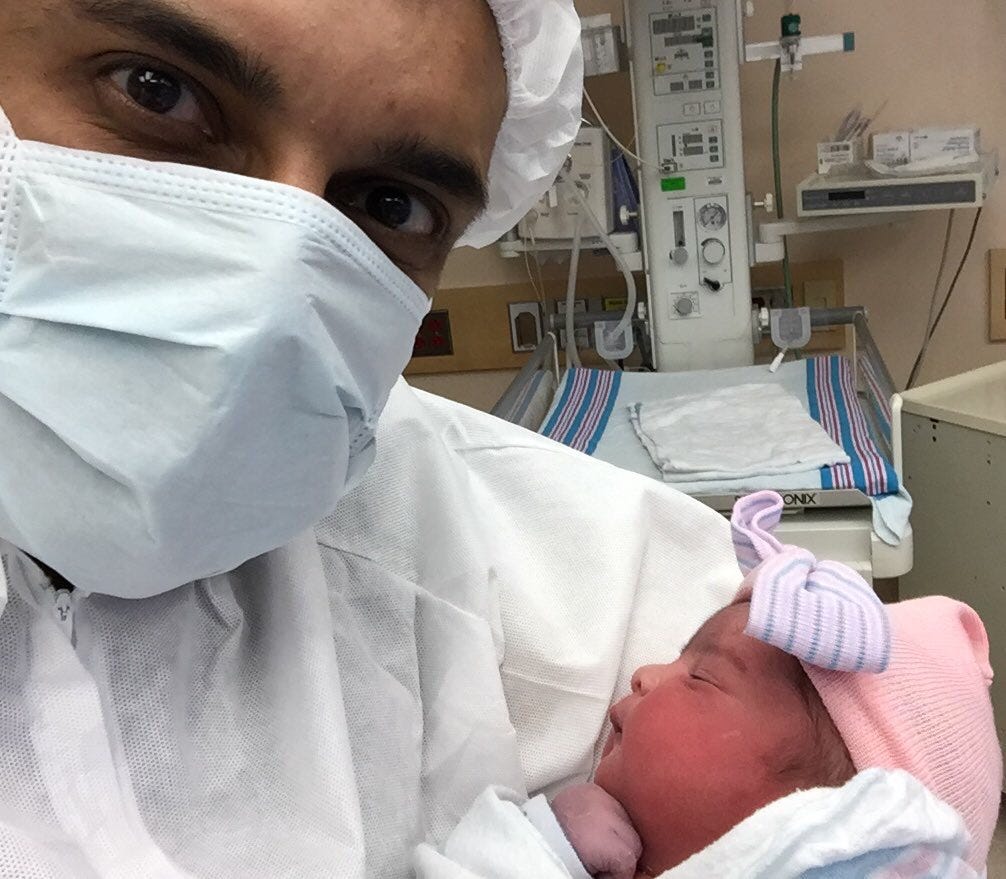
Hannah Noor (Pictured Right) at 5 hours old.
A Scream in the Dark
It was just after her sixth birthday in 2021 when our daughter screamed from her bed in the middle of the night. We rushed to her room to find she had thrown up all over her bed. We cleaned her up, changed her sheets, and blamed the incident on the Oreos she’d eaten after dinner. The next day she complained of a stomach ache and rushed to the bathroom, experiencing diarrhea. Like most parents, we dismissed it as a passing bug—kids get diarrhea now and then. But something felt different this time, even though it was her first experience.
When it happened again just a short time later, the stomach pain was more severe. She screamed, cried, and rushed to the bathroom, but this time there was blood—so much blood. It terrified us. Before we could even make it to urgent care, she had another episode with even more bleeding. We hurried her in, only to be told by the nurse practitioner to “keep her hydrated” and that it was probably a stomach virus. But again, something in our gut told us otherwise.
This was just before Thanksgiving 2021, and I convinced myself she’d recover over the break and be able to return to school. She loved school, as most kindergarteners do. But the bleeding continued. The pain worsened. More urgent care and pediatrician visits followed, but answers did not. By now, our once energetic and chatty daughter was pale, frightened, and visibly losing weight.
Navigating Through the Dark
We reached out to a close friend who happened to be a pediatric gastroenterologist. His questions and careful listening indicated it was not a simple virus, but he didn’t say much directly. He urged us to connect with the GI team at Children’s National Hospital in Washington D.C. Unfortunately, we were met with insurance hurdles and skepticism from her pediatrician. Weeks passed, and her condition deteriorated until, thanks to our friend’s intervention, we finally secured an appointment with a pediatric GI doctor in December.
Hannah Noor, now frail and scared, was put on iron supplements, and an colonoscopy was scheduled for January. She now weighed just 30 pounds—skin and bones, and we feared the worst. Her fear of eating, going to the bathroom, or even moving too much consumed her days. Our winter break became a period of sleepless nights, endless tears, and prayers. We felt like prisoners trying to navigate through treacherous terrain while blindfolded and shackled.
The preparation for the scope was grueling—a 24-hour liquid diet. To make matters worse, a severe snowstorm in early January 2022 left us without power for three days. Despite the chaos, we made it to the hospital. As I held her tiny hand, she bravely went under anesthesia. Hours later, the doctors confirmed what we feared: Hannah had ulcers all over her colon.
Inflammatory Bowel Disease (IBD) was the diagnosis—a chronic, lifelong condition that would require extensive management. Even as the doctor explained, I couldn’t fully grasp the gravity of it. I naively asked, “How long will she need the medication?” The doctor replied—“Do you understand what it means to have IBD? This is for life.”
It shattered me. My world crumbled.
Steroids, with their array of side effects, initially helped stabilize her condition, and she was subsequently started on mesalamine. However, managing IBD is never straightforward. Moving homes and finding a new doctor compatible with our insurance became an uphill battle. Procuring mesalamine was a nightmare, as our insurance kept on requiring prior-authorization—a term we’d never even heard before. Evidently, even though our doctor had prescribed a specific medication to save our daughter’s life, the insurance company required their non-medically trained admins to agree that our board certified physician knew what she was doing in prescribing the medication she prescribed. Spoiler: They disagreed and repeatedly denied the critical medication our daughter needed.
Making matters worse, moving meant we were in between doctors. Desperate to try anything to improve Hannah’s quality of life, we spent hours consulting with a nutritionist to see if dietary changes could make a difference. We invested extensive time and resources into a gluten-free diet, but it did not help at all; in fact, it made her averse to eating. We also tried the FODMAP diet, which was recommended during a flare, but it added to the confusion of what she should or shouldn’t eat. Every day became a battle over something as simple as food—one filled with uncertainty and frustration. Despite our efforts, Hannah’s condition remained unpredictable, with debilitating flares continuing to disrupt her life. By late 2023, we had pursued every imaginable route to find a way to protect our daughter’s health and life, and yet felt exhausted and at a dead end.
It was clear that only one option remained—she needed a quickly advancing form of therapy known as biological treatment. This would be a direct IV infusion of medication to stabilize the IBD, every six to eight weeks, forever.
A Dark Dead End
We were at the end of the road. If we couldn’t access biologic treatment, there was nowhere left to go. But what we hoped would finally bring us closure and healing, resulted in yet another emotional roller coaster and painful circus—our insurance corporation blocked us. Turns out, insurance corporations block more than 51% of patients whose doctors prescribe them biologic treatment to save their lives.
The recommended biologic promised not a cure, but a chance at living a healthy life. Our insurance rejected us outright reasoning that we hadn’t tried other medications first—a policy called “step therapy.” Despite our daughter’s life threatening condition, they wanted us to try every other variation of every other possible medication—knowing full well they would likely fail just as much and make our daughter suffer, vomit, bleed, and lose weight. But that did not matter to them, because that was the preferable path to ensure they “maximized shareholder value.”
Our doctor stepped in and conducted a peer-to-peer direct meeting with the insurance company to show all the data, blood tests, and medical reports to prove that our daughter needed biologics to live. To show without a shadow of a doubt that the yet untried medications they demanded we try were not substantively different than the plethora of medications we had tried and had not worked. Yet, that meeting also went in vain. The insurance company still refused to approve our claim. And Hannah Noor’s condition worsened. She was pale, swollen from steroids, in pain, losing weight, and back to missing school.
We finally contemplated paying for the biologic treatment out of pocket. We knew it would only require six doses a year. How much could one dose be, after all? We checked and our hearts sank once more. Each dosage cost and administration would run into the tens of thousands of dollars. A year’s supply to keep our daughter alive would run into the hundreds of thousands. We certainly did not have that kind of money. We were cornered and desperate.
We contemplated what any parents might. Do we sell the house and cars and move into a small apartment? Do we set up a GoFundMe? Do we borrow money from family and friends? Do we take out a second mortgage?
Do we file for medical bankruptcy, as 500,000 Americans do annually?
But we soon learned another sinister result of hyper-privatization of health insurance—even if we had the excessive means to pay the hundreds of thousands of dollars out of pocket, the hospital would not accept the funds. Why? The industry is such that not only do insurance companies deny 51% of claims, they have enacted policies forbidding people from paying for the critical medication they need out of pocket, lest the insurance company lose control and revenue. “Either you pay us, or you pay no one,” is a line you’d expect out of a mafia handbook—not out of a health provider. This is not health insurance, this is health exploitation.
A Spark of Light in the Darkness
In that moment of confusion we happened to run into to a fellow parent who, now is a great friend, and learned her children shared a similar medical struggle. She suggested calling the biologic manufacturers directly and applying for their patient assistance program. An idea that seems so obvious now, but something we did not even know was a possibility then.
The application process was tedious, and even then, it was initially rejected. But after weeks of back-and-forth, countless phone calls, and sleepless nights, a miracle happened—we finally secured approval. We let out a cathartic sigh of relief after more than two years of suffocation. And to be sure, the approval was not through our insurance company, who never even bothered to offer such an option, likely because it would cost them money. Rather, the approval was from the drug manufacturer directly. To this day our health insurance company has refused to budge on their cruel and calloused “maximizing shareholder value” decision to deny our daughter the medicine she needs to live.
On March 6, 2024—more than two months after the doctor first prescribed it, a period in which our daughter suffered horrific and unimaginable pain, bleeding, and vomiting—Hannah Noor received her first infusion at Comer Children’s Hospital in Chicago. And since then, everything has changed. Her spark of light returned. Our daughter was back.
The Light We Create
A process that should have only taken 30-60 days from the night we heard that scream in the dark, took us on a 28 month torturous journey to finally see light again. Hannah Noor’s journey since starting biologic treatment has been a blessing. She’s eating, playing, drawing, and even learning karate (currently a Yellow Belt). The last three years of her life had been a torture for her, but now she is finally thriving as any 9-year-old girl should. Though the fear of flares always looms, we refuse to let it dictate our lives. Herbal and homeopathic treatments complement her medical regimen, and her strength inspires us daily.
As for our insurance company? Those corporate leeches also denied covering the hospital costs as well. Fortunately, despite that high price tag still running into the thousands, we tightened our belts and found a way to pay for that out of pocket, and continue to pay for that out of pocket. (We were shocked there wasn’t some additional insurance rule preventing us from paying our hospital directly). Despite us paying our insurance premiums every single month without exception, our insurance company has not covered a single penny of our daughter’s critical healthcare needs. The care she needs to live. But at least they’re maximizing shareholder value.
This story isn’t just about one child’s struggle with IBD; it’s about the systemic barriers hundreds of millions of families face every single day. From insurance denials to inaccessible care, to step therapy nonsense, to prior authorization red tape, the system fails the most vulnerable. What if we didn’t speak English? What if we couldn’t afford out-of-pocket costs for tests and treatments? What if one of our close friends didn’t just happen to be a national expert on this particular rare disease, and couldn’t leverage his relationships to get us access to a world leading expert? What if we didn’t have a network of supportive friends to recommend new ways to acquire this life saving medicine?
A Brighter Future Is Possible
We named our daughter Hannah Noor because Hannah was the mother of Mary Mother of Jesus, and Noor means light. We couldn’t think of a more beautiful name for our only daughter, and she has lived up to it every day of her life.
In these darkest of times, she is the Light of our eyes.
Hannah Noor (now 9) at a recent family vacation in Lahore, Pakistan. Here she is giggling at a cat that wandered over to say meow, which Hannah Noor reminded us means “hello” in cat language.
Hannah Noor’s story highlights a flawed and cruel system that places profits over people. Yet it also underscores the power of advocacy, persistence, and community. To every parent navigating the complexities of chronic illness: stay strong, fight relentlessly for your child, and lean on the resources available, like the Crohn’s and Colitis Foundation, and do not underestimate support groups on Facebook. If I can be of any support, do not hesitate to reach out at ayesha [dot] noor @ gmail.com.
Hannah Noor is living proof that even in the darkest moments, there is hope. She teaches us daily to believe in miracles—and to fight for them when necessary. It is also a reminder that our for profit exploitative health insurance system will always only serve the wealthy elites, the stock market, and whatever private investor who decides to buy and sell these corporations. They will not serve the people. Not our beautiful baby girl, nor the nearly 70,000 Americans who die annually due to lack of care, nor the 500,000 Americans who are forced to file for medical bankruptcy every single year. It is by the sheer grace of the Almighty that we still have our wonderful Light with us today. But for so many parents and families, the end result is not so fortunate.
Perhaps the most frustrating part about all of this is that the medication to save our child’s life existed all along. But because some calloused business person decided her life wasn’t profitable enough and worth saving, it was an acceptable cost to reject her claim and let her die.
It is our responsibility to demand better, not just for our daughter, but for all the daughters, sons, and children out there. We do not suffer from a lack of resources, but from an excess of greed. We can ensure high quality, accessible, and affordable healthcare for all people in this country—but we cannot ensure the satiation of greed for the billionaire corporations, corrupt politicians, and elitists who care more about shareholder value than the survival of innocent children. We have to choose one side. And we choose the children of this great country—we hope you do too.


 Diane Ravitch's blog