Archives for category: Cruelty

Today is a good day to reflect on hypocrisy. The Trump administration is deeply entwined with two groups: evangelical Christians and Elon Musk’s DOGE team. The White House has frequent prayer meetings, issues proclamations written by evangelical leaders, and even has offices in the Weat Wing for Trump’s spiritual advisors.

Meanwhile, Trump empowered DOGE to ransack every federal agency, fire staff by the tens of thousands, and shutter agencies that were established by Congress. Many fear that Medicaid, Medicare, and Social Security will suffer deep cuts.

The result will be not “efficiency,” but inefficiency. Worse, people will die if they cannot afford to pay for health care and do not get their Social Security because their local or regional office has been closed and they do not have a cell phone or computer.

The prime example of DOGE slaughter of an agency that has saved millions of lives is USAID. Foreign aid has had bipartisan support for decades. It brings food, medicine, and medical clinics to desperately poor people around the globe. American farmers supply the grains that are exported and lose billions of dollars.

But most important, millions of people will die because of the cutoff of drugs and food.

This is rank cruelty. This is obscene. This is a crime.

What do the evangelicals who surround Trump say about this? Clearly they influence his words but not his deeds. Jesus spoke about love, compassion, healing the sick, feeding the hungry, welcoming the stranger. What do they say about withdrawing drugs and food from millions of the needy and poor?

Today is a good day to ask, What would Jesus do?

David Remnick, editor of The New Yorker, interviewed Dr. Atul Gawande about his work at USAID. He was especially interested in learning Dr. Gawande’s views about the likely consequences of the evisceration of USAID.

Remnick writes:

It is hard to calculate all the good that Atul Gawande has done in the world. After training as a surgeon at Harvard, he taught medicine inside the hospital and in the classroom. A contributor to The New Yorker since 1998, he has published widely on issues of public health. His 2007 article in the magazine and the book that emerged from it, “The Checklist Manifesto: How to Get Things Right,” have been sources of clarity and truth in the debate over health-care costs. In 2014, he published “Being Mortal: Medicine and What Matters in the End,” a vivid, poetic, compassionate narrative that presents unforgettable descriptions of the ways the body ages and our end-of-life choices.

Gawande’s work on public health was influential in the Clinton and Obama Administrations, and, starting in November, 2020, he served on President Joe Biden’s covid-19 Advisory Board. In July, 2021, Biden nominated him as the assistant administrator for the Bureau of Global Health at the U.S. Agency for International Development, where he worked to limit disease outbreaks overseas. Gawande, who is fifty-nine, resigned the position on the day of Donald Trump’s return to the Presidency.

When we spoke recently for The New Yorker Radio Hour, Gawande, usually a wry, high-spirited presence, was in a grave mood. There were flashes of anger and despair in his voice. He was, after all, watching Trump and Elon Musk dismantle, gleefully, a global health agency that had only lately been for him a source of devotion and inspiration. As a surgeon, Gawande had long been in a position to save one life at a time. More recently, and all too briefly, he was part of a vast collective responsible for untold good around the world. And now, as he made plain, that collective has been deliberately cast into chaos, even ruins. The cost in human lives is sure to be immense. Our conversation has been edited for clarity and length.

President Biden appointed you as the assistant administrator for global health at U.S.A.I.D., a job that you’ve described as the greatest job in medicine. You stepped down on Trump’s Inauguration Day, and he immediately began targeting U.S.A.I.D. with an executive order that halted all foreign aid. Did you know, or did you intuit, that Trump would act the way he has?

I had no idea. In the previous Trump Administration, they had embraced what they themselves called the “normals.” They had a head of U.S.A.I.D. who was devoted to the idea of development and soft power in the world. They had their own wrinkle on it, which I didn’t disagree with. They called it “the journey to self-reliance,” and they wanted to invest in Africa, in Asia, in Latin America, to enable stronger economies, more capacity—and we weren’t doing enough of that. I actually continued much of the work that had occurred during that time.

Tell me a little bit about what you were in charge of and what good was being done in the world.

I had twenty-five thousand people, between D.C. and sixty-five countries around the world, working on advancing health and protecting Americans from diseases and outbreaks abroad. The aim was to work with countries to build their systems so that we protected global health security and improved global outcomes—from reducing H.I.V./aids and other infectious diseases like malaria and T.B., to strengthening primary health-care systems, so that those countries would move on from depending on aid from donors. In three years, we documented saving more than 1.2 million lives after covid alone.

Let’s pause on that. Your part of U.S.A.I.D. was responsible, demonstrably, for saving 1.2 million lives—from what?

So, covid was the first global reduction in life expectancy in seventy years, and it disrupted the ability across the world to deliver basic health services, which includes H.I.V./aids [medications], but also included childhood immunizations, and managing diarrhea and pneumonia. Part of my target was to reduce the percentage of deaths in any given country that occur before the age of fifty. The teams would focus on the top three to five killers. In some places, that would be H.I.V.; in some places that would be T.B. Safe childbirth was a huge part of the work. And immunizations: forty per cent of the gains in survival for children under five in the past fifty years in the world came from vaccines alone. So vaccines were a big part of the work as well.

What was the case against this kind of work? It just seems like an absolute good.

One case is that it could have been more efficient, right? Americans imagine that huge sums of money go to this work. Polls show that they think that a quarter of our spending goes to foreign aid. In fact, on a budget for our global health work that is less than half the budget of the hospital where I did surgery here in Boston, we reached hundreds of millions of people, with programs that saved lives by the millions. That’s why I describe it as the best job in medicine that people have never heard of. It is at a level of scale I could never imagine experiencing. So the case against it—I woke up one day to find Elon Musk tweeting that this was a criminal enterprise, that this was money laundering, that this was corruption.

Where would he get this idea? Where does this mythology come from?

Well, what’s hard to parse is: What is just willful ignorance? Not just ignorance—it’s lying, right? For example, there’s a statistic that they push that only ten per cent of U.S.A.I.D.’s dollars actually got to recipients in the world. Now, this is a willful distortion of a statistic that says that only ten per cent of U.S.A.I.D.’s funding went to local organizations as opposed to multinational organizations and others. There’s a legitimate criticism to be made that that percentage should be higher, that more local organizations should get the funds. I did a lot of work that raised those numbers considerably, got it to thirty per cent, but that was not the debate they were having. They’re claiming that the money’s not actually reaching people and that corruption is taking it away, when, in fact, the reach—the ability to get to enormous numbers of people—has been a best buy in health and in humanitarian assistance for a long time.

Now the over-all agency, as I understand it, had about ten thousand people working for it. How many are working at U.S.A.I.D. now?

Actually, the number was about thirteen thousand. And the over-all number now—it’s hard to estimate because people are being turned on and off like a light switch—

Turned on and off, meaning their computers are shut down?

Yeah, and they’re being terminated and then getting unterminated—like, “Oops, sorry, we let the Ebola team go.” You heard Elon Musk say something to that effect in the Oval Office. “But we’ve brought them back, don’t worry.” It’s a moving target, but this is what I’d say: more than eighty per cent of the contracts have been terminated, representing the work that is done by U.S.A.I.D. and the for-profit and not-for-profit organizations they work with, like Catholic Relief Services and the like. And more than eighty per cent of the staff has been put on administrative leave, terminated, or dismissed in one way or the other.

So it’s been obliterated.

It has been dismantled. It is dying. I mean, at this point, it’s six weeks in. Twenty million people with H.I.V., for example—including five hundred thousand children—who had received medicines that keep them alive have now been cut off for six weeks.

A lot of people are going to die as a result of this. Am I wrong?

The internal estimates are that more than a hundred and sixty thousand people will die from malaria per year, from the abandonment of these programs, if they’re not restored. We’re talking about twenty million people dependent on H.I.V. medicines—and you have to calculate how many you think will get back on, and how many will die in a year. But you’re talking hundreds of thousands in Year One at a minimum. But then on immunization side, you’re talking about more than a million estimated deaths.

I’m sorry, Atul. I have to stop my cool journalistic questioning and say: This is nothing short of outrageous. How is it possible that this is happening? Obviously, these facts are filtering up to Elon Musk, to Donald Trump, and to the Administration at large. And they don’t care?

The logic is to deny the reality, either because they simply don’t want to believe it—that they’re so steeped in the idea that government officials are corrupt and lazy and unable to deliver anything, and that a group of young twentysomething engineers will fix it all—or they are indifferent. And when Musk waves around the chainsaw—we are seeing what surgery on the U.S. government with a chainsaw looks like at U.S.A.I.D. And it’s just the beginning of the playbook. This was the soft target. This is affecting people abroad—it’s tens of thousands of jobs at home, so there’s harm here; there’s disease that will get here, etc. But this was the easy target. Now it’s being brought to the N.I.H., to the C.D.C., to critical parts of not only the health enterprise but other important functions of government.

So the National Institutes of Health, the Centers for Disease Control and Prevention, and other such bureaucracies that do equal medical good will also get slammed?

Are being slammed. So here’s the playbook: you take the Treasury’s payment system—doge and Musk took over the information system for the Treasury and the payments in the government; you take over the H.R. software, so you can turn people’s badges and computer access on and off at will; you take over the buildings—they cancelled the leases, so you don’t have buildings. U.S.A.I.D.—the headquarters was given to the Customs and Border Protection folks. And then you’ve got it all, right? And then he’s got X, which feeds right into Fox News, and you’ve got control of the media as well. It’s a brilliant playbook.

But from the outside, at least, Atul, and maybe from your vantage point as well: this looks like absolute chaos. I’ve been reading this week that staff posted overseas are stranded, fired without a plane ticket home. From the inside, what does it look like?

One example: U.S.A.I.D. staff in the Congo had to flee for their lives and watch on television as their own home was destroyed and their kids’ belongings attacked. And then when they called for help and backup, they could not get it. I spoke to staff involved in one woman’s case, a pregnant woman in her third trimester, in a conflict zone. They have maternity leave just like everybody else there. But because the contracts had been turned off, they couldn’t get a flight out, and were not guaranteed safe passage, and couldn’t get care for her complications, and ended up having to get cared for locally without the setup to address her needs. One person said to me, as she’s enduring these things, “My government is attacking me. We ought to be ashamed. Our entire system of checks and balances has failed us.”

What’s been the reaction in these countries, in the governments, and among the people? The sense of abandonment must be intense on all sides.

There are broadly three areas. The biggest part of U.S.A.I.D. is the fema for disasters abroad. It’s called the Bureau for Humanitarian Assistance, and they bring earthquake response; wildfire response; response in conflicts, in famines. These are the people who suit up, and get assistance, and stabilize places where things are going wrong.

The Global Health Bureau, which I led, is the second-largest part of the agency, and that does work around diseases and health threats, as well as advancing health systems in low- and middle-income countries around the world. There’s coöperation on solving global problems, like stopping pandemics, and addressing measles outbreaks, and so on.

The third is advancing countries’ economies, freedom, and democracy. John F. Kennedy, when he formed U.S.A.I.D. in 1961, said that it was to counter the adversaries of freedom and to provide compassionate support for the development of the world. U.S.A.I.D. has kept Ukraine’s health system going and gave vital support to keep their energy infrastructure going, as Russia attacked it. In Haiti, this is the response team that has sought to stabilize what’s become a gang-controlled part of the country. Our health teams kept almost half of the primary health-care system for the population going. So around the world: stopping fentanyl flow, bringing in independent media. All of that has been wiped out completely. And in many cases, the people behind that work—most of the people we’re working with, local partners to keep these things going—are now being attacked. Those partners are now being attacked, in country after country.

What you’re describing is both human compassion and, a phrase you used earlier in our conversation, “soft power.” Describe what that is. Why is it so important to the United States and to the world? What will squandering it—what will destroying it—mean?

The tools of foreign policy, as I’ve learned, are defense, diplomacy, and development. And the development part is the soft power. We’re not sending troops into Asia and Africa and Latin America. We’re sending hundreds of thousands of civilians without uniforms, who are there to represent the United States, and to pursue common goals together—whether it’s stemming the tide of fentanyl coming across the border, addressing climate disasters, protecting the world from disease. And that soft power is a reflection of our values, what we stand for—our strong belief in freedom, self-determination, and advancement of people’s economies; bringing more stability and peace to the world. That is the fundamental nature of soft power: that we are not—what Trump is currently trying to create—a world of simply “Might makes right, and you do what we tell you,” because that does not create stability. It creates chaos and destruction.

An immoral universe in which everybody’s on their own.

That’s right. An amoral universe.

Who is standing up, if anyone, in the Administration? What about Secretary of State Marco Rubio, whom you mentioned. What’s his role in all of this? Back in January, he issued a waiver to allow for lifesaving services to continue. That doesn’t seem to have been at all effective.

It hasn’t happened. He has issued a waiver that said that the subset of work that is directly lifesaving—through humanitarian assistance, disaster relief, and so on, and the health work that I used to lead—will continue; we don’t want these lives to be lost. And yet it hasn’t been implemented. It’s clear that he’s not in control of the mechanisms that make these things happen. doge does not approve the payments going out, and has not approved the payments going out, to sustain that work.

The federal courts have ruled that the freeze was likely illegal and unconstitutional, and imposed a temporary restraining order saying that it should not be implemented, that it had to be lifted—the payment freeze. Instead, they doubled down. And Marco Rubio signed on to this, tweeted about it earlier this week—that over eighty per cent of all contracts have now been terminated. And the remaining ones—they have not even made a significant dent in making back payments that are owed for work done even before Trump was inaugurated.

There’s always been skepticism, particularly on the right, about foreign aid. I remember Jesse Helms, of North Carolina, would always rail about the cost of foreign aid and how it was useless, in his view, in many senses. I am sure that in your time in office, you must have dealt with officials who were skeptical of the mission. What kind of complaints were you getting from senators and congressmen and the like, even before the Trump Administration took over in January?

It was a minority. I’ll just start by saying: the support for foreign-aid work has been recognized and supported by Republicans and Democrats for decades. But there’s been a consistent—it was a minority—that had felt that the U.S. shouldn’t be involved abroad. That’s part of an isolationist view, that extending this work is just charity; it’s not in U.S. interests and it’s not necessary for the protection of Americans. The argument is that we should be spending it at home.

They’re partly playing into the populist view that huge portions of the budget are going abroad, when that’s not been the case. But it’s also understandable that when people are suffering at home, when there are significant needs here, it can be hard to make connections to why we need to fight to stop problems abroad before they get here.

And yet we only recently endured the covid epidemic, which by all accounts did not begin at home, and spread all over the world. Why was covid not convincing as a manifestation of how a greater international role could help?

Certainly that didn’t convince anybody that that was able to be controlled abroad—

Because it wasn’t.

Because it wasn’t, right. And covid did drive a significant distrust in the public-health apparatus itself because of the suffering that people endured through that entire emergency. But I would say the larger picture is—every part of government spending has its critics. One of the fascinating things about the foreign-aid budget, which has been the least popular part of the budget, is that U.S.A.I.D. was mostly never heard of. Now it has high name recognition, and has majority support for continuing its programs, whether it’s keeping energy infrastructure alive in Ukraine, stabilizing conflicts—whether it’s Haiti or other parts of the world—to keep refugees from swarming more borders, or the work of purely compassionate humanitarian assistance and health aid that reduces the over-all death rates from diseases that may yet harm us. So it’s been a significant jump in support for this work, out of awareness now of what it is, and how much less it turns out to cost.

So it took this disaster to raise awareness.

That’s human nature, right? Loss aversion. When you lose it is when you realize its value.

Atul, there’s been a measles outbreak in West Texas and New Mexico, and R.F.K., Jr.—who’s now leading the Department of Health and Human Services—has advised some people, at least, to use cod-liver oil. We have this multilayered catastrophe that you’ve been describing. Where could the United States be, in a couple of years, from a health perspective? What worries you the most?

Measles is a good example. There’s actually now been a second death. We hadn’t had a child death from measles in the United States in years. We are now back up, globally, to more than a hundred thousand child deaths. I was on the phone with officials at the World Health Organization—the U.S. had chosen measles as a major area that it wanted to support. It provided eighty per cent of the support in that area, and let other countries take other components of W.H.O.’s work. So now, that money has been pulled from measles programs around the world. And having a Secretary of Health who has done more to undermine confidence in measles vaccines than anybody in the world means that that’s a singular disease that can be breaking out, and we’ll see many more child deaths that result from that.

The over-all picture, the deeper concern I have, is that as a country we’re abandoning the idea that we can come together collectively with other nations to do good in the world. People describe Trump as transactional, but this is a predatory view of the world. It is one in which you not only don’t want to participate in coöperation; you want to destroy the coöperation. There is a deep desire to make the W.H.O. ineffective in working with other nations; to make other U.N. organizations ineffective in doing their work. They already struggled with efficiency and being effective in certain domains, and yet they continue to have been very important in global health emergencies, responding and tracking outbreaks. . . .

We have a flu vaccine because there are parts of the world where flu breaks out, like China, that don’t share data with us. But they share it with the W.H.O., and the result is that we have a flu vaccine that’s tuned to the diseases coming our way by the fall. I don’t know how we’ll get a flu vaccine this fall. Either we’ll get it because people are, under the table, communicating with the W.H.O. to get the information, and the W.H.O is going to share it, even though the U.S. is no longer paying, or we’re going to work with other countries and be dependent on them for our flu vaccine. This is not a good answer.

I must ask you this, more generally: You’re watching a President of the United States begin to side with Russia over Ukraine. You’re watching the dismantlement of our foreign-aid budget, and both its compassion and its effectiveness. Just the other day, we saw a Columbia University graduate—you may agree with him, disagree with him on his politics, but who has a green card—and ice officers went to his apartment and arrested him, and presumably will deport him. It’s an assault on the First Amendment. You’re seeing universities being defunded—starting with Columbia, but it’ll hardly be the last, etc. What in your view motivates Donald Trump to behave in this way? What’s the vision that pulls this all together?

What I see happening on the health side is reflective of everything you just said. There is a fundamental desire to remove and destroy independent sources of knowledge, of power, of decision-making. So not only is U.S.A.I.D. dismantled but there’s thousands of people fired—from the National Institutes of Health, the C.D.C., the Food and Drug Administration—and a fundamental restructuring of decision-making so that political judgment drives decision-making over N.I.H. grants, which have been centralized and pulled away from the individual institutes. So the discoveries that lead to innovations in the world—that work has a political layer now. F.D.A. approvals—now wanting a political review. C.D.C. guidance—now wanting a political review. These organizations were all created by Congress to be shielded from that, so that we could have a professional, science-driven set of decisions, and not the political flavor of the moment.

Donald Trump’s preference, which he’s expressed in those actions and many others, is that his whims, just like King Henry VIII’s, should count. King Henry VIII remade an entire religion around who he wanted to marry. And this is the kind of world that Trump is wanting to create—one of loyalty trumping any other considerations. So the inspectors general who do audits over the corruption that they seem to be so upset about—they’ve been removed. Any independent judgment in society that would trump the political whims of the leader. . . . The challenge is—and I think is the source of hope for me—that a desire for chaos, for acceding to destruction, for accepting subjugation, is not a stable equilibrium. It’s not successful in delivering the goods for people, under any line of thinking.

In the end, professionally organized bureaucracies—that need to have political oversight, need to have some controls in place, but a balance that allows decision-making to happen—those have been a key engine of the prosperity of the country. Their destruction will have repercussions that I think will make the Administration very unpopular, and likely cause a backlash that balances things out. I hope we get beyond getting to the status quo ante of a stalemate between these two lines of thinking—one that advances the world through incremental collective action that’s driven around checks and balances as we advance the world ever forward, and one in which a strongman can have his way and simply look for who he can dominate.

Right now, Robert F. Kennedy, Jr., is the head of H.H.S. His targets include not only vaccine manufacturers but the pharma industry writ large. But he’s talked a lot, too, about unhealthy food in the American diet—to some extent, he’s not wrong. Do you see any upside in his role in pushing this so-called Make America Healthy Again idea?

Of course there is good. I mean, we as a country have chronic illness that is importantly tied to our nutritional habits, our exercise, and so on. But for all our unhealthiness, we’ve also had an engine of health that has enabled the top one per cent in America to have a ninety-year life expectancy today. Our job is to enable that capacity for public health and health-care delivery to get to everybody alive, I would argue, and certainly to get it to all Americans.

What’s ignored is that half the country can’t afford having a primary-care doctor and don’t have adequate public health in their communities. If R.F.K., Jr., were taking that on, more power to him. Every indication from his history is that this is an effort to highlight some important things. But how much of it’s going to actually be evidence-driven? He’s had some crazy theories about what’s going to advance chronic illness and address health.

I’d say the second thing is the utter incompetence in running things and making things work. They’ve utterly destabilized the National Institutes of Health, the Centers for Disease Control, the F.D.A.

Explain that destabilization—what it looks like from inside and what effects it’ll have.

One small example: doge has declared that all kinds of buildings are not necessary anymore. That includes the headquarters of the Department of Health and Human Services. They’re saying, “Oh, everybody has to show up for work now, but you won’t have a building to work in anymore.”

No. 2 on the list is F.D.A. specialized centers around the country. There’s a laboratory in St. Louis where they have specialized equipment for testing food and drugs for safety. And so that whole capability—to insure that your foods and your medications are able to be tested for whether they have contaminants, whether they are counterfeit—that’s a basic part of good nutrition, good medicine, that could be pulled away.

Whether it’s maintaining the building infrastructure, maintaining the staff who are being purged sort of randomly left and right, or treating them not like they’re slaves but actually bringing good work out of everybody, by good management—that is what’s not happening.

I have the feeling that you, even in a short time, loved being in the federal government. What I hear in our conversation is a sense of tragedy that is not only public but that is felt very intimately by you.

I did not expect that going into government would be as meaningful to me as it was. I went into government because it was the covid crisis and I was offered an opportunity to lead the international component of the response. We got seven hundred million vaccines out to the world. But what I found was a group of people who could achieve scale like I’d never seen. It is mission-driven. None of these people went into it for the money; it’s not like they’ve had any power—

I assume all of them could have made more money elsewhere.

Absolutely. And many of them spent their lives as Foreign Service officers living in difficult places in the world. I remember that Kyiv was under attack about eight weeks after I was sworn in. I thought I was going to be working on covid, but this thing was erupting. First of all, our health team, along with the rest of the mission and Embassy in Kyiv, had to flee for safety. But within a week they were already saying, “We have T.B. breaking out, we have potential polio cases. How are we going to respond?” And my critical role was to say, “What’s going to kill people the most? Right now, Russia has shut down the medical supply chain, and so nearly a hundred per cent of the pharmacies just closed. Two hundred and fifty thousand H.I.V. patients can’t get their meds. A million heart patients can’t get their meds. Let’s get the pharmacies open.” And, by the way, they’ve attacked the oxygen factories and put the hospitals under cyberattack and their electronic systems aren’t functioning.

And this team, in four weeks, moved the entire hospital record system to the cloud, allowing protection against cyberattacks; got oxygen systems back online; and was able to get fifty per cent of the pharmacies open in about a month, and ultimately got eighty per cent of the pharmacies open. That is just incredible.

Yes, are there some people that I had to deal with who were overly bureaucratic? Did I have to address some people who were not performing? Absolutely. Did I have to drive efficiency?

As in any work . . .

In every place you have to do that. But this was America at its best, and I was so proud to be part of that. And what frustrated me, in that job, was that I had to speak for the U.S. government. I couldn’t write for you during that time.

Believe me, I know!

I couldn’t tell the story. I’ve got a book I’m working on now in which I hope to be able to unpack all of this. It is, I think, a sad part of my leadership, that I didn’t also get to communicate what we do—partly because U.S.A.I.D. is restricted, in certain ways, from telling its story within the U.S. borders.

If you had the opportunity to tell Elon Musk and Donald Trump what you’ve been telling me for the past hour, or if they read a long report from you about lives saved, good works done, the benefits of soft power to the United States and to the world and so on—do you think it would have any effect at all?

Zero. There’s a different world view at play here. It is that power is what matters, not impact; not the over-all maximum good that you can do. And having power—wielding it in ways that can dominate the weak and partner with your friends—is the mode of existence. (When I say “partner with friends,” I mean partner with people like Putin who think the same way that you do.) It’s two entirely different world views.

But this is not just an event. This is not just something that happened. This is a process, and its absence will make things worse and worse and have repercussions, including the loss of many, many, maybe countless, lives. Is it irreparable? Is this damage done and done forever?

This damage has created effects that will be forever. Let’s say they turned everything back on again, and said, “Whoops, I’m sorry.” I had a discussion with a minister of health just today, and he said, “I’ve never been treated so much like a second-class human being.” He was so grateful for what America did. “And for decades, America was there. I never imagined America could be indifferent, could simply abandon people in the midst of treatments, in the midst of clinical trials, in the midst of partnership—and not even talk to me, not even have a discussion so that we could plan together: O.K., you are going to have big cuts to make. We will work together and figure out how to solve it.”

That’s not what happened. He will never trust the U.S. again. We are entering a different state of relations. We are seeing lots of other countries stand up around the world—our friends, Canada, Mexico. But African countries, too, Europe. Everybody’s taking on the lesson that America cannot be trusted. That has enormous costs.

It’s tragic and outrageous, no?

That is beautifully put. What I say is—I’m a little stronger. It’s shameful and evil. ♦︎

Politico reports that Trump plans to go after the tax-exempt status of non-profit organizations he doesn’t like or send in DOGE to destroy them. Should we refer to him as King Donald? He also intends to wipe out the career civil service, replacing civil servants with appointees who are committed to his agenda, not to the U.S. government.

His second term is not about making America “great again” but about vengeance, retribution, and cruelty, as well as complete power over the federal government. Trump is now intent on punishing anyone who ever criticized him or stood in his way. It doesn’t matter to him that federal law prohibits the President from influencing IRS decisions. When has a law ever stopped him? Emoluments clause? Forget about it. Due process? No way. A nonpartisan civil service? No way.

Politico reported:

LATEST: President DONALD TRUMP announced this afternoon that he plans to invoke “Schedule F,” which would reclassify tens of thousands of federal workers. The change would make it easier for Trump to fire career government employees he believes are not in line with his agenda. The move comes three months after a Day One executive order which reinstalled Schedule F from his first term.

“If these government workers refuse to advance the policy interests of the President, or are engaging in corrupt behavior, they should no longer have a job,” Trump said in his post. “This is common sense, and will allow the federal government to finally be ‘run like a business.’”

NONPROFITS FEEL THE HEAT: The Trump administration is mounting a sweeping offensive on America’s nonprofit sector, deploying a blend of funding cuts, the elimination of tax benefits, bureaucratic paralysis and even installing a small DOGE team to target organizations that challenge the president’s agenda.

The tactics include indirect measures, like hollowing out entire grant-making agencies like AmeriCorps and USAID, and making federal personnel or contract cuts at other agencies so deep that groups can no longer access grants or loans. But there are also more direct efforts, like visits from DOGE or the USDA halting $500 million in deliveries to food banks.

DOGE staffers have attempted to install their own operatives inside major nonprofits like NeighborWorks, a community development group, and the Vera Institute, which advocates for lower incarceration rates.

It’s a campaign that’s hitting a sector that’s already struggling. “You’re cutting or eliminating government funding at the same time when donations are going down, at the same time that costs are going up for the nonprofits and the demand for their services is going up,” said RICK COHEN, chief communications officer at the National Council of Nonprofits.

In just over two months, at least 10,000 nonprofit workers have lost their jobs, according to an estimate from the Chronicle of Philanthropy. And groups providing essential services including housing, education and domestic violence support — and who are already scrambling in an uncertain economic environment — could now face an even steeper funding drought.

“Non profits have been running wild off of the drunken unchecked spending of the federal government and that stopped on Jan 20. We are no longer going to support organizations that stand in stark contrast to the mission of the president of the United States,” White House spokesperson HARRISON FIELDS said in a statement.

The Trump White House is considering a budget proposal that would completely eliminate funding for Head Start, a federal program providing early childhood education administered by 1,700 nonprofit and for-profit organizations, the Associated Press reported. It’s unclear if Congress, as it did during Trump’s first term, will keep funding for groups that Trump’s proposed budgets stripped.

Meanwhile, other groups such as NeighborWorks and the Vera Institute are being pressured from the inside. DOGE staffers met with senior leadership at NeighborWorks on Tuesday and requested that a DOGE operative be embedded in the organization’s staff, according to two people with direct knowledge of the meeting granted anonymity to avoid retribution.

“NeighborWorks America is a congressionally chartered nonprofit corporation,” not a government agency, said NeighborWorks spokesperson DOUGLAS ROBINSON, emphasizing that the group is aligned with the administration’s housing goals.

NeighborWorks, which provides grants and training to 250 community development groups, is usually governed by a five-person board composed of senior leaders from five different federal agencies.

“There’s concern they’re going to load the board up, get rid of officers, and install someone else to implode the organization,” one of the people said. “Slashing that organization during a housing crisis really goes against the president’s platform of creating additional homes and the ticket to the American dream.”

At the same time, Trump is escalating rhetoric against nonprofits that don’t receive federal dollars but have challenged his administration, including good governance groups.

Asked this week about whether he’d consider revoking tax-exempt status from groups beyond Harvard, Trump singled out Citizens for Responsibility and Ethics in Washington, a nonprofit ethics watchdog group. “They’re supposed to be a charitable organization,” Trump said. “The only charity they had is going after Donald Trump.”

“For more than 20 years, CREW has exposed government corruption from politicians of both parties who violate the public trust and has worked to promote an ethical, transparent government,” said CREW spokesperson JORDAN LIBOWITZ.

Meanwhile, White House officials are finalizing a set of executive orders that would revoke the tax-exempt status of environmental nonprofits, particularly those opposing oil, gas and coal development, Bloomberg reported. The move could be unveiled as early as Earth Day on Tuesday, symbolically reinforcing the administration’s fossil-fuel priorities.

Meanwhile the AP reported that DOGE contacted the Vera Institute of Justice, which tries to reduce incarceration rates, and said that DOGE planned to embed a team at Vera and all other nonprofits that receive federal funding. Vera told them they had already lost their federal funding so DOGE staffers were not welcome.

Vera, which has an annual budget of around $45 million that mostly comes from private funders, advocates for reducing the number of people imprisoned in the U.S. They consult with law enforcement and public agencies to design alternative programs to respond to mental health crises or traffic violations, and also support access to lawyers for all immigrants facing deportation.

Nonprofits told the AP that the Trump administration was eroding civil society by its efforts to undermine their work.

It was no secret that Governor Abbott was intent on passing voucher legislation by any means necessary. In 2024, he called four special sessions to demand a voucher law, offering a big increase in public school funding as a sweetener. A coalition of rural Republicans and Democrats voted them down again and again. Rural Republicans know that their schools are the most important institution in their community. They know the teachers and the principal. They and everyone else in the community support the school and its activities. In rural areas, the public school is not only the hub of community life, but the largest contributor to the economy.

With the help of out-of-state billionaires and home-grown evangelical billionaires, Abbott succeeded in defeating most of the Republicans who opposed vouchers. He blatantly lied about them, claiming they opposed his tough tactics at the border (they didn’t), he claimed they didn’t support increased funding for their local schools because they voted against his bribe. He blanketed their districts with lies.

The Houston Chronicle tells a straightforward account of how the voucher vote went down, based on Abbott’s strong arm tactics. Fear won.

Benjamin Wermund and Edward McKinley of The Houston Chronicle wrote the back story:

Pearland Republican Jeff Barry has long been skeptical of school vouchers, but on Thursday morning he voted to create what could become the largest voucher program in the nation. 

Barry, a freshman House lawmaker, said it felt like he had no choice. 

“If I voted against it I would have had every statewide and national political…figure against me – not to mention all of my bills vetoed,” Barry wrote in a post responding to one user who called his support for the measure a “betrayal.”

He added: “The consequences were dire with no upside at all.” 

Barry wasn’t the only Republican House member who felt cornered after an unprecedented, years-long pressure campaign by Gov. Greg Abbott to bend the chamber to his will. 

Only two GOP members joined Democrats in opposing the measure on Thursday, a remarkable turnaround from their widespread opposition to vouchers just a few years ago. It was a major vindication of Abbott’s governing approach of strong-arming lawmakers into submission. 

Where his predecessors, including Gov. Rick Perry, often cozied up to members of the Legislature, Abbott has looked to exploit their weaknesses. His success on what was once seen as an impossible issue marks a potentially major power shift in state leadership, where lieutenant governors have long been seen to hold as much or more power than the governor, because of their control over the Senate. 

“What Perry got by finesse, Abbott gets by force — and that definitely matters for the power structure,” said Brandon Rottinghaus, a political scientist at the University of Houston. “He, through expending a tremendous amount of political capital and money, was able to reshape the Republican party in his image. That’s something very few governors have been able to do.”

Abbott spent months on the road advocating for vouchers and poured nearly $12 million into unseating fellow Republicans who opposed the same legislation in 2023. Ahead of the vote this month, he met privately with GOP lawmakers on the fence, and on Wednesday morning he gathered the caucus for a call from President Donald Trump, who not-so-subtly reminded them of his success rate in Texas GOP primaries. 

Just four years ago, before Abbott began seriously campaigning for vouchers, four out of five House members publicly opposed the thought of using taxpayer dollars for private education. That included House Speaker Dustin Burrows and state Rep. Brad Buckley, the education committee chairman who carried the bill this year in the House. 

Just one of the remaining Republican holdouts voted the same way early Thursday morningas they did in 2021: state Rep. Gary VanDeaver of New Boston, who narrowly survived a primary runoff election last year against an Abbott-backed challenger.

State Rep. Drew Darby, R-San Angelo, also defeated one of Abbott’s primary challengers last year. He voted for vouchers this time, calling it a pragmatic move to retain at least some modicum of leverage.

“We made this decision with a clear understanding: the bill would pass with or without our support,” Darby wrote on social media shortly after the vote. “Rather than stand by, we chose to stay in the fight, negotiating critical amendments to reduce the impact on our communities.”

Those concessions included annual public audits of the voucher program and its contractors, clarified residency requirements for participants, a requirement that private schools be accredited for at least two years before participating and a permanent one-fifth cap of slots going to students from families that make more than 500% of the federal poverty line — or $160,750 for a family of four. 

One of the aims, Darby and others said, was to block unproven private schools from popping up in areas with few other options, just to access the new state dollars. And critics hoped to prevent existing private school students with wealthy families from taking up a bulk of the voucher slots, as has happened in other states.

Darby’s wife, Clarisa Darby, also posted online that not backing vouchers would have jeopardized billions of dollars in new public school funding for teacher raises and special education.

“School funding would be cut by the Senate in retribution and bills affecting our west Texas economy had a high chance of being vetoed if they voted against the bill,”  she wrote. “Bills affecting school funding, oil, gas, water, jobs, ASU, Howard College, are too important to be vetoed.”

Ahead of the vote Wednesday night, state Rep. James Talarico, an Austin Democrat, accused Abbott of intimidating Republican colleagues with the threat of a primary “bloodbath.” 

“No one including the governor should ever threaten a lawmaker,” Talarico said. “We do not serve the governor, we serve our constituents.” 

Abbott’s office denied the claim. But whether threats were real or implied, House Republicans were clearly feeling the heat after Abbott’s all-out offensive in last year’s primaries. 

“He’s working behind the scenes to make sure he’s got the vote. There’s no question about that,” state Rep. Sam Harless, a Spring Republican, said Wednesday as the voucher debate was beginning. 

Trump’s call Wednesday morning helped quash any lingering doubts among Republicans.

“Many of you I’ve endorsed, and I’ll be endorsing,” Trump told the members. “I won Texas in a landslide. Everybody who was with me got carried.” 

State Rep. Wes Virdell, who campaigned on supporting school vouchers, said earlier this week it was “no secret that the governor is pressuring a lot of people” to support the proposal. 

Steve Allison, a former Republican state lawmaker from San Antonio who lost his seat to an Abbott-backed challenger after opposing vouchers last session, said he liked the changes fought for by Darby and others but would have still voted against the bill.

“I think that members need to prioritize their districts… and I think that was interfered with here, not just in (my) district but elsewhere,” he said, adding that he’d spoken with several current lawmakers who’d been threatened by Abbott. He declined to say who. “It’s just unfortunate what the governor did,” Allison said.

The House GOP shift on vouchers stretched all the way to its top leadership. Even as he has helped block voucher legislation in the past, newly-elected Speaker Dustin Burrows was a vocal champion of the bill this year, appearing at multiple events with Abbott. 

“Speaker Burrows was the real X factor in the debate,” said John Colyandro, a former Abbott adviser who lobbied for the legislation. 

Burrows took the gavel from state Rep. Dade Phelan, one of only two Republicans to vote against the bill. 

As speaker, Phelan had not openly opposed the legislation. And heading into the speaker’s race he said he would prioritize it. 

But before the vote, he explained he was planning to vote against it because he felt voters in his Beaumont district did not support vouchers. He wanted to put it on the ballot in November, a failed proposal offered by Talarico. 

Phelan, who narrowly fended off a Trump-backed primary challenger last year, shrugged off the fear of political threats — real or implied. He brought up the Trump call in an interview ahead of the vote, saying he wasn’t in the room but heard audio of it. 

Trump noted only one of his endorsed candidates lost, apparently referencing David Covey’s failed bid to unseat Phelan, though the president did not name either candidate. 

“He said he went 42 and 0,” Phelan said. “And then he remembers he lost one.”

The Ink “sees” a therapist to explore the links between narcissism and authoritarianism — and get some advice for the next four years

THE INK AND NASTARAN TAVAKOLI-FAR

Anand Giridhadaras is a brilliant thinker and writer. He did all of us a service by seeing a therapist to get advice about how to survive the return of Trump, the Abuser-in-Chief. His blog is called “The Ink,” where this post appeared.

We’ve gotten ourselves into an abusive relationship, and it’s one we can’t escape.

The abuser in question is Donald Trump. And by abuse, we’re not talking about abuse of power, real as that may be. We’re talking about emotional abuse, doled out by a narcissist with an unstoppable need to rebuild the world in his image and to use the most powerful office in human history as a treatment center for his wounded ego.

Whether Trump suffers from a real disorder — malignant or traumatic narcissism has been floated — is a matter of debate among psychiatrists and psychologists. Most professionals have refused to make a diagnosis without a clinical interview (the so-called “Goldwater rule”), though before the 2024 election 225 experts felt Trump presented clear enough signs that they published an open letterwarning of his threat to the nation since, in their estimation, if it quacked like a duck, it was a duck:

Trump exhibits behavior that tracks with the American Psychiatric Association’s Diagnostic and Statistical Manual’s (DSM V) diagnostic criteria for “narcissistic personality disorder,” “antisocial personality disorder,” and “paranoid personality disorder,” all made worse by his intense sadism, which is a symptom of malignant narcissism. This psychological type was first identified by German psychologist Erich Fromm to explain the psychology of history’s most “evil” dictators.

We’ve talked often in the newsletter about the way autocrats can build support even without offering anything to their supporters by way of real material improvements, playing on the same deep emotional needs exploited by abusers within relationships and families. 

The real battleground of 2024 is emotion

Earlier this year we also looked back to Erich Fromm’s work to understand how Trump’s cultlike appeal depended on a bond of mutual emotional dependence between abuser and abused and against a threatening world — a bond Fromm called “group narcissism.”

“Even if one is the most miserable, the poorest, the least respected member of a group, there is compensation for one’s miserable condition in feeling ‘I am a part of the most wonderful group in the world. I, who in reality am a worm, become a giant through belonging to the group,”

Donald Trump, Victim King

The situation today is even more complex — and dire — than most expected early in the campaign, as Trump competes for power and attention with fellow narcissists: the oligarchs. And chief among them is the shadow president, Elon Musk, whose sense of his own omnipotence and importance is even stronger than Trump’s, and his vision of the future far more dystopian, and his disregard for humanity even more total.

What Elon Musk really wants

To better understand the situation facing Americans (and, to be honest, everyone around the world) our Nastaran Tavakoli-Far talked to therapist Daniel Shaw about how we can use the techniques that have helped people survive cults, abusive relationships, and toxic families to face and process and maybe even transcend the second Trump administration.


As someone who’s done a lot of reporting on topics involving narcissists and cults, something that’s really striking to me is that the advice given to the people suffering is to get out, go “no contact,” or have as little contact as possible. If you need to speak to this problematic individual do it via a lawyer, you know that kind of thing of just staying as emotionless as possible and not getting involved.

Now, what I always wonder is, because I think a lot of people when they look at Trump and MAGA, I mean a lot of people have said to me, “This is similar to what happened in my family.” A lot of these dynamics, if you’ve been exposed to narcissism, it’s actually very relatable to a lot of people.

But this isn’t a situation where you can go “no contact” because these are the people in power. You’re in a situation where you actually have to engage with these people. You can’t just leave the cult and try and heal. So what is your advice in this sort of scenario?

Stay sane, stay humane, and don’t isolate, would be the three phrases I would use.

Going “no contact” is sometimes a very good idea, but not always. And it’s also an idea that’s been turned around by abusive narcissists who isolate victims from their own families. You know, it’s the same thing that happens in Jehovah’s Witnesses. If you criticize the community, you are disfellowshipped and nobody, not your children, your spouse, your parents, or anybody is allowed to ever talk to you.

In terms of going “no contact” in a political situation, well, you don’t have that option. What are you going to do if, for example, the government benefits that you’ve paid into the system are suddenly turned off and there’s no more Social Security? Are you just going to say “Well, I’m not going to have anything to do with that bad president who just did that to me?” Or are you going to get involved in whatever way possible to fight against it?

Going “no contact” in this situation could be enabling the perpetrator, enabling the autocrat and I think that’s important to understand. If we’re enabling the autocrat, we’re complicit in the autocrat’s abuse.

So what can we do right now? If I wanted to ask for some practical advice?

One of the things that I’ve taken to heart about the current situation is the advice of Timothy Snyder, the historian who has studied the rise and fall of democracies and autocracies in Eastern Europe. One of the things he says is to not submit in advance.

Now, in the case of traumatizing narcissists, having managed a successful seduction they will begin to then create more dependence and they do that paradoxically through becoming more belligerent and belittling and more humiliating or shaming. What that does is create a state of constant intimidation at the same time increasing the sense of dependence the victim has on the narcissist.

In the current situation, it’s clear that everyone who is an opponent of the Trump administration is meant to feel horrified, shocked, belittled, and intimidated. That is what I believe is important: not to submit to the intention to terrify, intimidate, and make people feel powerless and small. So not to submit to that means that I don’t allow myself to be paralyzed with fear. I don’t allow myself to be boiling with rage, and I don’t isolate myself. I remember and connect to what I love about being in the world, about being a person, what I love about other people, and to the people who love me. Staying connected, not isolating, and not allowing yourself to drown in fear or rage is not submitting in advance.

So that’s my sense of what’s important right now.

You mentioned staying sane and about keeping connections. This time around it seems a lot of people are either kind of checking out or not checking the news every day. A lot of people are saying “I just want to do something positive in my community or be there for my family.” and things like that. What do you think about that? Why aren’t people protesting?

Right. I think everybody got exhausted, those who voted against Trump were exhausted by the amount of energy and effort spent hoping to elect Harris. I do limit my exposure so that I can keep my sanity for the time being. I don’t think that’s wrong and I encourage people who need to do that to do it.

So staying sane and humane, having those connections, and speaking up, speaking to our political representatives and pushing them.

People who care about these issues, who do not want to enable autocracy in this country or in general, exist at every level of society, and each of us has a certain amount of power. 

I speak primarily to other psychotherapists but some of my ideas can be useful in thinking about the political, so I try to speak where possible within my community. Each of us has a community, and if we can be vocal within our communities at least we can hope to make an impact, even on one person.

Groups will form that we may want to lend our support to, either financial support or volunteer support. I’m currently supporting Democracy Docket, for example, where Mark Elias has been conducting so many successful lawsuits against a lot of abuses of government. I am not a millionaire elite, so I make small donations on a regular basis. People can do that.

People can volunteer, they can protest and demonstrate. All of these things are happening. They will happen, I believe, to a greater extent. 

We may be under the threat of martial law in Trump’s world. We’re under the threat of having the National Guard tear-gas us if we take to the streets. He’s already demonstrated that he will do that and he’s saying he’ll do it again. But to whatever extent possible we need to speak, whatever our community might be, no matter how small. If you hold beliefs about injustice, it’s worth speaking out.

So what, exactly, is a traumatizing narcissist?

The traumatizing narcissist is a person who — for various reasons, based on their developmental history — has developed what starts out as a fantasy of omnipotence.

Did you ever buy a lottery ticket? That’s a fantasy of omnipotence. We all have them. It was said by Freud that we start out as babies with a sense of omnipotence because everybody adores us. And that we have to grow up and lose that sense of omnipotence so that we don’t become narcissists.

A traumatizing narcissist doesn’t lose that infantile omnipotence. They go through some kind of traumatic humiliation growing up, and that leads them to the fantasy that they can be the most powerful person in the world and nobody can hurt them or humiliate them or make them feel small or weak. As that fantasy becomes a delusion, they start to be absolutely convinced of their superiority, of their infinite entitlement, and of their greatness.

Some traumatizing narcissists focus on an individual or a family. There they can exercise their delusion of omnipotence over a small group of people or over just one person. But their delusion can be so powerful that it invites others to join in. Often the delusion makes them charismatic and persuasive. They can become, in some cases, autocratic politicians. In other cases, they can become gurus, or they can become internet influencers. They have so much conviction in their own delusion of their own omnipotence that they persuade others to join.

Could you briefly describe the kind of people who join in? Who get into these kinds of relationships?

When people speak to me about having been in this kind of a relationship, they’re often full of shame and trying to understand what’s wrong with them. What I’ll say is, “Well, you were being vulnerable, which is very human.”

There is nobody who volunteers to be groomed and the traumatizing narcissist grooms people. We don’t volunteer for that. Some people may be more vulnerable to grooming than others but I’ve seen some very together, high-functioning people who got groomed by traumatizing narcissists, it’s not about being weak or unstable as a person. Look at Bernie Madoff, who convinced some of the most wealthy, creative, high-functioning people in the world that they should give him all their money.

I was very inspired when I left the cult I had been part of when I was younger by Erich Fromm’s book Escape from Freedom. He tried to understand what was happening in Germany which led people to believe that Hitler was a savior.

I think in a similar vein, people believe that Donald Trump is a savior, and part of the problem is that they are only being exposed to the information that Donald Trump wants them to have, which is the propaganda that is funded by millions and millions and millions of dollars by fossil fuel oligarchs and digital oligarchs. There is extraordinary support for Trump as the CEO and them as the board of directors of the new world they think they’re creating. It’s frightening because it is like they read Orwell’s 1984 and decided the hero was Big Brother.

I would call these people malignant narcissists rather than traumatizing narcissists because they’re not just narcissistic, they’re also sociopathic and they believe that there is no law that they should have to obey, that they make the laws.

Sorry, when you say these people, do you mean Trump, or do you mean Trump and the tech bros and fossil fuel bros?

The group of elites who support autocrats. The autocrat and the elites that support the autocrat are people who see themselves as a superior race of people, entitled to rule over everyone else. Their solution for poor people is to create a jail system.

One of the major thinkers in the tech world has proposed that poor people be made into biofuel, that the prison system could become a factory for creating biofuel out of human beings. These things sound unbelievable. But they are being said publicly.

Is this Curtis Yarvin you’re thinking of?

Yes, that’s the person. He’s extremely influential over Vice President JD Vance, and Peter Thiel is a big disciple of his, as are quite a few other billionaires in the tech world. 

So we have an elite oligarchy in support of an autocrat. But why do people view Donald Trump as a savior?

There are a lot of reasons. But what Erich Fromm said is that people are afraid of freedom. They are uncertain of how to be free. And when they feel that there is a powerful leader, it’s like that becomes a magical person who they can feel safe and protected by. The allure of somebody promising absolute total protection, who seems very strong and very powerful and very certain, that is a very powerful allure.

To be a free person means that you have to provide yourself with a sense of safety and you have to create safety in your community.

Joyce Vance was US Attorney for Northern Alabama and a steady voice of reason. She wonders in this post what it will take to awaken Republicans to Trump’s erosion of the Constitution and our rights.

She writes:

Why doesn’t any of this break through? Why do Republicans still support Trump?

The reporting in The Atlantic on the Signal chain? The voter suppression executive order Trump issued…? The foul-ups in deporting supposed gang members who turn out not to be? Why aren’t Americans out on the streets protesting in massive numbers like we have seen people in other countries doing—Israel, Georgia, Turkey, South Korea, and others? In part, it’s because a large number of people who are Trump supporters just don’t care. Their guy can do anything, and they don’t care. They’ll believe any lie, and they’ll ignore any horrible; they’re all in for Trump for reasons the rest of us still struggle to understand.

The question is, how many of the rest of us are there? By that I mean Americans who, regardless of party affiliation, still care about truth and democracy. Those words are no longer just philosophical notions to be bandied about, an elite construct. They are the reality of what we are fighting a rearguard action to try and save.

Statistics from the last election provide reason for some optimism. Donald Trump won with 49.9% of the popular vote. Although he has claimed he has a mandate for a radical transformation of government, the numbers just don’t back that up. And they don’t suggest there’s a mandate for putting out military information on a Signal chain being used on personal phones, rather than on secured government systems. If there ever truly was a mandate for Trump, the reality is, it’s evaporating day by day as egg prices stay high and people lose their jobs. And now, there’s this, a cavalier disregard for the safety of our troops, lax security with one member of the Signal group apparently in Russia while communications were ongoing, what looks like an effort to do an end run around government records retention procedures.

Will the Atlantic story break through? It should. Trump’s Vice President, his Secretary of Defense, his CIA director, his DNI, all put American pilots in harm’s way. If that’s not enough for Senate Republicans to break ranks with Trump, especially those on subcommittees that have oversight into military and intelligence community operations, it’s hard to imagine what would be.

Why use Signal in the first place when American leaders have some of the most secure communications technology in the world available to them? Is it just for convenience? If so, that’s sloppy, and they should be committing to do better, not arguing over whether the information was classified or not. (But if it looks like a duck…) 

The truth is that by going to Signal, they avoided leaving a paper trail. No annoying records that could be unearthed down the road. Remember Trump’s first impeachment? It came about in large part because after the call where he threatened Ukraine’s president with withholding security aid if he wouldn’t announce his country was investigating Joe Biden for financial misconduct, records of the call were buried inside a classified information system where they didn’t belong. That was what got the ball rolling. It was about trying to hide records of an official call that everyone knew was wrong. 

As far as we know at this point, there was nothing improper about the attack on the Houthis. So why were high-ranking members of the Trump administration communicating off the books? How pervasive is the practice, and who knows/authorizes it? We are a government of the people. Transparency isn’t optional. There are rules about public records that have to be followed, and this president who likes to operate in secret and at the margins of our laws has frequently tried to skirt them.

It’s hard to imagine that the Signal chain for the Houthi attack was just a one-off, that they only went to Signal for this moment. Is this how this new government is operating routinely—off the books, in a hidden fashion designed to avoid scrutiny and accountability? 

It may seem like a minor point with everything else that’s going on, but this is how autocrats work, not how a democracy operates. That’s the danger we are now facing, and this is another marker on the path to tyranny.

Calls are mounting for Hegseth and others to resign. Anyone who would engage in this kind of behavior and then argue that it was not improper rather than apologizing and promising to do better should leave government, whether voluntarily or not. But they should never have been confirmed in the first place. There is a cancer on the heart of the presidency, to quote from the Watergate era, and it’s infecting all of us.

We’re in this together,

Joyce

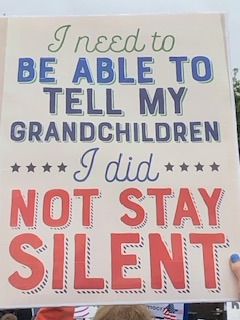
H/T to Erich Martel, former history teacher in D.C. This sign carried in April 5 rally in D.C.

Trump is following through on his frequent threats to punish anyone who crossed him in the past. He recently ordered his compliant Attorney General to investigate two men who were critical of him during his first term. Elie Honig, a former federal prosecutor, wrote about the tyrannical nature of this action and about Pam Bondi’s willingness to do whatever he wants.

Honig writes at the website Cafe, a hub for legal experts:

Donald Trump’s presidential payback tour rages on, and now it’s personal. It’s one thing to target multi-billion dollar law firmsuniversities, and media outlets for organizational retribution; those efforts, aimed at stifling and punishing any criticism or dissent, are reprehensible in their own right. But now Trump is going after individual private citizens, using the might of the Executive Branch to potentially throw his detractors in prison.

In a pair of official proclamations – rendered no less unhinged by the use of official fonts and White House letterhead – Trump identifies two targets who worked in the federal government during his first tenure and dared to speak out publicly against him. First: Chris Krebs, who led the Cybersecurity and Infrastructure Security Agency from 2018 to 2020 and made headlines when he publicly contradicted Trump’s false claim that the 2020 presidential election was stolen. For this act of heretical truth-telling, Trump labels Krebs “a significant bad-faith actor” – whatever the hell that means – who poses grave “risks” to the American public. 

And then there’s Miles Taylor, a former Department of Homeland Security official who publicly criticized the President in an anonymous book and various media appearances. Taylor, like Krebs, purportedly poses “risks” to the United States, is a “bad-faith actor” (though apparently not a significant one like Krebs) and “stoked dissension” with his public commentary. 

Are you scared? Don’t you fear the “risks” posed by these two monsters?

 True to the form he has displayed when going after disfavored law firms, Trump hits below the belt. The President orders security clearances stripped not only from Krebs and Taylor but also from everyone who works with them (Krebs at a private cybersecurity firm, Taylor at the University of Pennsylvania). He’s punishing his targets – plus their employers and colleagues, First Amendment freedom of association be darned. 

It gets worse. In a separate set of orders, Trump directed the Attorney General to open criminal investigations of Krebs and Taylor. Notably absent from the orders is any plausible notion that either might have committed a federal crime. This hardly needs to be said, but it’s not a federal crime to be a “bad-faith actor,” to “stoke dissension,” or even to be a “wise guy,” as Trump called Krebs from the Oval Office.

The next move is Pam Bondi’s – and we know how this will go. 

Any reasonable, ethical attorney general would follow the bedrock principle that a prosecutor must have “predication” – some kernel of fact on which to believe a crime might have been committed – to open a criminal investigation. The bar is low, but it serves the vital purpose of preventing precisely the baseless retributive inquests that Trump has now ordered up. In observance of this foundational precept, even Bill Barr – the subject of sharp criticism in my first book, Hatchet Man – generally ignored Trump’s public pleas for the arrests of Barack Obama, Joe Biden, and others. Like the exhausted parent of an unruly toddler, Barr would mostly sit back and let the tantrum pass. 

Don’t count on Bondi taking the same course of passive resistance to the President. She has already shown her true colors, and they’re whatever shade Trump pleases. For example, despite the distinct possibility of criminality by top administration officials around the Signal scandal, the AG refused even to investigate. Instead, she decreed – after zero inquiry, with zero evidence – that information about military attack plans was somehow not classified, and that nobody had acted recklessly. Case closed, no inquiry needed. 

Bondi no longer deserves the benefit of the doubt. She’s in the bag for Trump. The question now is whether she’ll cross the line that even Barr, her crooked predecessor, would not, and use the Justice Department’s staggering investigative power as an offensive weapon. 

Even if DOJ investigates but concludes it cannot bring a criminal charge, the threat to Krebs and Taylor is real. Any criminal inquiry takes an enormous toll on its subject; subpoenas fly, friends and colleagues get pulled into the grand jury, phones get seized and searched, legal costs mount, professional reputations suffer, personal ties fray. Ask anyone who has been investigated by the Justice Department but not indicted. They’ll tell you it’s a nightmare. 

If Bondi does somehow convince a grand jury to indict somebody for something, Trump has unwittingly handed both Krebs and Taylor a potent defense: selective prosecution, which applies where an individual has been singled out for improper purposes. Exhibit A (for the defense): Trump’s own grand proclamations, which openly confess to his personal and political motives for ordering a Justice Department inquiry. Selective prosecution defenses rarely succeed, often because prosecutors typically don’t commit their improper motives to paper. But this would be the rare case where the evidence is so plain – it’s on White House letterhead, signed by the President – that a judge could hardly overlook it.

Trump has long made a habit of threatening his opponents with criminal prosecution through social media posts and by spontaneous outbursts from the lectern. Until now, it was mostly bluster, a public form of scream therapy for the capricious commander-in-chief. But now it’s in writing, from the president to the attorney general, who typically jumps to attention to serve whatever suits the boss, prosecutorial standards be darned. Trump’s dark fantasies are coming to life. 

Elie Honig served as an Assistant U.S. Attorney in the Southern District of New York for 8.5 years and as the Director of the Division of Criminal Justice at the Office of Attorney General for the State of New Jersey for 5.5 years. He is currently a legal Analyst for CNN and Executive Director at Rutgers Institute for Secure Communities

David Sanger wrote an article in the New York Times about Trump’s “Experiment in Recklessness.” His plan is no plan at all. His approach is no more than “burn-it-down-first,” figure what to do later. His article appeared on Wednesday, before Trump announced a 90-day pause in his incomprehensible plan to tax every nation–even uninhabited islands–but exempt Russia, Belarus, North Korea, and Cuba. Even desperately impoverished Lesotho–where the average pay is $5 a day–was subject to Trump’s tariffs.

Our government is run by a cabal of people who are either evil or stupid or both. Probably both. People will die and are dying now because of their actions. Government agencies are being ripped apart. A generation of scientists has been ousted from important jobs in the government and in universities, where their federal grants have been terminated. All federal efforts to address climate change have been cancelled.

Where Trump goes, chaos , destruction and death go with him.

Sanger writes:

As the breadth of the Trump revolution has spread across Washington in recent weeks, its most defining feature is a burn-it-down-first, figure-out-the-consequences-later recklessness. The costs of that approach are now becoming clear.

Administration officials knew the markets would dive and other nations would retaliate when President Trump announced his long-promised “reciprocal” tariffs. But when pressed, several senior officials conceded that they had spent only a few days considering how the economic earthquake might have second-order effects.

And officials have yet to describe the strategy for managing a global system of astounding complexity after the initial shock wears off, other than endless threats and negotiations between the leader of the world’s largest economy and everyone else.

Take the seemingly unmanaged escalation with China, the world’s second largest economy, and the only superpower capable of challenging the United States economically, technologically and militarily. By American and Chinese accounts, there was no substantive conversation between Mr. Trump and China’s top leader, Xi Jinping, or engagement among their senior aides, before the countries plunged toward a trade war.

Last Wednesday, Mr. Trump’s hastily devised formula for figuring out country-by-country tariffs came up with a 34 percent tax on all Chinese goods, everything from car parts to iPhones to much of what is on the shelves at Walmart and on Amazon’s app.

When Mr. Xi, predictably, matched that figure, Mr. Trump issued an ultimatum for him to reverse the decision in 24 hours — waving a red flag in front of a leader who would never want to appear to be backing down to Washington. On Wednesday, the tariff went to 104 percent, with no visible strategy for de-escalation.

If Mr. Trump does get into a trade war with China, he shouldn’t look for much help from America’s traditional allies — Japan, South Korea or the European Union — who together with the United States account for nearly half of the world economy. All of them were equally shocked, and while each is negotiating with Mr. Trump, they seem in no mood to help him manage China.

“Donald Trump has launched a global economic war without any allies,” the economist Josh Lipsky of the Atlantic Council wrote on Tuesday. “That is why — unlike previous economic crises in this century — there is no one coming to save the global economy if the situation starts to unravel.”

The global trading system is only one example of the Trump administration tearing something apart, only to reveal it has no plan for how to replace it.

State Department officials knew that eliminating the U.S. Agency for International Development, the nation’s premier aid agency, would inevitably cost lives. But when a devastating earthquake struck central Myanmar late last month and took down buildings as far away as Bangkok, officials scrambled to provide even a modicum of help — only to discover that the network of positioned aid, and the people and aircraft to distribute it, had been dismantled.

Having dismantled a system that had responded to major calamities before, they settled on sending a survey team of three employees to examine the wreckage and make recommendations. All three were terminated from their jobs even while they stood amid the ruins in the ancient city of Mandalay, Myanmar, trying to revive an American capability that the Department of Government Efficiency — really no department at all — had crippled.

Secretary of State Marco Rubio was unapologetic about the paltry American response when he talked to reporters on Friday: “There are a lot of other rich countries, they should also pitch in and help,” he said. “We’re going to continue to do our part, but it’s going to be balanced with all of the other interests we have as a country.”

Similarly, there was no plan for retrieving a Maryland man who was wrongfully deported to a notoriously dangerous Salvadoran prison, a move a judge called “wholly lawless” and an issue the Supreme Court is expected to take up in the next few days. A Justice Department lawyer in the case was placed on administrative leave, apparently for conceding that the man never should have been sent to the prison.

Mr. Trump has appeared mostly unmoved as the knock-on effects of his policies take shape. He has shrugged off the loss of $5 trillion in the value of the American markets in recent days. Aboard Air Force One on Sunday night, he said: “Sometimes you have to take medicine to fix something.”

To finish reading the article, click here. It should be a gift article.

Friends, we are in a whole lot of trouble. Trump is not a businessman. He played one on TV. He is a performer. He is in way over his head. He called Elon Musk a “genius.” Musk called Trump’s trade advisor Peter Navarro “a moron.” Trump allowed Musk to tear almost every federal agency apart, destroying vital programs and firing essential personnel.

We have to push back as hard as we can. Trump and his minions have retreated on some of their stupid actions (like purging Harriet Tubman and the Jnderground Railroad of its role in helping slaves escape). Little victories like this should encourage wider protests against the chaos that Trump has unleashed. Is he doing it for Putin’s benefit? Does he suffer from dementia?

RESIST! PROTEST! STAND UP AND BE COUNTED!

In his vendetta against law firms who represented his opponents, universities whose high standards offend him, and anyone who dared to stand up to his lies, Trump has selected two former government employees for retribution. These actions are typical of dictators. Trump is wannabe dictator. He certainly aspires to be a full-fledged fascist. He has a compliant Departnent of Justice. Attorney General Pam Bondi thinks she works for Trump, not the people of the United States.

The blog SpyTalk is written by Jeff Stein.

He writes:

President Trump on Wednesday signed an executive ordering the Justice Department to investigate two prominent former senior Homeland Security officials, saying they could be guilty of “treason” because of their criticism of him. 

Trump also stripped Miles Taylor and Chris Krebs of their security clearances, although it was not clear if they maintained any. The order “also suspends any active security clearance held by individuals at entities associated with Taylor, including the University of Pennsylvania,” where Taylor is an adjunct professor, “pending a review of whether such clearances are consistent with the national interest.”

Likewise, the order also suspends security clearances held by associates of Krebs at SentinelOne, a California-based cyber security firm, where he is currently employed as the company’s chief intelligence and public policy officer.

Taylor, who served as the chief of staff to Homeland Security Secretary John Kelly during the first Trump administration, drew Trump’s wrath for writing a blistering, New York Times Op-ed, titled, “I Am Part of the Resistance Inside the Trump Administration“, and later a book, A Warning, both under the pen name “Anonymous,” detailing his concerns about the president’s policies. The Op-ed unleashed a furious media campaign to identify him. After he surfaced in October 2020, he became a prominent TV critic of Trump 

“You can’t have that happen,” Trump said as he signed the executive order, adding, “I think he’s guilty of treason if you want to know the truth, but we’ll find out.” 

The executive order called Taylor “a bad-faith actor who weaponized and abused his government position, prioritizing his own ambition, personal notoriety, and monetary gain over fidelity to his constitutional oath.”

Taylor responded on X (formerly Twitter): “I said this would happen. Dissent isn’t unlawful. It certainly isn’t treasonous. America is headed down a dark path. Never has a man so inelegantly proved another man’s point.”…

It’s almost funny to see Trump criticize anyone for failure to be faithful to their “constitutional oath,” since he has violated his own constitutional oath on a daily basis.

Rex Huppke writes opinion columns for USA Today. In his latest column, he muses about Trump’s on balance as most Americans watch their retirement savings melt away.

He has a way of finding the humor in gut-wrenching events. Recently he has been writing about Trump’s demolition of the global economy. Don’t worry if your life savings is shrinking. Trump isn’t worried. Trump promises a future of plenty, someday. Trust him at your own risk.

It’s important to remember that Trump was never a successful businessman. He filed for bankruptcy six times. American banks would not lend him money because he was not credit-worthy. His “Trump University” was required by the courts to pay former students $25 million for defrauding them. People forget that he played a businessman on TV. If they knew that, they might be reluctant to support his decision to impose tariffs on every nation (except Russia, North Korea, Cuba, and Belarus.) He literally doesn’t know what he’s doing.

He thinks we should not have any deficits. I heard a law professor explain how crazy that idea is. He said, “I shop at my local grocery store and have spent thousands of dollars there. They don’t buy anything from me. I have a large trade deficit with that store.” Nuts.

Huppke writes:

While Americans reeled from watching the economy tank and their retirement accounts get slap-chopped, President Donald Trump – lover of tariffs, destroyer of economies, liar above all – spent the weekend golfing in Florida and hobnobbing with wealthy pals.

He was gracious enough to take a break from the links Saturday to tell Americans, via social media, to “HANG TOUGH.”

Thanks, buddy. As we await whatever fresh hell Monday’s stock market brings and brace for the global response to the ludicrous tariffs you slapped on pretty much everyone, including some random penguins, we’ll do our best to hang tough, comforted by the fact that you and your assorted weirdo billionaires had a lovely weekend.

Look, the let-them-eat-cake vibe of Trump golfing while our economy burns – he even posted a video of himself playing on one of his own stupid golf courses – is enough to put satirists out of work.Need a break? Play the USA TODAY Daily Crossword Puzzle.

And I’d almost be able to swallow the maddening absurdity of it all if Trump and his Republican barnacles would just straight up admit their galactic-level hypocrisy.

What if a Democratic president had done this?

None of what Trump is doing with tariffs is a surprise. He told us over and over that he was going to do this. He has repeatedly demonstrated that he doesn’t care about anyone other than himself.

So, of course, he has ignorantly unleashed tariffs that are upending the world trade order and making everyone hate us. Anyone surprised by this insanity hasn’t been paying attention.

But imagine an America where a Democratic president got fixated on tariffs while clearly not understanding how tariffs work. An America where that Democratic president needlessly triggered a trade war, watched the stock market plummet for two days, then trotted off for a golf weekend during which he profited off people partying at his resort.

Would Fox News preach patience if a Democrat tanked the economy?

And let’s say this Democratic president has a weirdo rich pal he named Treasury secretary, and that guy – who’s worth a cool half-billion at least – went on TV and shrugged off the idea that Americans thinking about retiring are worried about the tariffs fallout.

In this scenario, Republicans would have already impeached the Democratic president – twice. Pitchfork sales among right-leaning Americans would have skyrocketed, and the Treasury secretary would have had to flee the country. Fox News would have wall-to-wall coverage painting this hypothetical president as a literal demon and demanding he step down because he’s insane or a communist or both.

That would bring a third impeachment from Republicans, and Fox News itself, along with the entire right-wing media ecosystem, would explode with enough ferocity to open a portal to another dimension.

Imagine if Biden did even a fraction of the damage Trump has done.

That hypothetical is 1,000% accurate. You know it. I know it. Republicans know it, and Fox News sure as hell knows it.

If Joe Biden, as president, intentionally murdered the stock market, it would have ended his presidency. Period. Biden, instead, made our economy the envy of the world and Republicans still wanted to end his presidency. So don’t tell me any of what Trump is doing would be even momentarily tolerated if Trump were a Democrat. 

This point is not debatable.

I’m sick of people shrugging off GOP hypocrisy – they need to own it

So all I ask, as my 401(k) shrivels like a raisin and rich jerks keep telling me to suck it up, is that Trump and his Republican bootlickers and all the little goobers on Fox News and Newsmax and the Illustrious King Trump Mighty Genius Appreciation Network (I might’ve made that last one up) muster the decency to admit they’re giant freakin’ hypocrites.

I’m talking about apex hypocrites. These are unrivaled practitioners of the dark art of hypocrisy. 

And they need to own it.

Better to be poor and honest than poor and a liar, right?

C’mon, tough guys. Show a modicum of courage and tell us what we already know. 

What do you have to lose? Your guy is in charge. He’s taking a wrecking ball to America, and there’s little people like me can do other than come up with clever opposition slogans for protest signs.

As the markets crash and the imaginary factories Trump keeps babbling about never come and regular Americans start Googling recipes that can stretch a pack of bologna out for a full week, Republicans need to say it loud and say it proud: “We are total hypocrites and we’re only OK with this mess because a Republican created it!”

You may end up as broke as the rest of us, but at least you’ll be able to tell your pauper children that, in the end, you were honest.

Do it, you cowards.