Archives for category: Creativity

If you plan to visit NYC (or live in it or near it), I have some recommendations for you.

You are not allowed to visit NYC without taking in a Broadway show. Did you know that?

I saw three outstanding shows recently, which I unequivocally recommend.

The great and timeless Ibsen play “An Enemy of the People” is spectacular. It has been updated. It stars Jeremy Strong (“Succession”) and Michael Imperioli (“The Sopranos” and “White Lotus”). What a great show!

If you want to laugh a lot, see “Spamalot,” a hilarious comedy-musical that was written by Eric Idle of the Monty Python troupe. It incorporates some of their funniest skits. The final performance is April 7.

If you want to see a spectacular musical, see “Moulin Rouge.” Boy George is one of the stars. Prepare to be dazzled. Don’t bring the children! It’s very bawdy, and there is quite a lot of female flesh.

You can often get cheap seats at a website called TodayTix. It also sells advance seats. In the center of Times Square, there is a large booth called TKTS where you can buy same-day tickets at a steep discount. Some theaters have standing-room tickets. It never hurts to ask at the box office before the performance. Sold-out shows sometimes get last-minute returns from ticket brokers.

Enjoy!

Greg Olear is a novelist and journalist. His blog is called “Prevail.” He is author of Dirty Rubles: An Introduction to Trump/Russia. When I was in high school, I memorized poetry. It’s a great gift. He posted this today.

Dear Reader,

Roland Flint, who taught my Introduction to Poetry class freshman year at Georgetown, gave us extra credit for memorizing poems. Back then, my now-beleaguered brain was still in top operating condition, and I loved poetry and admired the professor, so I took full advantage of this. Other, more pragmatic students chose the shortest poems they could find to memorize; to show off, and because it’s not un-useful to be familiar with 250-year-old rhyming-couplet pick-up lines, I went with “To His Coy Mistress.”

With his red beard and his paunch and the glimmer in his eye, Flint was a commanding presence, stocky and stout, and blessed with a booming baritone that he sometimes used to sing Bulgarian folk songs. (You can see him in action here.) To demonstrate what we’d have to do to earn points, he recited a poem that he himself knew by heart. It was called “Two-Headed Calf,” by Laura Gilpin, and it blew all of us away. I memorized it too, and when I’m in the right mood, I still recite it to myself, all four sentences of it, and marvel at its power to move me.

Polycephaly is a genetical blip that in bovines is a death sentence. Calves with two heads—or, more commonly, two faces—are usually stillborn. With extremely rare exceptions, two headed-calves that survive birth die in a matter of days, if not hours. Flint, who grew up on a farm in Nebraska, certainly knew more about this sort of thing than this child of the Jersey suburbs.

Here is Gilpin’s poem, which I have known by heart since 1991:

Two-Headed Calf

Tomorrow when the farm boys find this
freak of nature, they will wrap his body
in newspaper and carry him to the museum.

But tonight he is alive and in the north
field with his mother. It is a perfect
summer evening: the moon rising over
the orchard, the wind in the grass. And
as he stares into the sky, there are
twice as many stars as usual.

Three decades and change later, it still kills me every time.

Why does nature fate some of us to live long, healthy lives, while others suffer in sickness and infirmity? Is there larger purpose to this design, or is it just random probabilities—simple, brutal math?

Gilpin died young. She was a poet of acclaim—she won the Walt Whitman Award in 1976 for her first poetry collection, The Hocus-Pocus of the Universe—with degrees from Sarah Lawrence and Columbia, and taught in the city for a time. Later she became a registered nurse. She worked for Planetree, and was a tireless advocate for its patient-oriented care model. In the late summer of 2006, she was diagnosed with glioblastoma multiforme, an incurable brain cancer marked by terrible headaches, nausea, and (ironically, given that poem) double vision. She died half a year later, at age 56, right after finishing a second poetry collection, The Weight of a Soul.

After two Sundays in a row of breaking down heady novels, I intended this week to share something light, something simple and beautiful that did not require interpretation. For one thing, the news from the last seven days has been particularly bleak. For another, today is March 3—my father’s birthday. He would have been 76.

I considered writing about Roy Orbison, who my dad loved, but there was nothing I could think to say about The Big O that hadn’t already been better expressed by the likes of Bob Dylan and Bruce Springsteen. Then I remembered “Two-Headed Calf.” I hadn’t shared it previously because it is relatively recent. But as both of Gilpin’s books are currently out of print, my hope is that some attention paid to her work might convince a publisher to re-issue her collections.

As I read about Gilpin last night, I came upon her obituary, which contains a quote from one of her poems, “Life After Death,” that I’d never heard before. I tracked it down and read it. This poem, too, requires no interpretation, and seems especially appropriate for my father’s birthday. 

At the end of this ugly week, Dear Reader, I leave you with something beautiful:

Life After Death

These things I know:
How the living go on living
and how the dead go on living with them
so that in a forest
even a dead tree casts a shadow
and the leaves fall one by one
and the branches break in the wind
and the bark peels off slowly
and the trunk cracks
and the rain seeps in through the cracks
and the trunk falls to the ground
and the moss covers it
and in the spring the rabbits find it
and build their nest
inside the dead tree
so that nothing is wasted in nature
or in love.

Jess Piper is a Democratic activist in rural Missouri. She is a fierce advocate for rural communities and public schools. She lives on a farm where she and her husband raise hogs and chickens. She blogs, she makes videos for TikTok, she tweets, she hosts a podcast called Dirt Road Democrats and is executive director of Blue Missouri. She taught American literature for 16 years. She often writes about the absurdity of vouchers and school choice. In this post, she goes to towns in her district to gather signatures to restore abortion rights in Missouri..

I live at the tippy top of NWMO on a small 7 acre farm in a 125 year old farmhouse with a few dogs, a couple cows, a gaggle of kids and grandkids, and a miniature donkey. Everyone perks up when I mention the donkey…he’s 36 inches high and his name is Augustus.

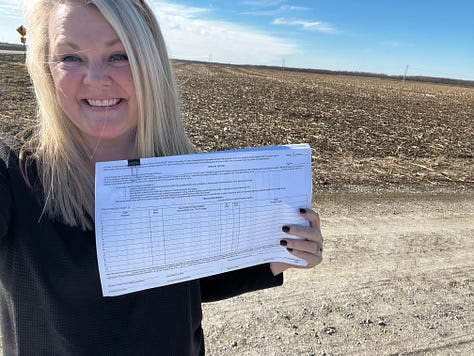
I drive across the state often these days and I am usually headed to a small town and this week was no different—I visited Chillicothe (the home of sliced bread), Carrolton, and Marceline and you’ll never guess why. I was getting rural folks and their Bible groups to sign the petition to restore abortion rights in Missouri.

Dirt Road organizing.

Missouri is in the process of putting abortion on the ballot and I have the petition—I have to tell you it’s kind of hard to get a petition, so I was excited to get them and also overwhelmed. I have to get this out to rural folks, and it’s not as easy as it would seem. 

First, there is the opposition to the petition—the Missouri Right to Life (Right to force others to gestate and deliver) has a literal snitch line to report folks accepting signatures. Now, I have no idea what they plan to do if they find us accepting signatures. I was raised to take care of myself and they shouldn’t mess with me, and I’m not the least bit intimidated, but I don’t want them to harass other rural folks who are signing quietly.

Second, folks have written off my congressional district—even some progressives who need signatures on a ballot initiative. They assume that we are too red to get enough signatures, so what’s the point, right? I’ll tell you the point: it creates excitement and solidarity in rural spaces. It acts to uplift us living in among MAGA extremists. It gives us hope.

Chillicothe was my first stop, and it is a pretty big town at over 9K folks. Chilli is also known for having a “patriot” group who have been successful in putting their extremists on the local health board — they also regularly object to school library books. Folks were on long text chains to get others to the event. I was able to gather about 30 signatures on a Tuesday at 9am. 

I was directing folks to the petition and how to fill it in correctly. One woman filled it out, stood up, and started texting. She told me, “I’m reminding my Bible group to come sign.” 

Wait…what?

The second place I drove was Carrolton, with a population of about 3,400. Still not tiny, but small. I sat in the basement of the library for almost 2 hours with…wait for it…a local pastor. A woman pastor. She signed the petition and then stayed the length of the signing event and visited with every single person who came in. Several folks attended her church or a neighboring church. 

Are you seeing a theme here?

My last stop of the day was in Marceline, population 2,100. I sat in the fire station with a local Dem organizer and we accepted signatures a few feet from the active train crossing. I met with a local candidate running for state house and again, folks signed, stood up, texted friends and relatives and their church community, and then headed back out to their farms and rural life.

This is why I organize in rural spaces across the state. This is why I drive 5 or 6 or 10 hours to meet with rural folks. They matter—we matter.

When we cede ground because it’s too red, because it’s too evangelical, because it’s too far of a drive, we create a self-fulfilling prophecy. It’s become more red, more uncontested. When we tell rural folks that their votes and signatures don’t matter because there aren’t enough of them, they agree and stop showing up. When we say Democrats and progressives support everyone, yet fail to have a presence in rural spaces, they notice…they know it’s a lie.

We can’t win Missouri if we avoid rural parts of the state. Missouri is 1/3 rural…33% of the state is outstate. 

I’m here and so are thousands of my friends. If state-level organizers will remember us, we can bring sanity back to the entire state.

Dirt Road Democrats are here.

~Jess

Secretary of Education Miguel Cardona has been nearly invisible these past three years, other than lamenting test scores. Veteran educator Nancy Bailey has some suggestions about how he could help kids, schools, and teachers right now. This post was reposted by the Network for Public Education.

The secretary keeps talking about raising the bar. Nancy Bailey has some thoughts about some bars he could work on. Reposted with permission.

She writes:

Education Secretary Cardona focuses on reducing absenteeism, tutoring, and after-school programs. And he refers to raising the bar, which sounds like A Nation at Risk talk.

Yet there are so many K12 issues that Cardona and the Biden administration could address, lead, and support the states and local school districts.

Here are some educational issues Cardona should drive this new year. If you have more, please share.

1. The Arts

Poor public schools have gone without the arts for years. Cardona should push for qualified art and music teachers for every school.

The arts help students struggling with mental health difficulties, and jobs exist in the arts.

Every child in K12 should have access to a vital arts program.

2. Career Education

Career-technical education is essential, but companies pushing their agendas into high schools to get workers raises concerns.

Tax dollars should help students decide what careers they want, giving them the chance to experience high school, not creating schools for corporate preparation.

3. Class Size

Reducing class sizes would help students with disabilities in inclusion classes and is essential for student safety. Cardona must endorse lowering class sizes and showcase schools that do.

If schools can’t lower every class (classes like P.E. wouldn’t be necessary), give students access to at least one small class where they are known.

Lowering class sizes in K-3rd grade would also help children get a good start. See the STAR Study.

4. Corporal Punishment

In 2023, The Washington Post reported that 15 states still permitted corporal punishment in schools (St. George, 2023). Like Florida, which vaguely gives a nod to it. Teens who wear the wrong kind of prom dress or misunderstandings resulting in paddling are examples.

Cardona deserves praise for standing against corporal punishment last year in schools, claiming educators should favor evidence-based approaches and that there should be no spanking, hitting, or paddling.

5. Data

Cardona must study and draw attention to child privacy laws which are currently inadequate.

In 2018, the NEPC published Educating All Our Children: Your Kids, Their Data, No Privacy by Linda McSpadden McNeil.

She stated:

When children’s privacy is violated in ways that are overt, visible, and knowable, the violation is unquestioned. It is unacceptable. In most cases, it is illegal.

So why is it different when the violation is hidden, opaque, electronic, commercial, and complicated?

6. High-Stakes Standardized Testing

President Biden promised teachers and parents he’d end harmful high-stakes standardized tests. Instead, he pushed assessments even during the pandemic.

Can Cardona show the American people who want these tests reduced or eliminated what, if anything, the Biden administration will finally do to end high-stakes standardized tests?

7. Lead in School Pipes

The Biden-Harris team promised to repair the lead pipes in homes and schools. They’re to be commended for this. It would be nice, however, if Cardona presented a report.

No amount of lead is O.K. for developing children, and it can lead to learning disabilities.

8. Reading

Reading has become a volatile issue, and Cardona has been mostly silent. Many commercial programs with little independent study, but nonetheless called the Science of Reading, are being pushed into classrooms.

The subject of reading deserves a better forum than short, often hostile debates on X.

Cardona should call for a new National Reading Panel to study programs and address reading instruction. The panel should include teachers who teach reading since they were left off the last panel. This panel should consider the concerns of the last NRP member, the only educator on the panel, Joanne Yatvin (Yatvin, 2002). Parents should also be given a voice on this panel. A new NRP would allow for a better collection of the research, old and the latest findings, and a review of the work of the last NRP.

9. Recess

Every public school in the nation should give children several unstructured breaks throughout the school day, supervised, on safe, well-designed playgrounds.

Driving students to work nonstop with mindfulness training or a dozen other excuses to bypass recess should not be permitted.

10. School Buildings

Americans need to know the status of their public school buildings. How are the HVAC systems and air quality? How many school facilities are still falling apart? Are public school buildings safe?

Are new schools being built to support teachers?

11. School Choice

The Biden administration discussed regulating charter schools (Lieberman, 2022). But concerns about vouchers, educational savings account, nonprofit and for-profit charters, and religion in schools needs to be better addressed.

In addition, the Biden administration should describe what they mean by community schools (often called charter schools), partnerships, and social impact bonds and how these schools are still public.

12. School Libraries and Librarians

It’s an abomination to drill children to learn to read in poor schools, and then not provide them a school library with a qualified school librarian.

Closing school libraries has been a disaster in many school districts, see Philadelphia as an example.

13. School Safety

The gun lobby is unfortunately influential, so despite shootings in this country, don’t hold your breath for meaningful gun laws. It was thoughtful of Cardona to visit Parkland.

In the meantime, school administrators must devise creative ways to make schools safe and identify students in their schools who need mental health help. See class size above.

14. Social-Emotional Learning

Concerns about the data collected on students includes social-emotional learning. Teachers always want their students to be socially and emotionally healthy, but social-emotional learning seems more about collecting unnecessary sensitive data about students.

Who is using this information and why?

15. Special Education

Parents are in danger of losing special education services. The All Handicapped Children’s Act reauthorized to IDEA should have evolved into a more inclusive and better programs for students with exceptional needs, but instead it has been hijacked by those who don’t want to pay for it.

Cardona should look into special education and create a task force to study it and determine exactly how much special education funding schools receive and the kind of services students receive. He might start with Tammy Kolbe’s work and the National Education Policy Center report Funding Special Education: Charting a Path that Confronts Complexity and Crafts Coherence.

16. Teacher Preparation

School reform has changed teacher preparation dramatically. There needs to be more effort to oversee these mostly fast-track nonprofit or for-profit programs often connected to charter schools.

Cardona should step up here to promote fully university-prepared teachers, and he should work with university education programs to improve their coursework and degree offerings. The United States Department of Education might provide scholarships to attract young people who want to pursue a teaching career in university education programs, not unknown nonprofits or charter school preparation.

Fast-track groups like Teach for America are a concern because they turn those without real qualifications into the system with little understanding of child development or what’s needed to teach well, and Grow Your Own programs are ill-defined.

17. Technology

While technology is useful to learning, a recent Columbia University study indicates that children read better with paper print not online.

The Guardian cites MIT neuroscientist John Gabrieli, skeptical about the promises of big tech and its salesmen.

Gabrieli states:

I am impressed how educational technology has had no effect on scale, on reading outcomes, on reading difficulties, on equity issues.

Is Cardona behind teachers or for replacing them with technology? Actions matter.

18. Third-Grade Retention

Third-grade retention is unnecessary. No child should be made to feel like a failure. Children can still learn to read in third grade, can still grow and become great learners. Speaking out on this issue would help end it.

References

St. George, D. (2023, August 10). In over 15 states, schools can still paddle students as punishment. The Washington Post. Retrieved from https://www.washingtonpost.com/education/2023/08/10/school-paddling-corporal-punishment/.

Yatvin, J. (2002). Babes in the Woods: The Wanderings of the National Reading Panel. Phi Delta Kappan, 83(5), 364–369. https://doi.org/10.1177/003172170208300509

Lieberman, M (2022). Lawmakers, Education Secretary Clash Over Charter School Rules. Education Week, https://www.edweek.org/policy-politics/lawmakers-education-secretary-clash-over-charter-school-rules/2022/04

Share this:

FacebookTwitterEmailShare

Readers wishing to comment on the content are encouraged to do so via the link to the original post.

Find the original post here:View original post

I believe that a liberal arts education is the heart and soul of what it means to be an educated person. No matter what job or career or profession you aim for, you are not educated unless you have studied history, literature, the arts and sciences. These are the studies that prepare you for citizenship and for a full life. Can you understand the world if you know little about history? Can you understand political debates about medicine and health if you never studied science? Are you prepared to understand the breadth and depth of the human spirit if you have never learned about art and music?

I think not. Oddly, it seems to me, cutting the humanities is an elitist path, a decision that students in rural areas don’t need or deserve a full education that tends to their mind, their heart, and their soul.

Sadly, The Daily Yonder reports, public colleges and universities in rural areas are slashing courses and majors in the humanities, favoring instead the courses that prepare students for jobs and careers.

Part of the decision is based on declining enrollments, but the state budget for piublic higher education is being cut even wen the stat’s coffers are overflowing. Governors prefer to cut taxes—income taxes or property taxes—rather than invest in the future of their state.

Elaine C. Povich of Stateline reports:

MORGANTOWN, W.Va. — Taya Sullivan, 20, is a freshman at West Virginia University, double majoring in neuroscience and Spanish. She also has a campus job in a linguistics lab, building on her majors and earning money she needs to continue her studies.

Next semester, both her Spanish major and her job will be gone.

Sullivan has been caught up in the university’s decision to eliminate its foreign language majors. The school is axing 28 majors altogether, ranging from undergraduate languages such as French and Russian to graduate majors in math and higher education. It also is cutting 12% of its professors.

Administrators say they’re responding to a budget shortfall, declining enrollment, flagging student interest in humanities courses, and pressure from parents who want their kids to be prepared for good-paying jobs after graduation.

“Are we going to revert back to ‘normal?’ No, we will have a new normal,” said West Virginia University President Gordon Gee in an interview with Stateline. “We are going to be much more oriented toward listening to the people who pay our bills — parents, students, legislators and others. And they very much want to see universities, particularly land grant institutions like ours, become engines of creativity and economic development.”

Many lesser-known public colleges nationwide have begun cutting back on the humanities, but West Virginia University is the “tip of the spear” for flagship state universities, Gee said.

Similar reductions are only expected to grow across the country, particularly in rural areas where campus budgets are lower, enrollments are more likely to be falling, and where the pressure for career-oriented majors may be greater. But critics argue that such changes in emphasis will sap states of intellectual firepower, leaving them with fewer leaders and citizens who are well-rounded.

In West Virginia, the cuts have prompted student demonstrations, a faculty resolution and objections from some lawmakers. Gee is unmoved.

“The budget [deficit] was only an accelerant; it’s change or die,” he said. “We are the first to jump off the cliff. I could make a living from calls from other university presidents to ask, ‘How are you doing it?’ We are having to change. We can no longer be everything to everyone. We’ve got to make choices.”

Other state universities, especially rural ones, are making similar choices. Missouri Western State University has eliminated dozens of majors and minors including English, history, philosophy, political science, economics, sociology, art, Spanish and French. Eastern Kentucky University shut theater programs and economics. The State University of New York at Potsdam is also cutting degree programs, including in art history, dance, French, Spanish and theater.

More cuts could be coming. The Board of Regents for the University of Kansas system announced in June it is reviewing proposals to eliminate programs at the six state universities. The review is meant “to ensure that programs meet student demand, improve student affordability, support Kansas communities and help meet the state’s workforce needs.” A decision is expected in 2024 on which programs to cut or consolidate, said Matt Keith, spokesperson for the Kansas Board of Regents.

Humanities courses such as languages, history, arts and literature are particularly vulnerable nationwide. Schools are more inclined to emphasize business, science, math and technology studies, which could lead to more high-paying jobs.

Students also appear to be turning away from the humanities: Data from the U.S. Department of Education’s National Center for Education Statistics shows that the percentage of bachelor’s degrees conferred by four-year institutions in the humanities dropped from 16.8% of all degrees in the 2010-11 school year to 12.8% in 2020-2021.

State budget reductions and schools’ funding shortfalls also have contributed to cuts, particularly in rural states. State spending on higher education fell in 16 of the 20 most rural states between 2008 and 2018, when adjusted for inflation, according to a Hechinger Report analysis of data from the Center on Budget and Policy Priorities, a research and policy institute that advocates for left-leaning tax policies.

Higher education funding per student declined by more than 30% in Alabama, Louisiana, Mississippi, Oklahoma and Pennsylvania during that period. In Kansas, it went down by nearly 23%.

State budget problems accounted for some of the reductions, but in other cases lawmakers preferred to spend available dollars on roads or K-12 education.

Even when state budgets were flush following a huge outlay of federal funds during the Covid-19 pandemic, many states, including West Virginia, opted for tax cuts rather than investments in higher education. In March, West Virginia Republican Governor Jim Justice signed a law immediately reducing the income tax by an average of 21.25%…

WVU English professor Adam Komisaruk, who also directs graduate studies in the English department, says the larger question is what state universities want to be.

“Is our mission as a university simply to respond to market forces and popular prejudice, and to make educational decisions based on supply and demand? Or are we committed to providing a robust and diverse exposure to modes of thought that will allow our students to become knowledgeable, responsible, ethical engaged members of society?

“If we want to run a vocational training program, fine. But you can’t pretend you are a liberal arts full institution committed not only to our land grant mission to serve the people of the state but also committed to modern ideas of liberal education and broad-based knowledge. You can’t have it both ways.”

Rural students can be particularly affected by university cuts, said Andrew Koricich, executive director for the Alliance for Research on Regional Colleges and an associate professor at Appalachian State University in North Carolina. As West Virginia is a mostly rural state, a higher proportion of its students come from rural areas.

“A lot of states are shifting more toward looking at higher education not just as a public good but as a cost-benefit calculation. Then it becomes a value judgment whether rural students deserve the same education as urban institutions and students,” Koricich said.

Billionaire vs. billionaire. The clash of a feminist titan with a neo-Nazi sympathizer! Get your popcorn and enjoy the tale of how Mackenzie Scott managed to infuriate super-pig Elon Musk. Granted, he’s the richest man in the world–worth $300-400 billion, while she has only $32 billion or so.

But she has made a practice of giving generously to worthwhile nonprofits while he gives away as little as possible.

Marcie Jones has the story at Wonkette, and it’s a great read.

It begins:

Billionaires are mostly despicable Montgomery-Burns type people. But then there’s MacKenzie Scott, one of the few ultra-rich who doesn’t deserve to get tarred and feathered in the coming revolution! She’s the third-wealthiest woman in the United States, 38th in the world, and has now given away $19.25 billion (with a B!) in 2,524 charitable gifts, with a focus on racial equality, LGBTQ+ equality, democracy, and climate change. 

She and her small team seek out nonprofits operating in communities facing high food insecurity, high measures of racial inequity, high local poverty rates, and low access to philanthropic capital. And then she gives away the money with no strings attached. Which is unusual in philanthropy! Also unusual, she’s pretty quiet about it. She has a web site that shows what she has donated to, but there’s no MacKenzie Scott ribbon cuttings, or buildings with her name on them when she drops a check. She donates, then she dips. And she plans to “keep at it until the safe is empty.”

Elon Musk warned that she is destroying Western civilization.

Read it and see what you think.,

Retired teacher Nancy Bailey has a way of putting school issues into perspective. In this post, she explains what recess is, why it’s important, what it is not, and why parents should beware of the programmed substitutes that are offered up instead of real recess. The war against play began with the Reagan-era report “A Nation at Risk,” then went into high gear with the passage of George W. Bush’s “No Child Left Behind” law and was reinforced by NCLB’s wicked stepchildren: Race to the Top and the Every Student Succeeds Act. What everything since 2001 stressed was the importance of test scores, not children’s health and well-being. Play in the era from 2001-2023 was a waste of time that would be better spent practicing for the next test.

Bailey wrote:

The lack of breaks for children and the misrepresentation of what constitutes recess continues to flourish.

School reformers try unsuccessfully to replace recess. But recess is not Playworks, Phys.Ed., meditation, or Brain Breaks controlled by adults who tell children what to do, denying them the ability to learn academic and social skills that recess provides when children are free to learn.

Recess is unstructured play. It’s supervised (supervision is critical) but not controlled by adults. It’s one of the easiest and inexpensive ways to help children flourish in school, and studies have highlighted its importance.

Removing recess from the school day involved one of the terrible school reforms in the ’90s connected to high-stakes standardized tests, with the bizarre belief (see A Nation at Risk) that children need more classwork without breaks.

After a while, adults realized the severe health problems that could arise if children don’t have breaks. Still, now they focus on physical activity and need to understand the significance of the critical social interactions children learn during recess.

In some places like Florida, parents have had to fight for a recess mandate, where they are always at risk of losing even 20 minutes of recess. Fortunately, the legislature allowed 20 minutes for now!

Recess involves unstructured play. As Mr. Rogers said, Play is often talked about as if it were a relief from serious learning. But for children, play is serious learning. Play is the work of childhood.

Conflict resolution and working out difficulties are critical parts of recess and another critical variable involving what children learn with unstructured play.

Playworks

The Pulse’s reporter Grant Hill, a Philadelphia NPR/PBS station, recently reviewed recess and its role in conflict resolution, especially after COVID-19. In Getting Better at Resolving Conflict, the recess discussions are at the end, and Hill covers recess’s importance. I get a short spot criticizing Playworks. The CEO misinterprets what recess involves and seems not to understand the impact of controlling what children do. This is not actual recess.

Playworks is a nonprofit run by volunteers from Americorps. It cashes in with donations from various outside corporations, people who likely confuse actual recess with an organized version of what is like Phys. Ed.

If charitable organizations were looking to assist with play and actual recess, they’d seek out poor schools with lousy playgrounds and fund those or find a way to offer children actual recess.

It’s also insulting to hear volunteers in a nonprofit getting donations and tax dollars say one of their purposes is to show teachers the importance of play. If Americorps volunteers want to work with children, they might consider becoming teachers.

Playworks is not alone in skewing the meaning of recess. Recess has been replaced with other inadequate substitutes like Phys. Ed., meditation, and Brain Breaks. Some classes have children sitting on bouncy balls, thinking that nonstop balancing keeps them on their toes!

Please open the link to learn about other efforts to supplant recess.

The school board of Sherman, Texas, was faced with a dilemma. The theater department of the high school had planned for months to put on a production of “Oklahoma,” a standby of American musicals. The cast was selected, the students built a set, the play was scheduled. But when the lead left the cast, the director replaced him with Max Hightower, a transgender student. The district superintendent promptly canceled the production; the set was demolished. But then something amazing happened.

The New York Times reported:

A school district in the conservative town of Sherman, Texas, made national headlines last week when it put a stop to a high school production of the musical “Oklahoma!” after a transgender student was cast in a lead role.

The district’s administrators decided, and communicated to parents, that the school would cast only students “born as females in female roles and students born as males in male roles.” Not only did several transgender and nonbinary students lose their parts, but so, too, did cisgender girls cast in male roles. Publicly, the district saidthe problem was the profane and sexual content of the 1943 musical.

At one point, the theater teacher, who objected to the decision, was escorted out of the school by the principal. The set, a sturdy mock-up of a settler’s house that took students two months to build, was demolished.

But then something even more unusual happened in Sherman, a rural college town that has been rapidly drawn into the expanding orbit of Dallas to its south. The school district reversed course. In a late-night vote on Monday, the school board voted unanimously to restore the original casting. The decision rebuked efforts to bring the fight over transgender participation in student activities into the world of theater, which has long provided a haven for gay, lesbian and transgender students, and it reflected just how deeply the controversy had unsettled the town.

The district’s restriction had been exceptional. Fights have erupted over the kinds of plays students can present, but few if any school districts appear to have attempted to restrict gender roles in theater. And while legislatures across the country, including in Texas, have adopted laws restricting transgender students’ participation in sports, no such legislation has been introduced to restrict theater roles, according to the National Conference of State Legislatures.

The board’s vote came after students and outraged parents began organizing. In recent days, the district’s administrators, seeking a compromise, offered to recast the students in a version of the musical meant for middle schoolers or younger that omitted solos and included roles as cattle and birds. Students balked.

After the vote, the school board announced a special meeting for Friday to open an investigation and to consider taking action against the district superintendent, Tyson Bennett, who oversaw the district’s handling of “Oklahoma!,” including “possible administrative leave.”

Suddenly, improbably, the students had won.

“I’m beyond excited and everyone cried tears of joy,” Max Hightower, the transgender senior whose casting in a lead role triggered the ensuing events, said in a text message on Tuesday. He and other theater students were at a costume shop on Tuesday, a class trip that had been meant as a consolation after the disappointment of losing their production. Instead, it turned into a celebration. “I’m getting new Oklahoma costumes!!” he said.

Before the school board vote Monday night, high schoolers and their parents had gathered at the district’s offices along with theater actors and transgender students from nearby Austin College. Local residents came to talk about decades of past productions at Sherman High School of “Oklahoma!,” which tells the story of an Oklahoma Territory farm girl and her courtship by two rival suitors. Many scoffed at the district’s objections to the musical, which school officials complained included “mature adult themes.”

“‘Oklahoma!’ is generally regarded as one of the safest shows you could possibly pick to perform,” said Kirk Everist, a theater professor at Austin College who was among those who came to speak. “It’s almost a stereotype at this point.”

Every seat in the room was filled, almost entirely with supporters of the production. Some lined the walls while others who were turned away waited outside. Of the 65 people who signed up to speak, only a handful voiced support for the district’s restrictions.

The outpouring came as a shock, even to longtime Sherman residents.

“What you’re seeing today is history,” said Valerie Fox, 41, a local L.G.B.T.Q. advocate and the parent of a queer high schooler. Ms. Fox said she was taken aback by the scene of dozens of transgender people and their supporters holding signs and flags outside the district offices. “This is one of the biggest things we’ve seen in Sherman.”

The town, a short drive from Dallas, has been a place where many conservatives have gone to escape the city. Some were supportive of the superintendent’s initial decision to restrict the musical.

“Adult content doesn’t belong in high school; they’re still kids,” Renée Snow, 62, said earlier on Monday as she sat with her friend on a bench outside the county courthouse. “It’s about education. It’s not about lifestyle.”

Her friend, Lyn Williams, 69, agreed. “It doesn’t seem like anyone is willing to stand up for anything anymore,” she said.

At a local shoe store, no one needed to be reminded of the details of the controversy. One shopper, shaking a pair of insoles, said that she believed that God made people either male or female, and that the issue was a simple as that.

Inside the courthouse, Bruce Dawsey, the top executive for Grayson County, described a rural community coming to terms with its evolution into a place where urban development is altering the landscape. Not far away, more than a half-dozen cranes could be seen towering over a new high-tech facility for Texas Instruments. The high school, with more than 2,200 students, opened on a sprawling new campus in 2021, its grass still uniform, its newly planted trees still struggling to provide shade. With all the growth, the school is already too small.

“The majority is Republican, and it’s conservative Republican,” Mr. Dawsey said. “But not so ultraconservative that it’s not welcoming.”

Still, some in and around Sherman have chafed at the changes. When Beto O’Rourke, a Democratic candidate for governor, campaigned through the county last year, he was met with aggressive protesters who confronted him over gun rights, some carrying assault-style rifles. A few wore T-shirts suggesting opposition to liberal urban governance: “Don’t Dallas My Grayson County.”

But the controversy over “Oklahoma!” came as a surprise. The musical had been selected and approved last school year, casting was completed in August and more than 60 students in the cast and crew — as well as dozens of dancers — had been preparing for months. Performances were scheduled for early December.

Max, 17, had been cast in a minor role. But then, in late October, one of the leads was cut from the production, and Max got the part, the biggest he had ever had. He was elated.

Days later, his father, Phillip Hightower, got a call from the high school principal, who told him that Max could not have the part because, under a new policy, no students could play roles that differed from their sex at birth. “He was not rude or disrespectful, but he was very curt and to the point,” Mr. Hightower recalled.

The district later denied having such a policy. But the principal also left messages for other parents whose children were losing their roles, one of which was shared with The New York Times.

“This is Scott Johnston, principal at Sherman High School,” a man’s voice said on the recording. “Moving forward, the Sherman theater department will cast students born as females in female roles and students born as males in male roles.”

The message diverged from the rules for high school theater competitions in Texas, which allow for students to be cast in roles regardless of gender.

The district did not make Mr. Johnston or the superintendent, Mr. Bennett, available for an interview.

In his previous role as an assistant superintendent, Mr. Bennett had objected to the content of a theater production by Sherman High School, according to the former choir director, Anna Clarkson. She recalled Mr. Bennett asking her to change a lesbian character into a straight character in the school’s production of “Legally Blonde” in 2015, and to cut a song entitled “Gay or European?”

At the school board meeting on Monday, theater students from the high school described how things had become worse for gay and transgender students at school since the production was halted. Slurs. Taunts. Arguments in the halls.

“People are following me around calling me girl-boy,” said Max.

Kayla Brooks and her wife, Liz Banks, arrived at the meeting bracing for a tough night. Their daughter Ellis had lost a part playing a male character, and they had been actively working with other parents to oppose the changes.

“We were both nervous, because we live in Sherman,” said Ms. Banks. Then they saw the large, supportive crowd outside. “We began weeping in the car,” Ms. Brooks said.

The school board sat mostly stone-faced as dozens of people testified in support of the theater students, sharing personal histories. A transgender student at Austin College said he had not before come out publicly. Sherman residents lamented the way the school district’s position had made the town look.

“I just want this town to be what it can be and not be a laughingstock for the entire nation,” one woman, Rebecca Gebhard, told the board.

After nearly three hours, the board went behind closed doors. The crowds left. Few expected a significant decision was imminent.

Then, after 10 p.m., the board took their seats again and introduced a motion for a vote: Since there was no official policy on gender for casting, the original version of the musical should be reinstated. All seven board members voted in favor, including one who had, months before, protested against a gay pride event.

“We want to apologize to our students, parents, our community regarding the circumstances that they’ve had to go through,” the board president, Brad Morgan, said afterward.

Sitting in their living room on Tuesday morning, Ms. Banks and Ms. Brooks recalled how their daughter delivered them the news. “She just said, ‘We won,’” Ms. Brooks said. “She was beaming, smiling ear to ear.” The musical would be performed in January.

The couple decided, for the first time, to hang a pride flag in the window of their home. For now, they felt a little more confident in their neighbors than they had a day before.
FOR IMMEDIATE RELEASE

From: Black Brown Dialogues on Policy co-founders: Angela Valenzuela, Ph.D. and

Gary Bledsoe, Esq. , Chair of the Texas NAACP


For more information, please contact Angela Valenzuela, Ph.D. at

blackbrownpolicy@gmail.com (512) 232-6008


In this moment of a dismantling of Diversity, Equity, and Inclusion (DEI) initiatives in Texas colleges and universities, along with toxic, polarizing battles in the Texas State Legislature and in local school boards throughout Texas, we invite you to the Inaugural Black Brown Dialogues on Policy Capitol Storytelling Event during the Texas Book Festival.

This in-person and online event takes place in the Member’s Lounge (E2.1002), at the Texas

State Capitol on Sunday, November 12, 2023 at 10:00 a.m. CST in partnership with National LULAC, the Texas NAACP, Mexican American Legislative Caucus, Latino Texas Policy Center, and the Texas Center for Education Policy.

Virtually, this event will be livestreamed and available live online at www.facebook.com/TeamBlackBrown.

Now, more than ever, we must come together as a Black and Brown community to amplify our collective power through community storytelling.Treat yourself on this day to oral stories of Black and Brown coalitional and partnership work that has been carried out throughout time in Texas. Author and Texas oral history researcher Dr. Max Krochmal will present from his book, Civil Rights in Black and Brown (University of Texas Press). UT History Professor Emilio Zamora and Texas NAACP President Gary Bledsoe will share instances in history when Black and Brown people worked together in solidarity. The Honorable Aicha Davis will discuss the importance of Black and Brown coalitional work at the Texas State Board of Education.

Former Ft. Worth ISD Board Member Dr. Jacinto “Cinto” Ramos, My Brother’s Keeper

Director Rickie Clark, Round Rock ISD’s Tiffanie Harrison will present on local school board struggles. Independent Scholar Martha P. Cotera will share her wealth of experience in Austin and enduring accomplishments by Austin’s Black and Brown working class community. A panel of students will close the event with their reflections of what was shared and how we move forward.

“Organizing this event is a dream come true,” says BBDP co-founder Gary Bledsoe. “It is to our own detriment if we fail to come together as a Black and Brown community to address matters of mutual concern.” This event is free and open to the public. We encourage community members, university faculty, students, advocates, and lawmakers to attend in person and online.

For more information about the town hall meeting, please contact Angela Valenzuela, Ph.D. at

blackbrownpolicy@gmail.com.

WHEN: Sunday, Nov. 12, 2023 at 10:00 a.m.

WHERE: Member’s Lounge (E2.1002), Texas State Capitol Annex Underground

Virtual: https://facebook.com/TeamBlackBrown

INTERVIEW OPPORTUNITY: Angela Valenzuela, Ph.D. and Gary Bledsoe, Esq.

There are some wonderful things happening in our public schools. HBO is featuring a film about the music created by students at the Hill-Freedman World Academy. HFWA is a public high school for high-performing students.

**TUNE-IN**TUNE-IN**TUNE-IN**

Presents

STAND UP & SHOUT: SONGS FROM A PHILLY HIGH SCHOOL

Debuts Tuesday, NOVEMBER 7 on HBO and Max

From Get Lifted Film Co.

NOW AVAILABLE TO SCREEN UPON REQUEST

StandUpandShout@id-pr.com  

The HBO Original documentary STAND UP & SHOUT: SONGS FROM A PHILLY HIGH SCHOOL , directed by Emmy ® and Peabody winner Amy Schatz (HBO’s “We Are the Dream: The Kids of the Oakland MLK Oratorical Fest” and “In the Shadow of the Towers : Stuyvesant High on 9/11”) and executive produced by the award-winning team at Get Lifted Film Co., Emmy ® and Tony ® winning producer Mike Jackson, EGOT recipient John Legend, and Emmy ® -winner Ty Stiklorius, debuts TUESDAY , NOVEMBER 7 at 9:00 pm ET/PT on HBO and will be available to stream on Max.

Synopsis: The film follows 10th graders from Hill-Freedman World Academy (HFWA), a Philadelphia public school, who take part in a unique songwriting collaboration. Working in teams with local musicians, students come together to create an album of powerful original songs that capture both the challenging times they’re living in and the joy that music brings.

Back in the classroom after two years of pandemic isolation, the teenagers find a way to express their experiences and feelings in stirring songs that come straight from the heart. HFWA offers a unique music program teaching students to write, compose, produce, and perform, their own work. Although many are new to music, they learn to trust their voices and lift each other up. STAND UP & SHOUT: SONGS FROM A PHILLY HIGH SCHOOL explores the transformative power of music and how arts education can unlock creativity and be a source of hope and healing.

Featured Participants: Joining the courageous and talented students of Hill-Freedman World Academy High School are award-winning musical talents Kristal Oliver, Andrew Lipke, Bethlehem Roberson, and program director and music technology teacher Ezechial Thurman.

Credits: HBO Documentary Films in association with Get Lifted Film Co. presents STAND UP & SHOUT: SONGS FROM A PHILLY HIGH SCHOOL. Directed and produced by Amy Schatz; executive produced by Mike Jackson, John Legend, Ty Stiklorius, and Tommy Benjamin for Get Lifted; For HBO: executive producers, Nancy Abraham, Lisa Heller, and Sara Rodriguez.