Archives for category: Corporate Reform

Carol Burris wrote the following post. Marla Kilfoyle provided assistance. They asked me to add that there are dozens more exceptionally well qualified people who should be considered for this important post: they are career educators who believe in public education, not closing schools or privatization.

The media has been filled with speculation regarding Joe Biden’s pick for Secretary of Education. Given the attention that position received with Betsy De Vos at the helm, that is not a surprise. 

In 2008, Linda Darling Hammond was pushed aside by DFER (Democrats for Education Reform) for Arne Duncan, with disastrous consequences for our public schools. Race to the Top was a disaster. New Orleans’ parents now have no choice but unstable charter schools. Too many of Chicago’s children no longer have a neighborhood school from the Race to the Top era when it was believed that you improved a school by closing it.

But the troubling, ineffective policies of the past have not gone away. Their banner is still being carried by deep-pocketed ed reformers who believe the best way to improve a school is to close it or turn it over to a private charter board. 

Recently, DFER named its three preferred candidates for the U.S. Secretary of Education. DFER is a political action committee (PAC) associated with Education Reform Now, which, as Mercedes Schneider has shown, has ties to Betsy De Vos. DFER congratulated Betsy DeVos and her commitment to charter schools when Donald Trump appointed her.  They are pro-testing and anti-union. DFER is no friend to public schools.

The DFER candidates belong to Jeb Bush’s Chiefs for Change, an organization that promotes Bush/Duncan education reform, as Jan Resseger describes here. “Chiefs for Change,” you support school choice, even if it drains resources from the public schools in your district, of which you are the steward. In their recent letter to President BidenChiefs for Change specifically asked for a continuance of the Federal Charter School Program, which has wasted approximately one billion dollars on charters that either never open or open and close. They also asked for the continuance of accountability systems (translate close schools based on test results) even as the pandemic rages.

We must chart a new course. We cannot afford to take a chance on another Secretary of Education who believes in the DFER/Chiefs for Change playbook. 

We don’t have to settle. The bench of pro-public education talent is deep. Here are just a few of the outstanding leaders that come to mind who could lead the U.S. Department of Education. Marla Kilfoyle and I came up with the following list. There are many more. 

Tony Thurmond is the State Superintendent of Public Instruction, California. Tony deeply believes in public schools. Prior to becoming his state’s education leader, he was a public school educator, social worker, and a public school parent. His personal story is both moving and compelling. 

Betty Rosa dedicated most of her adult life to the students of New York City.  She began her career as a bi-lingual paraprofessional in NYC schools, became a teacher, assistant principal, principal, superintendent, state chancellor, and now New York State’s interim commissioner. 

Other outstanding superintendents include Joylynn Pruitt -Adams, the Superintendent of Oak Park and River Forest in Illinois, who is relentlessly determined to provide an excellent education to the district’s Black and Latinx high school students by eliminating low track classes, Mike Matsuda, Superintendent of Anaheim High School District and Cindy Marten, the superintendent of San Diego.  

Two remarkable teachers with legislative experience who are strong advocates for public schools and public school students are former Teacher of the Year Congresswoman Jahana Hayes and former Arkansas state senator Joyce Elliot

There is also outstanding talent in our public colleges. There are teachers and leaders like University of Kentucky College of Education Dean, Julian Vasquez Heilig, who would use research to inform policy decisions.  

These are but a few of the dedicated public school advocates who would lead the Department in a new direction away from test and punish policies and school privatization. They are talented and experienced leaders who are dedicated to improving and keeping our public schools public and who realize that you don’t improve schools by shutting them down. Any DFER endorsed member of Chiefs for Change is steeped in the failed school reform movement and will further public school privatization through choice. They had their chance. That time has passed. 


Last year, Nancy Bailey and I co-authored a glossary of words, terms, and the names of organizations in education today. It is called Edspeak and Doubletalk: A Glossary to Decipher Hypocrisy and Save Public Schooling. Truly, folks, you can’t tell the players without a scorecard, and this book is the scorecard for education policy today.

Nancy has a great eye for how language is used to deceive, and in this post, she warns educators to beware of the infiltration of business language into education. When those terms are used, she says, there is an effort underway to turn parents into customers and promote privatization.

Beware when your superintendent is called a “CEO” instead of a school superintendent. In some districts, the switch covers up the superintendent’s lack of proper education credentials.

Beware “alignment,” which is an effort to standardize curriculum, instruction and testing, and to squelch teacher creativity and autonomy.

Beware “benchmarks” and “data-driven” anything, which fit widgets but not students.

Beware the use of “customers” instead of “parents”:

With privatization, parents are customers who choose the school they want because the school is a business.

When communities are devoted to their public schools, they follow and attend Friday night football games. They attend class plays and cheer for student accomplishments. They visit student art fairs and help with school fundraisers. Public schools can be a source of pride for the community.

Parents and those in the community never used to be called customers because they had ownership of the schools. The schools belonged to them.

Open the link and see many other examples of business language that does not belong in the lexicon of educators.

Tom Ultican writes here about three major school board elections: Oakland, Los Angeles, and Indianapolis. These are districts that are in the crosshairs of the billionaire privatizers. No one can explain why billionaires want to privatize the public schools in these three districts (as well as dozens more). We now have nearly 30 years of evidence that neither charters nor vouchers produce educational miracles. New Orleans is not a national model: Last year, half the charter schools in this all-charter district were identified by the state as D or F-rated schools. Assignment to anyone: Why do the billionaires keep funding failure?

Ultican reports that the pro-privatization candidates vastly outspent the pro-public education candidates. In Oakland, the pro-public education slate won all but one seat (in that race, the pro-public education groups were divided, or they would have had a clean sweep).

In Los Angeles, the billionaires won one seat, enough to give them a single-seat majority of the school board.

In Indianapolis, the billionaires swamped the pro-public education candidates with their vast spending power.

It is an attack on democracy when billionaires from out-of-state (or from in-state) can drop a few million into a local school board race and make it impossible for ordinary citizens to compete. The individuals and the groups funding this assault on democracy–Michael Bloomberg, William Bloomfield, Stacey Schusterman, Arthur Rock, the Walton family, Reed Hastings, Doris Fisher, and other billionaires should hang their heads in shame. So should Stand for Children (which funnels billionaire money into races against public school advocates) and The Mind Trust.

For their ceaseless efforts to dismantle public schools and replace them with privately managed charters, I hereby place the following billionaires on this blog’s “Wall of Shame”: Michael Bloomberg, the Walton family, Reed Hastings, William Bloomfield, Doris Fisher, Arthur Rock, and Stacy Schusterman.

The same richly deserved dishonor goes to the infamous servant of the billionaires, Stand for Children.

Jane Nylund, parent activist in Oakland, reports on the good news from that district. Oakland has been the Disrupter/Reformer playground for nearly twenty years. For most of those years, billionaire Eli Broad picked the superintendents.

Jane Nylund writes:

Good morning, the good news out of Oakland is that our grassroots campaigns for 4 school board seats beat back Bloomberg and his privatization machine. The board flipped 3 out of 4 seats, to elect the following:


District 1-Sam Davis

District 3-VanCedric Williams

District 5-Mike Hutchinson

District 7-Clifford Thompson


In addition, Oakland’s Measure Y, which passed by a whopping 77%, will provide $750 million for new school building construction/rehabilitation for our crumbling infrastructure. 


Measure QQ, giving 16 and 17-year olds the right to vote in school board elections, also passed by a wide margin.


In nearly 20 years of privatization push into Oakland, this is the first time since 2003 that Oakland schools will be returned to local control by a school board that values and embraces authentic public education. Remaining hopeful for the future, and look forward to strengthening and improving Oakland’s schools. 


Chalkbeat reports that the privatizers at “Democrats” for Education Reform have identified their candidates for Biden’s Secretary of Education. They are three big-city superintendents who have worked harmoniously with charter schools.

DFER is an organization of hedge fund managers and financiers who are supporters of charter schools, merit pay, high-stakes testing, and value-added evaluation of teachers. In 2008, DFER successfully advocated for the appointment of Arne Duncan, a supporter of their goals.

Democrats for Education Reform is coordinating a behind-the-scenes push for Chicago schools chief Janice Jackson, the head of Baltimore schools Sonja Brookins Santelises, or Philadelphia superintendent William Hite, according to an email sent to supporters Monday by the group’s presidentShavar Jeffries and obtained by Chalkbeat. All three, Jeffries wrote, would represent a “‘big tent’ approach to education policy making….”

DFER was an influential actor in policy during the Obama administration, but those policies have mostly proved ineffective and/or rejected by teachers. In light of Betsy DeVos’ fierce advocacy for charter schools, DFER’s agenda is out-of-step with the Democratic Party.

In general, though, DFER has found some of its favored policies moving further from the Democratic Party’s mainstream. As a presidential candidate, Biden has proposed a slew of new federal restrictions on charter schools and been critical of standardized testing — a clear shift from the Obama administration, which promoted the growth of charter schools and teacher evaluations linked to test scores. 

“It is certainly the Biden plan,” the campaign’s policy director Stef Feldman said at a recent event, describing the candidate’s agenda for schools. “The vice president is pretty committed to the concept that we need to be investing in our public neighborhood schools and we can’t be diverting funding away from them.”

A number of factors have driven the shift within the Democratic party — including disillusionment with Obama-era reforms, the increased political strength of teachers and their unions, and Education Secretary Betsy DeVos, who is highly unpopular among Democrats and became a figurehead for school choice.

This shifting ground is reflected in DFER’s recent policy agenda, which was signed onto by a few civil rights groups; the Center for American Progress, a progressive think tank; and major charter school organizations, including the National Alliance for Public Charter Schools. The document emphasizes areas of likely agreement with a Biden administration, including expanding access to early childhood education, increasing federal funding for low-income students and students with disabilities, and raising teacher pay. Charter schools get only a brief mention in a section about “choices in quality public schools.”

The Center for American Progress is not a “progressive” think tank. It has long advocated the Obama-era education policies that align with DFER.


Carl Cohn is a veteran educator who served as superintendent in Long Beach and in San Diego. He has received many awards for his service.

The selection of a new superintendent in Long Beach prompted him to write his thoughts about previous crises faced by the district and about the importance of teachers today. No superintendent can succeed without building relationships of mutual respect and collaboration with trusted teachers.

I first met Carl Cohn when he was selected to clean up the damage done by the first effort to disrupt a school district. That was San Diego. At the turn of the century, San Diego was one of the most successful urban districts in the nation—perhaps the most successful—but the school board decided it needed a massive overhaul. They hired lawyer Alan Bersin to disrupt the district. I described what happened there—including demoralization of teachers, and a philosophy of changing everything all at once because (as the saying then went) “you can’t jump over a canyon in two leaps.” The philosophy of the leadership was that change had to be abrupt, immediate, and “pedal to the metal.” Billionaires sent money. Books were written about the “bold” reforms. The infighting and controversy became so inflamed that the public eventually threw out the “reform” school board. San Diego, however, was the model for Joel Klein’s disruptions in New York City, which were the model for the same in D.C., and on and on.

I spent a week in the district interviewing teachers and principals and school board members. My last interview was with Carl Cohn. I saw him as a calming figure whose job was to restore morale, order, and professionalism. He succeeded.

After the collapse of the disruption era, the San Diego school board hired an experienced educator, Cindy Marten, who had been a teacher and principal in the district. Although she has had to impose devastating budget cuts, she has been a steady hand at the tiller. I met her in 2006, when she was a principal, running a progressive child-centered school. When I visited San Diego a few years ago, she took me for a drive, and I surprised myself for taking a paragliding ride at Torrey Pines. Needless to say, I am delighted that San Diego has such trustworthy, experienced leadership again.

I began my book The Death and Life of the Great American School System: How Testing and Choice Are Undermining Education with the San Diego story. It is a cautionary tale. If you read one chapter in that book, read that one. It ends with my interview of Carl Cohn.

The National Center for Education Statistics released NAEP scores in history and geography, which declined, and in civics, which were flat.

Secretary of Education Betsy DeVos went into her customary rant against public schools, but the real culprit is a failed federal policy of high-stakes testing narrowly focused on reading and math. If DeVos were able to produce data to demonstrate that scores on the same tests were rising for the same demographic groups in charter schools and voucher schools, she might be able to make an intelligent point, but all she has is her ideological hatred of public schools.

After nearly 20 years of federal policies of high-stakes testing, punitive accountability, and federal funding of school choice, the results are in. The “reforms” mandated by No Child Left Behind, Race to the Top, the Every Student Succeeds Act, as well as the federally-endorsed (Gates-funded) Common Core, have had no benefit for American students.

Enough!

When the ESSA comes up for reauthorization, it should be revised. The standardized testing mandate should be eliminated. The original name—the Elementary and Secondary Education Act—should replace the fanciful and delusional title (NCLB, ESSA), since we now know that the promise of “no child left behind” was fake, as was the claim that “every student succeeds” by complying with federally mandated testing.

Restore also the original purpose of the act in 1965: EQUITY. That is, financial help for the schools that enroll the poorest children, so they can have small classes, experienced teachers, a full curriculum including the arts and recess, a school nurse, a library and librarian, a psychologist and social worker.

Here is the report from Politico Morning Education:

MANY STUDENTS ARE STRUGGLING’: Average scores for eighth-graders on the Nation’s Report Card declined in U.S. history and geography between 2014 and 2018 while scores in civics remained flat, according to the National Center for Education Statistics. The results follow disappointing scores for math and reading released in October.

— “The results provided here indicate that many students are struggling to understand and explain the importance of civic participation, how American government functions, the historical significance of events, and the need to grasp and apply core geographic concepts,” stated Peggy G. Carr, the associate commissioner of assessment at NCES, which runs the National Assessment of Educational Progress, or NAEP, known as The Nation’s Report Card.

— The digitally based assessments were administered from January to March 2018 to a nationally representative sample of eighth-graders from about 780 schools. The results are available at nationsreportcard.gov. They will be discussed at a livestreamed event, beginning at 1:30 p.m.

— Education Secretary Betsy DeVos, in a statement, said “America’s antiquated approach to education is creating a generation of future leaders who will not have a foundational understanding of what makes this country exceptional. We cannot continue to excuse this problem away. Instead, we need to fundamentally rethink education in America

Open the link to find links to the NAEP reports.

Peter Greene once again nails a basic fact: education is not a business, and it can’t be run like a business.

Business ideas work well in the world of commerce, where businesses compete to provide a better product or better service. Probably there will be readers who question how well business is functioning right now, as megastores like Walmart gobble up neighborhood stores, destroying Main Street, and as online giants like Amazon threaten to gobble up all brick-and-mortar stores, even Walmart.

Greene writes, and I quote him in part:

We are living through yet another demonstration of the ways in which market-based approaches fail, and in some cases, fail really hard.

Long Term Preparation Is Inefficient But Essential

Back when I was a stage crew advisor, there was a pep talk I had to give periodically to crew members, particularly those working in the wings as grips or fly. “I know that you sit and do nothing for a lot of this show,” I’d say, “but when we need you, we really need you. In those few minutes, you are critical to our success.” In those moments we were talking about, every crew member was occupied; there was no way to double up or cut corners.

Emergency preparation is much the same. It’s economically efficient to, for instance, keep a whole stockpile of facemasks or ventilators. Big-time businessman Trump justified his cuts to various health agencies by citing business wisdom:

And rather than spending the money—I’m a business person. I don’t like having thousands of people around when you don’t need them. When we need them, we can get them back very quickly.

This turns out to be just as smart as disbanding the fire department and figuring you’ll just round up personnel and equipment when something is actually on fire. It doesn’t work. And as we have witnessed, it leaves you unprepared to deal with the critical moment when it arrives.

But the market hates tying up money in excess capacity or emergency readiness, because you’re spending all that money on capacity that isn’t being used this second. Are those guidance counselors and school nurses seeing students every single minute of the day? Well then, we should be able to cut them back. Are we sure that every teacher is teaching the maximum number of students possible? Couldn’t we just put some of those students on software? This is why so many business heads are convinced that public education is simply filled with waste–because there seems to be so much excess capacity in schools.

But in many schools, there’s not enough excess capacity. When a student is in the middle of a crisis, we should be able to respond immediately, whether it’s a personal crisis, a medical crisis, or an educational issue. The response should not be “tough it out till the counselor is on duty tomorrow” or “we’ll just wrap that in some gauze until the nurse comes in three hours from now” or “I know you need help with the assignment, but I can’t take my attention away from the other thirty-five students in this classroom.” And that’s on top of the issue of preparedness, or having staff and teachers who have the capacity–the time and resources and help– to be prepared for the daily onslaught of Young Human Crises. When wealthy people pay private school tuition or raise their own public school taxes, this is what they’re paying for– the knowledge that whenever their child needs the school to respond, the response will come immediately.

Sure, you can cut a school to the bones in the name of efficiency, but what you’ll have is the educational equivalent of a nation caught flatfooted by a global pandemic because it didn’t have the people in place to be prepared.

Competition Guarantees Losers

Ed Reformsters just love the bromide about how competition raises all boats and makes everyone better. And yet, the pandemic’s free market approach to critical medical supplies doesn’t seem to bear that out. States are being forced to compete with each other and the federal government, and all it’s doing is making vendors rich. This is free market competition at its baldest– if you have more money, you win. If you have less money, you lose. At some point, if it has not already happened, some people in this country are going to die because their state, municipality or medical facility will not have enough money to outbid someone else.

The free market picks losers, and it generally picks them on the basis of their lack of wealth. The notion that losers can just compete harder, by wrapping their bootstraps in grit, is baloney. It’s comforting for winners to believe that they won because of hard work and grit and not winning some fate-based lottery, and it also releases them from any obligation to give a rat’s rear about anyone else (“I made myself, so everyone else should do the same”).

A system built on picking losers and punishing them for losing is the exact opposite of what we need for public education. You can argue that well, we just want free market competition for schools and teachers, but if that kind of competition is in the dna of the system, it will stomp all over students as well, just as all free market businesses pick customers to be losers who don’t get served because they aren’t sufficiently profitable. Kind of like a low-revenue state or old folks home that can’t get its people necessary supplies because they don’t have enough wealth to bid with.

“Compete harder” just means “be richer.” It is not helpful advice.

Please open the link and enjoy the rest of his good essay on why business thinking and cost cutting doesn’t work in education.

A relatively new corporate reform group—the City Fund—acts as a pass-through for billionaires Reed Hastings (Netflix) and John Arnold (ex-Enron). The staff consists of six or seven (or more) veterans of the privatization movement. It opened its operations with $200 million in pledges from its billionaire funders. It has staff but no members. Its mission is to push the “portfolio district” (i.e., more charter schools) in designated cities. In short, the City Fund was designed to advance the goals of its billionaire funders, who have no relationship to the cities whose schools they want to disrupt. Grassroots groups in every city and state can only dream about what they could do if they had even $1 million in the bank.

One of the staff, Chris Barbic, started a charter chain in Houston (YES Prep), then became leader of the disastrous Achievement School District in Tennessee; he promised to lift the state’s lowest performing schools into the ranks of its highest performing in only five years by handing them over to charter operators. The ASD burned through $100 million in Race to the Top and failed to turn any of its takeover schools into a high-performing school. If anything, it proved that turning low-performing schools over to charter operators doesn’t produce change.

Another staffer, Neerav Kingsland, is a law school graduate and a Broadie who was CEO of New Schools for New Orleans. After Hurricane Katrina, New Orleans eliminated the teachers’ union and eventually eliminated every public school. The 2019 state report card rated 49% of the schools as D or F schools. The students in the lowest performing schools are almost all black. Hardly a success story.

Matt Barnum writes in Chalkbeat that the City Fund has dispensed over $100 million to help achieve its funders’ goal of detaching schools from elected school boards.

The newest major player in school reform has already issued more than $110 million in grants to support the growth of charter and charter-like schools across the U.S.

The City Fund’s spending, detailed on a new website, means the organization has quickly become one of the country’s largest K-12 education grantmakers. The money has gone to organizations in more than a dozen cities, including Atlanta, Baton Rouge, Denver, Memphis, and Oakland.

The spending is evidence that The City Fund’s brand of school reform continues to attract major financial support — and may foretell more battles over education politics in those cities…

The City Fund’s strategy is to grow the number of schools, including charters, run by nonprofits rather than traditional school boards. Advocates say that shift will help low-income students of color, pointing to academic improvements in virtually all-charter New Orleans as one example. Critics argue that strategy undermines teachers unions, democratically elected school boards, and existing public schools.

Overall, The City Fund says it has raised $225 million, largely from Netflix founder Reed Hastings and Texas philanthropist John Arnold. (Chalkbeat is funded by Arnold Ventures.) The organization has also created a political arm, Public School Allies, which has raised $15 million from Hastings and Arnold to support officials vying for state and local office.

The funders of the City Fund think that democratically elected school boards are the biggest obstacle to school reform. They like charter schools and stake takeovers. The fact that they have zero evidence that their strategies improve education doesn’t stop them, as long as the money keeps flowing. Unless you are impressed by a district, New Orleans, where half the schools are rated D or F.

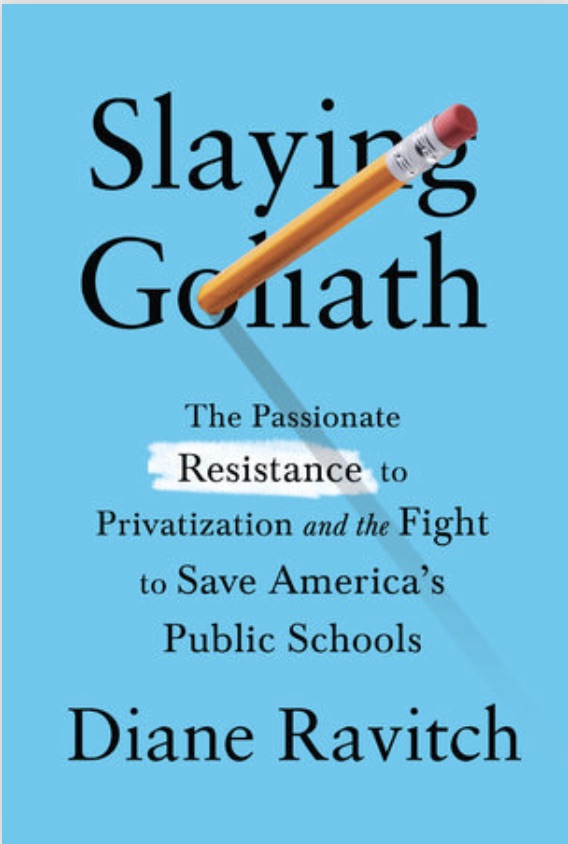
John Thompson, historian and retired teacher in Oklahoma, reviews SLAYING GOLIATH. This is the second part of his review.

This is an excerpt of a long and thoughtful review.

This second post will focus on Ravitch’s analysis of the research which predicted the defeat of accountability-driven, charter-driven policies. Perhaps the most striking pattern documented in Slaying Goliath is how they failed in the way that scholars and practitioners anticipated.

Decades of Disruption-driven reform began with the false claim “that American education was failing and the only way to fix it was with standards, tests, competition, and accountability.” As Arne Duncan’s public relations officer and Walton-funded reformer Peter Cunningham said, “We measure what we treasure.”

Ravitch’s response was, “I was taken aback because I could not imagine how to measure what I treasure: my family, my friends, my pets, my colleagues, my work, the art and books I have collected.” And that foreshadows the victory of the Resistance over Goliath. Most educators, patrons, and students agree that children are more than a test score.

No Child Left Behind and the Race to the Top set impossible test score targets. They were based in large part on the weird idea that “no-excuses” behaviorist pedagogies could be quickly “scaled up,” providing poor children of color a ladder to economic equality. Drawing on the tradition of Edward Thorndike and B.F. Skinner, reformers “rigidly prescribed conditioning via punishments and rewards.” Previewing their fatal flaw, Ravitch observes, “Behaviorists, and the Disrupters who mimic them today, lack appreciation for the value of divergent thinking, and the creative potential of variety. And they emphatically discount mere ‘feelings.’”

When educators resisted, corporate reformers became livid and doubled down on the punitive. Perhaps their worst debacle was using value-added teacher evaluations to hold each individual educator accountable for test score growth. It combined inappropriate test outputs with an unreliable and invalid algorithm, the VAM, as a club to enforce compliance. In the short run, it forced educators, who had previously tried to keep their heads down and “monkey wrench” testing mandates to join patrons and students in the Resistance. By 2018, however, pent up anger exploded as teacher strikes spread across the nation.

Today, many or most of Goliath’s coalition have become disenchanted with standardized testing, but their Disruption model can’t function without it. Few have gone as far as Paymon Rouhanifard, the former Camden superintendent who abolished report cards after listening to complaints, and denounced standardized testing as he left the job.

The more common path is to spin their punitive tests as “personalized” learning, and their incentives and disincentives as the “portfolio model.” As Ravitch explains, “A portfolio district is one where the local board (or some entity operating in its stead) acts like a stockbrokerage, holding onto winners (schools with high test scores) and getting rid of losers (schools with low test scores).”

As was also predicted by Campbell’s Law, test-driven accountability (made more intimidating by the dual threat of test-driven competition with charters) led to corruption. The cheating was far greater than just the scandals where adults erased and changed bubble-in answers. Graduation rates were easy to manipulate. For instance, NPR reported a “heartwarming story” in 2017 about a school with 100% graduation rate. A subsequent FBI investigation and a district audit found 1/3rd of the school’s graduates lacked credits and only 42% were on track to graduation.

And that leads to the corruption associated with school choice. Today’s Disrupters seem to be doubling down on charters to drive transformative change. As explained in a previous post, in 1988 Al Shanker saw charters as a path towards innovation. Within two years, however, the promise of win-win experimentation started to be undermined when conservative reformers Terry Moe and John Chubb claimed “choice is a panacea.”

In this case, it was choice-advocate Paul Peterson who predicted the political future. Charters didn’t take off because of the balanced approach of Shanker, but because reformers “radicalized” the concept. And, of course, there was plenty of big bucks available for pushing their radical but false narrative.

Within a decade, a shocking number of non-educators had been convinced by Goliath’s spinsters that the KIPP’s behaviorist model could be scaled up. As Slaying Goliath explains, “The biggest innovation in the charter sector was the invention of ‘no-excuses’ schools.” It took nearly another decade for policy makers to accept the fact that charters get average results except for those with high attrition.” And it took nearly as long to reveal the much greater down sides of charters…

Regardless of whether we’re discussing high-stakes testing, charter expansion, or the other pet theories, we should all heed Ravitch’s most important lesson of the past few decades is that “Reform doesn’t mean reform. It means mass demoralization, chaos, and turmoil. Disruption does not produce better education.”

Slaying Goliath celebrates a great victory for public education and democracy. However, Ravitch reminds us that the Disrupters are still threatening. She compares today’s danger to that which faced a man who decapitated a rattlesnake but who nearly died after being bitten by the detached head.

So, we can’t lower our guard until the principles that inspired the Resistance are safe in our schools.