Archives for category: Colorado

Please view the website of the Network for Public Education, where you can find the links and photos that accompany this announcement.

Koch Brothers Enter the Douglas County Race

NPE-endorsed Candidate Faces AFP-Backed Tea Party Candidate

NPE-endorsed candidate Ronda Scholting now faces an opponent in the Douglas County School Board race who is supported by the Koch brothers.

This week, it was announced that the Koch brothers have become involved in the School Board race in Douglas County, Colorado. The Americans for Prosperity Foundation (AFP), which is run by the Koch brothers, is the largest free-market organization in Colorado. AFP so far has spent $50,000 on an ad campaign featuring Denise Denny, a prominent figure in Douglas County’s local Tea Party.

In recent years, the School Board in Douglas County has promoted and initiated corporate reform policies. The district’s controversial voucher program has been pushed into legislation with the help of ALEC. And AFP is working hard – and spending thousands – to promote the idea that these corporate reforms have led to positive results and must be continued.

In truth, many parents and public school advocates in Douglas County view the reforms of the School Board as harmful. The policies initiated by the School Board have had teachers’ unions and school communities up in arms. Earlier this year, Diane Ravitch published a piece by a teacher in Douglas County who described the dire situation and affirmed that members of Douglas County are “in a fight for our public school life […] school board elections in November will determine the future of our public schools.”

Earlier this month, we announced our strong endorsement for Ronda Scholting in the Douglas County race. She is a candidate who will fight to protect public schools from harmful corporate reform policies. We encourage you to raise your voice and spread the word about Scholting’s candidacy. We also invite you to join NPE’s Anthony Cody in Douglas County on September 12th, where he will discuss the state of education reform and the importance of the school board election.

There are times when reality is zanier than satire.

Read about Douglas County, Colorado, where choice fanatics run the district.

They want students and families to choose schools the way you choose a color for your car or a brand of cereal.

In other words, they don’t believe in public education.

They don’t believe in the democratic ideal of common schooling, where children from many backgrounds learn together. They believe in consumerism.

Anthony Cody reports on legislation prepared by Colorado Senator Michael Bennet that would decimate teacher professionalism. He wants federal funding for new teacher and principal academies that would lower standards for entry into education.

There is the usual blather about “excellence,” “great teachers,” standards and accountability, but the heart of the legislation is what it does not require:

“(B) shall not have unnecessary restrictions on the methods or inputs the teacher preparation academy will use to train teacher candidates or teachers teaching on alternative certificates, licenses, or credentials, including restrictions or requirements–

(i) obligating the faculty of the teacher preparation academy to hold advanced degrees;

(ii) obligating such faculty to conduct academic research;

(iii) related to the physical infrastructure of the teacher preparation academy;

(iv) related to the number of course credits required as part of the program of study;

(v) related to the undergraduate coursework completed by teachers teaching on alternative certificates, licenses, or credentials, as long as such teachers have successfully passed all relevant State-approved content area examinations…”

Cody concludes,

“So anyone with a bachelor’s degree – actually it does not even specify that – can open a teacher preparation “academy.” They need no building, no trained faculty. The credential candidates need have no preparation whatsoever – all that matters is that they pass the state content exams.”

These federal academies might not have a single faculty member who held an advanced degree or had ever conducted research. There might not be a physical campus. The prep academies would eventually be judged–someday–by the test scores of their graduates.

This approach would eliminate professional training for teachers.

Contrast this with Finland, where only eight universities award teacher degrees, and competition to get into these institutions is highly competitive. Only 1 of every 10 applicants is accepted into them, and they are expected to conduct research, study academic and pedagogical courses, and practice teach.

Finland has very high standards, but Senator Bennett’s bill would eliminate all standards for students and faculty.

Need I add that the bill is supported by a veritable “Who’s Who” of the corporate reform world, including TFA, Stand for Children, and a multitude of charter schools, all of whom are committed via this document to lower standards for teachers..

This November, the Denver school board will be up for grabs.

As you will see in this article, the privatization movement has decided to make a play to take control of the board. You know what they want.

If the Denver race plays out like the one in Los Angeles, billionaires and Wall Street hedge fund managers, along with Michelle Rhee’s StudentsFirst, will pour millions into the race. Expect big gifts from Rupert Murdoch and Philip Anschutz, maybe the Koch brothers. They will turn the schools and the children over to the free market.

If you care about public education, now is the time to stop the corporate takeover.

Parents mobilized to defeat the so-called “parent trigger” in three states.

They referred to it as the “corporate empowerment” bill.

It could also be called the Corporate Enrichment bill.

A teacher in Douglas County, Colorado, reports that the school board and superintendent are determined to wreck the public school system for which they are responsible.

The teacher writes:

I can’t begin to tell you how your sharing the information about the LA school district victory for kids is boosting the morale of fighters for public education in Douglas County, Colorado. We’re in a fight for our public school life here too. The school board elections in November will determine the future of our public schools.

The school board was elected, partly in 2009 and partly in 2011, by money from sources outside of the district and heavily connected with the GOP and ties to ALEC. The purpose seems to be to conduct a corporate experiment to on an affluent, not broken, school district south of Denver.

The school board in turn has proudly broken all ties with the union. While the union still exists there is no collaborative, working relationship, or no collective bargaining agreement between the district and the union. And it seems that every time someone disagrees with them, these opponents are called “union thugs.” If this weren’t so serious, their tactics would look downright silly. At the last board meeting, the BOE supporters dressed up as Grinches in their interpretation of the union, and passed out inaccurate pamphlets about the union.

The school board hired a corporate reform superintendent in 2010. Some of her first contacts with the community involved traveling to community public schools to praise the charter school movement and the important of choice. If you want to listen to her speak, contact the Milton Friedman Foundation. http://www.edchoice.org/Foundation-Services/Speakers/Elizabeth-Celania-Fagen.aspx

The school board has also forced a voucher program currently tied up in litigation thanks to the group, Taxpayers for Public Education- http://www.facebook.com/pages/Taxpayers-for-Public-Education/165645363470905?fref=ts. The lawsuit is on its way to the Colorado Supreme Court. The community voted down funding for merit pay, but they have still spent the money from elsewhere to implement a merit pay program that is basically behavior modification for teachers. And they are extremely proud of the fact that they have reduced the teachers’ salary in this district. Polls show teacher morale at an all time low.

More about the voucher program. The right wing of our Republican party is now going after the head of our public libraries for his participation in supporting the lawsuit. http://www.ourcoloradonews.com/castlerock/news/douglas-county-commissioners-push-for-library-changes/article_11d11136-850d-11e2-9323-001a4bcf887a.html

And now they are moving on with a new era in charter school relations. http://www.9news.com/news/article/321642/222/Douglas-County-Schools-signs-unique-charter-school-deal?fb_action_ids=10200721010176750&fb_action_types=og.recommends&fb_ref=artsharetop&fb_source=other_multiline&action_object_map=%5B499626156739696%5D&action_type_map=%5B%22og.recommends%22%5D&action_ref_map=%5B%22artsharetop%22%5D

They have an $83 million reserve while students sit in unheated classrooms; parents have to pay for student busing, among other things a free public education is supposed to provide. http://strongschoolscoalition.org/dougco-finances-crystal-ball/

And just like the LA elections, the corporate reformers are continuing to spend money on commercials, and the Republic party headquarters here has no qualms about spending over $1 million on November’s elections. The air here is thick with propaganda.

But just like LA, and so many other areas in this country, we have a brilliant and dedicated community that wants its public schools back. Here are just a few of the very information blogs and organizations created by our communities. http://douglascountyparent.com/ and http://strongschoolscoalition.org/ While we don’t have their money, we can only hope that the truth will also prevail here in Douglas County.

Who is the miracle reformer of Colorado? Who wrote its law to evaluate teachers by their test scores? Who claimed that his high school graduated 100% of its seniors and sent them to college? Who so lauded by President Obama and DFER? Whose legislation became a model for ALEC? Why, Michael Johnston, of course.

Mercedes Schneider continues her portrait of the board of NCTQ by looking into Johnston’s history. NCTQ is the organization that tells the nation how to get high-quality teachers.

Previous posts by Schneider have included Wendy Kopp, Michelle Rhee, and Joel Klein, who have a cumulative teaching experience of three years among them (Rhee’s).

Responding to a post about a test question for second-grade students, which assumed they knew the words “commission” and “Mozart,” this parent replied:

My second-grader defined “commission” without needing the
multiple choice prompts this morning, but her school has a really
strong music program.

She credited her music teacher for having
taught her the term–which was done in the context of an annual
all-school field trip to a local Symphony Orchestra concert. (This
is not district-wide; our PTA fundraising pays for the cost of the
buses necessary to take all the kids. I don’t know of another
public school in the district or in the area that has all of its
kids at the concert every year; most take only one or two grades,
if they participate at all.)

Before they go to the concert, our music teacher gives the kids the elementary-school equivalent of a pre-concert lecture–which is to say, it takes place over a few
weeks and isn’t a lecture, but they come away with much of the same
information.

My daughter has also played violin since she was 4,
and her public school has a fabulous strings program that she’s
been in since kindergarten, also thanks to our fabulous and amazing
music teacher (who, it might be noted, belongs to the union and
runs the entire strings program during her free periods).

Our school is also blessed with amazing parents, and several of them
attend each and every orchestra rehearsal to help the kids tune
their instruments and set up music and stands. And in the spirit of
full disclosure, my daughter has a musicologist for a mother.

Do I think most second-grade students could define this term? Probably
not, especially with so many schools cutting music and arts
programs. Unfortunately, putting terms like this on a test will
likely have the effect of extending vocabulary lessons and cutting
into time that would otherwise be used for music or art or
P.E.

Jeannie Kaplan is an elected member of the Denver Board of Education. She has been critical of corporate-style reform and of the heavily-funded effort to persuade the public that it is successful. When she heard that Jonah Edelman of Stand for Children told an audience in Tulsa recently that Denver was a national model of success, she decided to review the score card for the district. (Stand for Children boasts of its civil rights credentials but supported a slate of Republican candidates for the state legislature in 2012, as part of its campaign for corporate reform).

Kaplan wrote for this blog:

So Much Reform. So Little Success

Denver, Colorado is a poster child for much of what reformers like to see: standardized testing, teacher accountability, charter schools, choice, co-location, and oh, did I mention testing? Denver Public Schools is trying or has tried almost all of them. Why, even Jonah Edelman, founder of one of the most well-funded, prominent reform organizations, Stand for Children, just today, January 10, 2013, pointed to Denver as a leader in reform because of its “portfolio” of school choice led by its charter schools. So, how is reform really working in Denver?

Let’s start by focusing on achievement, meaning test scores, since that is the focus of all things reform. (This post will have a lot of data since reform and data go hand in hand these days, especially data that can be spun). Denver Public Schools have been rated by the Colorado Department of Education as “Accredited with Priority Improvement Plan,” for the last three years. Out of five grades this is the second to the bottom. To be fair, DPS is inching toward the next category, “Accredited with Improvement plan.” The cut point is 52% of eligible points; Denver is at 51.7%. I am not sure how meaningful this data point is, since the GROWTH points count for 35 points out of 100 and ACADEMIC ACHIEVEMENT, meaning proficiency, counts for only 15.

Colorado now places enormous emphasis on “the growth model.” While no one would contest you need to have growth to get to proficiency, I believe this model masks what is really happening, and so the data I am citing is all about proficiency. To further emphasize how growth can mask proficiency, allow me to quote from one of Denver’s most ardent reformers, Alexander Ooms, who said on in a commentary on EdNewsColorado:

“Denver can celebrate academic growth for years to come without making much progress in the exit-level proficiency of students. And that is simply not the right direction. Growth is means, not end.”http://www.ednewscolorado.org/2012/05/23/38581-commentary-our-unhealthy-obsession-with-growth to read his entire commentary.

I could not have said it better. The data I cite are proficiency numbers, not growth numbers.

In 2005, when reform was in its infancy, Denver Public Schools hired its first non-educator superintendent: Michael Bennet, former businessman/lawyer, former mayoral chief of staff . Mr. Bennet’s childhood friend and fellow businessman, Tom Boasberg, was hired to replace him when Bennett became a Senator. Denver has been experimenting with reform since then. Oh, and BTW, Jonah Edelman grew up as Tom Boasberg’s neighbor in Washingon, D.C.

After 8 years, what academic changes has reform produced?

The following data is from 2005 through 2012, according to Colorado standardized tests. Here is the website for a deeper delve into the data

http://www.schoolview.org/performance.asp

ACHIEVEMENT:
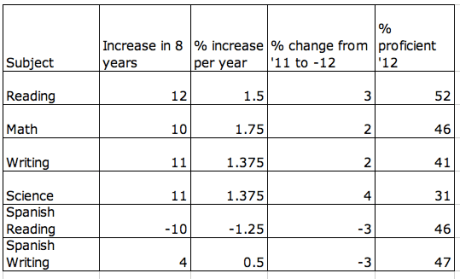
Screen shot 2013-01-12 at 4.32.48 PM
We can’t leave achievement without looking at the State of the Union shout-out school, Bruce Randolph. Bruce Randolph Middle School in 3 years of state tracked data shows a gain of 2% in reading to 28%, stayed at 19% in math, increased by 3% in writing to 17%, and increased 7% in science to 17%. It is tied for last in proficiency – 52nd – for all of Denver’s middle schools.

Bruce Randolph High School has declined 10% to 33% in reading, declined 3% in math to 10%, declined 2% in writing to 14% increased 1% to 12% in science. Bruce Randolph is 24th out of 27 high schools in academic achievement.

ACHIEVEMENT GAP increases based on 7 years of CSAPs/TCAPs

Elementary School

Reading 4.17
Writing 5.78
Math 6.46

Middle School

Reading 3.23
Writing 4.71
Math 6.72

High School

Reading 3.01
Writing 5.82
Math 6.30

According to DPS data, the gap between FRL and paid-lunch students has widened by 9% since 2005. In 2005, percent proficient for FRL was 29%, paid was 58%. In 2012 the numbers were 41% for FRL, 79% for paid. The gap has grown to 38%.

ACT RESULTS: (A composite score of 21 is generally accepted as a college readiness benchmark)

From a DPS presentation of September 2012​

2005 17
2012. ​17.6

GRADUATION for 2011 – we are still waiting state numbers for 2012 but the number of students graduating increased from 2,642 in 2005 to 3,414 in 2012, for a total of 772 more graduates in 8 years…or an average of 96.5 more graduates each year.

Here is how Denver Public Schools compares with the state:

State​​ 73.9%
Denver ​ 56.1%

REMEDIATION (from Fall of 2010)

From the Fall of 2007, when this data was first available to the Fall of 2010 (the latest data available, remediation numbers have increased from 57.1% to 59.7%. The state of Colorado is at 31.8%.

This is the achievement for 8 years of reform.

Need I say more?
Jeannie Kaplan is an elected member of the Denver Board of Education. She has been critical of corporate-style reform and of the heavily-funded effort to persuade the public that it is successful. When she heard that Jonah Edelman of Stand for Children told an audience in Tulsa recently that Denver was a national model of success, she decided to review the score card for the district. (Stand for Children boasts of its civil rights credentials but supported a slate of Republican candidates for the state legislature in 2012, as part of its campaign for corporate reform).

Kaplan wrote for this blog:

So Much Reform. So Little Success

Denver, Colorado is a poster child for much of what reformers like to see: standardized testing, teacher accountability, charter schools, choice, co-location, and oh, did I mention testing? Denver Public Schools is trying or has tried almost all of them. Why, even Jonah Edelman, founder of one of the most well-funded, prominent reform organizations, Stand for Children, just today, January 10, 2013, pointed to Denver as a leader in reform because of its “portfolio” of school choice led by its charter schools. So, how is reform really working in Denver?

Let’s start by focusing on achievement, meaning test scores, since that is the focus of all things reform. (This post will have a lot of data since reform and data go hand in hand these days, especially data that can be spun). Denver Public Schools have been rated by the Colorado Department of Education as “Accredited with Priority Improvement Plan,” for the last three years. Out of five grades this is the second to the bottom. To be fair, DPS is inching toward the next category, “Accredited with Improvement plan.” The cut point is 52% of eligible points; Denver is at 51.7%. I am not sure how meaningful this data point is, since the GROWTH points count for 35 points out of 100 and ACADEMIC ACHIEVEMENT, meaning proficiency, counts for only 15.

Colorado now places enormous emphasis on “the growth model.” While no one would contest you need to have growth to get to proficiency, I believe this model masks what is really happening, and so the data I am citing is all about proficiency. To further emphasize how growth can mask proficiency, allow me to quote from one of Denver’s most ardent reformers, Alexander Ooms, who said on in a commentary on EdNewsColorado:

“Denver can celebrate academic growth for years to come without making much progress in the exit-level proficiency of students. And that is simply not the right direction. Growth is means, not end.” http://www.ednewscolorado.org/2012/05/23/38581-commentary-our-unhealthy-obsession-with-growth to read his entire commentary.

I could not have said it better. The data I cite are proficiency numbers, not growth numbers.

In 2005, when reform was in its infancy, Denver Public Schools hired its first non-educator superintendent: Michael Bennet, former businessman/lawyer, former mayoral chief of staff . Mr. Bennet’s childhood friend and fellow businessman, Tom Boasberg, was hired to replace him when Bennett became a Senator. Denver has been experimenting with reform since then. Oh, and BTW, Jonah Edelman grew up as Tom Boasberg’s neighbor in Washingon, D.C.

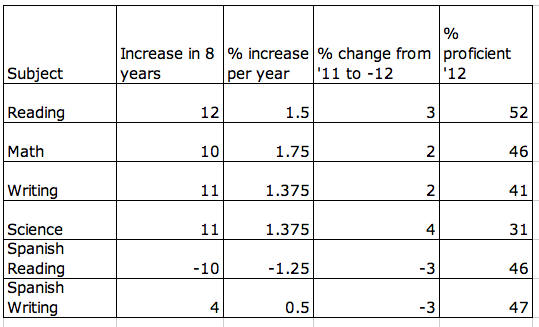
After 8 years, what academic changes has reform produced?

The following data is from 2005 through 2012, according to Colorado standardized tests. Here is the website for a deeper delve into the data

http://www.schoolview.org/performance.asp

ACHIEVEMENT:

8 yr increase–% incrse per year–% chnge from ’11-’12–% proficient

Reading – — 12———-1.5 ———– 3 –————— 52

Math — — 10———–1.75————–2———————-46

Writing —- 11——— 1.375————2———————41

Science —– 11 —— 1.375 ——— 4 ——————31

Lectura -10 /—–// -1.25 /// -3 /// 46
Spanish Reading

Escruita 4 ////—/ .5 ///// -3 ////// 47
Spanish Writing

We can’t leave achievement without looking at the State of the Union shout-out school, Bruce Randolph. Bruce Randolph Middle School in 3 years of state tracked data shows a gain of 2% in reading to 28%, stayed at 19% in math, increased by 3% in writing to 17%, and increased 7% in science to 17%. It is tied for last in proficiency – 52nd – for all of Denver’s middle schools.

Bruce Randolph High School has declined 10% to 33% in reading, declined 3% in math to 10%, declined 2% in writing to 14% increased 1% to 12% in science. Bruce Randolph is 24th out of 27 high schools in academic achievement.

ACHIEVEMENT GAP increases based on 7 years of CSAPs/TCAPs

Elementary School

Reading 4.17
Writing 5.78
Math 6.46

Middle School

Reading 3.23
Writing 4.71
Math 6.72

High School

Reading 3.01
Writing 5.82
Math 6.30

According to DPS data, the gap between FRL and paid-lunch students has widened by 9% since 2005. In 2005, percent proficient for FRL was 29%, paid was 58%. In 2012 the numbers were 41% for FRL, 79% for paid. The gap has grown to 38%.

ACT RESULTS: (A composite score of 21 is generally accepted as a college readiness benchmark)

From a DPS presentation of September 2012​

2005 17
2012. ​17.6

GRADUATION for 2011 – we are still waiting state numbers for 2012 but the number of students graduating increased from 2,642 in 2005 to 3,414 in 2012, for a total of 772 more graduates in 8 years…or an average of 96.5 more graduates each year.

Here is how Denver Public Schools compares with the state:

State​​ 73.9%
Denver ​ 56.1%

REMEDIATION (from Fall of 2010)

From the Fall of 2007, when this data was first available to the Fall of 2010 (the latest data available, remediation numbers have increased from 57.1% to 59.7%. The state of Colorado is at 31.8%.

This is the achievement for 8 years of reform.

Need I say more?