Archives for category: Closing schools

Jane Nylund, parent activist in Oakland, wrote the following warning after reading about the ouster of the Disrupters in Denver. Parents and activists and concerned citizens must organize and oust the agents of Disruption:


Oakland also must flip 4 board seats next year. The Walton-bought board has recently closed two schools, Roots and Kaiser Elementary, and there is talk of accelerating the “Blueprint process”, which is basically a plan to close and consolidate schools. Oakland’s portfolio model, which was only supposed to close “low performing” schools (nearly all of which were privatized into charters), has now morphed into the Citywide plan, in which no school is safe from the threat of closure. Kaiser was an exemplary model for a popular, well-supported, diverse neighborhood public school that attracted families both within and outside its boundaries. It also supported a significant number of LGBT families. It’s enrollment had been steady for years. Its closure (and planned consolidation with Sankofa, a struggling elementary school several miles away with a freeway in between) means that the beautiful piece of property where Kaiser is located (with SF bay views) will either be sold or handed over to a charter. Kaiser’s closure was a sacrifice, a political pawn in the school closure game, to show that the school board can be “bold” and not just close schools in high-needs neighborhoods. Look at us, we can close anything, and we will! This is the not-so-new normal for OUSD.

John Thompson, historian and recently retired teacher in Oklahoma, assays the damage that corporate reformers and their patrons have inflicted on the public schools of Tulsa. The district is overflowing with Broadies and has Gates money. What could possibly go wrong?


The Tulsa Public Schools (TPS) offers an excellent case study in data-driven, market-driven school reform.  Before No Child Left Behind, we in the Oklahoma City Public School System (OKCPS) studied Tulsa’s successes, and it quickly became clear that children entering TPS had advantages that their OKCPS counterparts didn’t have. They had lower poverty rates and, due to enlightened philanthropic leadership, they had higher reading skills. Moreover, philanthropists continued to invest in holistic social services, as well as early education.

By 2010, however, when the Tulsa Public Schools (TPS) accepted a $1.5 million Gates grant, the inherent flaws of the Gates effort were obvious. Back then, I would visit and learn about great work being done on early education and by Johns Hopkins’ experts advising the TPS. I also asked how it would be possible to reconcile investments in those evidence-based efforts and their opposite – the Gates shortcuts.

https://www.gatesfoundation.org/How-We-Work/Quick-Links/Grants-Database/Grants/2010/02/OPP1005881

When I showed a scholar a scattergram on the Tulsa website documenting the extreme gap between the “value-added” of its high and low performing high schools, the Big Data expert responded in a scholarly way.  Understanding that it would be impossible to control for those huge differences, the consultant replied, “Oh, sh__!”

http://static.battelleforkids.org/images/tulsa/vascatterplots_1_and_3_year_avg_final_2-10-12.pdf

So, how well did the Gates grant work in raising teacher quality?

The TPS now has to rely on the trainer of uncertified teachers, the Teacher Corps, which “is one of many recent strategies for finding bodies to put in classrooms.” According to the Tulsa World, “This is necessary because about 30% of the district’s teaching force started working there in the past two years.” That includes 388 emergency certified teachers.

https://www.tulsaworld.com/news/local/education/in-only-its-second-year-tulsa-public-schools-teacher-corps/article_cd295874-08df-5c0d-8398-cc1f382b6e23.html

As it turned out, the Gates experiment was just one of a series of corporate reform gambles. In addition to promoting charter expansion, the George Kaiser Family Foundation has joined with the Bloomberg and Walton foundations in funding “portfolio management” directors to “absorb the duties of the director of partnership and charter schools,” and “in the future, implement ‘new school models resulting from incubation efforts of the district.’” Worse, in 2015, one of the Chiefs for Change’s most notorious members, Deborah Gist, became the TPS’ superintendent. Before long, Tulsa had 13 central office administrators who were trained in the teach-to-the-test-loving Broad Academy.

https://www.gkff.org/what-we-do/parent-engagement-early-education/prek-12-education/

https://dianeravitch.net/2019/02/26/tulsa-broadie-swarm-alert/

And, how did the Broad-trained administrators do in raising student performance?

In 2017, Sean Reardon’s Stanford Center for Education Policy Analysis provided the best estimate of student test score growth from 2009 to 2015. It revealed that Tulsa students entered 3rd grade ahead of their counterparts in Oklahoma City. That is likely due to the great early education efforts led by philanthropists.

From 3rd to 8th grade, however, Tulsa students lost more ground than those in all but six of the nation’s school systems. TPS students gained only 3.8 years of learning over those five years; that was .6 of a year worse than the OKCPS. Neither did 2016 outcomes reflect progress. The updated report shows that TPS scores were .81 grade levels lower than districts with similar socioeconomic status. Its racial and economic achievement gaps were worse, and poor students declined further in comparison to similar districts.

https://cepa.stanford.edu/

https://www.nytimes.com/interactive/2017/12/05/upshot/a-better-way-to-compare-public-schools.html?action=click&contentCollection=The%20Upshot&region=Footer&module=WhatsNext&version=WhatsNext&contentID=WhatsNext&moduleDetail=undefined&pgtype=Multimedia

https://nondoc.com/2019/10/19/school-effectiveness-linked-to-diversity/

And the bad news just kept coming.  The State Department of Education’s latest report card assigned an “F” grade to 25 percent more TPS schools than to the more-challenged OKCPS.

https://nondoc.com/2019/03/07/new-school-report-cards-sad-outcomes/

Tulsa Superintendent Deborah Gist responded with an implausible claim that the district’s own assessments are more meaningful, and show more progress. However, benchmarks tend to encourage shallow in-one-ear-ear-and-out the-other teaching and learning. Gist’s statement isn’t proof that this is happening, but it raises the type of question that report cards should lead to.

https://www.tulsaworld.com/news/local/education/no-perfect-system-revamped-grade-cards-are-better-but-don/article_272ad2b5-4525-52ca-aa7f-e81462473c24.html

Part of the answer lies in another reform investment on reading instruction. Tulsa adopted the Common Knowledge Language Arts (CKLA) curriculum. Betty Casey, the publisher of Tulsa Kids magazine, began her thoroughly investigated report on the CKLA in Tulsa with an example of the 3rd grade questions that Gist trusts: “Do you think primogeniture is fair? Justify your answer with three supporting reasons.”

Casey quoted a first-grade teacher’s description of a reading lesson:

“You say, ‘I’m going to say one of the vocabulary words, and I’m going to use it in a sentence. If I use it correctly in a sentence, I want you to circle a happy face. If I use it incorrectly, I want you to circle a sad face. The sentence is Personification is when animals act like a person.’”

That lesson is given 10 days after the start of school. “I had kids who wouldn’t circle either one,” the teacher said. “Some cried. I have sped (special education) kids in my room, and they had no idea. That’s wrong. Good grief! These are 6-year-olds!”

https://www.tulsakids.com/is-ckla-the-best-way-to-teach-children-to-read/

So, how is the reading experiment working?

Oklahoma Watch studied federal data and learned that the TPS retained relatively few 3rd graders. But it retained 823 students through kindergarten and second grade!
Education Watch then reported, “Benchmarking itself is not an exact science. … Some kids score poorly because they are having a bad day or they don’t know how to use a computer mouse, which is common with kindergarteners.”

https://oklahomawatch.org/2018/12/14/oklahoma-nearly-tops-nation-in-holding-back-early-grade-students/

Tulsa’s expensive love affair with data may explain its latest crisis.  Tulsa has had a net loss of 5,000 students over the last decade. That means it must cut $20 million next year.

Ms. Casey and  many others suggest that another reason why Tulsa loses teachers and students is that it’s No Nonsense Nurturer classroom management system is a top-down mandate that hurts school cultures.

https://ktul.com/news/local/teachers-speak-on-controversial-no-nonsense-nurturer-program

The TPS held a series of community meetings, but it may not like the message it heard from the community. Two of the top recommendations from the community were: 44% survey-takers “chose to reduce teacher leadership roles …. Reducing the central office was the fourth most popular choice at 43%.”

Gist expressed a different opinion, however. And, in fairness I must add that a massive school closure effort preceded Gist; it was widely praised but as a subsequent post on Oklahoma City reforms will address, it may have contributed to loss of student population. But, Gist’s take of the closures is nothing less than weird. She said that the TPS might be losing students to the suburbs because they have larger schools!

https://www.tulsaworld.com/tps-report-on-community-feedback/pdf_61104782-617b-5b75-876c-cc52dc9fa1a2.html

It sounds to me like Superintendent Gist is grasping at straws. Maybe she is asking the same question that I am: How long will output-driven funders support her expensive and failed policies?

WHAT AN OUTRAGE! “Reform” strikes again. Literally.


PRESS STATEMENT & PRESS AVAILABILITY

October 24, 2019

Contact: OEA 2nd Vice President, Chaz Garcia, 510-414-3593

Statement from OEA 2nd Vice President Chaz Garcia on Behalf of the OEA Officers on OUSD’s Use of Violence at School Board Meeting


“Last night, OUSD police pushed, choked and clubbed peaceful elementary school parents and educators who were protesting school closures. We hold the OUSD Board of Directors and Superintendent Johnson-Trammell responsible for setting the stage for this violence by erecting barricades, and for the actions of their police force. The Oakland Education Association condemns these acts of policing and violence in the strongest possible way, as we have opposed (and went on strike against) the harm done to our students by school closures, the harm done when a Board member choked a teacher in March, and OUSD’s continued spending of over $6.5 million on OUSD police while underspending on counselors, nurses, and school psychologists that our students need.” 


“Oakland students, parents and educators deserve better than what the OUSD Board and Superintendent Johnson-Trammell are giving us. Oakland educators demand that OUSD immediately: 


  • Enact a moratorium on all planned and future school closures; 

  • Issue a public apology to our students, parents and educators for the use of police barricades, over-policing, and violence at last night’s board meeting;

  • Defund the OUSD police force, and redirect those funds toward the counselors, nurses and other supports our students need; and immediately suspend, investigate and discipline officers for their behavior last night.”


PRESS AVAILABILITY: OEA 2nd Vice President Chaz Garcia, Noon to 2pm today (October 24th); OEA office (272 E. 12th Street, Oakland, 94606)

Jeff Bryant writes here about the billionaires who corrupted the school leadership pipeline. Chief among them, of course, is billionaire Eli Broad, who created an unaccredited training program as a fast track for urban superintendents.

Bryant has collected stories about how superintendents who passed through the Broad program hire other graduates of the program and do business with others who are part of their network. The ethical breaches are numerous. The self-dealing and the stench of corruption is powerful.

Bryant begins with the story of a phone call from Eli Broad to one of his graduates:

It’s rare when goings-on in Kansas City schools make national headlines, but in 2011 the New York Times reported on the sudden departure of the district’s superintendent John Covington, who resigned unexpectedly with only a 30-day notice. Covington, who had promised to “transform” the long-troubled district, “looked like a silver bullet” for all the district’s woes, according to the Los Angeles Times. He had, in a little more than two years, quickly set about remaking the district’s administrative staff, closing nearly half the schools, revamping curriculum, and firing teachers while hiring Teach for America recruits.

The story of Covington’s sudden departure caught the attention of coastal papers no doubt because it perpetuated a common media narrative about hard-charging school leaders becoming victims of school districts’ supposed resistance to change and the notoriously short tenures of superintendents.

Although there may be some truth to that narrative, the main reason Covington left Kansas City was not because he was pushed out by job stress or an obstinate resistance. He left because a rich man offered him a job.

Following the reporting by the New York Times and the Los Angeles Times about Covington’s unexpected resignation, news emerged from the Kansas City Star that days after he resigned, he took a position as the first chancellor of the Education Achievement Authority of Michigan, a new state agency that, according to Michigan Radio, sought “radical” leadership to oversee low-performing schools in Detroit.

But at the time of Covington’s departure, it seemed no outlet could have described the exact circumstances under which he was lured away. That would come out years later in the Kansas City Star where reporter Joe Robertson described a conversation with Covington in which he admitted that squabbles with board members “had nothing to do” with his departure. What caused Covington’s exit, Robertson reported, was “a phone call from Spain.”

That call, Covington told Robertson, was what led to Covington’s departure from Kansas City—because it brought a message from billionaire philanthropist and major charter school booster Eli Broad. “John,” Broad reportedly said, “I need you to go to Detroit.”

It wasn’t the first time Covington, who was a 2008 graduate of a prestigious training academy funded through Broad’s foundation (the Broad Center), had come into contact with the billionaire’s name and clout. Broad was also the most significant private funder of the new Michigan program he summoned Covington to oversee, providing more than $6 million in funding from 2011 to 2013, according to the Detroit Free Press.

But Covington’s story is more than a single instance of a school leader doing a billionaire’s bidding. It sheds light on how decades of a school reform movement, financed by Broad and other philanthropists and embraced by politicians and policymakers of all political stripes, have shaped school leadership nationwide.

Charter advocates and funders—such as Broad, Bill Gates, some members of the Walton Family Foundation, John Chubb, and others who fought strongly for schools to adopt the management practices of private businesses—helped put into place a school leadership network whose members are very accomplished in advancing their own careers and the interests of private businesses while they rankle school boards, parents, and teachers.

Covington’s tenure at the Education Achievement Authority in Michigan was a disaster, and the EAA itself was a disaster that has been closed down.

Bryant compares the Broad superintendents to a cartel.

The actions of these leaders are often disruptive to communities, as school board members chafe at having their work undermined, teachers feel increasingly removed from decision making, and local citizens grow anxious at seeing their taxpayer dollars increasingly redirected out of schools and classrooms and into businesses whose products and services are of questionable value.

In fact, Broad superintendents have a very poor track record. They excel at disruption and alienating parents and teachers by their autocratic style. Despite their boasts, they don’t know how to improve education. They are not even skilled at management.

What they do best is advance themselves and make lucrative connections with related businesses owned by Broadie cronies.


Jan Resseger reviews fifteen years of corporate education reform led by Arne Duncan and Rahm Emanuel and finds failure, disruption, and racism.

It started in 2004 when Arne launched his Renaissance 2010 initiative, pledging to close 100 “failing schools” and replace them, in large part with charter schools. Rahm continued it by closing 49 schools on a single day.

Resseger relies on the brilliant analysis of the school closings by Eve Ewing, where she showed the pain inflicted on black families and communities by the closings.

Corporate school reform in Chicago, while claiming to be neutral and based on data, has always operated with racist implications. Ewing provides the numbers: “Of the students who would be affected by the closures, 88 percent were black; 90 percent of the schools were majority black, and 71 percent had mostly black teachers—a big deal in a country where 84 percent of public school teachers are white.”(Ghosts in the Schoolyard, p. 5).

Resseger then turns to a new study by Stephanie Farmer of Roosevelt University, which found that the city’s school-based budgeting disadvantaged the poorest schools, where black children were concentrated.

A new report from Roosevelt University sociologist, Stephanie Farmer now documents that Student Based Budgeting Concentrates Low Budget Schools in Chicago’s Black Neighborhoods.

Farmer explains: “In 2014, Chicago Public Schools (CPS) adopted a system-wide Student Based Budgeting model for determining individual school budgets… Our findings show that CPS’ putatively color-blind Student Based Budgeting reproduces racial inequality by concentrating low-budget public schools almost exclusively in Chicago’s Black neighborhoods…  Since the 1990s, the Chicago Board of Education (CBOE) has adopted various reforms to make Chicago Public Schools work more like a business than a public good.  CBOE’s school choice reform of the early 2000s created a marketplace of schools by closing neighborhood public schools to make way for new types of schools, many of which were privatized charter schools.”

There is a rumor in Washington that Rahm wants to be Secretary of Education in the next Democratic Administration. Nothing in his record qualifies him for the job. He failed. Arne Duncan failed. The nation is living  with the consequences of their failed ideas, which were inherited from George W. Bush, Rod Paige, Sandy Kreisler, and Margaret Spellings.


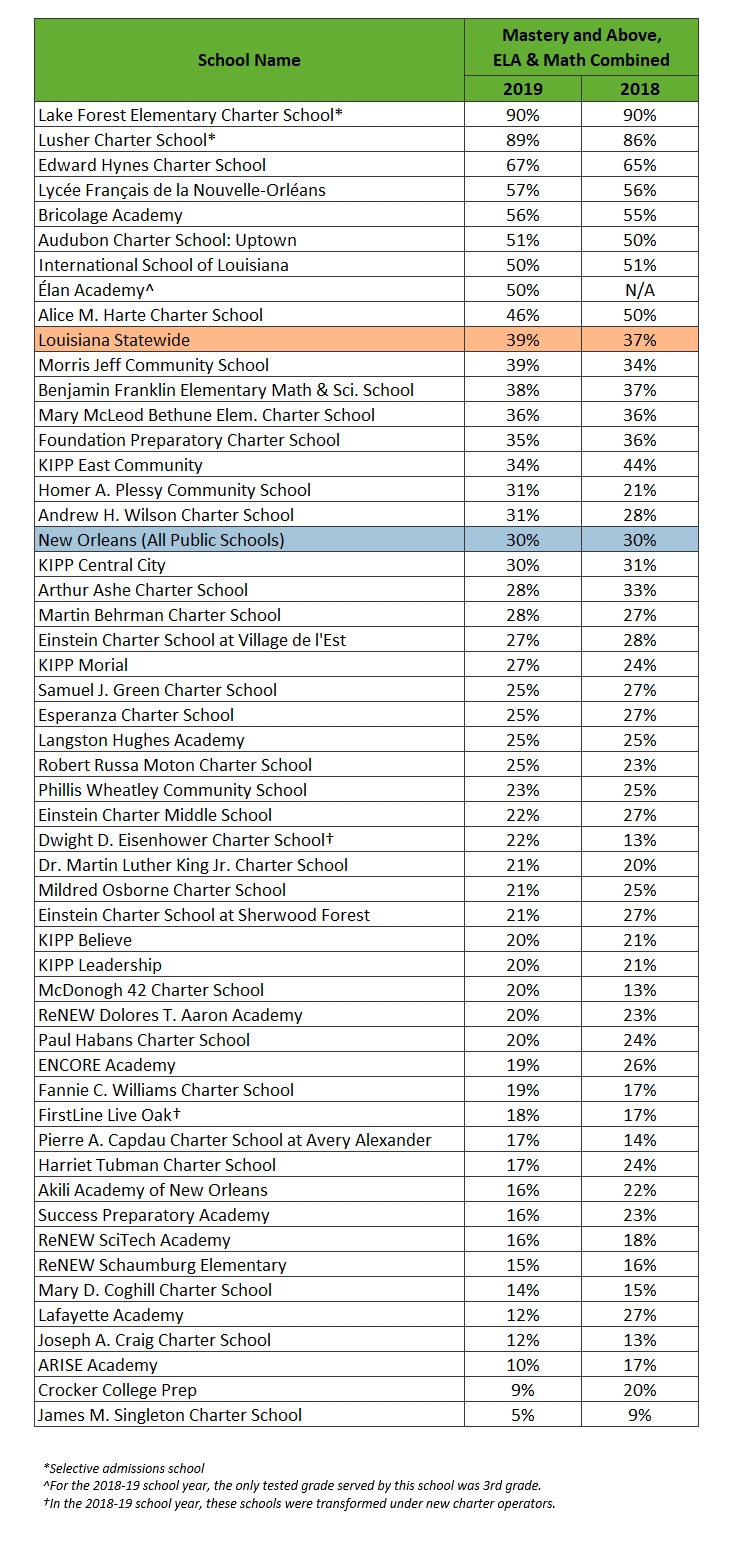
New Orleans is supposed to be the lodestar of the Corporate Reform Movement (or as I call it, the Disruption Movement), but the experiment in privatization is a costly failure, as Tom Ultican demonstrates in this post.

The old, underfunded school system was corrupt and inefficient. The new one is expensive, inefficient, and ethically corrupt because of its incessant boasting about what are actually very poor results.

Comparisons between the old and new “systems” are dubious at best because Hurricane Katrina dramatically reduced the enrollment from 62,000 to 48,000. As Bruce Baker pointed out in reviewing a recent puff study, concentrated poverty was significantly reduced by the exodus of some of the city’s poorest residents, who resettled elsewhere.

Ultican cites Andrea Gabor’s studies of the New Orleans schools to show that the lingering heritage of segregation and disenfranchisement has been preserved in the new all-charter system. The schools that enroll the most white students have selective admissions and high test scores. The majority of schools are highly segregated and have very low test scores.

Be sure to open this link and scroll down to “Individual School Performance,” where you will see that the majority of charter schools in BOLA perform well below the state average.

Do not look to New Orleans for lessons about school reform. But do admire it as a shining example of propaganda and spin paid for by Bill Gates and other billionaires who don’t like public education, democracy, or local school boards.


Every year since 2014, Democrats who fervently support the privatization of public schools have gathered at a conference they pretentiously call “Camp Philos.”

https://campphilos.org/

Check the agenda of meetings present and past.

There you will see the lineup of Democrats who sneer at public schools and look on public school teachers with contempt.

These are the Democrats who support the DeVos agenda of disrupting and privatizing public schools.

They are meeting again this year, and they will slap each other on the back for supporting school closures, charter schools, high-stakes testing, evaluating teachers by the test scores of their students, and hiring inexperienced teachers.

They have the chutzpah to call themselves “stakeholders,” although none of them are teachers, parents of public school students, or have any stake in the public schools that enroll 85-90% of all American students. Exactly what do they have a “stake” in?


The Education Research Alliance at Tulane University has accomplished a spectacular feat with its latest report about the “academic progress” (or lack thereof) of the all-charter district in New Orleans. The report claims that the disruption strategy of school takeovers and closures is responsible for the academic improvements in the district, but at the same time admits “The average school improved from the first to the second year after it opened, but school performance remained mostly flat afterwards. Schools starting off above the state average saw slightly declining performance in later years.” Furthermore, “quality peaked around 2013 and has either stagnated or started to decline during 2014-2016.”

So, here is the New Orleans model: Close almost all public schools. Replace them with private charters. Fire all the teachers. Replace most of the teachers with inexperienced, ill-trained TFA recruits. Close low-performing charters and replace them with other charters. Keep disrupting and churning. In the first two years, scores will go up, then stall. By year eight, “quality” will stagnate or decline. The schools will be highly stratified and racially segregated. The few high-performing schools will have selective admissions.

Here is the report, released this morning.

This report should be read in tandem with the latest state scores, which shows the all-charter district lagging far below state average scores, actually declining. Most charter schools in New Orleans, as detailed in this link prepared by a pro-charter organization, are very low-performing. The high-scoring schools have selective admissions.

New Orleans is one of the lowest performing districts in one of the lowest-performing states.It is a model of how privatization increases stratification and segregation. It should not be copied elsewhere.

But the report claims the success of the venture in school closings and privatization! Remember that the Education Research Alliance won a $10 million grant from Betsy DeVos after its report last year claiming the success of the privatization experiment.

Here is the press release for today’s report:

Study shows average public school quality has increased in New Orleans since Hurricane Katrina as a result of school closures, takeovers, and charter openings

New Orleans – The quality of New Orleans’ public schools improved considerably after Hurricane Katrina as a result of performance-based closures and takeovers, as well as charter openings, according to a new study from Education Research Alliance for New Orleans (ERA-New Orleans) at Tulane University. The study also found that variation in school quality has decreased, which means fewer students are in very low-performing schools.

Now an all-charter district, New Orleans public schools have returned to the control of the local school board. The city’s education leaders face challenging decisions about the district’s role in in school improvement, especially when and how the district should help support low-performing schools or take over these schools. This study provides insight into how these decisions can affect school quality.

“There are two main paths to improving the city’s schools: improving the ones we have or replacing them,” said ERA-New Orleans Director and lead author Douglas Harris. “Our findings suggest that we’ve been more successful with closing and taking over low-performing schools.”

The study’s authors analyzed data from 2002-2016 and found that the average New Orleans public school improved from the first to the second year after opening, but school performance remained mostly flat after the second year.

The study also examined factors beyond academic achievement to better understand how the city’s schools have evolved.

“The number of extracurricular activities that schools say they offer has increased over time,” co-author and ERA-New Orleans research analyst Alica Gerry said. “Also, there may have been a slight upward trend in the variety of school options in the city after the reforms, though this could just reflect school marketing rather than actual program offerings.”

“Students now have access to a wider range of higher quality schools than they did before, even in the first few years of reform,” Harris said. “School closures and takeovers should be a last resort, but they also show some promise when schools are consistently low-performing.”

The study’s authors are Douglas Harris (Tulane University), Lihan Liu (Tulane University), Alica Gerry (Tulane University), and Paula Arce-Trigatti (Rice University).

The novice journalist is likely to read the claims made about New Orleans—that outcomes improved because of charters and closing schools with low scores—and assume that this strategy of disruption is the key to good results. But unless they read the report closely, they may not notice that gains ended after the first or second year of an experiment now in its 15th year.

Expect more headlines about the New Orleans “miracle,” about the stagnation of market-based reforms in a city where most schools “perform” far below state averages.

Jan Resseger reminded me of this moving paragraph in Eve Ewing’s profound book Ghosts in the Schoolyard: Racism and School Closings on Chicago’s South Side:


Understanding these tropes of death and mourning as they pertain not to the people we love, but to the places where we loved them, has a particular gravity during a time when the deaths of black people at the hands of the state—through such mechanisms as police violence and mass incarceration—are receiving renewed attention. As the people of Bronzeville understand, the death of a school and the death of a person at the barrel of a gun are not the same thing, but they also are the same thing. The people of Bronzeville understand that a school is more than a school. A school is the site of a history and a pillar of black pride in a racist city. A school is a safe place to be. A school is a place where you find family. A school is a home. So when they come for your schools, they’re coming for you. And after you’re gone, they’d prefer you be forgotten. (Ghosts in the Schoolyard, pp. 155-156)

I am pleased to announce that Eve Ewing has been chosen to speak this fall in the annual Diane Silvers Ravitch Lecture Series at Wellesley College.  The event is open to the public and admission is free.


Larry Buhl of Capital and Main writes here about the transient nature of charter schools. In California, as in other states, they open with bold promises but many close with short notice to patents due to under enrollment  or financial problems or both.

As Buhl writes, parents are left scrambling and students’s lives are disrupted when their charter school closes suddenly.

Buhl begins:

IN LATE AUGUST OF 2018, Donald and Christine Fergusson were looking forward to the start of their daughter’s second year (second grade) at the International Preparatory Academy. The school, part of the Partnerships to Uplift Communities (PUC Schools), is located in the northeast Los Angeles suburb of Eagle Rock. But three weeks before the start of school, iPrep’s new superintendent, a PUC national board member and the PUC CEO held an emergency meeting where they told parents they would need to bring in more students or the school would close. The Spanish-Mandarin dual immersion school originally aimed to enroll 275 in grades K-2 and 6-8, although the organization told parents it could get by with 200. Panicked parents began distributing fliers in the neighborhood and urging neighbors to register for iPrep immediately.

“They gave us until September 24th to bring in more students,” Donald Fergusson said. “That’s not the parents’ job.”

After scrambling for a few days, the Fergussons decided iPrep was a sinking ship and enrolled their daughter in a Los Angeles Unified School District school with Mandarin immersion, which had been their main reason for choosing iPrep. It turned out to be a good decision. Three days after iPrep opened for its second year of operation — with only 114 students — PUC’s board voted to shut it down.

“Our school was under-enrolled from the very start,” Christine Fergusson said. “They told us it would grow and add one grade per year. I think [the board was] going to close the school anyway. They just strung us along.”