Archives for category: Closing schools


Jan Resseger reviews fifteen years of corporate education reform led by Arne Duncan and Rahm Emanuel and finds failure, disruption, and racism.

It started in 2004 when Arne launched his Renaissance 2010 initiative, pledging to close 100 “failing schools” and replace them, in large part with charter schools. Rahm continued it by closing 49 schools on a single day.

Resseger relies on the brilliant analysis of the school closings by Eve Ewing, where she showed the pain inflicted on black families and communities by the closings.

Corporate school reform in Chicago, while claiming to be neutral and based on data, has always operated with racist implications. Ewing provides the numbers: “Of the students who would be affected by the closures, 88 percent were black; 90 percent of the schools were majority black, and 71 percent had mostly black teachers—a big deal in a country where 84 percent of public school teachers are white.”(Ghosts in the Schoolyard, p. 5).

Resseger then turns to a new study by Stephanie Farmer of Roosevelt University, which found that the city’s school-based budgeting disadvantaged the poorest schools, where black children were concentrated.

A new report from Roosevelt University sociologist, Stephanie Farmer now documents that Student Based Budgeting Concentrates Low Budget Schools in Chicago’s Black Neighborhoods.

Farmer explains: “In 2014, Chicago Public Schools (CPS) adopted a system-wide Student Based Budgeting model for determining individual school budgets… Our findings show that CPS’ putatively color-blind Student Based Budgeting reproduces racial inequality by concentrating low-budget public schools almost exclusively in Chicago’s Black neighborhoods…  Since the 1990s, the Chicago Board of Education (CBOE) has adopted various reforms to make Chicago Public Schools work more like a business than a public good.  CBOE’s school choice reform of the early 2000s created a marketplace of schools by closing neighborhood public schools to make way for new types of schools, many of which were privatized charter schools.”

There is a rumor in Washington that Rahm wants to be Secretary of Education in the next Democratic Administration. Nothing in his record qualifies him for the job. He failed. Arne Duncan failed. The nation is living  with the consequences of their failed ideas, which were inherited from George W. Bush, Rod Paige, Sandy Kreisler, and Margaret Spellings.


New Orleans is supposed to be the lodestar of the Corporate Reform Movement (or as I call it, the Disruption Movement), but the experiment in privatization is a costly failure, as Tom Ultican demonstrates in this post.

The old, underfunded school system was corrupt and inefficient. The new one is expensive, inefficient, and ethically corrupt because of its incessant boasting about what are actually very poor results.

Comparisons between the old and new “systems” are dubious at best because Hurricane Katrina dramatically reduced the enrollment from 62,000 to 48,000. As Bruce Baker pointed out in reviewing a recent puff study, concentrated poverty was significantly reduced by the exodus of some of the city’s poorest residents, who resettled elsewhere.

Ultican cites Andrea Gabor’s studies of the New Orleans schools to show that the lingering heritage of segregation and disenfranchisement has been preserved in the new all-charter system. The schools that enroll the most white students have selective admissions and high test scores. The majority of schools are highly segregated and have very low test scores.

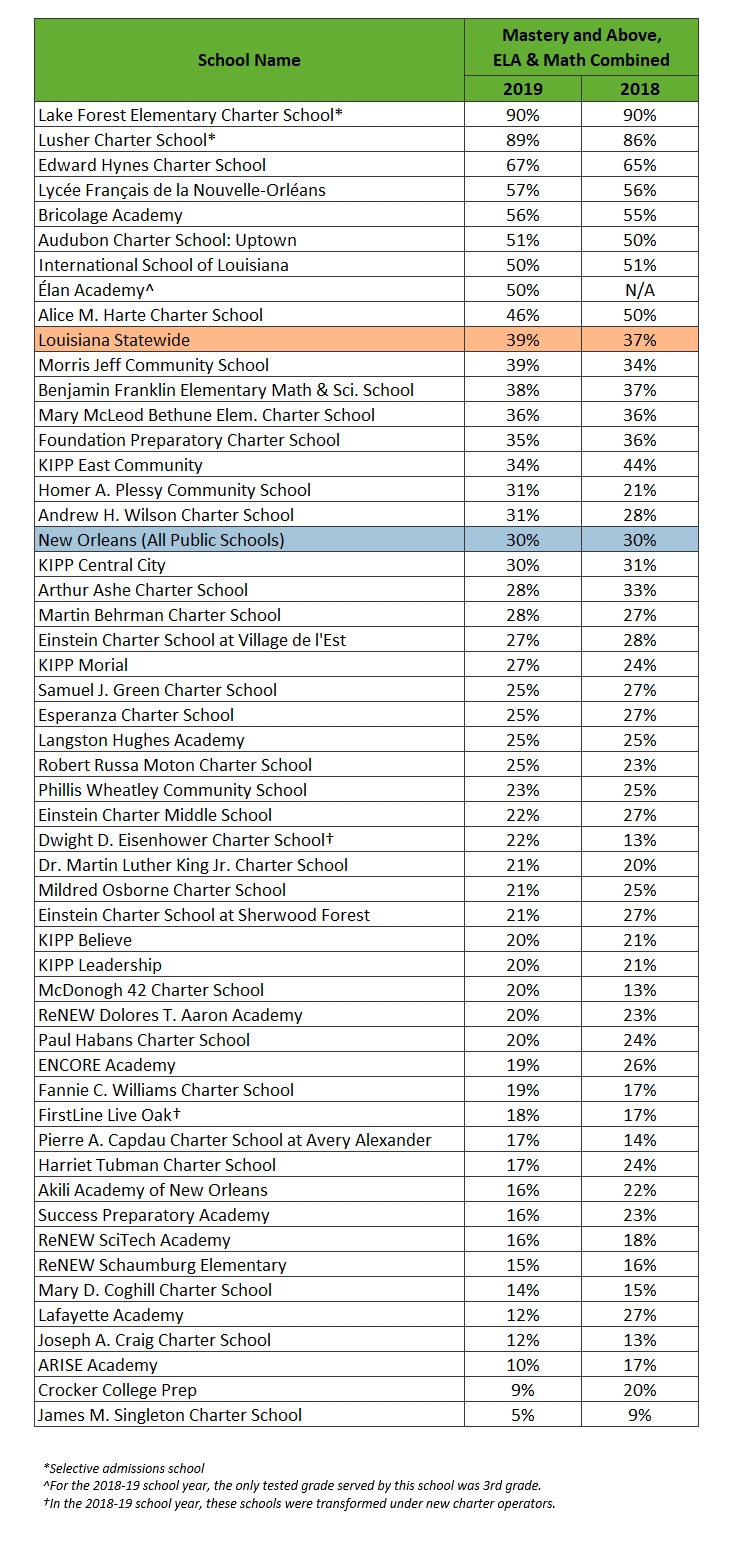
Be sure to open this link and scroll down to “Individual School Performance,” where you will see that the majority of charter schools in BOLA perform well below the state average.

Do not look to New Orleans for lessons about school reform. But do admire it as a shining example of propaganda and spin paid for by Bill Gates and other billionaires who don’t like public education, democracy, or local school boards.


Every year since 2014, Democrats who fervently support the privatization of public schools have gathered at a conference they pretentiously call “Camp Philos.”

https://campphilos.org/

Check the agenda of meetings present and past.

There you will see the lineup of Democrats who sneer at public schools and look on public school teachers with contempt.

These are the Democrats who support the DeVos agenda of disrupting and privatizing public schools.

They are meeting again this year, and they will slap each other on the back for supporting school closures, charter schools, high-stakes testing, evaluating teachers by the test scores of their students, and hiring inexperienced teachers.

They have the chutzpah to call themselves “stakeholders,” although none of them are teachers, parents of public school students, or have any stake in the public schools that enroll 85-90% of all American students. Exactly what do they have a “stake” in?


The Education Research Alliance at Tulane University has accomplished a spectacular feat with its latest report about the “academic progress” (or lack thereof) of the all-charter district in New Orleans. The report claims that the disruption strategy of school takeovers and closures is responsible for the academic improvements in the district, but at the same time admits “The average school improved from the first to the second year after it opened, but school performance remained mostly flat afterwards. Schools starting off above the state average saw slightly declining performance in later years.” Furthermore, “quality peaked around 2013 and has either stagnated or started to decline during 2014-2016.”

So, here is the New Orleans model: Close almost all public schools. Replace them with private charters. Fire all the teachers. Replace most of the teachers with inexperienced, ill-trained TFA recruits. Close low-performing charters and replace them with other charters. Keep disrupting and churning. In the first two years, scores will go up, then stall. By year eight, “quality” will stagnate or decline. The schools will be highly stratified and racially segregated. The few high-performing schools will have selective admissions.

Here is the report, released this morning.

This report should be read in tandem with the latest state scores, which shows the all-charter district lagging far below state average scores, actually declining. Most charter schools in New Orleans, as detailed in this link prepared by a pro-charter organization, are very low-performing. The high-scoring schools have selective admissions.

New Orleans is one of the lowest performing districts in one of the lowest-performing states.It is a model of how privatization increases stratification and segregation. It should not be copied elsewhere.

But the report claims the success of the venture in school closings and privatization! Remember that the Education Research Alliance won a $10 million grant from Betsy DeVos after its report last year claiming the success of the privatization experiment.

Here is the press release for today’s report:

Study shows average public school quality has increased in New Orleans since Hurricane Katrina as a result of school closures, takeovers, and charter openings

New Orleans – The quality of New Orleans’ public schools improved considerably after Hurricane Katrina as a result of performance-based closures and takeovers, as well as charter openings, according to a new study from Education Research Alliance for New Orleans (ERA-New Orleans) at Tulane University. The study also found that variation in school quality has decreased, which means fewer students are in very low-performing schools.

Now an all-charter district, New Orleans public schools have returned to the control of the local school board. The city’s education leaders face challenging decisions about the district’s role in in school improvement, especially when and how the district should help support low-performing schools or take over these schools. This study provides insight into how these decisions can affect school quality.

“There are two main paths to improving the city’s schools: improving the ones we have or replacing them,” said ERA-New Orleans Director and lead author Douglas Harris. “Our findings suggest that we’ve been more successful with closing and taking over low-performing schools.”

The study’s authors analyzed data from 2002-2016 and found that the average New Orleans public school improved from the first to the second year after opening, but school performance remained mostly flat after the second year.

The study also examined factors beyond academic achievement to better understand how the city’s schools have evolved.

“The number of extracurricular activities that schools say they offer has increased over time,” co-author and ERA-New Orleans research analyst Alica Gerry said. “Also, there may have been a slight upward trend in the variety of school options in the city after the reforms, though this could just reflect school marketing rather than actual program offerings.”

“Students now have access to a wider range of higher quality schools than they did before, even in the first few years of reform,” Harris said. “School closures and takeovers should be a last resort, but they also show some promise when schools are consistently low-performing.”

The study’s authors are Douglas Harris (Tulane University), Lihan Liu (Tulane University), Alica Gerry (Tulane University), and Paula Arce-Trigatti (Rice University).

The novice journalist is likely to read the claims made about New Orleans—that outcomes improved because of charters and closing schools with low scores—and assume that this strategy of disruption is the key to good results. But unless they read the report closely, they may not notice that gains ended after the first or second year of an experiment now in its 15th year.

Expect more headlines about the New Orleans “miracle,” about the stagnation of market-based reforms in a city where most schools “perform” far below state averages.

Jan Resseger reminded me of this moving paragraph in Eve Ewing’s profound book Ghosts in the Schoolyard: Racism and School Closings on Chicago’s South Side:


Understanding these tropes of death and mourning as they pertain not to the people we love, but to the places where we loved them, has a particular gravity during a time when the deaths of black people at the hands of the state—through such mechanisms as police violence and mass incarceration—are receiving renewed attention. As the people of Bronzeville understand, the death of a school and the death of a person at the barrel of a gun are not the same thing, but they also are the same thing. The people of Bronzeville understand that a school is more than a school. A school is the site of a history and a pillar of black pride in a racist city. A school is a safe place to be. A school is a place where you find family. A school is a home. So when they come for your schools, they’re coming for you. And after you’re gone, they’d prefer you be forgotten. (Ghosts in the Schoolyard, pp. 155-156)

I am pleased to announce that Eve Ewing has been chosen to speak this fall in the annual Diane Silvers Ravitch Lecture Series at Wellesley College.  The event is open to the public and admission is free.


Larry Buhl of Capital and Main writes here about the transient nature of charter schools. In California, as in other states, they open with bold promises but many close with short notice to patents due to under enrollment  or financial problems or both.

As Buhl writes, parents are left scrambling and students’s lives are disrupted when their charter school closes suddenly.

Buhl begins:

IN LATE AUGUST OF 2018, Donald and Christine Fergusson were looking forward to the start of their daughter’s second year (second grade) at the International Preparatory Academy. The school, part of the Partnerships to Uplift Communities (PUC Schools), is located in the northeast Los Angeles suburb of Eagle Rock. But three weeks before the start of school, iPrep’s new superintendent, a PUC national board member and the PUC CEO held an emergency meeting where they told parents they would need to bring in more students or the school would close. The Spanish-Mandarin dual immersion school originally aimed to enroll 275 in grades K-2 and 6-8, although the organization told parents it could get by with 200. Panicked parents began distributing fliers in the neighborhood and urging neighbors to register for iPrep immediately.

“They gave us until September 24th to bring in more students,” Donald Fergusson said. “That’s not the parents’ job.”

After scrambling for a few days, the Fergussons decided iPrep was a sinking ship and enrolled their daughter in a Los Angeles Unified School District school with Mandarin immersion, which had been their main reason for choosing iPrep. It turned out to be a good decision. Three days after iPrep opened for its second year of operation — with only 114 students — PUC’s board voted to shut it down.

“Our school was under-enrolled from the very start,” Christine Fergusson said. “They told us it would grow and add one grade per year. I think [the board was] going to close the school anyway. They just strung us along.”


Neema Avashia learned that her middle school in Boston was going to close. She decided that she would stand and fight. She did. She is a true patriot. She made a difference. She defeated the powerful. She is a hero of the Resistance. She joins the honor roll of this blog.

She writes:

My gloves came off the day representatives of my school district told us they would be closing our school. Our students would be sent to a turnaround high school that had never taught middle school students. Recently arrived immigrant students in language-specific programs, which the high school did not offer, would be dispersed across the city. As for our staff, the representative from Human Capital glibly told us, “We have no plan for you.”

What does it mean when the school system that you’ve poured your heart into doesn’t have the decency to consider a thoughtful transition plan before making the decision to close your school?

It means they never saw you as human in the first place.

It means that your job, then, is to make it impossible for them to look away from your humanity.

I went home from work that afternoon and opened a Twitter account. Opponents of other district proposals had successfully used Twitter to shame city leadership into changing course.

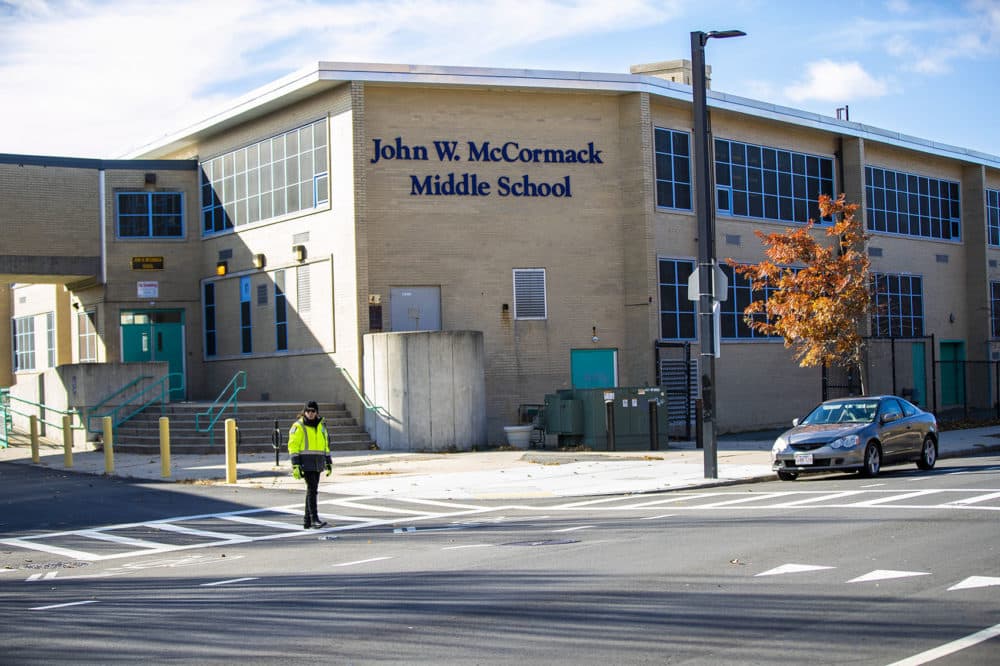
The John W. McCormack Middle School on Columbia Point. (Jesse Costa/WBUR)

“I am a @McCormackMiddle teacher,” my first tweet read. “Today the district announced they will be closing my school, and I am left full of questions.”

Once I began, there was no stopping. I knew that if the McCormack closed, I would not be a teacher anymore. That the work it took to build these relationships, and this community, was not something I could take up a second time under the scepter of further closures.

On Twitter, I relentlessly poked holes in the plan: BuildBPS was founded on the premise of renovating pre-WWII buildings, yet our building was constructed in 1968. Multiple schools have failing heat systems and leaking roofs, but our building had received a new boiler, windows and roof within the last ten years. BuildBPS purported to prioritize the most vulnerable students, yet disrupted the education of our English Language Learners.

My recklessness knew no bounds. I went before the Boston School Committee and announced, “I’m here to give you a history lesson,” then reminded them that our students had merged with a turnaround previously — the elementary school next door — and that doing so had placed the elementary school under even higher scrutiny from the state.

Read her story. Hers is the kind of dedication that the corporate reformers and Disrupters can’t buy. She is a champion of children, not a billionaire’s lackey. She carries within her the spark of revolution that inspired patriots in the 18th century.  She is a patriot for our times, uncowed by  money and power.

Michigan Governor Gretchen Whitmer originally offered the Benton Harbor District a desl that relieves them of their debt if they closed their high school. Residents and students rebelled at the idea of closing the high school. Governor Whitmer has reached a tentative deal with the district to save the high school. 

Representatives from the governor’s office and the Department of Treasury had a productive meeting with Benton Harbor school board members regarding a tentative joint plan that requires the district to meet attainable benchmarks and goals to show improvement in academic outcomes among Benton Harbor area students while stabilizing the finances of the district,” Whitmer spokeswoman Tiffany Brown said.

Brown noted Wednesday that the state has “has identified national experts who have experience turning around school districts that are struggling and we would like to engage in a day of learning alongside the board and community partners.”

Bill Phillis of Ohio writes:

School Bus
Cleveland Plain Dealer analysis of trends in test scores in HB 70 districts: NO IMPROVEMENT
The state takeover of school districts (HB 70 of the 131stGeneral Assembly) has caused chaos in school communities, fattened the wallets of consultants, but has not demonstrated improved test scores.
The federal government, via No Child Left Behind (NCLB), has created chaos in school communities throughout the nation. Every Student Succeeds Act (ESSA) is not much better than NCLB. The feds are attempting to run schools via NCLB and ESSA with no success. Some states like Ohio are also trying to run school districts with no success.
The feds need to help the states implement a system of education in accordance with each state’s constitutional provisions. In turn, the states need to help districts provide equitable and adequate educational opportunities and then butt out of local school management. Communities have far greater capacity to manage their schools than state and federal officials.
William L. Phillis | Ohio Coalition for Equity & Adequacy of School Funding | 614.228.6540ohioeanda@sbcglobal.net| www.ohiocoalition.org
STAY CONNECTED:
School Bus

In no particular order.

These are books I enjoyed and learned from.

Anand Giridharadas, Winners Take All: The Elite Charade of Changing the World

Rucker Johnson, Children of the Dream: Why Integration Works

Noliwe Rooks, Cutting School:  Privatization,  Segregation, and the End of Public Education
Richard Rothstein, The Color of Law: A Forgotten History of How Our Government Segregated America 
Gordon Lafer, The One Percent Solution: How Corporations Are Remaking America One State at a Time
Nancy McLean, Democracy in Chains: The Deep History of the Radical Right’s Stealth Plan for America
Daniel Koretz, The Testing Charade: Pretending to Make Schools Better
Yong Zhao, What Works May Hurt—Side Effects in Education
Pasi Sahlberg and William Doyle, Let the Children Play: How More Play Will Save Our Schools and Help Children Thrive
Eve Ewing, Ghosts in the Schoolyard: Racism and School Closings on Chicago’s South Side
Sent from my iPad