Advocates for fair funding for public schools in New York have pursued a remedy from the state for years. They finally won a big increase in the budget, but were shocked to discover that almost the entire increase in funding will be diverted to charter schools, which enroll 14% of the state’s students. Either coincidentally or not, Governor Hochul’s election campaign is heavily funded by charter school advocates from the financial industry.
CHARTER SCHOOL FUNDING INCREASE WIPES OUT STATE FORMULA AID BOOST FOR NYC DISTRICT SCHOOLS
February 2, 2022
In testimony on Governor Kathy Hochul’s FY23 Executive Budget, Education Law Center warned New York lawmakers that a proposed increase in state aid to charter schools in New York City will nearly offset the aid increase to district schools under lawmakers’ promised phase-in to reach full funding of the State’s Foundation Aid Formula.
Last year, after over a decade of resistance, New York elected officials committed to fully funding the Foundation Aid Formula enacted in 2007, with a three-year phase-in. After Andrew Cuomo’s resignation, Governor Hochul declared her intention to fulfill this commitment. Her administration also reached a settlement agreement with the plaintiffs in NYSER v. State, a school funding lawsuit by public school parents in New York City and Schenectady, which conditions ultimate dismissal of the case on reaching full formula funding by 2024. The Governor’s proposed FY23 budget provides for a $1.6 billion increase in Foundation Aid, as required to meet the planned phase-in.
In testimony on the proposed FY23 State Budget, ELC underscored to legislators that the Governor’s proposed 4.7% increase in state aid to New York City charter schools will effectively negate the phase-in of formula funding to the City’s district schools. If the Governor’s proposed budget is enacted, New York City charter schools would receive an increase of $300 million this year, while the City’s district schools will be allocated an increase of approximately $345 million in Foundation Aid. Under state law, New York City is the only district that receives no transitional state aid to offset what the district is required to pay in charter school tuition.
“The math is simple and shocking,” said ELC senior attorney Wendy Lecker. “The increase in tuition payments to charter schools, which enroll just 14% of New York City students, will consume the entire increase in Foundation Aid intended for the almost one million City students enrolled in district schools. Even worse, the City is also mandated by state law to provide space or pay rent for charter schools.”
The ELC testimony also calls out the Executive Budget’s failure to make any additional investments in New York’s preschool program. In a May 2021 ruling, in the “Small Cities” school funding case, a New York Appellate Court recognized preschool as an essential element of a sound basic education guaranteed students under the State Constitution.
It is undisputed that high quality preschool provides a host of academic and life benefits, such as decreased placement in special education, decreased suspension rates, higher educational attainment, higher income, and decreased contact with the criminal justice system. Yet, tens of thousands of four-year-olds across New York lack access to any preschool classes, let alone a high-quality program. ELC is urging the Legislature to invest an additional $500 million to help ensure all four-year-olds access to this essential resource.
ELC also pressed the New York Legislature to maintain and strengthen the Contracts for Excellence (C4E) Law. This law was enacted in 2007 to ensure that struggling school districts receiving additional Foundation Aid would spend those funds on programs proven to improve student outcomes. As districts across the state finally receive these long-awaited increases in funding, it is crucial to have a strong framework for directing the funding to essential resources, including class size reduction in New York City district schools.
Sustained grassroots advocacy – coupled with strategic litigation – has moved New York to make important strides toward providing all students, including students of color, the essential resources required for a constitutional sound basic education. Lawmakers must revise Governor Hochul’s proposed budget to ensure the equitable distribution of increased funding, especially in New York City.
The Guardian in the U.K. reports on a study finding that parents in England are unhappy with the past three decades of “school choice.” By contrast, parents in Scotland are satisfied with their local public schools.
Three decades of school choice in England has left parents feeling more “cynical, fatalistic and disempowered” than their peers in other parts of the UK, according to new research.
A study comparing parents in England, where families can name up to six state schools for their children to attend, with those in Scotland, where children are generally assigned to local state schools, found Scottish families were still more likely to be satisfied with the outcome.
While 75% of parents in England said they had enough choice of schools, 76% of those in Scotland said the same, despite their lack of explicit choices within the admissions process.
Parents in England were more likely to express frustration and disempowerment, with several calling the current school choice policies an “illusion”, in surveys and interviews conducted for the research published in the Journal of Social Policy.
Aveek Bhattacharya, the chief economist at the Social Market Foundation and the author of the paper, said: “This research adds to the growing evidence that school choice policies have failed to bring the benefits they were supposed to.
“For all the emphasis that policymakers in England have put on increasing choice, parents south of the border are no happier with their lot than their Scottish counterparts. Indeed, many are disenchanted and dismayed.
“These findings show that parents offered a range of options for their children’s school are no happier than parents who have less choice about education.”
Gary Rubinstein has followed the progress of the much-lauded Success Academy charter chain, supposedly the most successful in the nation. He has noted that SA graduates only a small fraction of those it admits. He estimates that about 75% are gone before graduation.
Success Academy has argued that a 75% attrition rate isn’t so bad because it is about a 11% attrition per year, compounded, which, they say, is what happens in public schools too. But I don’t think this is a valid argument. Getting into Success Academy is supposed to be like winning the lottery. The attrition rate should be miniscule if Success Academy is as good as they claim. You don’t just give away a winning lottery ticket.
The event is sponsored by Public Funds Public Schools and the Network for Public Education.
Dr. MacLean is author of the brilliant book Democracy in Chains, which documents the Koch brothers’ relentless efforts to privatize government functions.
North Carolina has been in the forefront of destructive education policies ever since the Tea Party won control of the state’s General Assembly (legislature) in 2010. Charters, vouchers, TFA, high-stakes testing, hostile indifference to teachers, etc.
But the rightwingers in NC wanted more. They wanted their own version of the Tennessee Achievement School District. They knew that Tennessee lawmakers had created a special district containing the state’s lowest-scoring schools; these schools would show dramatic improvement if handed over to charter operators.
The North Carolina legislators ignored the clear evidence that the Tennessee ASD was a failure, despite the state’s investment of $100 million from Race to the Top funding. Failure was no deterrent, no way to dissuade them from launching the magic elixir of privatization.
The Innovative School District was supposed to contain five schools, but every time a school was designated, its district fought to keep the school. The ISD opened with only a single school, and that one school had a principal, a superintendent, and a charter management organization. An awful lot of administrators for one school.
Alex Granados wrote about the collapse of this bad idea in EdNC:
In an experiment, a hypothesis is tested. In the case of the Innovative School District(ISD), the hypothesis was that some of the state’s lowest-performing schools could be improved if they were grouped into one district, given charter school-like flexibility, and turned over to the management of alternative operators.
To judge by the biennium budget passed by the General Assembly in November 2021, North Carolina lawmakers must have concluded that the ISD experiment did not yield the result of improving schools, at least not in the way it was originally conceived. What other conclusion can be drawn from the fact that lawmakers put an end to the project in their two-year spending plan?
Background
The Achievement School District bill was passed during the 2016 General Assembly short session. At the heart of the legislation was the creation of a district that would eventually include five low-performing schools from around the state that could be turned over to charter school operators.
It was originally called the Achievement School District and its first superintendent, Eric Hall, said at the time that it was modeled after similar experiments from other states that had “mixed results.”
“We have an opportunity as a state to redefine what it means in North Carolina,” Hall told the State Board of Education in 2017. But that redefinition never quite came to be.
A single school
The initial plan was that all five schools in the ISD would be up and running by the 2018-19 school year. It is now the 2021-22 school year, and there is still only one school. That is thanks to, in large part, massive resistance from some of the districts approached by the state.
The single school that was taken over as part of the ISD was Southside-Ashpole Elementary School in Robeson County. And it’s been a tough journey both for the school and for the district — since its inception, the ISD has had four superintendents and the school has had three principals.
Current ISD Superintendent Ron Hargrave told the State Board of Education in December 2021 about visiting a kindergarten class at Southside-Ashpole on his first day. A teacher said to him: “‘Well, you’ll be number four,’ and she was talking about the number of superintendents who’ve come through there,” he said.
Hargrave replied, “I’m going to do everything in my power to make sure you don’t need a number five, because I’m here to stay.”
But turnover hasn’t been the only issue.
The nonprofit charter organization that was running the operation was ultimately relieved of its responsibilities by the State Board of Education. You can read about the difficulties with that organization, Achievement for All Children (AAC), in N.C. Policy Watch here and here.
‘No common ground’
Did Southside-Ashpole improve? According to data, no.
Trip Stallings, whose team conducted the external evaluation of the ISD when he was with the Friday Institute for Educational Innovation, said that a single school’s performance can’t really tell us anything about how well the ISD concept might work as a multi-school turnaround program.
“Because they only had one school in three years, you can’t really use that experience to validate or disprove the ISD approach,” he said. But there are a number of issues evident from even the experience of a single school that may have weakened the ISD structurally, according to Stallings.
One issue was that the legislation that created the ISD assumed there would be a wide variety of Charter Management Organizations (CMOs) vying to manage schools in the ISD. Instead, only three CMOs applied to manage Southside-Ashpole. The State Board of Education asked all three to resubmit their original proposals and, ultimately, the revised proposal from AAC was accepted.
“The real question is, ‘Why did other CMOs not apply?’” Stallings said.
Former ISD Superintendent Eric Hall presents to the State Board of Education Thursday, April 5, 2018. Alex Granados/EducationNC
Another problem, according to Stallings, was the disconnect among the operator, the State Board of Education, and the state Department of Public Instruction (DPI) regarding how the ISD as a program should be implemented and managed.
“For example, none of the parties really reached agreement on the question of what this ‘charter-like flexibility’ means,” he said.
As a result, a superintendent, principal, and CMO leader all tried to assert separately how the single school in the district needed to operate. This led to confusion and dysfunction, he said.
Finally, Stallings said that the remote nature of the program was a “significant handicap.” DPI, AAC, and the school were all in separate locations and remote from each other not just geographically, but also culturally.
“They didn’t see many things in the same way,” he said. “For some issues, there was no common ground.”
According to the budget, Southside-Ashpole Elementary School will continue as part of the ISD until 2023-24 at the latest, when it will be returned to the Public Schools of Robeson County.
Craig Horn, a former Republican state representative from Union County, said this is terrible news. Not because he was a big fan of the ISD — he said he wasn’t — but because it is indicative of how the General Assembly operates.
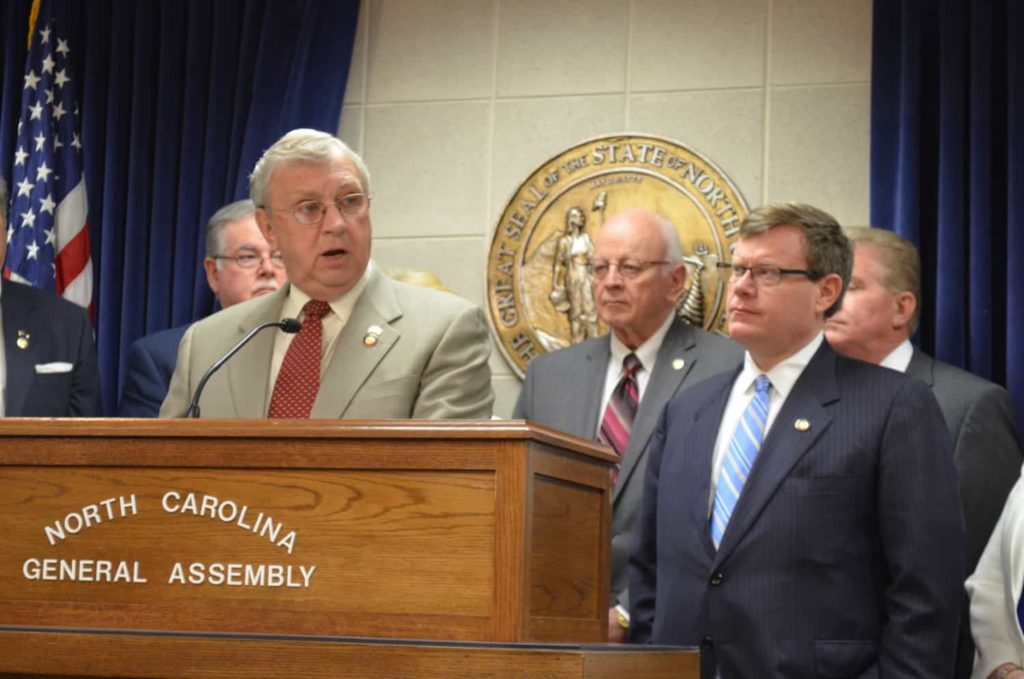
Rep. Craig Horn, R-Union, talking about the education portions of the budget at a 2017 press conference. Alex Granados/EducationNC
Horn, an influential legislator when it came to education, lost his seat when he ran for the state superintendent position and lost to Catherine Truitt in 2020. He was there for the inception of the ISD.
“I’m going to suggest that rather than sit down and work out the problems, it’s easier and faster to say, ‘Ok, we’re done. We’re not doing it,’” he said.
Horn had a lot of problems with the ISD program, but said that if it has failed, he hopes lawmakers have done their homework to understand why.
“If we can say that we did our homework, we actually talked to the people inside, we actually talked to parents and students, we actually made some adjustments and we’re still failing, OK, then we made an informed decision,” he said. “But my experience with the General Assembly is they don’t always make informed decisions.”
Preparing for transition
The State Board of Education heard from the current leaders of the ISD and Southside-Ashpole at the December 2021 meeting.
Derrick Jordan, associate superintendent of agency schools, told the Board that efforts to improve the school are still happening.
“There is absolutely still work to be done, but there is an unwavering commitment to improving outcomes for the students at Southside-Ashpole,” he said.
And Hargrave stressed to Board members that the students in that school are “full of potential.”
“It is a school full of children who desire to be loved and desire to be taught, and they have a hunger for learning,” he said.
Freddie Williamson, superintendent of the Public Schools of Robeson County, said the district is ready to have the school back and is already working with the school and the ISD to prepare for a “smooth, seamless transition.”
There isn’t yet a timeline for the transition, but when Southside-Ashpole does return back to the control of Robeson County schools, State Board of Education member Olivia Oxendine said she hopes it keeps innovation a priority. She said innovation takes a long time, and whatever the ISD, the new teachers, new principal, or the community have done, it should continue.
“Whatever is beginning to happen called innovation, let’s carry it forward,” she said.
Nothing on the record shows that there was either innovation or achievement at the one school in the experimental district. But whatever it is, says Ms. Oxendine, keep doing it, even though it yielded no improvement.
The full story of North Carolina’s failed experiment is fascinating. The bill to create the state’s Innovative School District was sponsored by Republican Rob Bryan. The money to promote the bill was supplied by an ultra-conservative businessman from Oregon named John Bryan (no relation to the legislator). After the bill passed, the state Board of Education selected Achievement for All Children (AAC) as the charter operator, although it had no experience turning around low-performing schools.
Mecklenburg County Republican Senator Rob Bryan sponsored the bill as a member of the House in 2016 that became law and created the ISD. That law specifies that the ISD can have up to five schools, selected from the lowest-performing in North Carolina.
Bryan argued at the time that the new district would provide much-needed reforms, but the following year, as Policy Watch reported, he received at least $5,000 as a “stipend” for his work with AAC.
Several other low-performing schools, including two in Durham, were targeted for state takeover in 2017, but resisted the move. Then-ISD Superintendent Eric Hall ended his pursuit of those schools.
That left Southside-Ashpole, which began operating as the state’s first and only school within the Innovative School District at the start of the 2018-19 school year. Southside-Ashpole has an enrollment of 270, 95% of whom are students of color: Black, Latinx and American Indian.
In its first year as an ISD school, there was a wholesale house cleaning at Southside-Ashpole: After Superintendent Allen abruptly left, the State Board of Education hired Ellerbe to replace her. School principal Bruce Major also suddenly resigned, and AAC then hired Bowen.
It remains unclear whether the changes were due to job performance.
Meanwhile, there has also been a major upheaval within AAC’s business partner, TeamCFA, a Charlotte-based nonprofit that provides financial, instructional and management support to more than a dozen schools in North Carolina and four in Arizona.
TeamCFA is AAC’s curriculum partner, according to the ISD website.
TeamCFA was started by John Bryan (no relation to Rob Bryan), a retired Oregon businessman who has used his wealth to promote school choice causes.
John Bryan is also a major contributor to Republican lawmakers and was instrumental in helping to pass the North Carolina law that created the ISD. From 2013 to 2016, Rob Bryan’s campaign received more than $22,000 in contributions from John Bryan, state reports show. John Bryan also contributed to then-Gov. Pat McCrory, Lt. Gov. Dan Forest, NC House Speaker Tim Moore and Senate President Pro Tem Phil Berger.
Raleigh’s News & Observer reported in October that Bryan and the Challenge Foundation, which Bryan also formed, stopped funding TeamCFA. In his final founder’s letter, Bryan talked about passing on the responsibility to other private investors and philanthropists.
TeamCFA had received as much as 95% of its annual revenue from Bryan and the Challenge Foundation, the paper reported. TeamCFA also receives $510,000 annually from the Charles Koch Foundation.
The NC Republican leadership was heavily funded by John Bryan from Oregon. Bryan was the funder of TeamCFA. TeamCFA was the partner of the only charter operator that applied to manage the district that was created by legislation funded by John Bryan.
What happened to the 270 students in the one school in the Innovative school District? Well, they have had a constant turnover of principals and superintendents. They were Guinea pigs for legislators who don’t know them and apparently don’t care about them.
Our flawed policy is the result of deeply ingrained flawed thinking.
The United States, he writes, is the victim of a combination of forty years of skepticism of government solutions and acceptance of “let’s be realistic about what we can accomplish” thinking.
For example, for decades scattershot treatments of outcomes have characterized bi-partisan education improvement efforts with little to nothing to show for it except undermined public education and stress. The driving causes of inequitable outcomes, systemic inequity, its enabler, racism, and resultant precarious lives remain rampant and unaddressed.
Instead, the dominant education interventions have been to push or blame individuals. These include rewards and punishments for educators or students based on standardized test scores; rigid discipline regimes; and, more recently, a focus on developing grit to work through, put up with, or overcome rather than eliminate challenging social and economic conditions.
Equally, if not more, insidious is you-can’t-save-everyone solutions, such as escape hatches for some kids through charter schools and vouchers, most of which are no better than local public schools. More broadly, the lack of universal health care and inequitable funding of schools through local real estate yield the same help-a-few result.
Leonie Haimson, executive director of Class Size Matters and a member of the board of the Network for Public Education, wrote “a short history” of the rise and meteoric fall of Seth Andrews. He founded a no-excuses charter chain called Democracy Prep, which received adulatory praise from the media and millions of dollars in grants from foundations and the federal government. He moved in the top Ed reform circles. He knew all the key players. He was one of them.
After Andrews invited Leonie to tour his charter school, she wrote:
I found him an intriguing character, obsessively throwing a rubber ball against the wall while we walked through the halls of the school, and never taking off his baseball hat though the network had a rigid dress code for students, who were forbidden to wear hats, wear the wrong color socks or the wrong kind of belt. When we were touring the school, he stopped one student in the hall and berated her for having her Uggs showing. I wondered how long he would last at his own charter school before being suspended or pushed out. I later learned that his baseball hat was something of a calling card for Seth, and it is even mentioned in the indictment document.
Democracy Prep is a “no excuses” charter chain, known for its strict disciplinary practices and high attrition rates. I questioned him about their demerit system which called for keeping students after school for small lapses of behavior, to sit in a room silently, without being able to read or do homework.
But then he was arrested for embezzlement of more than $200,000 from the bank accounts of the charter he founded. His schools were allegedly teaching civic virtue. He is not an exemplar of civic virtue, nor of following the rigid rules he set for his students.
Frances Scarlen Martinez was one of the first students to attend the first KIPP school in the Bronx. David Levin came knocking on her family’s door, recruiting students. Her family taught her that education was the key to success and she eagerly accepted the invitation, feeling fortunate to have been chosen. In the years since, she has a different view of her experience at KIPP. What she remembers most now was the strict control under which she lived.
She writes:
“I showed up for the first day of summer school feeling chosen and unique. What happened next blindsided me. I’d always loved school and learning. At my Bronx elementary I’d regularly made the honor roll. Suddenly adults were policing my every move, my every word. Suddenly I wasn’t good enough. The way I carried myself was no longer acceptable, the way I spoke was not proper. Still, being the high achiever I was, I took all of this as a challenge. I can be silent, keep my body straight and track speakers with my eyes. I can nod my head to show engagement and I can lose my Dominican accent. After all, this was my golden ticket, and my family was counting on it. I was willing to accept anything said to me in order to prove my worth.
“In my experience as a student, I was told how and when to speak, how to dress, where to look, how to nod, how to sit, and how to think from 7:25 am until 5 pm Monday through Friday and from 8-1 pm on Saturdays. Every aspect of our day was controlled, our compliance was routinely tested. At any given moment, the leader of our school would appear in our classroom, demanding to know, “What room is this?” To which we were expected to chant back in unison: “This is the room, that has the kids, that want to learn to read more books, to build a better tomorrow.” If one student did not comply, everyone else would have to repeat the chant again and again until they joined in or were taken away for an individual redirection. The point of this exercise was to keep us on our toes. Just like random cell checks in a prison keep the prisoners from ever feeling at ease, this power exercise was meant to remind us who was in control.”
On reflection, she realized she was part of a “culture of submission” that obliterated her own identity. For most of us, school is a place to explore who we are, what we believe, and what we hope to be. For Frances, school meant submit and obey.
This article is part of a series called “Public Voices for Public Schools,” posted by the Network for Public Education.
Politico reports that Republicans view the pandemic and school closures as an opportunity to promote school closures. This should appeal to the 30% of the population who are unvaccinated and oppose mask mandates and other public health measures. These are probably the same parents who want to block teaching about racism and want parents to decide what their children should be taught (think creationism).
‘A WINNING POLITICAL ISSUE’ — The nation watched as Glenn Youngkin won the Virginia governor’s race last November by tapping into parental outrage over school closures and using the rallying cry “Parents Matter.”
— Now, as the highly contagious Omicron variant complicates the spring school semesterand the 2022 midterms ramp up, GOP strategists say it is an opportune time to also propel one of their education priorities: school choice.
— “Parents being able to have a greater role in where and how their children are educated is a winning political issue, and we intend to promote it as much as possible in the coming year,” said South Carolina GOP Chair Drew McKissick, adding that bills to advance school choice initiatives, like education savings accounts, are ready to go this legislative session.
— “We look at education as being the civil rights issue of our time,” he said. McKissick also pointed out that school choice will be a key issue for Sen. Tim Scott, who’s in the middle of a re-election campaign. Scott, in an address to rebut Biden’s first address to Congress, said the pandemic-spurred public school closures created the “clearest case I’ve seen for school choice in our lifetime.”
If education “is the civil rights issue of our time” in South Carolina, why does the state refuse to fund its public schools adequately and equitably?

 Diane Ravitch's blog