Archives for category: Budget Cuts


Usually, members of the President’s Cabinet go before Congress to defend their department’s budget and to explain the good works the department is doing.

Not Secretary DeVos! She went to a Congressional heading to ask the Appropriations Committee to cut her budget.

Much has been made of her plea to zero out federal support for the Special Olympics, which backfired. Not only were the families of 272,000 participants offended but so were the families of many millions of people with disabilities. Trump quickly res indeed the cut, which was a tiny sliver of the ED budget, equivalent to six weekend trips to Mar-a-Lago by Trump.

Many more programs were jeopardized, as Denis Smith writes here.

“In her testimony before the House Education Appropriations Subcommittee on Tuesday, Betsy DeVos, the anti-public education Secretary of Education, was present to defend $7 billion in proposed cuts to her department. The cuts in the education budget are seen as measures to offset billions in lost revenue from tax breaks for the wealthy that have exploded the federal deficit.

“An examination of Trump’s FY2020 budget shows that the administration is asking to cut the Department of Education’s funding from $71 billion to $64 billion, eliminating 29 programs. In addition to zeroing out popular and proven programs like Special Olympics, which has garnered strong support during its 50-year existence, Pell Grants for higher education tuition assistance, literacy and after-school programs would also be adversely affected by new budget statements.

“Broadcast and print media were all over the story about a cabinet secretary who was as heartless as Genghis Kahn in laying waste to her department’s budget so that money could be freed up for other purposes. The one area that stood out the most was the elimination of $18 million in federal funds for Special Olympics and the added support the program provides for students with special needs….

”The Secretary’s propensity for cluelessness is seen in defending a budget that harms so many children with program cuts yet reserves a huge amount of public funds for charter schools, many of which are run by for-profit management companies. Her advocacy for increased funding for charter schools at a time when massive cuts are proposed for children with special needs is appalling, and when the Department of Education’s own inspector general examined the efficacy of the Charter Schools Program for state education agencies, where federal start-up grant funds are available to establish new charter schools…

”If there was any value in the Education Subcommittee hearing, it is that all should know without any doubt where the priorities of Republicans are in the area of education. Forget about kids and learning. Forget about being civic-minded and making investments in the community through public education. Instead, profit must be the result. In this model promoted by Republican budget priorities, students come in third behind profit/shareholder value and executive compensation for the for-profit school leaders. In this alternative universe, it’s all about people who look at market activity and portfolios and concern themselves with calculating yield on investment.”

The bottom line: Greed is good.

Fortunately, the Democrats who control the Appropriations Committee will not approve any of DeVos’s proposed cuts. Congresswoman Rosa DeLauro of Connecticut is chair of the Education subcommittee. She questioned DeVos closely. DeVos will not get anything past DeLauro, a champion for children and public schools.



Yes, charters and vouchers take money from public schools, which enroll nearly 90% of students.

In Tuesday’s election, a pro-public school slate swept the Milwaukee school board. It will be interesting to see what happens with that city’s heavy dose of privatized charters and vouchers.

In Wisconsin, a legislator revealed that school choice removes $193 million in state aid from public schools. 

“MADISON, Wis. — A new report shows voucher and charter schools will reduce aid to public schools by nearly $193 million.

“Democratic state Rep. Sondy Pope released an analysis Thursday that the Legislative Fiscal Bureau prepared for her. The report shows voucher and charter schools will consume $192.9 million that could have gone to public schools this year.”

There’s only one pot of State money for K-12 schools. Dividing it three ways makes all sectors suffer.


The militant Chicago Teachers Union issued a statement following the election of Lori Lightfoot, who was not its first choice. The CTU celebrates the end of the nightmare rule of Mayor Rahm Emanuel and Governor Bruce Rauner. And it commemorates the historic leadership of its President Emerita Karen Lewis, who inaugurated a historic awakening of teacher militancy with the Chicago teachers’ strike of 2012, which laid the seedsfor the walkoutsof the past year.


Our militancy is not dictated by who sits on the fifth floor of City Hall

The Chicago Teachers Union and SEIU Local 73 will continue to fight for an elected, representative school board and progressive revenue for the schools our students deserve.

CHICAGO, April 2, 2019—The Chicago Teachers Union and Service Employees International Union Local 73 issued the following joint statement tonight regarding the election of Lori Lightfoot as mayor of Chicago:

The most obvious win for our movement is that Chicago will be Rahm-less by May 20, for which we have a movement of educators, parents, workers, community organizers and activists to thank. Elections are about contrast, and at least on the surface, tonight’s results represent a contrast to the last eight years.

Tonight, the city of Chicago elected a new mayor out of a desire for bold and progressive ideas, and a commitment to building a more fair, just and equitable city. Mayor-elect Lori Lightfoot has her work cut out for her on day one.

We did not win class size limits for students in kindergarten, first and second grades, TIF distribution to our school communities, or a special education monitor appointed by the state because we asked nicely or behaved politely. We will aggressively bargain, aggressively defend our platform and aggressively organize for social, economic, educational and racial justice in Chicago and Springfield. The Chicago Teachers Union and SEIU Local 73 have fought for fairness alongside our allies for nearly a decade because our city deserves it.

As a movement, we helped defeat the twin privatization forces of Rahm Emanuel and Bruce Rauner. But the millionaires and billionaires who supported them remain, along with astroturf education “deform” groups they fund that continue to support the push-out of Black families, the under-funding and closure of public schools, pension theft, marginalization of democracy and privatization of public services.

There is a significant amount of hope for city government, with checks and balances, that represents the will of this movement. Governance in the Chicago City Council will shift significantly with newly elected movement leaders like Matt Martin, Byron Sigcho-Lopez, Jeanette Taylor and Andre Vasquez, who join progressive champions Sue Garza, Carlos Ramirez Rosa, Maria Hadden and Mike Rodriquez. The progressive agenda is advanced by a powerful community organizing presence that was largely built against the policies of Rahm Emanuel, and is committed to taxing the rich and funding our schools.

The only reason either mayoral candidate embraced this agenda was because of this presence, and these leaders will hold the mayor accountable to her campaign promises. Congratulations to our endorsed winners whose victories represent a repudiation of the Rahm and Rauner agenda, and the vision of independent political organizations like United Working Families.

A Black woman will lead a city with a tragic history of racial strife and segregation. A Black woman will lead the nation’s third-largest school district, whose current leader closed 50 Black and Latinx schools in a single year and fired thousands of experienced Black female educators. Mayor-elect Lightfoot’s leadership must stop the hemorrhage of Black families from our city, prioritize affordable housing and rent control, secure a Community Benefits Agreement for the Obama Center, make the wealthy pay their fair share, and stabilize and fund public services. We expect her appointments to the Chicago Board of Education to be stakeholders—the very people who inhabit communities and neighborhoods that have lost the most under the racist influence of neoliberal school leadership.

And to be clear, we do not reach this moment—this moment—as a city without Chicago Teachers Union President Emerita Karen Lewis.

Mayor-elect Lightfoot’s work begins immediately. Our school communities need $2 billion and the wealthy must pay their fair share of the bill. School communities need justice and equity; an elected, representative school board; fully resourced school communities; Black, Latinx and veteran teachers in classrooms; and full restoration of our collective bargaining rights. Our parks need to be fully funded and staffed so they are safe and clean, no longer subsidized by an over-reliance on part-time workers who are paid poverty wages with little or no benefits, and provide the programs and services our community deserves.

School communities need a nurse and librarian in every building; counselor and social worker staffing levels that meet recommended ratios; special education classroom assistants, teaching assistants and restorative justice coordinators; clean and safe buildings that place our students’ interests above the profits of outside contractors; and 75 sustainable community schools. Our movement will continue to beat this drum, as well as demand adequate special education services and sanctuary for immigrant students.

Rahm and Rauner are gone. Their policies must go as well. We hope Mayor-elect Lightfoot separates herself from the dubious interests that funded her campaign, and governs like the progressive she claims to be by ending the funding of #NoCopAcademy and the Lincoln Yard TIF. We expect her to fight for an immediate $15/hr minimum wage in the city, for real and meaningful criminal justice reform, and for equitable investment in all of Chicago’s communities—especially those that have been habitually overlooked and underfunded.

We will also demand that Mayor-elect Lightfoot use her authority to make sure that Chicago is a city of unions for all, and that everyone has the opportunity to join a union no matter where they work.

If not, she will face immediate pushback. Elections are moments. We are a movement. See you at City Hall on April 9.

Sent via ActionNetwork.org. To update your email address, change your name or address, or to stop receiving emails from Chicago Teachers Union, please click here.

An Arizona Teacher left this comment:

“I teach in an AZ public school–title 1 school. The poverty in this school is astonishing. This is my first year teaching in AZ after moving here from another state. I taught almost 20 years in a public school that was also a Title 1 school before moving to AZ. I have a lot of experience teaching in poverty schools. I have never seen anything as dysfunctional and as underfunded as the school I teach in currently. The whole district is in dire straits as it is funneling money away from public schools into charters. The lack of resources in this school is stupefying and confounding. It seems that the people in AZ are automatons and that this “cheating” of public schools is the new-normal. It’s not that people don’t care about education, its just that most people who can leave the poverty schools behind do so without realizing the impact they have. And to be honest, if I had children I don’t know if I would want them to attend one of these public schools. The discipline problems and lack of support for teachers is driving parents and teachers away. Buildings are falling apart. Just today part of the roof caved in at the school library. And then the corruption in the state legislature is driving the drain of resources.”


In this post, Matthew Gardner Kelly of Pennsylvania State University  explains why demands for charter moratoriums are growing.

The root of the problem is money. Public schools in most states were hurt by the recession of 2008 and funding never recovered. Adding competition with charters made the financial situation worse.

“In Pennsylvania, the local district makes a tuition payment to the charter school enrolling each student from that district. The payment is based on per-pupil spending for similar students. For example, if a fourth grader leaves a public school in the Pittsburgh School District to attend a charter, the Pittsburgh School District is required to pay the charter school $16,805.99 – which is the average amount the district spends on a student in the district.

“At first glance, it perhaps makes sense to have money follow the children. The problem is that increased charter enrollments rarely allow a district to save as much as they lose in charter tuition. As a result, without additional revenue from state governments or local taxes, districts are forced to make budget cuts and spend less on the students who remain in traditional public schools.

“Consider an example. Bethlehem Area School District paid $25 million in charter school tuition payments in 2017. It was not possible to save $25 million with the students gone, however, because of the way the students were distributed across the district.

“The students enrolled in charter schools came from 13 different grades in 22 different schools. Since students moving to a charter were rarely all of the students from a single school, grade or class, the district was not able to reduce staff or close classes to help cover the charter tuition payments. If next year’s third grade class goes from 28 students to 26 students in a school, district officials still need to keep that third grade class open. They cannot pay that teacher 2/28th less, heat 2/28th less of that classroom, or reduce the operation of electricity in that classroom by 2/28th.

“Yet, if the class went from 28 to 26 students because two students enrolled in charters, the district needs to make tuition payments for the missing students. When those payments are repeated and distributed unevenly across schools and grades, it adds up to millions of dollars. Students move between districts all the time, but nowhere near the scale– nor with the fiscal impact – that takes place because of charter expansion. Bethlehem Area School District had 1,900 students, about 12 percent of the district’s population, enrolled in charter schools in 2017.”

This kind of fiscal drain is unsustainable. The vast majority of students are harmed so that 12% can go to charters. If it continues, the public schools will be irreparably damaged. This is not sound policy.

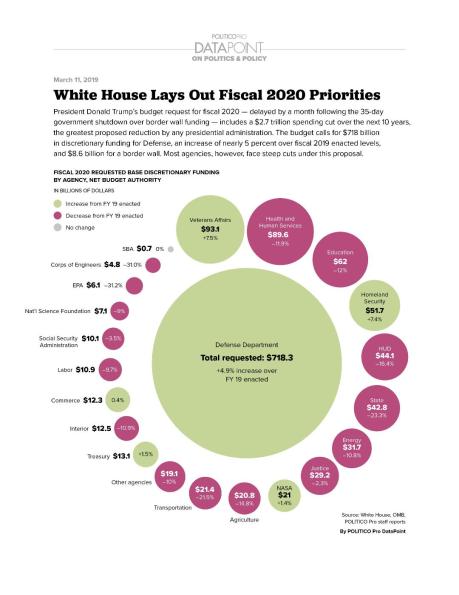
The graphic below shows clearly where Trump’s priorities are and where they are not. A big boost to the military and border security. Deep cuts to Medicare, Medicaid, Social Security, the Environmental Protection Agency, the National Science Foundation, Labor, Interior, Agriculture, Justice, Housing, Energy, Education, Transportation, and everything else that has to do with social/human/non-military needs.

oil


John Cassidy of The New Yorker describes the most important broken promise in the Trump budget proposal. We should all fall to our knees and thank whatever deity we choose that the Democrats won control of the House of Representatives last fall. It is doubtful that even his own party would want to own these budget proposals, which slash the social safety net that so many millions of Americans depend upon. This budget enhances the Trump administration’s well-established reverse Robin Hood approach, robbing from the middle class and the poor while giving to the rich and corporations.


I’ve noted before that Donald Trump lives by a famous dictum from Joseph Goebbels, the Nazi propagandist: “When one lies, one should lie big, and stick to it.” (Goebbels attributed this tactic to the English.) And the President has outdone himself with his Administration’s new budget proposal for the 2020 fiscal year, which is entitled “A Budget for a Better America: Promises Kept. Taxpayers First.”

“Promises kept” has a particularly nice ring to it. Almost as nice as what Trump said on that fateful day, June 16, 2015, when he descended the escalator at Trump Tower. “Save Medicare, Medicaid, and Social Security without cuts,” he declared. “Have to do it.” Throughout the Republican primary campaign, Trump repeated this pledge many times and also accused his G.O.P. opponents of wanting to slash the three big entitlement programs. In the general-election campaign, he stuck to the same mantra. A few days before Election Day, he suggested that Hillary Clinton wanted to “destroy” Medicare, the public health-care system for the elderly, which she had vowed to expand, and claimed that he alone would “protect” it.

So how does the “Budget for a Better America” treat Medicare and the other programs that Trump vowed to safeguard at all costs? By calling for even larger cuts to them than the White House proposed this time last year, when it formally abandoned Trump’s campaign pledges. The budget for the 2019 fiscal year called for five hundred and fifty billion dollars in cuts to Medicare over ten years. With the budget deficit skyrocketing as a consequence of the Trump-G.O.P. tax bill, the 2020 budget would reduce spending on Medicare by eight hundred and forty-five billion dollars over the next decade. Even in Washington, that’s a lot of money.

The cuts to Medicare would be imposed as the budget allots billions of dollars a year in extra spending to the Pentagon and another $8.6 billion for Trump’s wall along the southern border. The economies would be achieved largely by reducing payments to doctors, hospitals, and other health-care providers, which could affect benefits and drive some providers to leave the program. Rather than spelling this out, the document adopts the language of Newspeak: “The Budget proposes to reduce wasteful spending and incentivize efficiency and quality of healthcare in Medicare, extending the solvency of the program for America’s seniors consistent with the President’s promise to protect Medicare.”

The budget treats Medicaid, the federal health program for poor people and children, in even more draconian fashion. Reflecting a long-standing priority of the Republican Party, the budget would convert Medicaid into a decentralized system administered by the states and financed by federal block grants. By indexing these grants to the consumer price inflation, which rises more slowly than inflation in the health-care sector, the budget would substantially reduce the federal-spending commitment going forward. In addition, it would eliminate funding that the Affordable Care Act provided for individual states to expand Medicaid to more recipients—funding that more than thirty states have taken advantage of in recent years.

Even for an ardently conservative administration like this one, you might think that would be enough cuts to health-care spending. No. The budget also proposes to eliminate some federal subsidies that the A.C.A. provided for the purchase of private insurance plans by people who aren’t quite poor enough to qualify for Medicaid. “The budget overall would cut funding for Medicaid and ACA subsidies by $777 billion over ten years, compared to current law,” Hannah Katch, an analyst at the Center on Budget and Policy Priorities, a liberal think tank, noted.

Education Week describes Trump’s proposed cuts for programs in the U.S. Department of Education. Trump proposes eliminating 29 federal education programs while maintaining level funding for Title 1 and Special Education. The key quote in this article is the one from Secretary DeVos, who says the budget is about “education freedom,” by which she means, “So long, you are on your own, don’t expect the feds to help you.” The administration proposes $5 billion for vouchers and an increase in the federal charter school program to $500 million. It is not clear why the federal government needs to spend any money to start charter schools, since this project is now well covered by the Waltons, the Koch brothers, the DeVos family foundations, Michael Bloomberg, the Broad Foundation, the Dell Foundation, the Arnold Foundation, the Fisher Family Foundation, the Gates Foundation, the NewSchools Venture, the Charter School Growth Fund, and others too numerous to mention.


President Donald Trump is seeking a 10 percent cut to the U.S. Department of Education’s budget in his fiscal 2020 budget proposal, which would cut the department’s spending by $7.1 billion down to $64 billion starting in October.

Funding for teacher development under Title II, totaling $2.1 billion, would be eliminated, as would $1.2 billion in Title IV funding for academic supports and enrichment and $1.1 billion for 21st Century Community Learning Centers that support after-school programs. In total, funding for 29 programs would be eliminated in the federal budget. 

On the other side of the ledger, Trump’s budget blueprint calls for $500 million for federal charter school grants, a $60 million increase from current funding levels. The president also wants $200 million for the School Safety National Activities program, which would more than double the program’s $95 million in current funding—of that amount, $100 million would be used to fund a new School Safety State Formula Grant program. There are no requirements for the grant program related to firearms, according to the Education Department. And the office for civil rights would get $125 million, the same as current funding.

On the school choice front, the department says its main proposal has already been introduced: a federal tax-credit scholarship program from Republicans. The Treasury Department’s budget proposal includes $5 billion for the cost of such a program. 

Meanwhile, the Education Innovation and Research fund would be funded at $300 million, a $170 million increase from fiscal 2019. Of that amount, $200 million would “test the impact of teacher professional development vouchers,” according to a presentation from the Education Department, while $100 million would go toward innovative STEM grants. In addition, the Trump budget would provide $50 million for a pilot program under Title I to help districts create and use weighted student-funding formulas—this pilot program was created under the Every Student Succeeds Actin order to help schools focus money directly on disadvantaged students and those with special needs. Funding for the District of Columbia Opportunity Scholarships Program, which provides vouchers to students in the nation’s capital, would increase to $30 million. 

Title I funding for disadvantaged students, the single-largest federal funding program for public schools, remains flat at $15.9 billion in Trump’s budget pitch. Special education grants to states would also be level-funded at $13.2 billion. Also flat-funded are the English Language Acquisition formula grants at $737.4 million. 

“This budget at its core is about education freedom—freedom for America’s students to pursue their life-long learning journeys in the ways and places that work best for them, freedom for teachers to develop their talents and pursue their passions, and freedom from the top-down ‘Washington knows best’ approach that has proven ineffective and even harmful to students,” said U.S. Secretary of Education Betsy DeVos in a statement about the budget proposal.

On a Monday conference call with reporters, Jim Blew, the assistant secretary for planning, evaluation, and policy development, acknowledged that Congress and the Trump administration have not been synced up in terms of education spending priorities. 

“The administration believes that we need to reduce the amount of discretionary funding for the education,” Blew said. “That is based on the desire to have some fiscal discipline and address some higher-priority needs.”

Blew indicated that the priorities should be the disadvantaged children and students with disabilities. 

For more details on Trump’s fiscal 2020 proposal for the Education Department, click here. And check out our chart below to see the effects Trump’s budget request would have on different programs.


When the Democrats regained control of the House of Representatives last fall, a great champion of working people, children, and public schools was restored as chair of a key committee overseeing the social safety net. Congresswoman Rosa DeLauro of Connecticut is determined to protect the federal funding on which millions of people depend. Trump wants to increase military spending.


FOR IMMEDIATE RELEASE

March 11, 2019

CONTACT:

Will Serio: 202-225-3661


DeLauro Statement on Trump’s 2020 Budget


WASHINGTON, DC — Congresswoman Rosa DeLauro (CT-03), Chair of the Labor, Health and Human Services, and Education Appropriations Subcommittee, today released the following statement regarding President Trump’s 2020 budget.


“For the third year in a row, President Trump has released a budget that is cruel and reckless. His administration has proposed $21 billion in cuts to programs at the Departments of Labor, Health and Human Services, and Education—cuts that will crush critical programs that serve working people and middle-class families. This is not hyperbole. President Trump actually wants to cut Medicare, Medicaid, home energy assistance for seniors and people with disabilities, groundbreaking medical research, tools that help local communities fight poverty, job training programs, funding to enforce our trade agreements, pre-school grants, teen pregnancy prevention programs, anti-hunger programs like SNAP, afterschool programs, Pell Grants, federal work study programs, and much more.”


“It is disheartening to see a budget that would dismantle so many programs that people rely on every day. It would be a cold day in hell before I helped pass a budget like this—one that hurts the American people in order to lavish tax cuts on millionaires, billionaires, corporations, and special interests. Instead, Democrats will continue fighting for working people, the middle class, and the most vulnerable.”


Some cuts President Trump’s budget proposes within the Departments of Labor, Health and Human Services, and Education include:


Department of Labor

  • Cuts Job Corps by $703 million
  • Cuts the Bureau of International Labor Affairs by $68 million
  • Cuts Women’s Bureau by $10 million
  • Eliminates job training for Native Americans and Migrant and Seasonal Farmworkers (-$143 million)
  • Eliminates Senior Community Service Employment (-$400 million)
  • Eliminates Susan Harwood Training Grants (-$10.5 million)


Department of Health and Human Services

  • Cuts the National Institutes of Health (NIH) by $5.4 billion
  • Cuts the Centers for Disease Control and Prevention (CDC) by $750 million
  • Cuts the Health Resources and Services Administration by $1 billion, eliminating most programs that support training for health professions, including nursing
  • Eliminates the Low Income Home Energy Assistance Program (LIHEAP) (-$3.7 billion)
  • Eliminates the Social Services Block Grant (SSBG) (-$1.7 billion per year)
  • Eliminates the Community Service Block Grant (CSBG) (-$725 million per year)
  • Eliminates Preschool Development Grants (-$250 million per year)
  • Eliminates the Teen Pregnancy Prevention Program (-$108 million per year)


Department of Education

  • Eliminates numerous programs, including:
    • Supporting Effective Instruction State Grants (-$2 billion)
    • Afterschool programs (-$1.2 billion)
    • Student Support and Academic Enrichment Grants (-$1.2 billion)
    • Arts in Education (-$29 million)
    • Special Olympics (-$17.6 million)
    • Supplemental Educational Opportunity Grants (-$840 million)
  • Cuts Federal Work Study by $630 million
  • Proposes a Pell rescission of $2 billion


In addition, the President’s Budget:

  • Cuts Medicare and Medicaid by over $1 trillion
  • Repeals the Affordable Care Act
  • Contains a woefully inadequate paid leave proposal that falls short of what the nation needs
  • Cuts the Supplemental Nutrition Assistance Program (SNAP) by more than $20 billion per year
  • Reduces Temporary Assistance for Needy Families (TANF) by more than $2 billion per year
  • Cuts the Environmental Protection Agency (EPA) by $2.8 billion


###


The story of the task force charged with reviewing the charter law and the fiscal impact of charters on public schools continues to evolve, and not in a good way.

Of the 11 members of the task force appointed by Tony Thurmond, in consultation with Governor Gavin Newsom, at least six are directly connected to the charter industry.

How can this be possible when the charter industry supported former Los Angeles Mayor Villaraigosa against Gavin Newsom, and when the charter industry spent millions to defeat Tony Thurmond, outspending his supporters by a margin of 2-1?

Here is the task force with new information about one member, the superintendent of El Dorado County:


The task force members are:


  • Cristina de Jesus, president and chief executive officer, Green Dot Public Schools California (charter chain);
  • Dolores Duran, California School Employees Association;
  • Margaret Fortune, California Charter Schools Association board chair; Fortune School of Education, president & CEO;
  • Lester Garcia, political director, SEIU Local 99 (Local 99 took $100,000 from Eli Broad to oppose Jackie Goldberg, a critic of charters);
  • Alia Griffing, political director, American Federation of State, County and Municipal Employees (AFSCME) Council 57;
  • Beth Hunkapiller, educator and administrator, Aspire Public Schools (charter chain);
  • Erika Jones, board of directors, California Teachers Association;
  • Ed Manansala, superintendent, El Dorado County; board president, California County Superintendents Educational Services Association; the El Dorado County Office set up a Special Education Local Plan Area (SELPA) specifically to service students with disabilities in charter schools and wooed charter students away from their local districts; El Dorado supposedly offers services to disabled students enrolled in charter schools who live hundreds of miles away;  
  • Cindy Marten,  superintendent, San Diego Unified School District;
  • Gina Plate, vice president of special education, California Charter Schools Association (charter lobby);
  • Edgar Zazueta, senior director, policy & governmental relations, Association of California School Administrators (ACSA endorsed Marshall Tuck against Tony Thurmond). 


By my count, six members of the 11-member panel are directly connected to the charter industry, including two from the lobbying organization CCSA. That’s a majority.

As a supporter of public schools, I supported Tony Thurmond as best I could on this blog. I personally contributed to his campaign. I thought that his election and the election of Gavin Newsom meant that charter schools in California would be held to the same standards of academic, financial, and ethical accountability as public schools; I hoped that the state would stop stacking the deck in favor of charters. I hoped that necessary reforms would eliminate shady operators and grifters and put a halt to the unchecked  proliferation of unstable, unsound charter schools.

Now, I am not so sure.

The fox is in charge of the henhouse.

If you are as outraged as I am, if you feel you have been had, please contact Superintendent Tony Thurmond.

Only 10% of the students in the state of California attend charter schools.

Why do their representatives get to police themselves?

Why do their representatives get to decide whether they are hurting the public schools that most students attend?

Why does the charter industry get to decide whether it is okay for them to drain funds and impose budget cuts on public schools?