Archives for category: Billionaires

Homi Kharas of the Brookings Institution writes about ways that the world’s billionaires could solve persistent global problems by paying an annual tax of 1% of their wealth.

He writes:

Until recently, even the wealthiest individuals did not have enough money to make a material dent in global problems, let alone “solve” them. Compared to the size of national economies, or the budgets of the governments of national economies, their wealth appeared small.

This is no longer the case. There are 2,755 billionaires in the world today, with an estimated wealth of $13.2 trillion. Even just 1 percent of this wealth (equivalent to a tax rate of 15-20 percent on the accrued income that billionaires have received with returns of 5-7 percent per year) would yield a flow of $130 billion per year. This can be compared with annual official aid (net ODA) of roughly $160 billion from all countries and multilateral institutions combined. Looking for contributions from billionaires has moved from a nice-to-have niche improvement to becoming part of the conversation on financing to solve large-scale global issues.

What could be done with $130 billion each year?

Figure 1 below provides some estimates of the cost of solving selected global problems. For example, updating previous work, I estimate that $95 billion would be enough to eradicate extreme poverty for all the 708 million people in the world living below the international threshold of $1.90 per person per day. Yes, a 1 percent contribution from the world’s billionaires would provide more than enough resources to end extreme poverty today.

Other major global issues have less precise costing estimates but paint a similar picture. The issue of “solving” world hunger has a range of estimates, partly because solving hunger is not simply about having enough food, but about having consistent access to sufficient, safe, and nutritious food, often in conflict-prone, or climate change-affected areas. Preferably, the food should also be grown in a sustainable way and the food system changes required depend on simultaneous system changes in health, energy, and transport. The U.N.’s Food and Agriculture Organization (FAO) nevertheless estimates that annual investments of $39 billion to $50 billion would be required to achieve a world without hunger by 2030. This includes both the 800 million people suffering from acute food insecurity, as well as the 1.5 billion additional people suffering from moderate food insecurity.

If you were a billionaire, wouldn’t you be willing to support a 1% tax on your wealth that would save the lives of millions of people living in desperate conditions?
Tom Ultican, retired teacher of physics and advanced mathematics, has written an incisive analysis of the libertarian attack on democracy and public education, funded by billionaires and advanced by rightwing think tanks. He “follows the money,” and it leads him to Charles Koch, the Bradley Foundation, the Scaife Foundation, the Walton Family Foundation, ALEC, the Manhattan Institute— and other oligarchs and their tools.

He pulls no punches as he weaves together the contrived panics over “critical race theory” and anti-maskers. “Parents Defending Education” and “Moms for Liberty” are but a few of the astroturf groups who have been mobilized to terrorize school boards and other parents. Funded by Dark Money.

Ultican writes:

Nancy MacLean observed that Buchanan and Koch had concluded, “There was no glossing over it anymore; democracy was inimical to economic liberty.” (Democracy in Chains page 152)

The anti-democratic impulse of the oligarch must be contained. There is an underlying wisdom to democratic decision making. It is a wisdom that bends toward equity and humanism. Public education is the soil from which that wisdom can flower. For the past five decades, an autocratic businessman has been pushing our country in the direction of widespread suffering and discrimination.

Neither capitalism nor socialism is a perfect guide for society. Education, medicine, prisons and policing are not well suited to a strict capitalist approach. A strict socialist approach does not function well in manufacturing, farming and entertainment. Ideologues demanding one of these two economic methods to the exclusion of the other are a problem. The guide to balancing these competing ideologies is humanism. In other words ponder, “The policy best serving the majority of the people while maintaining a keen eye to insure that the minority is not abused.”

The best way to move society forward toward a more perfect union is to make democracy ever more inclusive. And the best way to improve democracy is to protect and fund public education.

An important read.

This article by Ed Montini in the Arizona Republic explains the childish behavior of Republican leaders, who engage in taunts instead of reasoned discourse about their agenda. They don’t want to expand Medicare. They don’t want universal pre-K. They don’t support efforts to combat climate change. They oppose paid family leave for families in need after surgery or childhood. They are against a federal guarantee of two years tuition-free community college. They oppose higher taxes on billionaires. They don’t care about voting rights. They don’t want to expand opportunity. They don’t want to reduce inequality. They don’t invest in the future.

What are they for? Tax breaks for the rich.

Since they have no agenda, their goal is to make sure Biden can’t succeed. After blocking everything he proposes (with the help of Senator Manchin of West Virginia and Senator Krysten Sinema), they have nothing to offer other than the schoolyard chant.

Ed Mancini was walking his dog early one morning, and he saw two other dog owners engage in conversation, a man and a woman. As they part ways, the man says to the woman, “Let’s go, Brandon!” then turning away.

The woman is puzzled and asks Montini if he knows what that phrase means.

So, first thing in the morning I am called upon to explain this recent cultural phenomenon to one of the few American grown-ups who has managed to remain a fully functioning adult, while most of the rest of us have been transformed by social media into crude, smart-alecky 8-year-olds.

There’s that Southwest Airlines pilot

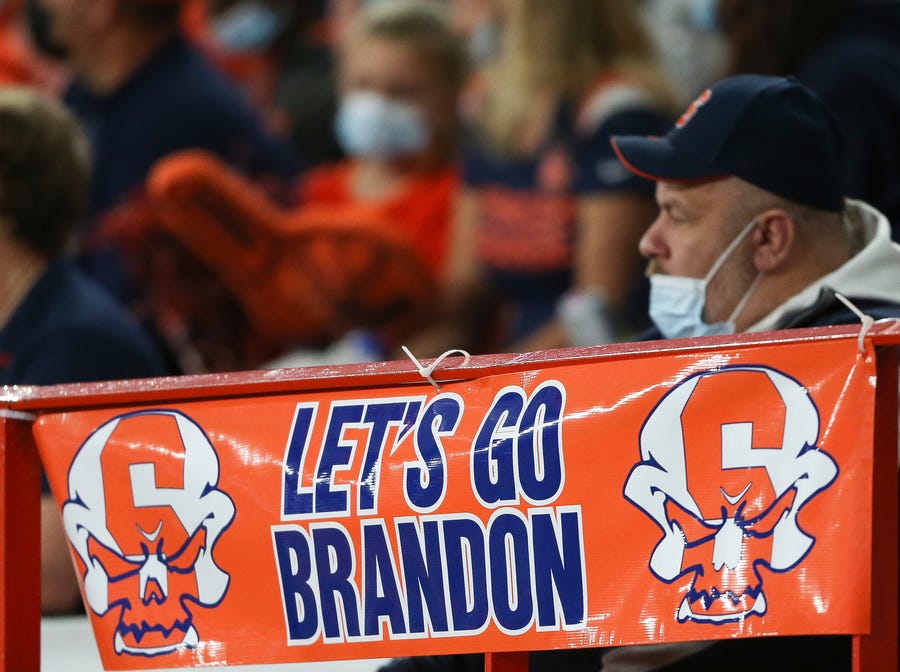
This particular sign was a the Boston College-Syracuse football game Oct. 30. A fan’s juvenile jab at President Joe Biden.Joshua Bessex
For instance, the woman had not heard about the Southwest Airlines pilot who recently signed off on a flight, telling passengers, “Let’s go, Brandon.”

Or about how the whole thing began when a race car driver named Brandon Brown won a NASCAR race and, while being interviewed on TV, the crowd started chanting, “F–k Joe Biden.” The flummoxed interviewer suggested they might be saying, “Let’s go, Brandon.”

After that, the phrase became a way for grown-up 8-year-olds to say the f-word about Biden without actually using it.

Really.

Elected Republican politicians in Washington, D.C., started using the phrase.

Donald Trump began selling “Let’s go Brandon” T-shirts through his Save America PAC for $45, and grown-up 8-year-olds in America actually purchased them.

$45.

There are adults who channel their 8-year-old selves by bringing signs saying, “Let’s go, Brandon” to public events, as well as some who scribble the message in paint on the rear window of their automobiles….

How to answer someone who says such a thing

Of course, we all learned as children that infantile behavior tends to draw some type of backlash….

After I explain the whole “Let’s go, Brandon” thing to the woman who’d been walking her dog she says, “That seems incredibly childish. How are you supposed to answer someone who says such a thing?”

I tell her that, as a grown-up, she would be best served simply ignoring it.

As for the rest of us, suffering as we do from social-media-induced age regression, I’d respond, “I’m rubber and you’re glue …”

Reach Montini at ed.montini@arizonarepublic.com.

Problem viewing email? View in browser

Anand Giridharadas interviewed Senator Ron Wyden of Oregon, who is sponsoring a ”billionaires’ tax,” which would tax assets, not just income. This tax on the growth in their assets would affect between 600-700 billionaires. The revenue from the billionaires’ tax would pay for a large part of President Biden’s proposed budget plan. Two members of the Democratic Party—Senator Joe Manchin of West Virginia and Senator Kyrsten Sinema of Arizona—have blocked the bill, objecting to its cost and to raising taxes to pay for it. Republicans will unanimously oppose it, so Biden can’t afford to lose even one vote. The discussion has gone on for months, and the Republicans hope to stall and stall, then win enough seats a year from now to destroy Biden’s plans and his presidency.

In another interview, Anand talks with Berkeley economist Gabriel Zucman, who explains how the wealth tax would work. In a fascinating overview, he says the tax would affect fewer than 1,000 people: it’s the most progressive tax possible, targeted at the tippy top. It’s also technically different from a wealth tax in that it does not tax wealth itself, but the increase in wealth — what economists call unrealized capital gains.

To get an idea of who will pay the tax, scan Bloomberg’s Billionaires Index. Elon Musk is #1, with more than $200 billion. Jeff Bezos is #2.

If The.Ink interviews are behind a paywall, you should subscribe. Anand is consistently interesting.

ANAND: Is the wealth tax on? Is this in the final package? Is this thing happening?

SENATOR WYDEN: We’re pulling out all the stops. Tonight we’re going to start talking about it in more detail. I have been unable to see even one senator getting up and actually saying, “Gee, I think it’s OK that billionaires are not paying any taxes for years on end.”

What the opponents are trying to do, because they aren’t willing to get up and actually act like they’re sympathetic to billionaires, they’re running the old FUD strategy — fear, uncertainty and doubt. If you can just throw enough FUD at it, then senators say, “Oh, gee, I really don’t know.”

ANAND: I’m hearing from a lot of people that Senators Joe Manchin and Kyrsten Sinema, who have resisted even modest tax increases on corporations and rich people, that they’re with you on this. I’m curious: How did they get behind an unprecedented and historic wealth tax instead of relatively more modest ideas?

SENATOR WYDEN: Well, first of all, we’re calling this the “billionaires’ income tax,” so that people know that billionaires should pay taxes every year, just the way nurses and firefighters are.

All of the members are still making up their minds and saying we want to know more information about this and that, but around here, everything is always impossible until 15 minutes before it comes together — and particularly when you’re taking on such enormous, concentrated power. Billionaires know lots and lots of United States senators.

Editor’s Note (me): After Anand published this interview, and after Senator Wyden released his bill, Senator Manchin said he was not likely to support it because it targets such a small and specific number of people. It’s “divisive,” he said, to single out billionaires. When you don’t want to do something (like tax billionaires), any excuse will do.

Jeannie Kaplan, a former member of Denver’s elected school board, has warned for years about the subversion of Denver’s school election by well-funded, out-of-state “reformers.” Their money makes it difficult for ordinary citizens to run for the school board.

In this post, Jeannie reports that Dark Money is back and is prepared to fund candidates who support charter schools and other elements of the failed “reform” agenda. She has identified the groups that act as pass-throughs for Dark Money, she has tallied the total (to date) of $360,000, but it’s usually impossible to identify the original source of the money.

Nora de la Cour is a high school teacher and writer. This article about the sham of for-profit remote instruction appeared in Jacobin. Study after study has demonstrated the poor results of virtual instruction, but the research does not deter the greedy entrepreneurs who see the profit in virtual charter schools. You may recall the recent press release from the National Alliance for Charter Schools about how charter schools increased enrollment by 250,000 during the pandemic; what the press release didn’t admit was that the “increase” was due entirely to growth in virtual charter enrollments, which may turn out to be a temporary response to the pandemic.

De la Cour sees the push for for-profit remote learning as another front in the privatization movement.

She begins:

In spring of 2020, we saw signs that billionaires and neoliberal politicians were looking to use the COVID-19 lockdown to finally eliminate one of the last remaining venues where Americans convene in the practice of democratic self-governance: the brick-and-mortar schoolhouse.

Plutocrat-funded techno-optimists giddily suggested we use the temporary requirement of virtual learning to test-drive modelsthat give families more “flexibility” and “freedom.” Then-governor Andrew Cuomo formed a partnership between New York state and the Bill & Melinda Gates Foundation to explore a post-pandemic future without “all these physical classrooms.” Betsy DeVos announced $180 million in grants for states to “rethink” K–12 learning, and her cohort of privatization pushers began licking their chops.

Advocates of public education were rightly horrified, recognizing that this would amount to a further hollowing out of one of our last remaining public goods. Fortunately, a combination of factors turned the discourse emphatically back in favor of preserving in-person K–12 learning as the American standard — for now.

The nearly universal problems with remote instruction last year made it politically impossible for the privatization crew to continue arguing that e-learning is the glittery new frontier of educational progress. In fact, survey data shows that a majority of parents disapprove of any kind of change to traditional schooling. This is despite a relentless onslaught of rhetorical attacks on public schools — from the bipartisan vilification of teachers’ unions to right-wing attempts to use mask mandates and critical race theory to breed ill will among parents. The term “school choice” has apparently become so distasteful that school choice conservatives are looking to rebrand their body blows to public education as a “school freedom” and “parents’ rights” movement. They’re winning legislative battles in diverse states, but they’re losing the war for public opinion.

It’s widely accepted that in-person schools meet critical developmental needs and are necessary for most students. Nevertheless, the pandemic has swiftly accelerated the expansion of digital instruction. Public education advocates are now at a crossroads. We can either proactively define the relationship between remote and in-person schooling, or we can watch from the sidelines as private companies claim a monopoly over distance learning and use it to undermine public education.

Open the link and read the whole article.

The organization called “UnKoch My Campus” does a great job of tracking and exposing the influence of billionaire Charles Koch in schools and higher education. Join with them in calling attention to Koch’s Dark Money:

Essential Information C/O UnKoch My Campus (EIN 52-1299631)

Each year in October, UnKoch My Campus coordinates a National Day of Action that focuses on building public awareness of the impact of the Koch network within institutions of education and our broader democracy. This year, we will take collective action and reach out to Secretary of Education Miguel Cardona, requesting that he address the issue of dark money in education, all the way from Kindergarten through college. Our K-12 and Critical Race Theory reports have shown us the role dark money’s influence has in destabilizing our democracy, advancing climate denial, and prioritizing private profits over people and our planet.

Join us October 28th and 29th! We want to make sure Secretary Cardona knows about the impact of the Koch network and how they are leveraging our institutions of education to spread climate disinformation and destabilize our democracy.

Click the link below and we’ll do the work for you. Simply enter your information and we’ll add your name and return address to the postcard. SIGN UP FOR A POSTCARD BEFORE OCTOBER 15th.

In Solidarity,

Jasmine Banks, Executive Director SEND A POSTCARD

I am posting this notice after the press conference described here, but the details are important nevertheless. A group called Oakland Not For Sale formed to fight privatization and just won a major settlement. For many years, the Oakland public schools have been a plaything for billionaire privatizers and a succession of Broadie superintendents.

MEDIA ADVISORY FOR: September 23, 2021, 3:30 PM PT

CONTACT: Melissa Korber, 510-541-9669 or Amanda Cooper, 917-930-7552

Parents, Teachers, Atty Dan Siegel Announce Settlement with OUSD Over Police Brutality at 2019 School Board Meeting,

Plans to Donate Funds to Fight Public School Closures & Privatization

Parent and Teacher Members of Oakland Not For Sale (ONFS) Will Hold Press Conference With OUSD School Board Member Mike Hutchinson To Address Settlement, Donation Plans and Update in Kaiser School Fight

Oakland, CA — On Thursday, Sept. 23, at 3:30 pm PT, Oakland Not for Sale (ONFS) will host a press conference for parent and teacher plaintiffs and their attorney Dan Siegel to announce a six-figure legal settlement with the Oakland Unified School District as well as plans to donate toward the fight against school closures and public school-supporting Board candidates in the 2022 election. OUSD School Board Member Mike Hutchinson will also be present.

“We have reached a settlement of our dispute regarding the school board’s October 2019 meeting. We reached an agreement for a total amount of $337,500 in damages,” said Saru Jayaraman, plaintiff in the litigation Jayaraman v. OUSD. “We’re thrilled to be announcing not only this settlement with the District, but our ability to now give a six-figure donation to our fight to stop public school closures and support candidates who will fight the privatization of the Oakland Unified School District. We’re also thrilled that in the same moment, we can declare victory in that Kaiser Elementary, which we fought to keep public, will indeed remain a public facility — and we will build on these victories with resources to continue to fight all future public school closures.”

The settlement resolves litigation filed by the parents and teachers, many of whom are members of ONFS, over police brutality at an October 2019 school board meeting protesting the proposed closure of Kaiser Elementary School. At the press conference on Thursday, parents and teachers will announce that they plan to make a six-figure donation to continue the fight against further public school closures and privatization. They will also discuss their victory in keeping Kaiser Elementary a public facility.

“While it isn’t exactly what we would have hoped, we’re happy Kaiser is being used as a public facility for students and that we were able to resolve the litigation,” said Amy Haruyama, OUSD teacher who is a plaintiff in the lawsuit, taught at Kaiser Elementary, and now teaches at Sankofa United Elementary School.

These actions come in the context of a long history of OUSD School Board decisions to close 17 public schools, mostly majority Black and brown schools, almost all of which have been replaced with charter schools. OUSD’s history of closing schools and allowing them to be replaced by charters has been driven by both the state of California, which retains trusteeship over OUSD, and by outside billionaire charter school advocates like Michael Bloomberg and Eli Broad.

ONFS was formed after the announcement that Kaiser Elementary School would become the latest in a long line of school closures that was intended for replacement by charter or private schools. After protracted peaceful public protest by parents, teachers, and students, and despite police brutality as a response to this protest, the School Board recently agreed to a public use for Kaiser Elementary. The school will house public early education .

NPE ACTION’S NEW PROJECT TO BRING TALES FROM THE FRONTLINES OF PUBLIC SCHOOL ADVOCACY

Public schools remain incredibly popular among Americans across the political spectrum, even under the strains of a global pandemic and a divisive political culture being inflamed by opportunists seeking to push radical, unpopular agendas. Parents, students, volunteers, and communities who rely on and cherish their public schools deserve to be heard now more than ever. Public Voices for Public Schools, a community project of the Network for Public Education Action, launches today with tales from the frontlines of public school advocacy.

Unfortunately, public education in America has been under systematic attack for decades by an axis of right-wing political radicals, self-appointed reformers, opportunists, segregationists, and wealthy special interests, all working together to dismantle and privatize our treasured public schools. Their efforts have done lasting harm to students and their communities, and it is time those communities have a platform where their stories can be shared.

“After my two sons enrolled in a private school thanks to vouchers, I began to understand that school is about more than academics,” said Dountonia Batts, a former voucher parent. “As charter schools and vouchers expanded, the school system in Indianapolis was falling apart. All of the high schools in our neighborhood had been shut down, even as charter high schools were popping up. I realized I could no longer accept school vouchers for my children because it was unethical.”

People like Batts rarely get a chance to be heard, especially by policymakers who are often targeted for pressure by pro-privatization groups with access to campaign donations and full-time public relations machinery. That’s why Public Voices for Public Schools is so important, as it is a place to elevate the regular people in our community and help them have access to the tools to engage their elected representatives directly.

“Once I understood that our funders wanted us to help them burn down the entire public school system, I realized I had very different intentions than the school reform movement,” said Gloria Evans Nolan, a former Missouri education reformer. “I could see for myself the toll that education “reform” was having on my city. The result was that our sense of community was dropping away. We were also losing our history. Every school I attended is now closed.”

Public Voices for Public Schools will regularly bring you stories from parents like Batts and Nolan, students, academics researching the effects of privatization, along with many others. Visit us at pv4ps.org where you can join our shared community and always be kept up to date. You will learn what you can do to preserve a pillar of our democracy, our neighborhood public schools.
*************

CBS News reported on an analysis by the U.S. Treasury showing that the richest Americans avoid paying $163 billion each year.

The top 1% of Americans are avoiding paying an estimated $163 billion in taxes a year, according to the Treasury Department. In contrast, more than 99% of taxes on regular incomes — paid via a paycheck — get paid.

That discrepancy is pushing the estimated tax gap, the amount of money owed by taxpayers that isn’t collected, to nearly around $600 billion annually, and to approximately $7 trillion in lost revenue over the next decade, the Treasury Department finds.

Tax evasion is concentrated among the wealthy in part because high-income taxpayers are able to employ experts who can better shield them from reporting their true incomes, the Treasury Department argued in a blog post. More complicated incomes such as partnerships and proprietorships – more frequent among high earners — have a far greater noncompliance rate that can hit as high as 55%.

“The tax gap can be a major source of inequity. Today’s tax code contains two sets of rules: one for regular wage and salary workers who report virtually all the income they earn; and another for wealthy taxpayers, who are often able to avoid a large share of the taxes they owe,” wrote Treasury Deputy Assistant Secretary for Economic Policy Natasha Sarin.

Meanwhile our roads, bridges, tunnels, and other vital infrastructure are underfunded. Schools need to invest in physical improvements. Class sizes are too large, especially in urban districts. Teachers are underpaid in comparison to other professionals with the same education credentials.

Taxes are too low on those who can most afford to pay them. Tax avoidance is thriving while our society’s basic needs are not.

It’s past time for nation building at home.