Archives for category: Betsy DeVos

After a long and bruising battle, voters in Arizona will have their first chance to vote on vouchers in November. Arizona has vouchers now for specific groups of students, but last year the legislature enacted an e passion that would make vouchers available to all. Arizona is beloved by ALEC, the Koch brothers, and the DeVos family due to its choice programs. After passage of voucher expansion, supporters of public schools gathered over 100,000 signatures calling for a referendum. The Koch brothers sent in lawyers to try to block the referendum (Prop 305), but the state courts ruled that it could go forward. Then the Koch operatives pushed the idea that the legislature should repeal and re-enact the voucher expansion law, which would force the opposition to start over. But, in the days after the mass protests of the #RedForEd movement, the legislature was unable to gather enough votes for repeal.

Why are the Koch brothers and Betsy DeVos’s American Federation for Childre so frightened of a referendum? Vouchers have lost every time they have been put to a vote.

How do vouchers work in Arizona?

This article, published a year ago, says that oversight of public money is nearly a sham.

“As the program expanded, resources to scrutinize the expenditures — made using state-provided debit cards — never kept pace. The Legislature gave the Department of Education money for the program butwouldn’t authorize spending much of it.

“The warnings of lax oversight and little accountability proved prescient. Money was misspent but the state recovered almost none of it.

“For example, some parents transferred all of their scholarship money into a 529 college-savings account and then left the program — preventing the state from recouping the funds.

“Others pocketed the money and sent their kids to public schools.

“Some purchased books or other materials using their state-issued debit cards and then immediately returned them. The refunded money was put on gift cards, allowing parents to spend it with no scrutiny.

“And despite the Legislature’s vehement opposition to public money paying for abortions, the ESA program became one of the only state programs to allegedly fund the procedure. In 2014, payment to a health clinic led education officials to believe ESA money had been spent on an abortion.

“These illegal expenditures of taxpayer money have sparked little outrage and no widespread calls for changes from either the Governor’s Office or the Legislature.

“State leaders’ apathy is in stark contrast to their condemnation of and crackdown on abuse of social-welfare programs. Arizona has in recent years implemented among the nation’s most restrictive rules for lower-income recipients of cash assistance.

“Chris Kotterman, lobbyist for the Arizona School Boards Association, said that “double standard” reflects the special status Republican state leaders afford school-choice programs.

““Private-school choice is much more favored than cash assistance to the poor,” Kotterman said. “If it’s a welfare program, then strict accountability is necessary … On the school-choice side, there’s an inherent assumption that parents, no matter what, are able to make the best choices and the government should get out of the way.”

North Carolina gives out public money to private and religious schools with little or no oversight. Do not be surprised that some people take advantage of the open cash register and help themselves to taxpayers’ money that should have done to public schools.

This is what Secretary of Education Betsy DeVos hopes to see in every state.

In the latest case of embezzlement, the former headmaster of a Christian school was indicted on multiple counts of stealing $134,000 of public money.

“The former headmaster at Rutherfordton’s Trinity Christian School, Tiffany Walker, was indicted by a grand jury earlier this month on 137 counts of embezzlement and obtaining property by false pretenses while serving in her official capacity at the school…”

“According to press accounts, between July 2016 and December 2017 Walker wrote herself checks from the school’s bank account on a regular basis, totaling nearly $35,000. She also used school credit cards to make more than $100,000 in personal purchases.

“Trinity Christian is a private school in western North Carolina that has participated in the state’s publicly funded Opportunity Scholarship Program since its inception. Between 2014 and 2018, the school has taken in $327,178 worth of scholarships, also known as school vouchers, that low-income families have received from the state to use toward private school tuition.

“The school voucher program is promoted by advocates as a pathway toward improved academic achievement for poor students who are not succeeding in their local public schools. Vouchers enable some of these students to access private educational options; however, throughout its existence the program has faced criticism not only for lawmakers’ failure to ensure participating private schools employ high academic standards, but also the fact that there is little in the way of robust financial oversight for the millions of public dollars that are being funneled to privately managed schools.

“Because Trinity Christian does not receive at least $300,000 on an annual basis in voucher funds, the school is not legally obligated to file a financial review with the state agency tasked with overseeing the Opportunity Scholarship Program. The headmaster’s fraudulent activity was only discovered when the school was undergoing an optional reaccreditation review process and began gathering documentation for a financial audit, according to Trinity Christian’s board chairman, Grant Deviney…

“If the name Trinity Christian School rings a bell, that’s because it’s also the name of the state’s largest voucher school located in Fayetteville – and that school, too, has been in the news over the past year and a half.

“In a Wake County courthouse last summer, Trinity Christian’s (Fayetteville) athletic director and high school teacher Heath Vandevender pleaded guilty to embezzling nearly $400,000 in employee state tax withholdings over an eight year period while serving as payroll manager for the school.
Vandevender entered into a plea deal struck with the state that allowed him to serve three months in prison, pay a $45,000 fine and be placed under supervised probation for five years. He was also required to serve 100 hours of community service. Vandevender has already repaid the nearly $400,000 owed to the state that he embezzled.

“Following his plea deal, Vandevender continued to work and coach at Trinity Christian (which is run by his father, Dennis) while serving his jail sentence on the weekends as part of a work release option. The school is home to one of the state’s top high school basketball programs and has produced high profile players like Joey Baker, who recently decided to graduate early to join the Duke Blue Devils, and Dennis Smith Jr., who spent just one year playing for NC State University before joining the NBA’s Dallas Mavericks.

“Trinity Christian (Fayetteville) has received more than $2 million in school voucher funds since 2014 and continues to be the state’s top recipient of publicly-funded vouchers despite the revelation that public funds were embezzled by a school employee over nearly a decade. The flow of taxpayer dollars to the school has not stopped despite the fact that Vandevender, now a convicted felon who was responsible for the embezzlement, continues to teach and coach at the school. It’s not clear if he continues to manage payroll operations as well.

“Remarkably, Vandevender’s fraudulent activity was not uncovered by way of oversight mechanisms required by the Opportunity Scholarship Program. As the state determined Trinity Christian to be eligible to participate in the program in 2014 and then began sending millions of public dollars to the school through scholarships awarded to low-income families, Vandevender was nearing the end of an eight year period of embezzling hundreds of thousands of employee payroll tax dollars, which only came to light thanks to an investigation by the state’s Department of Revenue.

***

“North Carolina places few requirements on private voucher schools to account for how the taxpayer dollars they receive are used to educate students.

“While private voucher schools receiving more than $300,000 annually in taxpayer dollars must undergo a financial review that is then submitted to the state, that requirement only captures a very small percentage of the schools that currently receive public dollars. Last year only ten voucher schools out of more than 400 were subject to that requirement. And a financial review is not nearly as robust or revealing as a financial audit, which means fraud and abuse of taxpayer dollars could still continue under the radar.

“This indicates that the overwhelming majority of private voucher schools are free to spend public funds as they choose, out of the public eye.”

Really, who cares how they spend the money? Who cares if it’s stolen or pays for the personal expenses of the headmaster or the coach?

If legislators don’t care and taxpayers don’t care, just keep shoveling the money out the door and forget about it.

NPR reports that thousands of teachers who received grants under the federal TEACH program recently discovered that they had been converted to loans, with interest accruing.

What a disgrace!

America needs teachers committed to working with children who have the fewest advantages in life. So for a decade the federal government has offered grants — worth up to $4,000 a year — to standout college students who agree to teach subjects like math or science at lower-income schools.

But a new government study, obtained by NPR and later posted by the Department of Education, suggests that thousands of teachers had their grants taken away and converted to loans, sometimes for minor errors in paperwork. That’s despite the fact they were meeting the program’s teaching requirements.

“Without any notice, [my grant] was suddenly a loan, and interest was already accruing on it,” says Maggie Webb, who teaches eighth-grade math in Chelsea, Mass. “So, my $4,000 grant was now costing me $5,000.”

Since 2008, the Education Department has offered these so-called TEACH grants to people studying to get a college or master’s degree. The deal is, they get to keep the grant money if they spend four years teaching a high-need subject like math or science in schools that serve low-income families.

If they don’t keep their end of the bargain, the grants convert to loans that need to be paid back. But, the study finds, many teachers believe they kept their end of the bargain but are now being asked to repay that money anyway.

Christine Langhoff reports a Twitter exchange with a lawyer in New York who is willing to help any teacher caught in this snare. @chuckrock

Like Trump’s separation policy, DeVos will stop at nothing to hurt debt-ridden students and support debt collectors. She thinks that is her job. To harass students and teachers.

Jan Resseger writes here about Betsy DeVos’s decision to overrule a strong recommendation from Department career staff and resinstate an accrediting agency with a terrible record.

Before the Obama Department of Education put the Accrediting Council for Independent Colleges and Schools (ACICS) out of business in 2016, ACICS had been instrumental in accrediting a number of unscrupulous, for-profit colleges whose fiscal survival depended on attracting students bringing dollars from federal loans. After ACICS was put out of business by the Obama Department of Education, ACICS filed a lawsuit claiming its record had not been fully examined. In March of this year, a federal judge ruled in favor of the accreditation agency—saying that the Department of Education still needs to consider 36,000 pages of information ACICS submitted that was never considered. On April 3, 2018, after the judge’s ruling, Education Secretary, Betsy DeVos conditionally reapproved ACICS pending further study.

Last Friday, however, DeVos’s department was forced to release an internal report drafted by career staff at the U.S. Department of Education, a report condemning ACICS and recommending that its status as an accreditor be terminated. In April, DeVos ignored this new staff report when she restored—conditionally— the agency’s status. The Chronicle of Higher Education‘s Eric Kelderman explains: “For the second time in less than two years, officials at the U.S. Department of Education have recommended against approving a controversial accrediting agency that primarily oversees for-profit colleges. But their finding may have little effect on the accreditor’s future. Friday evening, the department released a 244-page document advising that the Accrediting Council for Independent Colleges and Schools, known as ACICS, failed to meet nearly 60 federal regulations on accreditation. The analysis is a draft of a report that was meant to be released in May at a hearing scheduled to consider the accreditor’s status. That hearing was cancelled following a judge’s order in a lawsuit filed by the council.”

Advocates have pressured for the release of the Department’s internal draft report, while, of course, ACICS has been trying to block the report’s becoming public. The Wall Street Journal‘s Michelle Hackman explains: “The document was released Friday under the Freedom of Information Act after the Century Foundation… sued the Education Department for initially declining to make it public. ‘It’s no wonder that ACICS and Education Secretary Betsy DeVos didn’t want this report to come out,’ said Alex Elson, a former Obama-era Education Department official whose firm, the National Student Loan Legal Defense Fund, helped sue the department. ‘Clearly, she was well aware that ACICS was getting worse, not better.’ The career staff’s findings could put Mrs. DeVos in a tough position as she weighs whether to allow the accreditor to continue operating.”

Why would DeVos do this?

Does she like accrediting agencies that ignore fraud?

Apparently the answer is yes.

After all, she was an investor in for-profit colleges before she became secretary. Did she divest? Who knows?

Henry Giroux places the recent wave of teacher strikes in historical perspective. The teachers are fighting a battle on behalf of the public good against an assault by reactionary neoliberalism.

He writes:

“The power of collective resistance is being mounted in full force against a neoliberal logic that unabashedly insists that the rule of the market is more important than the needs of teachers, students, young people, the poor and those deemed disposable by those with power in our society. Teachers are tired of being relentless victims of a casino capitalism in which they and their students are treated with little respect, dignity and value. They have had enough of corrupt politicians, hedge fund managers and civically illiterate pundits seduced by the power of the corporate and political demagogues who are waging a war on critical teaching, critical pedagogy and the creativity and autonomy of classroom teachers.

“Since the 1980s, an extreme form of capitalism — or what in the current moment I want to call neoliberal fascism — has waged a war against public education and all vestiges of the common good and social contract. In addition, this is a war rooted in class and gender discrimination — one that deskills teachers, exploits their labor and bears down particularly hard on women, who make up a dominant segment of the teaching force. In doing so, it not only undermines schooling as a public good, but also weaponizes and weakens the formative cultures, values and social relations that enable schools to create the conditions for students to become critical and engaged citizens.

“Schools have been underfunded, increasingly privatized and turned into testing factories that deliver poor students of color to the violence of the school-to-prison pipeline. Moreover, they have also been restructured in order to weaken unions, subject teachers to horrendous working conditions and expose students to overcrowded classrooms. In some cases, the dire working environment and dilapidated conditions of schools and classrooms appear incomprehensible in the richest nation in the world…

“Moreover, as state and corporate violence engulfs the entire society, schools have been subject to forms of extreme violence that in the past existed exclusively outside of their doors. Under such circumstances, youth are increasingly viewed as suspects and are targeted both by a gun culture that places profits above student lives and by a neoliberal machinery of cruelty, misery and violence dedicated to widespread educational failure. Instead of imbuing students with a sense of ethical and social responsibility while preparing them for a life of social and economic mobility, public schools have been converted into high-tech security spheres whose defining principles are fear, uncertainty and anxiety. In this view, a corporate vision of the U.S. has reduced the culture of schooling to the culture of business and an armed camp, and in doing so, imposed a real and symbolic threat of violence on schools, teachers and students. As such, thinking has become the enemy of freedom, and profits have become more important than human lives…

“Rejecting the idea that education is a commodity to be bought and sold, teachers and students across the country are reclaiming education as a public good and a human right, a protective space that should be free of violence and open to critical teaching and learning. Not only is it a place to think, engage in critical dialogue, encourage human potential and contribute to the vibrancy of a democratic polity, it is also a place in which the social flourishes, in that students and teachers learn to think and act together.”

Andre Perry reviews Betsy DeVos’s unsustainable claim that her school safety commission need not consider the role of gyns in preventing gun violence.

Dors she really believe that guns are best used to protect against grizzlies?

Or is her feigned ignorance a way to protect guns?

Betsy DeVos’ smoking gun of ignorance

I am no longer giving lectures because I am devoting full time to writing a book.

So, if you want to see the lecture I gave at Western Michigan University in Kalamazoo, here it is.

What was most wonderful about this visit was that in preparing for my talk, I learned about the Kalamazoo Promise, a guarantee of subsidized tuition to every high school graduate from the Kalamazoo Public Schools by an anonymous donor. (I was so inspired that when I was in Seattle a week earlier, I recommended that Bill Gates launch the Washington State Promise, guaranteeing college tuition to every high school graduate in the state to any college where they were accepted. He is looking for new ideas, and this is one with great results.)

Michigan is a state that has invested heavily in charter schools and seen its standings on NAEP drop like a stone. No wonder Betsy DeVos brags about Florida but not her own home state.

Kalamazoo is a charming town with wonderful old-fashioned homes and office buildings.

The educators on campus could not have been friendlier. I enjoyed my visit and had the pleasure of seeing Gary Miron, who does very important work in studying charters and virtual charters.

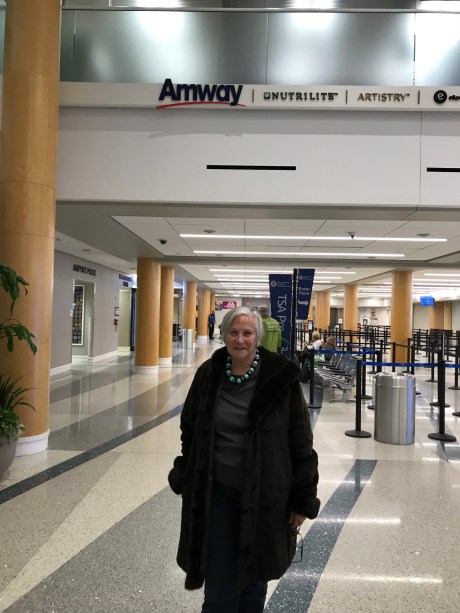
In the photo, you will see that I wore a fur coat in mid-April. When I left New York, the temperature in Kalamazoo was 22. On arrival, there were a few inches of snow on the ground. The next day it was in the 60s, and all the snow was gone.

I traveled via the airport in Grand Rapids, Michigan, and walked under an arch at the airport that carried the big logo “Amway.” I was expecting Betsy DeVos to pop up any minute, but there was no sign of her. However, I did see her husband’s aviation charter school on the periphery of the airport.

IMG_2153

Leonie Haimson is a true school reformer, unlike the hedge funders, tycoons, and entrepreneurs who have falsely claimed that title. She is a dedicated education activist who has led the fight over many years for fully funded public schools and student privacy.

In this video, she talks with veteran journalist Bob Herbert about the mistakes of those in power who rely on standardized testing as the sole definition of success, about segregation, about the damage wrought by charter schools, and about the changes that will benefit all students.

Jan Resseger reports on a startling development in Michigan. She quotes the new superintendent of the Detroit Public Schools, who just completed his first year on the job. His words are inspiring. He is actually fighting for the kids and the public schools. Dr. Nikolai Vitti was chosen by Detroit’s elected school board in 2017, after years of disastrous state control, led by people who enabled erosion of the public schools and the advance of privatization.

She writes:

Dr. Nikolai Vitti was their choice, and last week at the end of his first year on the job, at a conference sponsored by the Chamber of Commerce at the Grand Hotel on Mackinac Island, he confronted the dogma of Michigan’s power establishment—Rick Snyder, the DeVos family and all the rest.

The Washington Post‘s Valerie Strauss reprinted part of Dr. Vitti’s remarks: “People often ask me, ‘What were you most surprised about when you took the job and started to work in the system?’ And I often say I was shocked, horrified at the lack of systems and processes for traditional public education. Traditional public education has always been, and hopefully will always be, the vehicle for social change, for social justice, for equal opportunity in this country. And walking into the system and seeing a lack of systems and processes is a testament to the lack of belief in what children can do.”

Vitti continued: “And there is a racist element to what has happened. Children in Detroit have been treated like second-class citizens. When a system is allowed to be run over a decade by individuals, and it’s not about one individual, but individuals that had no track record of education reform, no local governance structure to address immediate concerns and issues by the community through an elected board… and year after year of low performance, a lack of growth, drop in enrollment, facilities that are not kept up, that would never ever happen in any white suburban district in this country. And that is a testament of race. Because this country would not allow that. We see signs of that in Flint and we saw signs of that in New Orleans after the flood and we have multiple examples of this.”

Resseger quotes a column written by Rochelle Riley of the Detroit Free Press, who served as moderator for the panel discussion at Mackinac Island. Her column was titled “Miracle on Mackinac Island: Business Community Gets Woke to Race.”

She said that the meeting may have been “a watershed moment in Michigan history.” For once, the power structure got a lesson about racism and the treatment of children in Detroit as second-class citizens.

Speaking to the state’s white power structure, Vitti pulled no punches:

His words drew loud and sustained applause. But Vitti also said something that drew tears. When I, as moderator of the forum, asked him to speak to the assembled crowd as an 8-year-old third-grader and tell them what he wants, he looked out and said:

“I want the same thing that your child wants,” he said to loud applause. “I may not have your privilege. I may not have the color of your skin. I may live in a different ZIP code. But I want the exact same thing you want for your son, your daughter, your grandchild, your niece, your nephew. That’s what I want.”

The Michigan legislature keeps piling on mandates, but with no support to reach them, she wrote.

The Michigan Legislature has scared some parents and teachers to distraction with a new law banning schools from promoting third-graders who do not read at grade level. Nine of 10 third-graders in the city schools do not read at grade level. And some parents and teachers feel the law will exacerbate an existing third-grade-to-unemployment pipeline similar to the fourth-grade-to-prison pipeline that already exists.

The shame is this is yet another example of the state attempting to polish its reputation at the expense of our children. Rather than help districts find ways to improve, then raise standards, the Legislature keeps raising standards without any support to make meeting them possible. One would think that legislators are trying to make public schools fail to make it easier to increase the number of charters across Michigan, but nah, that couldn’t be it, right?

Detroit’s Mayor Mike Duggan said that all of Michigan was in trouble, not only Detroit, because of bad leadership at the state level:

“We know the history. We had 10 years of state-appointed emergency managers,” Duggan said. “During that time, we lost half of the enrollment. … They eliminated career technical education, eliminated art, eliminated music … and all that happened was children continued to leave. … But this isn’t just Detroit.”

He cited National Assessment of Educational Progress scores that tell a larger story.

“For white students in the state of Michigan, fourth-grade math and reading level, in 2013 we were 14th in the country,” he said. “Last year — 46th in the country. Now, if you sat down in 2013 and said how can I sabotage Michigan’s future? … I’m not sure you could have accomplished it.”

Duggan said the state chose tax cuts over children, which was a mistake.

Michigan’s leaders (think Betsy DeVos, who has played a major role in state education policy, pushing charters) thought that they could fix the schools by adopting school choice while cutting taxes.

It didn’t work.

Now, let’s see how the power structure responds. Are they able to change course or will they double down on failure?

Sarah Lahm is an independent journalist based in Minneapolis. Her work has appeared in The Progressive, In These Times and other local and national publications. She blogs about education at brightlightsmallcity.com.


Should progressives embrace charter schools?

This question came up again recently when Teach for America alum and apparent expert on school choice, Conor P. Williams, landed an op-ed in the June 3 New York Times. Williams, who is now an education policy analyst with the New America Foundation, used Minneapolis’s Hiawatha Academies charter school chain as a key example of why, in his opinion, liberal and progressive activists should indeed be pro-charter school.

In 2017, Hiawatha Academies, which operates five highly segregated charter schools in Minneapolis, received a federal school choice expansion grant worth over $1 million dollars, courtesy of Secretary of Education Betsy DeVos. The money has likely been absorbed into Hiawatha Academies’ expansion plans, as the charter network seeks to enroll “6.2% of the Minneapolis student population” in the coming years.

Being affiliated in any way with DeVos and her devotion to accountability-free school choice schemes is probably uncomfortable for a charter school network like Hiawatha Academies, which likes to bill itself as progressive. DeVos continues to not only staunchly defend a Wild West-style approach to public education, she is also heavily engaged in rolling back many federal education policies that are there to protect the nation’s most vulnerable students.

Frankly, it is becoming harder and harder to separate, or pretend to separate, school choice and the spread of segregated charter schools from Betsy DeVos.

Perhaps that is why many of the links in Williams’ op-ed are as stale as the very premise underlying his piece. His first paragraph includes a description of an elementary school in the Hiawatha Academies’ chain, complete with a charming image of a teacher standing before students in a colorful kindergarten classroom. This, Williams proclaims, is one of “Minnesota’s best public schools.” To support this, he links to a celebratory 2012 PR-laden article written by Minnesota based education writer, Beth Hawkins.

Hawkins’ piece was published in MinnPost, a local online news outlet. Here’s why that matters: Hawkins’ stint as an education reporter at MinnPost was funded by the Bush Foundation, one of many local philanthropic groups that has bestowed money, clout and endless public relations support on the growth of charter schools in Minnesota. Oh, and MinnPost was started and run for years by former Minneapolis Star Tribune publisher, Joel Kramer. (Hawkins has since become the national education correspondent for the reform-funded outlet, The 74.)

Here’s why that matters: Kramer’s two sons, Matt and Eli, are both heavily invested in the national and local education reform movement. While Matt was serving as the co-CEO of Teach for America, Eli was busy “growing” the Hiawatha Academies charter school network, which serves mostly Latino families in south Minneapolis. It would be fair to say that the Kramer family has close political and financial ties to elite education reform policy makers and financiers, in Minnesota and on the national stage.

Eli Kramer is leaving Hiawatha Academies. The charter school chain’s new executive director is Colette Owens, another Teach for America acolyte who received her administrative training through a reform-funded venture, the School Systems Leaders Fellowship. Kramer made over $170,000 annually as head of Hiawatha Academies’ five school sites; Owens’s salary has not been publicly disclosed. (For comparison purposes, Ed Graff, superintendent of the Minneapolis Public Schools and its 60+ sites, has a contract worth $225,000.)

The Hiawatha Academies’ site (Morris Park) profiled by Williams sits in one of the two Minneapolis Public Schools buildings purchased by the charter school chain nearly ten years ago, on its path to grow its market share. “Hiawatha schools should be easy for the left to love,” Williams insists, before promising (without any evidence) that the schools are “full of progressive educators helping children of color from low-income families succeed.”

Beneath the wince-worthy white savior aura of this argument lurk some actual facts worth exploring further. First, Minnesota’s charter schools do not have to follow the same desegregation laws as public schools. This means highly segregated charter schools, like Hiawatha Academies, have been allowed to flourish, creating artificially isolated sites that cater to one particular demographic. If this is progressive, it sure smacks of age-old segregationist policies that allowed for school vouchers and, eventually, charter schools in the face of federal desegregation lawsuits.

Hiawatha Academies’ Morris Park location, for example, sits in a south Minneapolis neighborhood where over 75 percent of residents are white, and the majority do not live in poverty. But you would never know this by reviewing the school’s demographic data.

According to the Minnesota Department of Education, 91 percent of Hiawatha Academies’ Morris Park students are Latino, and 88 percent live in poverty. Still, Williams insists that the charter network is “successfully” meeting these kids’ needs, and so, presumably, should be excused for being unnaturally racially and economically segregated. But what is the definition of success? If it is standardized test scores, then no, Hiawatha’s Morris Park students are not receiving an education that is “beating the odds,” as education reformers like to say.

Data actually show that test scores at Hiawatha Academies-Morris Park dropped in 2017 and are lower than those of a nearby Minneapolis public school site, Northrop Elementary. Another neighborhood public school, Lake Nokomis Community School, serves almost as many students in poverty and special education students as the Morris Park charter school, but also has twenty-four homeless or highly mobile students on its roster. The charter school had zero.

In his New York Times piece, Williams does acknowledge that Hiawatha Academies schools are staffed by non-union teachers. He also notes that many progressives may also “worry that charters foster segregation, siphon funding from traditional public schools and cater to policymakers’ obsession with standardized tests.” Rather than addressing any of these very real concerns, however, Williams continues on with his fantasy-like defense of charter schools in general and of Hiawatha Academies in particular.

Hiawatha Academies schools are staffed and run by progressives, he assures readers, and they are determined, in the words of outgoing director Eli Kramer, to “elevate the importance of identity, race consciousness” and “pride in self.” Williams then describes taking a walk through the charter chain’s high school, which will relocate this fall to a newly-built campus that has been funded in part by wealthy, Republican-aligned local venture capitalists and philanthropists, not to mention the Walton Family Foundation.

How progressive is that? Many Walmart employees live on food stamps, leaving plenty of profit left over for the Walton family to pour into the promotion of non-union charter schools.

To wrap up his defense of Hiawatha’s privately run, publicly (and privately funded) charter schools, Williams revives yet another stale debate. In trying to prop up Hiawatha’s racially and economically segregated charters, Williams mentions Robert Panning-Miller, who was president of the Minneapolis teachers union from 2007-2009. (Michelle Wiese, the current head of the Minneapolis Federation of Teachers, is a Latino woman who has helped push the union in a more progressive, social justice-oriented direction. Perhaps her brand of union leadership doesn’t fit into Williams’ narrative.)

Panning-Miller once called Eli and Matt Kramer emblems of a kind of “educational apartheid” for allegedly sending their own children to a private Montessori school (the Kramers’ alma mater) full of wood blocks, natural play areas and hands-on learning, while simultaneously profiting from a test score-driven charter school network for students of color who live in poverty (Hiawatha Academies). Panning-Miller also documented the tightly woven, Kramer-Teach for America cabal that has drawn attention nationwide, and received PR support from, again, Beth Hawkins.

Maybe Williams had to harken back to Panning-Miller’s 2014 critique of the Kramers and Hiawatha Academies because there are so few of them. There is almost no counter-narrative out there for anyone, progressive or not, who would like a more realistic examination of the role Hiawatha Academies and other such narrowly marketed charter schools are playing in the systematic attacks on public education in the United States. As I mentioned, the Kramer family once employed an education writer who continues to serve as a philanthropist-funded champion of school choice.

It is impossible, then, to join Connor P. Williams’ in his unbridled praise for charter schools without fully examining the “ecosystem” of funding, hype and political support that prop up such “schools of choice.” To embrace the racially and economically marginalized population of the Hiawatha Academies charter chain, which Williams tries but fails to defend, would be to also, presumably, embrace the nearly all-white charter schools that also exist in the Twin Cities.

Among these are the Twin Cities German Immersion School, Nova Classical Academy and Great River Montessori School. Is it somehow right for public dollars to be diverted from the public school system (both Minneapolis and St. Paul are facing double-digit deficits for the upcoming school year) to create portfolios of niche charter schools that selectively serve segregated populations of students?

Is that what it means to be a progressive or a liberal? No, it is not. Don’t let the kind of propaganda peddled by Williams and the Kramer family convince you otherwise.