A few readers asked for more information about the men who spent two years building a handmade boat. Here they are.
Archives for category: Art
Governor Ron DeSantis vetoed all arts funding for ALL Florida because of two performing groups that he considers “sexualized.” Six hundred groups lost $32 million in state funding, in some cases jeopardizing their survival.
The two groups that offended the prudish DeSantis offered to give up state funding so DeSantis could restore funding to the others.
Leaders of two performing arts festivals said Thursday that they would gladly give up their grants if Florida Gov. Ron DeSantis restores the $32 million in state funding he nixed for more than 600 Florida arts groups, explaining the reason for his veto as being because the two theatrical events were “a sexual festival.”
Leaders of The Orlando Fringe and Tampa Fringe described the governor’s description as inaccurate on Thursday at a news conference, but they said it was important for the state’s arts groups to be funded because they play critical roles in their communities. The Orlando festival had been slated to get $70,500, and the Tampa festival was in line to receive $7,500 before the veto.
I recently visited the Metropolitan Museum of Art, one of the world’s finest museums, to see a memorable exhibition. It’s called “The Harlem Renaissance and Transatlantic Modernism.”
It is a spectacular collection of works by and about African-American artists. The art is drawn from museums around the country. You may never see these artworks in one space again.
The quality of the art is breath-taking. I know that many of you don’t live in or near New York City, but this is a good reason to plan a trip. The show runs through the end of July.
Here are a few of the photos I took with my cell phone. I wish I had taken more. Some of the pictures are off-center because the crowds were large, and I didn’t have a clear path.
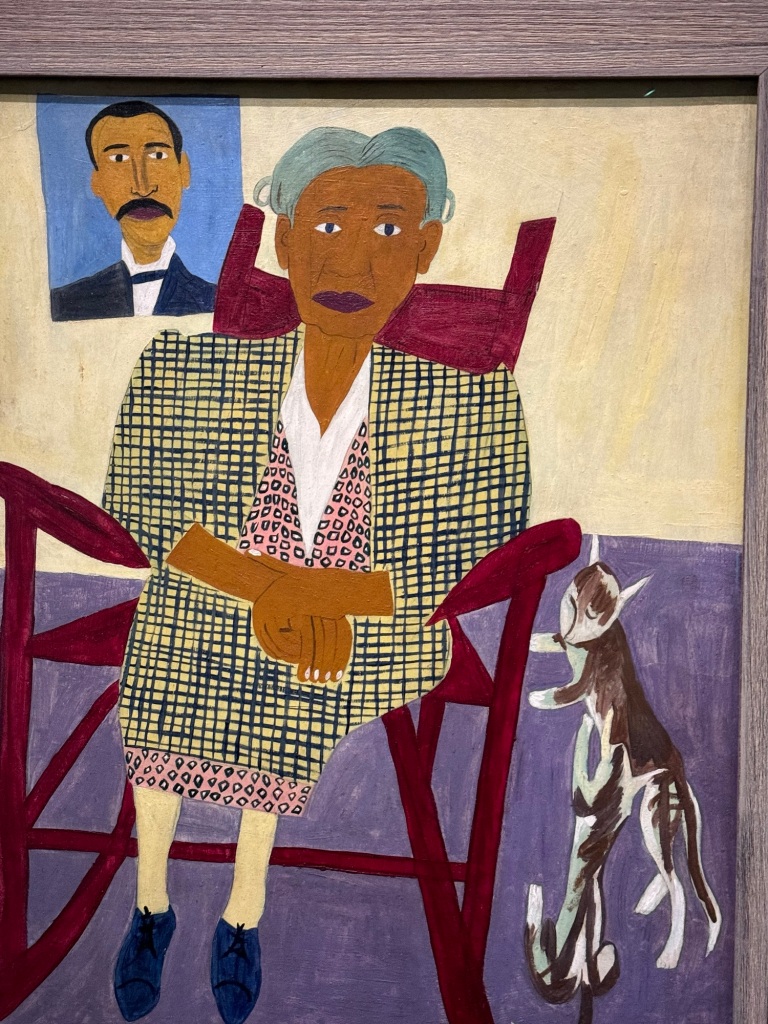
Painted by William H. Johnson (1901-1970), “Mom and Dad, 1944.” This folk-art painting of the artist’s mother and a portrait of his late father was borrowed from the Smithsonian American Art Museum.
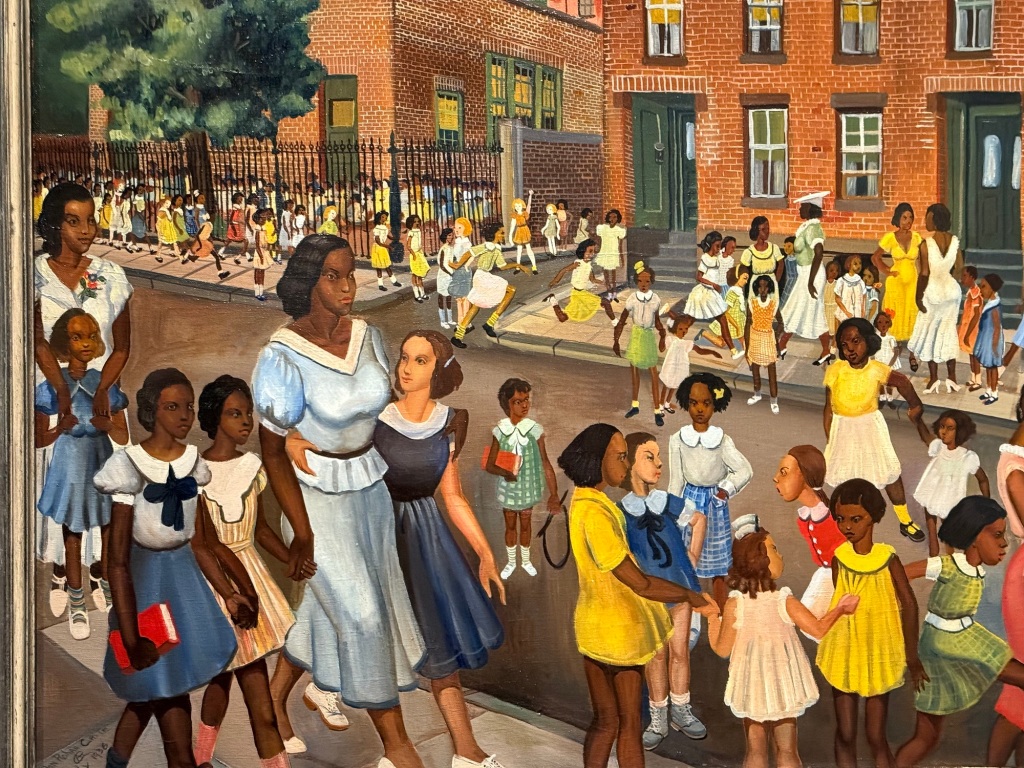
Painted by Allan Rohan Crite (1910-2007). It is titled “School’s Out” and was painted in 1936. It depicts children emerging from Everett Elementary School in Boston. It was lent to the exhibition by the Smithsonian American Art Museum.
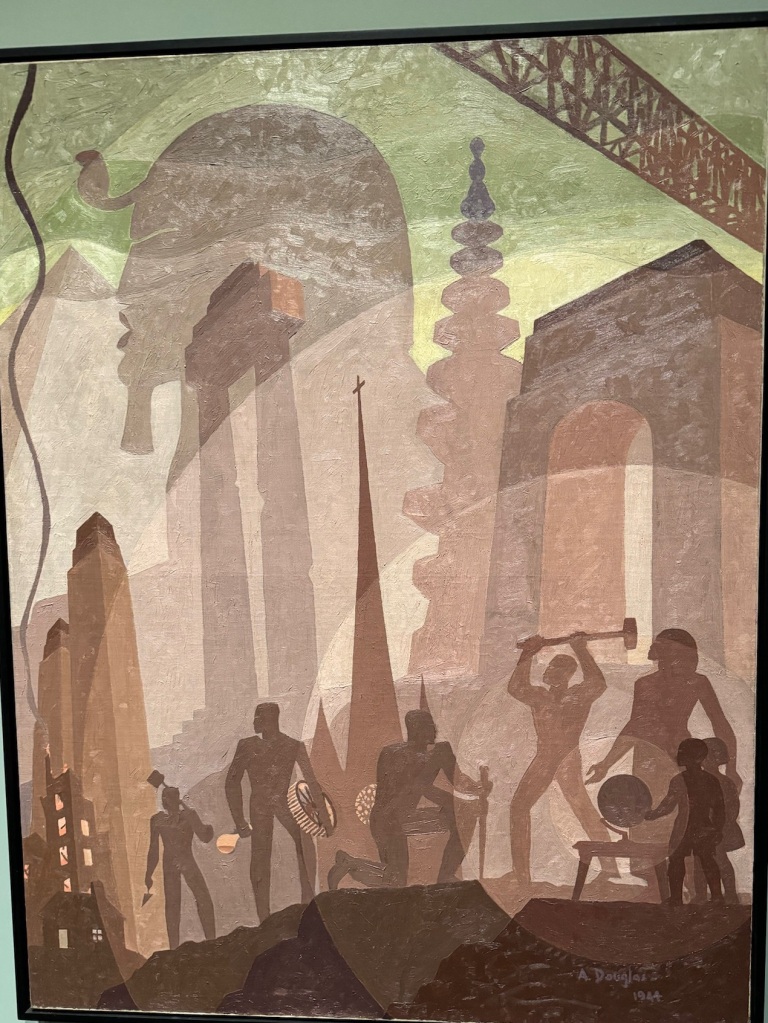
Painted by Aaron Douglas (1879-1979). Titled “Building More Stately Mansions, 1944.” It is owned by the Fisk University Galleries in Nashville. According to the artist, “his objective was to spotlight the contributions of exploited Black labor to great civilizations worldwide. He thus resituated African American history in a global context, in which the sphinx of Egypt appears together with the spire of a Western cathedral, the tiers of an Asian Buddhist pagoda, and a building crane extending over American skyscrapers, emblems of modernity meant to connote growth.”
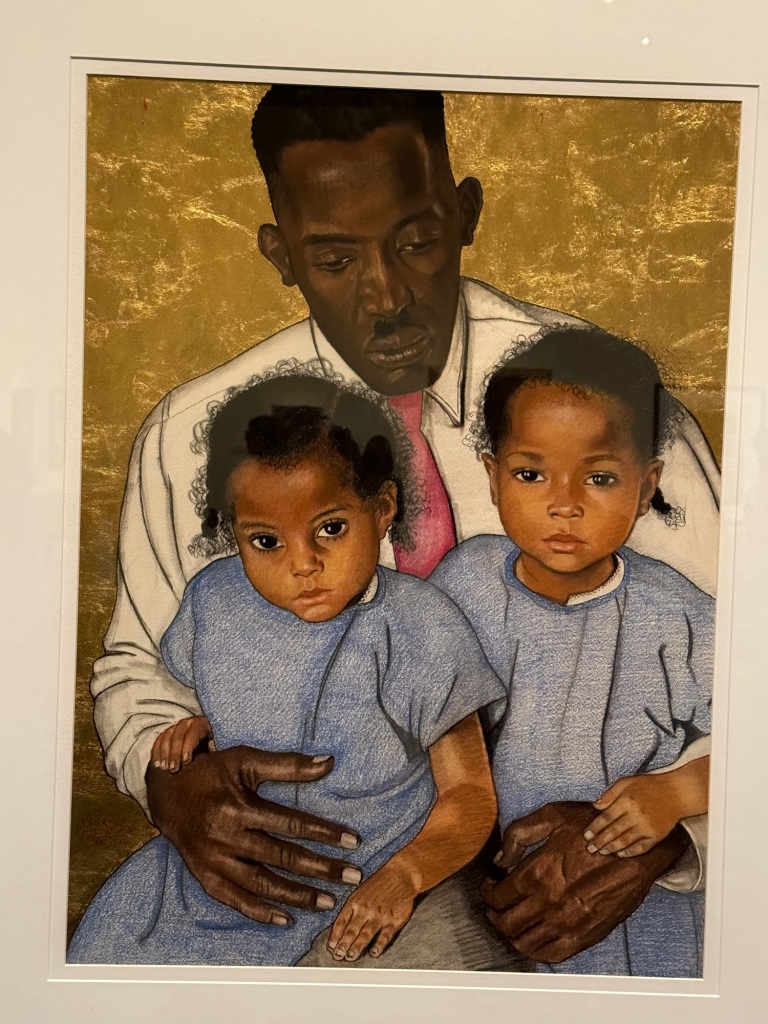
Painted by Winold Reiss (1886-1953), who emigrated from Germany to America. It is a painting of Fred Fripp, a graduate of the Penn School and a teacher, with his daughters Carol and Evelyn. The painting is owned by the Fisk University Galleries in Nashville.
The caption of the portrait says:
“The sitter looks away in introspection while his young daughters gaze outward, settled into the security of their father’s steadying embrace.
“Reiss met Fred Fripp when he traveled to South Carolina to portray the Gullah-speaking Black residents of St. Helena Island, whose ancestors were among the last enslaved West African people forcibly brought to the United States. The luminous triple portrait, its triangular composition and gold leaf background reminiscent of Renaissance madonnas, celebrates Fripp as a teacher, scholar, and parent.”
As I viewed this magnificent exhibit, I kept wondering about the African-American artists. In their wildest dreams, did they ever imagine that their paintings and sculptures would one day be shown in the nation’s premiere museum?
The exhibition is a large and rich portrayal of the artists and intellectuals of the Harlem Renaissance. If you can’t get to New York by July 28, the last day, you might consider buying the catalogue from the Met.
If you plan to visit NYC (or live in it or near it), I have some recommendations for you.
You are not allowed to visit NYC without taking in a Broadway show. Did you know that?
I saw three outstanding shows recently, which I unequivocally recommend.
The great and timeless Ibsen play “An Enemy of the People” is spectacular. It has been updated. It stars Jeremy Strong (“Succession”) and Michael Imperioli (“The Sopranos” and “White Lotus”). What a great show!
If you want to laugh a lot, see “Spamalot,” a hilarious comedy-musical that was written by Eric Idle of the Monty Python troupe. It incorporates some of their funniest skits. The final performance is April 7.
If you want to see a spectacular musical, see “Moulin Rouge.” Boy George is one of the stars. Prepare to be dazzled. Don’t bring the children! It’s very bawdy, and there is quite a lot of female flesh.
You can often get cheap seats at a website called TodayTix. It also sells advance seats. In the center of Times Square, there is a large booth called TKTS where you can buy same-day tickets at a steep discount. Some theaters have standing-room tickets. It never hurts to ask at the box office before the performance. Sold-out shows sometimes get last-minute returns from ticket brokers.
Enjoy!
Secretary of Education Miguel Cardona has been nearly invisible these past three years, other than lamenting test scores. Veteran educator Nancy Bailey has some suggestions about how he could help kids, schools, and teachers right now. This post was reposted by the Network for Public Education.
The secretary keeps talking about raising the bar. Nancy Bailey has some thoughts about some bars he could work on. Reposted with permission.
She writes:
Education Secretary Cardona focuses on reducing absenteeism, tutoring, and after-school programs. And he refers to raising the bar, which sounds like A Nation at Risk talk.
Yet there are so many K12 issues that Cardona and the Biden administration could address, lead, and support the states and local school districts.
Here are some educational issues Cardona should drive this new year. If you have more, please share.
1. The Arts
Poor public schools have gone without the arts for years. Cardona should push for qualified art and music teachers for every school.
The arts help students struggling with mental health difficulties, and jobs exist in the arts.
Every child in K12 should have access to a vital arts program.
2. Career Education
Career-technical education is essential, but companies pushing their agendas into high schools to get workers raises concerns.
Tax dollars should help students decide what careers they want, giving them the chance to experience high school, not creating schools for corporate preparation.
3. Class Size
Reducing class sizes would help students with disabilities in inclusion classes and is essential for student safety. Cardona must endorse lowering class sizes and showcase schools that do.
If schools can’t lower every class (classes like P.E. wouldn’t be necessary), give students access to at least one small class where they are known.
Lowering class sizes in K-3rd grade would also help children get a good start. See the STAR Study.
4. Corporal Punishment
In 2023, The Washington Post reported that 15 states still permitted corporal punishment in schools (St. George, 2023). Like Florida, which vaguely gives a nod to it. Teens who wear the wrong kind of prom dress or misunderstandings resulting in paddling are examples.
Cardona deserves praise for standing against corporal punishment last year in schools, claiming educators should favor evidence-based approaches and that there should be no spanking, hitting, or paddling.
5. Data
Cardona must study and draw attention to child privacy laws which are currently inadequate.
In 2018, the NEPC published Educating All Our Children: Your Kids, Their Data, No Privacy by Linda McSpadden McNeil.
She stated:
When children’s privacy is violated in ways that are overt, visible, and knowable, the violation is unquestioned. It is unacceptable. In most cases, it is illegal.
So why is it different when the violation is hidden, opaque, electronic, commercial, and complicated?
6. High-Stakes Standardized Testing
President Biden promised teachers and parents he’d end harmful high-stakes standardized tests. Instead, he pushed assessments even during the pandemic.
Can Cardona show the American people who want these tests reduced or eliminated what, if anything, the Biden administration will finally do to end high-stakes standardized tests?
7. Lead in School Pipes
The Biden-Harris team promised to repair the lead pipes in homes and schools. They’re to be commended for this. It would be nice, however, if Cardona presented a report.
No amount of lead is O.K. for developing children, and it can lead to learning disabilities.
8. Reading
Reading has become a volatile issue, and Cardona has been mostly silent. Many commercial programs with little independent study, but nonetheless called the Science of Reading, are being pushed into classrooms.
The subject of reading deserves a better forum than short, often hostile debates on X.
Cardona should call for a new National Reading Panel to study programs and address reading instruction. The panel should include teachers who teach reading since they were left off the last panel. This panel should consider the concerns of the last NRP member, the only educator on the panel, Joanne Yatvin (Yatvin, 2002). Parents should also be given a voice on this panel. A new NRP would allow for a better collection of the research, old and the latest findings, and a review of the work of the last NRP.
9. Recess
Every public school in the nation should give children several unstructured breaks throughout the school day, supervised, on safe, well-designed playgrounds.
Driving students to work nonstop with mindfulness training or a dozen other excuses to bypass recess should not be permitted.
10. School Buildings
Americans need to know the status of their public school buildings. How are the HVAC systems and air quality? How many school facilities are still falling apart? Are public school buildings safe?
Are new schools being built to support teachers?
11. School Choice
The Biden administration discussed regulating charter schools (Lieberman, 2022). But concerns about vouchers, educational savings account, nonprofit and for-profit charters, and religion in schools needs to be better addressed.
In addition, the Biden administration should describe what they mean by community schools (often called charter schools), partnerships, and social impact bonds and how these schools are still public.
12. School Libraries and Librarians
It’s an abomination to drill children to learn to read in poor schools, and then not provide them a school library with a qualified school librarian.
Closing school libraries has been a disaster in many school districts, see Philadelphia as an example.
13. School Safety
The gun lobby is unfortunately influential, so despite shootings in this country, don’t hold your breath for meaningful gun laws. It was thoughtful of Cardona to visit Parkland.
In the meantime, school administrators must devise creative ways to make schools safe and identify students in their schools who need mental health help. See class size above.
14. Social-Emotional Learning
Concerns about the data collected on students includes social-emotional learning. Teachers always want their students to be socially and emotionally healthy, but social-emotional learning seems more about collecting unnecessary sensitive data about students.
Who is using this information and why?
15. Special Education
Parents are in danger of losing special education services. The All Handicapped Children’s Act reauthorized to IDEA should have evolved into a more inclusive and better programs for students with exceptional needs, but instead it has been hijacked by those who don’t want to pay for it.
Cardona should look into special education and create a task force to study it and determine exactly how much special education funding schools receive and the kind of services students receive. He might start with Tammy Kolbe’s work and the National Education Policy Center report Funding Special Education: Charting a Path that Confronts Complexity and Crafts Coherence.
16. Teacher Preparation
School reform has changed teacher preparation dramatically. There needs to be more effort to oversee these mostly fast-track nonprofit or for-profit programs often connected to charter schools.
Cardona should step up here to promote fully university-prepared teachers, and he should work with university education programs to improve their coursework and degree offerings. The United States Department of Education might provide scholarships to attract young people who want to pursue a teaching career in university education programs, not unknown nonprofits or charter school preparation.
Fast-track groups like Teach for America are a concern because they turn those without real qualifications into the system with little understanding of child development or what’s needed to teach well, and Grow Your Own programs are ill-defined.
17. Technology
While technology is useful to learning, a recent Columbia University study indicates that children read better with paper print not online.
The Guardian cites MIT neuroscientist John Gabrieli, skeptical about the promises of big tech and its salesmen.
Gabrieli states:
I am impressed how educational technology has had no effect on scale, on reading outcomes, on reading difficulties, on equity issues.
Is Cardona behind teachers or for replacing them with technology? Actions matter.
18. Third-Grade Retention
Third-grade retention is unnecessary. No child should be made to feel like a failure. Children can still learn to read in third grade, can still grow and become great learners. Speaking out on this issue would help end it.
References
St. George, D. (2023, August 10). In over 15 states, schools can still paddle students as punishment. The Washington Post. Retrieved from https://www.washingtonpost.com/education/2023/08/10/school-paddling-corporal-punishment/.
Yatvin, J. (2002). Babes in the Woods: The Wanderings of the National Reading Panel. Phi Delta Kappan, 83(5), 364–369. https://doi.org/10.1177/003172170208300509
Lieberman, M (2022). Lawmakers, Education Secretary Clash Over Charter School Rules. Education Week, https://www.edweek.org/policy-politics/lawmakers-education-secretary-clash-over-charter-school-rules/2022/04
Share this:
Readers wishing to comment on the content are encouraged to do so via the link to the original post.
Find the original post here:View original post
This story is fascinating. It’s about the quest to understand the origins of a painting of three white children that originally included a young slave. At some point, the enslaved youth was painted over and eliminated.
One determined art collector enlisted the help of art historians to identify the white children and the enslaved youth. The young man was named Bélizaire. The painting was held for decades in storage in a New Orleans art museum. It was just another family painting: three children. If you can open the video, please do (I don’t know if it is behind a pay wall).
Once the original painting was restored and its history documented, it was purchased by the Metropolitan Museum of Art, where it is prominently displayed.
“How a Rare Portrait of an Enslaved Child Arrived at the Met” is a 10-minute film that touches on themes of race, art and history.
For many years, a 19th century painting of three white children in a Louisiana landscape held a secret. Beneath a layer of overpaint meant to look like the sky: the figure of an enslaved youth. But a 2005 restoration revealed him and now the painting has a new, very prominent home at the Metropolitan Museum of Art. Who was the enslaved child? Who covered over his figure? Why did the painting languish for decades in attics and a museum basement?
The Times further describes the journey of the painting:
To learn more, read “‘His Name Was Bélizaire’: Rare Portrait of Enslaved Child Arrives at the Met.” Alexandra Eaton writes:
One reason “Bélizaire and the Frey Children” has drawn attention is the naturalistic depiction of Bélizaire, the young man of African descent who occupies the highest position in the painting, leaning against a tree just behind the Frey children. Although he remains separated from the white children, Amans painted him in a powerful stance, with blushing cheeks, and a kind of interiority that is unusual for the time.
Since the Black Lives Matter movement, the Met and other museums have responded to calls to reckon with the presentation of Black figures. When the European Galleries reopened in 2020, the museum included wall texts to highlight the presence of African people in Europe and to call attention to issues of racism, previously unmentioned. In the American Wing, which had presented “a romanticized history of American art,” Kornhauser said, a presidential portrait was recast with the consciousness of the present: John Trumbull’s 1780 portrait of George Washington and his enslaved servant William Lee identified only the former president until 2020, when Lee’s name was added to the title. However, unlike Bélizaire, Lee is depicted at the margins, lacking in any emotion or humanity.
Jeremy K. Simien, an art collector from Baton Rouge, spent years trying to find “Bélizaire” after seeing an image of it online in 2013, following its restoration, that featured all four figures. Intrigued, he kept searching, only to find an earlier image from 2005, after the painting had been de-accessioned by the New Orleans Museum of Art and was listed for auction by Christie’s. It was the same painting, but the Black child was missing. He had been painted out.
“The fact that he was covered up haunted me,” Simien said in an interview.
There are some wonderful things happening in our public schools. HBO is featuring a film about the music created by students at the Hill-Freedman World Academy. HFWA is a public high school for high-performing students.
**TUNE-IN**TUNE-IN**TUNE-IN**
Presents
STAND UP & SHOUT: SONGS FROM A PHILLY HIGH SCHOOL
Debuts Tuesday, NOVEMBER 7 on HBO and Max
NOW AVAILABLE TO SCREEN UPON REQUEST
The HBO Original documentary STAND UP & SHOUT: SONGS FROM A PHILLY HIGH SCHOOL , directed by Emmy ® and Peabody winner Amy Schatz (HBO’s “We Are the Dream: The Kids of the Oakland MLK Oratorical Fest” and “In the Shadow of the Towers : Stuyvesant High on 9/11”) and executive produced by the award-winning team at Get Lifted Film Co., Emmy ® and Tony ® winning producer Mike Jackson, EGOT recipient John Legend, and Emmy ® -winner Ty Stiklorius, debuts TUESDAY , NOVEMBER 7 at 9:00 pm ET/PT on HBO and will be available to stream on Max.
Synopsis: The film follows 10th graders from Hill-Freedman World Academy (HFWA), a Philadelphia public school, who take part in a unique songwriting collaboration. Working in teams with local musicians, students come together to create an album of powerful original songs that capture both the challenging times they’re living in and the joy that music brings.
Back in the classroom after two years of pandemic isolation, the teenagers find a way to express their experiences and feelings in stirring songs that come straight from the heart. HFWA offers a unique music program teaching students to write, compose, produce, and perform, their own work. Although many are new to music, they learn to trust their voices and lift each other up. STAND UP & SHOUT: SONGS FROM A PHILLY HIGH SCHOOL explores the transformative power of music and how arts education can unlock creativity and be a source of hope and healing.
Featured Participants: Joining the courageous and talented students of Hill-Freedman World Academy High School are award-winning musical talents Kristal Oliver, Andrew Lipke, Bethlehem Roberson, and program director and music technology teacher Ezechial Thurman.
Credits: HBO Documentary Films in association with Get Lifted Film Co. presents STAND UP & SHOUT: SONGS FROM A PHILLY HIGH SCHOOL. Directed and produced by Amy Schatz; executive produced by Mike Jackson, John Legend, Ty Stiklorius, and Tommy Benjamin for Get Lifted; For HBO: executive producers, Nancy Abraham, Lisa Heller, and Sara Rodriguez.
On September 21, a bus carrying the Farmingdale (Long Island, New York) High School marching band to band camp in Pennsylvania crashed through a guard rail and plummeted down a 50-foot ravine, killing the band director and a retired teacher chaperoning the group. Many in the community thought the marching band would not perform this season, given the tragic circumstances.
But perform they did, to the great pleasure of thousands who turned out for the homecoming football game. The musicians thought it was a way to honor the memory of their lost leader.
FARMINGDALE, NY — Thunderous cheers and applause. Tears. Pride. Hugs. Hope. All of that was in abundance as a sea of Dalers green, black and white descended upon Farmingdale High School for the school’s homecoming on Friday night.
Of the thousands surrounding the perimeter of the football field, many of them were there to celebrate the marching band’s return to the field, just two weeks after the horrific bus crash that claimed the lives of two educators: Gina Pellettiere, 43, of Massapequa, and Beatrice “Bea” Ferrari, 77, of Farmingdale. The bus overturned in Orange County on Sept. 21 as it was transporting the marching band to its annual band camp in Greeley, Pennsylvania.
For the first time in more than a decade, the Daler Marching Band performed without the guiding baton of Pellettiere — or “Ms. P,” as her students affectionately knew her. But while Pellettiere was not physically on the field during the pre-game and halftime performances, her students knew she was there in spirit.
“This is definitely what she would’ve wanted,” Philip Sullivan, a senior trumpet player in the Farmingdale marching band, told Patch. “I know she’s looking down on us right now, happy that we’re back performing, carrying on her legacy.”
The band first took the field before the opening kick-off between the Farmingdale Dalers and Baldwin Bruins. It performed “The Star-Spangled Banner” in front of an emotional crowd, followed by the school’s fight song.
By the way, the home team won, 42-0.
Gustav Klimt’s portrait of Adele Bloch-Bauer is mesmerizing in its beauty. It has a very important historical provenance. The Neue Gallery is a small collection concentrated on a single period in Austrian art. This painting is the masterwork of the collection, which was assembled by Ronald Lauder, son of cosmetics queen Estée Lauder.
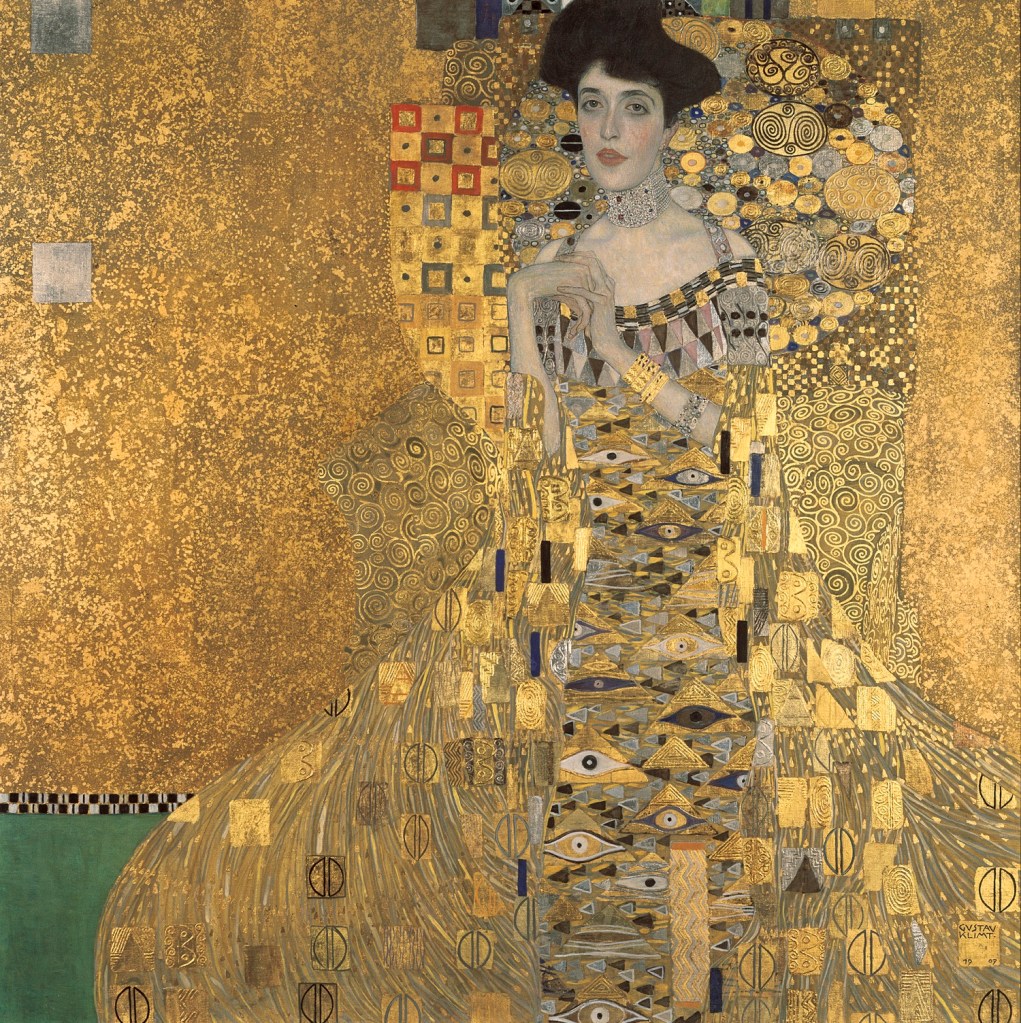
GUSTAV KLIMT (1862–1918)
Portrait of Adele Bloch-Bauer I , 1907
Oil, gold, and silver on canvas
Neue Galerie New York
Acquired through the generosity of Ronald S. Lauder, the heirs of the Estates of Ferdinand and Adele Bloch-Bauer, and the Estée Lauder Fund
Gustav Klimt’s Portrait of Adele Bloch Bauer I (1907) is considered a masterpiece of Klimt’s so-called “Golden Style.” Few paintings have captured the public’s imagination as thoroughly as the Woman in Gold. Klimt’s painting of the Jewish socialite not only rendered Adele’s irresistible beauty and sensuality; its intricate ornamentation and exotic motifs heralded the dawn of modernity and a culture intent on radically forging a new identity.
In 1938, when the Nazis entered Austria, they seized five Klimt paintings from the Bloch-Bauer family. Ferdinand Bloch-Bauer fled to Switzerland. He wrote a will bequeathing his assets to two nephews and a niece, Maria Altman. She escaped to California, where she fought unsuccessfully for decades to recover the Klimt paintings.
In 1998, a copy of her uncle’s will became public, making clear that he wanted his Klimt paintings bestowed on his heirs, not the Belvedere Museum in Vienna. Maria Altman sued in Austria for restitution and lost. She then sued for the paintings’ return in American courts, where she and the Austrian government agreed to binding arbitration. In 2005, the arbitrators decided that the Klimt paintings belonged to the heirs of Ferdinand Bloch-Bauer. The “Portrait of Adele Bloch-Bauer” was purchased by Ronald Lauder and installed in the Neue Gallery.
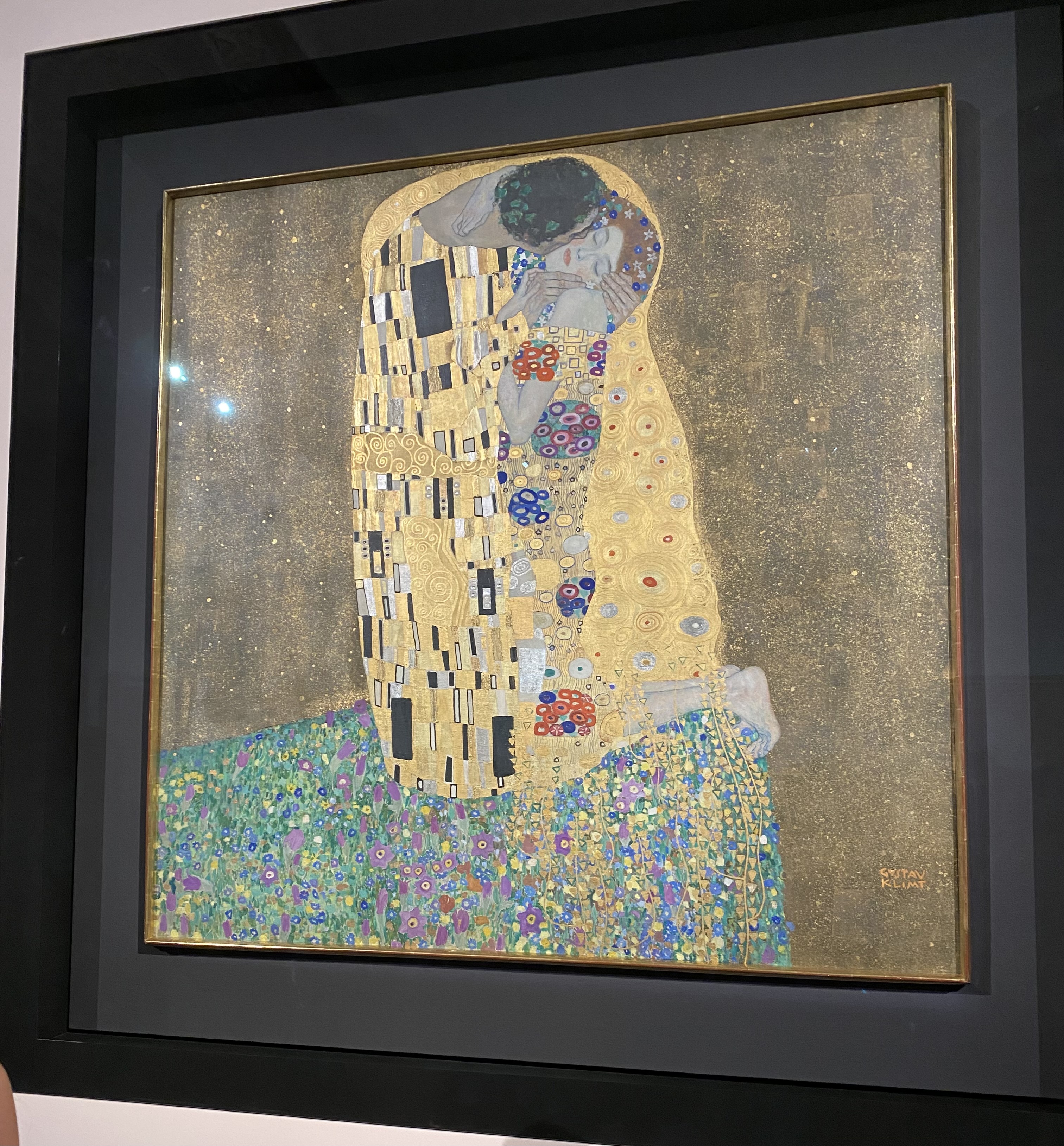
“The Kiss” attracts huge numbers of viewers, all of whom have their cell-phone cameras out or take turns posing in front of it. Personally, there are other works by Klimt that I prefer, most in the Neue Galerie in New York City. But “The Kiss” is celebrated in Austria as Klimt’s finest work. The colors are magnificent, made with real gold and other precious metals ground into paint. I visited the Belvedere Museum, a work of art itself, on September 30 in the morning.