Archives for category: Accountability

What an embarrassment for the U.S. Department of Education!

Carol Burris writes on Valerie Strauss’s Washington Post blog, “The Answer Sheet,” that Secretary Miguel Cardona just awarded one of its largest grants ever to expand a Hillsdale College charter school in Ohio. Hillsdale is closely tied to the conservative Christian movement and to Republican leaders such as Donald Trump, Governor Ron DeSantis of Florida, and Governor Bill Lee of Tennessee.

Hillsdale’s history program is called “the 1776 curriculum,” intended to refute the ideas of journalist Nicole Hannah-Jones’ controversial “1619 Project.” Hannah-Jones argued that American history began with the arrival of African slaves in 1619. To counter her narrative, the Trump administration in its waning days created “the 1776 Commission” to produce a quick version of a patriotic history. On President Biden’s first day in office, he abolished the 1776 Commission. Hillsdale College, however, continued the work of writing a full U.S. history curriculum based on the work of the 1776 Commission and made it available to schools that wanted history as it used to be taught: with great men, high ideals, and unblemished patriotism.

Hillsdale is now associated with a chain of charter schools that have adopted its Christian worldview and the 1776 curriculum. As Burris, executive director of the Network for Public Education explains, a Hillsdale charter just won nearly $2 million from the federal Charter Schools Program. CSP is administered by the U.S. Department of Education. The charter made claims about its location and its demographics that are “misleading.”

Trying to think of an analogy to Secretary of Education Miguel Cardona giving a large grant to a Hillsdale charter school: imagine Secretary of Education Betsy DeVos giving $2 million to a charter school for transgender children. Neither seems likely. But one scenario happened.

Valerie Strauss introduces Burris’s column.

A recent federal audit had a bit of bad news for the U.S. Education Department’s Charter Schools Program (CSP), which has provided more than $2.5 billion in grants to help open or expand charter schools. The audit by the department’s Office of Inspector General found that the CSP office may not have had “reliable information needed to make informed decisions” about continuing funding for charter schools with program grants.

There was more in the audit, which you can read about here, but this post looks at a different problem facing the CSP: schools with highly problematic applications that win millions of dollars of federal money anyway.

Charter schools are publicly funded but privately operated, some of them as for-profit entities, and they educate about 7 percent of U.S. schoolchildren. The 30-year-old charter sector has been riddled with financial and other scandals over the years, although supporters say that the problems these schools face are expected growing pains and that they offer families an important option to schools in publicly funded districts. Critics say that they are part of the movement to privatize public education and that some states have lax charter school laws that do not properly regulate them.

This post was written by Carol Burris, an award-winning former New York high school principal and now executive director of the advocacy group called Network for Public Education, which is an alliance of organizations that advocates for the improvement of public education and seeks legislative reform of charter schools. Burris has written previously on the charter school program for Answer Sheet (for example, here and here). She has chronicled how the program spent hundreds of millions of dollars on charter schools that never opened or closed not long after opening.

Burris writes about the funding application of a charter school in Ohio, the Cincinnati Classical Academy, and says that her organization, along with a group of Ohio legislators and other organizations, have asked Education Secretary Miguel Cardona to rescind the school’s nearly $2 million CSP grant. I asked the school to comment and will add its response if I get one. I asked the Education Department about the letter, and a spokesman said this in an email:

“The U.S. Department of Education (Department) is committed to supporting state and local efforts to increase school diversity and reduce racial and socio-economic isolation in schools, including through the Charter School Program (CSP). There are multiple safeguards in place to ensure the integrity of CSP applications and funded grants. For example, all CSP applicants must provide attestations confirming the accuracy of information submitted in their application. False, fictitious, or fraudulent statements or claims may subject applicants to criminal, civil, or administrative penalties. Such safeguards are in place to help ensure charter schools serve communities well.”

By Carol Burris


An invitation to fiction writing. That is how Mike Winerip described the federal Charter School Program (CSP) grant process in a 2012 New York Times story, a characterization based on his investigation of a New Jersey charter school, which, despite three failed attempts to open and an application full of “misrepresentations,” had secured a CSP grant.

This issues didn’t go away. The All Football Club of Lancaster, Pa., an unauthorized charter school with no community support, submitted an often-incoherent application and yet won $1.2 million in 2020. A school run by a for-profit operator immersed in self-dealings and a segregation academy turned charter school cashed in on a North Carolina grant.

But the prize for the most inventive story to secure a CSP grant may belong to the Cincinnati Classical Academy (CCA), a Hillsdale College member school, for securing a nearly $2 million grant. CCA, which prides itself on teaching virtue, asked for the grant on the basis of its claim that it was closing the achievement gap and serving disadvantaged students, never reporting that only 16 percent of its students are economically disadvantaged and that 2 percent are Black — a starkly different student body from the overwhelmingly disadvantaged and majority-Black Cincinnati Public School students, who, CCA says, it wants to save from poverty.

Cincinnati Classical Academy


Cincinnati Classical Academy is located on a cul-de-sac in a leafy residential suburb of Cincinnati called Reading. The school’s website features a motto and a coat of arms, and plays a video showing the school building with a cross atop a tower at the entrance as well as a large American flag. It currently runs from kindergarten through seventh grade but says it plans to add a grade each year until it becomes a full K-12 school.

It takes considerable digging on its website to realize that CCA is a charter school, not a tuition-free Christian private academy. Its headmaster’s message speaks of morals, virtue and “old-fashioned” methods. Pictures of the gymnasium show a large crucifix on the wall next to an American flag. In a photograph of a school hallway lined with posters depicting the school’s virtues, Mary and the infant Jesus from Botticelli’s “Madonna of the Magnificat” illustrates the virtue of humility. To illustrate gratitude, CCA shows a family praying before a meal.

Nearly all of the uniformed children featured on the website are White. There is no mention of a provision for free lunch on the school’s webpage, which features catered lunches students can purchase in full or a la carte.

Although CCA is only in its second year, it has the status of being a member school of Hillsdale College’s K-12 initiative, which entitles it to free curriculum, training and consultation from the small, nondenominational, conservative Christian college in Michigan. Hillsdale President Larry Arnn is an ally of former president Donald Trump as well as of Trump’s former education secretary, Betsy DeVos, and “distinguished fellow” Christopher Rufo, an activist who has fueled the culture wars.

Hillsdale provides support for CCA through its Barney Charter School Initiative, which began in 2010 with a half-million-dollar contribution from the Barney Family Foundation and which has opened a few dozen charter schools across the country. Hillsdale College’s mission is to maintain “by precept and example the immemorial teachings and practices of the Christian faith,” while the mission of its K-12 charter schools includes a call for “moral virtue.” A Hillsdale K-12 civics and U.S. history curriculum released in 2021 praises conservative values, criticizes liberal ones and distorts civil rights history.

According to its 990 tax forms, the Barney Family Foundation gives to health and child-centered charities along with Americans for Prosperity, the Cato Institute, the Hoover Institution, the Heartland Institute, the State Policy Network, the Friedman Foundation for Educational Choice, the Heritage Foundation, and other right-wing foundations and think tanks.

Stephen Barney, a trustee emeritus on the Hillsdale College Board, has been one of its most generous donors. Between 2010 and 2019, the Network for Public Education identified more than $4 million earmarked for Hillsdale from Barney’s foundation, excluding unlisted donations in 2011 and or donations before or after those years.

Despite Hillsdale College’s frequent boasts of rejecting federal money (and the federal regulations that come with it, including Title IV provisions), the college’s affiliated charter schools eagerly dip into the federal Charter School Program through state entitlement grants. To date, the Network for Public Education has identified more than $16.75 million given to Hillsdale charters for school start-ups or expansions.
The grant to CCA is the first given directly by the federal department to a Hillsdale-connected charter school.

The questionable narrative

Applicants for Charter Schools Program Developer Grants fill out extensive applications in making the case for why their schools deserve the funds. According to the Federal Register, which calls for applications, the first purpose of the CSP is to “expand opportunities for all students, particularly for children with disabilities, English learners, and other traditionally underserved students, to attend charter schools.”

However, CCA caters to the well-served in disproportionately high numbers. State records show that it had no English language learners in 2022-2023 when it applied. Students with disabilities were enrolled at less than half the rate of the Cincinnati Public Schools. More than 80 percent of the students in Cincinnati Public Schools were economically disadvantaged compared to fewer than 17 percent at CCA. Other charter schools in Hamilton County had no problem attracting economically disadvantaged students; their average rate topped 85 percent.

The only category in which CCA exceeds a demographic of Cincinnati Public Schools is White students. More than 82 percent of CCA students are White, compared to 20 percent in the public school district.

So what can a school like this do to get a grant intended for schools that serve underserved kids? It didn’t reveal itself.

CCA cited Cincinnati Public Schools demographics to make its case in its application even though it is located in the Reading Community City School District, which is whiter, wealthier and has better ratings. Then it provided another handful of schools within five miles for comparison, none of which are in Cincinnati Public Schools. The school also talked in its application about closing the achievement gap and serving diverse, underserved students even though its unrevealed Black student population (2.4 percent) is so tiny the state does not even give it a gap-closing measure.

But where the school best revealed itself is in its list of goals and objectives. Not only did it fail to share its lack of diversity, it included no goals or objectives to address it. The application does not discuss the need to increase the number of English language learners, homeless children, students with disabilities, or students who get free or reduced-price lunches to level the enormous gap between the school’s proportions and the greater Cincinnati area.

If achieved, the goals in the application prepared by Kentucky’s Adkins and Company and signed off by the president of the school’s governing board will not disrupt the status quo. CCA will be able to meet them and keep the federal dollars flowing for four years while maintaining the reality projected on its website — that it is a magnet for White, Christian conservative families to escape the area’s diverse schools.

The CSP review process

If you have ever applied for a mortgage, you remember the extraordinarily detailed evidence you must provide to support every claim. That is not the case when “free government money” for charter schools is at stake.

The curious lack of a demographic profile of the school’s students was never a concern for the reviewers. CCA received the highest score of all applicants — 101. One of the three reviewers gave the school a perfect score. You can find the application and the reviewers’ scoring here.
Reviewers, who are solicited from the charter school world, were satisfied that “comprehensive data is provided, revealing the underperformance of Cincinnati public schools and underscoring the necessity for a high-quality alternative that offers families a viable choice,” even though the school is not a part of Cincinnati Public Schools.

The reviewers bought the same old narrative — a high-poverty district is bad, so bring in a charter school. They parroted back what the applicant said and praised Hillsdale College’s Barney Charter School Program.

Inexplicably, given the CSP’s checkered history, the Education Department increased the maximum amount of Developer Grants per charter school from $1.5 million to $2 million this year, and CCA got nearly every penny of the limit: a grant for $1,991,846. Grants are usually for five years, but CCA had been open for a year when it applied, so it got a four-year grant. The average amount per year is $300,000 but the Education Department gave CCA nearly half a million dollars a year — on the basis of claims that even cursory checks on state data or a visit to the school’s website would show to be untrue.

Back in Ohio, public education advocacy groups are outraged but not surprised. Bill Phillis, the executive director of the Ohio Coalition for Equity and Adequacy of School Funding, told me that the charter industry in his state “has been rife with financial and academic fraud and corruption.” He also said the CCA’s application for a development grant, with its “deception and disingenuous information,” is “typical of the charter industry in Ohio.”

The Network for Public Education sent a letter to U.S. Education Secretary Miguel Cardona protesting the grant and asking that it be rescinded. It was signed by Phillis’s coalition, along with U.S. Rep. Greg Landsman (D-Ohio), five state legislators who represent the area, the Ohio PTA, both state teachers unions, the Cincinnati NAACP, and more than a dozen public education, civil rights, local teacher associations and advocacy groups.

Other 2023 CSP awardees are being challenged. The St. Louis Board of Education has passed a resolution protesting the more than $35 million CSP grant received by the billionaire-funded Opportunity Trust to open more charter schools in Missouri — nearly all of which will, because of state law, be located in St. Louis or Kansas City. According to the St. Louis Post-Dispatch:

“The group misrepresented its relationship with SLPS in its application to the U.S. Department of Education, the resolution states. The school board “does not have a working relationship with the Opportunity Trust, does not collaborate with the Opportunity Trust and has opposed efforts by the Opportunity Trust to enact legislation to divert district funds to charter schools,” it [the resolution] reads.”

CSP grant applications that have been misleading and deceptive have still been rewarded with millions of taxpayer dollars from CSP. Whether the source of the problem is the department’s process, a less-than-rigorous application, the reviewer selection process or faulty regulations, awards that are based on disingenuous claims and deceit do not serve children or taxpayers well.

Until something changes, the statement that applicants sign — “I am aware that any false, fictitious, or fraudulent statements or claims may subject me to criminal, civil, or administrative penalties. (U.S. Code, Title 18, Section 1001)” — should be enforced, and the secretary should use his authority to terminate the grant.

Last spring, a television station in Nashville reviewed state data and discovered that 80% of the state’s charter schools are “less successful” than the districts they allegedly serve. In other sectors, when a new idea is tried and fails, it is abandoned. But this is not likely in education, because someone is making money from failure. Among the state’s lowest performing charter schools were those in the “Achievement School District,” which was created with $100 million on Race to the Top funding, promising to taise the state’s lowest performing schools into the top 25% in the state.

NASHVILLE, Tenn. (WTVF) — About 80% of the taxpayer-financed, privately operated charter schools in Tennessee have a lower success rate than the districts where they are located, according to a NewsChannel 5 analysis of state data.

Out of 109 charter schools for which data was available for the 2021-2022 school year, 87 had success rates below the rates reported for other schools in the same geographic district — in many cases, much lower. More than a third of the charter schools, a total of 38, reported success rates of 10% or less; 10 of those had success rates below 5%.

Only 21 charter schools reported higher success rates, while comparisons were difficult for one school because of the way that the state reports the data.

The data also raises questions about how well the privately operated charter schools are meeting the needs of children with disabilities, with two-thirds reporting that they had so few students that they were not required to report success rates for those children.

Tennessee’s Department of Education calculates the one-year success rate based on the percentage of students in grades 3-5 whose scores on state assessments “met expectations or exceeded expectations” for math and English Language Arts.

Success rates are now at the center of Tennessee’s education policy under a new law set to require the retention of third graders who don’t meet ELA expectations.

In the larger debate, the data appears to run counter to some ideological arguments — mainly from the right, but sometimes from the left —that taxpayer-funded charter schools are a critical response to low-performing traditional public schools, with much of the focus often directed at the potential of charter schools to meet the needs of children of color.

Charter school advocates largely focus on metrics regarding “student growth,” a complex calculation used to argue that students in those schools statistically tend to learn more statistically than their peers in traditional public schools.

At the lower end of the scale, the LEAD Brick Church charter school had a success rate of just 5.7% for grades 5-8, compared to Metro Nashville Public Schools’ 26.2% for grades 3-5 and 22.5% for grades 6-8.

Brick Church is 70% economically disadvantaged, and more than 95% of students are children of color.

The traditional public school was taken over by the state and converted to a charter school under the Achievement School District in 2012 as part of an ambitious notion that the state could take schools in the bottom 5% and turn them into top performers within five years.

In fact, data shows that Tennessee’s Achievement School District has largely failed in that goal, producing some of the worst results of any district.

The ASD success rate was 10.6% for grades 3-5, compared to Metro Nashville’s 26.2% and Memphis-Shelby County’s 20.9%.

The relatively new Tennessee Public Charter School Commission District, by comparison, had a 37.4% success rate — a figure driven largely by just one school, KIPP Antioch College Prep Elementary. The commission’s Nashville Collegiate Prep reported a success rate of 23.4% for grades 3-5, compared to MNPS’ 26.2%.

On the other hand, the commission’s Bluff City High School in Memphis reported a success rate of just 6.7%, compared to Memphis-Shelby County’s 6.8% for grades 9-12.

Has the U.S. Supreme Court stripped away all limits on the right to buy and carry arms? We are soon to find out, as the Court just heard a case challenging restrictions on domestic violence abusers. A federal appeals court decided that even violent people should have the right to bear arms, because that is what the Founders wanted. Some states allow open carry of weapons; some require no background checks for purchasers. We may soon be living in the “O.K. Corral,” where shootouts are a common occurrence.

Rachel Barkow of the website CAFE analyzes the case and the likely ruling of the High Court. Barkow is a professor at the New York University School of Law, specializing in criminal law.

She writes:

Since 2008, there has been no greater obstacle to confronting America’s epidemic of gun violence than the Supreme Court. That was the year five justices on the Court decided the Heller case, which held, for the first time in the country’s history, that the Second Amendment of the Constitution protected an individual’s right to bear arms and was not, in spite of its plain language, cabined to protecting the collective right of a militia to bear arms. The Court’s majority claimed its view was consistent with the original meaning of the clause, but legal historians have demolished that claim. The Court’s decision was instead the product of an orchestrated campaign by the National Rifle Association over decades to shift opinion on the Constitution’s meaning. Heller was the culmination of those efforts and the decision drastically curtailed the ability of voters to limit gun possession because it entrenched a constitutional right to possess firearms. The actual holding of Heller covered only the ability to possess a gun inside one’s home for self-defense, but it was just the first step in the Court’s takeover of gun policy.

Despite widespread criticism by legal scholars and historians of the Court’s interpretation of the Second Amendment, the Court (pardon the pun) stuck to its guns. Last Term in Bruen, the Court expanded the scope of the Second Amendment by striking down a New York law that required people to show “proper cause” to get a permit to carry guns for self-defense in public. That decision not only expanded the right to bear arms to include carrying a weapon in public, but it also changed the manner in which the Court would analyze Second Amendment claims to make it even harder for sensible gun regulations to survive the Court’s review.

The Court, in an opinion authored by Justice Thomas, rejected the argument that a regulation that covers guns outside the home can be upheld if it promotes an important interest. Instead, “The government must affirmatively prove that its firearms regulation is part of the historical tradition that delimits the outer bounds of the right to keep and bear arms.”

In other words, no matter how much the government might want to address the scourge of gun violence and mass shootings, its hands are tied by what the Court believes white men in the 18th century would have wanted. Moreover, this is an inquiry that the Court typically gets wrong because it is not a body composed of trained historians, but of lawyers doing back-of-the-envelope history (derisively and accurately referred to as “law office history”) that typically just so happens to yield the very result a majority of justices would like to see.

That is how we have arrived at the surreal moment at the Court on Tuesday in which the justices heard arguments about whether the government can remove guns from domestic violence abusers. That is the issue in United States v. Rahimi, a case out of the Fifth Circuit, a conservative federal intermediate appellate court that covers Louisiana, Mississippi, and Texas. The Fifth Circuit believed it correctly followed the framework from Bruen and struck down a federal law that prevents people subject to domestic violence restraining orders from possessing firearms. To obtain such a restraining order, a court must find, after notice and a hearing, that a person presents a credible threat to their intimate partner or child, and that the order is necessary to protect the partner or child from “domestic gun abuse.”

In a sane world, the question of whether someone should lose access to weapons would turn on the adequacy of the procedures for making that determination and the evidence that the person poses a threat. In the Supreme Court’s world, in contrast, whether someone is stripped of access to guns depends solely on whether the government of the 18th century disarmed similarly situated people. According to the Fifth Circuit, the government’s evidence from the 18th century about taking guns from “dangerous” people was not sufficiently similar, so the federal law could not pass muster.

Will five justices of the Supreme Court agree with the Fifth Circuit that the historical record is too thin to support the domestic violence law? The Court’s three liberal justices will almost certainly side with the government. Justices Kagan and Sotomayor have already expressed their disagreement with the Court’s flawed framework for deciding these issues by joining Justice Breyer’s dissent in Bruen. Justice Jackson was not on the Court in Bruen, but she expressed skepticism about the Bruen framework in her questioning at oral argument in Rahimi. She got to the heart of the insanity of the matter when she asked Rahimi’s lawyer if the Court’s task, in his view, was to look for “the regulation of white Protestant men related to domestic violence,” or if it was possible to take the level of generality up a notch.

The question is whether at least two of the six conservative justices will agree, and all signs from the oral argument are that the government has amassed enough evidence to get five votes to uphold this particular law. Justice Barrett wrote an opinion when she was on the Seventh Circuit that recognized firearms can be removed from dangerous people, and her questions at argument suggested she sees Rahimi as falling into that category. Indeed, she talked about domestic violence as being in the heartland of danger. Justice Gorsuch also gave indications that the facts of this case would survive Second Amendment scrutiny because he kept carving out issues for future cases. It is likely other justices will join this decision as well, given the clear finding of danger under the facts of the case. Even Rahimi’s counsel had a hard time arguing his client was not a danger when asked at oral argument.

It is less clear that there are enough votes to shift the framework for deciding these cases so that the government in 2023 and beyond is not hamstrung by what the government did in the 18th century. Part of the debate at oral argument was over how specific a historical analog has to be to allow a gun regulation today. If the Court does not make clear that governments today can identify threats and dangers – even if the Framing generation did not identify those same threats and dangers – as suitable for disarmament, the government in Rahimi will have won a battle, but not the war, on gun violence. Whether gun regulations survive will depend on what five lawyers on the Supreme Court think.

The Court’s track record in Second Amendment cases does not inspire confidence. The Court got the history of the Second Amendment’s scope wrong in Heller. It is not an individual right but a collective one in the service of militias. The Court then made matters far worse in Bruen by broadening the scope of that right and preventing the government from regulating firearms unless the Framers passed a similar regulation. Everything comes down to an interpretation of 18th century America’s approach to guns, despite the fact that almost nothing about firearms is the same as it was at the time of the framing.

Nor does the Court limit itself to history so rigidly in other contexts. That is what led legal scholar Khiara Bridges to declare “the right to bear arms the most protected of rights in the Constitution.”

The Court’s inconsistent approach to originalism is the reason people can more easily lose their liberty than their right to keep a firearm. Although we are supposed to have a presumption of innocence in America and that is a concept firmly rooted in the original meaning of due process, if you are merely charged with a crime – not convicted – you can be locked in jail, according to the Supreme Court, as long as a judge thinks you are dangerous. No originalist should permit this, as the Framing generation did not condone incarceration on the basis that someone was merely accused of a crime and then deemed dangerous by a judge before conviction. Yet we have hundreds of thousands of people incarcerated on just this basis because the Court has not taken the same strict originalist approach to pretrial detention. We can only ponder why we ended up with a regime that would allow liberty to be taken away so cavalierly, but that treats gun rights as inviolate without a sufficiently precise historical analog.

The Framers were not so foolish as to place greater protections on guns than freedom. But the Supreme Court does not seem to understand the relevant history. Whatever the Court decides in Rahimi, we are a long way from a sensible constitutional framework for thinking about these issues as long as the inquiry will depend on the Court’s faulty historical analysis. Tragically, this is an area where the Court’s law office history is literally killing us.

The Center for Budget and Policy Priorities in D.C. issues reports on high-profile issues. This one should be in the hands of every legislator, school board member, and policymaker. It succinctly explains why states should not authorize vouchers.

Iris Hinh and Whitney Tucker wrote this report, which was published in June 2023. One conclusion is clear: vouchers inflict damage on public schools, attended by the vast majority of children, while helping affluent families. .

Hinh and Tucker write:

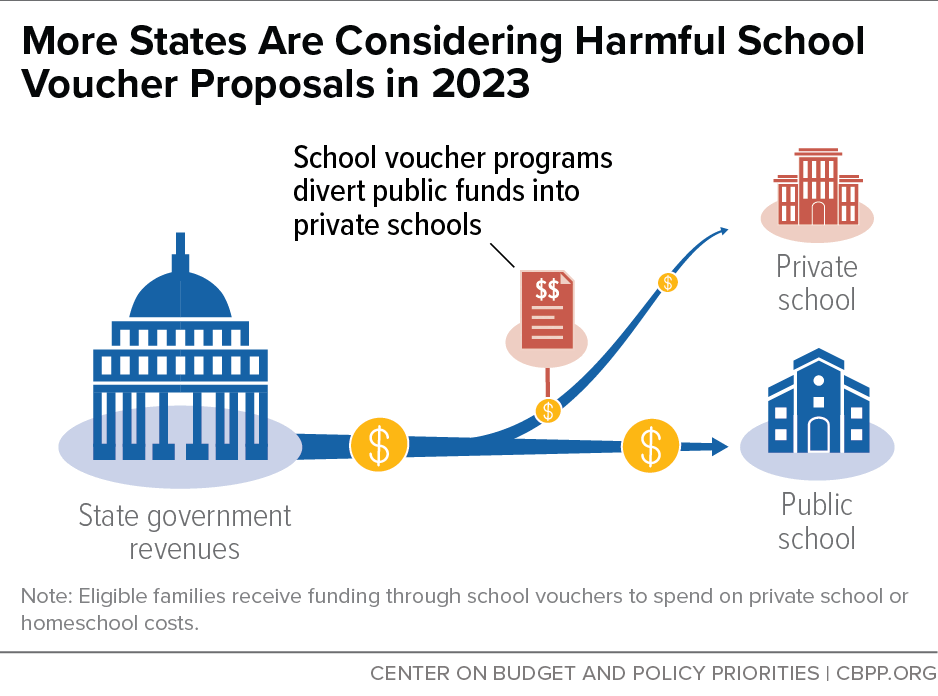
K-12 school vouchers are typically funded through state revenues and give families a set amount of money per eligible student to cover a portion of private school tuition. These vouchers divert money away from public schools, sometimes by directly re-routing education funding to private schools, and other times indirectly by making it harder to pay teachers, buy new textbooks, and provide quality after-school programming. The support for public schools is high: families overwhelmingly support their schools, and many teachers and other advocates for public education oppose vouchers.[1]

In the past few months, state lawmakers have expanded and created a record number of school voucher programs with little to no limits on eligibility. This will deplete available state revenues for public education and other critical services and do little to expand opportunity for students.

Regardless of whether school vouchers directly or indirectly divert funding from public schools to private education, state K-12 funding formulas depend on some metric of student count to allocate per-pupil funding. Some school districts can absorb some of the cuts with layoffs and reduced spending on textbooks and supplies. But fixed expenses such as air conditioning, school buses, and building maintenance can lead to funding shortfalls and layoffs.

In early 2023, these states created or expanded their school voucher policies:

  • Nebraska passed the state’s first voucher program, a K-12 tuition tax credit initially capped at $25 million annually, though the cap could rise to $100 million a year depending on demand for tax credits. Individuals and businesses can donate up to half of their taxes owed (with a maximum of $100,000); donations are funneled to scholarship granting organizations (SGOs), which pay private school tuition and other eligible expenses on behalf of students and their families. The tax credits reduce tax liability and thus, decrease the state revenues available for investments in public services, including public schools. Public school advocates are planning to challenge the bill on the 2024 ballot.
  • ArkansasLEARNS Act created, among other harmful policies for public education and teachers, an education savings account (ESA) program, which will phase in universal eligibility by the 2025-2026 school year and provide state-funded vouchers for families to use toward private school tuition and several other allowable expenses (like homeschooling, exam fees, and tutoring).
  • Florida broadened eligibility requirements to make its existing ESA program available to all students (rather than only students with disabilities or those from low-income families), with an estimated cost of $4 billion in the first year of implementation.
  • Iowa created an ESA that is initially targeted to families with lower incomes. But it will expand over time to include all students by the 2025-2026 school year and cost over $340 million per year when fully in effect.
  • South Carolina expanded the state ESA, lifting household income eligibility to 400 percent of the federal poverty level beginning in 2026-2027, but placing a 15,000-student cap on the program.
  • Utah created an ESA starting in the 2024-2025 school year that is available to all students but gives priority to students based on their household’s income.

Other states should not follow the paths of these states. For one, school vouchers primarily benefit wealthier students, families, and businesses. States with existing voucher programs — Arizona, Missouri, New Hampshire, and Wisconsin — have reported that most families who benefitted were already covering the costs of private schools and homeschooling prior to the voucher becoming available.

Wealthy people and companies also benefit when vouchers take the newer form of K-12 tuition tax credits. People and companies who donate to SGOs are allowed to opt out of paying tax to fund public needs and instead fund tuition scholarships at private K-12 schools. This tax incentive can provide state credits — up to 100 percent of the donation — to families with incomes over $200,000 and even allows businesses to profit from claiming federal expense deductions and avoiding capital gains tax.

Vouchers can also increase the likelihood that students experience discrimination and harm. Private schools are not required to offer the same federal civil rights protections for students as public schools. In fact, many voucher bills explicitly require families to waive students’ protections and rights under the federal Individuals with Disabilities Education Act for educational services that students with disabilities may need to learn.

Further, vouchers do not necessarily expand opportunities for students with the greatest needs. Students from families with low incomes often face barriers to navigating the voucher application and private school admission processes. Smaller, rural areas often rely on their local public schools as community hubs and primary sources of employment. Private schools can more easily push students out without recourse based on how they style their hair, what they wear, test scores, and subjective disciplinary action.

Voucher costs often grow beyond what is projected and thus, reduce overall revenues for other state spending. A recent study of school voucher programsin seven states shows how state voucher spending from 2008 to 2019 increased by hundreds of millions of dollars annually, while K-12 spending for public education declined despite public school enrollment increases. Arizona became the first state to implement a universal voucher program in 2022, and as of mid-March 2023, the ESA program is expected to cost the state at least $345 million more than initial projections for the first year. New Hampshire’s voucher program was estimated to cost $130,000 in 2021 and it now costs $14.7 million. And a few private schools in Iowa are already raising tuition only a few months after the new voucher program passed in January of this year.

Some state lawmakers understood the great cost at the expense of public services and stopped multiple school voucher bills this year. For example, 16 House Republicans broke with their party to defeat Georgia’s universal voucher proposal in the final hours of session. And Idaho Senate Republicans raised concerns about the long-term cost of a universal ESA bill, which also applied to subsequent voucher bills.

As some states continue to debate school vouchers during legislative sessions, state lawmakers should understand that their actions now and in the future will have large fiscal and harmful consequences for public education and student opportunities.

Another state that did NOT pass vouchers was Texas, even though Governor Greg Abbott called four special sessions of the legislature. Rural Republicans refused both bribes and threats and voted against vouchers because they wanted to protect their community schools.

More States Are Considering Harmful School Voucher Proposals in 2023

The graph above appeared in an earlier version of this report, published in March 2023.

John Thompson, historian and retired teacher in Oklahoma, noticed that the Carnegie Unit is under fire. Do you know what a Carnegie Unit is? It’s a measure of time spent learning a subject. Here’s the definition on the website of the Carnegie Foundation for the Advancement of Teaching:

The unit was developed in 1906 as a measure of the amount of time a student has studied a subject. For example, a total of 120 hours in one subject—meeting 4 or 5 times a week for 40 to 60 minutes, for 36 to 40 weeks each year—earns the student one “unit” of high school credit. Fourteen units were deemed to constitute the minimum amount of preparation that could be interpreted as “four years of academic or high school preparation.”

Why is this controversial?

John Thompson explains:

I was stunned when reading the opening paragraph of Mike Petrilli’s “Replacing Carnegie Unit Will Spark Battle Royale.” Petrilli is the president of the corporate reform-funded Thomas B. Fordham Institute, with a history of fervent support for Common Core. But now, Petrilli warns of the ways that the Carnegie Foundation’s and Laurene Powell Jobs’ XQ Institute’s competency-based model could open a “Pandora’s Box.” He writes:

The scant coverage of this initiative—and the limited number of players involved—implies that many see this as just a technocratic reform, one that merely seeks to replace “credit hours” with mastery-based approaches to learning. Don’t be mistaken: If it gets traction, this move is likely to spark a battle royale that will make the Common Core wars look like child’s play.

While recognizing the Carnegie Unit – where graduation standards are driven by time in class and credits earned – is flawed, Petrilli correctly argues “we can’t just focus on ‘disrupting’ the current system.”  Moreover, he says the heart of this disruptive model would be “a lot more high-stakes testing.”

Petrilli notes that a rapid, digital transformation of schooling “has huge potential upsides for high-achieving students.”  Even though Petrilli was one of the true believers in college-readiness who pushed Common Core without, I believe, adequately thinking ahead, he now asks whether they should set the graduation bar “at the ‘college-ready’ level” if that “means denying a diploma to millions of young people who are nowhere near that bar today and not likely to clear it tomorrow?” For instance:

How do we deal with the enormous variation in student readiness upon arrival in high school? Will the new system allow students prepared to tackle advanced material to do so, even if it means further stratification along line(s) of achievement, race, and/or class?

In 2019, Chalkbeat reported on the slow growth and mixed successes and setbacks of Jobs’ innovation schools. Back then, Matt Barnum wrote, “what kinds of change, exactly, XQ wants people to get behind remains unclear to some.” And he quoted Larry Cuban on the number of schools that abandoned the effort, “To have that kind of mortality rate at the end of three years — that would strike me as high given that huge amount of money.”

And, I’d certainly worry about transformative changes, such as those pioneered in Rhode Island, that are “driven” by XQ’s Educational Opportunity Audit (EOA). Given the failure of data-driven reformers’ efforts to create reliable and valid metrics for measuring classroom learning “outputs,” it’s hard to imagine how they could evaluate the learning produced by the large (perhaps limitless?) number of their untested approaches.

I followed the few links to Tulsa’s experiment, under Deborah Gist, to “re-imagine” high schools.” In 2019, the district received $3.5 million for three schools for “Tulsa Beyond,” using a “nationwide high school redesign model,” which was “funded through Bloomberg Philanthropies and XQ Super Schools.”  It would be hard to evaluate any reforms’ outcomes during the Covid years and today’s rightwing attacks. But, then again, those reforms were based on the claim that data-driven accountability can do more measurable good than harm.

Only two of the three Tulsa schools have published state “grades” before and after their experiment.  Daniel Webster H.S received a “D” in both 2017-2018, and a “D” in 2021-2022. Nathan Hale H.S received an “F” in both years. Again, I don’t have data to make a serious evaluation of the Tulsa reforms, but it is the corporate reformers who have promised a method of evaluating them. And they should carry the burden of proof, as opposed to dumping the costs of failed gambles on students.

Petrilli’s article, and the sources he cited, convinced me that the push to replace the current system without learning the lessons of edu-political history and adequately planning for a post-Carnegie Unit era is extremely worrisome. I checked with another corporate reformer who I have opposed, but also respect, about the lessons of history that mastery-learning advocates should consider. He said, “Nothing ever gets learned.” Given the failed track record of the disruptive change, as well as Petrilli’s advocacy for it, we need to pay attention when he goes on record saying that the under-reported story of “‘multiple pathways’—via multiple diplomas” could create “multiple pitfalls.”

Thom Hartmann analyzes the implications of the recent presidential election in Argentina. The victor was an unconventional candidate with bizarre ideas and minimal experience in office. We have already had our Trump. Now it’s Argentina’s turn.

Hartmann writes:

I hope I’m wrong, but I think I just saw the future of America if Republicans manage to sweep the 2024 elections, Trump or no Trump.

Argentina just embarked on a Grand Experiment, untried before in any developed country in the world; it’s one that multiple American billionaires have been pushing in the US ever since David Koch ran for VP on the Libertarian ticket in 1980.
When I arrived at the airport in Buenos Aires on Sunday morning this week, Election Day, I asked my cab driver who he’d be voting for and why.

The cab driver said he would assuredly vote for Javier Milei, because inglation was out of control and things couldn’t get worse.

I asked him about the Libertarian Congressman’s (and now newly elected president’s) plans to replace the national “Medicare for All” type of healthcare system Argentina has with American-style private, for-profit health insurance plans that people must finance out of their paychecks (if they have a job, otherwise they’re SOL); to end the nation’s free colleges; and his plan to turn all the nation’s public schools and prisons over to “entrepreneurs” to run for profit.

And what about his promise to end all government support for average people, including disability payments, unemployment insurance, and all forms of welfare? His saying that abortion is murder and he’ll re-criminalize it, along with ending women’s and queer rights?

He shrugged.

“Things can’t get any worse,” was his terse reply, adding that he’s driving an airport car as a second job because inflation has wiped out the income from his regular job. This working two and three jobs, he said, has become common across the country.

Argentina has been suffering from an ongoing economic crisis for decades, but it got really bad when the “currency crisis” hit the nation in 2018 after they complied with IMF demands, wiping out half the purchasing power of the peso virtually overnight.

Much like the United States, up until the 1960s Argentina had a top income tax bracket of 90%, which stabilized the economy and prevented massive wealth inequality. Subsequent administrations, including the military dictatorship, cut that down to 35%, like today’s US, with enough loopholes that, like America, most billionaires pay virtually nothing.

Like the US, they also cut taxation on capital gains (although they’ve taken them all the way down to zero), giving a huge boost to Argentina’s morbidly rich and stripping massive amounts of revenue from the federal government.

Their draconian tax cuts, like Reagan’s, drove huge federal deficits. Right wingers, citing the deficits, demanded cuts in social programs, but, until now, weren’t successful in gutting Social Security and other social programs in either country.

In part, because the US dollar is the world’s reserve currency, we can sell debt (treasuries) to finance our deficits; Argentina has a much harder time, because nobody else uses the peso and international investors are wary, so they’ve been pursuing a policy of printing money and borrowing from the IMF, which has debased their currency leading, in part, to today’s massive inflation.
Inflation this year has been over 100%, exacerbated by previous presidents experimenting with neoliberalism as demanded by the IMF, irresponsible borrowing, along with several years of climate change-induced drought which have badly damaged Argentina’s agricultural production, driving up food prices.

Milei’s opponent in Sunday’s runoff election was the nation’s finance minister, so he took much of the blame for the state of things while Milei — often referred to as “Argentina’s Trump” because he’s a wealthy former TV star, tantric sex instructor, and crackpot economist with no governmental experience other than his first year in parliament — promised to dump the rapidly devaluing peso and replace it with the US dollar. (He campaigned carrying around a chainsaw, saying he was going to take it to “welfare,” the “deep state,” and the nation’s social programs.)

When Milei won the top slot in the runoff election a few months ago, his victory caused the peso to fall further, as markets anticipated mass chaos resulting from the possible implementation of his plan to abandon the Argentinian currency if he won the general election. (It’s going to require huge cooperation from the IMF, and they don’t seem inclined to want to help.)

His primary win set off a run on the peso and produced a further currency devaluation (inflation is at 143% today) which, in turn, caused greater voter discontent. Ironically, that funneled more votes to Milei, who overwhelmingly (55%) won Sunday’s election.

The Libertarianism that Milei and American politicians like Rand Paul and Mike Lee embrace, as I’ve noted previously, is a political/economic system that was invented and named in the 1950s by a front group for the real estate lobby to rationalize their opposition to rent control, which was then spreading out of New York City and across America.

It basically argues, as Koch did in his 1980 campaign, that the only “commons” (things publicly owned and administered) a country can legitimately claim are the police and the courts.
They, in turn, have the primary job of making sure that property rights of wealthy people supersede all other rights, including the rights to healthcare, education, clean air and water, protection from abuse by employers, housing, and anti-poverty programs (including Social Security). All of these, Libertarians will tell you, are simply vestigial forms of socialism (or communism) and should be turned over to billionaires or giant corporations.
Libertarians’ key rationalization for this is that “private industry is always more efficient than government,” an argument that, while false, anybody who’s ever stood in line for an hour at the DMV can understand.

Ever since the 1980s, when Reagan embraced the libertarian worldview claiming that, “The nine most frightening words in the English language are, ‘I’m from the government and I’m here to help,’” the GOP has increasingly embraced Libertarian policies. Republican presidential candidates now compete for who can gut or shut down the most federal government agencies, from the EPA to the DOE to, well, ask Rick Perry.
Milei haș taken it so far as to say that poor people should feel free to sell their body parts, children, and organs to wealthy people on private, unregulated exchanges to pay their rent and medical expenses.

Billionaires and big corporations love Libertarianism because they end up with all the formerly-government-run sectors that they can then turn into profit centers to rip off the public. And shutting down regulatory agencies like the EPA, Interior, and USDA means they no longer have to pay for pollution controls, food safety systems, and other pesky protections for the “little people.”

Probably the example most Americans would recognize is Medicare Advantage, a privatized health insurance scam for seniors that makes billions in profits every week for our largest insurance companies while routinely refusing to pay for doctor’s visits, procedures, and even hospitalizations. It’s literally killing people by denying them care.

Milei ran on the promise of shutting down 10 of Argentina’s 18 federal agencies, throwing most of his countrymen, women, and children into the arms of the nation’s largest and richest corporations and the billionaires who own them.
He’s also a climate change denier, winning him — like Trump — the support of the nation’s fossil fuel industry, claiming the country’s drought and wildfire problems are part of natural climate variations.

Milei is a climate change denier, so count on Argentina to do nothing to mitigate climate change.

Milei claims that any attempts to “fix the problem of hunger” or “fix the problem of poverty,” or even deal with unemployment is “communism or socialism”; all of these problems should be left to billionaires and giant corporations to solve through private charity or minimum wage work.

Programs like public schools, the free college system that Argentina has that allows any capable student to become a doctor or lawyer at no cost, their national healthcare system, housing supports, Social Security, and even a minimum wage and unemployment insurance are “abhorrent,” Milei says. He claims that “social justice” is simply another word for “theft from rich people.”

Rightwing Republicans were giddy about Argentina’s new president.

Trump posted to his vanity Nazi-infested social media site, “MAKE ARGENTINA GREAT AGAIN!” while Vivek Ramaswamy tweeted, “May the spirits of {neoliberalism’s founders] Mises & Hayek be with you…”

Because Milei doesn’t have a parliamentary majority, it’s unlikely any effort to replace the peso with the dollar will to go anywhere, but all bets are off on his reconfiguring the federal government to trash the poor, gut social services, and privatize the nation’s schools, colleges, and medical system. Converting the country to dollars, however, would require a massive stock of the US currency that is simply unavailable within the country; the World Bank is suggesting they are unlikely to finance necessary reserves…

His victory is an international marker, of sorts, for America’s billionaires and largest corporations who share Milei’s desire to end liberal democracy and the so-called “welfare state” both in Argentina and around the world.

In its wake, expect to see the GOP double down on Milei-like language and policies as they try to drive America back toward their own libertarian ideal, which hundreds of years ago in Europe was simply known as “feudalism.”

The political story of the year in Florida is the accusation by an unnamed woman that she was raped by Christian Ziegler, chairman of the Florida Republican Party, on October 2. Ziegler famously said that he would not be happy until there were no Democrats elected anywhere in Florida.

The Miami Herald published the search warrant records, which contains salacious details of the imbroglio.

The accuser said that she was expecting Christian’s wife Bridget to have a threesome. When Christian told the accuser that Bridget would not be showing up, she canceled the date with Christian. He came to her apartment anyway, forced his way in, she said, and raped her. She told her sister that she had been raped, then she called the police and reported the rape.

Frankly, it’s worth subscribing to the Miami Herald to read the search warrant.

The woman said she had had a sexual tryst with Christian and Bridget over a year ago. She wanted to do it again, but lost interest when she heard that Bridget would not be there. Bridget is co-founder of Moms for Liberty, a Sarasota school board member, and a DeSantis appointee to the board that controls Disney World.

The police have video footage of Christian arriving at the accuser’s door and leaving.

On 10/24/23, Detective viewed the video surveillance footage from the victim apartment complex. The video captured Christian Ziegler arriving in his gray Ford track bearingFL, 4g SRQGOP on 10/02/23, a 1429 hours. Christian immediately entered the apartment complex, is seen coming off the elevator and driving away in the parking lot at 1507 hours, Christian was wearing dark shorts and a red shirt.

Thirty-eight minutes!

As part of the investigation, Detectives performed a digital extraction on the victim’s cell phone. Detectives located several digital messages from Christian 10 the victim ‘on 10/02/23 starting at 0729 hours. In the messages Christian told the victim to go to Instagram. The victim said Christian liked to Instagram because he conceals the messages using vanish mode. 6. In another message he asked the victim for her address and told her they were driving around referring to him and Bridget. Christian continued sending the victim ‘messages, but she did not respond in a timely manner, When the victim finally responded she asked who was coming. At 1412 Christian said “Prob just me this time ‘now. Was ready at 1:30.” Chistian was referring to Bridget being ready at 1:30. At 1424 hours, the victim responded “Sorry I was mostly in for her” referring to Bridget.

Then the Detective joined the victim in communicating with Christian.

On 10/27/23, Detectives leamed that Christian was tryingto contact the victim by ‘sending her messages via Instagram. Detectives and the victim began communicating with Christian via controlled/recorded messages. The following is a summary of the ‘communication: = Victim: I’m not okay with what happened the other day between us.

«Christian: Oh. That’s not good. You are my friend. Known ya for like twenty ‘years now. Lol. Note: Chistian goes on to talk about how long they have been Friends.

Victim: Yeah I know but that was not cool and you didn’t bring her and then did that to me.

«Christian: She was in. Then coulda’ because no response. She said in next time. But understand. You are my friend. I actually like you as a person, so sorry you got upset, but I can leave you alone if you prefer. Note: Christian then tried to change the conversation to getting his haircut,

It goes on and on, and Christian begins to suspect he is being recorded.

One of the great stories of our time.

Fabiola Santiago of the Miami Herald asked the best question: if Bridget Ziegler is having sex with another woman, why is she so hellbent on persecuting gays?

Another question, from me:

Was DeSantis trying to protect the Zieglers when he pushed his “Don’t Say Gay” law?

Jeb Bush, a founding father of the corporate reform movement, was governor of Florida from 1999 to 2007. He implemented a regime of high-stakes standardized testing, third grade retention, school report cards, and choice. He vigorously championed charter schools and tried to change the state constitution to allow vouchers for religious schools. Now he is concerned that the legislature might undermine high-stakes testing, so he penned this opinion piece for the Orlando Sentinel bragging about the success of his test-and-punish regime.

Yes, Florida’s fourth-grade NAEP scores are high. But he does not acknowledge that the scores are high because Florida “retains” third-graders who don’t pass the reading test. Holding these kids back artificially inflated the fourth-grade scores. By eighth grade, Florida’s scores are at the national average. Nothing to boast about there. The moral of the story: retention raises test scores by removing from the testing pool the kids who were retained (flunked).

The other curious omission in this article is voucher schools. Jeb is a huge fan of vouchers but voucher schools don’t take any state tests. How does he explain this? He doesn’t.

He wrote:

For more than two decades, Florida has remained committed to educational excellence by ensuring that transparency, accountability and opportunity define our K-12 system. We’ve consistently pushed the envelope, transforming Florida into a national leader. This has not happened by accident.

When I took office, nearly half of Florida’s fourth graders had significant reading deficiencies. Similarly, half of Florida’s fourth graders were significantly below grade level in math. Only half of high school students graduated on time.

In partnership with state lawmakers, we championed the A+ Plan in 1999 based on core principles of high expectations, standardized measurement, a clear and achievable system of accountability, rewards and consequences for performance, effective teaching in the classroom and more choices for families to customize an education for each student.

Today, Florida’s fourth graders rank third in the nation for reading achievement and fourth in the nation for math achievement. Our high school graduation rate is approaching 90%.

This is why it’s concerning that some lawmakers now seem eager to throw out or water down key components of the policies that led our students from the back of the pack to top in the nation.

I understand the goal of the Florida Senate’s recently unveiled deregulation package (Senate bills 7000, 7002and 7004). Cutting red tape and removing outdated regulations is a worthwhile effort.

But this cannot come at the cost of our state and students taking a step backward.

Lawmakers have proposed watering down our third grade literacy policy, removing the backstop of retention and paving the way to reinstate social promotion. Requiring that students objectively demonstrate they are reading successfully before being promoted to fourth grade has been a core part of Florida’s comprehensive early literacy policy — one that research has consistently supported.

This is why it’s concerning that some lawmakers now seem eager to throw out or water down key components of the policies that led our students from the back of the pack to top in the nation.

I understand the goal of the Florida Senate’s recently unveiled deregulation package (Senate bills 7000, 7002and 7004). Cutting red tape and removing outdated regulations is a worthwhile effort.

But this cannot come at the cost of our state and students taking a step backward.

Lawmakers have proposed watering down our third grade literacy policy, removing the backstop of retention and paving the way to reinstate social promotion. Requiring that students objectively demonstrate they are reading successfully before being promoted to fourth grade has been a core part of Florida’s comprehensive early literacy policy — one that research has consistently supported.

Most parents believe their children are reading on grade level even when they are not. Florida’s retention policy raises expectations. We know there are grave later-life outcomes for struggling readers. Lowering expectations by watering down the retention requirement will not help students in third grade or beyond.

Moreover, abandoning the requirement that Florida students pass the tenth grade English Language Arts and Algebra I end-of-course assessments further reduces expectations and hampers Florida’s workforce development efforts. Removing this requirement may aid Florida’s graduation rates, but it will reduce the diploma to nothing more than a participation certificate.

If we expect less, we will get less. This cannot be the future we want for Florida.

Finally, part of the package would turn back recent gains for charter schools to be treated equitably alongside their traditional public school peers. The bill’s proposed changes would make it harder for charter schools to access vacant public school buildings and reduce the share of Title I funds made available to students attending charter schools. This is a step backward.

Maintaining Florida’s system of high expectations, clear accountability and robust choice is as important to our future as anything. We’ve spent two decades establishing, maintaining and building upon these ideals.

Now is not the time for lawmakers to get weak-kneed on policies that have played key roles in contributing to two decades of educational progress.

Jeb Bush was governor of Florida from 1999 to 2007. He is the founder and chair of ExcelinEd, ExcelinEd in Action and the Foundation for Florida’s Future.

Peter Greene has been following the debate over voucher legislation in Wyoming, where they have failed until now. Surely some Republicans must be following what happened to vouchers in Texas, where a significant number of Republicans representing rural districts voted them down to protect their community public schools. They knew their schools needed funding, not competition. What states like Wyoming need is a public referendum on vouchers: let the public decide. Could it be that the politicians know that no state referendum on vouchers has ever passed?

Greene writes:

Attempts have been made to sell a school voucher bill in the Wyoming legislature, like the Wyoming Freedom Scholarship Act (because “scholarship” and “freedom” are more popular terms than “voucher”) earlier this year, but they have all failed. Now a new variation on the theme is aiming at a place on the 2024 schedule.

Oddly enough, the bill comes from Speaker of the House Albert Sommers, a Republican who actually helped block the Freedom Scholarship Act. But he thinks this alternate form will work better. Opponents disagree. Actually, some supporters disagreed, too– State Senator Bo Biteman said this new version was too watered down and was a “crap sandwich,” and so, as we’ll see, GOP reps managed to un-water the bill.

Some key features.

The bill runs on $40 million taken from the general fund. Of that $40 million, $12 million (30%) goes to fund preschool education. Because if there’s one technique that voucher proponents have learned, it’s to team up your unpopular voucher plan with something that people want.

The rest of the funding would go to ESA vouchers.
The bill uses the usual foot-in-the-door feature of an income cap for receiving the vouchers. This bill sets the cap at 250% of federal poverty limit, which adds up to $75,000 for a family of four. Median household income in Wyoming is $68,000. One legislator unsuccessfully tried to boost this up to 350% ($105K). At this point, nobody should be fooled by the “we’re just doing this to rescue the poor kids” line, as we have seen multiple states modify their program with ever-increasing caps or simply getting rid of the cap entirely.

With that expansion of eligibility, we keep seeing voucher program costs explode to budget-busting extremes.

Voucher amount would be up to $5,000. According to the website Private School Review, average private school tuition in Wyoming is $8,719 per year.

In one feature that is not common to voucher laws, the bill proposes that the Department of Education would certify vendors eligible to be paid with the taxpayer-funded vouchers. (That was not part of the Freedom Scholarship Act.) But a legislator successfully added an amendment, typical of current voucher law, that the state can’t interfere with the private school’s curriculum or admission policies, meaning that the school could teach religion, flat earth science, creationism, and racial supremacy if it so desired, as well as discriminating against whatever applicants it so desired.

In practice, what that means is that religious schools can accept vouchers while offering religious indoctrination and religion-based discrimination (e.g. the Illinois voucher school that requires families to be born-again Christians)
And another legislator successfully stripped the portion of the bill that voucher-using students had to take the same state tests as public school students. Rep. Karlee Provenza pretty well captured what all these changes mean.

“When we remove that testing standard, we are moving away from saying is government money being well spent?” Provenza said. “We’re not regulating choice, we’re regulating accountability of our state funds.”

True enough, but current voucher theory says that a voucher bill isn’t non-crappy unless it’s stripped of accountability and oversight. So if Wyoming is going to have school vouchers, they should be as unaccountable and unregulated as possible. Kiss those dollars goodbye, taxpayers, and don’t ask where they went or how effectively they were spent. Freedom!

The bill will still have to clear some hurdles, including a state constitution that prohibits the use of “any portion of any public school fund” for private schools (Article 7, Section 8).

Wyoming voucher advocates have struggled with this, and the argument seems to boil down to:

1) Once we hand the money over to the parents, it is transformed into private money and so there’s no problem!

2) Supreme Court thinks public money should absolutely finance the exercise of religion, so if this makes it all the way to SCOTUS, they will be on our side.

So we’ll see. There are unique features to a voucher initiative in Wyoming. For one, funding vouchers by having “the money follow the child” would never fly, because Wyoming schools have wildly different per pupil costs. In 2019-2020, Laramie #1 spent $14,582 per student, but the very rural Sheridan district (90 students) spent $41,176 per student. That means Wyoming is better inclined to fund vouchers separately from public education. They could, in fact, be the first legislature to be honest and say, “We believe in choice so much that we are going to raise your taxes to fund it.”

For another, there’s that state constitution, exactly the same sort of challenge that sank a voucher proposal in Kentucky.

Other state constitutions, such as Florida and Ohio, ban public funding for religious schools, but that has not been an obstacle to GOP politicians.

Governor DeSantis is teaching the nation that “parental rights” are limited. They are respected only when you agree with his ideology. For example, he hates anything related to gay people. He especially hates drag queens. So, parents do not have the right to take their children to a drag queen show, even if the show has zero sexual content. This is peculiar behavior for a short guy who wears white go-go boots to tour hurricane damage.

DeSantis is cracking down on drag queen performances. How dare parents exercise their “parental rights!”

The Orlando Sentinel reported:

The Orlando Philharmonic has settled with state regulators over its “A Drag Queen Christmas” show, agreeing to pay a $5,000 fine and to not allow children into such performances in the future.

The settlement, reached in August but only publicly announced Wednesday, came even though undercover agents reported that they found nothing lewd about the event.

The Plaza Live, owned by the Philharmonic, could have had its alcohol license revoked in the wake of the complaint filed in February by the Florida Department of Business and Professional Regulation over the Dec. 28 show at the theater.

The agency claimed The Orlando Philharmonic Plaza Foundation, which oversees the Plaza Live, had a responsibility under Florida statutes to make sure no minors were in attendance for the show which allegedly featured “simulated sex acts.”

There was a sign at the entrance warning of potentially unsuitable content for those under the age of 18, according to the complaint.

While undercover agents took photos of three minors at the show, all apparently accompanied by adults, an incident report obtained by the Miami Herald stated that nothing indecent had happened on stage.

The Philharmonic admitted no liability by settling the dispute and agreed not to permit minors into such shows. The Philharmonic and state agency also waived all claims against each other.

A spokesperson for the Philharmonic did not respond to requests for comment on the agreement or whether the event would be held this year. No such show was listed on the calendar on the Plaza Live website on Thursday.

In Miami, the city-owned James L. Knight Center agreed to a similar $5,000 fine for a Drag Queen Christmas event the day before the Orlando show. That settlement did not find any violations of administrative or criminal laws, the Herald reported.

The show toured several Florida cities including Orlando, Miami, Fort Lauderdale and Clearwater in December 2022. The Orlando show drew in large crowds of supporters who backed parents’ rights to take their children where they wish and to protest the conservative movement’s attacks on the LGBTQ community.

The show also drew protesters who claimed it exposed children to “sexually explicit” content and accused organizers of “grooming,” an allegation often baselessly directed at LGBTQ people to suggest a link between them and child abuse.

A later law criminalizing “knowingly” admitting children to “adult” live performances, signed earlier this year by Gov. Ron DeSantis, was temporarily blocked from taking effect in July by a judge who ruled that it targeted drag show performers’ free speech rights. The ongoing suit was brought by Orlando restaurant Hamburger Mary’s.

Publicity photo for the “Drag Queen Christmas Show” at the Broward Center for Performing Arts

I sent a gift of $50 to the Orlando Philharmonic to thank them for defending freedom of expression. If 99 others do the same, we can make up the ridiculous fine they were forced to pay to pander to DeSantis’s homophobia.

https://orlandophil.org/ways-you-can-give/