Archives for category: Accountability

Blogger Aaron Rupar, writing at “Public Notice,sums up the goal of Project 2025, which is a lengthy tome describing the plans of the next Trump administration. The main goal, Rupar writes, is to abolish the 22nd Amendment—the one that sets limits for Presidents at two terms. Their hope: Trump for life. In recent days, Trump insisted that he knows nothing about Project 2025 or those who wrote it. That’s hard to believe since the authors served in his administration, and the project was sponsored by the Heritage Foundation. There’s a photo of Trump shaking hands with Kevin Roberts, the President of the Heritage Foundation, on the Heritage Twitter feed. Trump must have forgotten that he knows him.
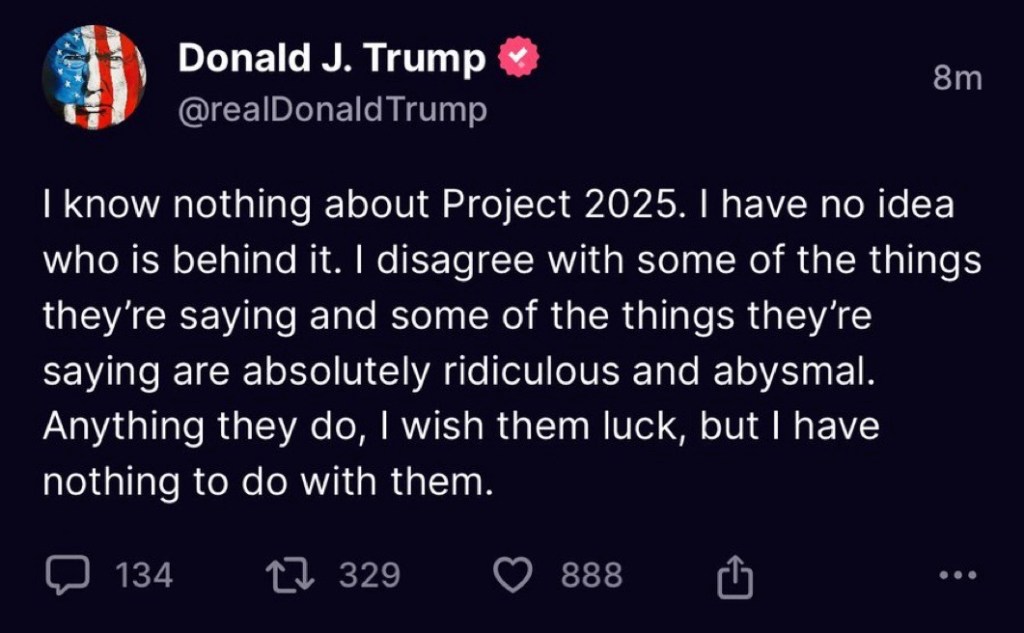
Rupar writes:

Project 2025, the Republican plan to functionally annihilate not just the federal government but democracy as well if Trump wins in November, is an unceasing parade of horrors. 

Banning the abortion pill nationwide? Check. Rolling back protections for LGBTQ people? Check. Deporting literally millions of undocumented immigrants? Check. But amid each objectively horrible aim is an even more more insidious one: abolishing the 22nd Amendment, which limits presidents to two terms. It’s an unvarnished, right-out-in-the-open plan to keep Trump in office well past 2028. 

It’s not as if this is genuinely unexpected. By July 2019, Trump had “joked” at least six times about being president for life. Floating that as a possibility, as Peter Tonguette did last week over at The American Conservative, is a great opportunity to show fealty to a candidate who values loyalty over all else. 

The American Conservative is a “partner” of Project 2025, along with such luminaries as Stephen Miller’s America First Legal law firm (currently suing everyone over the mildest of diversity efforts) and the Claremont Institute, which gave us Christopher Rufo and Moms for Liberty.

As Media Matters notes, the reasoning in Tonguette’s piece is dubious at best, but that doesn’t really matter. Project 2025 doesn’t rest on solid law, respect for democracy, or an understanding of history. It rests only on the notion that Trump should be allowed to exhibit raw, vicious, and unchecked power. 

Tonguette’s piece doesn’t even bother with the pretense that getting rid of the 22nd Amendment would strengthen democracy overall. Instead, the piece is predicated on the utterly unfounded notion that when the amendment was passed, no one could have foreseen that a president would be elected to nonconsecutive terms.

While Tonguette does mention Grover Cleveland, who every schoolchild learns did indeed serve two nonconsecutive terms, he seems to think that people were perhaps unaware of him when the 22nd Amendment was passed in 1951. Tonguette handwaves away the existence of Cleveland by simply writing, “In modern times, it is virtually inconceivable that any of the ousted one-term presidents would have seriously thought of running anew against the same opponent (now the occupant of the White House) who had bested them four years earlier.” 

It’s also inconceivable that millions of Americans would line up for a candidate who incited an insurrection, is facing 91 criminal charges, was found liable for sexually abusing E. Jean Carroll, and was just recently rich-guy panhandling to pay his massive bond to appeal his civil fraud penalty in a different case, but here we are. 

Embracing autocracy … for this guy?

Like many other projects of the modern Republican Party, a newfound loathing of the 22nd Amendment is wildly hypocritical. 

Though there were multiple unsuccessful pushes for presidential term limits before the passage of the 22nd amendment, the GOP House majority prioritized the issue after Franklin Delano Roosevelt’s death in 1945. No Republicans broke the party line during key congressional votes on the amendment, but they were helped along by southern Democrats who were mad that President Harry Truman continued FDR’s liberal economic policies.

To be fair, vaguely kicking around the idea of a third term has been standard procedure for a lot of two-term presidents, with President Barack Obama saying he thought he would likely have won a third election and President Bill Clinton saying he would probably have run for a third term if possible. However, the only serious push for a third term came from President Ronald Reagan, who said in 1987 that he “would like to start a movement” to repeal the amendment because it interfered with the right to “vote for someone as often as they want to do.” Reagan said he didn’t want this for himself but would press for it going forward, but like many things he said, that was somewhat less than truthful, as Republicans fundraised off the possibility of a Reagan third term starting in 1986.

Returning to Tonguette’s argument, it rests largely on his assertion that Trump is incredibly, historically popular, so he should get a third term. This, of course, ignores the fact that Trump is not actually that popular. He lost the popular vote in both 2016 and 2020. In 2016, Hillary Clinton trounced him by 2.87 million votes, while in 2020, Biden bested him by over 7 million.

🚨 Subscribe to Public Notice 🚨

Project 2025 is about enshrining minority rule

Much of the post-2020 discussion from Republicans — the parts not about unhinged conspiracy theories — has centered around outrage that anyone could disregard Trump’s 74 million votes. It’s unclear what conservatives mean by that, save for that even when they have less support and don’t win elections, they should still run things. 

And that’s what Project 2025 is all about. Republicans want to permanently enshrine their minority policies into law despite the fact that what they want is broadly unpopular. Fifty-nine percent of Americans want abortion to be legal. Over half of registered and likely voters do not want to vote for someone who makes robbing transgender youth of health care their core issue. Nearly three-quarters of American adults want the government to take bold steps to fight climate change. 

Project 2025 is all about enacting minority rule in America immediately upon Trump’s election. To do so, Trump would first need to gut civil serviceprotections, which ensure that federal workers don’t have to adhere to the politics of any given president.

Trump tried this at the end of his term, issuing an executive order that would have made thousands of federal civil servants at-will employees. When he didn’t win a second term, he didn’t have time to implement it. Those apolitical employees — as many as 50,000 people — would be replaced with Trump loyalists. Power would be wholly consolidated in the executive branch. 

Of course, Republicans hate that the executive branch, currently led by a Democratic president, wields any power and have been engaged in a decades-long project to dismantle the administrative state. Conservatives on the Supreme Court are helping along nicely with this project. But that pendulum would swing the other way fast if Trump retakes power, at which point conservatives will again love consolidating all power in the executive branch because the administrative state will be completely beholden to Trump. 

Comparisons to historic fascist leaders once felt overblown, but with Trump declaring he’d be a dictator on day one of his presidency, those comparisons no longer seem so hyperbolic. However, Trump has much more modern analogs. Russia’s Vladimir Putin has thrashed that country’s nascent attempts at democracy, amending the constitution twice to allow him to stay in power as long as he wants. With his most recent victory last month in an election that was really no election at all thanks to widespread coercion and censorship, Putin may end up being ruler for life.

Then there’s Benjamin Netanyahu, Israel’s prime minister. In the summer of 2023, he forced a vote to curtail the power of Israel’s Supreme Court, a project his conservative government had been pursuing for months because the court doesn’t vote in lockstep with his goals. There’s also the fact that Netanyahu, like Trump, faces corruption charges and needs to be sure the courts can’t take action against him.

And finally, there’s Hungarian Prime Minister Viktor Orbán. Orbán has been the king of the culture wars in a way that Republicans can’t get enough of. In 2022, he gave a speech joking about gas chambers and warning against Europeans becoming “peoples of mixed race.” Unsurprisingly, this did not result in him getting disinvited to the Conservative Political Action Conference a short while later. Instead, Republicans loved his nationalist rhetoric so much that there is now a CPAC Hungary, where in 2023, Orbán complained about “the woke movement and gender ideology.” 

If you want a preview of what would happen in a second Trump term, look to Hungary, which now bans anything with LGBTQ content whatsoever being shared with minors, and where the constitution was amended in 2020 to define “family” only as “based on marriage and the parent-child relation. The mother is a woman, the father a man.” Orbán also hates migrants and refugees, saying that people fleeing from war in places like Syria are a threat to Christianity. He has said he will defend Hungary against “tens of millions” of immigrants. 

Trump’s vision for America is impossibly grim. It’s fueled by hate and disrespect for democracy, and the only way it can be stopped is at the ballot box in 2024, so that Project 2025 never comes to fruition.


I wonder how many voters have read Project 2025 or heard of it. Apparently enough to worry Trump, who claims that he knows nothing about it or who wrote it. The 900-page document was drafted by people who are well known to him; it’s supposed to be the master plan for the next Trump term.

Heather Cox Richardson explained the controversy about Project 2025:

For all that certain members of the media continue their freakout over Biden’s electability after his appearance in last Thursday’s event on CNN, it is Trump and his Republicans who appear to be nervous about the upcoming election. 

Journalist Jennifer Schulze of Heartland Signal noted today that as of 8:00 this morning, the New York Times had published 192 pieces on Biden’s debate performance: 142 news articles and 50 opinion pieces. Trump was covered in 92 stories, about half of which were about the Supreme Court’s immunity ruling. Although Trump has frequently slurred his words or trailed off while speaking and repeatedly fell asleep at his own criminal trial, none of the pieces mentioned Trump’s mental fitness. 

But for all of what independent journalists are calling a “feeding frenzy,” egged on by right-wing media figures, it seems as if the true implications of Project 2025 are starting to gain traction and the Trump campaign recognizes that the policies that document advocates are hugely unpopular. 

On July 2, Heritage Foundation president Kevin Roberts assured Trump ally Steve Bannon’s followers that they are winning in what he called “the second American Revolution, which will remain bloodless if the left allows it to be.” In March, Roberts told former Trump administration official and now right-wing media figure Sebastian Gorka about Project 2025: “There are parts of the plan that we will not share with the Left: the executive orders, the rules and regulations. Just like a good football team we don’t want to tip off our playbook to the Left.” 

This morning, although Roberts has described Project 2025 as “institutionalizing Trumpism,” Trump’s social media feed tried to distance the former president from Project 2025. “I know nothing about Project 2025. I have no idea who is behind it,” the post read. Despite this disavowal of any knowledge of the project, it continued: “I disagree with some of the things they’re saying and some of the things they’re saying are absolutely ridiculous and abysmal. Anything they do, I wish them luck, but I have nothing to do with them.” 

In what appeared to be a coordinated statement, the directors of Project 2025 wrote on social media less than two hours later that they “do not speak for any candidate.”  

Aside from the fact that “[a]nything they do, I wish them luck,” sounds much like the signaling Trump did to the Proud Boys when he told them to “stand back and stand by,” Trump’s assertion and Project 2025’s response can’t possibly erase the many and deep ties of the Trump camp to Project 2025. Juliet Jeske of Decoding Fox News noted that Trump’s name shows up on more than 190 pages of the Project 2025 playbook. 

Rebekah Mercer, who sits on the board of the Heritage Foundation, was one of Trump’s top donors in 2016; her family founded and operated Cambridge Analytica, the company that misused the data of millions of Facebook users to push pro-Trump and anti-Clinton material in 2016. Trump’s national press secretary, Karoline Leavitt, has appeared in a Project 2025 video. Trump’s own super PAC has been running ads promoting Project 2025, calling it “Trump’s Project 2025,” and many of its policies—killing the Department of Education, erasing the separation of church and state, ending renewable energy programs and ramping up use of fossil fuels, deporting immigrants—are also Trump’s.

Project 2025’s director, Paul Dans, as well as both of its associate directors, Spencer Chretien and Troup Hemenway, were in charge of personnel in Trump’s White House, and the theme of Project 2025 is that “people are policy,” by which they mean that hand-picked loyalists must replace civil servants. Trump’s former body man John McEntee, who reentered the White House as a senior advisor after having to leave because he failed a background check, was in charge of hiring in the last months of the Trump White House; he helped to draft Project 2025. Key Trump ally Russell Vought wrote the section of Project 2025 that called for an authoritarian leader; he is also on the platform committee of the Republican National Convention. 

If indeed Trump knows nothing about Project 2025 and has no idea who is behind it, his cognitive ability is rotten. As former chair of the Republican National Committee Michael Steele wrote, “Since [Project 2025] is designed to institutionalize Trumpism and you know nothing about it, then why do you echo some of its policy priorities during your rallies? Coincidence? And how exactly don’t you know that Project 2025 Director Paul Dans served as your chief of staff at the Office of Personnel Management, and Associate Director Spencer Chretien served as your special assistant and associate director of presidential personnel? And folks say we should be worried about Biden.”

Trump’s attempt to distance himself from Project 2025 indicates just how toxic that plan is with voters. As political scientist Ian Bremmer dryly noted, it seems that “the second [A]merican revolution apparently [is] not polling as well as the first in internal focus groups.” Former Republican strategist Rick Wilson was even more direct, saying that Trump was trying to distance himself from Project 2025 because “most of it polls about like Ebola,” the deadly virus that causes severe bleeding and organ failure, and has a mortality rate of 80 to 90%.

The extremism of the MAGA Republicans was on display in another way today as well after The New Republic published a June 30 video of North Carolina lieutenant governor Mark Robinson, currently the Republican nominee for governor of North Carolina, saying to a church audience about their opponents—whom he identified in a scattershot speech as anything from communists to “wicked people” to those standing against “conservatives”—”Kill them! Some liberal somewhere is gonna say that sounds awful. Too bad!… Some folks need killing! It’s time for somebody to say it…” 

The other big news today was that the U.S. added 206,000 jobs in June, bringing the total number of jobs created under this administration to 15.7 million. Last month’s numbers were, once again, higher than economists expected and, according to economic analyst Steven Rattner, above job growth levels before the pandemic. He added that these jobs are not simply a bounceback from the depths of the pandemic: 6.2 million more Americans are employed now than before Covid hit. 

Voucher advocates are justly frightened of state referenda. They claim that “polls show” that vouchers have public support. They don’t. The voucher forces know that every state referendum about sending public money to private schools has failed. In state after state, vouchers have been turned down by voters, typically by large margins.

I wrote a few days ago that concerned citizens in Arkansas were trying to collect enough signatures to get a referendum on the ballot for voucher school accountability. They were outmatched by big money. More than $1 million in spending defeated $8,217.

Supporters of public schools in Arkansas wanted the state to hold voucher schools to the same accountability standards as public schools. Why not? The voucher lobby has boasted for years about the superiority of private and religious schools. But the lobby goes to great lengths to shield those wonderful private schools from taking the same tests as public schools! The evidence is in: when poor kids use vouchers, they fall behind their peers in public schools. In Arkansas right now, almost all the voucher money is going to kids who never attended public schools.

Despite the efforts of some 1,200 volunteers in Arkansas, they collected only about 70,000 of the 90,704 signatures needed to put the referendum on the ballot this November. They promise to try again in 2026.

The anti-voucher group is called For AR Kids, which includes the Arkansas Conference of the NAACP, Arkansas Education Association, Arkansas Public Policy Panel, Citizens First Congress, Arkansas Retired Teachers Association and Stand Up Arkansas.

Opposition to the referendum was funded by the multibillionaire Walton family and the multibillionaire Jeff Yass from Philadelphia.

The Arkansas Advocate reported:

The measure faced opposition from Arkansans for Students and Educators and Stronger Arkansas, two ballot question committees with close ties to the governor. Additionally, the measure was opposed by Family Council Action Committee 2024, which like Stronger Arkansas also opposes the proposed abortion and medical marijuana amendments.

Arkansans for Students and Educators and Stronger Arkansas have received a total of $986,000 and $375,000, respectively, in campaign contributions, according to June financial disclosure documents. Meanwhile, For AR Kids received a total of $8,217 from donors.

Bottom line: the billionaires spent about $1.3 million to protect voucher schools free of any accountability.

The anti-voucher group had $8,217 to spend in hopes of getting the same standards for voucher schools and public schools.

Unfair. Unethical. Shameful.

The New Republic published a hypothetical speech by Sidney Blumenthal that Joe Biden might give if were as ruthless as Trump. However, he won’t because he is an institutionalist. He believes in the law and the Constitution. He believes, despite the Roberts Court, that no one is above the law, not even the President.

Here is the hypothetical Biden speech:

Good evening, my fellow Americans. With the close of the current session of the Supreme Court, I want to report to you on my compliance with their decisions, especially in the case involving presidential immunity, United States v. Trump.

When I took the oath of office, I swore that I would “preserve, protect and defend the Constitution of the United States.” The Supreme Court has now reinterpreted that document. The court, for all intents and purposes, has also reinterpreted the Declaration of Independence, which proclaimed, “Governments are instituted among Men, deriving their just powers from the consent of the governed” to replace the “absolute tyranny” of a king. 

I have read the court’s majority opinion that an official act of the president is “presumptively” immune from all prosecution during and after his term, and that the president’s motive cannot be questioned. I have read, according to the majority, that a president who orders the Department of Justice and his vice president to commit election fraud is immune. I have read that a president who incites a mob to attempt to assassinate the vice president for failing to follow those instructions is immune. As Justice Sonia Sotomayor wrote in her dissent, “Orders the Navy’s Seal Team 6 to assassinate a political rival? Immune. Organizes a military coup to hold onto power? Immune. Takes a bribe in exchange for a pardon? Immune. Immune, immune, immune.”

Fellow Americans, I have taken the court’s opinion to heart. I am not one to defy the court. I am, as many have remarked, an institutionalist. I believe with all my soul in our institutions. And now, following the letter and the spirit of the court’s ruling, I have acted swiftly, decisively, and enthusiastically to enforce it. I will not, I cannot, shirk my constitutional duty. As Justice Sotomayor states, “In every use of official power, the president is now a king above the law.” 

To begin with, certain “gratuities,” as we shall call them, have been paid to the court majority as a token of appreciation. In their ruling in the case of Snyder v. United States, the majority decided that James Snyder, the former mayor of Portage, Indiana, who cajoled $13,000 from a trucking company after he granted it a city contract, was not liable for bribery. The court stated that it was a “gratuity.” “Gratuities are typically payments made to a public official after an official act as a reward or token of appreciation,” wrote Justice Brett Kavanaugh in the majority opinion.

Payment of “gratuities” to the justices who ruled in the majority in y follows the court’s decision in Snyder. It cannot be considered a bribe because it was not promised beforehand. But I do hope, as Justice Kavanaugh wrote, that there is “appreciation.” 

Now, following my strict construction of the court’s ruling on immunity, I can report to the nation that the threat to national security posed by my former political opponent, my late predecessor, has been eliminated. It was an official act. It was, to quote the court, “presumptive.”

The reasons for his removal do not need to be explained. Under the court’s decision, as an official act, it is more than privileged. I hope you understand that I need not disclose the reasons. I must respect the Supreme Court. I can assure the American people that there will be a thorough report that is currently being written by the intelligence community. It is classified. The substance cannot be disclosed—and never can be.

But I do want to tell you that he did have sex with a porn star. She didn’t like it. And he lied about his golf handicap.

Why am I doing this? That’s not admissible. The state of mind of the president, according to the court, is not admissible. My state of mind falls under an official act, so it’s nobody’s business but my own. I am proud of my official acts. I must respect the precedent of keeping secret all my reasons. Otherwise, I would be damaging the presidency for others who might follow in this office.

I regret to inform you that Speaker of the House Mike Johnson has been arrested. A number of other members of the House Republican Conference have been taken into custody. Jim Jordan, unfortunately, attempted to resist arrest. After wrestling with an FBI agent, he met a tragic fate. In the sudden absence of those members, there is a new majority in the House. I look forward to a long and cooperative relationship. I can say proudly, gridlock is at last broken. And we can all give thanks to the Supreme Court.

I further regret to inform you that 10 members of the Republican Senate caucus have been arrested. Again, unfortunately, Josh Hawley attempted to run away and was wounded in the leg. The incident was entirely his fault: if only he had submitted to the authorities. Lindsey Graham was arrested in his office. He has renounced all of his former allegiances, and I have issued him a pardon—a conditional pardon. There will be no more obstruction from filibusters. Again, we can thank the court. 

Now, about the court itself, with the present available members of the Congress, I have proposed that the Supreme Court be expanded by 26 justices. I can report that those new justices have already been nominated and approved. Advise and consent is on the fast track. All 26 will be here tomorrow. A longer bench is already under construction.

Tragically, Chief Justice John Roberts has been arrested for his treasonous comment that the president is doing something illegal, based on his very own opinion. I will name a new chief justice after the new 26 members take their posts.

More reform is on the way. The Twenty-Second Amendment prohibiting the president from holding more than two terms will be replaced by the Twenty-Eighth Amendment, which rescinds it. The new amendment has been proposed in the states. I have no doubt that three-quarters of the states, through their legislatures, will be cooperative. In fact, I can promise you that I expect 100 percent cooperation from each and every state legislature on a bipartisan basis. I have alerted FBI offices in every state to assist in our plan to extend democracy. 

To that end, I am creating a new Cabinet department, the Department of Official Acts, to coordinate, simplify, and centralize the far-flung activities of the Department of Homeland Security, the Internal Revenue Service, the Department of Defense, and other departments and agencies. I am committed to eliminating waste and abuse in official acts.

Moreover, the vice president will head a new office here at the White House, the Office of Reimagining Official Acts, to spur innovation, creativity, and efficiency, and above all the execution of justice. That office will review all of the acts that I take so that they qualify as official.

The Office of Reimagining Official Acts has already held a Zoom conference this morning with all of the Fortune 500 CEOs. Each and every executive without exception has released a statement in support of my official acts and promised full cooperation, with gusto. By the way, the chairman of the Democratic National Committee will hold a press conference to announce the details of the amazing news that our campaign has just received new contributions of $43 billion and counting. 

I can also report that Rupert Murdoch has been arrested for seditious conspiracy, along with his accomplices at Fox News, who have previously been liable for defamation. They have been spewing libels every hour of every day since. That’s as much as I can say. I cannot give another reason without breaking the strictures laid down by the court.

The Supreme Court’s immunity decision has also had a big impact on international relations. I have had a conversation with Vladimir Putin, who told me that he misunderstood me all along, and that after the day’s events here at home, he has decided to withdraw Russian troops from Ukraine. He told me he has the greatest admiration for our form of government now. He said, we can do business, strongman to strongman. 

As for the rest of the campaign, when the Republican National Committee decides on its candidate, I would consider a debate with the ground rules that candidates adhere to national security guidelines, which will be presented as needed—before, during, and after such an event, consistent as official acts.

If any reader of this column can show where anything described here would be illegal under the Supreme Court immunity ruling, please turn yourself in to the nearest FBI bureau to avoid yet another tragic result. Thought is mother to the deed. Thought must be included among the potential threats to be countered by presidential official acts. “Presumptive,” as the court stated, must mean presumptive. And the reason? The president does not need to explain. 

As we celebrate this Fourth of July, in a fervent prayer that the court’s ruling will work out for the best of all possible worlds, I want to say in conclusion, what goes around comes around.

Governor Sarah Huckabee Sanders and the Arkansas, which has a Republican supermajority, passed a voucher plan that allows the state’s voucher schools to evade the accountability required of public schools.

Outraged citizens have been gathering signatures for a referendum that would subject voucher schools to the same accountability as public schools. Today is the deadline to submit signatures. We will know soon if the rebellion against voucher schools’ freedom from accountability succeeded.

The Arkansas Times reported.

Organizers are racing to try to meet the signature threshold for an ambitious ballot initiative that would dramatically reorient the state’s K-12 education priorities and hold private schools receiving public funds to the same standards as those for public schools.

They still need thousands of signatures and face an uphill climb to meet the threshold by the July 5 deadline. We won’t know until the bitter end whether or not the group manages to get over the hump (more than a thousand volunteers are working at events across the state over the next 24 hours).

But I think it’s worth taking a moment to examine the stakes. The Arkansas Educational Rights Amendment would force the legislature to make real commitments to areas of educational need with a proven track record of improving learning outcomes. And it would force accountability on the governor’s voucher scheme, which is funneling tens of millions of dollars in taxpayer money into the pockets of private school families via a program with a long history of catastrophic failure in improving learning outcomes when states actually take the trouble to fairly measure and transparently report results at the private schools.

At a time when Republicans have total control of state government and Gov. Sarah Huckabee haughtily rules as if she has an infallible and possibly divine mandate, the education amendment would be the most comprehensive and far-reaching progressive policy victory in Arkansas since Medicaid expansion passed more than a decade ago.

Legislating by direct democracy

The education amendment is somewhat unusual for a ballot initiative, which usually present relatively straightforward “up-or-down” questions on issues like the minimum wage, casinos, weed, etc. The ballot initiative currently collecting signatures to reverse the state’s abortion ban is like that. Yes, there are details — abortions are allowed up to 18 weeks and for certain exceptions such as rape, incest and saving the life of the mother — but the fundamental issue is a yes-or-no question about whether or not abortion should be legal.

If someone wants to quibble with the headline above and say that the abortion initiative would be the biggest win in terms of liberal priorities in the state, I wouldn’t argue much. But it’s different in kind. The education amendment lays out a very broad-reaching slate of priorities and then would force the Legislature to act. It doesn’t articulate just how lawmakers should go about implementing it. It just establishes certain areas that are an absolute priority — required by law — tying lawmakers hands. The ripple effects through every aspect of the budget would be massive. It would steer the state toward a massive policy project that state leaders don’t want to do. The Legislature has prioritized vouchers and tax cuts skewed toward the wealthy and ignored issues like access to pre-k. If the public votes for this constitutional amendment, it would mandate that the Legislature make new tradeoffs.

This is why Arkansas Republican lawmakers are not fans of direct democracy. The overwhelming majority of voters in the state are going to back the candidate with an “R” by their name. But that doesn’t mean they share their narrow ideological obsessions. They will happily vote for minimum wage increases by huge majorities even if their elected officials hate it. With the advent of one-party rule, the state’s government is not responsive to issues that voters care about that don’t align with doctrinaire right-wing dogma. That’s why you’re seeing more expansive efforts to legislate from the bottom up via ballot initiative. Pre-k is popular; vouchers are not.

Equal standards and transparency for public and private schools getting vouchers

The push to put the education amendment before voters comes in the first year of Arkansas LEARNS, the education overhaul backed by Gov. Sarah Huckabee Sanders and passed by the Republican supermajority in the Legislature last year. Among the law’s most controversial provisions was the creation of a voucher program to help families cover the tuition and other costs of private schools. The program began this year and will be phased in until all K-12 students in the state are eligible to apply starting with the 2025-26 school year.

One curious feature of LEARNS is that the accountability measures it establishes for private schools accepting vouchers are not the same as those for public schools. The amendment would seek to reverse that, insisting on the same accreditation and testing for all schools receiving public funds, as well as public reporting by school of the results. This would allow citizens to see how well the voucher program is working as compared to public schools and help guide parents.

In the early days of voucher programs, advocates wanted to arrange apples-to-apples comparisons of student performance because they thought the voucher students would perform better. But once voucher programs scaled up to statewide efforts, the results were awful: Students who switched from public school to private school via voucher saw their test scores plummet to an unheard of degree — akin to the learning loss associated with a natural disaster like Hurricane Katrina or the COVID pandemic.

You might think such empirical results would give voucher advocates pause, but instead they shifted gears to trying to keep the test results secret or making comparisons impossible. Like many other new voucher programs in red states sweeping the country, Arkansas allowed private schools receiving boatloads of public money to arrange their own standards and tests, with none of the results made public. What could go wrong?

The irony here is that voucher advocates were often the ones screaming loudly about the need for accountability via testing in public schools, and pointing to those very results to disparage the quality of education in public schools. So you wind up with this very strange two-step: Voucher advocates will say something like, “these public school standards have led to lots of kids being below grade level in reading, let’s try something new.” But the measurement of how many kids are at grade level in reading is itself something we know via the standards, assessment and reporting! If voucher advocates claim to want to improve on these metrics, why wouldn’t we measure and report them at private schools, too?

I’ll let you know what happens. Republicans are terrified of voucher referenda: They always lose. To the extent that the public learns that voucher schools are actually worse than public schools and that the primary beneficiaries of vouchers are private school families whose children never attended public schools, the more likely that the public will oppose vouchers. Sending public money to private schools has never won a state referendum.

Greg Olear writes a terrific blog called PREVAIL about whatever he wants.

He writes about the Supreme Court’s latest decision placing the President above the law, freeing him to commmit crimes with absolute immunity from prosecution. He notes that they ignore history and the clear-cut intentions and writings of the Framers of the Constitution.

He is not a lawyer or a constitutional scholar. He explains in plain language how extreme this decision is by citing the dissenting Justices.

He writes:

A Prince whose character is thus marked by every act which may define a Tyrant, is unfit to be the ruler of a free people.
—Declaration of Independence


As a lapsed novelist with a robust imagination, I can come up with all kinds of creative ramifications regarding the Supreme Court’s shit-awful ruling in Donald J. Trump v. United States: the so-called Immunity Case.

This is, alas, a waste of time. 

Whatever the MAGA narrative about his alleged crime family, President Biden is as honest as politicians come, and regardless of his newfound kingly powers, he’s not going to recommission Alcatraz and send Trump there, or nationalize Fox News, or deport Elon Musk and Rupert Murdoch and Peter Thiel, or sic SEAL Team Six on SCOTUS. The guy won’t even pardon his son—the obvious victim of a humiliating political witch hunt—because he thinks it would be inappropriate. So it’s safe to say he’s not gonna go John Wick on Donald anytime soon. Brandon only runs so dark.

Furthermore, I am neither attorney nor law school graduate nor Supreme Court Kremlinologist. Legal texts bore me. Like, I don’t even like court procedurals. So I’d be lying if I told you I had any idea what the decision augurs for the FPOTUS, the election, or the future of the country. I’m going to defer, instead, to the experts who do know: three sitting Supreme Court Justices.

“The main takeaway of [yesterday]’s decision is that all of a President’s official acts, defined without regard to motive or intent, are entitled to immunity that is ‘at least…presumptive,’ and quite possibly ‘absolute,’” Sonia Sotomayor wrote, in a dissent for the ages. “Whenever the President wields the enormous power of his office, the majority says, the criminal law (at least presumptively) cannot touch him.”

We must presume a POTUS is immune from, basically, any potentially criminal act committed while he was in office. Ah, and who determines what he isn’t immune from? The Supreme Court! Fancy trick, that.

“In sum,” Sotomayor continues, “the majority today endorses an expansive vision of Presidential immunity that was never recognized by the Founders, any sitting President, the Executive Branch, or even President Trump’s lawyers, until now. Settled understandings of the Constitution are of little use to the majority in this case, and so it ignores them.”

In her own addendum to the dissent, Ketanji Brown Jackson discusses the IRL impact the decision will have:

In short, America has traditionally relied on the law to keep its Presidents in line. Starting today, however, Americans must rely on the courts to determine when (if at all) the criminal laws that their representatives have enacted to promote individual and collective security will operate as speedbumps to Presidential action or reaction. Once selfregulating, the Rule of Law now becomes the rule of judges, with courts pronouncing which crimes committed by a President have to be let go and which can be redressed as impermissible. So, ultimately, this Court itself will decide whether the law will be any barrier to whatever course of criminality emanates from the Oval Office in the future. The potential for great harm to American institutions and Americans themselves is obvious.

Obvious to anyone who is not a Leonard Leo radical Catholic reactionary weirdo on Harlan Crow’s payroll, that is.

And speaking of Leonard Leo radical Catholic reactionary weirdos, there is an “Easter egg” in the decision! In his concurrence, Clarence Thomas—who violated the law by not recusing from the case, not that Dick Durban gives a shit—shared his unsolicited opinion, clearly directed at the corrupt judge Aileen Cannon, that the Office of the Special Counsel should not exist, constitutionally speaking.

You might want to take your heart medication before reading this excerpt from Thomas’s little addendum, because this is next-level—which is to say, Kremlin-worthy—trolling:

I write separately to highlight another way in which this prosecution may violate our constitutional structure. In this case, the Attorney General purported to appoint a private citizen as Special Counsel to prosecute a former President on behalf of the United States. But, I am not sure that any office for the Special Counsel has been “established by Law,” as the Constitution requires. Art. II, §2, cl. 2. By requiring that Congress create federal offices “by Law,” the Constitution imposes an important check against the President—he cannot create offices at his pleasure. If there is no law establishing the office that the Special Counsel occupies, then he cannot proceed with this prosecution. A private citizen cannot criminally prosecute anyone, let alone a former President.

Wow, someone really doesn’t want that case to go to trial! One can’t help but wonder, reading that oddly specific wording, what Clarence and/or his insurrectionist-adjacent wife might be hiding in regards to January 6th. Does Trump have something on them? Are they trying to protect themselves from eventual prosecution? Are they bona fide True Believers? Or is there something even more insidious happening chezClarence et Ginni?

Thomas may as well have borrowed Trump’s Sharpie and scrawled I AM A TRAITOR—or, better yet, я предател—on the hard copy of the decision. The man is an adenocarcinoma on the prostate of democracy. At this point, we must question, if not fully doubt, Thomas’s allegiance to the United States. 

But the true evil genius of Trump v. United States, if you’re fash, is in the shielding of POTUS communications, such that, even if an act is deemed personal and unofficial, most of the available evidence to prove criminality isn’t admissible in court.

“Not content simply to invent an expansive criminal immunity for former Presidents,” Sotomayor explains, “the majority goes a dramatic and unprecedented step further. It says that acts for which the President is immune must be redacted from the narrative of even wholly private crimes committed while in office. They must play no role in proceedings regarding private criminal acts.”


In her dissent, Sotomayor lays out what the majority—which is to say, the aforementioned Leonard Leo radical Catholic reactionary weirdos—decided, why it’s “atextual, ahistorical, and unjustifiable,” and the malefic impact it will have on our democracy: (Note: I’m removing the references that appear after every other sentence, to make it easier for us non-lawyers to read.)

Today’s decision to grant former Presidents criminal immunity reshapes the institution of the Presidency. It makes a mockery of the principle, foundational to our Constitution and system of Government, that no man is above the law. Relying on little more than its own misguided wisdom about the need for “bold and unhesitating action” by the President, the Court gives former President Trump all the immunity he asked for and more. Because our Constitution does not shield a former President from answering for criminal and treasonous acts, I dissent….

The Court now confronts a question it has never had to answer in the Nation’s history: Whether a former President enjoys immunity from federal criminal prosecution. The majority thinks he should, and so it invents an atextual, ahistorical, and unjustifiable immunity that puts the President above the law. The majority makes three moves that, in effect, completely insulate Presidents from criminal liability. First, the majority creates absolute immunity for the President’s exercise of “core constitutional powers.” This holding is unnecessary on the facts of the indictment, and the majority’s attempt to apply it to the facts expands the concept of core powers beyond any recognizable bounds. In any event, it is quickly eclipsed by the second move, which is to create expansive immunity for all “official act[s].” Whether described as presumptive or absolute, under the majority’s rule, a President’s use of any official power for any purpose, even the most corrupt, is immune from prosecution. That is just as bad as it sounds, and it is baseless. Finally, the majority declares that evidence concerning acts for which the President is immune can play no role in any criminal prosecution against him. That holding, which will prevent the Government from using a President’s official acts to prove knowledge or intent in prosecuting private offenses, is nonsensical. 

Argument by argument, the majority invents immunity through brute force. Under scrutiny, its arguments crumble. To start, the majority’s broad “official acts” immunity is inconsistent with text, history, and established understandings of the President’s role. Moreover, it is deeply wrong, even on its own functionalist terms. Next, the majority’s “core” immunity is both unnecessary and misguided. Furthermore, the majority’s illogical evidentiary holding is unprecedented. Finally, this majority’s project will have disastrous consequences for the Presidency and for our democracy.

What Trump v. United States does, as I am hardly the first to point out, is turn the president into a king. This is ironic, because for all of Alito’s and Thomas’s bluster about “originalism,” where they ask WWJD (where “J” stands for “Jefferson”), the one thing we Americans—even little kids, ffs!—know for sure about the Founders is that they did not want another king. How do we know this? They wrote a whole fucking letter about it and posted it to George III. You can see a copy at the National Archives Museum.

Anyway, said Troll King of the Supreme Court, Clarence Thomas, worked the George III stuff into his reasoning that Jack Smith has no more authority to indict Donald Trump than Jack White, Jack Black, Jack B. Nimble, or Jack B. Quick. “In fact, one of the grievances raised by the American colonists in declaring their independence was that the King ‘ha[d] erected a multitude of New Offices, and sent hither swarms of Officers to harass our people and eat out their substance,’” Thomas writes, no doubt pleased with himself for working “erect” and “eat out” into a concurrence.

“The Founders thus drafted the Constitution with ‘evidently a great inferiority in the power of the President, in this particular, to that of the British king,’” he continues, noting that they “broke from the monarchial model by giving the President the power to fill offices (with the Senate’s approval), but not the power to create offices. They did so by ‘imposing the constitutional requirement that new officer positions be “established by Law” rather than through a King-like custom of the head magistrate unilaterally creating new offices.’”

In short, Clarence Thomas is attempting to eighty-six Jack Smith on the grounds that the Founders explicitly rejected a “monarchial model,” while simultaneously arguing that Trump should be given kingly powers.

These bought-and-paid-for fascists are just fucking with us at this point.


The last six paragraphs of Sotomayor’s dissent are, in a word, chilling. Again, I’ve not read many Supreme Court decisions, but I’d be surprised if this were not the first one that mentioned the possibility of a president tapping SEAL Team Six to whack a political rival. 

There’s no way to sugarcoat it: this is the senior liberal justice on the Supreme Court freaking the fuck out about what Roberts and his reactionary chums have unleashed. Lines from this section have been quoted in every article published about the decision, but I’m going to include the entire excerpt, for maximum impact:

Looking beyond the fate of this particular prosecution, the long-term consequences of today’s decision are stark. The Court effectively creates a law-free zone around the President, upsetting the status quo that has existed since the Founding. This new official-acts immunity now “lies about like a loaded weapon” for any President that wishes to place his own interests, his own political survival, or his own financial gain, above the interests of the Nation. The President of the United States is the most powerful person in the country, and possibly the world. When he uses his official powers in any way, under the majority’s reasoning, he now will be insulated from criminal prosecution. Orders the Navy’s Seal Team 6 to assassinate a political rival? Immune. Organizes a military coup to hold onto power? Immune. Takes a bribe in exchange for a pardon? Immune. Immune, immune, immune.

Let the President violate the law, let him exploit the trappings of his office for personal gain, let him use his official power for evil ends. Because if he knew that he may one day face liability for breaking the law, he might not be as bold and fearless as we would like him to be. That is the majority’s message today.

Even if these nightmare scenarios never play out, and I pray they never do, the damage has been done. The relationship between the President and the people he serves has shifted irrevocably. In every use of official power, the President is now a king above the law.


The majority’s single-minded fixation on the President’s need for boldness and dispatch ignores the countervailing need for accountability and restraint. The Framers were not so single-minded. In the Federalist Papers, after “endeavor[ing] to show” that the Executive designed by the Constitution “combines . . . all the requisites to energy,” Alexander Hamilton asked a separate, equally important question: “Does it also combine the requisites to safety, in a republican sense, a due dependence on the people, a due responsibility?” The answer then was yes, based in part upon the President’s vulnerability to “prosecution in the common course of law.” The answer after today is no.

Never in the history of our Republic has a President had reason to believe that he would be immune from criminal prosecution if he used the trappings of his office to violate the criminal law. Moving forward, however, all former Presidents will be cloaked in such immunity. If the occupant of that office misuses official power for personal gain, the criminal law that the rest of us must abide will not provide a backstop.

With fear for our democracy, I dissent.


Six weeks ago, Sotomayor spoke at the Radcliffe Institute for Advanced Study at Harvard University, where she was honored with an award. She was remarkably candid about her experience working with six fascists. “There are days that I’ve come to my office after an announcement of a case and closed my door and cried,” she said. “There have been those days. And there are likely to be more.”

I wonder if the immunity case was one of the times Sotomayor wept in her office—or if the ugly future it portends was too horrifying for the tears to come.

Share


Photo credit: George III and an admirer.

Jamelle Bouie is an opinion writer for The New York Times. He writes with exceptional insight and clarity. In this column, he explains the radical, unprecedented nature of the Supreme Court’s decision on presidential immunity. The majority claims to be “originalists,” paying strict attention to the meaning of the words of those who wrote the Constitution, but this decision clearly demonstrates their complete indifference to the original intent of the Framers of the Constitution. The Framers created a strong balance of power among the three branches of the Federal Government; this Court negates those checks and balances.

With this ruling, Trump vs. US, the six member majority of the Supreme Court has shown that they are rank partisans. Their overriding objective was to protect Trump, first, by dragging out their decision as long as possible; second, by remanding the case to a District Court, where it may require months of hearings and appeals to determine which acts are official and which are not; and third, by affirming Trump’s once-absurd claim that the President can do whatever he wants and it’s not illegal.

The Roberts Court is a disgrace.

Jamelle Bouie writes:

In 1977, nearly three years after leaving office in disgrace, President Richard Nixon gave a series of interviews to David Frost, a British journalist. Of their hourslong conversations, only one part would enter history.

“When the president does it,” Nixon told Frost, defending the conduct that ended his presidency, “that means that it is not illegal.” He went on to add that if “the president approves an action because of the national security — or in this case because of a threat to internal peace and order of significant magnitude — then the president’s decision in that instance is one that enables those who carry it out to carry it out without violating a law.” Otherwise, Nixon concluded, “they’re in an impossible position.”

Yesterday, in a 6-3 decision along partisan lines, the Supreme Court affirmed Nixon’s bold assertion of presidential immunity. Ruling on the federal prosecution of Donald Trump for his role in the effort to overturn the results of the 2020 presidential election, Chief Justice John Roberts explained that the president has “absolute immunity” for “official acts” when those acts relate to the core powers of the office.

“We conclude that under our constitutional structure of separated powers, the nature of presidential power requires that a former president have some immunity from criminal prosecution for official acts during his tenure in office,” Roberts writes. “At least with respect to the president’s exercise of his core constitutional powers, this immunity must be absolute. As for his remaining official actions, he is also entitled to immunity.”

The majority divides official conduct from “unofficial conduct,” which is still liable for prosecution. But it doesn’t define the scope of “unofficial conduct” and places strict limits on how courts and prosecutors might try to prove the illegality of a president’s unofficial acts. “In dividing official from unofficial conduct, courts may not inquire into the president’s motives,” Roberts writes. “Such an inquiry would risk exposing even the most obvious instances of official conduct to judicial examination on the mere allegation of improper purpose, thereby intruding on the Article II interests that immunity seeks to protest.” In other words, the why of a president’s actions cannot be held as evidence against him, even if they’re plainly illegitimate.

Roberts tries to apply this new, seemingly extra-constitutional standard to the facts of the case against the former president. He says that the president “has ‘exclusive authority and absolute discretion’ to decide which crimes to investigate and prosecute, including with respect to allegations of election crime” and may “discuss potential investigations and prosecutions” with Justice Department officials, effectively neutering the idea of independent federal law enforcement. Turning to Trump’s attempt to pressure Mike Pence into delaying certification of the Electoral College, Roberts says that this too was an official act.

Having made this distinction between “official” and “unofficial” conduct, Roberts remands the case back to a Federal District Court so that it can re-examine the facts and decide whether any conduct described in the indictment against Trump is prosecutable.

The upshot of this decision is that it will delay the former president’s trial past the election. And if Trump wins he can quash the case, rendering it moot. The conservative majority on the Supreme Court has, in other words, successfully kept the American people from learning in a court of law the truth of Trump’s involvement on Jan. 6.

But more troubling than the court’s interference in the democratic process are the disturbing implications of the majority’s decision, which undermines the foundations of republican government at the same time that it purports to be a strike in defense of the constitutional order.

Presidential immunity from criminal prosecution does not exist in the Constitution, Justice Sonia Sotomayor observes in her dissent. The historical evidence, she writes, “cuts decisively against it.” By definition, the president was bound by law. He was, first and foremost, not a king. He was a servant of the public, and like any other servant, the framers believed he was subject to criminal prosecution if he broke the law.

And while the majority might say here that the president is still subject to criminal prosecution for “unofficial acts,” Sotomayor aptly notes that the chief justice has created a standard that effectively renders nearly every act official if it can be tied in some way, however tenuously, to the president’s core powers.

If the president takes official action whenever he acts in ways that are “not manifestly or palpably beyond his authority” and if “in dividing official from unofficial conduct, courts may not inquire into the president’s motives,” then, Sotomayor writes, “Under that rule, any use of official power for any purpose, even the most corrupt purpose indicated by objective evidence of the most corrupt motives and intent, remains official and immune.”

A president who sells cabinet positions to the highest bidder is immune. A president who directs his I.R.S. to harass and investigate his political rivals is immune. A president who gives his military illegal orders to suppress protesters is immune.

These examples only scratch the surface of allowable conduct under the majority’s decision. “The court,” Sotomayor writes, “effectively creates a law-free zone around the president, upsetting the status quo that has existed since the founding.” When he uses his official powers in any way, she continues, “he now will be insulated from criminal prosecution. Orders the Navy’s SEAL team 6 to assassinate a political rival? Immune. Organizes a military coup to hold onto power? Immune. Takes a bribe in exchange for a pardon? Immune.”

The bottom line, Sotomayor concludes, is that “the relationship between the president and the people he serves has shifted irrevocably. In every use of official power, the president is now a king above the law.”

If the president is a king, then we are subjects, whose lives and livelihoods are only safe insofar as we don’t incur the wrath of the executive. And if we find ourselves outside the light of his favor, then we have find ourselves, in effect, outside the protection of the law.

Roberts says that presidential immunity from criminal prosecution is necessary to preserve the separation of powers and protect the “energy” of the executive. But the aim of the separation of powers was not merely to create exclusive spheres of action for each branch — if this were true, the Senate, which ratifies treaties and confirms executive branch appointments, would not exist in its current form — but to prevent the emergence of unchecked authority. Roberts has reversed this. Now separation of powers requires the absolute power of the executive to act without checks, without balances and without limits.

In their relentless drive to protect a Republican president and secure his power for a future administration, the conservative majority has issued a fundamentally anti-republican opinion. In doing so, it has made a mockery of the American constitutional tradition.

By the end of his time in the White House, Nixon was a disgrace. But to the conservative movement, he was something of a hero — hounded out of office by a merciless liberal establishment. One way to tell the story of the Republican Party after Nixon is as the struggle to build a world in which a future Nixon could act unimpeded by law.

Roberts has done more than score a victory for Trump. He has scored a victory for the conservative legal project of a unitary executive of immense power. Besides Trump, he has vindicated the lawlessness of Republican presidents from Nixon to George W. Bush. The Nixonian theory of presidential power is now enshrined as constitutional law.

This time when the president does it, it really won’t be illegal.

The Supreme Court ruled 6-3 that the President of the United States has absolute immunity for criminal acts committed in his official capacity. He may order the Department of Justice to prosecute his political opponents. He can organize a coup against the government. He may order the military to assassinate his enemies. He may, as Trump did, send a mob to storm the U.S. Capitol and seek to stop the certification of the man who won the election and to murder elected officials. He may take a bribe for appointments or pardons.

The Court laid the groundwork for authoritarianism. For fascism. It eroded a basic understanding of our democracy. The six reactionary justices obliterated the bedrock principle of our government that “no person is above the law.” Under this ruling, the President is above the law. He is a King. The Founders would be appalled by this decision. Under this ruling, Richard Nixon need not have resigned.

This court is a threat to democracy. The majority is not conservative. It overrules precedent without hesitation, as it did in Dobbs (the abortion decision) and as it does in this decision.

Read the decision and the dissents yourself.


Michael Tomasky of The New Republic offers good advice about defeating Donald Trump. It’s about shaping a narrative, constantly reminding people that he is a convicted felon.

It might also be helpful to reiterate that he had sex with a porn star while his wife Melanie was recuperating from childbirth; that a jury decided that he sexually assaulted and defamed journalist E. Jean Carroll and owes her nearly $100 million dollars; that the State of New York successfully sued him for fraudulently reporting the value of his properties to reduce his taxes and was ordered to pay more than $400 million.

Tomasky writes:

If there is such a thing as one infamous quote that defines an era, then during the George W. Bush presidency it was an on-background remark made by a Bush aide to the journalist Ron Suskind in 2002 that appeared two years later in The New York Times Magazine. A “senior adviser” who was unhappy about an earlier article by Suskind had called him on the carpet and then went on to explain the broader world view that Suskind failed to comprehend:

The aide said that guys like me were “in what we call the reality-based community,” which he defined as people who “believe that solutions emerge from your judicious study of discernible reality.” I nodded and murmured something about enlightenment principles and empiricism. He cut me off. “That’s not the way the world really works anymore,” he continued. “We’re an empire now, and when we act, we create our own reality.”

The passage was instantly incendiary (everyone thinks it was Karl Rove; Rove has never confirmed this, and Suskind has never revealed his source). The arrogance of it, at a time when the Iraq War was hardly going to plan, was staggering. Some Democrats took the jibe as a badge of honor and began sporting “Reality-Based Community” buttons.

Republicans have a long track record of disastrous results. The Iraq War, which we were told in early 2003 would take a couple months, lasted years, killed hundreds of thousands, and cost trillions (and by the way, Iraq is still not close to being a free country). Bush also would go on to let a major American city drown (New Orleans) and nearly destroy the global economic order.

But we have to say this: None of that ever dims their confidence that they can create their own reality. And today, by which I mean right now, this week, Democrats can and must learn a thing or two from Republicans.

While Donald Trump was on trial, the conventional wisdom was that the outcome would have no effect on the election. The only people who disagreed were some conservatives—because they were sure it would actually help him.

But now we have a couple polls telling us something different. The conviction has the potential to hurt Trump. But emphasis on “potential.” It depends entirely on what the Democrats do with it. So this is the key question: Are the Democrats capable of creating their own reality? Do they have the imagination and courage to do it?

First, the polls. In a Reuters/Ipsos poll taken after Trump’s conviction, 10 percent of Republicans and 25 percent of independents said the conviction made them less likely to vote for Trump. To be sure, majorities of both said it would have no effect, and 35 percent of Republicans said a conviction made them more likely to back Trump.

But the important number is that 10 percent. That is a huge number. Think it through with me. In 2020, 158 million people voted. According to the CNN exit polls, 36 percent were Republicans. That’s 57 million voters. If Trump were to lose 5.7 million Republicans, he would not only lose but probably lose convincingly. Even if half of that 10 percent comes back to him, he’d lose 2.85 million. That’s still a huge number.

Let’s do a little more math. In the key swing state of Arizona, the vote total was about 3.3 million. If we follow the CNN exit polls that put the GOP vote nationwide at 36 percent, then just shy of 1.2 million Arizona voters were Republican. If Trump were to lose 5 percent of them, that would amount to about 59,000 votes. And Arizona was decided, of course, by about 12,000 votes in 2020. In Georgia, which again was decided by roughly 12,000 votes, Trump would lose around 88,000 votes. In Michigan, it would be 99,000 votes lost if just 5 percent of Republicans desert him. In Pennsylvania, it would be close to 124,000 votes. And remember, I’m lowballing Republican defections from the poll’s 10 percent to half that, and I’m not even counting independents.

I trust you see the importance here.

Second post-conviction poll: Morning Consult found that 15 percent of Republicans believe Trump should end his candidacy. Now, there are no numbers to crunch here, and Trump is obviously not going to do that. But if roughly every seventh Republican really thinks Trump should end his candidacy, that is a staggering number, and again a potentially devastating one for him.

And again—emphasis on “potentially.”

Democrats, the ball is in your court. You can make your usual “judicious study of discernible reality” and buy into the lazy—and apparently wrong—conventional wisdom that says the verdict will make no difference.

Or you can create a new reality in which the verdict makes a big difference—maybe the difference between Joe Biden being reelected and Donald Trump destroying our democracy.

How to do it? There are lots of ways. But let’s start with this. “Convicted felon Donald Trump.” Not once. Not 10 times. Not 10,000 times. More like 500,000 times.

Seriously: No federal Democratic officeholder should, for the foreseeable future, say the name “Donald Trump” without putting the words “convicted felon” before it. We might give Biden himself a partial exemption here, because for a president, that kind of blunt, partisan repetition may be a little undignified. But no one else. Chuck Schumer. Hakeem Jeffries. Cori Bush on the left. Jared Golden on the right. Every. Single. One of them.

Blunt repetition may be boring. Democrats and liberals are intellectually averse to it, because it’s intellectually dull, and we’re supposed to be the smart side, always finding clever new arguments. But it works. People need to hear things over and over and over for it to lodge in their long-term memory.

Think of how many times you heard “Crooked Hillary” in 2016. Did they sound like mentally dull robots? Yes. But did it sink in, for millions of swing voters? Well, we do know this: As many as 40 percent of voters in 2016 polls said they thought she was corrupt. And when James Comey reopened that email investigation in late October, many of those voters thought: Aha. Crooked Hillary. Just what the Republicans have been saying.

This is how people’s brains work. Don’t take it from me. Take it from Gretchen Smelzer, a psychologist whom I admit I just found on Google on Sunday morning but who appears to be legit and whose 2018 book Journey Through Traumaearned a brief but respectful write-up in The New York TimesOn her website, Smelzer writes:

There are only three ways that information can move from short-term memory to long term memory: urgency, repetition, or association.…

Repetition is the most familiar learning tool—everyone has memorized facts or vocabulary words by repeating them, and some have improved basketball free-throw shooting or playing piano scales through practice. Repetition creates long term memory by eliciting or enacting strong chemical interactions at the synapse of your neuron (where neurons connect to other neurons). Repetition creates the strongest learning.…

So Democrats. Here’s your situation. You can let this drop, thus ensuring that by November 5, Trump’s conviction on 34 felony counts by a jury that deliberated for less than 10 hours will be totally forgotten, and no one will carry the thought of it into the voting booth. Or you can hammer away at it, never letting voters forget it—and by the way, driving Trump crazy the whole time, making it likely that he’ll say nuttier and nuttier things about it—and do all you can to swing those 59,000 votes in Arizona and all the rest.

It’s up to you. Do you want to wake up on Wednesday, November 6, with Trump having won, and with exit polls showing that his conviction made no difference? If not, well … as Malone (Sean Connery) said to Eliot Ness (Kevin Costner) about stopping another mobster: “What are you prepared to do?”

Every time I see New Hampshire Governor Chris Sununu interviewed on CNN, he plays the role of the GOP “moderate.” Don’t be fooled. When it comes to education, he’s a clone of Betsy DeVos.

Veteran New Hampshire Garry Rayno pulls away the mask of “moderate” that Sununu wears in this article in InDepthNH.

This is an important article for everyone to read, no matter where you live. It explains succinctly the true goals of the privatization movement.

He writes:

Public education has been since its inception with the work of Horace Mann, the great equalizer.

Students from poor families have been able to compete with students from the other side of the tracks, maybe not in reality, but close enough to at least have an opportunity to excel.

Many of the founding fathers understood the need for an educated public if democracy was going to survive and thrive.

A responsible citizen is an informed citizen, and that appears to be the problem today. Too many people interested in power instead of governing don’t want a truly informed public. Instead, they want enough of the public spoon fed “alternative facts,” conspiracy theories, and outright lies to ensure they retain power although they have views that are both harmful to the majority of citizens and allow the tyranny of the minority to overturn the will of the majority.

At the heart of the minority’s transformation plan is the destruction of the public school system.

New Hampshire has had a front row seat to the war on education since Chris Sununu was elected governor and named his rival for the Republican nomination in 2016, Frank Edelblut, to be Education Commissioner, a man without any experience in public education, which was the first for someone holding that position in our lifetime.

If Sununu did not know what would happen when he put Edelblut in charge of this critical state department, shame on him, because Edelblut’s one term in the House was a roadmap for his actions during his two terms as commissioner, his second ending in March 2025.

Sununu has also packed the State Board of Education with school choice advocates instead of supporters of public education, so you have the two entities in the executive branch responsible for the state’s public education systems, maybe not anti-public schools, but certainly not advocates for the state’s public education system.

According to the statutes, the education commissioner “is responsible for the organizational goals of the department and represents the public interest in the administration of improving the effectiveness and efficiency of administrative and instructional services to all public schools in New Hampshire.”

Notice it says public schools, not private schools or religious schools, or homeschooling, or learning pods, or any of the other non-public entities that are approved vendors under the state’s Education Freedom Account program, some with questionable philosophies or intent.

An attempt by lawmakers this year to better define the education commissioner’s qualifications and responsibilities to the public school system was defeated this term by the same element that pushed to establish the EFA program and then to expand it, although this year’s attempt to increase the income threshold to participate in the program failed on the last day of the session to act on bills.

The outright attacks on public education began in New Hampshire about a decade ago but gained more warriors as FreeStaters/Libertarians swelled the ranks of the House and Senate Republican members.

The attack on public education here has been much the same as it has been in other states, mostly in the south and the west, with claims of the indoctrination of students by leftwing faculty members.

They have also attacked educators directly and have tried to pack school boards — without much success — to undermine curriculum, educators and slash budgets as happened in Croydon several years ago when the annual school meeting was poorly attended due to a snowstorm.

The Republican majority in the 2021-2022 legislature passed the state’s divisive concepts law forbidding teaching controversial subjects such as institutional racism.

The law was recently found unconstitutional by a US District Court judge.

That was the same term the EFA program was approved after earlier unsuccessful attempts.

Both the EFA program and the divisive concepts law were included in the state’s biennial budget package because they were not likely to pass on their own.

The same folks also tied education into the trumped out recent outrage over the LGBTQ community and sold it as an attack on parental rights.

The intent was to start a war between parents and educators, although parents already have many of the rights touted by the anti-public school advocates.

The theory touted was that educators were keeping information from parents about their students and their sexual identification and that educators were urging students to explore different sexual identities.

Then came the book banning other areas of the country experienced like Florida where some school libraries were stripped of books.

The red herring advocates touted here came from a national app that contains almost every book published that students could access both in schools and at home, and not on school library shelves.

Some tried to enlist town and city libraries in the surveillance of children and what they read and accessed, but that did not go very far.

All of this goes to create the appearance that schools are hotbeds of leftist politics and anti-parental values, some fueled by Edelblut in an op-ed he sent to media outlets.

And despite all this ginned up controversy, local public schools that educate about 90 percent of the school age children in the state remain very popular with parents and the public at large.

If that is true, you have to ask what is behind the push to demonize public schools like political candidates demonize opponents.

Keep in mind this attack on public education occurs at the same time when the superior court’s latest education funding decision says the state does not provide enough money to cover the cost of an adequate education for every student and the way it raises its biggest contribution to public education — the Statewide Education Property Tax — is unconstitutional.

Education is governments’ —not just state government’s — single biggest expense, costing about $3.5 billion a year.

If you are a Libertarian or Free Stater who believes “taxation is theft,” destroying public schools will shift the cost directly to parents, and you could keep a lot more of your money to spend as you see fit and not for the good of society.

And if you espouse the philosophy of the Koch Foundation or former US Education Commissioner, Betsy DeVos, you not only keep more of your money, one of the largest union-backed workforces in the country will be dismantled when certified teachers are no longer needed.

Without a public education system, a child would receive the education his or her parents could afford and for many, particularly minorities, and the historically poor, that may not be much beyond the time they turn 16 and have to go to work to keep the family treading the economic waters.

And then maybe they will work for a lot less than if they had a high school, or even a college education.

And without even an adequate education, how informed will the general public be or how capable of the critical thinking needed to realize all those folks touting their parental rights really do not have their best interests at heart.

Garry Rayno may be reached at garry.rayno@yahoo.com.

Distant Dome by veteran journalist Garry Rayno explores a broader perspective on the State House and state happenings for InDepthNH.org. Over his three-decade career, Rayno covered the NH State House for the New Hampshire Union Leader and Foster’s Daily Democrat. During his career, his coverage spanned the news spectrum, from local planning, school and select boards, to national issues such as electric industry deregulation and Presidential primaries. Rayno lives with his wife Carolyn in New London.