Archives for category: Accountability

Beth Lewis wrote this report about the great news from Arizona, where SOS Arizona is staying strong, united, dedicated, and powerful.

SOS Arizona won NPE’s first annual Phyllis Bush Award for Grassroots Leadership, presented at the NPE conference last October in Indianapolis.

Beth Lewis writes:

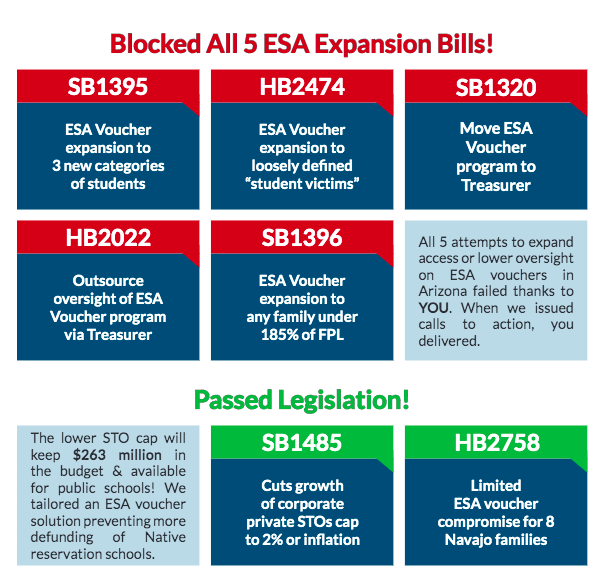
We have good news from Arizona! Coming off of their huge victory in defeating Proposition 305, which would have been the nation’s largest voucher expansion, Save Our Schools Arizona took their fight to the statehouse and won several critical battles.

The grassroots powerhouse stymied all five legislative attempts to either expand access to “Empowerment Scholarship Account” (ESA) vouchers or lower oversight of the existing program.

This marks three years in a row that the national voucher lobby has been defeated by volunteer parents, teachers and retirees in AZ. It’s thanks to mounting pressure to respect voters and fund Arizona schools, as well as wide reaching efforts to educate voters about the harms of privatization. Thousands of everyday citizens called, emailed, and met with lawmakers to make their opposition clear. In the end, the voice of the people prevailed over the various local and national special interest groups trying to push these bills. Arizona, the one-time school choice proving ground, is now demonstrating to the nation how to fight and prevail against privatizers. And that’s exactly why SOSAZ needs our support – to continue prevailing and protecting public schools. Please support their incredible work by donating at sosarizona.org/donate – they are nowhere near done fighting and need massive support to continue their work!

Ann Cronin is an educator in Connecticut.

In this post, she explains what real achievement is, and it has nothing to do with test scores.

There are all kinds of suggestions for improving student achievement – privatize public schools, increase the number of standardized tests that students take, implement national standards, and enforce no-excuses classroom discipline. None of these practices, however, have made a bit of difference. That is for two reasons. One reason is that the underlying causes of poverty and racial injustice have gone unaddressed, and the other reason is that standardized test scores can never measure achievement and, instead, reliably indicate only one thing: the income of the parents of the test taker.

So the first step in increasing student achievement is to redefine what we mean by achievement.  I recently witnessed something that crystallized for me what real achievement is.

She recently attended a ceremony in her community where high school seniors and adults were honored for community service.

When it was time for the second adult recipient, Roseanne Sapula, to give her speech, she spoke about how honored she was to receive the award she regarded as prestigious and how she had tried to write a speech but gave up. It was clear that she gave up because her volunteer work with the Monday Night Social Group, a group comprised of 40 special needs individuals of high school age and older, was so close to her heart that it was hard for her to explain her interactions with those in the group in a short speech. She did tell the audience that thinking up new adventures for those young adults and new ways for them to be part of the larger community was her “calling”.

As Roseanne was talking, she looked out in the audience and spotted one of the members of the Monday Night Social Group, Jacob, Fialkoff, a 20 year-old whom I later learned has cerebral palsy and a seizure disorder. She called out to him and asked him a favor. She explained to the audience that Jacob is scheduled to sing the National Anthem at the opening of the Connecticut Special Olympics and that he has a beautiful voice. She asked Jacob if he would sing it right there for all of us.

Jacob hesitated, probably feeling unprepared and that it was too much of a challenge at that moment. Roseanne, aware of his hesitation, asked him again, telling him that she would not be at the opening ceremony of the Special Olympics and would love to hear him sing the National Anthem. He still hesitated. Roseanne then asked him if he could do it just for her. He softly said OK.

He sang beautifully.

Jacob’s singing the National Anthem, unrehearsed and on the spot out of love for the person who asked him, is what is missing in the conversation about increasing student achievement, which has been the illusive national goal since the passing of “No Child Left Behind” in 2001. We have tested and prepared kids for tests. And achievement doesn’t budge. We have declared that urban schools are “failing schools” and opened charter schools.  And achievement doesn’t budge. We have put in place Common Core standards.  And achievement doesn’t budge. We suspend and expel students at high rates, particularly in charter schools. And achievement doesn’t budge. That’s because we have been looking in the wrong places for achievement. We have been looking at standardized tests.

What a narrow definition of achievement has ruled our nation since 2001, and even earlier.


Justin Parmenter, NBCT in North Carolina, writes here about the educational malpractice inflicted on the state’s youngest readers by order of State Superintendent Mark Johnson. A TFA alum, Johnson overruled the recommendations of expert professionals in the state and decided to assess and diagnose children’s reading skill with technology instead of a teacher.

As the 2019-20 school year wound down and teachers began their well-earned summer breaks, Superintendent Mark Johnson dropped an unexpected bombshell: North Carolina schools would be scrapping the mClass reading assessment system and replacing it with the computer-based Istation program.

North Carolina schools have used mClass as the diagnostic reading assessment tool in grades K-3 since the Read to Achieve legislative initiative was implemented in 2013.

Johnson’s announcement of the change referred with no apparent irony to “an unprecedented level of external stakeholder engagement and input” which had gone into making the decision.  He neglected to mention that he had completely ignored the recommendations of those stakeholders.

When the Request for Purchase (RFP) for a Read to Achieve diagnostic reading assessment first went out in the fall of 2018, a statewide committee of experts in curriculum and reading instruction was assembled largely under the direction of Dr. Amy Jablonski, then-Division Director of Integrated Academic and Behavior Services at the Department of Public Instruction, to inform the process.

This team included specialists in general education, special education, and English language learner services, school psychologists, representatives of Institutions for Higher Education, dyslexia experts, and school and district leaders. They reviewed the four vendors that were passed through to the team, including mClass and Istation, working extensively through detailed demonstrations with all four products before determining which would best serve the needs of North Carolina’s children.

The committee presented its recommendation to Superintendent Mark Johnson in December of 2018.  They noted that students and teachers needed a tool which could accurately assess risk in all domains of reading.  They noted the crucial importance of having a teacher actually listen to a child read and sound out words. They noted the legislative requirement of an effective dyslexia screener.  And they recommended that schools continue using the mClass diagnostic tool, which they believed best accomplished all of those things.

Six months later, Superintendent Johnson completely disregarded the recommendations of those professional educators in announcing his unilateral selection of the computer-based Istation diagnostic tool.  

Parmenter goes on to explain why this was a terrible decision.

Superintendent Johnson has all the earmarks of TFA. Uninformed, inexperienced, sure of himself.

Here is hoping he gets tossed out of office and replaced by someone who respects professionalism.


Governor Gretchen Whitmer spent four hours listening to constituents in Benton Harbor. They do not want her to close their high school.

She has backed away from earlier deadlines and is seeking a compromise.

This shows that she is different from Governor Rick Snyder. She listens. He never did.

Late afternoon turned to early evening in the crowded pews of Brotherhood of All Nations Church of God in Christ in Benton Harbor.

Angry residents pummeled Michigan Gov. Gretchen Whitmer with questions earlier this month. She answered and kept answering, staying in the church for almost four hours trying to explain why she believed it was in the best interest of Benton Harbor children to close the impoverished community’s lone high school and send those students elsewhere.

“I can see (my plan) is not being met with a lot of enthusiasm with many people in this room,” Whitmer said at one point. Before she made the two-hour trek back to the governor’s mansion in Lansing, she promised to extend the deadline to work out a deal with the Benton Harbor School Board.

The meeting between the Democratic governor and residents of this Democratic stronghold didn’t change many minds. But it did crystalize a governing style that at times risks alienating the governor’s supporters in an effort to resolve the state’s long-standing problems.

Her approach ‒ announcing bold plans and then asking critics to come up with something better ‒ was also on display when Whitmer agreed to a compromise on no-fault auto insurance that had stymied Lansing for years, and in promoting a 45-cent gas tax – a plan that at minimum got Republican leadership in the Legislature to the table to trade ideas on a long-term fix for Michigan’s crumbling roads.

How that style pans out in Benton Harbor is yet to be determined. After first threatening to dissolve the district if board members didn’t agree to close its low-achieving high school, Whitmer was barraged with vociferous and sustained criticism from residents and leaders of the city, which cast 95 percent of its ballots in her favor last November.

The protest was soon joined by fellow Democrats including legislators from Detroit and the two Democratic African-American members of the state school board. Whitmer has since taken a more measured tone publicly, and is negotiating the fate of Benton Harbor schools with the local board behind closed doors.

The governor could still try to dissolve the entire school district, either by asking the Republican-led Legislature to take the step or by trying to use a 2013 law that allows the state treasurer and state school superintendent to dissolve a district under certain circumstances.

To ward that off, the local board presented Whitmer with a plan that would keep Benton Harbor High School open in exchange for agreements to pay down district debt and address low academic achievement in part through enhanced teacher recruitment and retention.

My view: When a district is poor and can’t tax itself enough to pay for good schools, the state has an obligation to provide the needed resources.

Bill Phillis writes about Ohio’s connection to the biggest charter school heist in history (so far):


School Bus
More about the STEAM charters that have connections with the individuals indicted in California for an $80 million charter fraud
Five STEAM charters were “licensed” to operate in Ohio. Two of them, sponsored by Ohio Council of Community Schools, closed after a short period (2 years for one and 4 years for the other.)
Three STEAM charters are still in business as follows:
·       STEAM Academy of Warrensville Heights sponsored by Ohio Council of Community Schools
·       STEAM Academy of Akron sponsored by the Buckeye Community Hope Foundation
·       STEAM Academy of Warren sponsored by the Ohio Department of Education
Three of 11 individuals indicted in California for an $80 million charter fraud case have direct connections to the STEAM charter business enterprise in Ohio.
Other Ohio charter operations have been connected to charter operators indicted in other states. Several months ago some charter operators indicted for charter fraud in Florida had Ohio charter connections. The deregulated charter environment attracts people that relish the possibility of a quick buck.
The Ohio Department of Education and the two other sponsors should initiate an investigation into the operation of STEAM charters in Ohio.
William L. Phillis | Ohio Coalition for Equity & Adequacy of School Funding | 614.228.6540| ohioeanda@sbcglobal.net| www.ohiocoalition.org
STAY CONNECTED:
School Bus

Haha, the charter industry keeps intoning over and over that charter schools are not public schools, but of course they are not. They are private schools that receive public funding and want more of it every year.

David Osborne, one of the loudest cheerleaders for charters, wrote in the Washington Post that charter schools are indeed private schools, and that is what makes them so fabulous.

It seems that the public sector mucks up everything, and the private sector really knows how to make things go well.

Kind of like those brilliant guys in California who figured out how to work the funding stream so they could siphon off $80 million for themselves and their allies.

And like the entrepreneurs who have figured out how to milk government funds by buying the real estate, then leasing it to their charter at exorbitant rates.

And like the legislators in Florida who direct public funding to the for-profit charters owned by their family.

It is refreshing to see a charter advocate admitting what everyone knows: charter schools are private, deregulated schools. Numerous studies have shown that they don’t get better results than public schools unless they cherrypick their students.

Now if someone can explain the rationale for government funding two sets of schools at the same time–one free to choose its students and set its own admissions rules, the other required to accept all students, including those kicked out by the private charters–then we might make sense of this mess.


One of the most valuable sites online is KnowYourCharter in Ohio.

This post lays out the waste of taxpayer dollars gobbled up by charters.

Time to close the spigot of money going down the drain in Ohio, leeched away from public schools to fatten charter operators.

Ohio has long been a hotbed of for-profit charter schools.

While Ohio requires that all charter schools be technically non-profit, Ohio law permits these schools to hire for-profit management companies that come in and, in essence, run the schooland take control of the school’s taxpayer funding.

For-profit charter school operators have been at the forefront of Ohio’s array of charter school scandals. From White Hat Management’s long history of dodging scrutiny while maintainingpolitical influencei, to Imagine Schools’ boondoggle on school rent agreementsii to the collapse ofWhite Hat’s political successor, Altair Learning Management, that ran the Electronic Classroom of Tomorrow – the epic collapse of which was widely reported last year and continues to generate headlines even today. It was recently reported that not one of the more than 4,666 students enrolled in ECOT’s final year actually attended the schooliii. Yet Ohio taxpayers paid ECOT to educate those kids for half a year.

But long overdue change is in the wind. Ohio House Speaker Larry Householder told assembledmedia shortly after he took the gavel that “I know they are technically nonprofit, but that secondtier, those management entities, I believe should be nonprofit.”1

The Know Your Charter website has updated the state data found on the website so parents, students, officials and media can compare the performance of charter schools and local public schools and districts. As part of that new data release, the Ohio Charter School Accountability Project examined how the 178 Ohio Charter Schools run by for-profit management firms2perform and spend money compared with the costs incurred by local public school districts.

The results are eye-opening.

  • Schools run by for-profit operators spend a hefty $1,167 more per pupil than school districts on non-instructional administrative costs3.
  • That’s 73 percent more money per pupil being spent by for-profit operators outside the classroom than the typical Ohio school district4.

Mercedes Schneider read the voluminous indictment of the founders of the online charter chain called A3. She describes the counts in the indictment in this post.

She writes:

In this post, I offer excerpts of the 67 counts detailed in the 235-page indictmentof Sean McManus, Jason Schrock, and nine others who used weaknesses in California’s charter school laws to construct a network of fraud and launder $50M in public funds into their own pockets over the course of years. These 11 individuals (and unidentified others) did so by opening multiple charter schools and using companies, both pre-existing and newly-created, to establish a complex system of self-dealing– with little to no education actually happening via those exploited, educational dollars.

The California legislature is currently deciding whether and how to reform the state’s charter law. The California Charter School Association is fighting any accountability or reform of the law. If a theft of more than $50 million by charter vultures doesn’t persuade the legislature of the need for reform, nothing will.

Bring on more theft of public money! More millions scooped up by entrepreneurs and grifters!

Thanks, Reed Hastings, Eli Broad, Bill Bloomfield, the Fischer family (the Gap and Old Navy), the Walton family, and all the other billionaires who make this piracy possible and who fund the CCSA!

Why spend money on public schools when it can go right into the bank accounts of smart and savvy entrepreneurs?


Jitu Brown is leader of the Journey for Justice and a national civil rights leader.

In this interview, he explains why he opposes school closings, charter schools, and vouchers, which have been disproportionately imposed on communities of color.

Don’t believe the claims by corporate reformers that black and brown parents want privately managed charters where they have no voice. They want well-funded public schools with experienced teachers and a full array of programs and services, where their voice matters.


Michigan Governor Gretchen Whitmer is poised to close the high school of Benton Harbor instead of giving it the resources and support it needs. Perhaps it is time to review the state’s funding formula, created by a generation of Republican legislator, Gov. Engler, Gov. Snyder, and Betsy DeVos.

In this article, journalist Anna Clark describes what the public schools of St. Joseph, the twin city of Benton Harbor, meant to her.

It begins:

Over on Court Street in St. Joseph, Michigan, one mile from the little bridge to Benton Harbor, my hardworking family struggled to make do. We poured milk over broken Saltines and called it cereal. I tried, in a thousand obnoxious ways, to persuade my parents to buy food they couldn’t afford, not least in a choreographed song-anddance routine with my siblings titled “The There’s-No-Food Blues.”

We had one big advantage: terrific public schools.

For all the separateness between St. Joseph and Benton Harbor – one whiter and richer, the other poorer and mostly African American, with the St. Joseph River curving between them, doomed to be a perpetual metaphor – these are small communities. For many of us, our roots span both sides. I grew up in St. Joseph, but Benton Harbor is where my mother was raised, where relatives live, where our family church is, where I worked part-time jobs in high school and college, and where I run a 5K on Thanksgiving mornings. It, too, is home.

Yet the differences between our so-called “Twin Cities” grow ever more serious. Gov. Gretchen Whitmer has proposed closing Benton Harbor High School for at least a few years, to get the distressed school district out of the death spiral of debt, following a consent agreement that gave the state oversight of the schools for years; it was lifted last November in favor of a financial plan that has, apparently, been scrapped. Benton Harbor’s enrollment may be lower than it used to be, but the prospect of shuttering the community’s single public high school – one that many still take pride in – is a blow.

St. Joe schools gave me the chance to thrive. Besides classes with experienced teachers, I edited a newsmagazine, performed in plays, went out for speech competitions, and failed to make many, many athletic teams. The first time I traveled out of the country was on a class trip for fourth-year Spanish students. I worked constant extra hours to pay the bill, but I got to spend two wide-eyed weeks in Spain.

I didn’t have a conversation with someone my own age from Benton Harbor until I was a freshman at the University of Michigan, leading creative writing workshops at a juvenile detention center. He was in the workshop. We traded joyful memories of the beach at Jean Klock Park and brown bag lunches at Henry’s Hamburgers, while the gulf between us loomed. We had grown up as veritable neighbors, both in working- class families, and here I was, a college student, and there he was, incarcerated.

I began to see how segregation is not only bizarre but sinister. If you grow up on the St. Joe side of the river, even in a family that is poor, you have opportunities your peers in Benton Harbor don’t have.

I’ve often heard people in St. Joe blame Ben- ton Harbor parents for the school system’s woes: “They could have fixed it. They just don’t care,” they say, pointing to empty seats at PTA meetings and sporting events. I understand the value of loving parents, but I had a great public education because my schools were supported by the taxes of people far richer than my family. Until the passage of Proposal A in 1994 (most of my student years), property taxes were the main source of school funding. Unequal schools were a matter of policy.

Even now, in the era of per-pupil funding, schools with a disproportionate number of poor students must meet disproportionate needs, but with few resources.

Michigan ranks 50th for funding growth in public education, with total revenue declining 30% since 2002. Not coincidentally, it also ranks low for math and reading proficiency. But in St. Joseph, millages help. In May, my hometown renewed a millage for support services, technology, transportation and maintenance. The levy only applies to second homes and commercial properties, but it’ll generate $5.8 million.

Poverty is concentrated in Benton Harbor. Second-home millages aren’t an option. It’s a challenge to keep teachers, when salaries are among the lowest in the state. Average annual pay was $34,761 for the 2016-2017 school year, and fell during a statewide teacher shortage. In St. Joseph and nearby Stevensville, average salaries increased to more than $63,000.

I’m proud that I come from a community that prizes public education. But it is outrageously painful that some look across the river and suggest that Benton Harbor’s children don’t have the same advantages because their parents love them less.

It also misses the obvious: Inequality perpetuates itself. It can’t be forgotten that in living memory, segregation was law. Through redlining and racially restrictive deeds, enforced by every level of government and private enterprise, we designed a system where homes owned by African Americans were worth less. Then we tied school funding to property values.

Open the link and read the rest.