Archives for category: Accountability

Patrick O’Donnell is one of the best education journalists in the nation. He has covered charter and cyber charter scandals in Cleveland and in Ohio without fear or favor. Ohio, as you may have noticed, is awash in charter corruption.

O’Donnell worked for the Cleveland Plain-Dealer until last weekend, when the newspaper pushed out its leading journalists and told them they could cover far-flung areas if they want to stay employed. The order from on high essentially fired union journalists and gutted the newspaper’s coverage of Cleveland.

The Plain-Dealer is part of Advance Publications, which is owned by the billionaire Newhouse family. Advance is engaged in cost-cutting that will destroy local journalism. It’s all about the Almighty Dollar.

Wisconsin long ago scheduled its primaries for April 7. When the dimensions of the public health crisis became apparent, Governor Tony Evers tried to postpone the election and to encourage voting by mail. Evers’s order to postpone the election was overturned by the state court, and its ruling was sustained by the U.S. Supreme Court, voting along partisan lines. Hundreds of thousands of people were disenfranchised.

To understand the fiasco, read this article by Stephen Rosenfeld:

The Republican Party affirmed with startling clarity on Monday that preserving political power was a higher priority than protecting public health or enabling voters to cast ballots that will be counted in the COVID-19 era.

The stage for this stunning partisan display embracing voter suppression was a constitutional crisis that erupted in Wisconsin, a day before scheduled statewide elections on April 7 for its 2020 presidential primary, a state Supreme Court seat, and contests for hundreds of local offices.

The election will continue on April 7, but the reverberations from Monday rulings by Wisconsin’s Supreme Court and the U.S. Supreme Court later in the day in a related lawsuit have set down markers that suggest that securing voting rights in a pandemic is anything but assured—especially if anti-participatory state laws and voting procedures will be upheld by majorities on the highest courts.

Efforts by Democrats to postpone in-person voting and extend voting by mail due to the pandemic were rejected by conservative majorities on the Wisconsin Supreme Court and on the U.S. Supreme Court. In separate rulings, both courts sided with the Republican National Committee and Wisconsin Republicans.

“The Court’s order, I fear, will result in massive disenfranchisement,” Supreme Court Justice Ruth Bader Ginsburg wrote
in a dissent signed by the court’s three other liberal justices. “A voter cannot deliver for postmarking a ballot she has not received. Yet tens of thousands of voters who timely requested ballots are unlikely to receive them by April 7, the Court’s postmark deadline [to return ballots].”

While this ideological split may not be new in electoral politics, especially in voting right cases where conservatives seek strict laws limiting participation and liberals seek flexibility to enfranchise voters, it was a “bad sign” for the climate heading into elections in the fall, said Rick Hasen, ElectionLawBlog.org founder and a nationally known constitutional scholar.

“It is a very bad sign for November that the Court could not come together and find some form of compromise here in the midst of a global pandemic unlike anything we have seen in our lifetimes,” he wrote. “Like the Wisconsin Supreme Court, the U.S. Supreme Court divided along partisan and ideological lines.”

The courts’ rulings capped a day of high drama and a state constitutional crisis.

On Monday afternoon, Wisconsin’s Democratic Gov. Tony Evers issued an executive order to postpone in-person voting and extend the deadline for absentee ballots to be mailed in, citing the pandemic. But the state’s Republican majority legislature challenged Evers’ order before the conservative-led Wisconsin Supreme Court. The GOP legislative leadership issued a statement telling local officials to keep planning for Tuesday’s election, creating great tension and uncertainty as the Democratic governor and Republican legislature headed into court.

By a 4-2 vote later in the day, the Wisconsin Supreme Court nullified Evers’ executive order, forcing the in-person voting to continue on April 7 and restoring the deadline for absentee ballots to be returned by the same day for them to count. Meanwhile, hundreds of polling places were not going to open after poll workers withdrew due to the pandemic. For example, only five of Milwaukee’s 180 polls would be opened in that non-white epicenter, ElectionLawBlog.org noted.

“The April 7 Spring Election and Presidential Preference Primary is occurring as scheduled,” a headline on the Wisconsin Elections Commission (WEC) website said after the state Supreme Court ruling.

In addition to in-person voting, the WEC website said that 1,275,254 absentee ballots had been requested by voters and that 724,777 had been returned by April 6. Other reports by academics citing WEC data said that local officials had yet to mail out 10,000 ballots. Meanwhile, half-a-million ballots had yet to be returned.

The Wisconsin Supreme Court’s decision was not entirely unexpected, because in 2016 outgoing Republican Gov. Scott Walker and the GOP-led legislature stripped many authorities from the incoming Democratic governor. Democrats had fought those laws, enacted after the 2016 election in a lame-duck session, but lost.

“This is a real constitutional showdown,” said Kevin Kennedy, the ex-executive director of Wisconsin’s Government Accountability Board, which oversaw the elections for decades until Walker and GOP legislators dismantled the board.

“When I was there I thought the governor had the power to do something [like postpone an election in a crisis], but in 2016 the Legislature severely restricted the governor’s power,” Kennedy said. “He [Walker] signed all of these laws that he would never have tolerated as restrictions on his power. Even the Attorney General can’t settle a lawsuit without approval from the legislature.”

However, shortly after the Wisconsin Supreme Court ruled on Monday, the U.S. Supreme Court weighed in—responding to another lawsuit filed late on Friday by the Republican National Committee and Wisconsin’s GOP-led legislature. (Its Republican majority was created by gerrymandering after the 2010 census.)

The U.S. Supreme Court decision followed a tortuous path that began with lower court orders that sought to help voters but ended with its ruling withdrawing that help.

Earlier on Friday, April 3, a federal district court with a judge appointed by President Obama extended the Wisconsin election’s mail-in balloting deadline by a week and said that absentee voters did not have to find a witness to sign their ballots. The witness requirement was a pre-existing state law.

That pro-voter ruling was appealed by Republicans to a federal circuit court, which reinstated the witness requirement but kept the week-long extension for absentee ballots to be returned. The RNC then appealed the extension to the U.S. Supreme Court, arguing that some Wisconsin voters would be voting after Election Day.

The Republicans argued that no special exceptions should be made, even though the pandemic had led local officials to send out six times as many vote-by-mail ballots as in the 2018 election—and by late Monday more than 500,000 hadn’t been returned, according to the WEC.

The Supreme Court’s conservative bloc agreed with the Republican litigants, issuing a ruling that drew harsh criticism by the court’s liberal minority.

“The Court’s [majority] suggestion that the current situation is not ‘substantially different’ from ‘an ordinary election’ boggles the mind,” Justice Ginsburg’s dissent said. “Some 150,000 requests for absentee ballots have been processed since Thursday, state records indicate. The surge in absentee-ballot requests has overwhelmed election officials, who face a huge backlog in sending ballots.”

“It is among the most cynical decisions I have read from this Court—devoid of even the pretense of engaging with the reality that this decision will mean one of two things for many WI voters: either they will risk their health & lives to vote, or they will be disenfranchised,” tweeted Sherrilyn Ifill, president and lead counsel of the NAACP Legal Defense and Educational Fund.

A Troubling Precedent

In the coming days, it will become clear how many thousands of voters will see their absentee ballots rejected because they arrived too late to be returned by April 7. But Monday’s high court rulings—by a state supreme court and federal Supreme Court—will resonate in other 2020 swing states that are wrestling with expanding absentee balloting in response to the pandemic.

The partisan divide that led to Wisconsin’s constitutional crisis, where a Democratic executive branch and a Republican-led legislature could not agree on voting reforms, is not unusual—although the Wisconsin governor’s weakened authority is somewhat unique. The 2020 swing states of Michigan, Pennsylvania and North Carolina all have different parties controlling their executive and legislative branches. These states are already seeing clashes over expanding absentee voting in response to the pandemic.

Analysts in Wisconsin, including conservatives such as Charlie Sykes, said that no one should doubt that the Wisconsin GOP was putting partisan power before the public interest. Sykes noted that Republicans believe they can win a state Supreme Court seat if the April 7 election continued and other voting options were curtailed.

“In Wisconsin, the GOP would rather endanger people’s lives and have a clusterf—-k election, so long as it gives them a chance at clinging to a piece of government power,” he wrote Monday on TheBulwark.com, which Sykes founded and where he is an editor at large. “Don’t be confused about any [of] the motivations here: [The] GOP position is about power, not ideology.”

[Please read the rest of the article by opening the link.]
G.F. Brandenburg wonders where the $2 trillion is going.

A retired math teacher, he did the numbers. If every American gets $1,200, that’s $400 billion. That’s 20%.

Who gets the other 80%?

Politico reported on April 8 that Trump insists that there be no oversight of the $2 trillion.

Apparently he thinks it was appropriated by Congress solely for him to dispense as he wishes.

WATCHMEN — As the Trump administration begins pumping trillions of taxpayer dollars into the economy, none of the built-in oversight mechanisms are even close to functional, Congress reporter Kyle Cheney writes. Congressional leaders have appointed just one of five members to a commission meant to serve as lawmakers’ eyes on Trump administration decisions for a $500 billion fund for distressed industries. An inspector general nominated by Trump intended to provide a second check has already generated controversy among Democrats, and the president’s sidelining of the chairman of a third independent overseer set back the one mechanism that appeared on track.

Friends? Family? Cronies? Campaign donors?

The potential for massive corruption is worse than you can imagine under a president with a long history of bankruptcies, tax evasion, stiffing creditors, and bending the rules to benefit himself, his family, and his company—and Republican Senators are his willing accomplices.

This was in Politico yesterday:

THE CORONAVIRUS crisis has brought to the fore two trends that, when put together, are a tad alarming.

GOVERNMENT IS GROWING, and becoming far more crucial in our everyday lives.

— JARED KUSHNER is in the middle of discussing a plan to track what health care we are receiving. … THE TREASURY is doling out checks to families and individuals. … THE SBA is giving grants to businesses to help them cover payroll. … THE GOVERNMENT has the ability to take a significant equity stake in one or more of the nation’s airlines.

YET, GOVERNMENT OVERSIGHT is shrinking.

— THE PRESIDENT has fired two inspectors general, and, if you believe reports, is planning on firing more. … THE ADMINISTRATION has routinely flouted subpoenas for appearances and documents. … SENATE REPUBLICANS have shrunk from checking the president.

THE KIND OF INTERVENTION into the economy that we are seeing right now typically requires stringent oversight over many years. KYLE CHENEY writes that “none of the built-in oversight mechanisms are even close to functional.” ANDREW DESIDERIO reports on a bipartisan group of senators asking Trump for answers about the intelligence community IG firing.

— AND NOW THIS: “Recovery bill allows the Fed to spend billions without keeping records,” by Maggie Severns and Victoria Guida: “Tucked into the recent recovery bill was a provision granting the Federal Reserve the right to set up a $450 billion bailout plan without following key provisions of the federal open meetings law, including announcing its meetings or keeping most records about them, according to a POLITICO review of the legislation.

“The provision, the existence of which has not been previously reported, further calls into question the transparency and oversight for the biggest bailout law ever passed by Congress. President Donald Trump has indicated he does not plan to comply with another part of the new law intended to boost Congress’ oversight powers of the bailout funds. …

“The changes at the central bank – which appear to have been inserted into the 880-page bill by sympathetic senators during the scramble to get it approved — would address a complaint that the Fed faced during the 2008 financial crisis, when board members couldn’t easily hold group conversations to address the fast-moving economic turmoil.”

Here is a constructed response question:

Why does the Trump administration want little oversight as it dispenses $2 trillion in aid? Why are Senate Republicans agreeable to Trump’s removal of independent monitors in government agencies?

The $2 trillion appropriated by Congress as coronavirus relief funds will benefit for-profit colleges with poor records, according to Marketwatch. They are likely to collect $1 billion. DeVos has been an investor in for-profit colleges, so don’t expect her to care. Democratic Senators have complained to DeVos but got no response this far.,

Dozens of for-profit colleges that are among those most likely to benefit from stimulus funding face thousands of claims from students demanding their money back because they say they were defrauded, according to analysis prepared for MarketWatch.

Some of the schools eligible for bailout funds also face federal scrutiny for mismanaged funds, while others have been dubbed “failed” under a federal standard requiring them to provide an education adequate for repaying loans, the analysis shows. Some schools eligible for bailout funds have settled lawsuits with the U.S. Justice Department following allegations of fraud and misuse of federal student aid…

The analysis found that of the top estimated 100 for-profit schools eligible for coronavirus crisis subsidies, 79 had students who demanded their loans be forgiven under a federal program meant to provide relief to students who alleged they had been defrauded. From these top 100 for-profit schools, 12,000 students had filed federal complaints alleging they were victims of fraud. Twenty-three of the top 100 for-profit schools most likely to receive funding were previously characterized by federal regulators as “failed” under a requirement that students go on to find jobs good enough to repay loans. DeVos last year rescinded the requirement that schools meet this standard as a condition for benefiting from federal subsidies.

Twelve of the top 100 for-profit schools eligible for stimulus funds also faced some form of legal action as of 2017 for alleged fraud involving recruitment and misuse of federal student aid programs, according to the analysis. Thirteen, meanwhile, were under “heightened cash monitoring,” an extra level of scrutiny under U.S. Department of Education rules meant to serve as a caution to students that can indicate problems with finances or accreditation.

“Colleges like these with a predatory history and thousands of prior students who are still awaiting compensation for deceptive practices should not be getting a federal bailout,” said Bob Shireman, deputy undersecretary of education under President Obama who now oversees higher education programs at The Century Foundation, a liberal think tank.

As the rushed effort to dispense $2 trillion in stimulus funds unfolds, experts are questioning how the government more broadly will guard against fraud, waste and abuse, and whether the public can trust whether tax dollars will be used to achieve the program’s goals.

Expect waste, fraud, and abuse, and a big payday for some of the worst actors in higher education, as well as a payday for the charter industry, which lobbied to be included in the fund for struggling small businesses, although they have not lost a dime.

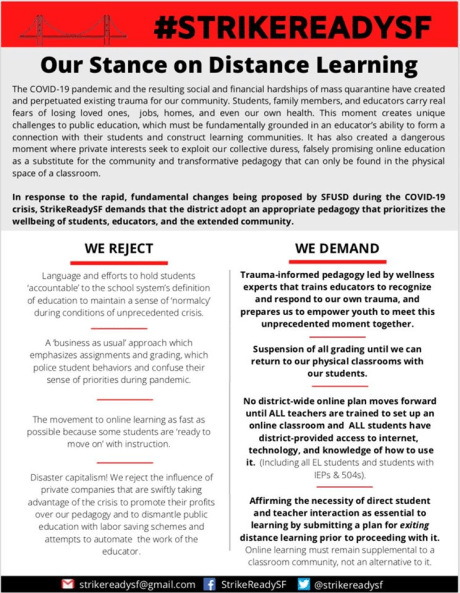
Parents, educators, and community activists in San Francisco formed an organization to protest the inequities in over reliance on distance learning. They call themselves StrikeReadySF. This is their manifesto.

distancelearning

Are charters public schools or are they businesses? The charter lobby wants a slice of the $2 trillion intended to save small businesses even though the charters have suffered no loss of funding during the pandemic.

Many businesses are nearly bankrupt. This money was meant for them, not charters and their lobbyists.

Please sign this petition to Congress.

John Thompson writes here about yet another virtual charter scam, this one in Oklahoma.

He writes:

After years of failing to regulate charters, especially online and for-profit charters, Oklahoma is just one state that illustrates how hard it is to catch up and hold virtual schools accountable for either education outcomes or financial transactions.

In July 2019, according to an Oklahoma State Bureau of Investigation search warrant, “[Epic’s co-founders] enticed ghost students to enroll in Epic by offering each student an annual learning fund ranging from $800 to $1,000.” This was despite the fact that Epic knew that the parents of many homeschool students “enrolled their children . . . to receive the $800 learning fund without any intent to receive instruction.”

Epic’s recruitment of “ghost students,” who were technically enrolled but received minimal instruction from teachers, allowed the company to legally divert state funds for their own personal use, while simultaneously hiding low graduation rates to attract more support.

This year, Epic has received over $100 million in taxpayer money. And the company, in an exposé by the Tulsa World, admitted that over the years its “Learning Fund”—which is shielded from public scrutiny—received $50.6 million from the Oklahoma State Department of Education.

Tulsa World estimates the Learning Fund could cost the state about $28 million for 2019-2020. Moreover, the private management company Epic Youth Services receives a “10 percent cut” of the charter’s student funding. Also, state appropriations pay for the millions that Epic spends on advertising and generous contributions to elected officials.

If nothing else, Epic is helping to nail down the case that charters are a tool for privatization.

In this post, Tom Ultican reviews two recent books.

One is Mercedes Schneider’s guide to sleuthing through online records and following the money. It is called A Practical Guide to Digital Research: Getting the Facts and Rejecting the Lies.

Schneider is an expert at “following the money,” and she reveals the secrets of her craft in this book. The book grew out of a presentation that Schneider gave at an NPE conference in Indianapolis in collaboration with Darcie Cimarusti and Andrea Gabor. As Tom Ultican explains, the purpose of the session was to teach a seminar in doing the kind of research that these three have mastered. When Mercedes was asked to summarize her presentation, she realized that it would require a book to do it, and this is that book.

So if you want to dig up the tax records of a pseudo-reform organization, here is the place to start.

The other book that Tom reviews is one that I co-write with veteran educator Nancy E. Bailey. Regular readers of this blog know Bailey as a blogger whose views are grounded in long experience and knowledge. She and I discovered that we both had a fascination with the language now used to misrepresent teaching, schools, and education. And from our online conversations came this book called EdSpeak and Doubletalk: A Glossary to Decipher Hypocrisy and Save Public Schooling.

The book is a glossary with a pro-public education attitude. It aims to identify and describe the lingo of corporate education reform and to decipher the many faux groups that are funded by billionaires to advance privatization. Of course, we think it is an invaluable tool for parents and educators who want to stop the billionaires before they get a foothold. It will help you find your way through the vacant and deceptive vocabulary used by faux reformers to grab your public schools.

As Tom points out, the book has another advantage:

Thanks to the authors and the facilities at Teachers College, this is a living book. At the book’s cyber address, there is a link to a 58 page downloadable supplement as well as an updates tab.

In other words, as new organizations, new flimflam, and new jargon emerges, it will be added to the book online and available to arm you with knowledge.

Here are two contrasting views about what happens when (if?) children return to school in the fall.

In an article in the Washington Post, Mike Petrilli, president of the rightwing Thomas B. Fordham Institute, proposes that all students be held back a grade to make up for the ground they lost when schools closed in March. He also suggests that this is a good time to embrace distance learning.

Jan Resseger, retired social justice director for a religious group, says that this is the right time to recognize the failure of the standards-tests-accountability regime of the past two decades and to develop fresh ideas about children and learning.

Petrilli does not address the many studies (such as CREDO 2015) that show the abject failure of cyber schools. That study found that students lost 44 days in reading and 180 days in math when they were schooled online. Nor does he consider that being “held back” is universally seen as failure. The students haven’t failed. Why should they be punished? Expect a parent revolution if any state or district tries this.

Resseger writes:

Conceptualizing public education as students climbing ladders of curricular standards without missing a rung is only one way to think about education. And while such a theory has been drilled into all of us as a sort of “standards-based accountability conventional wisdom,” it isn’t really how most of us learn. If we want to understand something new, and there is some background we need, most of us look to experts or do some research to fill in the holes. School curriculum is better conceptualized as a spiral instead of a ladder. Children learn some processes and then as they move on to more advanced material, teachers are taught to spiral back—to review and even provide new and previously missed background. Sometimes people apply what they have learned in one discipline to help them understand or enhance what they have learned in another discipline. Remedial classes worry educators because too frequently they trap students in the most basic material—material skillful teachers can introduce and reinforce as children learn more complex material. After schools reopen, acceleration will be preferable to remediation.

To use a different metaphor, the advocates for the status quo see each grade as a measuring cup that must be filled. Some students will get the full measure, some will get less. The standardized tests, they think, can gelll is how much of the cup was filled. This is all nonsense, an outgrowth of a vapid, mechanistic approach to education that explains the failed regime of standards and testing. After twenty years, can anyone seriously claim that NCLB and Race to the Top succeeded? Seriously.

Due to the blinders tightly strapped on our policy makers, we are stuck in a pointless, soul-deadening approach to schooling that kills the joy of teaching and learning, except for those few subversive educators who have found devious ways to escape the dead cold hand of the status quo.

PLAINTIFFS ASK TENNESSEE COURT TO HALT UNCONSTITUTIONAL VOUCHER PROGRAM

FOR IMMEDIATE RELEASE
CONTACTS:

Ashley Levett, SPLC, ashley.levett@splcenter.org / 334-296-0084
Sharon Krengel, ELC, skrengel@edlawcenter.org / 973-624-1815, x 24

Lindsay Kee, ACLU-TN, communications@aclu-tn.org / 615-320-7142
Christopher Wood, Robbins Geller, cwood@rgrdlaw.com / 615- 244-2203

TENNESSEE – Parents and community members in Shelby and Davidson Counties who are challenging the constitutionality of the Tennessee Education Savings Account (ESA) voucher law filed a motion Friday asking the Chancery Court for Davidson County to halt implementation of the program before the state begins diverting taxpayer funds to private schools.

The motion asks the court to stop implementation of the law — which applies only to students living in those counties — that would illegally siphon much-needed taxpayer funds away from their public schools.

Although Tennessee’s voucher program was originally slated to begin in the 2021-2022 school year, Governor Bill Lee’s administration has rushed to distribute private school vouchers in the fall of 2020, despite the ongoing COVID-19 pandemic, which caused hundreds of millions to be slashed from education funding in the emergency budget passed by the state legislature in March.

Shelby County Schools and Metro Nashville Public Schools were already underfunded before the COVID-19 pandemic. The current crisis will only increase the need for funding and resources in these schools.

“Schools throughout Tennessee have been chronically underfunded for years. Diverting money to pay for private school vouchers in Shelby County and Nashville is not going to solve this problem, and will only exacerbate the challenges these districts face to provide all students with a quality education,” said Chris Wood, partner at Robbins Geller Rudman & Dowd LLP, which has joined with the ACLU of Tennessee, the Southern Poverty Law Center, and Education Law Center to represent the plaintiffs in the lawsuit. Southern Poverty Law Center and Education Law Center collaborate on the national Public Funds Public Schools campaign.

The lawsuit challenging the ESA voucher program, McEwen v. Lee, was filed last month. It charges that the law violates several provisions of the state’s constitution and laws.

The temporary injunction motion filed Friday asserts that the voucher program violates the Tennessee Constitution’s “Home Rule” provision, which prohibits the General Assembly from passing laws that apply only to certain counties. In this case, the voucher program will be instituted only in Shelby and Davidson counties. Because the legislature failed to appropriate funding for the first year of the law’s implementation, yet paid over $1 million to a private company for its administration using funds from an unrelated program, the voucher law also violates constitutional and statutory requirements governing appropriation of public money.

# # #

The Southern Poverty Law Center, based in Alabama with offices in Florida, Georgia, Louisiana, Mississippi, and Washington, D.C., is a nonprofit civil rights organization dedicated to fighting hate and bigotry, and to seeking justice for the most vulnerable members of society. For more information, visit http://www.splcenter.org/.

Founded in 1973, Education Law Center is a national leader in advancing the rights of public school students to equal educational opportunity under state and federal law through litigation, policy, advocacy and research. For more information, visit http://www.edlawcenter.org/.

The ACLU of Tennessee, the state affiliate of the national American Civil Liberties Union, is a private, non-profit, non-partisan public interest organization dedicated to defending and advancing civil liberties and civil rights through advocacy, coalition-building, litigation, legislative lobbying, community mobilization and public education. For more information, visit http://www.aclu-tn.org/.

Robbins Geller Rudman & Dowd LLP is one of the world’s leading complex litigation firms representing plaintiffs in securities fraud, antitrust, corporate mergers and acquisitions, consumer and insurance fraud, multi-district litigation, and whistleblower protection cases. With 200 lawyers in 9 offices, Robbins Geller has obtained many of the largest securities, antitrust, and consumer class action recoveries in history, recovering tens of billions of dollars for victims of fraud and corporate wrongdoing. Robbins Geller attorneys are consistently recognized by courts, professional organizations and the media as leading lawyers in their fields of practice. Visit http://www.rgrdlaw.com/.