Archives for category: Accountability

Jan Resseger is one of our wisest commentators of issues of education, equity, and social justice. She devoted her professional life to these issues. In her latest blog post, she is critical of Eve Ewing for ignoring the “economic catastrophe” that charter schools impose on public schools. She has seen it up close and personal in Cleveland and other cities in Ohio, where public schools suffer as charter schools expand, and most of the state’s charter schools are rated as “low-performing” by the state.

She begins:

I am a great fan of Eve Ewing’s book, Ghosts in the Schoolyard.  I have read the book twice, visited in Chicago some of the sites she describes, given the book to friends as a gift and blogged about it.  In that book, Ewing documents the community grief across Chicago’s South Side, where the now three decades old Renaissance 2010 “portfolio school plan” pits neighborhood public schools and charter schools in competition and closes the so-called “failing” neighborhood public schools when too many families opt for a charter school.

In a column published in Monday’s NY Times, Eve Ewing wants to make peace with charter schools.  She writes that we should allow families to choose and ensure that neighborhood schools and charter schools can all be well resourced and thriving. Ewing grasps for a third way—some sort of amicable compromise in a very polarized situation.

Ewing is a University of Chicago sociologist, and, in her column she examines many of the factors by which neighborhood public schools and charter schools have been compared and rated. She points out that academic quality is a mixed bag with neighborhood and charter schools sometimes besting each other in terms of student achievement. Then she wonders, “What would it look like if we built an education policy agenda dedicated to ensuring… resources for all students?

The problem in Ewing’s column this week is that she never identifies or addresses the matter of public funding for education. I assume she wants to equalize school funding across both sectors. But when charter schools compete for students with public schools, there are now two separate education sectors to split what has proven to be a fixed pot of money.  In every single place I know about where charter schools have been allowed to open up, this is a zero sum game.  A sufficient and growing body of research demonstrates that there is no way to split the funding both ways without cutting the funding that most states and local school districts have been budgeting for their public schools.

Bruce Baker, the school finance expert at Rutgers University, explains that one must consider more than the comparative test scores and students’ experiences in neighborhood schools and charters, and instead examine the impact of adding new charter schools into what he calls the entire educational ecosystem of the school district: “If we consider a specific geographic space, like a major urban center, operating under the reality of finite available resources (local, state, and federal revenues), the goal is to provide the best possible system for all children citywide….  Chartering, school choice, or market competition are not policy objectives in-and-of-themselves. They are merely policy alternatives—courses of policy action—toward achieving these broader goals and must be evaluated in this light. To the extent that charter expansion or any policy alternative increases inequity, introduces inefficiencies and redundancies, compromises financial stability, or introduces other objectionable distortions to the system, those costs must be weighed against expected benefits.” “In this report, the focus is on the host district, the loss of enrollments to charter schools, the loss of revenues to charter schools, and the response of districts as seen through patterns of overhead expenditures.”  In his report, Baker calls charter schools “parasites.”

One issue is that charter schools tend to serve fewer English language learners and fewer students with extremely severe disabilities, leaving behind in the neighborhood public schools the children whose needs are most expensive to serve.  Research by Mark Weber and Julia Sass Rubin at Rutgers University demonstrates, for example, that: “New Jersey charter schools continue to enroll proportionally fewer special education and Limited English Proficient students than their sending district public schools. The special education students enrolled in charter schools tend to have less costly disabilities compared to special education students in the district public schools…  (D)ata…  show that many charter schools continue to enroll fewer at-risk students than their sending district public schools.”

In Pennsylvania, the state funds special education in charter schools at a flat rate of $40,000 per student no matter whether the child is autistic, blind, a victim of severe multiple handicaps or impaired by a speech impediment.  Peter Greene reports that in Chester Upland, where a charter school is sucking up a mass of special education funding, in a court decision, Judge Chad Kenney declared: “The Charter Schools serving Chester Upland special education students reported in 2013-14… that they did not have any special education students costing them anything outside the zero to twenty-five thousand dollar range, and yet, this is remarkable considering they receive forty thousand dollars for each one of these special education students under a legislatively mandated formula.”

The biggest financial loss caused by the introduction of a charter sector into a school district is that it is not possible for the school district to recover the stranded costs when children exit to  charter schools.  In a groundbreaking 2018 report, the Oregon political economist, Gordon Lafer demonstrates that California’s Oakland Unified School District loses $57.3 million every year to charter schools.  Here’s how: “To the casual observer, it may not be obvious why charter schools should create any net costs at all for their home districts. To grasp why they do, it is necessary to understand the structural differences between the challenge of operating a single school—or even a local chain of schools—and that of a district-wide system operating tens or hundreds of schools and charged with the legal responsibility to serve all students in the community. When a new charter school opens, it typically fills its classrooms by drawing students away from existing schools in the district…  If, for instance, a given school loses five percent of its student body—and that loss is spread across multiple grade levels, the school may be unable to lay off even a single teacher… Plus, the costs of maintaining school buildings cannot be reduced…. Unless the enrollment falloff is so steep as to force school closures, the expense of heating and cooling schools, running cafeterias, maintaining digital and wireless technologies, and paving parking lots—all of this is unchanged by modest declines in enrollment. In addition, both individual schools and school districts bear significant administrative responsibilities that cannot be cut in response to falling enrollment. These include planning bus routes and operating transportation systems; developing and auditing budgets; managing teacher training and employee benefits; applying for grants and certifying compliance with federal and state regulations; and the everyday work of principals, librarians and guidance counselors.”

Lafer concludes: “If a school district anywhere in the country—in the absence of charter schools—announced that it wanted to create a second system-within-a-system, with a new set of schools whose number, size, specialization, budget, and geographic locations would not be coordinated with the existing school system, we would regard this as the poster child of government inefficiency and a waste of tax dollars. But this is indeed how the charter school system functions.”  In the same report, Lafer adds that in 2016-17, the San Diego Unified School District lost $65.9 million to charter schools.

In a subsequent report, Lafer explains: “Public school students in California’s West Contra Costa Unified School District are paying dearly for privately managed charter schools they don’t attend… Charter schools add $27.9 million a year to WCCUSD’s costs of running its own schools… That’s a net loss, after accounting for all savings realized by no longer educating the charter school students.”

Please continue reading her excellent post.
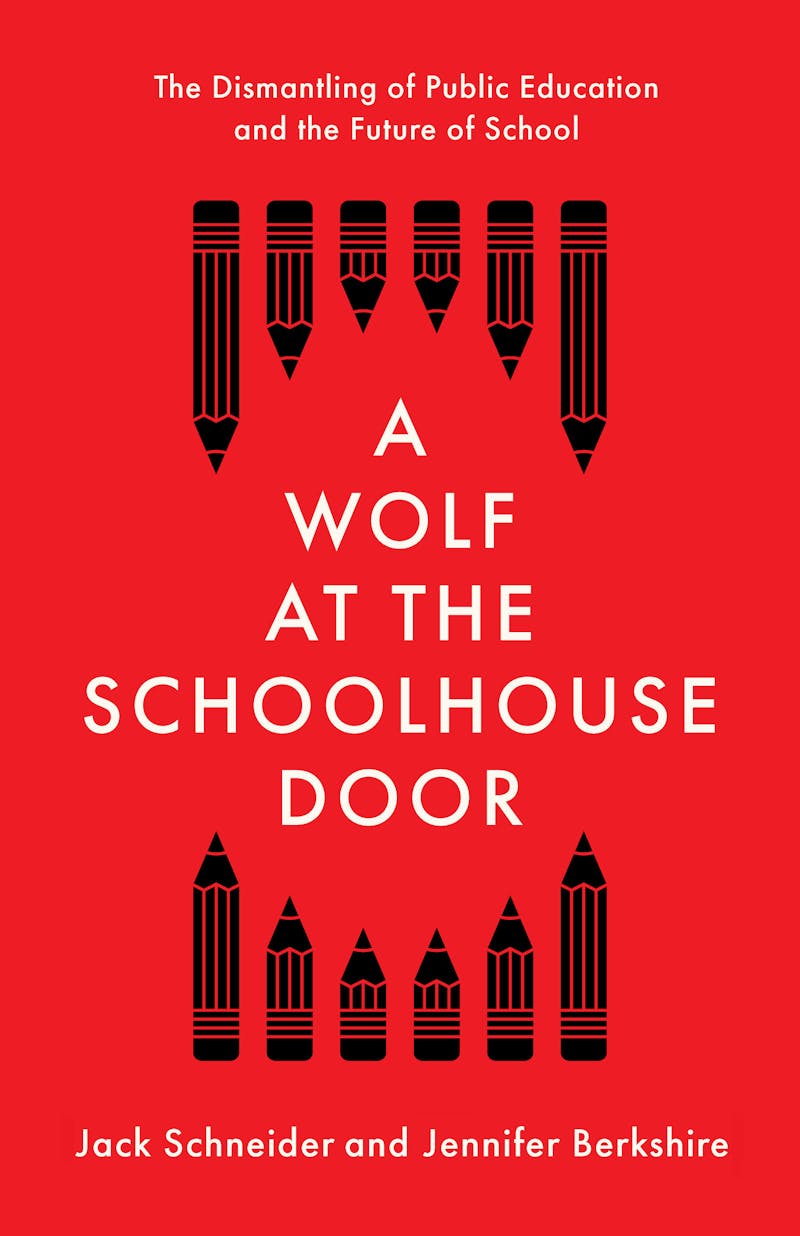
I reviewed A Wolf at the Schoolhouse Door in The New Republic. It is an important book that pulls together all the threads of the privatization movement and shows that their agenda is not to improve education or to advance equity but to destroy public education. The review is here.

Tonight, I will join the authors at a town hall Zoom meeting in Seattle at 9 p.m. EST, 6 p.m. PST. Please join us!

It begins like this:

Two years ago, Margaret Spellings, George W. Bush’s secretary of education, and Arne Duncan, Barack Obama’s secretary of education, wrote an opinion article in The Washington Post lamenting the decline of public support for the bipartisan consensus about education policy that began under Ronald Reagan. Elected officials strongly supported a regime of testing, accountability, and school choice, they wrote, but public enthusiasm was waning due to a lack of “courage” and “political will.”

A Wolf at the Schoolhouse Door: The Dismantling of Public Education and the Future of Schoolby Jack Schneider and Jennifer BerkshireBuy on BookshopThe New Press, 256 pp., $26.99

They were right. Elected officials, educators, and parents were rapidly losing faith in the bipartisan consensus. For a decade, it had failed to produce any improvement on national tests. Parents were opting their children out of the annual testing mandated by federal law; in New York, 20 percent of eligible students refused to take them. Teachers went to court to fight the test-based evaluation methods imposed by Duncan’s Race to the Top. Communities from Los Angeles to Philadelphia were complaining about the growth of charter schools, which diverted funds away from public schools. A year after Spellings and Duncan’s essay appeared, teachers across the nation, from West Virginia to California, went on strike to protest low wages, low funding, and large class sizes, issues that were ignored during the era of bipartisan consensus.

What went wrong? Why did the bipartisan consensus that Spellings and Duncan praised fall apart? In their new book, historian Jack Schneider and journalist Jennifer Berkshire provide a valuable guide to the history and the politics of the rise and fall of the bipartisan consensus. Theirs is indeed a cautionary tale, because they show how Republicans and Democrats joined to support failed policies whose ultimate goal was to eliminate public education and replace it with a free-market approach to schooling. Betsy DeVos was publicly reviled for her contemptuous attitudes toward public schools, but she was not an exception to the bipartisan consensus: She was its ultimate embodiment. She was the personification of the wolf at the schoolhouse door. 

Schneider and Berkshire write that they began the book to answer “a puzzling question: Why had conservative policy ideas, hatched decades ago and once languishing due to a lack of public and political support, suddenly roared back to life in the last five or so years?” Their prime example was private school vouchers, an idea first promoted by Ronald Reagan in the early 1980s and rejected at that time by Congress. Private school vouchers were not the only policy prescription that was recycled from the ashcan of failed ideas. There was also “market-based school choice, for-profit schools, virtual schools,” and deregulation. These ideas were repackaged as innovative while their history and their conservative ideological origins were obscured. True believers, intent on eliminating public schools, built donor networks, cultivated political alliances, and churned out ready-made legislation. A key element in this network-building was the enlistment of billionaires who were enamored of free-market solutions and who opened their wallets to persuade national and state elected officials to inject competition and private-sector solutions into the public education system. 

This is a book you will want to read. Give it to your local school board members and your legislators.

Teacher Nora De La Cour writes on her blog that it is time to restore the joy of teaching and learning by abolishing high-stakes testing. She writes that candidate Joe Biden forcefully promised to get rid of standardized testing and restore teacher autonomy, but Secretary of Education Miguel Cardona seems unwilling to commit to granting states a waiver from the mandated federal testing. He did not seek a waiver for Connecticut when he was state commissioner there, and he was noncommittal at his Senate hearings.

She writes:

While NCLB and RTT were marketed as efforts to strengthen public education for disadvantaged students, the overwhelming action of these reforms has been to redirect funding away from normal school operations in under-resourced districts, impose state takeovers and other dehumanizing restructuring plans, and replace community schools with privately run charters. The rampant school closures precipitated by NCLB and RTT have mainly impacted schools attended by the poor black and brown students who are used as mascots by those pushing these neoliberal “equity and accountability” measures. Researchers have documented links between high-stakes testing and high incarceration rates. Test scores have been used to limit opportunitiesfor students with disabilities, another group hailed as primary beneficiaries of test-based reforms.  


The obsession with standardized testing has drained K-12 public education of the vibrant, joyful things that make kids want to be in school. Districts have been forced to cut art, music, extracurriculars, and recess in order to save time and money for tests and test prep. 

The Bill Gates-funded Common Core Standards that drive the current tests have undermined teachers’ creative autonomy, stripping us of our ability to shape instruction around what motivates our students. Instead of teaching whole novels and plays, language arts teachers are pushed into teaching mainly “informational texts” (as though fiction doesn’t contain information) and decontextualized literary excerpts. My students experienced Frankenstein, for example, not as a gripping monster story that prompts questions about what it means to be human, but as a lifeless fragment on a practice test, from which they were required to extract and regurgitate specific information that corporate test-makers deem important. 

She adds, quite accurately:

Standardized tests do not measure teaching. Indeed, the premise that poor children struggle because their teachers are lazy is both racist (teachers of color are more likely to have low-income students) and illogical (why on earth would lazy people pursue positions in underfunded schools?). Contrary to claims, standardized tests don’t measure the skills needed for fulfilling jobs requiring complex problem-solving (although the curiosity- and criticality-punishing accountability system unquestionably prepares kids for drudgery under capitalism). Standardized tests cannot account for the myriad forms meaningful learning can take. The only thing these assessments reliably measure is poverty.

Despite Biden’s promise to get rid of the test-driven policies of the past 20 years, the jury is out on whether he will follow through and he is being pressured by Gates-funded groups to hold fast to the testing regime.

It’s true that some high-profile civil rights groups continue to push for standardized testing–a fact that is reported everywhere privatizers have clout. These civil rights organizations use the same “guideposts for equity” logic Cardona invoked in his statement on 2021 testing for Connecticut students. Unfortunately, many of these groups rely on funding from Gates and other pro-privatization philanthropists and corporations. This funding can mean a variety of things, but it’s reasonable to surmise that some degree of political alignment occurs. 

If standardized tests were actually about ensuring equity, they would not have triggered the closure of schools attended by low-income students of color. If the reforms that spawned these tests were actually about increasing accountability, they would not have occasioned the transfer of power over classroom learning from teachers and publicly accountable officials to hedge fund-backed charter-boosters and profit-hungry edu-businesses. 

Nora De La Cour has some smart observations about testing and equity, as well as the political forces compelling teachers to do what they know is not in the best interests of their students. This post is well worth a read!

UPDATE TO NEWS RELEASE: 50,000 signatures submitted to SBE-parents, educators urge waiving standardized testing

NEWS RELEASE                      

California Teachers Association                                                                                                                                                                                                                        February 22, 2021

1705 Murchison Drive                                                                                   

Burlingame, CA 94010

www.cta.org

Contact: Claudia Briggs cbriggs@cta.org

FOR IMMEDIATE RELEASE

Educators Call on State Board of Education to Seek Waiver from U.S. Department of Education Suspending Standardized Testing for Current School Year
More than 40,000 concerned parents and educators sign petition echoing concerns over undue pressure on students, technology inequities, and data reliability; call for focus on other supports in response to pandemic


BURLINGAME 
— The California Teachers Association (CTA) has submitted a letter to the State Board of Education (SBE) urging the California Department of Education (CDE) to submit a waiver requesting the U.S. Department of Education (USDOE) to suspend standardized testing for the 2020-21 school year. In the February 22, 2021, letter to the SBE, CTA cites problems with both feasibility of administration, useability and reliability of resulting data, and the cruelty of putting students, families, and educators through high stakes assessments in the middle of a pandemic. If submitted and approved, the waiver would suspend summative assessments required under the Every Student Succeeds Act (ESSA), normally conducted in the spring.

Most California students are still engaged in distance learning, and many students still lack reliable internet bandwidth and access or inconsistent learning and testing environments. Educators have also expressed concerns about the validity and comparability of a statewide test administered under widely varying and largely uncontrolled circumstances. CTA is advocating for the suspension of high stakes tests that will take away precious instructional time and put unnecessary additional stress on students and their families.

CTA has also sent a letter to Acting U.S. Secretary of Education, Phil Rosenfelt, urging the USDOE to issue assessment waivers to states as soon as possible, reiterating educator concerns about the harm that standardized testing in the middle of a pandemic would cause.

“Given widespread inequities in student access to technology and the internet, as well as the concerns both educators and parents have about the value of any data gathered from traditional annual testing in the midst of a global pandemic, we firmly believe testing would be detrimental to students, and of little use to teachers and school districts,” said CTA President E. Toby Boyd. “These factors lead us to urge policy makers to instead focus on providing support to students in distance learning and their safe return to physical classrooms instead of on assessments of little value.”

A petition by the California Teachers Association calling for the suspension of state standardized testing has so far gathered 40,000 signatures from parents and educators who are deeply concerned about the continuation of normal testing during this most challenging school year. That petition is being shared with the SBE and the USDOE.

More background on these letters, standardized testing, and CTA’s position on suspending testing this year can be found here. 

###

The 310,000-member CTA is affiliated with the 3-million-member National Education Association.

Claudia Briggs, Communications Assistant Manager, California Teachers Association (EST 1863)

916.325.1550 (office) | 916.296.4087 (cell) | cbriggs@cta.org

The California Teachers Association exists to protect and promote the well-being of its members; to improve the conditions of teaching and learning; to advance the cause of free, universal, and quality public education; to ensure that the human dignity and civil rights of all children and youth are protected; and to secure a more just, equitable, and democratic society.

New York State Allies for Public Education created sample opt out letters for parents to present to the school.

Click to access Refusal-letter-2020-21.pdf

For both English and Spanish, visit the NYSAPE homepage.

Congressman Jamaal Bowman, experienced teacher and principal and teacher, was elected last November and now is a member of the House Education Committee. He was outraged by the announcement that the Biden administration demands a resumption of annual testing. He denounced it as “a big mistake.” He knows what kids need, and it’s not testing.

Rep. Jamaal Bowman on Tuesday joined progressive education experts in criticizing the Biden administration’s decision to mandate standardized testing in schools despite the ongoing coronavirus pandemic. 

“We have an obsession with arbitrary testing metrics above all else, even in the middle of a pandemic that’s dislodged every facet of American life.”
—Rep. Jamaal Bowman

Bowman (D-N.Y.)—a former teacher and principal—argued that “prioritizing testing in the middle of the pandemic is a big mistake.”

“It’s a mistake that reflects a broader problem in American education,” the first-term congressman said in a statement. “We have an obsession with arbitrary testing metrics above all else, even in the middle of a pandemic that’s dislodged every facet of American life. We’ve forgotten that testing is one useful tool, and should not be the goal of education in and of itself.”


New York State Allies for Public Education has led the successful opt out movement in their state for years. As much as 20% of all eligible students have refused the annual tests in most years, in some schools and districts, a majority of students don’t take the test.

They reacted angrily to the news that the Biden administration plans to require annual testing after Joe Biden publicly promised not to.

FOR IMMEDIATE RELEASE: February 23, 2021More information contact:Lisa Rudley (917) 414-9190; nys.allies@gmail.com

Jeanette Deutermann (516) 902-9228; nys.allies@gmail.com

NYS Allies for Public Education – NYSAPE

The Biden Administration Fails to Put Children First; NYSAPE Urges Parents to Opt Out

In a recent letter released by Ian Rosenblum, Acting Secretary of Education and former Executive Director of the reformer organization Education Trust NY, the USDOE and the Biden Administration have signaled that testing waivers submitted by the states will be denied this year. Although the ESSA accountability measures will be granted waivers, the insistence on forging ahead with ESSA-mandated student assessments completely ignores the damaging impact that administering state assessments in the midst of a pandemic will have on our children. 

Unfortunately, the Biden Administration believes that traumatized children, including those who have yet to set foot in their school buildings since last March, will be best served preparing for and taking standardized tests, even though this will only add to the stress they are already experiencing. 

However, parents are not without recourse. New York State parents can, and will, exercise their right to refuse to allow their children to participate in the grades 3-8 state assessments. NYSAPE’s New York State Test Opt Out parent letter can be found here.

NYSAPE applauds the New York State Education Department (NYSED) for announcing “Regents Exams would not be required to meet graduation requirements and to cancel any Regents Exam that is not required by USDOE”.

NYSAPE now calls on the New York State Board of Regents and the New York State Education Department to take immediate action to demand any and all flexibility on ESSA regulations, and provide clear guidance to school districts that they must inform parents of their right to opt out of the state assessments and prohibit any mixed messaging to coerce parents otherwise. 

NYSED led by Commissioner Betty Rosa & the Board of Regents are leading the way in putting our children’s needs first. 

NYSAPE is a grassroots coalition with over 70 parent and educator groups across the state.

###


Al Franken is the former Senator from Minnesota. He wrote this retrospective on Rush Limbaugh in the New York Daily News.

Rush Limbaugh died this week. His impact on our nation’s discourse and polity will long outlive him.

Many Americans had been puzzled when President Trump bestowed upon Limbaugh our nation’s highest civilian honor, the Presidential Medal of Freedom. After all, previous honorees include Cesar Chavez, Martin Luther King and the crew of Apollo 13. I, however, was not surprised. Because without Limbaugh, there is no (former) President Trump.

Rush was the first broadcaster to take full advantage of the FCC’s little-noticed 1987 repeal of the Fairness Doctrine. Since its adoption in 1949, the rule had required broadcasters to present controversial issues in a fair and balanced manner. Its repeal cleared the way for disreputable broadcasters to present manifestly dishonest and unbalanced content, and Rush, it turned out, had a real talent for just that kind of thing.

And when I say talent, I mean it. Limbaugh created right-wing talk radio, holding court three hours a day, five days a week for 32 years, attracting an audience of 20 million listeners because he was compelling, sometimes funny, always provocative, if routinely sexist, homophobic and racist.

Racist? He once asked his audience, “Have you ever noticed how all composite pictures of wanted criminals resemble Jesse Jackson?”

Homophobic? In 1990, Limbaugh ran a recurring segment entitled “AIDS Update,” in which he’d mock the death of a gay man who had just recently died of AIDS, cheekily playing ironic popular songs like Dionne Warwick’s “I’ll Never Love This Way Again.”

Sexist? You may remember Sandra Fluke, the Georgetown University law student who testified before Congress in 2012, on an exception within the Affordable Care Act that would allow religious institutions to opt out of covering contraception. Here’s Limbaugh referring to her testimony that contraception can cost as much as $3,000: “What does it say about the college co-ed Susan Fluke (sic), who goes before a congressional committee and essentially says that she must be paid to have sex, what does that make her? It makes her a slut, right? It makes her a prostitute.”

Rush went on like that for quite a while. He had three hours to fill.

But mainly, he was a shill for the right wing of the Republican Party. Along the way, he promoted conspiracy theories: Hillary Clinton had Vince Foster murdered; global warming is a hoax; Barack Obama was born in Kenya; COVID-19 is no worse than the common cold and is being used by the media to prevent Donald Trump’s re-election. And, yes, the election was stolen.

Here’s what he told his listeners on Jan. 7: “There’s a lot of people out there calling for the end of violence…lot of conservatives, social media who say that any violence or aggression at all is unacceptable regardless of the circumstance…I am glad Sam Adams, Thomas Paine, the actual tea party guys, the men at Lexington and Concord didn’t feel that way.”

In 1995, I wrote a book, “Rush Limbaugh is a Big Fat Idiot And Other Observations.” The book was satirical, but its intent entirely serious. Limbaugh’s radio show had become an effective arm of the right wing of the Republican party. The previous November, Republicans had won the House of Representatives for the first time in 40 years, and the new Speaker, Newt Gingrich, named Limbaugh an honorary member of the class of ’95.

At the time, Limbaugh had a TV show in which he referred to “The White House dog” while the control room put up a picture of Chelsea Clinton.

The show’s producer, Roger Ailes, would go on to run Rupert Murdoch’s Fox News Channel, whose slogan, ironically, would echo the “fair and balanced” language of the Fairness Doctrine, purporting to provide a balance to the liberal mainstream media.

Fox’s right-wing propaganda machine had built a huge, rabid audience by relentlessly attacking Democratic administrations and then functioning as virtual state TV for President Trump. Currently, the network is faced with a $2.7 billion lawsuit from election software company Smartmatic, for spreading false rumors that the company had helped Joe Biden steal the election in several states (none of which, by the way, had used Smartmatic’s software).

Right-wing radio. Right-wing TV. Then came the internet, where websites like Newsmax and Breitbart and social media platforms like Facebook have created a more opaque world where far more extreme and untethered worldviews fester and grow.

This is how you get QAnon. How not a small number of Trump supporters believe that not a small number of Democrats are blood-sucking pedophiles. It’s how you get a member of Congress who blamed Jewish lasers for starting the wildfires in California. It’s how you get Jan. 6.

The most dangerous problem facing America today is the existence of two universes of information. The second universe, a universe of disinformation, has been expanding since 1989. Rush Limbaugh was the Big Bang.

Bette Midler wrote about Limbaugh’s death on Twitter and was not as polite as Franken.

Mercedes Schneider comments here on the Biden administration’s unexpected and ridiculous decision to insist on another round of standardized tests in the middle of the pandemic.

She begins:

On February 22, 2021, acting ed secretary Ian Rosenblum (formerly of testing-friendly ed reform org, Education Trust) sent this letter to state school superintendents informing them that standardized testing must happen in the 2020-21 school year “to understand the impact COVID-19 has had on learning and identify what resources and supports students need” and “to address the educational inequities that have been exacerbated by the pandemic.”

Anyone with a smidge of critical thought and modest powers of observation could easily make a short list of the impact that COVID-19 has had on learning. Furthermore, the biggest support public schools have needed for years is adequate (equitable) funding not tied to property taxes and not tied to any federal competition.

Surveying district and state superintendents about what they need in order to provide equitable education opportunities for their students would be a much better use of US Dept of Ed time and money than spending multiple millions on standardized tests.

But, but, but, according to Rosenblum, as a last-thought, tacked-on reason for administering tests during a pandemic, “parents need information on how their children are doing.”

I have been teaching the better part of three decades, and I have yet for any parent to ask me for standardized test scores so that the parent can know how their children are doing. They ask about grades on class assignments; they discuss specific skill areas that are challenging and ask for help with addressing the specific challenges arising from completing classroom assignments; they discuss supports needed when the children or other family members are facing health issues or other crises at home; they ask for assistance addressing behavior issues, but they never ask for standardized test scores out of a need to know how their children are doing.


Writing in Forbes, where he is a columnist, Peter Greene explains why the Big Standardized Tests are a very expensive waste of money and rime.