Archives for category: Accountability

This post is so important that it is the only one I have scheduled today. Please read it and share it with your friends, your local newspaper, your local radio station, your elected representatives, social media, anyone who cares about the future of our society. This is not a reprint. The author, Josh Cowen, wrote this post for this blog.

Josh Cowen, a professor at Michigan State University, has been studying vouchers for more than 20 years. He has been a member of the teams conducting major studies of vouchers. When I read his article in The Hechinger Report, where he declared that he was convinced that vouchers were disastrous for students who use them, I wanted to know more about him and his experience. I wanted to ask him, “Why did you change your mind?” That’s the question that’s been asked of me hundreds of times. I have a simple answer and a complicated answer: the simple answer is “I was wrong.” The complicated answer is contained in my recent books, starting with The Death and Life of the Great American School System: How Testing and Choice Are Undermining Education.

I invited Josh to explain his views for my blog, and he graciously accepted. I consider this piece to be one of the most important statements I have posted in the decade this blog has been live. Please note two points he makes:

One, vouchers harm the children who leave public schools to use them.

Two, most of the early voucher research was conducted by researchers who were partisan supporters of vouchers.

Josh Cowen writes:

It’ll be a few more days for the final election results to be tallied nationwide, but it seems clear that with midterm wins by voucher supporters in places like Oklahoma, Texas and even Pennsylvania—where even the Democratic gubernatorial victor is on record in cautious favor—voucher opponents are going to have to keep working hard to block public funding of private and religious schools.

School vouchers have devastating effects on student outcomes. Full stop. That’s something even the nation’s voucher advocate-in-chief Betsy DeVos has had to admit, because the data are so stark.

Large-scale independent studies in D.C.,Indiana, Louisiana, and Ohio show that for kids who left public schools, harmful voucher impacts actually meet or exceed what the pandemic did to test scores. That’s also a similar impact in Louisiana to what Hurricane Katrina did to student achievement back in 2005.

Think about that next time you hear a politician or activist claim we need taxpayer support for private schools to offset what the pandemic did to student learning. Here, their cure would in test score terms be quite literally worse than the disease.

There’s another data point you need to know up front: vouchers overwhelmingly fund children who were already in private school without them. In states that have released those numbers—Arizona, New Hampshire, and Wisconsin—we know more than 75% of voucher applicants came from private schools.

The bottom-line: most kids using vouchers didn’t need them to go to private school, and the few kids who actually did use vouchers to transfer sectors schools suffer average test score drops on par with what a once-in-a-generation pandemic did to test scores too.

If you’re a picture person, our friends at the National Coalition for Public Education were kind enough to put their considerable talents into two graphics based on these data I provided to them.
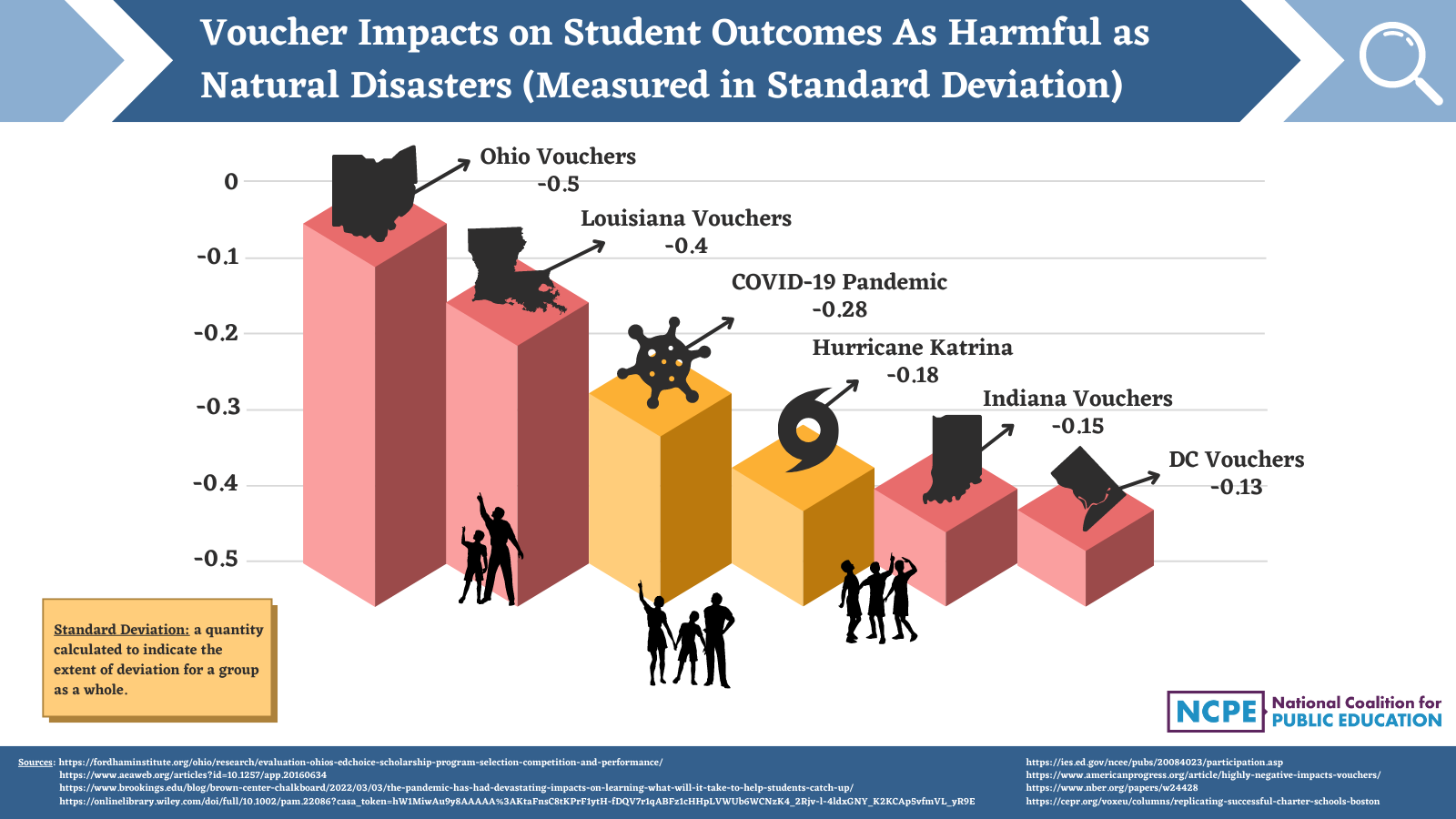
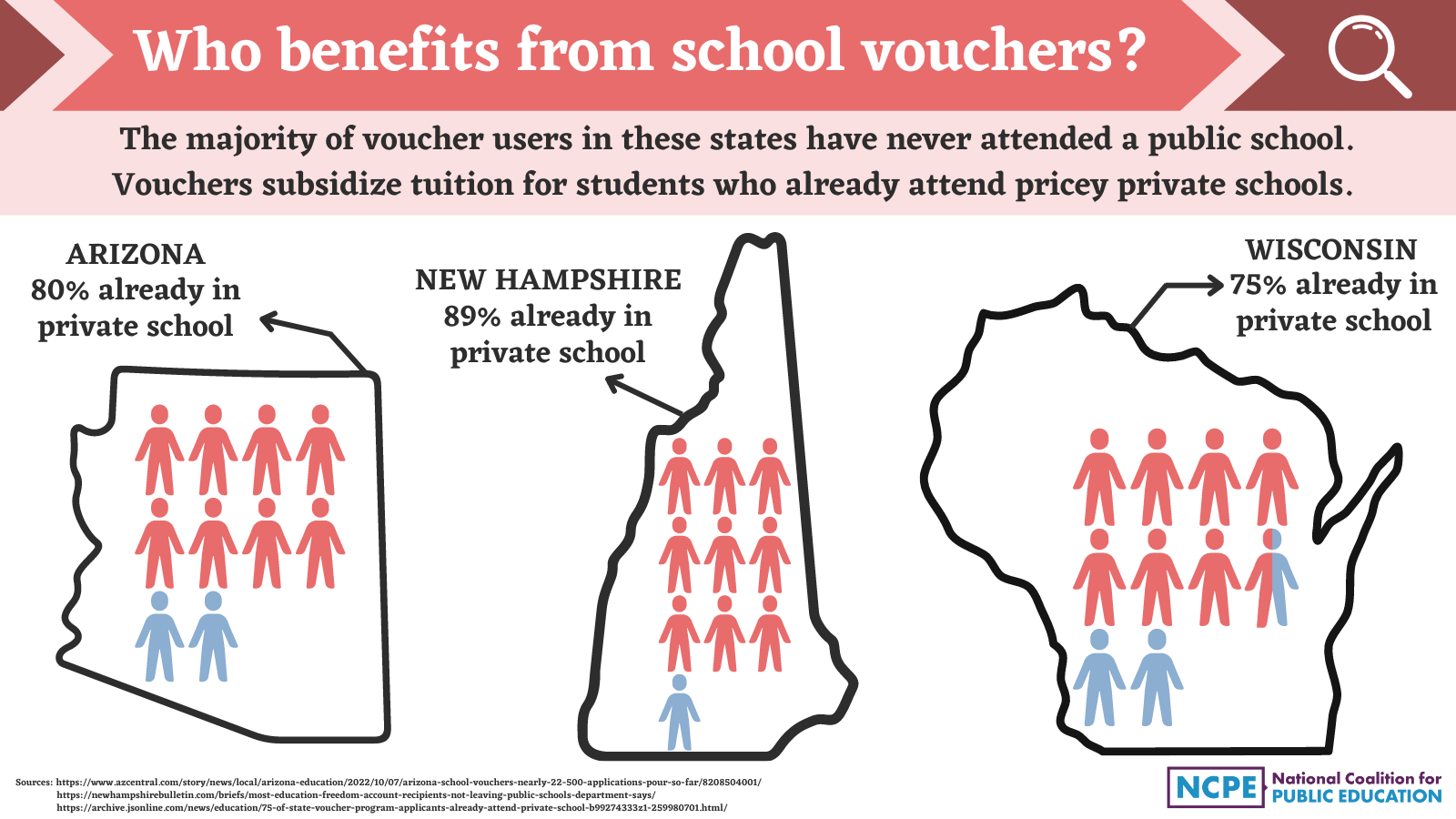
Notice the citations these graphs include. They’re the same as the hyperlinks above. These data come from independent sources and from non-partisan journalists. That’s a critically important part of this story.

And then there’s this, before we get into the details: the same people pushing vouchers are the same people working to undermine fair elections and the right to vote.

None of these are metaphors, and this is not a drill.

So how did we come to this?

1. A Quick History of Voucher Research

First let’s talk about the evidence.

I came into the school voucher research community early. It was around 2001 or so, as a young graduate student assistant for a study of privately funded vouchers led by the conservative professor Paul E. Peterson who was based at both Harvard and the conservative Hoover Institution at Stanford (never heard of Hoover? Think Condoleeza Rice.)

Peterson and his protégé Jay Greene had already done one study of Milwaukee’s publicly funded voucher program, as well as the one in Cleveland that was about to be the subject of the U.S. Supreme Court’s first favorable ruling on voucher funding. That work generally showed positive results for vouchers. As did the research of a young academic named Cecilia Rouse, who is now President Biden’s chief economist.

But they were small programs. What policymakers and researchers call a “pilot phase.” Back then when both parties cared at least nominally about evidence, you wouldn’t expand a program like vouchers without testing it. So those early tests seemed somewhat positive.

The first research I joined was Peterson and team’s next project: multi-site studies in Dayton, New York City, and Washington D.C. Those programs were also pilot-size. And the New York site in particular showed some limited evidence of voucher success. But overall the lead researchers focused as much on things like parental satisfaction and measures of civic engagement as metrics. That work resulted in a book called The Education Gap. You can find my name in the credits if you own a copy. If you don’t own one, don’t waste your money.

No one knew it at the time, but the mixed results documented in The Education Gap were to be the best vouchers were ever going to do—and ever have done since by an academic based team looking at voucher test scores.

Just a short time later in 2005, I joined a new voucher evaluation led by Patrick Wolf, another Peterson protégé and contributor to The Education Gap. Wolf was by then ensconced with Jay Greene at the University of Arkansas Department of Education Reform, a Walton Family-funded academic group that was about to train a new generation of voucher advocates. Most notably Corey DeAngelis, now at Betsy DeVos’s 501(c)4 voucher lobbying group American Federation for Children.

The Milwaukee evaluation, which was officially done for the state of Wisconsin, lasted from 2005-2010. We found no evidence in five years that voucher kids outperformed public school kids. Two exceptions: we found limited evidence that graduation rates and college enrollment were somewhat higher for the voucher kids. We also found that voucher kids improved when the state required private schools to participate in the same No Child Left Behind-style accountability systems as public schools. In particular once voucher schools knew their performance would be made public they—shockingly!—improved their outcomes.

At the same time as the Milwaukee evaluation, Patrick Wolf and other Arkansas colleagues were working on a new evaluation of Washington D.C.’s federally funded voucher program. That study showed no difference in test scores, but large positive graduate results.

That pattern of “no test score benefits, some attainment benefits” has stuck in the research narrative even among voucher skeptics. But as I recently explained in a piece for the Brookings Institution, it’s just that: a narrative. Other studies in New York, Louisiana and Florida all show no real advantages for vouchers on educational attainment.

And certainly nothing to offset the cataclysmic results that began to come out after the early-stage evaluations I just described. The newer D.C., Indiana, Louisiana, and Ohio studies that took place after 2013 and have showed pandemic and Katrina-sized harm to student test scores are all of at-scale voucher programs.

What do I mean by “at scale?” I mean that despite limited evidence in those pilot programs, vouchers have been steadily expanding across the country, and within states. So those D.C., Indiana Louisiana and Ohio studies represent our best understanding to date of what happens when you expand vouchers beyond the initial test phase. The answer: horrific impacts on student outcomes.

There are a number of reasons this could be, but I tend to argue we need not overthink this. Vouchers just don’t work. The kids who stand to gain from private schooling were and are already there. For the vast majority of kids, they’re better off in public schools. That’s what the latest voucher research shows.

As an example of what I mean: consider that in Wisconsin (which has not had a statewide study since ours ended in 2010), 41% of voucher-receiving schools have opened and then closed and failed since public funding began in the early 1990s.

That’s what happens when policymakers divert tax dollars to private schools: it’s like venture capitalism for education. It’s like Theranos but for private schooling. New providers race to gobble up new taxpayer money, but most of them have no business near kids.

Now, to fully understand why these terrible policies exist and in fact have never spread faster and further than they are today, we need to understand the politics. And to understand the politics, we need to understand the money.

On the one hand it’s pretty simple. Once you understand that the same people pushing vouchers are the same people funding groups that insist Donald Trump won the election and are now organizing a similar “Big Lie” for 2022’s results, you understand a lot. But read on.

2. Funding Vouchers, Funding Election Lies

It’s difficult to tell how much money has been spent to advocate for school vouchers over the years. But we know perhaps the biggest single funder—perhaps even larger than Betsy DeVos herself—is the Lynde and Harry Bradley Foundation. The Bradley Foundation is a little-known group based in Wisconsin and they’ve given tens of millions of dollars to voucher activism over the years.

Bradley not only funds voucher activism, it funds voucher research too. It was a major funder of the Milwaukee evaluation I was part of and described above. I don’t think they directly influenced our results, but generally speaking you don’t want activism and research funding to mix. Think about it this way: should the Sackler family fund research on the addictive properties of oxycontin? Should Exxon fund studies about the existence of climate change?

For me though, the real problem today is that the Bradley Foundation is hardly limiting itself to supporting research and political advocacy for private schooling. As the New Yorker’s Jane Mayer has meticulously documented in her reporting on financing behind Big Lie activism sowing doubts about President Biden’s 2020 victory, the Bradley Foundation is the convening funder around those activities—the “extraordinary force”, in Mayer’s words, funding and coordinating the Big Lie and other efforts to undermine the integrity of democratic elections.

Bradley is not alone. The Heritage Foundation, a right-wing organization known for its pro-voucher advocacy is, according to Mayer, “working with the American Legislative Exchange Council (ALEC)—a corporate-funded nonprofit that generates model laws for state legislators—on ways to impose new voting restrictions.”

In recent months, Heritage has also distributed talking points that under the guise of objective research attack school diversity and inclusion and directly question health care support for LGBTQ children. Heritage has recently released a report-card style rubric rating state laws on a so-called “Education Freedom” index for tax-supported private tuition. That report card includes the extent to which issues like diversity or sexual preference are components of public school teaching curricula.

The author of each of these documents is a Heritage Senior Fellow named Jay P. Greene. The same Jay Greene who while a conservative scholar at the University of Arkansas was co-director of that Bradley-funded voucher project that hired me back in 2005.

Greene is not alone in the Heritage-Bradley nexus. Cleta Mitchell, a lawyer who participated in Donald Trump’s infamous phone call to the Georgia Secretary of State demanding evidence that would overturn the state’s election results, was actively training poll watchers to question voters leading up to the 2022 midterms in places like my own state of Michigan. The night before the election, the New York Times even ran a story about Mitchell’s work in Michigan. The headline read: “Fueled by Falsehoods, a Michigan Group is Ready to Challenge the Vote.”

Mitchell is a known elections conspiracy theorist, according to CNN, and figures prominently in Mayer’s New Yorker reporting on broader election-related organizing. In her spare time Mitchell is on the Board of Directors of—wait for it!—the Lynde and Harry Bradley Foundation. She’s actually an officer on the Board too.

Michigan is important because we have a voucher proposal waiting to go to the state legislature—even though voucher opponent Gretchen Whitmer has won reelection. That proposal, backed by billionaire and privatization advocate Betsy DeVos, exploits a quirk in the state law allowing lame-duck Republicans to pass the voucher plan without the governor’s signature.

The spokesman for the DeVos voucher campaign is a man named Fred Wszolek. Wszolek is also the strategist for a group that tried unsuccessfully to prevent abortion access from becoming enshrined in the Michigan state constitution. And he heads a political action committee (PAC) called Michigan Strong, which has worked to elect now-defeated DeVos-backed GOP gubernatorial candidate Tudor Dixon.

Also working for Dixon was Kyle Olson of the Education Action Group, an entity devoted to right-wing education reform that’s received money from Charles Koch, the DeVos Family and Harry Bradley—he of the Bradley Foundation.

That’s just one example, but you get the idea: the same people working to push school vouchers are the same people working to undermine elections. And in some cases even reproductive rights.

3. So Why Now?


I’ve spent the last six months writing column after column in opinion pages across the country trying to warn ordinary readers who aren’t education lifers about the dangers of vouchers. You can read samples here or here or here or here if you like. There are more than 10 in all.

Because of my long career working in the middle of all these voucher advocates and researchers, I’ve been asked multiple times what changed my mind. Or, more specifically, why am I speaking out today?

I hope the story I’ve told you above answers some of that. But the reality is, I was also doing other things. I had a young family, other research interests, and other professional tasks like editing the country’s premier education policy journal.

Most of all I had a naïve sense that the facts would speak for themselves. Remember, those pandemic-sized voucher failures began appearing back in 2013. I was an associate professor then, newly arrived at Michigan State University after receiving tenure at the University of Kentucky.

To me, after a decade of mixed-at-best results that I outlined here, I assumed that catastrophic results like those in Louisiana—and then confirmed in Indiana, Ohio, and D.C.—would have killed vouchers a thousand times over.

It’s sort of quaint now, that assumption of mine. In my research community, which is centered in the Association for Education Finance and Policy, we talk a lot about using evidence to inform policy. It’s a nice idea, but vouchers are the big, glaring and alarming counterpoint. We have never seen such one-sided, consistently negative research results as we have for school vouchers in the education research community.

And yet they thrive.

To me, the piece to that puzzle is politics. Negative voucher results aren’t the only thing to happen since 2013.

2016 happened. Donald Trump happened. January 6th happened. Dobbs v. Jackson happened.

Voucher advocates are overwhelmingly on one side of those events. And they’ve racked up some wins.

We know voucher programs exist today not for how they might help some kids, but for how they might exclude others. We know private schools taking public money can and often do discriminate against certain children. In Florida for example, one private school barring LGBTQ kids has received $1.6 million so far in taxpayer funding. In Indiana, more than $16 million has gone to schools refusing to admit LGBTQ kids—or even kids with LGBTQ parents!—or about 1 out of every 10 private schools on the taxpayer dime.

I wish I had come around earlier to the level of alarm I’m raising today. Others have even without having to take a kind of road to Damascus like I did.

I’m a tenured full professor now. I’ve had a successful career working hard to bring evidence to public policy. I firmly believe that school vouchers are a fundamental threat not just to student learning, but also to democracy and to human rights.

So on vouchers I’ve come to the same view any number of us would if we stumbled onto a massive fraud in our workplace, or if we saw a young child being bullied simply for being who they are. None of it is okay.

And if you see something, you have to say something.

You can find Josh Cowen on Twitter

@joshcowenMSU

Gary Rubinstein is a high school math teacher and blogger. He has been following Success Academy charter chain, which has been nationally acclaimed for its high test scores. In his latest post, Rubinstein examines the case of a student who thrived at Success Academy until the pandemic, but struggled when the school switched to remote learning. Read the story and answer the question, was she treated fairly by her school?

He begins:

A few months ago I published the first part of this series where parents of current or former Success Academy students can share their stories. As I hoped would happen, another frustrated parent found that post and contacted me with his own disturbing story to tell.

Success Academy is known for its high 3-8 standardized test scores and its extreme rigidity. In a way, the rigidity is part of what causes them to have such high test scores. They demand compliance from their students and from the families of those students. When a student or the family of a student is not conforming to the expectations of the school, that student or family are going to be harassed, humiliated, and punished until they either fall into line or ‘voluntarily’ transfer to another school.

The heartbreaking saga of a girl I will call ‘Carla’ began pleasantly enough eight years ago when she was accepted into Success Academy Springfield Gardens as a kindergartener. From kindergarten through fourth grade, she thrived at the school. Her fourth grade report card grades were mostly the highest or second highest category, except for writing where she was struggling….

In fifth grade, she started having problems academically, though not catastrophically, and then as we all know, the pandemic hit and schools in New York went remote for the next year and a half. For the end part of fifth grade and all of sixth grade, Carla struggled to learn remotely. She had various connection issues and would wait in zoom waiting rooms endlessly. She was really traumatized by the pandemic year and was eager to return to in person classes for her seventh grade year.

But she was still suffering the effects of the 18 months of remote learning. She was having mental health issues and was seeing a therapist about them. At school she was failing several classes. Carla is a very hard working student and someone who really tries her best and her parents work very hard to support her needs and to keep on top of what assignments Carla was missing. Everyone knows that Success Academy has one trick in their playbook which is to make students repeat grades for failing courses. So Carla managed to improve most of her grades but she still failed two subjects, writing and science and was told that she would have to pass those two courses in summer school or she would have to repeat the entire seventh grade.

How Success Academy can make such a threat is incomprehensible to me. For elementary school grades it makes more sense, but in a secondary school setting, why not just retake the courses that you failed? But that wasn’t the threat, it was that she had to pass both courses with a 70 or higher or she would be repeating the entire seventh grade, including all the classes that she had passed.

Please read the rest of the post to learn what happened to Carla? Was it fair? Was it just? What do you think?

Valerie Strauss published an article by David Kirp about his new book, Disrupting Disruption. Kirp is one of my favorite education thinkers because he doesn’t believe in miracles or instant success. He believes in commitment and steady work. His new book describes three districts that have applied that formula successfully.

Valerie Strauss begins:

We live in an era where public school districts are routinely slammed for being hidebound and resistant to change. Some are, but others make changes all the time, sometimes with success. This post looks at a few districts that have done just that.


It was written by David Kirp, a professor of public policy at the University of California at Berkeley and co-author of “Disrupting Disruption: The Steady Work of Transforming Schools.” A senior fellow at the Learning Policy Institute, a nonprofit education think tank based in California, Kirp has written more than 15 other books and dozens of articles about social issues and have been focused on education and children’s policy. He was the founding director of the Harvard Center for Law and Education, a national support center and advocacy organization that offers help to people experiencing difficulty in the implementation of key education programs and initiatives.


By David Kirp


Public schools are frequently in the news these days, and seldom is the news good. The spotlight is on ideological donnybrooks over how race and gender-related topics are discussed in classrooms; the growing demand that parents, not teachers, decide what their children should be taught; assaults on the system by opportunistic politicians; and the learning loss blame game, with schools faulted for keeping schools closed during the pandemic. Some state lawmakers have proposed junking the common school and replacing it with a market-based regime.


The good news is that it doesn’t have to be this way.

In “Disrupting Disruption,” my co-authors and I shine a light on three racially and ethnically diverse school systems: Roanoke, nestled in Virginia’s Shenandoah mountains; Union, Okla., Tulsa’s neighbor; and Union City, N.J., across the Hudson River from Manhattan. Their students don’t resemble those in highflying places like Wilmette, Ill., or Lexington, Mass., predominantly White and well-off, with their off-the-charts test scores and graduation rates, and they do not appear on any list of the nation’s highest-performing districts. But they look like much of America, where White students don’t constitute a majority, and many come from low-income families.


These districts have earned the support of their communities. Parents have not fled to charter schools because (as their surveys show) they trust their schools to do the right thing. Rather than engaging in school-bashing, local politicians take pride in generously funding their schools, and taxpayers vote for school bonds.


There’s good reason for this vote of confidence — in each instance, the graduation rate is substantially higher than in school systems with similar demographic characteristics; what’s more, the opportunity gap that in most places separates minority students from their classmates is at or near the vanishing point. In other words, they have managed to combine excellence and equality of opportunity.


There is nothing fantastical about what is taking place, no feats of legerdemain, no superman or superwoman running the show. What they are doing to overcome the demographic odds sounds dishwater-dull, no match for the livelier terminology of markets and choice. But genuine reform isn’t sexy, and the “secret sauce” isn’t much of a secret. Here’s their “to do” list.

● Meet the diverse needs of the students; don’t batch-process them.
● Make equity a priority.
● Deliver high-quality early education.
● Fixate on maintaining high-quality education systemwide, rather than islands of excellence, while constantly seeking ways to do better.
● Beware of fads.
● Help teachers become more effective through mentoring and coaching.
● Use data to drive decisions.
● Engage teachers and parents in decision-making.
● Build an administrative structure that incorporates networks of teachers.
● Forge ties with local organizations and the political system.
● Maintain stable leadership and minimize teacher turnover.
Everything on this list will be familiar to any educator with a pulse. The hard part is getting it right.

There’s more. Open the link. This is a realistic, upbeat book that you will want to read. It describes school reforms built on professional knowledge, not hat tricks. If only Arne Duncan had asked David Kirp to advise him, instead of the crew from the Gates and Broad Foundations.

Parents in South Los Angeles are angry that their schools have been forced to share their space with a charter school. This practice, called co-location, creates tension and rivalry. Robin Urevich of Capital & Main tells the story:

In the Los Angeles Unified School District, some 50 public schools share their campuses with charter schools. It is often a contentious relationship. But now parents and teachers at Baldwin Hills and Trinity elementary schools in South Los Angeles, asserting that such arrangements jeopardize their children’s education, are demanding the Los Angeles Unified School District board end them for the 2022-23 school year. Baldwin Hills Elementary shares its campus with New Los Angeles Charter Elementary School, while Gabriella Charter School 2 is located at Trinity Elementary.

Students at Baldwin Hills take violin lessons on the playground during recess because there is no other space, said Jacquelyn Walker, Baldwin Hills’ community school coordinator. A program that offers fresh produce and clothing to kids and families who need them was forced to move to a nearby school for the same reason, Walker said. Private rooms are sometimes unavailable for counseling kids and families in crisis.


“We lost our computer lab,” said the Rev. AmberMarie Irving, DD, whose son is a second grader at the school. “If that happened at a majority Caucasian school, all hell would break loose,” Irving said.

“We’ve worked tirelessly to find a permanent home that is not on an LAUSD campus,” said Brooke Rios, executive director of New LA Charter School, which has about 198 students on Baldwin’s campus, according to Rios. “We’re aware of the tension,” she said.

Designated a 2020 California Distinguished School, Baldwin Hills is one of just three elementary schools in the district with a majority African American student body that includes a magnet school for gifted students. The school emphasizes science, technology, engineering, arts and mathematics. It boasts robotics, engineering, yoga and chess classes, and higher than average test scores. But teacher Marie Germaine said the district has undermined the school’s efforts with the space sharing arrangement. “They want us to accept our own suffering and our own demise. We refuse to accept it.”

Germaine, Walker and Irving were among parents and educators from Baldwin and Trinity who demanded the district get charter schools off their campuses when they addressed the school board on Nov. 1, the deadline for charter schools to request space on district campuses for the upcoming school year. Baldwin and Trinity are both among some 34 LAUSD community schools that are designed to be neighborhood hubs, offering services to children and families after traditional school hours. United Teachers Los Angeles treasurer Alex Orozco said that in 2019, the district agreed to avoid co-locating charter schools on such campuses, but hasn’t done so.

Trinity Elementary is at the other end of the achievement spectrum; it is struggling as one of 100 schools that LAUSD Superintendent Alberto Carvalho has targeted for improvement, said teacher Tanya Flores. However, Flores said it is hard to improve when kids do not have adequate space for learning. A fifth grade class meets in the auditorium and a section of the school library serves as a makeshift second grade classroom, she said.

Parent Yuvicela Ruiz said when her fifth grade son’s special education class was moved to another school because of lack of space at Trinity, “it hurt him academically and emotionally. It showed that my son’s education is not valued by the district,” she said.

*   *   *

Relationships between charters and the traditional schools with which they share space have long been fractious. Sharon Delugach, chief of staff to school board member Jackie Goldberg, said sharing campuses can be “like having a really horrible roommate.” Delugach said few co-locations are successful. “There are places where they’ve managed to have a civil relationship, but there’s rarely a positive one.”

I’m sorry to post so much about Elon Musk,, but it’s fascinating in a horrifying way to see the nation’s richest person, a man celebrated for his business acumen and technological genius, take over a social media platform with 400 million followers and proceed to disrupt it, frighten advertisers away, and create chaos. After I wrote this post, I read this morning that Musk warned employees that bankruptcy was a real possibility. And more of his top leadership team left.

NBC News reported:

Twitter’s chief information security officer and chief compliance officer resigned late Wednesday night as the company started implementing changes that would allow users to more easily impersonate major brands and government officials.

The departures came just hours before the company’s new CEO, Elon Musk, sent his first email to Twitter employees, titled “difficult times ahead,” and implementing a mandatory return-to-work policy.

Lea Kissner, the chief information security officer, confirmed they had left in a Twitter post Thursday morning. Chief Compliance Officer Marianne Fogarty has also left the company, according to a person familiar with the situation who asked to remain nameless because they were not authorized to speak publicly.https://www3.nbcnews.com/news/embedded-newsletter/rcna56597#amp=1

“I don’t watch Game of Thrones. I certainly don’t want to play it at work,” Fogarty tweeted Monday.

A spokesperson for the Federal Trade Commission said in an emailed statement that it is keeping watch on the situation.

“We are tracking recent developments at Twitter with deep concern,” the spokesperson wrote. “No CEO or company is above the law, and companies must follow our consent decrees. Our revised consent order gives us new tools to ensure compliance, and we are prepared to use them.”

On Wednesday, Twitter rolled out the new Twitter Blue, which allows any user to purchase a verification badge for $7.99 per month as long as they joined Twitter before Nov. 9. As feared by cybersecurity professionals, users immediately used the pay-to-play feature to impersonate public figures and brands. One user impersonating LeBron James demanded a trade from the Los Angeles Lakers.null

The resignations add to what has already been a chaotic two weeks with Musk at the helm of Twitter, where he recently said the company “will do lots of dumb things in coming months.”

Musk has sent mixed signals about whether Twitter will or will not screen out tweets that are racist and hateful and tweets that contain lies and propaganda. The NAACP, among other activist groups, has called on Elon Musk to take a clear stand against hate. Major advertisers have suspended their advertising until Musk clarifies his policies.

Musk responded by threatening to “name and shame” the advertisers who have pulled their ads. This is a curious position, since their names are already in public.

He held a live meeting on Wednesday, attended by 100,000 or so people including some of Twitter’s largest advertisers and marketing partners, hoping to reassure the biggest sources of Twitter’s revenues.

Elon Musk laid out more of his plans for Twitter in a publicly broadcast meeting Wednesday, assuring advertisers he had noted their concerns about hate speech and misinformation on the site while saying the platform would continue changing rapidly and that some of its new features would fail.


Musk took questions over the course of roughly an hour from two of his executives and a representative of the advertising industry during a Twitter Spaces meeting, which was broadcast live on the site midday. More than 100,000 people listened live….


He repeated that the company hasn’t made any changes to its content moderation policies — which attempt to keep rule-breaking content off the site — but said he believes requiring more people to pay to use Twitter through a new $8 verification program would lower the amount of hate speech overall.

The billionaire said the company’s progress would be much more freewheeling than in the past, with new ideas rapidly becoming features and then being cut quickly if they don’t work out. Mistakes will be made, he said.


“If nothing else I am a technologist and I can make technology go fast,” Musk said. “If we do not try bold moves, how will we make great improvements?”

The move comes days after Musk – who acquired the company in a $44 billion deal last month – threatened a “thermonuclear name & shame” campaign against advertisers that jilt his platform.

Musk last week said Twitter was facing a “massive drop in revenue” as advertisers paused campaigns on the platform. Since Musk completed his acquisition, reports of hate speech and abuse on Twitter have swelled.

NAACP President Derrick Johnson called on businesses to drop their advertisements on Twitter “until actions are taken to make Twitter a safe space.” Musk, a self-proclaimed “free speech absolutist,” accused businesses that participate in the boycott of “trying to destroy free speech in America.”

Automakers Ford, General Motors and Volkswagen have all pulled their Twitter ads, along with cereal and snack companies General Mills and Mondelez, the corporation behind Oreo cookies, Ritz crackers and Sour Patch Kids candy. International ad and consulting firm Interpublic, which represents American Express, Coca-Cola, Fitbit, Spotify and dozens of other major corporations, has also suspended its Twitter ad buys.

With the help of the teachers’ unions, the people of Ohio elected three new members of the state board of education who support public schools. This is great news because the politicians in the State House and the Legislature have been frantically diverting public funds to charter schools and vouchers, as well as endorsing extremist policies on race and gender. The state constitution explicitly authorizes a system of public schools and forbids public funding of religious schools. Ohio’s charter schools are among the lowest-performing in the nation and are lower performing than the state’s public schools. Half of those authorized by the state have closed.


Anti-culture war candidates win three seats on Ohio State Board of Education, with big boost from teachers’ unions

By Laura Hancock, cleveland.com

COLUMBUS, Ohio – Voters elected three candidates to the Ohio State Board of Education on Tuesday who oppose fights over LGBTQ students in bathrooms and attempts to control how American racism is discussed in social studies classes. The Ohio Federation of Teachers and the Ohio Education Association contributed tens of thousands of dollars to help the campaigns of former state senator Teresa Fedor of Toledo, Tom Jackson of Solon and Katie Hofmann of Cincinnati, who each won their races against more conservative candidates. Candidates the unions did not support, including one who ran unopposed, won races in two districts.

The unions were involved in recruiting the three candidates. Fedor and Hofmann are each former teachers and members of OFT. Jackson, a businessman, is a volunteer coach at Solon High School and serves on the Solon City Schools Strategic Planning Team. Their members volunteered to knock on doors and spread the word about the candidates.

They also gave their candidates a big fundraising boost. In addition to writing checks for each candidate’s campaign — OEA gave $13,700 to each candidate’s campaign and the OFT gave $12,000 to Fedor and Jackson and $13,700 to Hofmann — the unions spent at least $100,000 to get them elected through an independent super PAC called Educators for Ohio. The PAC is normally controlled by OEA, but OFT this year was also involved in it, said Melissa Cropper, president of the OFT.

The super PAC spent money only on the three state school board candidates, said Scott DiMauro, president of the OEA. “The three individuals who won those contested races are all strong advocates of public education, they have strong records on that,” DiMauro said. “I would anticipate they would work closely with other members of the state board who have been pushing back on some of those (culture wars) attacks. How everything is going to play out still remains to be seen, because you still have an extremist faction that is pushing some of those resolutions. Some of those members are still there.”

Fedor defeated Sarah McGervey, a Catholic school teacher who talked about parental rights against perceived liberal bias in education and keeping LGBTQ protections out of Title IX. Jackson defeated incumbent Tim Miller and Cierra Lynch Shehorn, who was ran further to the right of Miller. Hofmann defeated conservative incumbent Jenny Kilgore.

Hoffman, Jackson and Fedor vastly outraised their opponents. Kilgore individually raised $5,800 in 2022. Hofmann raised nearly $44,000. Jackson raised $53,000 this year, compared to Miller’s $7,600 and Lynch Shehorn’s $4,800.

Fedor’s and McGervey’s campaign finance reports are more complicated. McGervey ran for the Ohio House in August. After she lost that race she ran for the state board. Her total fundraising haul was $15,000. Fedor was a sitting senator in 2021, the beginning of the two-year funding cycle, and she raised $95,000 during the two-year period.

Other candidates who won but were not supported by the unions include incumbent member John P. Hagan, a conservative on the board, who beat a challenge from Robert R. Fulton. Neither candidate in that race received the unions’ endorsement. Ohio State Board of Education President Charlotte McGuire won reelection unopposed. Ohio Value Voters, a conservative Christian organization, backed the conservative slate of candidates, including Hagan.

As Ohio students fell academically behind from remote learning during the pandemic and Ohio has been without a permanent state superintendent for more than a year, conservatives on the state school board pressed to take on several controversial issues over the last year.

Last year, conservatives on the board successfully overturned an anti-racism resolution that the board had previously passed in the wake of George Floyd’s death. Two members of the state board who voted to overturn the anti-racism measure were defeated Tuesday night: Miller, of Akron, and Kilgore, of Hamilton County. A third supporter of the resolution, Kirsten Hill – who organized a bus from Lorain County to attend the “Stop the Steal” rally on Jan. 6 but said she never entered the U.S. Capitol – opted not to seek reelection.

More recently, conservatives on the board have been pushing a resolution that would urge local school districts to defy Title IX protections for LGBTQ students that are being proposed by President Joe Biden’s administration, potentially putting federal money for free and reduced lunch and special education in jeopardy. The resolution remains under consideration. Board members have spent 10 hours taking public testimony and discussing it since September.

Most of the state school board campaigning and fundraising took place in just the past two months, Cropper said.

“Remember, this election cycle, no one knew what the lines were going to be,” she said. Every 10 years, the boundaries for the Ohio State Board of Education shift when Ohio Senate boundaries are redrawn. Gov. Mike DeWine changed state school board boundaries Jan. 31, a move panned by critics as gerrymandering. DeWine didn’t change the school board map, even as state mapmakers shifted the Senate’s boundaries found to violate the Ohio Constitution, and on July 14, Ohio Secretary of State Frank LaRose notified county boards of election to use the Jan. 31 changes DeWine made. Candidates for the state school board, which are nonpartisan, had to file to run for the seats Aug. 10, which left just a few months to campaign.

“It really was a crunch in trying to get quality candidates to run,” Cropper said. “We had incumbents we know that were not pro-public education, who were in my opinion, pushing these culture war issues at the state board level. And it was just critical to us that we could get them out of there. So we definitely were looking for people who understand public education, who have been engaged in conversations about equity, social-emotional learning, the whole child approach, all the things that are really important to us.”

The whole child approach refers to the state board’s 2019-2024 strategic plan that says the state is concerned with the “whole child,” not just academics but stressors children experience at home that can influence learning. In 2019, the Ohio Department of Education unveiled social-emotional learning standards that aim to help children become successful in their interactions with others, to establish positive relationships, manage their emotions, and make healthy, drug-free choices in life.

“My estimation is that people rejected extremists and the extreme issues that they’re bringing to the table and children are caught in the middle,” Fedor said Wednesday. “I believe this is an overall rejection of using our children as political fodder.” Fedor had the most name recognition among the state school board candidates. In addition to her legislative career, she was on the Democratic gubernatorial ticket this spring with former Cincinnati Mayor John Cranley. Fedor said that as she campaigned, she talked about reducing the number of standardized tests kids have to take. She talked about her own time in the classroom, when she worked an additional part-time job at the Toledo Zoo to make money for classroom materials.

She said she learned that people were horrified that Hill led Ohioans to the Jan. 6 rally. “There was a flood of different ideas and thoughts about what’s going on,” she said. “And they did not support the extremists who are bringing the extreme issues forward. The culture wars in the classrooms have to end so we can get to the business of educating our children with quality public education.”

Billionaires have been pouring millions of dollars into state and local school board races for at least the last dozen years. These elections are often flooded with money from out-of-state billionaires who support expansion of charter schools and invalid ways of evaluating teachers.

It’s great to see the unions step up and support state school board members who care about public schools and teachers and care about issues that matter, rather than divisive conflicts that don’t help anyone. The amount of money spent by the unions was small compared to what the billionaires spend, but it made a difference.

The polls said that extremist Colorado Republican Lauren Boebert was a shoo-in for re-election to Congress. No way the gun-toting Christian fundamentalist could be beaten.

But they were wrong.

Boebert is now in a near tie with her Democratic opponent, Adam Frisch, slightly behind him with more votes to be counted.

VOX wrote:

As of late Wednesday afternoon, Boebert was narrowly trailing Democrat Adam Frisch, 49.7 percent to 50.3 percent, in the House race for Colorado’s Third District, which includes much of the western half of the state.

The closeness of the race is surprising given the district’s Republican lean and polling that heavily favored Boebert ahead of Election Day. A loss for her would suggest that voters are fed up with the controversy and antics that Boebert has trafficked in since taking office, and would be a notable rebuke of one of former President Donald Trump’s most vocal and bombastic backers in Congress. It also would nod to concerns expressed by her constituents — some of whom have said that she seems to care more about her celebrity than addressing issues in the district, including funding for infrastructure, which would bolster steel jobs in the area.

During her tenure in the House, Boebert, previously a gun rights activist, has spent much of her time on attention-grabbing stunts including Islamophobic comments targeting Rep. Ilhan Omar, attempts to carry a gun throughout the Capitol, and heckling President Joe Biden during his State of the Union address. She’s faced scrutiny for these actions as well as for controversial social media posts advancing false and dangerous theories suggesting that LGBTQ people “groom” children.

Frisch, a moderate businessman and former Aspen city council member, has attempted to appeal to voters tired of what he described as the “angertainment” Boebert provides. He’s also leaned into qualms constituents have had about the focus Boebert has put on her own image versus delivering for the district. A Frisch win would be a surprising pick-up for Democrats in a place that Cook Political Report, a nonpartisan political analysis firm, has rated as Solid Republican…

Polling up until this point had Boebert as the likely winner: FiveThirtyEight’s predictive model, for example, gave Frisch a 3 in 100 chance of taking the district.

Randi Weingarten, president of the AFT, campaigned across the country for candidates who support public schools and their teachers. She released the following statement:

American Voters Reject Extremism in Win for Democracy and Freedom

WASHINGTON—AFT President Randi Weingarten issued the following statement on the emerging results of the 2022 midterm elections:
“In a year when democracy, freedom, public education, public safety and economic security were on the ballot, voters overwhelmingly rejected MAGA extremism and fear.


“They stood up for who we are as a country. They stood up for democracy and against election deniers. They stood up for the right of women to make decisions about their reproductive health, and against chaos and hate.


“Our country remains deeply divided—and there were many heartbreaking losses. But voters in so many close races elected problem solvers rather than problem makers.


“When public education was on the ballot, public education mainly won. Dynamic, progressive governors who ran on a positive agenda focused on the promise and potential of public schools prevailed. Ballot initiatives in California, Massachusetts and New Mexico passed. Even in Florida, against millions spent by Ron DeSantis, levies boosting funding for schools saw widespread success.


“These results show a deep reservoir of support for public schools and for the sustained investment that parents want to help their kids thrive. And the endorsement of collective bargaining provisions in multiple states and cities comes at a time when the labor movement—including unions representing educators—maintains strong and enduring approval. AFT members—educators, healthcare workers, public employees, and retirees—campaigned relentlessly for what our kids and communities need, and those efforts made a difference.


“The final picture will emerge in the coming days. Still, one thing is already clear: Last night, Americans boldly asserted their rights and freedoms and rallied around the democratic institutions that give our country meaning and hope for the future.”

Evelyn Douek, a professor at Stanford Law School, writes in The Atlantic about the international appetite to regulate social media, a fact that Elon Musk seemed not to anticipate.

She writes:

In the coming weeks, Musk is in for some surprising meetings and phone calls, it seems (if anyone’s left in the Twitter legal department to set up those meetings or calls). Canada’s C-11 bill, also known as the Online Streaming Act, would greatly increase governmental control over online content, and it is part of a wave of new internet-speech laws now being debated or implemented in countries around the world….

Since then, Musk has made numerous statements about his plans to change how the platform moderates content—that is, how it treats the material that its users post on its site. Most of these plans seem to involve taking a lot less content down. The mercurial Musk might not actually follow through on these thought bubbles; making good on his vow to “defeat the spam bots,” for example, would require Twitter to shut down more accounts, not fewer. But the overall tenor of his comments reflects a certain nostalgia for the more libertarian early days of social media. Musk seems to believe that “the tweets must flow,” as one of Twitter’s co-founders famously declared in 2011.

But the halcyon days of social-media platforms’ youth are over, and the regulatory landscape that these platforms grew up in is gone forever. In fact, contrary to common understanding, social media has never been unregulated. As the Georgetown professor Anupam Chander has argued, “Law made Silicon Valley,” by intentionally giving platforms a wide berth in how they treated content on their website. The centerpiece of this approach is the now-famous Section 230, which immunizes platforms from liability for most of their content-moderation choices. No other country has been as hands-off as the United States, but platforms have enjoyed substantial regulatory leeway in much of the rest of the world too. Now, amid a widespread belief that the tech giants are changing society for the worse, many jurisdictions are looking for ways to rein them in. And in many places, they are succeeding.

In the U.S., members of Congress have introduced a pile of bills to amend Section 230, but even if none becomes law, the legal framework in which internet platforms operate appears to be on shaky ground. In October, the Supreme Court agreed to hear two cases that may dramatically narrow Section 230’s scope and expose platforms to much more regulatory risk. In the first, Gonzalez v. Google, the relatives of an American student killed in a 2015 terrorist attack in Paris are suingYouTube’s parent company over Islamic State propaganda on the site. The Court will decide whether social-media platforms become liable for users’ content if they algorithmically recommend it to other users. If the justices say yes, then Twitter could suddenly be on the hook for recommending defamatory speech or harassment or speech that supports terrorism. The impact of such a ruling on Musk’s platform could be enormous, because basically everything in most users’ Twitter feed is “recommended” in one form or another.

In the second case, Twitter v. Taamneh, the Court will decide whether platforms can be found to have aided and abetted terrorism if terrorist propaganda appears on their sites, notwithstanding the fact that platforms already remove a lot of such material. If both of these cases come out against the platforms, Musk’s apparent disdain for taking content down might quickly evaporate….

More regulation is coming across the Atlantic too. After Musk tweeted “the bird is freed” on Thursday, European Union Commissioner for Internal Market Thierry Breton responded with a friendly reminder: “👋 @elonmusk In Europe, the bird will fly by our 🇪🇺 rules. #DSA.” The hashtag referred to the EU’s new Digital Services Act, which was passed this year and will take effect over the next few years. The complicated and sweeping law imposes a wide variety of risk-assessment, auditing, transparency, and procedural obligations on large platforms and exposes them to massive fines if they don’t comply. Unlike with the Canadian bill, Musk at least has heard of this one. In May, a few weeks after Musk announced he was buying Twitter with much bravado, Breton released something that vaguely resembled a hostage video, shot just after he had explained the DSA in a discussion with Musk. In it, the two men shook hands, and an uncharacteristically obliging Musk told Breton, “I agree with everything you said, really.”

In short, Musk wants fewer limits on Twitter content, but the regulatory environment is changing in ways that he won’t like. Not only in the U.S., but internationally. Racists, haters, anti-vaxxers, anti-maskers, and conspiracy theorists might not find a congenial home on Twitter.

In addition tto regulators and courts, Musk will have to persuade the big advertisers whose revenue he needs that Twitter has not turned into a swamp of lies, hate, and propaganda.