Rhode Island welcomed charters under former Governor Gina Raimondo. When she left to become President Biden’s Secretary of Commerce, lieutenant governor Dan McKee took her place. He was widely viewed as a strong supporter of charter schools. He was closely associated with the creation of Rhode Island’s mayoral academies, especially the Blackstone Valley Prep network. But this year, he signed legislation pausing the approval of new charter schools for three years. He said that declining enrollment and funding challenges warranted the pause.
This was awkward for the National Alliance for Public Charter Schools (sic), which had honored him in 2009 as a Charter School Champion. Taken aback, the Alliance did something unprecedented. It withdrew his award!
Today, the National Alliance for Public Charter Schools withdrew its recognition of Rhode Island Governor Dan McKee as a Charter School Champion, marking the first time in the organization’s 21-year history this award has been rescinded.
This happened after McKee signed a bill “that enacts a moratorium on public charter schools for three years, lowers the statewide cap from 35 to 28, and prohibits already approved schools from opening.”
Think about it: 9.9% of Rhode Island’s students are enrolled in charter schools. Some are in private and religious schools. Probably 80-85% attend public schools. Where should the Governor’s priorities lie?
This is a rare and unusual move in the U.S. given how aggressively neoliberals have been imposing school privatization on the nation for the last few decades. It is also noteworthy that both chambers of the State’s legislature overwhelmingly approved the three-year moratorium on these privately-operated schools. Opposition to charter schools has been steadily growing across the country over the years.
Not surprisingly, many business groups, charter school advocates, and even some democrats tried to pressure the Governor and legislature not to approve such a moratorium. The fact that many democrats still support privately-operated charter schools goes against the mainstream narrative that it is mostly or only republicans who support school privatization.
Whether this moratorium decision by Governor McKee and the state legislature is based on principle or cynical maneuvering by certain factions of the rich against other competing factions, the moratorium is still a positive step forward for the public interest and public schools. More charter schools always means more problems.
The Fairbanks North Star Borough School Board has made some charter fans big mad, and now the courts will be involved.
FNSBSD last fall dealt with a request to open a charter school in the district, to be the Pearl Creek Steam Charter School. The board voted unanimously to deny the request. They had plenty of reasons– 52 pages worth, in fact. Those reason included a lack of a facility plan, lack of a clear enrollment projection, a mess of a contract, no transportation plan, an inadequate instructional plan that doesn’t fully address state standards, no student lunch plan, no professional development plan, an admission plan that is probably illegal, an error-filled and incomplete budget, and the fact that this would have a big financial impact on the district. FNSBSD has already been closing schools to deal with dropping enrollment and funding. “Hey, the district is financially strapped, so let’s open a new building,” said no responsible school board ever. The Pearl Creek proposal is to reopen one of the closed schools as a charter school.
Also, said the FNSBSD board, this school is probably going to fail. “The plans in the application do not demonstrate likelihood of success,” is how the board put it. Again, 52 pages of details covering the above.
The charter crew offers an estimate of $830,000 cost to the district. The district COO says it’s more like $2.8 million. Coverage of the “controversy” has been extensive, especially from reporters Patrick Gilchrist and Shyler Umphenour at KUAC and Corinne Smith at the Alaska Beacon.
But Governor Mike Dunleavy would really like to see more charters, and so would Education Commissioner Deena Bishop, and so would the Dunleavy-appointed members of the Alaska State Board of Education, which has the power to overrule local school boards.
So in April, the state board went ahead and approved the charter over the objections and explanations of the duly-elected local school board. The state board declared that, essentially, the charter board had filled out all the paperwork, and that was good enough. Took them a whole fifteen pages to say it.Bobby Burgess, the president of the FNSBSD Board of Education, had a comment for KUAC.
“Basically, my read of the state’s decision is that, if the application is filled out in full, the contents don’t really matter, even if the plan described is impossible to execute,” Burgess said. “It kind of seems like a lower standard than we hold students to on homework assignments.”
Now, in the newest twist, Acting Attorney General Cori Mills has filed an emergency petition to force the district to get that school opened. Because nothing says “We do too have an adequate plan for this charter school” than insisting you can get it up and running in two months. (Mills is Acting AG because the legislature rejected Dunleavy’s first choice.)
Meanwhile, Pearl Creek STEAM Charter is still announcing that it will be open in the fall on both its website and Facebook page.
There are other issues at play here. Veteran reporter and columnist Dermot Cole points out that Pearl Creek will widen the gap between the haves and the have-nots, part of a larger charter trend in Fairbanks:
I believe that nearly all of the charter schools in the Fairbanks area have tended to attract enrollment from families with higher incomes or families where the parents have the time, energy and ability to be directly involved in their children’s education…
There are far fewer economically disadvantaged students in Alaska charter schools than neighborhood schools. There are also fewer students for whom English is a second language. Most charter schools do not have bus transportation for students, school lunch programs or other features that would make them more accessible to poor families.
I’m guessing, based on what I know about Fairbanks, that most charter school families have more flexibility built into their lives, whether it’s because of economic status, help from extended family members or the sense of mission that the best parents share.
Beyond all that, Fairbanks now has the bizarre situation of a district that has tried to cut costs by closing a school now being told by the state that they must reopen the building and pay for someone else to run a school there, reversing the decision of the elected local school board.
It’s not the most extreme version of state governments usurping the power of local school boards (take Ohio, where school districts can get in legal trouble for failing to hand buildings over to charters). But it is one more literal example of how running multiple parallel school districts costs the taxpayers extra. If only choice fans were honest enough to say, “We want choice, so we are going to levy a new School Choice Tax to pay for it.” Good luck, Fairbanks.
We have read all about the scandals of Graham Platner. We know about the women he dated, the women he texted, and his tattoo. The media has written about all of them in detail.
What we don’t know is about the financial scandals of his opponent, Senator Susan Collins. Her husband is a lobbyist, and she has lovingly taken care of his business.
The Founding Fathers had a finely honed sense of the corroding power of corruption. They wrote prohibitions on self-enrichment and the pull of bribery directly into the Constitution on three separate occasions, banning foreign and domestic gifts, changes to presidential compensation during one’s period in office, and appointments for members of Congress that could be remunerative. They believed that someone treated well by a foreign potentate or stateside special interest would be naturally inclined to benefit them, if even unconsciously, and that a wall needed to be constructed to guard against this.
That the Supreme Court has directly or indirectly nullified these one by one is a tragedy. But the court of public opinion, at least as mediated by gatekeepers of information, has also separated what counts as corruption from what counts as a political scandal. Donald Trump personally earning $1.4 billion from a family cryptocurrency business that benefits from his administration’s lenient crypto policies (much of those crypto purchases coming directly from a foreign government) is less well known to the public than whatever wild thing he said on his personal social media site the night before.
By the same token, Marjorie Taylor Greene is a household name, and Darializa Avila Chevalier will soon be, because of what they say, or once said. Thomas Daffron is not a household name.
Daffron is Susan Collins’s husband. He was also a registered lobbyist and eventually became chief operating officer of a K Street consulting firm named Jefferson Consulting, prior to and after marrying Collins. This firm received $76 million in government contracts for acquisition and improvement consulting during Daffron’s tenure from 2006 to 2016. Much of it came after he became COO, and especially after Collins wrote a contracting reform bill in 2007, parts of which boosted Jefferson Consulting.
Some of the connections appeared rather clear. To use one example, the Collins bill required a strategic plan for acquisition at the Federal Acquisition Institute, and Jefferson billed the Federal Acquisition Institute for its strategic plan. This pattern repeated; the bill put in rules mandating precisely the services Jefferson Consulting provided.
This is not a new revelation. It was released on the eve of Collins’s last re-election campaign six years ago. Collins’s response was that Daffron, the man she has been married to since 2012 and has known since the 1970s, never officially lobbied her. Collins won re-election and that was that, until her Democratic opponent for Senate this year, Graham Platner, brought it up as part of an anti-corruption agenda he released a week ago. He proposed the “Collins Rule”: Any senator whose spouse or the firm where they work receives government contracts should have to recuse themselves from voting or oversight work on that contract.
Collins was apoplectic. She tweeted that the claim was “outrageous and false,” and that she was defamed as a criminal. (Platner replied that he didn’t say it was criminal, but that it should be.) She sent her campaign manager to stand outside Platner’s press event and rebut the charges. The campaign manager said that money is delivered to contractors through the executive branch and not the Senate, eliding the fact that the bill Collins wrote benefited the firm her good friend and future spouse worked at.
For six years, this has been a nonstory, because we don’t have a political culture that imprints this kind of financial machination and leveraging of political power as a scandal. It’s either too complicated or just politics, and people move on.
Scandals are reserved for old internet comments and personal failings. Of these, Platner has plenty. When I talked to him last week, I mentioned that he’s become like a figure in Homer’s epics who is always preceded with an epithet: the “scandal-plagued” Graham Platner.
He’s talked about these scandals countless times, and I don’t need to rehash them here. But you can believe both that personal character is important in assessing elected officials and make room within that definition of character to cover how their actions in office affect their personal bank accounts.
“We’ve been working within a political system that for so long now, this form of self-dealing and self-enrichment has become intrinsic to the system itself,” Platner told me. “A lot of people who cover this stuff have created this framework in which that kind of thing is not even worthy of discussion … We write off actual scandal, legalized corruption, because we’ve been so immunized to it.”
This may seem solely like a media critique, and yes: It’s partially that. Headlines like “Platner Tests Democrats’ Tolerance for Scandal” are rarely matched by ones like “Collins Tests Republicans’ Tolerance for Self-Dealing.” But that takes everyone but the media off the hook.
Platner and Collins are locked in a virtually tied race, according to recentpolling. Other statewide Maine races show the Democrat comfortably in front. Part of Collins’s still being in the game is due to her experience and durability, but part of it is the way in which this definition of political scandal is massaged and shaped.
In her career, Susan Collins hasn’t faced a drumbeat of questions about her consistent violations of the congressional stock trading disclosure laws that she co-authored. She hasn’t had to answer many queries about a net worth that has more than doubled since 2012, after her marriage to Daffron. She doesn’t respond to reporters about her family stock holdings in Amazon and UnitedHealth and Visa, and the votes she makes affecting those businesses.
She isn’t forced to explain why she switched her vote to allow a tax break for private equity managers to stand, and how now private equity managers are supporting her re-election with millions of dollars. She hasn’t said much about the 100 billionaires who are funding a super PAC on her behalf (run by a lobbyist whom Daffron recently consulted for) that has spent $9 million in attack ads just through the end of last month. There’s been little about how one of the billionaires is a private equity mogul who destroyed paper mills in Maine and put residents out of work.
We all know chapter and verse about Platner’s Totenkopf tattoo, his texts to women other than his wife early in his marriage, and allegations of misconduct from former girlfriends (that one he vociferously denies). These are the kinds of revelations that are grist for gossip. We don’t have a mentality that puts financial scandal and personal scandal on the same plane. Old tweets are easy to cover, but they’re also easy to understand and to render judgments in ways not applied to things that take more consideration.
The people who decide what does and doesn’t matter in politics also don’t speak the language of no-bid contracts, pay-to-play deals, and family benefits from contractswith the same zeal reserved for putting an old tweet on a screen. Maybe that’s because corruption hits both ways and can blow back on one’s own party, and maybe that’s because personal peccadilloes are a shortcut and time-saver.
Either way, this dearth of consideration has saddled us with this myopic definition of scandal that contributes to a disaffection with politics. If graft is seen as normal, the ability for reform and even progress feels remote.
Please open the link to finish reading this examination of the media’s double standards.
Appalled by low scores in math, California is thinking of testing kindergartners to see what they know about math and to help them learn it. Many kindergartners don’t know how to hold a pencil. Most are likely unfamiliar with math. If the state doesn’t have the funding for smaller classes and extra support for students, testing won’t solve the problem.
Confronted with math test scores showing that 68% of California public school third-graders do not meet grade-level standards, state lawmakers are considering one way to potentially reverse the trend: Give kindergartners a math test to find out if they are ready for the rigors of first grade. Do they have a sense of what numbers mean? Can they group items? Can they compare quantities? Do they know the difference between a square and a circle?
By discovering what the state’s youngest students know about early, foundational math concepts, teachers can better target weaknesses before their skills sink, said supporters of the early tests.
Senate Bill 1067, authored by Sen. Akilah Weber Pierson (D-La Mesa), would require every public school to assess students in kindergarten through second grade for early math difficulties and provide additional support to those who are struggling.
The law aims to address sobering data. California ranks 43rd in the country in fourth-grade math achievement. Only about 38% of public school students test at or above grade level when testing begins in third grade. And early scores are the start of a steady decline in standardized math assessments through high school.
The bill passed the California Senate unanimously in May and is slated to be heard by the Assembly on Wednesday.
Recent amendments to be considered include assessing a kindergartner’s math knowledge rather than screening for math deficiencies, something that would help identify students who need additional support. Parents would be notified of the results and schools would be required to report the results to the California Department of Education.
The proposed law shares similar goals with California’s early literacy screening program — signed into law by Gov. Gavin Newsom in 2023 and rolled out this school year — which assesses kindergartners, first- and second-graders for reading difficulties.
The math bill calls for the State Board of Education to establish criteria for selecting assessments and then the education department would develop a recommended list of tests that meet those standards for schools. Assessments would be required by the 2028-29 school year.
Researchers say the assessments focus on what’s known as early number sense: a child’s ability to count sets of objects, and grasp basic addition and subtraction. In kindergarten, that means manipulating objects rather than written numerals.
Beginning in kindergarten, children’s knowledge of numbers becomes more formal and symbol-based, according to Alice Klein, a developmental psychologist who studies early math screening and intervention. This means a child should be able to count a set of 10 or 15 tokens or blocks, recognize numerals up to 10 and match a set of objects with the correct numeral.
In the Compton Unified School District, for example, educators show kindergartners a photo of 10 cows and ask students to count them. It looks simple, but if a child miscounts, counts one cow twice or skips one, it reveals they need to work on their number sense.
“Early number sense is the single best predictor of academic success in elementary school,” Klein said. By first and second grade, problems become more symbolic, are presented verbally and use numerals.
The bill proposes for around $106 million over four years after approval to cover the work of the expert panel, district preparation and teacher training before the 2028-29 test mandate would take effect.
Some point out that there is no dedicated funding for what is most needed: Intervention plans for a child if the assessment reveals students aren’t on track.
Los Angeles Unified school board member Nick Melvoin said he supports the spirit of early math identification, but has reservations about whether a statewide assessment mandate is the right mechanism.
“When you’re a kindergartner, especially depending on where you went to preschool, or because kindergarten is not mandatory in California, you can come to first grade and never have had any formal math,” Melvoin said.
L.A. Unified schools and teachers, at their discretion, already use math assessment tools. California Teacher Assn. President David Goldberg agrees that simply mandating a new test is not enough and a clear pathway to address challenges identified by the assessment is needed.
“In California, funding for math instruction, assessment and educator professional development is far below what is spent on literacy,” Goldberg said. “SB 1067 does not address that disparity or provide more support for students and educators to overcome ongoing learning challenges in math.”
One education expert said the bill targets early math intervention incorrectly, putting the burden on districts without giving teachers the tools to act on what the assessment finds.
“It basically just says: Test kids, figure out which ones are having difficulty — and in many school districts that’s going to be over 50% — and then fix it,” said Deborah Stipek, a professor emeritus at Stanford University specializing in early childhood and elementary education. “Among teachers it’s going to get you a lot of anger and anxiety, because their kids keep testing poorly and they don’t know what to do differently.”
Stipek says a assessment won’t capture what learning math looks like in its entirety — and some teachers tend to agree.
“Math, so much of it, especially in the primary grades is hands-on,” said Nicole Estrada, a first-grade teacher at Lucille J. Smith Elementary in Lawndale. “It’s them touching things, counting them, drawing things. I think a screener would be really difficult for kids like that.”
Administering the one-on-one assessment is also time-consuming, pulling teachers away from instructional time.
But Pierson said there is a real sense of urgency, warning that delaying intervention has lasting costs.
“When we wait and see, we are losing more students,” Pierson said. “We’ll look up and 10 years have gone by, we’ve lost a whole other generation of students.”
Pierson said she expects the bill to reach the governor’s desk before the legislative session ends in late August. But some districts aren’t waiting for a law to act.
Compton Unified has been screening students for math difficulties three times a year for students in kindergarten through eighth grade, according to Jennifer Moon, Compton Unified’s executive director of educational services for K-8. If a student scores below 80%, they are placed in an intervention group.
William Kristol had a storied career as a conservative and neoconservative. His father Irving Kristol (a friend of mine) was considered “the father of neoconservativism,” that is, disillusioned liberals. Bill Kristol was chief of staff to Vice-President Dan Quayle. He founded The Weekly Standard, a magazine of cutting-edge neoconservative commentary.
But he couldn’t tolerate Trump. When Trump was elected in 2020, Bill changed his party registration from Republican to Independent. In 2026, he registered as a Democrat. He is now an editor and writer at The Bulwark. What a transformation! As you will read in this article, his change of mind is more than skin-deep.
He wrote, in the same post that carried Jim Swift’s piece, the following about the indifference and arrogance of the elites:
America today has lots of hard-working immigrants, and plenty of native-born citizens who accept and respect them. But there are also plenty of Americans these days who were born on third base and think they hit a triple.
I hasten to say there’s no fault in being born on third base. Indeed, all of us, whether rich or poor, who were born in today’s America might be said, in the grand historical scheme of things, to have been born on third base. A healthy American patriotism begins with acknowledgment of our good fortune, and with gratitude for what our forebears—most of whom were not born on third base—did to make our privileged lives today possible.
Of course there’s nothing wrong with also taking pride in what we and our contemporaries have accomplished. And if we sometimes overestimate our own achievements and underrate those of our predecessors—and therefore underrate our simple good fortune in being born here—well, that’s human nature, and it’s probably not worth getting all worked up about.
But what is worth getting worked up about is those who have no sympathy for others who didn’t happen to enjoy good fortune. What’s worth getting worked up about is those who have contempt for and who revel in cruelty toward the less fortunate.
There are lots of those people in America today. They include our president. They include many in his administration. They include many in the world of MAGA.
And they include Megyn Kelly, who was so proud of what she said on her show yesterday after the Supreme Court’s TPS decision that she then posted the clip on X:
Megyn sends a message to the Haitians who lost their TPS today:
“Go home! Get out! We know our country is better than yours. That’s because we filled it with our work ethic, culture, and values. You being here only dilutes it for us . . . GO BACK TO FUCKING HAITI!”
Kelly thinks that “we” made America great with “our work ethic, culture, and values.” But most Americans of Kelly’s generation—and, to be clear, of mine—have had to do little in the way of heavy lifting to make America great. And is it clear that today’s culture and values are so exceptionally wonderful?
It was our forebears who made America great. Many of them were immigrants and refugees, whom earlier generations of nativists treated with hostility, bigotry, and cruelty.
The rhetoric of yesterday’s Court ruling is not itself bigoted or cruel. But the policies it permits are bigoted and cruel. They are the policies of people who found themselves, mostly by good fortune, standing on third base. Many of them aren’t particularly good hitters or fast runners. But they’ve decided to protect their status by making sure no one else—especially no one else of a different skin color or background—will have a chance to get up to bat.
During the Presidential campaign of 2024, Trump claimed that Haitian immigrants in Springfield, Ohio, were eating the cats and dogs of the local white people. He heard this from J.D. Vance, who was then a Senator from Ohio. It was such a stupid claim that it became a huge joke and the source of many memes and parodies.
What remained was Trump’s enmity towards Haitians, whom he wanted to deport.
Bill Kristol of The Bulwark posted this article by Jim Swift about the reaction in Springfield, Ohio, to the U.S. Supreme Court’s decision to revoke their Temporary Protected Status.
As Swift notes, the Haitian immigrants to Springfield had revitalized the city. The local white people wanted them to stay, not to be deported.
SPRINGFIELD, OHIO—What organizers had hoped would be an evening of celebration was instead an interfaith prayer service. Ministers, immigration lawyers, community organizers, Haitian families, and hundreds of their neighbors gathered in front of Springfield City Hall beneath the city’s motto, “Forward Together,” alternating between English and Creole as they decried the Supreme Court’s decision and prepared for what many fear could become mass deportations.
Thursday morning, after the Supreme Court cleared the way for the Trump administration to end temporary protected status for Haitians, the people who helped revive Springfield, Ohio, were trying to figure out how long they could keep their jobs and their driver’s licenses, and whether they should start preparing for deportation. Pastor Carl Ruby captured the mood: “We had hoped this would become a time of celebration . . . but it has become a time of lament.”
Fleeing gang violence and what has become a de facto civil war, thousands of Haitians have helped reverse decades of decline in Springfield since 2010. They filled factory jobs, opened businesses, started churches, and helped stabilize the city’s population after years of shrinkage. But that growth stopped after JD Vance amplified a pernicious lie about Haitians in Springfield eating dogs and cats.
Now the Trump administration is set on removing many of the very people who helped bring Springfield back.
Yesterday’s 6–3 ruling by the Supreme Court cleared the way for the Trump administration to end TPS, meaning that although litigation may continue, many Haitians here in Ohio and all across America under TPS are subject to deportation immediately.
On a live zoom press conference earlier yesterday held by Springfield G92, a volunteer-led group of churches and faith advocates that focus on immigrant rights and mutual aid, Geoff Pipoly, a lead attorney on the TPS case, Mullin v. Doe, explained that while they’re reviewing what’s left of the case to determine whether any further legal appeals from his plaintiffs were tenable, the situation for Haitians here varies by their status.
Haitians here under TPS could consider filing asylum claims—if they can find an immigration lawyer to help them. The immigration court system is, to put it mildly, a shitshow right now. Donald Trump is purging judges who don’t deport a lot of people, the New York Times reported this week.
The data say the purge is having its desired effect: In Fiscal Year 2025, the denial rate for asylum claims more than doubled—from 14.3 percent to 30.8 percent—while the grant rate fell from 12.0 percent to 9.9 percent, its lowest level since 2017.
Those here under TPS alone are facing a lot: Their state-issued driver’s licenses are set to expire on July 6, as Ohio provided them with temporary extensions due to the uncertainty of their TPS status. Before the stay, Haitians were unable to renew their driver’s licenses because DHS made it clear that Trump wanted to end their protected status. Their expiry in ten days will make driving illegal, not that many are going to be venturing out due to the chance that ICE could stop them and deport them. And, unless they have another legal basis to remain, they won’t have jobs to drive to: the end of TPS will mean the end of their work authorization.
Biassou Pierre, a community organizer from Haiti, told the crowd: assembled in front of city hall, “Today many people call me asking, ‘How will I feed my children if I lose my job? What will happen to my family if I get detained by ICE?’ Unfortunately, we don’t have a good answer.”
But even if one had the money and could find an immigration lawyer with availability to take up their case, that doesn’t mean a quick return to work. “People who have pending asylum applications may be eligible to apply for a work permit after their application has been pending for 180 days,” Katie Kersh, a senior attorney with Advocates for Basic Legal Equality in Dayton, told reporters. “But the administration is trying to extend the required waiting period to one year.”
At the rally last night, Kersh put this avoidable tragedy in these terms: “These individuals followed the law. They followed the law and applied for TPS, and often asylum. The law abandoned them.”
There is some hope in Congress in the form of H.R. 1689, which would extend TPS until the end of the Trump administration. By some small miracle, it passed the House in April on a bipartisan basis, with ten Republicans, including Ohio’s Mike Carey and Mike Turner (who represents Springfield), supporting it. But Haitians here now have to depend on the Senate, and Ohio’s senators are notably silent.
Sens. Moreno, an immigrant himself, and Jon Husted, who is up for election this fall, having been appointed to fill Vance’s seat, do not have a position on the bill. Outgoing Gov. Mike DeWine, who grew up in the area and has done charitable work in Haiti with his wife, has supported extending TPS and called Thursday’s ruling a mistake that was “not in the best interest of the United States nor Ohio.”
This has the potential to become a big campaign issue for both Husted and Vivek Ramaswamy, the controversial Republican candidate for governor. As Jonathan Cohn reported in these pages earlier this week, Haitian immigrants are a bedrock in multiple industries around the country, most notably healthcare.
Former Sen. Sherrod Brown, running against Husted, has been vocal in his support for the Haitian community, calling on both Husted and Moreno to support an extension of TPS for Haiti. Amy Acton, the Democratic nominee for governor, has been more careful in her wording, saying: “Law enforcement should be keeping people safe by going after dangerous criminals, not terrorizing communities.”
Viles Dorsainvil is a Haitian pastor and co-founder of the Haitian Support Center, which has been helping with utility bills, rent assistance, legal services, and transportation for Haitians who have been looking over their shoulder since Trump and Vance propagated heinous lies about them.
“Everything has changed in the community” Dorsainvil told reporters early Thursday, “And the worst thing now is that the employers will terminate workers immediately. . . . It was predictable that our community will be in trouble and that the decision will amplify the humanitarian crisis that we’ve already had here. That’s the reality. So as a center, we’ll continue to do our best, but we don’t know how long we’ll be able to survive.”
Viles Dorsainvil (L) and Carl Ruby (R) talk to the press after the rally. (Photo by Jim Swift)
What awaits these Haitians in Springfield? Pastor Ruby, who welcomed me into Springfield Central Christian in February to talk and show me the preparations they had made to provide this community sanctuary, said, “We have had to think about issues of civil disobedience. We’ve had to think about the issue of providing sanctuary, and when there’s a conflict between man’s laws and God’s laws, we have an obligation to side with God’s laws.”
The situation in Haiti remains bleak. The State Department doesn’t advise Americans to travel there, as it’s one of the “most dangerous places on earth right now” Ruby says. He recounts a conversation with a young boy, about his life before coming to America:
I was talking with a 12-year-old boy . . . we were talking about farm animals. And he started talking about seeing huge pigs. . . . I said, “What were the huge pigs doing?” And he said, “The huge hog was eating bodies.”
He added:
So that’s what Haitian children have observed. They’ve all been traumatized. This is gonna re-traumatize them. I can’t imagine the fear that they’re experiencing right now. There’s another person in our church . . . the decapitated body of a friend was left in front of his house. That’s what Haiti is like right now, and our justices knew that.
Springfield residents console each other. (Photo by Jim Swift)
Dorsainvil, for his part, is appreciative of the support his center has gotten from around the country. “We are grateful for people who’ve been standing in solidarity with us . . . because you understand our struggle . . . We will continue to count on you to stand in solidarity with our community here in Springfield.”
“I am no different from other folks.” he told reporters, “I just have a pending asylum. . . . Everything is in limbo now. I don’t know how that will be.”
Pierre, speaking to an audience beyond those assembled in front of him, pleaded: “We are not just immigration cases or statistics. We are your neighbors, your coworkers, and members of your church.”
“Please don’t forget us.”
You can donate to the Haitian Support Center here and other local charities here.
Dan Froomkin writes a blog called Press Watch. He calls out reporters who fudge the facts or distort the story by omission or commission. In this post, he critiques the press for refusing to acknowledge that Trump is racist and wants to expel 350,000 Haitians because they are Black.
This issue is important because it played an important role in the Supreme Court decision about whether to cancel the Haitians’ Temporary Protected Status. Lawyers for Haitians argued that his actions were motivated by his racism. The Supreme Court disagreed.
Froomkin believes that the press took the familiar stance of bothsiderism. Some think he’s racist, others think he’s not.
Justice Elena Kagan, who wrote the dissent for the three liberal judges, argued that Trump’s racism was undeniable, and she cited numerous vile and racist statements he had made.
The legal and moral question at the heart of Thursday’s 6-3 Supreme Court opinion giving Donald Trump the go-ahead to deport over 350,000 mostly Haitian immigrants was a simple one: Was Trump’s decision motivated even in part by racial animus?
And that, in turn, came down to the question: Were Trump’s past statements about Haiti racist?
That is not a tough one.
Trump has accused Haitians of eating their neighbor’s pets. He has called Haiti a “shithole” country and has said he preferred immigrants from “nice” predominantly white countries. He has said that most Haitian immigrants “probably have AIDS.” He has said nonwhite immigrants are “poisoning the blood of our country.”
Even the mainstream political journalists who bend over backwards not to call Trump a racist outright have acknowledged that some of his comments about Haiti in particular qualify as racist smears and as elements of a racist and inflammatory narrative.
But after Justice Samuel Alito wrote in the majority opinion that none of Trump’s statements about Haiti were “overtly racial,” I had a bad feeling that our top political journalists would wimp out and treat Alito’s assertion as debatable –- as one of two plausible sides of a political argument –- rather than as the bald-faced, ridiculous lie that it is.
I was worried that rather than state the obvious, they would throw up their hands and say, effectively, “You decide whether what Trump said is racist or not. You decide whether his statements on race represent reasonable, legitimate political discourse. We’re not going to judge.”
Readers, I was right to worry.
Our elite political media is now bothsidesing racism.
Most of the coverage of Thursday’s Supreme Court decision -– to the extent that it raised the issue of racial animus at all — consisted of, literally, both sides. Reporters briefly quoted Alito’s opinion, briefly quoted Justice Elana Kagan’s blistering dissent, and left it at that. Jump ball.
The Supreme Court on Thursday confronted two questions that have also confounded many Americans for the past decade: How seriously should people take President Trump’s wild, coarse and ugly statements? And are some of them marred by racial animus?
Like the country itself, the court was deeply divided on both.
This is pure poppycock. The question about Trump’s racial animus has not “confounded” many Americans. His animus is on display almost daily.
Who thinks Trump’s “wild, coarse and ugly statements” are some sort of joke? Nobody.
Indeed, everybody in touch with reality knows very well that Trump holds “racial animus.” Even Alito and the five other Trump acolytes on the high court know that, they just choose to lie about it.
To the extent that the country is “deeply divided,” it is between a minority of people who share Trump’s views and an overwhelming majority (I hope) who don’t.
And that shouldn’t be a “both sides” issue. Journalists should have the integrity to call out racist language and racist acts by name, and to cast racism as a societal ill.
The coverage should have made it clear that Alito was making an indefensible argument.
Here’s what the top of my “news analysis” would have looked like:
The six hard-right justices who control the Supreme Court on Thursday gave Donald Trump the go-ahead to deport hundreds of thousands of legal Haitian and Syrian immigrants, insisting – against a mountain of evidence – that Trump’s decision-making was not even slightly motivated by racial animus.
The Opinion
If you haven’t read the key sections of Alito’s opinion and Kagan’s dissent, they are really worth your time. The opinion approves the termination of Temporary Protected Status (TPS) for immigrants from Haiti and Syria, taking away their legal status and making them subject to deportation.
In his discussion of Trump’s comments, Alito split hairs:
The President’s comments fall into four main categories. First, many express strong objections to the immigration that this country has experienced in recent decades and to many of the immigrants who have come here, particularly those who have come to or stayed in the United States illegally. These statements associate these immigrants with crime and other social ills. Second, some statements express great displeasure with TPS. They note, among other things, that TPS designations have often been far from temporary and that aliens who are allowed to stay in the United States under the program are not vetted like other aliens who seek admission. Third, some statements broadly denigrate the countries for which TPS designations have been granted—including Haiti—portraying them as hellish places in which to live. And fourth, some statements malign Haitians who have come to the United States.
Then he concluded:
None of the cited statements by either the President or the Secretary was overtly racial, and in substance all expressed policy views that could rest on race-neutral justifications. For example, one may oppose TPS and favor tighter restrictions on immigration for economic or other reasons that have nothing to do with race. And a person without racial bias can provide a harshly unfavorable description of living conditions in some of the countries with TPS designations. The criteria for TPS designations guarantee that many, if not most, designated countries have such characteristics.
Alito casually shrugged off Trump’s “heated language” as the new normal. (The case, Mullin v. Doe, was formerly known as Trump v. Miot):
In offering the cited statements as proof that the termination of Haiti’s TPS termination was motivated by race, Miot respondents seek to capitalize on the statements’ heated language. Political discourse by prominent public figures is increasingly couched in terms that would have scandalized the public just a short time ago, and the statements cited by Miot respondents—especially those concerning Haiti and Haitian immigrants to this country—exemplify this development. But whatever one may think of the cited statements, they are insufficient to show that the termination of Haiti’s TPS designation was based on the race of the Haitian people.
Interestingly enough, Alito personally distanced himself from Trump’s statements, expressing empathy for Haitians and writing that “there is no justification for denigrating the character of Haitians who suffer from and bear no responsibility for their country’s ills.”
I agree that there is no justification. But there is an explanation. And that explanation is that Trump is racist.
The Dissent
Kagan, in dissent, wrote that the Haitian plaintiffs had provided clear evidence that race played a role in Trump’s decision:
The evidence they have offered includes statements by the President so repellent and racially inflected that the majority declines to put them in print. (Indeed, one measure of the President’s way of speaking about Haitians is to compare it with the majority’s, which is unfailingly respectful.)
So here are some of those statements. Haitians are “eating the dogs . . . . They’re eating the cats. They’re eating—they’re eating the pets of the people that live [in Springfield, Ohio].” And: Haitians are also eating “other things too that they’re not supposed to be.” And: Haitians in the United States “probably have AIDS.” And:Haiti is a “shithole country,” which is “filthy, dirty, [and] disgusting.” And: Haitian immigration is “like a death wish for our country.” And: Haitians, along with some others, are “poisoning the blood” of our country. And: “Why is it we only take people from shithole countries” like “Haiti [and] Somalia”? “Why cannot we have some people from Norway [and] Sweden?”
The majority briefly replies that those remarks are not “overtly racial,” but it is hard to know what that means. Haitians are Black. (Norwegians and Swedes not so much.) The references—of filth, disease, and primitiveness—are shot through with racial stereotypes and tropes. It is hard to imagine the statements being made today of any White community. No very “sensitive inquiry” …. is needed to see them for what they are; judges, as we often say, are “not required to exhibit a naiveté from which ordinary citizens are free.”
The statements fairly shout, in their racial undertones and overtones alike, that race entered into the President’s resolve to remove Haitians from this country.
No reasonable person could read Kagan’s dissent and take Alito’s opinion at face value.
Alito and the other Republicans on the Supreme Court have given constitutional protection to the openly racist and white supremacist policies of the Trump administration.
And he concluded:
The decision to ignore Trump’s racism means that the Republicans on the Supreme Court are racist. I don’t claim to know what’s in their hearts, but more to the point, I don’t care. I can see their racist actions. And their actions affirm, time and again, Trump’s own overt racial biases. It has been clear for a long time that that affirmation must be interpreted as an endorsement.
He wrote that “the court effectively blessed Trump’s bigotry toward Haitians and dealt potentially catastrophic damage to federal civil rights laws.” He called attention to the “echoes of Nazi Germany when the president says that a minority group is ‘poisoning the blood’ of our country.” And he concluded:
In the end, it comes as no real surprise that the Supreme Court’s conservative majority takes no issue with Trump’s description of Haiti as a “shithole country,” nor that it finds no racist motivation in describing Haitians as eating people’s pets or poisoning the blood of the American Volk. They don’t see Trump’s remarks or actions as racist because they apparently agree with him.
It’s the Whole Party
If you’re going to write about politics and racism, one of the most important stories to tell is that not just Trump, but the entire Republican Party – inspired and liberated by Trump — is becoming more and more overtly racist. And that includes the Republicans on the high court.
As I wrote in October, “It’s becoming increasingly clear that white supremacy is one of the core animating principles of the Republicans who control all three branches of government.”
Case in point, Rep. Tom Emmer of Minnesota, who as majority whip is the third-ranking Republican in the House, proudly acknowledgedovertly racist views on Thursday at a Faith and Freedom Coalition event on Capitol Hill.
“Minnesotans are so afraid that you’re gonna call us a racist, you’re gonna call us an Islamophobe…. You know what?… I’m done being careful, even the least bit careful,” he said. Somalis “don’t assimilate,” he said, “And if they don’t assimilate, then they should go the hell back to where they came from.”
This is a change. Ten years ago, Emmer was bragging about how quickly Somalis assimilated and saying he supported them “wholeheartedly.”
Racism is now rampant in one of our two political parties. But that’s not an excuse for journalists to treat it like an issue with two legitimate sides -– or to cover it up.
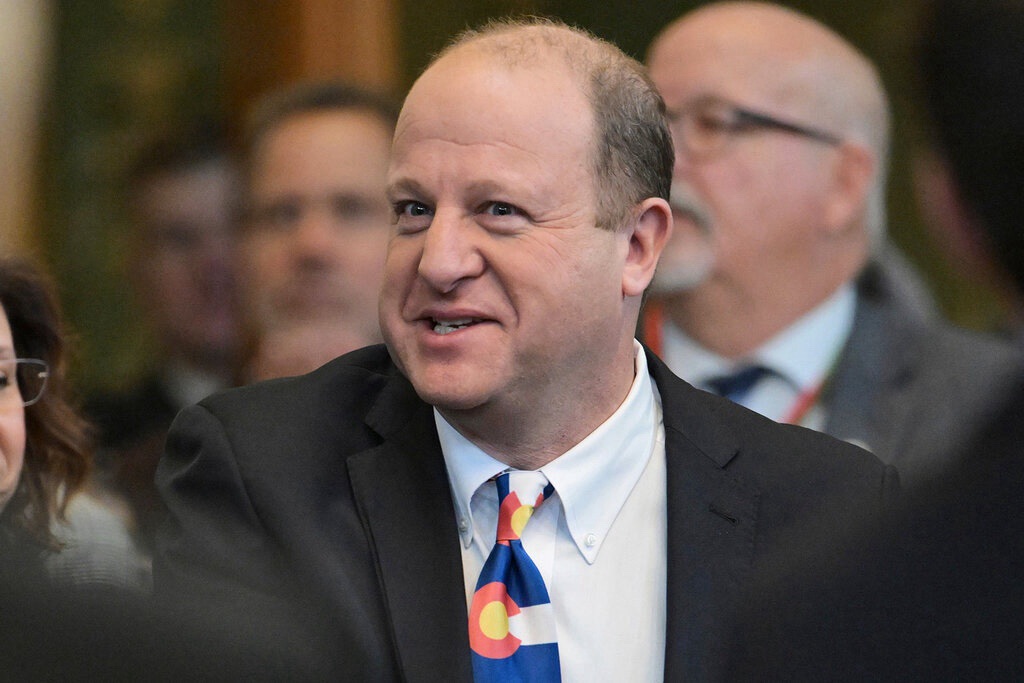
Tina Peters was a county clerk in western Colorado who was convicted of tampering with voting machines, as she tried to show that Trump had won the election. Although she certified that the election was fair, she allowed an unauthorized person to access Mesa County’s voting machines and copy their hard drives. In her conservative county, she was sentenced to nine years in prison. President Trump was furious that one of his avid supporters was in prison, and he pressured Democratic Governor Jared Polis to commute her sentence. In mid-May, Polis ordered Peters’ release, and she was freed on June 1.
Many Democrats were appalled that Polis would set free a prominent and unrepentant election denier.
Two members of the Governor’s clemency board went public in opposing his decision. Polis fired them.
Gov. Jared Polis of Colorado on Wednesday fired two members of his clemency board after they spoke out against his decision to commute the prison sentence of the election denier Tina Peters.
The board members, Hannah Seigel Proff and Azra Taslimi, had objected to Mr. Polis’s decision in May to release Ms. Peters from prison after pressure from President Trump.
After the commutation, Ms. Proff and Ms. Taslimi revealed that the board — appointed by Mr. Polis — had twice voted unanimously to reject Ms. Peters’s application for a shortened sentence. Mr. Polis, a Democrat, has the final decision, and overruled the board.
The board normally operates in secret, and does not disclose the pardon and commutation recommendations it makes to the governor. Ms. Proff and Ms. Taslimi said they had been compelled to pierce that veil of secrecy in Ms. Peters’s case.
On Wednesday, they said they had paid the price. They received a letter from the governor saying they were being dismissed for violating the board’s confidentiality standards.
“You breached the required duty of confidentiality by publicly divulging board members’ votes,” Mr. Polis wrote to each of the women, who shared the letters with The New York Times.
Ms. Peters, a former county clerk in conservative western Colorado, had been sentenced to nine years in prison after being convicted in 2024 in a plot to tamper with voting machines under her control in an attempt to show that the 2020 election had been rigged against Mr. Trump.
Mr. Trump spent months attacking Mr. Polis and demanding that he free Ms. Peters, but Mr. Polis has said that the president’s harangues played no part in his commutation decision.
On Wednesday, Ms. Proff and Ms. Taslimi said they had known that they might be removed. The women, who are former public defenders now working as lawyers in Denver, said the public had a right to know how the governor’s clemency board had grappled with one of the most consequential cases to ever cross its desk.
Still, they said they were disappointed in Mr. Polis.
“He’s saying the public doesn’t have the right to know his own advisory board told him no — twice,” Ms. Taslimi said. “He’s not protecting a process. He’s protecting himself from scrutiny.”
Ms. Peters has hardly stayed in the shadows since getting paroled. She has appeared on right-wing podcasts and a conservative “Freedom Fest” event in Colorado, where she continued to promote election conspiracies. This week, she met with Mr. Trump in the Oval Office.
An anthropology professor at the University of Tennessee-Knoxville wrote a comment on her private Facebook page after Charlie Kirk was murdered. She was not sorry. Her post was forwarded to university officials, and she was fired.
She sued and said that the University had punished her for exercising her First Amendment rights. She won in court and was awarded $1.9 million. She did not get her job back. The university board approved the settlement. It must now be approved by the Governor and Attorney General.
The University of Tennessee at Knoxville reached a $1.9 million settlement with a former professor who was fired after she criticized slain conservative activist Charlie Kirk.
Tamar Shirinian, who had been an anthropology professor at the university, sued the university’s chancellor, the state university system president and the faculty senate president, claiming that the school violated her constitutional rights by retaliating against her. Her lawsuit said her speech was protected by the First Amendment.
The settlement, which was approved Monday night in a meeting of the University of Tennessee Board of Trustees Audit and Compliance Committee, does not restore her faculty position. Some other people have prevailed in similar First Amendment cases.
A Reuters investigation found that more than 600 people were “suspended, fired, disciplined or investigated in a sweeping backlash.”
Shirinian wrote a very uncharitable comment on her Facebook page, assuming that it would be read by her circle of friends:
Shirinian wrote in a private Facebook post after the shooting, “The world is better off without him in it. Even those who are claiming to be sad for his wife and kids …. like, his kids are better off living in a world without a disgusting psychopath like him and his wife, well, she’s a sick f*#k for marrying him so I don’t care about her feelings.”
Someone forwarded her post to a state representative who had lashed out at people in higher education who were critical of Kirk’s views. Within days of the shooting, campus Chancellor Donde Plowman began termination proceedings.
Professor Shirinian promptly wrote a letter of apology to the Chancellor, saying that her comments were “ineloquent and heartless.” She said she condemned political violence; her letter was insensitive, she said, but she did not advocate political violence.
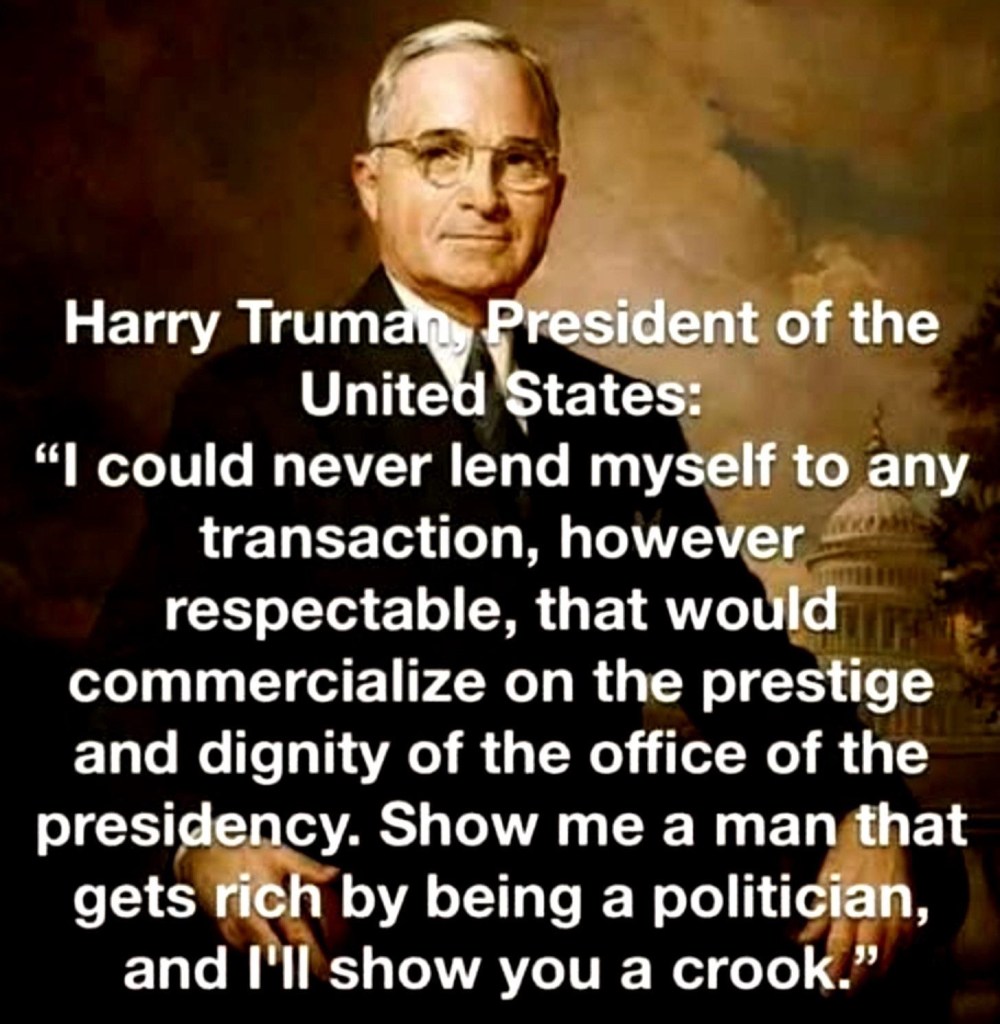
Are there no laws against conflict of interest? Nepotism?
And to think that Republicans were outraged by Hunter Biden! Whatever he did (a seat on the Burisma board; name-dropping his father in business meetings?) is chump change compared to the money-grubbing Trump boys.
Where is the outrage?
Mary Trump writes:
Donald has always insisted that his children run their businesses independently. We have been told repeatedly that there is a bright line separating the presidency from the Trump family’s financial interests. We have also been told to ignore the remarkable coincidence that, every time Donald returns to power, his family somehow discovers lucrative new industries that depend almost entirely on decisions made by the federal government.
Those coincidences are becoming increasingly difficult to believe.
Since Donald returned to the White House, his two oldest and arguably most useless sons have dramatically expanded their investments into industries that rely almost entirely on Pentagon spending and federal policy. These are not businesses they spent years building. They are not industries in which either Don Jr. or Eric has any meaningful experience. They simply happen to be some of the fastest growing sectors benefiting from the Trump regime’s priorities.
Coincidentally, of course.
Don Jr.’s venture capital firm acquired a stake in Vulcan Elements shortly before the company received a $620 million Pentagon loan. According to reporting by ProPublica, that loan was accelerated after intervention from the White House.
Eric, meanwhile, serves as Chief Strategy Advisor for a robotics company despite possessing no discernible qualifications for such a role. That same company later received a $24 million Pentagon contract.
Neither Don Jr. nor Eric serves in government.
Neither is required to comply with federal ethics rules.
Neither files public financial disclosures.
Yet both continue to profit from industries whose fortunes increasingly depend on decisions being made by the administration run by their father.
Late in 2025, the Pentagon established the Defense Autonomous Warfare Group, appropriately abbreviated DAWG, to rapidly expand the military’s use of drones, robotics, and artificial intelligence. Initially funded at roughly $226 million for fiscal year 2026, the Pentagon is now requesting an astonishing $54.6 billion for fiscal year 2027.
That represents an increase of more than 24,000 percent.
It is also larger than the entire proposed budget for the United States Marine Corps.
Think about that for a moment.
The Pentagon is proposing to spend more money on autonomous warfare than on the Marine Corps itself.
And it just so happens that Donald’s two oldest sons have recently become enthusiastic investors in autonomous defense technologies.
This is what MSNBC reported:
This is a major business move and another in a series of examples of the president’s family’s dealings seeming to intersect with his administration. In this case, the Pentagon, as the war with Iran rages on. Just yesterday, drone maker PowerUS announced it will merge with a golf course holding company backed by Trump’s sons Eric and Don Jr., with plans to create a new publicly traded company. That new company calls the Trumps notable investors and says it aims to support American drone industry dominance. The company is expected to compete for lucrative military contracts, trying to fill a void created after the Trump administration banned new foreign made drones on national security grounds. An investment firm joined by Donald Trump Jr. shortly after his father’s reelection has also taken a significant stake in another defense contractor supplying AI powered military technology to the Pentagon. The Trumps maintain their father is not involved in their business dealings, and the White House says President Trump acts only in the best interests of the American people.
The phrase “notable investor” deserves closer examination.
It does not mean Don Jr. or Eric possess unique knowledge about robotics, drones, artificial intelligence, or national defense.
It certainly does not suggest either of them suddenly became experts in autonomous weapons systems. It means they are the sons of the President of the United States. That relationship is their greatest asset. It is the reason companies want them associated with their businesses. It is the reason investors pay attention. And it is almost certainly the reason government contracts suddenly become easier to obtain.
No private citizen should be allowed to leverage proximity to presidential power in this way.
Yet that appears to be exactly what is happening.
Members of Congress are beginning to ask difficult questions.
Following ProPublica’s investigation into Vulcan Elements, Democratic lawmakers demanded explanations after learning that the company’s $620 million Pentagon loan was reportedly handled very differently from virtually every other application under consideration.
According to the report, Don Jr.’s investment firm, 1789 Capital, purchased a stake in Vulcan during 2025. Only months later, the Pentagon approved the largest loan ever issued through its Office of Strategic Capital.
Internal documents reportedly revealed that Vulcan’s application moved through the approval process with unusual speed after direct involvement from senior White House adviser Peter Navarro.
One anonymous Pentagon official summarized the situation bluntly.
The call came from the White House. We have to get this done.
The Pentagon insists political considerations played no role in the decision. Don Jr. likewise denies participating in securing the loan. Those denials become increasingly difficult to accept when viewed alongside the broader pattern.
One contract might be coincidence.
One investment might be luck.
One White House intervention might be explainable.
But eventually coincidences stop looking like coincidences.
They begin looking like a business model.
The deeper problem is that none of this violates the disclosure rules that govern executive branch officials because Don Jr. and Eric are not executive branch officials.
That loophole allows enormous sums of money to flow toward businesses connected to the First Family while shielding the public from understanding the true extent of their financial interests.
Transparency disappears. Accountability disappears. And public trust disappears right alongside them.
Unfortunately, this pattern does not stop with rare earth minerals or autonomous weapons.
It extends into robotics as well.
Apparently, Eric Trump has now become an expert on robotics too, a development that would be more amusing if it were not attached to Pentagon spending, military applications, and the rapidly expanding market for autonomous weapons systems.
This is what Eric Trump said in a FOX state TV Interview:
We have to win robotics in the United States of America. You had a great segment two days ago, Maria, about the robot in Beijing that was literally running marathons and beating the fastest marathoners by seven, eight minutes for a full marathon. These are in the very early days. We better be winning this race in the United States of America. We are the greatest economy in the world, and that is exactly what this company is doing. I am telling you, he is doing a phenomenal job. When you go up and interact with these robots and they fist bump you, they high five you, they follow your commands. You bring in the AI economy. It is going to change industry, it is going to change military application, it is going to change hospitality. The uses are unlimited and I think it is a very beautiful thing, but we must win this race.
What race, exactly?
The marathon the robot is running?
In what universe does the world become a better place because we have fast-running robots that can fist bump people? Although, to be fair, I would be more than happy to have robots replace Eric and Donnie.
Eric is listed as Chief Strategy Advisor, which, after listening to him speak, makes perfect sense if the strategy is to say a lot of words without demonstrating any understanding of the subject matter. In April 2026, the Pentagon awarded Foundation Future Industries a $24 million contract to test its Phantom robotic systems for military applications. That contract immediately drew attention from lawmakers concerned about potential conflicts of interest.
This is what Senator Elizabeth Warren said:
Is the Pentagon just a cash machine for Trump’s kids now? This looks like corruption in plain sight.
Yes. It does.
The Pentagon has defended the contracting process and has not alleged wrongdoing by Eric or the company. Of course it has not. This is Pete Hegseth’s Pentagon. Expecting it to objectively assess whether Donald Trump’s son is benefiting from conflicts of interest is like asking Donald to fact-check his own net worth.
We need a slightly more objective entity to decide whether there is wrongdoing here.
In May 2026, Ranking Member Robert Garcia wrote a letter to the Department of Defense laying out the concerns with unusual clarity.
Eric and Donnie’s purchases, consultancies, and advisory roles create unprecedented intertwining of Donald’s personal financial interests with U.S. policy and national security. Each new venture opens new opportunities to direct DOD funds to the first family’s pockets, and the Trump administration appears to be taking advantage of those opportunities. Such actions raise concerns that DOD is rewarding companies with contracts for recruiting a Trump family member into their ownership group or directly onto their payroll. Such companies have amassed over $725 million in loans, grants, and awards since Donald took office.
No kidding.
The coincidences are mind-boggling.
The Pentagon maintains that its decisions are based on merit, which is a difficult claim to take seriously when Pete Hegseth is the Secretary of Defense. His appointment alone is evidence that merit is not exactly the organizing principle of this administration.
Because neither Eric nor Donnie is subject to federal disclosure requirements, the public has very limited visibility into the scale of their financial exposure. That is precisely how this kind of corruption is allowed to happen. The President’s children can invest in, advise, or promote companies that stand to benefit from federal contracts, while the American people are left guessing how much money they are making and how directly their father’s administration may be helping them make it.
This is the Trump family business model in its purest form. Find an industry dependent on government action. Attach the Trump name to a company operating in that space. Let the machinery of government create the opening. Then insist there is nothing to see when the money begins flowing.
The problem is not merely that Eric and Donnie are unqualified. That has always been the least surprising part of the story. The problem is that their lack of qualifications does not matter. In fact, it may be part of the point. Companies do not need them for their expertise. They need them for their access.
This is the same pattern that has defined Donald’s entire life. He has never understood the difference between public power and private profit because nobody ever forced him to learn it. Fred Trump built the empire. Donald inherited it, hollowed it out, sold off pieces of it, and survived only because other people kept rescuing him. Now his sons are applying the same principle to national security.
The stakes, however, are much higher this time.
We are not talking about failed casinos, licensing deals, branded steaks, or golf course scams. We are talking about drones, rare earth minerals, autonomous warfare, artificial intelligence, robotics, and Pentagon contracts. We are talking about the future of American military policy and billions of dollars in public money being routed through a system in which the president’s family appears to have direct financial interests.
There needs to be an investigation.
Someday, when we finally get through this mess, Eric and Donnie need to be held accountable, stripped of their ill-gotten gains, and, if warranted by the evidence, prosecuted. The American people should not be treated as a revenue stream for the Trump family. The Pentagon should not function as another Trump family ATM. National security should not be turned into a business opportunity for two men whose only qualification is their last name.




 Diane Ravitch's blog