Archives for the month of: March, 2024

NBC showed the nation how NOT to hire a conservative commentator. They picked a MAGA firebrand who stood squarely behind Trump’s lies about the election. Their entire stable of in-air stars at MSNBC revolted, along with Chuck Todd of NBC, the network’s chief political honcho.

It was not Ronna McDaniel’s conservative views they rejected, but her lying. Lying is unethical.

Jill Lawrence, a journalist who writes at The Bulwark, a site for anti-Trump Republicans, offered the following advice:

YOU HAVE TO DRAW THE LINE SOMEWHERE, and where if not at the Big Lie?

If the Ronna McDaniel saga were a miniseries or magazine piece, it would be called “The Five-Day Tenure of a Great Get”: It starts last Friday when NBC News announces that it has hired the former chairwoman of the Republican National Committee as a political commentator. A massive backlash ensues, led by the network’s on-air talent, over McDaniel’s role in trying to reverse the 2020 election results, her year of denying them, and her continued attempts to underminethem. Okay, maybe not that great a get. By Tuesday, she’s out.

We live in complicated media times, and mistakes are constantly made—even now. They’ve been made since 2015 and the struggle will continue as long as Donald Trump is a dominant presence in American life.

I’ve been through it on the inside, and the McDaniel debacle brought back a lot of memories. The hardest journalism job I’ve ever had was being commentary editor of USA Today during “the reign of Donald Trump and his loyalists’ deadly attack on the Capitol to try to keep him in power,” as I called it in a 2021 interview. “Handling op-eds during this period was the challenge of a lifetime. I’ve never been so familiar with the Constitution, the Federalist Papers, the criminal code and the unique angst of fact-checking in the Trump era.”

As that era continues to drag on, so do the challenges. And let’s be blunt: This is an asymmetrical problem. With so many Republicans tethered to Trump, MAGA, and their self-serving fictions, how do you showcase conservative voices while maintaining professional standards of truth, reality, and facts that aren’t “alternative”?

At USA Today, our editing team of liberals and conservatives tried like hell to do both. We had conservative regulars, conservative guest columnists, and first-person essays by conservatives. One column I edited mentioned the “liberal mob” and I remember chuckling at the phrase—it was an opinion, and the author was certainly entitled to it. I also remember fact-checking a Joe Biden op-ed during his 2020 campaign, and it was not difficult—because there were facts in it, and they were confirmable.

Most if not all traditional news outlets want very much to publish viewpoints across the ideological spectrum. David Mastio, my center-right editor and immediate boss at USA Today, used to mock-sigh as he told me that “You do ‘wrong’ so well.” He did, too, from my center-left perspective.

A commitment to viewpoint diversity is part of a business model, of course, but it’s also part of a fairness model—and a way to sharpen readers’ thinking, as well as our own. Whatever the motivation for this commitment, it can be difficult to maintain in our fraught media moment: the ongoing clashes over evidence and reality make it easy for a journalist or manager or organization to get into trouble.

I saw it when a conservative friend lost a job over insisting on facts in a commentary about Trump—by a pro-Trump writer. We all saw it when CNN aired a live Trump town hall with a cheering audience and an outgunned moderator, reviewed by the network’s own media writer as “a spectacle of lies.” And don’t even get me started about the time the news section of USA Today fact-checked a high-level Trump official’s “opposing view” to a USA Today editorial. (Spoiler: It was Peter Navarro, who reported to prison last week to serve four months for contempt of Congress.)

The temptation to hire big names like McDaniel is understandable, especially if—like NBC News—you have $300,000 lying around to pay her. Trump himself had the occasional byline on our page, and he was fact-checked. Vice presidential nominee Mike Pence wrote the “opposing view” in 2016 when the editorial board, breaking with USA Today tradition, said Trump was “unfit for the presidency.” Pence also wrote it in 2020 after we went even further and endorsed Biden—the first time in the paper’s history that the board endorsed a presidential candidate.

That election was, or should be, a line of demarcation. Before the Big Lie, and after it. Before the January 6th Capitol attack, and after it.

My 2021 Christmas wish was zero tolerance for the Big Lie, Stop the Steal crowd in Congress. I laid it all out in a column that ran with the headline “Oust Trump coup planners, enablers and provocateurs from public office. They betrayed us.” But they’re still there, from House Speaker Mike Johnson on down.

There’s nothing news organizations can do about that, or about Trump’s current starring roles as presumptive GOP presidential nominee and defendant in his many criminal and civil trials, or about the endless dilemma of when and how and whether to cover him in year nine of his lies and outrages.

What they can do, at the very least, is stop rewarding Big Lie opportunists like McDaniel.
Alabama has one of the most restrictive abortion laws in the nation, and its highest court recently banned in vitro fertilization. In a special election for the legislation, candidate Marilyn Lands swept to victory by emphasizing reproductive rights.

Politico reported:

An Alabama Democrat who campaigned aggressively on abortion access won a special election in the state Legislature on Tuesday, sending a message that abortion remains a winning issue for Democrats, even in the deep South.

Marilyn Lands won a state House seat in a rare competitive race to represent a district that includes parts of Huntsville. Lands, a mental health professional, centered her bid on reproductive rights and criticized the state’s near-total abortion ban along with a recent state Supreme Court ruling that temporarily banned in vitro fertilization. 

“Today, Alabama women and families sent a clear message that will be heard in Montgomery and across the nation,” Lands said in a statement. “Our legislature must repeal Alabama’s no-exceptions abortion ban, fully restore access to IVF, and protect the right to contraception.”

Her opponent, Madison City Council member Teddy Powell, focused his campaign on economic development and infrastructure.

Lands spoke openly about her own abortion experience, when she had a nonviable pregnancy that ended in abortion two decades ago. Her campaign ran a television ad sharing that story.

“It’s shameful that today women have fewer freedoms than I had two decades ago,” Lands says in the ad.

Open the link to finish the story.

John Merrow was the PBS correspondent on education for many years. Since he stepped down from this important role, I have discovered that he is quite a wonderful person. I didn’t think so when he burnished Michelle Rhee’s reputation, but he redeemed himself when his last hour-long segment on her delved into the cheating scandal that consumed her final year as chancellor of the DC schools.

But now I know John as a generous friend. When I was suffering in the aftermath of knee surgery, he printed out “Dr. Merrow’s Advice.” Every year, he is committed to riding the same number of miles as his age and thus far he has kept his pledge. He very kindly recommends organizations to receive donations in support of his bike ride, and NPE has been among them. We were very gratified by his recognition and support.

And now he has created an award he calls “TAMPU”—Towards a More Perfect Union. I love the award because its first recipient is Peter Greene, who is one of the best educational thinkers and writers of our time.

He writes at his blog, The Merrow Report:

I’ve always loved the elegant, aspirational phrase, “Toward a More Perfect Union,” found in the opening sentence of our Constitution.  It was our Founding Fathers’ first priority, ahead of establishing justice, ensuring domestic tranquility, providing for the common defense, promoting the general welfare, and securing the blessings of liberty to ourselves and our posterity.

I think it’s time to do more to honor those who in their daily lives attempt to move us “Toward a More Perfect Union.” To that end, and only slightly with tongue in cheek, I suggest we create an award–call it the TAMPU Prize–acknowledging those who are attempting to push the envelope forward.  

While someone else works out the rules and timing, I am jumping the gun and awarding the TAMPU Prize to three remarkable people who are on my mind this week.  Please read on, and please add your own names.

The first TAMPU recipient is from the world of education, Peter Greene. Mr. Greene, whom I do not know, spent 39 years teaching English and now devotes his time to turning over rocks to expose wrong-doing in public education, to celebrate accomplishments, and to make us think.  You can find a lot of his well-researched columns here on Forbes Magazine, but he also blogs regularly at ‘Curmudgucation,’ a word I assume he made up.  

Here’s how Mr. Greene describes himself:  I started out life in New Hampshire and finished growing up in Northwest Pennsylvania. I attended a non-traditional education program that no longer exists at Allegheny College, a small liberal arts college, student taught in Cleveland Heights, and landed my first job in Lorain, Ohio. The year started with a strike and ended with a large workforce layoff, so I came back home, bought a mobile home, and lived in a trailer court while I subbed in three districts.

After a year, I started landing year-long sub jobs with the same school district I had graduated from in the mid-seventies. It was not the plan, but there was a woman… After thirty-some years in that district, I’ve taught pretty much every brand of English we have here, 7-12. But high school is my home; middle schoolers are, as I said back when I taught them, the emotional equivalent of having someone scream in your ears all day. God bless, MS teachers. And now, after thirty-nine total years in the classroom, I’ve retired.

My second recipient is Jessica Craven, a veritable ‘Energizer Bunny’ who’s working to help our democracy survive extremism of all sorts, but particularly MAGA.  She blogs almost every day, with a newsletter she calls “Chop Wood, Carry Water,” a title that carries a message: This is what you do when the chips are down–Get to work!

Click here to begin the “Chop Wood, Carry Water” experience.  Here’s how she introduces herself and her newsletter: 

What goes on here? Well, this newsletter is dedicated to saving democracy, addressing the climate crisis, preserving our freedoms, electing better lawmakers, and, in general, creating a better country—one simple action at a time. As the author, I’m essentially a bundler. Not of donations, but of easy things each of us can do to make a difference. I do these things, too—because I want my kid to grow up in a democracy AND because doing them makes me feel less anxious. My motto? Hope is an action.

I have no idea where Ms Craven lives with her husband, child, cat, and dog. Ms Craven publishes at least six times a week and always tells readers how to get involved.  She makes activism easy, no small feat.   “Chop Wood, Carry Water” is free, but I hope you will do as I do and subscribe ($60 per year). 

My final TAMPU recipient (this time around) is National Book Award recipient Jonathan Kozol, whose new book, “An End to Inequality,” is the 12th in his illustrious career. Now 87, Jonathan burst on the scene in 1967 with “Death at an Early Age,” which I can remember devouring.  His new book–which he says will be his last–is a passionate call for racial justice in education and the larger society.  Never one to call for compromise, he rejects all forms of tokenism.  “There is no such thing as perfectible apartheid. It’s all a grand delusion,” he writes. “Apartheid education isn’t something you can ‘fix.’ It needs to be dismantled.”  For more, see Dana Goldstein’s recent profile of Jonathan in the New York Times.

(Digression: I’ve known Jonathan for a long time, and he kindly wrote a glowing preface to a book of mine, “Choosing Excellence,” back in 2001. Unfortunately, my (inept) publisher misspelled his first name. Jonathon!  When they sent me an advance copy, I saw the error and immediately called the publisher.  “Sorry,” they said, “But the initial printing is only 5,000 copies. We will correct it on the next printing.” 

I explained very calmly that I would sue their asses if they released that printing, and I suggested that they shred those 5,000 copies and reprint it.  Instead, they hired people to paste over the error with a small sticker that spelled his name correctly. Somewhere I have the uncorrected version and a pasted-over version, as well as a clean copy from the second printing.)

So those three, Jessica Craven, Peter Greene, and Jonathan Kozol, are pushing and pulling us toward A More Perfect Union.  Who else deserves our attention?  Make your suggestions here.  

Thanks, 

John

During the past few decades, we have seen the persistence of failed policies in education. Most of them were codified by No Child Left Behind and Race to the Top: give standardized tests; punish teachers and schools where scores are low or do not rise; reward teachers and schools where scores go up. Pay bonuses to teachers if their students’ scores go up. Tie teacher pay to student scores. Close schools with low scores. Turn low-scoring schools over to private management. Give vouchers to parents to send their children wherever they want.

All of these remedies failed. They encouraged cheating and gaming the system. They encouraged educators to avoid schools that enrolled the neediest students. They demoralized teachers who were idealistic and wanted to teach the joy of learning. Test prep became far more important than intellectual curiosity.

All of these are zombie policies. No matter how consistently they fail, policymakers won’t let go of them.

Merit pay is a policy that has been tried since the 1920s. It has never accomplished anything. I summarized the research on merit pay in my last three books: The Death and Life of the great American School System; Reign of Error; and Slaying Goliath. The research is overwhelming: merit pay doesn’t improve education and doesn’t even raise test scores. Yet in true zombie style, it never dies. It should.

John Thompson writes here about the revival of the merit pay zombie in Oklahoma:

As the “mass exodus” of teachers from Oklahoma schools continues, the legislature has rejected an across-the-board pay raise for teachers. Instead, several legislators are searching for a fix for the state’s “flawed” bonus system. If that doesn’t work, maybe Walters’ use of public money to spread his attacks on “on the radical left” will bring educators back to Oklahoma …

Seriously, Walters’ push for his vision of incentive pay prompted some education advocates to ask me to research performance pay. I sure appreciated the oportunity to reread new and older research on the subject.

Twenty-five years ago, I opposed performance pay because there were better ways to improve teacher quality. But I didn’t have major concerns; although its likely benefits would be small, I thought its downsides shouldn’t be a big deal. However, starting with No Child Left Behind and taking off with Race to the Top, test scores were weaponized, and the dangers of performance pay grew dramatically. Output-driven teachers’ salaries, joined at the hip with unreliable and invalid accountability metrics, promoted educational malpractice that undermined meaningful teaching and learning, increasing in-one-ear-out-the-other, worksheet-driven instruction. Teamwork was damaged, trust was compromised, the flight of educators from classroom increased, and the joy of student learning declined significantly.

During that time, I communicated frequently with data-driven analysts working for think tanks, who almost never had experience in urban schools. Their job was to provide evidence that performance pay, and other incentives and punishments, can work. They ignored educators and social scientists who tackled the real policy question – how will those experiments work? 

Sometimes, merit pay produced modest test score gains, but there was no way of determining whether those test scores revealed an increase or a drop in meaningful learning. Neither did they address the overall learning losses due to teachers being pressured to focus on metrics, as opposed to children. In 2012, a Rand study concluded, “most studies have found no effects on student outcomes.” By 2015, the U.S. Department of Education found that large incentives, such as $15,000 per teacher, may attract talent, but:

In addition to creating an environment that lends itself to narrowed pedagogical approaches and teaching to tests (and even cheating on them), this article suggests that merit pay schemes that require teachers to compete with one another may likely undermine positive collaboration.

Around the time of the 2018 Oklahoma teacher walk-out for higher pay, Denver threatened a strike to get rid of performance pay. Chalkbeat explained the complexity of balancing for larger or smaller payments to teachers in diverse classrooms. It went into depth answering the question, “How did a pay system that once seemed to hold so much promise bring teachers to their breaking point?”  The concise conclusion was, “lack of trust.”

Education Week studied the minimal effects of performance pay in Tennessee and Texas, which implemented expensive reward-and-punish, and often short-lived programs. The negative effects of the Houston plan, which State Superintendent Ryan Walters seems to support, are especially relevant for Oklahoma. The Houston teachers’ union president explained, “Performance pay demeans students and undermines teachers, so if the focus is on pay for performance, you’re incentivizing the test-and-punishment model.” Similarly, Education Week cited comprehensive studies that concluded that the relatively more effective programs “avoided an overemphasis on test scores.” But even many or most of the more successful programs were unlikely to survive.

Finally Education Week reported how the $200 million Bill and Melinda Gates Foundation merit pay experiments “did little to boost retention of high-performing teachers,” and it “had little effect on student achievement.”

At the peak of merit pay mandates, and now, Bixby Superintendent Rob Miller explained, “Teacher merit pay is one of the more persistent and seemingly indestructible zombie ideas related to education.” Miller said, “Merit pay for teachers has been tried again and again since the 1920s.” He cited cognitive and social science that explained why performance pay experiments were doomed to fail, as well as numerous evaluations of how it failed in the 21st century.  Miller now asks, “Is it fair to place the primary responsibility on teachers and schools for outcomes strongly affected by factors outside their control?” and answers, “Doing so damages school culture and teacher morale and obstructs meaningful dialogue about school improvement.”

At a time when Ryan Walters is threatening to put the worst of the failed policies of the last twenty years on steroids, I was struck by a recent column by Thomas Dee, a fervent believer in output-driven accountability. Even though he seems to think that teachers were to blame, Dee also seems to acknowledge that performance pay had disappointing results. Now he recommends:

It may be possible to achieve durable political support for a teacher evaluation system if that system focuses narrowly on identifying master teachers and providing them with training and extra pay to coach their peers but takes a more incremental approach toward dismissing underperforming teachers.

Dee’s latest almost brings me back to 25 years ago, before NCLB, when the schools I knew were improving, and a win-win approach to performance pay didn’t seem so problematic. At the urging of the union, the Oklahoma City Public School System briefly implemented the Toledo peer review plan, which included a fair and efficient plan for removing ineffective teachers. The best evidence is that the plan was a reliable method for improving classroom instruction. But, it and so many other promising programs were undercut by corporate school reform.

Maybe I’ll once again be open to a compromise involving constructively built, non-punitive merit pay incentives, once the destructive school cultures advanced by corporate school “reform” have disappeared. But, I won’t hold my breath.  

Top brass at NBC thought it was a brilliant idea to hire Ronna McDaniel, former chair of the Republican National Committee, as a paid contributor. They did not check with their on-air commentators, who had taken the brunt of McDaniels’ criticism of the “fake news” on behalf of Trump. They knew she had fiercely defended his lies about election fraud. She has now retracted her lies, but that didn’t erase her history as a liar.

When the on-air commentators lambasted the hiring of McDaniel during their shows on Sunday and Monday, NBC leadership withdrew their offer.

But they had signed a contract to pay McDaniel $300,000 a year for two years, and she’s expecting to be paid in full.

Politico reports that she’s also considering a lawsuit for defamation and a hostile work environment.

If NBC wanted to add a Republican commentator who did not participate in the effort to overthrow the election and subvert the Constitution, they could have hired Liz Cheney, Adam Kinzinger, or Mitt Romney (Ronna McDaniel’s uncle). She used to call herself Ronna Romney McDaniel but Trump insisted that she drop her middle name and she did.

Michelle Davis writes a blog called TurnLeftTexas. Texas used to elect Democrats. Texas used to elect Democrats like Lyndon B. Johnson, Ralph Yarborough, and Ann Richards. Now the state is ruby red. What happened?

Michelle Davis writes:

I’ve often said Texas Democrats are a whole other breed. We have to be, after the decades of abuse we’ve suffered from the opposing party. For those who watch the legislative sessions and follow our lawmakers on social media, we know that Texas Democrats have been David, staring down Goliath. 

They say that Texas is the right-wing sandbox, the place where far-right institutions spend millions to test their fascist-aligned ideas. Radical legislation like the abortion ban, the DEI ban, or the ban on gender-affirming care are all being rolled out in Texas as testing grounds so that right-wing institutions can take these radical policies nationwide.

Texas Democrats never get enough credit for the work they put in while in Austin. Texas Democratic Lawmakers are literally on the front lines of democracy, fighting to block awful GOP policies and keep Texans from harm. Whether calling points of order, filibustering, or breaking quorum, Texans know that we can rely on most Texas Democrats to stand tall with a heart and a spine. 

With so much at stake in this election cycle, you must ask yourself, “Is it enough?”

Of course, it isn’t “all Democrats.” Too often, from too many districts in all corners of the states, people are saying that they live in blue areas, have a Democrat as representation, and are telling people that their elected official isn’t showing up.

Some elected Democrats are doing great; they show up and have a high turnout for elections. Again, this isn’t “all Democrats,” but the occurrences of Democrats not showing up in Texas are widespread. 

It shouldn’t surprise you that people talk. Precinct chairs talk to grassroots organizers, political clubs talk to the city council, and commissioners’ court talks to various political candidates. If you aren’t showing up to your local Democratic events, engaging with your local grassroots organizers, and communicating with your local precinct chairs, you’re not doing enough. 

The political chatter from South Texas to North Texas, from East to West, is that not enough elected Democrats are doing enough to turn out the vote when they are in safe blue districts. And they aren’t doing enough to help other Democrats get elected.

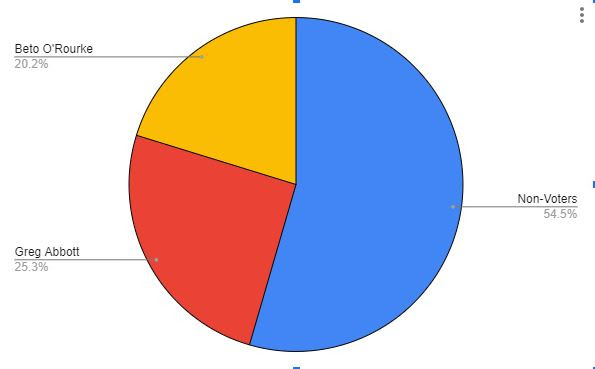
Why is there voter apathy in Texas?

This is an important question that many intelligent people are spending a lot of money on trying to change. I think it’s a complex issue that includes generations of voter oppression, lack of infrastructure, and lack of engagement, among other things. 

One thing Beto O’Rourke always used to say was, “There’s no one coming in to save us.”

He was right. Texas is royally screwed as long as Republicans are leading the charge. No one is going to save us from that other than ourselves. We are the ones we’ve been waiting for. We have the numbers on our side and must convince them of them. 

You know who I mean when I say “them.”

It will take all of us, and if you have already been elected in a safe blue district and you have no opponent, it will take you, too. It will take helping your neighboring districts and getting your own voters to show up.

Of all people, Texas Democrats know how far-right the Republicans have moved in recent years. You know the threats we face. 

Too much is at stake. 

If Democrats in Texas do not make gains this year, the first thing Texans may lose is our right to vote. We already saw several of the ALEC-backed authoritative legislation that came through the 88th Legislature and how Republicans have already tested the waters on stripping Texans of their rights to vote. Banning specific poll locations, like on college campuses, or massive data purges on the voting rolls are all real possibilities if Republicans can’t be stopped. 

What about our rights to freedom of expression and privacy? The GOP has already banned certain forms of art in Texas. Why do you think they’ll stop there?

Republicans passed a bill to give protesters at least 10 years if they are protesting a pipeline. The rights to freedom of assembly are at risk. 

We already have an abortion ban and travel restrictions on women; IVF and birth control are next. 

The civil rights of all marginalized groups are at risk. 

We change this by changing the culture of not voting. 

We need to do many things to change the culture of not voting. Still, as Democrats who have already been elected, you serve as a leader in your community. It would be best to actively work to foster a culture of engagement, participation, and voting within your communities. Your role isn’t just legislating but inspiring, educating, and actively participating in the democratic process. 

Your presence in the community should be a constant, not just during election cycles. Attend local events, hold town halls, and visit schools and community centers to discuss the issues that matter most to your constituents. Your visibility and accessibility can bridge the gap between the electorate and the political process, making democracy feel more tangible and immediate to the people you serve.

Knowledge is power, and too many people feel disconnected from the political process because they don’t understand how it affects their daily lives. Lead educational initiatives that demystify the legislative process, explain the importance of local elections, and highlight the impact of specific policies on the community. Work with schools, universities, and community groups to develop programs that engage young people and first-time voters early.

Grassroots movements and community organizations are the lifeblood of democratic engagement. Support these groups with endorsements by actively participating in their events, sharing their successes, and facilitating connections that can amplify their impact. Empower these organizations with resources and platforms to reach a wider audience.

As an elected Democrat, you have a unique opportunity and responsibility to lead the charge in changing the culture around voting and civic engagement.

By being accessible, engaging in education, and supporting grassroots movements, you can inspire a wave of active, informed participation that strengthens the foundations of our democracy. Remember, leadership is not just about holding a position; it’s about the action you take and the example you set for others to follow.

To change Texas, it’s going to take all of us. We believe in you and need your help.

Josh Cowen of Michigan State University is a veteran voucher scholar. He has been doing voucher research for nearly two decades. For years, he was hopeful about the outcomes for students. He recently realized that the results were appalling. Students who took vouchers and left their public school actually lost ground academically. The real benefits of vouchers went to students who were already enrolled in private schools; their family, which could afford the tuition, won a subsidy from the state. In some states, even wealthy parents won a state subsidy for their children. vouchers do not help poor students; instead, they are harmed.

Josh Cowen has a new book coming out in September: The Privateers: How Billionaires Created a Culture War and Sold School Vouchers.

Cowen wrote in The Philadelphia Inquirer:

If you’ve ever run a small business or talked to a business owner, you might have heard the phrase “under promise, over deliver” as a strategy for customer service.

Unfortunately, when it comes to school voucher plans like those being considered by Pennsylvania lawmakers this spring, what happens is the opposite of a sound investment: a lot of overpromising ahead of woeful under-delivery.

As an expert on school vouchers, I think about the idea of what’s promised in the rhetoric vs. what actually happens when the realcost sets in. To hear voucher lobbyists tell it — usually working for billionaires like Betsy DeVos, or Pennsylvania’s own Jeff Yass — all that’s needed to move American education forward is a fully privatized market of school choice, where parents are customers and education is the product.

As I testified to Pennsylvania lawmakers last fall, however, vouchers are the education equivalent of predatory lending.

One promise that never holds up is the idea that states can afford to create voucher systems that underwrite private tuition for some children, while still keeping public school spending strong.

Other states that have passed or expanded voucher systems have rarely been able to sustain new investments in public schools. Even when those voucher bills also came with initial increases in public education funding. Six out of the last seven states to pass such bills have failed to keep up with just the national average in public school investment.

But for children and families — especially those who have been traditionally underserved by schools at different points in U.S. history — the cost of school vouchers goes beyond the price for taxpayers.

Although most voucher users in other states (about 70%) were, in fact, in private schools first, the academic results for the kids who transfer are disastrous. Statewide vouchers have led to some of the largest academic declines in the history of education research — drops in performance that were on par with how COVID-19 or Hurricane Katrina affected student learning.

Although school vouchers have enjoyed fits and starts of bipartisan support from time to time, today’s push for universal voucher systems across the country is almost entirely the product of conservative politics. All 12 states that created or expanded some form of a voucher system in 2023 voted for Donald Trump in 2020. Of those that passed voucher laws since the COVID-19 pandemic hit in 2020, only two (Arizona and New Hampshire) voted for Joe Biden that election year.

In states like Arkansas and Iowa, voucher laws either immediately followed or immediately preceded extreme new restrictions on reproductive care, a weakening of child labor laws, and other conservative policy priorities.

And this isn’t just about electoral politics. The right-wing origins of school vouchers have real day-to-day implications for who gets to use them and who is left out. We know from states like Florida, Indiana, and Wisconsin that the latest voucher bills allow schools to discriminate against certain children if schools can claim they do so for religious reasons.

Who pays that particular price? Examples include students with disabilities and children and parents from LGBTQ families, who may be asked to leave or not even admitted at all. And that’s because when it comes to vouchers, it’s not really school choice at all. Families don’t get their choice of schools; instead, schools get their choice of which families to admit.

And the price tag for all of this usually comes in wildly over budget anyway. The big culprit for those cost overruns goes back to who actually gets a voucher. Because most voucher users were in private schools first— paid by the private sector before — voucher costs are actually new expenditures taxpayers have to make. In the worst-case scenario, Arizona, vouchers cost more than 1,000% beyond what their advocates first promised.

Despite claims some supporters make that vouchers are part of an efficient education market, the result is really the opposite of any strategy a successful business would recognize.

To put it plainly: The promises rarely pan out, and eventually, the check comes due.

Chalkbeat Tennessee reported on the Legislature’s recognition that the “Achievement School District” is a failure.

The ASD was launched by the Obama-Duncan Race to the Top on the theory that charter schools were a magic solution to low test scores. Duncan awarded $500 million to Tennessee, one of the first RTTT winners; $100 million was allocated to the ASD.

The ASD gathered the lowest-performing public schools in the state and clustered them into a new, all-charter district. Chris Barbic, leader of YES Prep charter schools in Houston, was selected to lead the ASD. He boldly predicted that within five years, the ASD schools would rank among the top 25% in the state. ASD started with six schools and eventually expanded to 33..

Blogger Gary Rubinstein has followed ASD over the years, with growing disillusionment. None of the ASD schools ever broke into the top 25%.

The state has spent more than $1 billion to help the ASD.

Chalkbeat wrote a few weeks ago that the Legislature is ready to throw in the towel:

After a decade of painful takeovers of neighborhood schools, contentious handoffs to charter networks, and mostly abysmal student performance, Tennessee’s Achievement School District appears to be on its way out.

Several of the GOP-controlled legislature’s top Republicans are acknowledging that the state’s most ambitious and aggressive school turnaround model has failed — and should be replaced eventually with a more effective approach.

Meanwhile, Democrats continue to push for legislation designed to end the so-called ASD, created under a 2010 state law aimed, in part, at transforming low-performing schools.

“I expect we will move in a different direction,” Sen. Bo Watson, the powerful chairman of his chamber’s finance committee, recently told reporters.

The Hixson Republican called the charter-centric school turnaround model an “innovative” idea that fell flat, at least in Tennessee. It would be foolish, Watson added, to keep spending money on an initiative that isn’t working and already has cost the state more than $1 billion — a sentiment echoed by Lt. Gov. Randy McNally and House Speaker Cameron Sexton.

But if the legislature decides to shutter the ASD and Gov. Bill Lee signs off, important questions remain about how Tennessee will support thousands of students in its lowest-performing schools.

There are currently 4,600 students enrolled in ASD schools, 12 in Memphis and one in Nashville.

Initially, the ASD attracted some of the nation’s biggest charter chains.

Evaluations showed that students in ASD schools gained no more in tested subjects than students in schools that received no interventions at all.

Now Tennessee must revise its contract with the federal government to revise its plans to help the lowest performing students.

Chalk up another loss for the “Disruption Doctrine” imposed by Bo Child Left Behind and Race to the Top. One can only imagine the difference that might have been made if the same sums were invested in full-service community schools and reduced class sizes.

NBC decided not to hire Ronna McDaniel, former chair, of the Republican National Committee, after an on-air revolt by its biggest stars.

Her loud defense of Trump’s lies about the 2020 election were unacceptable to the NBC and MSNBC commentators.

Amid a chorus of on-air protest from some of the network’s biggest stars, NBC announced on Tuesday night that former Republican National Committee chair Ronna McDaniel will no longer be joining the network as a paid contributor.


The announcement came in a memo from NBCUniversal News Group Chairman Cesar Conde, who said he had listened to “the legitimate concerns” of many network employees. “No organization, particularly a newsroom, can succeed unless it is cohesive and aligned,” he wrote. “Over the last few days, it has become clear that this appointment undermines that goal.”


Conde also apologized to employees “who felt we let them down” and took “full responsibility” for the hiring…

But the company’s on-air personalities — especially those on NBC’s liberal-leaning cable affiliate MSNBC — disagreed vehemently, saying that McDaniel’s promotion of Donald Trump’s media-bashing and false election-fraud claims disqualified her for a role in their news divisions.

And one by one, they took to the airwaves to deliver that message to their bosses in front of their live audiences Monday.


“Take a minute, acknowledge that maybe it wasn’t the right call,” MSNBC’s top-rated star Rachel Maddow said on her show that night. “It is a sign of strength, not weakness, to acknowledge when you are wrong.”

The commentators at NBC and MSNBC are furious that NBC top brass hired Ronna Romney McDaniel as a paid commentator for the network. Presumably, the executives thought it would broaden their audience to bring on someone who had led the Republican National Committee for the past eight years.

They now face an internal rebellion. As Dan Rather explains on his blog Steady, prominent newscasters at NBC were apoplectic. The commentators at MSNBC—where Trump is despised—were assured that they did not have to invite her onto their programs.

Last night, I watched MSNBC, and every commentator lashed out against the hire. Joy Reid, Jen Psaki, Rachel Maddow, and Laurence O’Donnell expressed their outrage. They did not care that she was a Republican. They did not care that she was a conservative. They cared that she was an election denier and a liar. She did whatever Trump wanted, and he booted her anyway. She was actively involved in the fake electors scheme in Michigan. She even dropped her middle name (Romney) to please Trump. She lacks integrity. She insulted the media, as Trump did. As Jen Psaki said, she is not honest.

Dan Rather shared their views:

Journalism Lesson #1 for 2024:

The mainstream media should not normalize Donald Trump’s behavior, nor should they give a platform to his lies or those of his sycophants, who for years have spread disastrous untruths that may have irreparably damaged our nation.

But in one fell swoop, NBC News has managed to do both. By hiring former Republican National Committee chief Ronna McDaniel, NBC has given credence and legitimacy to a Republican who has been in lockstep with the lies, helping spread plenty of the former president’s falsehoods. Allowing McDaniel to be in the same area code as NBC News is a huge mistake and will only further shred the small amount of trust Americans still have in the mainstream media. I don’t blame journalists at NBC. They have long been some of the finest in the business. But one wonders what the hell executives at the network were thinking.

Before she sold her soul, Ronna McDaniel was considered Republican royalty. She’s the granddaughter of George Romney, former GOP governor of Michigan, and niece of Senator Mitt Romney, former Republican presidential nominee and former governor of Massachusetts. She has been the chair of the RNC since the day Donald Trump took office in 2017. And she has been loyal to him at all costs, especially the truth.

During her tenure, she was a prolific fundraiser yet oversaw the net losses of Republican governorships and congressional seats. But her biggest claim to fame during her seven years on the job is that she was a Trump supporter, loyalist, and apologist above all else.

One could argue that this is the role of the head of a political party: to support the highest-ranking member of said party. Yes, that is typically true. But McDaniel spent years repeating Trump’s disinformation, making cases for his lies and paying his legal bills. Here are just a few of her misdeeds:

  • Told CNN’s Chris Wallace of Joe Biden’s election win, “I don’t think he won it fair.”
  • Characterized the January 6 insurrection as “legitimate political discourse.”
  • Orchestrated the censure of Representatives Liz Cheney and Adam Kinzinger, the two Republican January 6 Committee members.
  • Encouraged Michigan canvassers not to certify the 2020 election results, promising them lawyers.
  • Took part in Trump’s scheme to assemble fake electors.
  • Refused to condemn QAnon to George Stephanopoulos on ABC News.
  • Mocked Senator John Fetterman and President Biden for speech impediments.
  • Warned that those Republicans who didn’t embrace Trump’s policies “will be making a mistake.”

McDaniel made her NBC News debut on this Sunday’s “Meet the Press.” At the top of the broadcast, host Kristen Welker disclosed McDaniel’s new role. She said, “This interview was scheduled weeks before it was announced that McDaniel would become a paid NBC News contributor. This will be a news interview, and I was not involved in her hiring.”

During the interview, McDaniel defended her time as chair with what may be the quote of the year. “When you’re the RNC chair, you kind of take one for the whole team. Now I get to be a little bit more myself, right?”

No, Ms. McDaniel, you don’t get to have it both ways. The truth does not change depending on who signs your paycheck. Whom are we supposed to believe, your RNC or NBC self?

McDaniel walked back some of her more outrageous statements, sort of. As of yesterday, she now admits that Joe Biden won the election “fair and square.” However, she continued to insist there were issues with the election. When pushed, she mentioned the huge increase in mail-in ballots in Pennsylvania and suggested voter fraud. Reminder: No significant fraud of any kind was found in any state in the 2020 election.

In defending their hire, NBC News’s Carrie Budoff Brown, senior vice president of politics, said, “It couldn’t be a more important moment to have a voice like Ronna’s on the team.”

Many on the NBC team vehemently disagreed. “We weren’t asked our opinion of the hiring, but, if we were, we would have strongly objected to it for several reasons,” Joe Scarborough, the “Morning Joe” co-host, said at the top of the broadcast Monday. Mika Brzezinski added, “We hope NBC will reconsider its decision. It goes without saying that she will not be a guest on ‘Morning Joe’ in her capacity as a paid contributor.”

Chuck Todd, NBC’s chief political analyst, could barely contain his anger and disbelief on “Meet the Press.”. “She [McDaniel] wants us to believe that she was speaking for the RNC when the RNC was paying for it. So she has — she has credibility issues that she still has to deal with. Is she speaking for herself or is she speaking on behalf of who’s paying her?”

He continued, “There’s a reason why there’s a lot of journalists at NBC News who are uncomfortable with this because many of our professional dealings with the RNC over the last six years have been met with gaslighting, have been met with character assassination.”

Now we come to the why. Why would NBC News hire someone as controversial as Ronna McDaniel? 

News gathering is a business, as unfortunate as that is. As a business, it needs to make money. In television news, more viewers equals more money. So news organizations feel they need to appeal to the broadest spectrum of viewers possible. We will exempt Fox, which calls itself a news organization but is more of a propaganda outfit for the GOP.  

The mainstream middle is a much more crowded field that is bombarded by accusations of bias and liberalism. So they feel the need to show their Republican bona fides by hiring conservative voices.

But that is the crux of the problem. Which Republicans? Trump loyalists who are election deniers and January 6 apologists? Never-Trumpers who are as likely to appeal to many Republican viewers as progressives? How do they represent the political right without alienating their loyal viewers and their correspondents? These are the new political realities ushered in by Donald Trump. And another reason independent journalism is essential right now, essential to provide unvarnished coverage in one of the most important elections in American history and to hold the mainstream media accountable.