Jim Hightower is a Texan who represents the best of the state. He blogs at “Jim Hightower’s Lowdown.” This is a terrific post.
In my view, the greatest of America’s “Founding Fathers” was not Washington or Jefferson – nor, technically, he wasn’t even an American. Rather, he was a British immigrant and itinerate agitator for real democracy, enlightenment, and universal human rights.
He was Thomas Paine, a prolific, profound, persuasive, and widely popular pamphleteer in the movement for American Independence. With plain language and genuine passion for the cause, Paine’s 47-page pamphlet, Common Sense, was so compelling in its support of the Revolution that it was passed around from person to person – and even read aloud in taverns! But Paine wasn’t content with democratic rhetoric – he actually believed in an egalitarian society, and his post-revolution writings (including Age of Reason, and Agrarian Justice) unabashedly demanded that the new hierarchy of US leaders fulfill the promise of democracy.
Even before the War for Independence, Paine called for slaves to be freed and slavery prohibited. After the war, he terrified most of the gentlemen of means who’d signed the Declaration of Independence by insisting that non-landowners be eligible to vote and hold office (John Adams was so appalled by this that he decried Common Sense as a “crapulous mess”). But Paine just kept pushing, calling for women’s suffrage, progressive taxation, state-funded childcare, a guaranteed minimum income, universal public education, strict separation of church and state, and adoption of some of the democratic principles of the Iroquois Nation.
This is Jim Hightower saying… Don’t tell small-minded, right-wing demagogues like Ron DeSantis and Greg Abbott – but Thomas Paine was WOKE! Some 250 years before their push to impose autocracy, plutocracy, and theocracy over us, this revolutionary founder championed social justice and economic fairness. As one historian noted, “we are today all Paine’s children,” for he imbued America’s destiny with democratic impulse and aspiration.


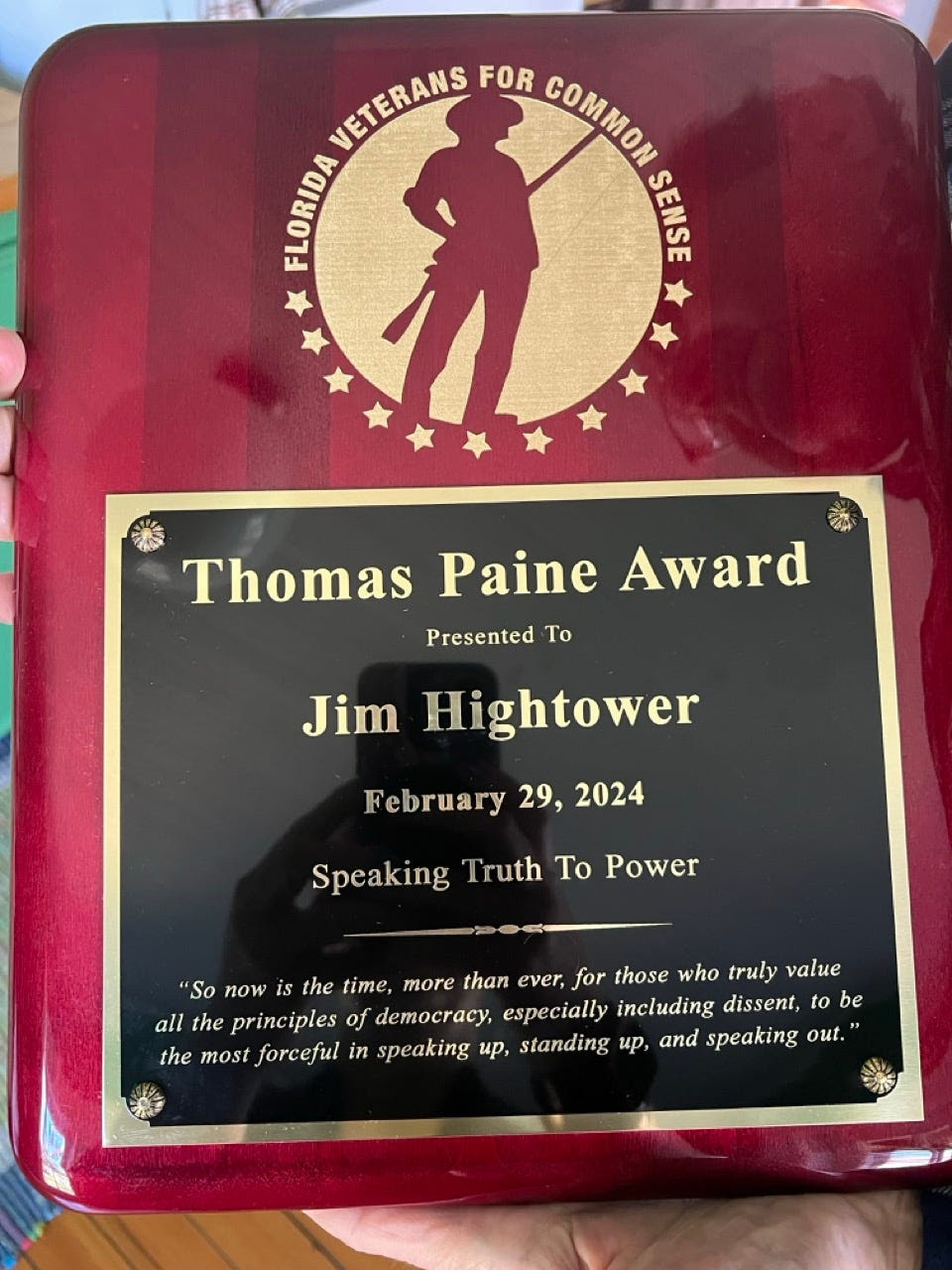
PS, from the staff— Hightower was recently give the Thomas Paine award by the Florida Veterans for Common Sense, where he learned a ton about Paine that he never knew. Hence the inspiration for this commentary! Thanks FLVCS!
Jim Hightower’s Lowdown is a reader-supported publication. To receive new posts and support my work, consider becoming a free or paid subscriber.

Thanks again for being a paid subscriber to the Lowdown. If you like the work we do here, please consider referring your friends— you’ll earn credits towards your own subscription when they sign up.
Or consider giving the gift of agitation! A Lowdown subscription makes a great gift:
Give a gift subscriptionLIKECOMMENTRESTACK
© 2024 Jim Hightower
PO Box 40446 Austin TX 78704
Unsubscribe


 Diane Ravitch's blog
a “crapulous mess” I so want to use that!
Jim Hightower & Molly Ivans are both Texas legends whose insight & wit will stay with us forever.
LikeLike
Paine was ahead of his time with his egalitarian beliefs and support for governance free from religious influence. He was perhaps the original progressive. We need more leaders dedicated to these ideals today.
LikeLike
On another topic that has been featured on this blog in recent days, here’s what I wrote here about NAEP and the supposed Covid-related “learning loss” back in July of 2023:
About “Misinterpretation of NAEP Scores”
Let’s assume just for giggles that these tests actually measure what they purport to measure—reading and math ability.
Possible scores on a NAEP test range from 0 to 500. These are 500-point tests. Average NAEP scores for Grade 9 students in 2022 declined 5 points in reading and 7 points in mathematics compared to 2020. So, we’re talking declines of 1 percent and 1.4 percent.
1 to 1.4 percent. Barely a tick on the dial. A TINY blip. I mean, declines SO SMALL that they might be well within the margin of error of the testing.
MUCH ADO ABOUT ALMOST NOTHING.
To put this into perspective, suppose that you had a grading scale like this for a classroom test:
A+ (97–100), A (93–96), A- (90–92), B+ (87–89), B (83–86), B- (80–82), C+ (77–79), C (73–76), C- (70–72), D+ (67–69), D (65–66), D- (below 65)
A decline of 1 percent would not even, typically, move you down a portion of a letter grade. Oh, gosh, I dropped from a 99 to a 98 (from an A+ to a slightly lower A+), from an 88 to an 87 (from a B+ to a slightly lower B+). Or, worst case, from an 87 to an 86 (from a B+ to a B).
Oh, the horror!!! Where are the smelling salts? The sky is falling! This is the end!!!! Quick, call Bill Gates! He has the solution to every problem, even ones this dire!!! Maybe ChatGPT can solve this biggie? Or Clippy the Paperclip! It’s surely going to take a long time to recover! The sky is falling! The sky is falling! Aie yie yie. Ridiculous.
Yet journalists and pundits keep on talking about this as though this “decline” (oh, the horror!) were significant.
It’s not.
LikeLike
As much as I care about the illegitimacy of high stakes test scores and the ramifications of all standardized testing, I think we need to stay on topic.
LikeLike
And you have appointed yourself the speech police?
LikeLike
My comment addresses an issue raised several times recently on this blog.
LikeLike
I agree, btw, that often threads on this blog have been, in the past, hijacked for unrelated purposes, and I do commend your desire to end that. But it’s a different matter, I think, to raise issues here that are and have been of widespread common interest among blog readers.
LikeLike
Nothing personal intended, Bob. I would take personally critical comments personally if anyone here other than Diane had ever actually met and spoken to me in person. Who is Left Coast Teacher, really? Only Diane and I have the faintest idea. This is the internet. It is impersonal. I’ve learned over the years, especially recently, not to invest my self (two words) too much here.
In such a situation, posting comments without using my real name, I could easily slip into the throes of anonymous internet spite, hurting others and myself. What keeps me from allowing it to happen, usually, is my username. I’m a teacher. I represent my profession to the best of my ability. And I strive to discuss ideas, not people, only hurling insults at disturbingly wealthy, publicly self-aggrandizing people named Broad, Gates, Walton, and the like.
Please take no offense at my suggestion. None was intended or, for that matter, possible. How could I be angry with you? I don’t even know you.
LikeLiked by 1 person
I personally should do a better job of editing, personally.
LikeLike
You’re fine. Sorry about the testiness.
LikeLike
Credit where credit is due, the Republican handlers, not MAGA, they’re the Handled, but Hillsdale College, Heritage Foundation, AIPAC (foreign policy), Corporate Lobbies, AEI, Cato, etc., have done a masterful job in controlling/owning the information (Corporate News) & in dismantling Public Education. In this, they’ve controlled the message & our ability to recognize what is best for our nation, communities & even our very personhood. To combat this, we might consider Paine’s method, up close & personal, not in phone calls, door knocking, yard signs, or even protesting in groups but in small groups, conversation circles v. Town Halls of less than 6 people at a time focused on ONE issue at a time. No preaching, not even politicking, just the issueconcern, the facts/stats & current proposals. ?
LikeLike
One Achilles Heel of Thomas Paine was his anti – Semitism .i know he was an agnostic , but his animus toward Hews went beyond being an agnostic to anti – Semitism .
As a Jewish American, I applaud all he did fir our country and “ accept” that everyone has a flaw ; or two ) .
LikeLike
Hi Diane (if I might),
Thank you for this (and for your piece the other day about Judge Rosenman at the opera). I enjoy your blog, and have also been delving into your books about education and civil society (collection), national educational standards, public education, and national standards, as I write a comparative study of civic education in Germany and the U.S., per below.
As to Paine, I thought Hightower’s treatment was a little thin, at least for my taste. Much more satisfying is Jill Lepore’s essay on “The Age of Paine” in her excellent 2012 Story of America – Essays on Origins (largely from the NYorker). What a quirky, weird, contradictory, and (IMO) brilliant guy Paine was!
Much more to say about national standards, Center for Civic Education vs National Center for History in the Schools, if you are interested in corresponding on that topic.
Best regards,
Chris Witteman San Francisco, CA
Book Synopsis:
In Search of the Missing Citizen, or Teaching Democracy in an Era of Social Media — How a Little-Known Civics Program Born in a Divided Germany Could Save Democracy in the USA.
(cc) Chris Witteman
January 6, 2021 was a wake-up call for American democracy. We watched in disbelief as breaking-and-entering substituted for political discourse. Alarming yes, but it should not have been a surprise. For over 50 years a chorus of voices, from Supreme Court Justices (Sandra Day O’Connor foremost among them) to legislators, teachers, and parents have cautioned that civic literacy was lacking and students were unprepared to meaningfully participate in government.
This book takes the Federal and State Centers for Civic Education in Germany as an object lesson in the possibilities and problems of educating for democracy in a pluralistic society. The German programs receive substantial public monies – estimated at over € 1 billion/year — yet their work is largely unknown in the U.S. (ironic as it was the U.S. and its Alies who first insisted on such programs 75 years ago). Coordinated federal, state, and extracurricular programs immediately distinguish their effort from the underfunded and fragmented offerings passing for civic education in the U.S.
At its core, German education for democracy is about discourse, debate, and pluralism. It addresses not just the inheritance of the Nazi era, but also the legacy of 40 years of authoritarian socialism in East Germany, and the prejudices evoked by the millions of newly arrived asylum-seekers (not to mention the prejudices within those populations, many from countries without strong democratic traditions). It takes up the problems of the digital age – disinformation, group polarization, algorithmic manipulation, information asymmetry – that frame democratic discourse today. Although these are contentious issues, German civic educators move toward them rather than away. Their embrace includes critics of the education system itself; fostering multi-perspective conversation is a key part of the program. Civic education becomes an all-purpose engine of social integration, necessary but not itself without controversy.
The book evaluates (to the extent possible) what works, what doesn’t, what might be suitable for import into the American education system, what not. It builds on my previous work in comparative constitutional law, relating to another pillar of post-war German democracy, public broadcasting (https://papers.ssrn.com/sol3/cf_dev/AbsByAuth.cfm?per_id=1372934 https://papers.ssrn.com/sol3/cf_dev/AbsByAuth.cfm?per_id=1372934). Finally, it investigates how perennial issues in civic education — legitimacy, balance, inclusiveness – have been addressed by German educators. A more complete summary is available
>
LikeLiked by 1 person
A truly fascinating topic. Civics education is SOOOOO important!
LikeLike
Best of luck with your book, btw! Keep us informed on your progress.
LikeLike
I agree about Thomas Paine and that Gov Abbott is the direct antithesis to enlightenment, but cannot overlook Ben Franklin if we’re comparing enlightened thinkers.
LikeLike
YES!!!! There was a fellow way, way ahead of his time.
LikeLike
Yes indeed! Franklin’s autobiography is the first volume of the Harvard Classics, the Five Foot Shelf, which I acquired from Diane. It’s a great read. Franklin was selfless. He’s my hero of ideas. Lately, I’ve been reading Louis Pasteur in Volume 38, which is downright entertaining.
LikeLike
I haven’t read Pasteur. Thanks for the recommendation!
LikeLike
LCT,
I am so happy that you are enjoying Eliot’s 5-foot shelf! It’s way better than the Library of America. Every book is timeless. I know the collection is in good hands. I should mention that you acquired it in an online auction in which the proceeds went to NPE.
LikeLike
The Five-Foot Shelf has some great stuff in it, but some of the choices are weird. Only someone with a specialist interest in the history of mathematics would want a copy of Euclid’s Elements. Not a place for learning geometry today. The Library of America is outstanding. I wish I could afford to buy every volume in it! ROFL.
LikeLike
The Five Foot Shelf is a history lesson.
I never met my grandfather for whom I was named. He died of a heart attack playing handball when my mother was sixteen. He was a Mason. He was a Jewish American soldier and a POW of the Nazis in WWII. He spoke German, among other languages, and survived the prison camp because of it (long story). One day, hopefully a long time from now, when my mother dies, I will receive his gold Mason ring from her. It will be my most prized possession. It will remind me of who I am. In the meantime, my most prized possession is the Five Foot Shelf. It’s not so important, the value of the asset; it’s that I gave $600 to NPE and got it from my hero, Diane. It reminds me of who I am. And it’s a great history lesson. It’s enlightening.
The irony of this reply is that we’ve wandered off topic together, again. Haha.
LikeLike
xoxoxoxoxoxo!!!!
LikeLike