Archives for the year of: 2023

The Miami Herald editorial board published the following editorial about the end of meaningful gun control in Florida. Elect DeFascist and every American will be armed or fearful of leaving their home. This is a way to erode trust among citizens. Which lunatic bought a gun? Who’s packing heat? You? You? You?

Anyone with good sense in Florida is dreading July 1.

That’s the day when the state starts allowing people over the age of 21 to carry a concealed weapon without a permit and without any gun training — at all.

It’s the terrible law that Florida Gov. Ron DeSantis and the complicit Legislature pushed through this session as they piled aboard the DeSantis-for-president train, intent on giving the governor the rightest of far-right of platforms to run on, in the hope of siphoning support from Donald Trump.

Florida isn’t the only state to do it. In fact, it’s the 26th, joining Kentucky, Alabama, Maine and Texas, among others.

But in a state that spawned the “Florida man” meme, lowering restrictions on guns is crazy. And scary.

You don’t have to look far to see why. Just a few weeks ago, on June 15, a Dunedin man emptied his assault rifle at a pool cleaner he thought was an intruder.

It was around 9 p.m., and the man and his wife were watching a movie when they heard noises coming from their patio and saw a man walking around their pool. They said they yelled at him to go away and told deputies that they didn’t recognize him.

The wife, sensibly, called 911. The husband got his gun. He saw a flashlight and fired into the back yard — from behind his couch, through closed blinds.

lIt was their 33-year-old pool cleaner who had been cleaning their pool for at least six months and was running behind schedule.

He wasn’t hit by a bullet, only glass and shrapnel. And of course, he ran. But the homeowner, with the blinds closed, thought someone was still outside. So, as video footage shared by the local sheriff shows, almost a minute after the cleaner ran from the pool deck, the man emptied the magazine of his rifle into the back yard. He shot a total of 30 rounds in about 90 seconds. Stray bullets were found on the shuffleboard court behind the couple’s home.

Will the homeowner face charges? Under Florida’s existing “stand your ground” law, which allows a homeowner to fire at someone he thinks is a threat, apparently not.

Sheriff Bob Gualtieri of the Pinellas County Sheriff’s Office offered the right assessment of the situation in a June 26 news conference: “It’s probably one of those things that I would call lawful but awful.”

And now we will have “permitless carry” in Florida. With it, no doubt, will come more “lawful but awful” situations. And deadly ones, too.

Can’t wait for July 1.

Peter Greene writes here about the latest news from Pennsylvania, where he lives. The Republican-dominated state senate passed a voucher bill. Newly elected Democratic Governor Josh Shapiro has said he supports vouchers. He’s getting lots of kudos from Rightwingers. Is this why we was elected? It’s now up to House Democrats, who have a sliver majority, to stop this giveaway to private and religious schools.

Peter Greene writes:

Choicers in Pennsylvania are so close they can taste it, and everyone has come off the bench to help push this newest bill past a governor who has said he likes vouchers just fine—under certain condition. This is from my piece from Forbes.com this morning.

Democrat Josh Shapiro made no secret of his support for school vouchers when he was campaigning for the Pennsylvania governor’s seat. Now conservatives are pushing him to put that support to work.

The Senate passed the newest school voucher bill Thursday night; House Democrats say that it will not advance. Supporters are still hoping that it can be saved in the budget process.

The Lifeline Scholarship Program has been kicking around Harrisburg in a variety of bills that presented a variety of school voucher formats as voucher supporters looked for a version that would garner enough support to pass. The current iteration is a traditional school voucher, essentially a taxpayer funded tuition subsidy for students attending private schools.

Under this bill, students in the lowest 15% of schools in the commonwealth (as determined by standardized test scores) would be eligible.

The vouchers, named a top priority by Pennsylvania’s GOP, have become a key part of the current budget negotiations in the state that is already under a court order to fix its funding system for public schools.

The voucher system would be a chance for school voucher proponents to get their foot in the door, an especially tasty victory in a state with a Democratic governor. To add to the pressure to pass, a coalition of right wing voucher fans has sent Shapiro a letter arguing for the voucher program.

Open the link to the article to find the link to the entire article in Forbes.

Michigan is in track to make record investments in the quality of life for children and schools.

My friend Mitchell Robinson, a member of the State board of education, shared the following good news:

The State of Michigan passed a third consecutive historic education budget last night—and did so with bipartisan support, meaning the changes included in this budget can go into effect immediately.

It’s amazing to see what a state education budget can look like when you have pro-education legislators in charge–and teachers chairing the House and Senate Education Committees and the Senate Appropriations Subcommittee on PreK-12.

The budget includes:

•universal school meals

•foundation allowance increase of 5% — the largest in state history

•fully funded special education programs

•expanded Pre-K programs

•student teacher stipends for K-12

The budget also appropriates $11 million to a K-5 Music Education Pilot Program that provides funding to school districts that currently do not have elementary music instruction to hire certified music teachers.

Budgets are about more than dollars—they are moral documents; and in Michigan we are showing that we value our children, our families, and our future by directing funding to programs and initiatives that strengthen our schools and communities.

edbudget2023.jpeg

In a decision handed down today, the United States Supreme Court banned the use of race-based affirmative action in college admissions. The six conservative justices voted for the decision, the three moderate-liberal justices voted against it.

The media coverage stresses the likelihood that entrants to elite universities will become more Asian and more white, because of reliance on standardized tests, where those two groups typically have higher scores.

But we do not yet know how much it matters to eliminate official policies of affirmative action.

Most colleges in this country admit everyone who applies, so the elimination of affirmative action won’t change anything for them.

The elite colleges have many more applicants than openings. This is where the elimination of affirmative action is expected to matter. The top colleges often have five or ten times more applicants than spaces.

But selective colleges don’t rely solely on standardized test scores to fill their freshman class. They consider a variety of factors, including grade point average, the student’s participation in non-academic activities, students’ essays, and other factors. They may give preferences to fill their athletic teams, to provide enrollment for all majors, to recruit talented musicians, to accept “legacy” students, the children of alums.

In addition, growing numbers of selective colleges are test-optional, so the tests don’t matter for them.

After nearly 50 years of affirmative action, most elite colleges have internalized the norms of equity, diversion and inclusion. They have welcomed the diversification of faculty, students, and staff. How likely are they to abandon those norms? Not likely, in my view.

My own undergraduate college is led by a very respected African American woman; the director of admissions is also an African American woman. Harvard University has a new president, an African American woman. I doubt that the ethnic profiles of such institutions will change much if at all.

Conservatives have forgotten that President Richard Nixon started affirmative action. That decision was hotly debated but never abandoned until now. At the time, in the late 1970s, I questioned a system that gave points for skin color but in retrospect, I think Nixon’s policy was a great success. It generated a significant number of Black professional. That’s good for Anerican society.

I doubt that the decision today will curtail access to higher education for Black students, not even in the elite colleges that are the target of today’s decision. Diversity, equity and inclusion have become the norm.

Paul Bowers, who covered education for the Charleston Post and Courier, writes on his blog Brutal South about deteriorating working conditions for the state’s teachers. Class sizes are rising, and the state has chosen to divert funding from the public schools.

Compared to 15 years ago, South Carolina public school teachers are doing more work, administering more tests with higher stakes, for wages that increasingly get eaten by inflation, under intensifying scrutiny from aggrieved political actors — and in many cases, they’re doing it with more students than ever.

The last time I looked into the growth of K-12 classroom sizes in my state was 2019, and the picture was bleak. While state regulations1 set strict limits on student-teacher ratios in most types of classrooms, the state legislature had started granting waivers to those caps during the Great Recession and had not resumed enforcement.

Predictably, median classroom size soared as the state stopped funding its obligations to school districts, teachers’ promised pay increases were frozen, and teachers quit the profession faster than the colleges of education could graduate new ones. When I wrote about the trend for The Post and Courier in 2019, classroom sizes had begun to shrink but were still significantly larger than they were in the 2007-08 academic year…

I’m a graduate of South Carolina public schools who sends his kids to South Carolina public schools, and despite the bad headlines and flagging test scores, I’ve seen firsthand how our education system can change people’s lives for the better. I’m certainly better for it, and my own kids are flourishing.

But after a decade-and-a-half of austerity and a century-and-a-half of backlash to the universal public good of education in South Carolina, I’m left wondering how many more hits the system can take….

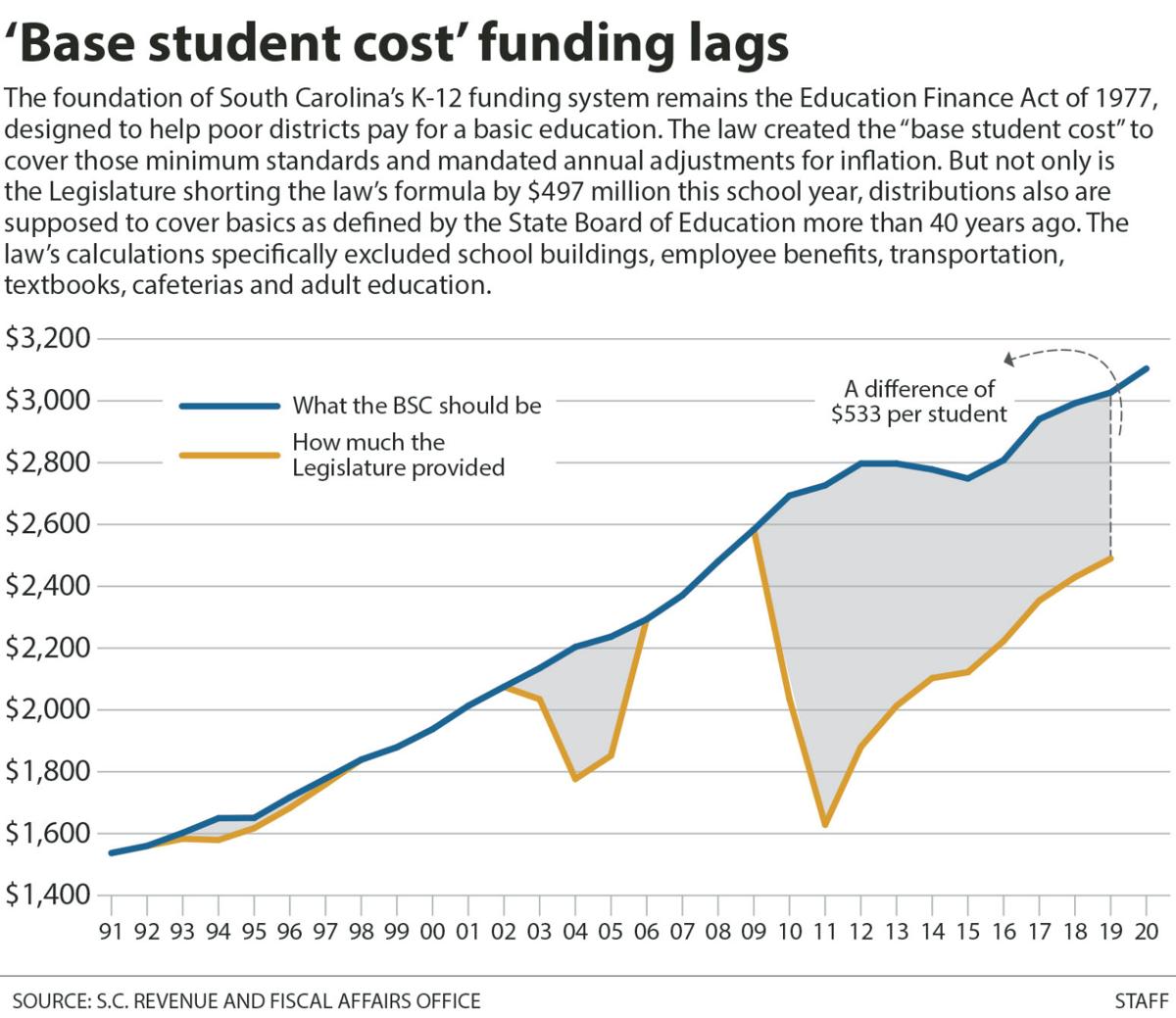
South Carolina Gov. Mark Sanford and the Republican-controlled legislature kneecapped school funding in 2006 with a tax handout to homeowners (Act 388) that routinely wrecks school revenues during economic downturns. As metropolitan school districts have grown thanks in part to an influx of workers for manufacturing concerns like Boeing, Volvo, and BMW, county governments have handed those employers massive tax incentives that cheated schools out of $2.2 billion in the last 5 years alone. And the legislature has not funded its own legally mandated Base Student Cost to districts since 2009, flagrantly violating the law every time it passes a budget — with outsize effects in our poorest rural districts.

Clearly, the leaders of the state don’t understand that their penuriousness towards the schools will hurt the next generation and the future of the state. They think in the moment. They forget about the future. They can attract corporations with a low-wage, non-union workforce, but they can’t build a thriving state unless they educate all the children.

I discovered Diane Franscis’s blog while reading the latest Robert Hubbell. She writes here what many people suspected: Russia is controlled by a ruthless gang. In this country, we call them the mafia. In Russia, they are the government.

She writes:

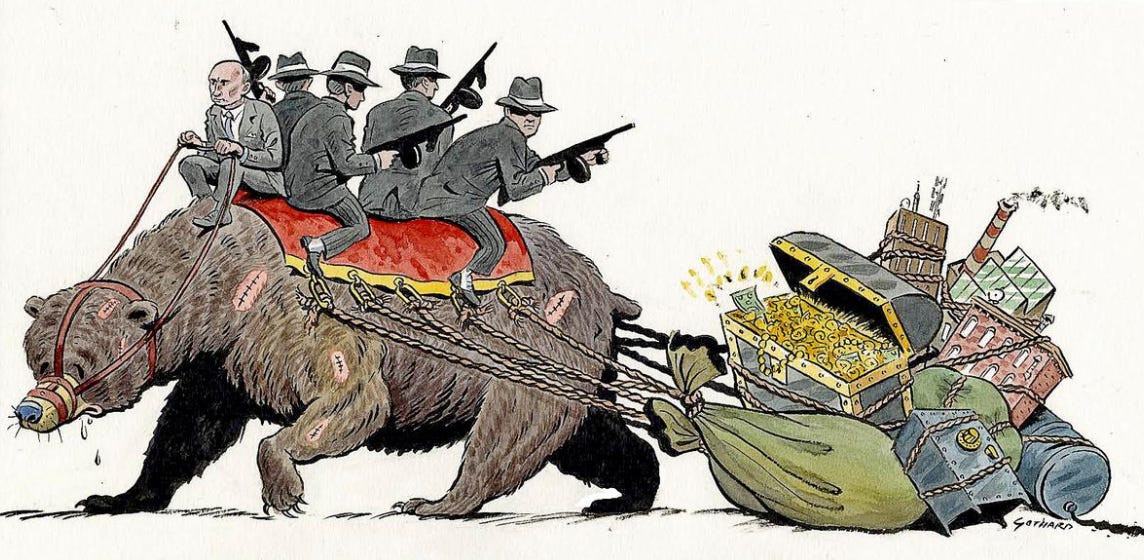
The bizarre events in Russia over the weekend provide a glimpse into the reality that the country is not a nation, but an empire with warring factions that is run by a mafia. Vladimir Putin has reigned as the “Boss” for 23 years and remained in place by enriching Russia’s thugs, bridling them, and playing one off against another. Under his rule, they have built palaces, stolen the national wealth, become warlords, amassed staggering portfolios, and lived like Czars. But on February 24, 2022, Putin decided to escalate the grift by invading Ukraine to steal more of its resources. Now this war is failing, as is Russia’s economy and Putin’s grip on power. And on June 23, Putin’s inability to control a wartime feud between warlord Yevgeny Prigozhin and Russia’s military brass turned into a full-blown armed mutiny. Prigozhin pulled his mercenaries from the frontline in Ukraine and led a “march for justice” against Putin’s military inside Russia. Putin labeled Prigozhin a “traitor” on national television, ordered his arrest, then instructed his puppet in Belarus, Aleksandr Lukashenko, to make an offer to Prigozhin that he couldn’t refuse: Stand down, charges would be scrapped, and move to Minsk. The crisis ended quickly, but Putin, the Russian Federation, and the war in Ukraine, will never again be the same.

Putin and the gangsters. David Gothard. WSJ

Prigozhin grew up in St. Petersburg, where Putin did, and went to jail as a young man for fraud and theft. He has since become a billionaire oligarch as a result of his connections to Putin and business smarts. More recently, he has become a household word in Russia because of the success of his personal army, the Wagner Group mercenaries, as well as his diatribes on social media against Russia’s generals. He has accused them of poor strategies, corruption, and of using Russian soldiers as cannon fodder. His gutsy stances have made him a populist hero even though he is also a member of the elite. But Prigozhin is different. He’s gone “native” and dons fatigues, is on the frontlines with his mercenaries in the Ukrainian war zone, and excoriates Putin’s generals for drafting young Russians from poor families and regions then sending them to their deaths by the thousands without training or proper equipment.

“The children of the elite smear themselves with creams, showing it on the internet; ordinary people’s children come in zinc, torn to pieces,” said Prigozhin, a reference to metallic coffins. “Those killed in action had tens of thousands of relatives, and society always demands justice and, if there is no justice, then revolutionary sentiments arise.”

Prigozhin warns of revolution but is not a revolutionary. He became a successful chef, then caterer and started a mercenary army that has operated for years surreptitiously around the world on Putin’s behalf. For instance, Wagner helped Putin occupy Crimea and Donbas in 2014, it fought in Syria and various African countries for Moscow for years, and has been involved in the 2022 invasion, fighting alongside Russian regulars in Ukraine. But last year he began to aggressively criticize Russia’s Minister of Defense, Sergei Shoigu, and Chief of General Staff, Gen. Valery Gerasimov and Putin never intervened. This was because he was doing Putin’s dirty work again and blaming the generals for military failures. But Shoigu and Gerasimov struck back by sabotaging the Wagner Group on the battlefield. Prigozhin claimed they withheld ammunition and provided only sub-standard equipment. Then, last month, he alleged that the two actually shelled Wagner troops.

By June, Prigozhin’s success in the battlefield and growing social media presence across Russia and abroad was becoming a threat, so Putin sided with his generals. He ordered Wagner fighters to sign contracts with the Ministry of Defense by July 1. This represented a de facto expropriation which is why Prigozhin pulled his troops from the front line in Ukraine on June 23 and marched them into Russia. That night, Putin condemned Prigozhin on state television and ordered Lukashenko to deliver the deal. Putin has not surfaced since June 24, and unconfirmed reports are that he fled Moscow.

A coup or armed conflict was avoided, but damage was done. Putin’s climb-down and capitulation to a man he had just called a “traitor” destroyed his tough-guy image. It’s obvious that he is not the “Boss”, but merely a figurehead who sits atop a rotten system of squabbling and greedy oligarchs. Prigozhin’s stunt also unveiled Russia’s vulnerability. He was able to march two-thirds of the way toward Moscow in a few hours without resistance. His troops also reportedly shot down six Russian helicopters and an IL-22 airborne command-center plane, killing 13 airmen, along the way, without consequences.

Prigozhin backed down and agreed to self-exile, but he’s not going to disappear, except physically. The generals he demanded that Putin fire still remain in power so he will continue to broadcast his criticisms from afar and plot a comeback, either from a dacha somewhere around the world or on a yacht. He will rebuild Wagner and may attract allies inside and outside Russia who want to overthrow Putin and his generals. He may aspire to be President but that is unlikely. He would be thoroughly unsuitable as President, but, unless assassinated, his ongoing crusade will be a catalyst for change inside Russia and serve the interests of Ukraine and the West. Prigozhin has already undermined Russia’s leadership, damaged frontline morale, stirred up the public, and shredded Putin’s concocted narrative that the invasion was necessary because Ukraine and NATO were a threat to Russia’s existence.

There’s little likelihood that a grassroots movement against Moscow will sprout around Prigozhin because it is a reign of terror and because he’s another thug whose forces have killed many Ukrainians and others. But his popularity was rising in polls before his armed mutiny because his rants resonated with civil society, mostly younger people. He also attracted international recognition with his condemnation of the war itself in the days leading up to the confrontation: “The war wasn’t needed to return Russian citizens to our bosom, nor to demilitarize or denazify Ukraine,” he said. “The war was needed so that a bunch of animals could simply exult in glory.”

The weekend’s events may not have brought about regime change, but Prigozhin has already dealt Putin, and Russia as currently constituted, a fatal blow. As the war continues to backfire, Ukraine and its alliance will push harder and so will separatist movements inside Russia who want autonomy or secession. Putin’s weakness is now apparent, and his tenure uncertain, which will also convince neighboring nations and Russian allies to recalibrate their relationship or forge new ones. Most significantly, Putin’s cave-in and cowardice concerning Prigozhin also means that his many “red lines” in this war are meaningless which is why many have been crossed and more should be ignored in future.

It is ironic that Prigozhin has opened a Pandora’s Box about corruption and injustice in a country run by criminals like himself. His lightning attack also raises fears internationally as to how secure Russia’s nuclear arsenal is from seizure by disgruntled factions such as Wagner or others. Experts say the events haven’t altered the security status of Russia’s nuclear weapons, and the West carefully monitors their movement and storage facilities.

But the country is run by gangsters who have upended the world order. Only “100 beneficiaries and several thousand accomplices” own everything, said Mikhail Kodorovsky, an oligarch jailed by Putin in 2005 on trumped-up charges. “Most of these people began their careers in the criminal underworld of St. Petersburg. Despite having now taken control of the Presidency, the group retains every aspect of the criminal ilk from which they came.”

Putin’s Russia is a criminal organization that must be overthrown. And finally, one of its own has told the world, and Russian people, why it must disappear.

Last Saturday, we awoke to news that the mercenary Wagner Group was marching to Moscow. For a few hours, it seemed that there was a coup in the making. The Wagner troops did not encounter any resistance. They shot down several Russian helicopters. But suddenly the leader of the Wagner Group announced that he had struck a deal with the president of Belarus, and the advancing army turned back, only 120 miles from Moscow.

There are two articles that helped explain the odd series of events. One was written by Anne Applebaum in The Atlantic. When the Wagner Group rolled into Rostov-on-Don, there was no resistance. People brought them drinks and treats. She says that Putin had cultivated a sense of apathy among the Russian people. One man has been in office for 23 years and will remain in office for the next 13 years. Unless he wants to stay longer. Since the people have no say in how the nation is governed, why get involved? And so no one sprang to defend Putin.

Timothy Snyder is always worth reading. He is a professor of European history at Yale University. This post appeared on his blog.

He writes:

How to understand Yevgeny Prigozhin’s march on Moscow and its sudden end? Often there are plots without a coup; this seemed like a coup without a plot. Yet weird as the mercenary chief’s mutiny was, we can draw some conclusions from its course and from its conclusion.

1. Putin is not popular. All the opinion polling we have takes place in an environment where his power is seen as more or less inevitable and where answering the question the wrong way seems risky. But when Putin’s power was lifted, as when the city of Rostov-on-Don was seized by Wagner, no one seemed to mind. Reacting to Prigozhin’s mutiny, some Russians were euphoric, and most seemed apathetic. What was not to be seen was anyone in any Russian city spontaneously expressing their personal support for Putin, let alone anyone taking any sort of personal risk on behalf of his regime.

The euphoria suggests to me that some Russians are ready to be ruled by a different exploitative regime. The apathy indicates that most Russians at this point just take for granted that they will be ruled by the gangster with the most guns, and will just go on with their daily lives regardless of who that gangster happens to be.

2.  Prigozhin was a threat to Putin, because he does much the same things that Putin does, and leverages Putin’s own assets.  Both the Russian state itself and Prigozhin’s mercenary firm Wagner are extractive regimes with large public relations and military arms.  

The Putin regime exists, and the cities of Moscow and St. Petersburg are relatively wealthy, thanks to the colonial exploitation of hydrocarbon resources in Siberia.  The wealth is held by a very few people, and the Russian population is treated to a regular spectacle of otherwise pointless war — Ukraine, Syria, Ukraine again — to distract attention from this basic state of affairs, and to convince them that there is some kind of external enemy that justifies it (hint: there really isn’t).  

Wagner functioned as a kind of intensification of the Russian state, doing the dirtiest work beyond Russia, not only in Syria and Ukraine but also in Africa.  It was subsidized by the Russian state, but made its real money by extracting mineral resources on its own, especially in Africa.  Unlike most of its other ventures, Wagner’s war in Ukraine was a losing proposition.  Prigozhin leveraged the desperation of Russia’s propaganda for a victory by taking credit for victory at Bakhmut.  That minor city was completely destroyed and abandoned by the time Wagner took it, at the cost of tens of thousands of Russian lives.  

But because it was the only gain in Russia’s horrifyingly costly but strategically senseless 2023 offensive, Bakhmut had to be portrayed by Putin’s media as some kind of Stalingrad or Berlin.  Prigozhin took advantage of this. He was able to direct the false glory to himself even as he then withdrew Wagner from Ukraine.  Meanwhile he criticized the military commanders of the Russian Federation in increasingly vulgar terms, thereby preventing the Russian state (and Putin) from gaining much from the bloody spectacle of invaded Ukraine.  In sum: Wagner was able to make the Putin regime work for it.

3.  Prigozhin told the truth about the war.  This has to be treated as a kind of self-serving accident: Prigozhin is a flamboyant and skilled liar and propagandist.  But his pose in the days before his march on Moscow made the truth helpful to him.  He wanted to occupy this position in Russian public opinion: the man who fought loyally for Russia and won Russia’s only meaningful victory in 2023, in the teeth of the incompetence of the regime and the senselessness of the war itself.  

I’m not sure enough attention has been paid to what Prigozhin said about Putin’s motives for war: that it had nothing to do with NATO enlargement or Ukrainian aggression, and was simply a matter of wishing to dominate Ukraine, replace its regime with a Moscow-friendly politician (Viktor Medvedchuk), and then seize its resources and to satisfy the Russian elite.  Given the way the Russian political system actually works, that has the ring of plausibility.  Putin’s various rationales are dramatically inconsistent with the way the Russian political system actually works.

4.  Russia is far less secure than it was before invading Ukraine.  This is a rather obvious point that many people aside from myself have been making, going all the way back the first invasion of 2014.  There was never any reason to believe, from that point at the latest, that Putin cared about Russian national interests.  If he had, he would never have begun a conflict that forced Russia to become subordinate to China, which is the only real threat on its borders.  Any realist in Moscow concerned about the Russian state would seek to balance China and the West, rather than pursue a policy which had to alienate the West.  

Putin was concerned that Ukraine might serve as a model.  Unlike Russians, Ukrainians could vote and enjoyed freedom of speech and association.  That was no threat to Russia, but it was to Putin’s own power.  Putin certainly saw Ukraine as an opportunity to generate a spectacle that would distract from his own regime’s intense corruption, and to consolidate his own reputation as a leader who could gather in what he falsely portrayed as “Russian” lands.  But none of this has anything to do with the security of Russia as a state or the wellbeing of Russians as a people.  

The Putin of 2022 (much more than the Putin of 2014) seems to have believed his own propaganda, overestimating Russian power while dismissing the reality of the Ukrainian state and Ukrainian civil society — something no realist would do. That meant that the second invasion failed, and that meant (as I wrote back in February 2022) that it would give an opportunity to a rival warlord. Prigozhin was that warlord and he took that opportunity. This might have all seemed abstract until he led his forces on a march to Moscow, downing six Russian helicopters and one plane, and stopping without ever having met meaningful resistance. To be sure, Wagner had many advantages, such as being seen as Russian by locals and knowing how local infrastructure worked. Nevertheless, Prigozhin’s march shows that a small force would have little trouble reaching Moscow. That was not the case before most of the Russian armed forces were committed in Ukraine, where many of the best units essentially ceased to exist.

5.  When backed into a corner, Putin saves himself.  In the West, we worry about Putin’s feelings.  What might he do if he feels threatened?  Might he do something terrible to us?  Putin encourages this line of thinking with constant bluster about “escalation” and the like.  On Saturday Putin gave another speech full of threats, this time directed against Prigozhin and Wagner.  Then he got into a plane and flew away to another city.  And then he made a deal with Prigozhin.  And then all legal charges against Prigozhin were dropped.  And then Putin’s propagandists explained that all of this was perfectly normal.  

So long as Putin is in power, this is what he will do.  He will threaten and hope that those threats will change the behaviour of his enemies.  When that fails, he will change the story.  His regime rests on propaganda, and in the end the spectacle generated by the military is there to serve the propaganda.  Even when that spectacle is as humiliating as can be possibly be imagined, as it was on Saturday when Russian rebels marched on Moscow and Putin fled, his response will be to try to change the subject.  

It is worth emphasizing that on Saturday the threat to him personally and to his regime was real.  Both the risk and the humiliation were incomparably greater than anything that could happen in Ukraine.  Compared to power in Russia, land in Ukraine is unimportant.  After what we have just seen, no one should be arguing that Putin might be backed into a corner in Ukraine and take some terrible decision.  He cannot be backed into a corner in Ukraine.  He can only be backed into a corner in Russia.  And now we know what he does when that happens: record a speech and run away.

(And most likely write a check. A note of speculation. No one yet knows what the deal between Putin and Prigozhin was. There are rumblings in Russia that Sergei Shoigu, Prigozhin’s main target, will be forced to resign after accusations of some kind of corruption or another. There are reports that Prigozhin was given reason to be concerned about the lives of his own familymembers and those of other Wagner leaders. I imagine, personally, that one element was money. On 1 July, Wagner was going to cease to exist as a separate entity, at least formally speaking. It like all private armies was required to subordinate itself to the ministry of defense, which is to say to Shoigu. This helps to explain, I think, the timing of the mutiny. Were Wagner to cease to function as before, Prigozhin would have lost a lot of money. It is not unreasonable to suppose that he marched on Moscow at a moment when we still had the firepower to generate one last payout. Mafia metaphors can help here, not least because they are barely metaphors. You can think of the Russian state as a protection racket. No one is really safe, but everyone has to accept “protection” in the knowledge that this is less risky than rebellion. A protection racket is always vulnerable to another protection racket. In marching from Rostov-on-Don to Moscow, Prigozhin was breaking one protection racket and proposing another. On this logic, we can imagine Prigozhin’s proposal to Putin as follows: I am deploying the greater force, and I am now demanding protection money from you. If you want to continue your own protection racket, pay me off before I reach Moscow.)

6.  The top participants were fascists, and fascists can feud.  We don’t use the term “fascist” much, since the Russians (especially Russian fascists) use it for their enemies, which is confusing; and since it seems somehow politically incorrect to use it.  And for another reason: unlike the Italians, the Romanians, and the Germans of the 1930s, the Putin regime has had the use of tremendous profits from hydrocarbons, which it has used to influence western public opinion.  All the same, if Russia today is not a fascist regime, it is really difficult to know what regime would be fascist.  It is more clearly fascist than Mussolini’s Italy, which invented the term.  Russian fascists have been in the forefront of both invasions on Ukraine, both on the battlefield and in propaganda.  Putin himself has used fascist language at every turn, and has pursued the fascist goal of genocide in Ukraine.  

Prigozhin has been however the more effective fascist propagandist during this war, strategically using symbols of violence (a sledgehammer) and images of death (cemeteries, actual corpses) to solidify his position.  Wagner includes a very large number of openly fascist fighters.  Wagner’s conflict with Shoigu has racist overtones, undertones, and throughtones — on pro-Wagner Telegram channels he is referred to as “the Tuva degenerate” and similar.  

That said, the difference between fascists can seem very meaningful when that is all that is on offer, and it is absolutely clear that many Russians were deeply affected by the clash of the two fascist camps.  That said, it is important to specify a difference between Putin and Prigozhin’s fascism and that of the 1930s.  The two men are both very concerned with money, which the first generation of fascists in general were not.  They are oligarchical fascists — a breed worth watching here in the US as well.

7.  The division in Russia was real, and will likely endure.  Some Russians celebrated when Wagner shot down Russian helicopters, and others were astonished that they could do so.  Some Russians wanted action, others could not imagine change.  Most Russians probably do not care much, but those who do are not of the same opinion.  Putin’s regime will try to change the subject, as always, but now it lacks offensive power in Ukraine (without Wagner) and so the ability to create much of a spectacle. Russian propaganda has already turned against Wagner, who were of course yesterday’s heroes. The leading Russian propagandist, Vladimir Solovyov, recruited for Wagner. The son of Putin’s spokesman supposedly served in Wagner. Although this was almost certainly a lie, it reveals that Wagner was once the site of prestige. 

It might prove hard for Russian propagandists to find any heroes in the story, since for the most part no one resisted Wagner’s march on Moscow.  If Wagner was so horrible, why did everyone just let it go forward?  If the Russian ministry of defense is so effective, why did it do so little?  If Putin is in charge, why did he run away, and leave even the negotiating to Lukashenko of Belarus?  If Lukashenko is the hero of the story, what does that say about Putin?

It is also not clear what will happen now to Wagner.  The Kremlin claims that its men will be integrated into the Russian armed forces, but it is hard to see why they would accept that.  They are used to being treated with greater respect (and getting paid better).  If Wagner remains intact in some form, it is hard to see how it could be trusted, in Ukraine or anywhere else.  More broadly, Putin now faces a bad choice between toleration and purges.  If he tolerates the rebellion, he looks weak.  If he purges his regime, he risks another rebellion.

8.  One of Putin’s crimes against Russia is his treatment of the opposition.  This might seem to be a tangent: what does the imprisoned or exiled opposition have to do with Prigozhin’s mutiny?  The point is that their imprisonment and exile meant that they could do little to advance their own ideas for Russia’s future on what would otherwise have been an excellent occasion to do so.  The Putin regime is obviously worn out, but there is no one around to say so, and to propose something better than another aging fascist.  

I think of this by contrast to 1991.  During the coup attempt that August against Gorbachev, Russians rallied in Moscow.  They might or might not have been supporters of Gorbachev, but they could see the threat a military coup posed for their own futures.  The resistance to the coup gave Russia a chance for a new beginning, a chance that has now been wasted.  There was no resistance to this coup, in part because of the systematic political degeneration of the Putin regime, in part because the kinds of courageous Russians who went to the streets in 1991 are now behind bars or in exile.  This means that Russians in general have been denied a chance to think of political futures. 

9.  This was a preview of how the war in Ukraine ends.  When there is meaningful conflict in Russia, Russians will forget about Ukraine and pay attention to their own country.  That has no happened once, and it can happen again.  When such a conflict lasts longer than this one (just one day), Russian troops will be withdrawn from Ukraine.  In this case, Wagner withdrew itself from Ukraine, and then the troops of Ramzan Kadyrov (Akhmat) departed Ukraine to fight Wagner (which they predictably failed to do, which is another story).  In a more sustained conflict, regular soldiers would also depart.  It will be impossible to defend Moscow and its elites otherwise.  Moscow elites who think ahead should want those troops withdrawn now. On its present trajectory, Russia is likely to face an internal power struggle sooner rather than later.  That is how wars end: when the pressure is felt inside the political system.  Those who want this war to end should help Ukrainians exert that pressure.

10.  Events in Russia (like events in Ukraine) are in large measure determined by the choices of Russians (or Ukrainians).  In the US we have the imperialist habit of denying agency to both parties in this conflict.  Far too many people seem to think that Ukrainians are fighting because of the US or NATO, when in fact the situation is entirely the opposite: it was Ukrainian resistance that persuaded other nations to help.  Far too many people still think the US or NATO had something to do with Putin’s personal decision to invade Ukraine, when in fact the character of the Russian system (and Putin’s own words) provide us with more than enough explanation. 

Some of those people are now claiming that Prigozhin’s putsch was planned by the Americans, which is silly.  The Biden administration has quite consistently worked against Wagner.  Prigozhin’s main American connection was his hard work, as head of Russia’s Internet Research Agency, to get Trump elected in 2016.  Others are scrambling to explain Prigozhin’s march on Moscow and its end as some kind of complex political theater, in which the goal was to move Prigozhin and Wagner to Belarus to organize a strike on Ukraine from the north.  This is ludicrous.  If Prigozhin actually does go to Belarus, there is no telling what he might improvise there. But the idea of such a plan makes no sense. If Putin and Prigozhin were on cooperative terms, they could have simply agreed on such a move in a way that would not have damaged both of their reputations (and left Russia weaker).  

Putin choose to invade Ukraine for reasons that made sense to him inside the system he built.  Prigozhin resisted Putin for reasons that made sense to him as someone who had profited from that system from the inside.  The mutiny was a choice within Putin’s war of choice, and it exemplifies the disaster Putin has brought to his country.

(PS this has been corrected to repair an autocorrection mistake in a surname. Thanks for your patience. TS 26 June 2023).

Today is the funeral of my former husband, Richard Ravitch. He died on Sunday only days before his 90th birthday.

He was a remarkable man in many ways, not only in his professional, political, and civic life but in his wide-ranging personal interests. Sam Roberts of the New York Times wrote a fulsome account of his life and accomplishments in this obituary.

His grandparents immigrated from Russia to New York City in the 1880s. They came with nothing and lived in tenements on the Lower East Side. His grandfather started a small foundry, making iron gratings, manhole covers, and other such things. Eventually, he entered the construction business and created HRH, which he later turned over to his son (Dick’s father) and son-in-law.

Dick was born in 1933. He attended the progressive Lincoln School and Fieldston School. He started college at Oberlin but transferred to Columbia College to take care of his mother when his father died at a young age. He then went to Yale Law School.

Dick’s parents revered FDR. They were liberal, progressive, and educated (his father went to Tufts, his mother to Hunter). Among their friends were artists, musicians, and writers. Dick learned to love classical music, opera, and Broadway musicals.

We met in 1959 when he was working on the staff of a Democratic congressman in Washington. We married a year later, two weeks after I graduated college. I was 21 and he was 26. We divorced in 1986. We had three sons, one of whom died of leukemia at the age of 2.

After we married, Dick joined his family’s construction company in partnership with his cousin Saul Horowitz Jr., known as JR. JR was interested in construction, Dick was interested in real estate development. As a lawyer, he mastered the federal programs that encouraged middle-income housing. That’s where he directed his energy.

While other developers built only luxury housing, Dick focused on middle-income housing. Whatever he did, he wanted to serve a social purpose. That was his FDR legacy. He wanted to make a difference. Among the buildings he developed are Waterside, on the East River in the 30s; Manhattan Plaza, moderate-cost housing for performing artists on 42nd Street; and Riverbend in Harlem. He built the first desegregated housing in Washington, D.C.

He enjoyed being a developer, but he yearned to have a life of public service. He became the guy that mayors and governors called upon whenever there was a crisis. Governor Hugh Carey asked him to run the Urban Development Corporation, which built low- and middle-income housing. At one point, Dick told me, Donald Trump came to see him about getting tax breaks for the renovation of a luxury hotel; Dick turned him down. Trump threatened to get him fired from his $1 a year job. Dick told him to do something that is anatomically impossible. He considered Trump to be an inconsequential playboy.

When the city was in the throes of a fiscal crisis in 1975, Dick was among a small number of people who helped to end it. I recall a night when Albert Shanker, president of the United Federation of Teachers, came to our home, and Dick spent hours convincing him to use the teachers’ pension funds to bail out the city. The unions saved the city. Dick was always close to labor leaders, including Shanker, Victor Gotbaum, and Lane Kirkland, head of the AFL-CIO. He always believed in the importance of organized labor.

Dick went on to lead the MTA, the state agency that oversees rail and bus transit for the entire metropolitan region. He was in his glory.

After our divorce, there was a period of estrangement but we eventually became good friends and enjoyed talking about our children, our grandchildren, and the world.

He was always very busy solving fiscal crises in different states and cities. When Eliot Spitzer resigned as governor of New York, his Lieutenant Governor David Paterson succeeded him and asked Dick to be his Lieutenant Governor, from 2009-2010.

Dick taught a course in state and municipal finance at Yale Law School right up to last year. He was a philanthropist: he established a chair in pediatric hematology at Mount Sinai on Hospital, named for the son we lost. He served on the Mount Sinai board for more than forty years. He created a program to train journalists to cover fiscal matters at the City University of New York’s Journalism School. A list of the organizations where he was a board member or president would be longer than this post.

Dick was married in 2005 to Kathy Doyle, the CEO of a major auction house. This was a marriage made in heaven. Kathy is a wonderful woman who brought great joy to Dick. She has three beautiful daughters, who adored Dick. Her daughters married and among them had nine children, who were of course his grandchildren. Adding our four grandsons, Dick had 13 grandchildren. He was thrilled to have such a large, beautiful family. And it made me happy to see that he had found a wife who was just right for him.

I mentioned his personal interests. Dick was an accomplished woodworker. He taught himself at first, then took courses. He bought wood turning equipment and heavy duty saws. He loved turning bowls and eventually made beautiful pieces of furniture, reproductions of antiques that he had seen in books. Dick and Kathy’s home is filled with his elegant handmade furniture.

His other passion was gardening. There too he made himself a master, studying the right soil composition and tending to the earth in which he planted.

Dick died just two weeks shy of his 90th birthday. He lived a full and happy life. He was loved by his family, by hundreds of friends, and by uncounted admirers. He was a man of principle and integrity. He believed that political problems could be solved by reasonable people, working things out.

These days, when our politics is so polarized and when many political figures act so unreasonably, I know how Dick would respond. Organize. Build coalitions. Support the good guys. Do what’s right for the underdog. Ignore the extremists who make compromise impossible. Progress requires give and take. Never lose sight of the goal, which is the betterment of life for all people. He loved New York City, New York State, and America, and he wanted to make them better. He was a disciple of FDR to the end.

Rest in peace, dear Richard.

Diane

Our son Joe commissioned this portrait of his father. It hangs in the halls of Yale Law School, which both Joe and Dick attended.

News from the Philadelphia Inquirer:

Can you strengthen democracy by dialogue with hate groups? The Museum of the American Revolution thinks so. I agree. But when will the dialogue occur? Not at this event.

The newspaper reports:

What you should know:

  • The Museum of American Revolution is hosting a welcome event for the controversial “parental rights” group Moms for Liberty, which is holding a four-day summit in Philadelphia this weekqqRep PPP featuring former President Donald Trump, Florida Gov. Ron DeSantis, and other speakers.
  • Seven historian groups have written their members and the museum denouncing the event and the organization.
  • Moms for Liberty is best known for its book ban efforts and calls to limit conversations about race, sexuality, and gender identity in classrooms.

Seven groups of historians have now denounced an upcoming welcome reception at the Museum of American Revolution for “parental rights” group Moms for Liberty. They’ve written their members, the museum, and one group has canceled an event they had planned at the Old City institution.

Moms for Liberty, or M4L, has made national headlines since its founding in 2021 for its efforts to lift pandemic precautions, ban books, and limit conversations about race, sexuality, and gender identity in classrooms. Earlier this month, the Southern Poverty Law Center labeled the group an “antigovernment extremist organization.”

The group is scheduled to hold a four-day sold-out summit in Philadelphia starting Thursday where aspiring school board candidates can receive training and hear from guests, including former President Donald Trump and Florida Gov. Ron DeSantis. The group says Pennsylvania has one of its largest membership bases, second only to Florida.

The museum has defended its decision to host the controversial group, arguing its mission is to share diverse and inclusive stories about the country’s history with as broad of an audience as possible and that it hopes to strengthen democracy through dialogue.

But dozens of the museum’s staffers have pushed back. The historian groups are the latest to repudiate the museum’s rationale for hosting the event, acknowledging it’s unusual for them to try to intervene in what’s essentially a space rental. Still, the groups said Moms for Liberty was not a group simply espousing different points of view. They said it has encouraged the harassment of teachers and librarians.

“This organization consistently spreads harmful, hateful rhetoric about the LGBTQIA+ community, including popularizing the use of the term ‘groomer’ to refer to queer people and attacking the mere existence of trans youth,” read a statement from The Committee on LGBT History, the first historian affinity group to condemn the museum.

John Thompson writes here about the negative consequences of shallow reporting on NAEP data. Reporters are sensitive to whether scores are up or down, but tend to ignore contextual factors that may play a role in student performance.

He writes:

Despite the problems with education metrics, the decline in the nation’s 2022 math and reading scores on the National Assessment of Educational Progress (NAEP) test is worrisome – if we look at the big picture. 

As Diane Ravitch explained, the decline in scores during the pandemic was a “duh” moment. Rather than publishing panicky headlines, these predictable drops in scores should be seen in the broader context of the decade of declines which followed the implementation of rushed and simplistic corporate school reforms. And, as we should have done previously, we must acknowledge what reformers should have previously understood – meaningful increases in learning require inter-connected, holistic team efforts, as opposed to metric-driven instructional shortcuts.    

And we should also listen to Peggy Carr, commissioner of the National Center for Education Statistics (NCES), which administers the tests. “The new data, she said, ‘reinforces the fact that recovery is going to take some time.” Carr and other experts also warn that the “academic decline is part of a broader picture that includes worsening school climate and student mental health.”

For example, “Oklahoma NAEP results reflect pandemic-fueled decline in math and reading scores.” Eighth grade reading in Oklahoma (which reopened schools more quickly than most states) declined by 7 points, compared to a three-point average national decline. Our Eighth grade math scores declined by 12 points, compared to a nationwide decline of eight points. And the state’s and the nation’s “plunge” in history scores has been worse.

But the story behind those numbers is complicated. So, before we can understand the mixed messages of short- and long-term NAEP findings, we how they have often been misrepresented by the non-education press.

Chalkbeat properly quoted Peggy Carr, “There is nothing in this data that tells us there is a measurable difference between states and districts based solely on how long schools were closed.” And Education Week appropriately explained that all but the top-performing students saw declines, but the biggest drops were for the lowest-performing students, who were more likely to have parents who were “essential workers” who were disproportionately exposed to Covid, who were more likely to live in multi-generational households, and had the least access to medical care. Moreover, it further explained, “Reading scores for students in cities (where schools tended to be slower to reopen) stayed constant, as did reading scores for students in the West of the country.”

Yes, Covid closures led to an unprecedented decline in test scores, but many commentators should look more deeply at public relations spin dating back to the Reagan administration that inappropriately used NAEP test scores when arguing that public schools are broken. They stressed low levels of “proficiency” claiming that it correlated with grade level. And Jan Resseger explained:

A common error among journalists, critics, and pundits who misunderstand the achievement levels of the National Assessment of Educational Progress (NAEP). “Proficient” on NAEP is not grade level. “Proficient” on NAEP represents A level work, at worst an A-. Would you be upset to learn that “only” 40% of 8th graders are at A level in math and “only” 1/3 scored an A in reading?

On the other hand, the admittedly unprecedented (but expected) fall in NAEP scores during Covid followed a decade of stagnating or declining NAEP scores. Moreover, the recent release of falling history scores should lead to an open discussion about why the U.S. History scores have declined by 9% since 2014.

And Chalkbeat stresses the need for conversations about the last two years, when “nearly every state has considered a bill that would limit how teachers can discuss racism and sexism in their classrooms, and 18 states have bans or other restrictions in place, according to a tracker compiled by Education Week.”  For reasons I explain later, I’m especially impressed with its recommendation regarding the need for “weaving the (historical) material into other places in their (classrooms’) schedule.”

I began teaching History at John Marshall H.S. in the early 1990s during the crack and gangs crisis and after the standardized testing of the 1980s peaked. For the next 1-1/2 decades, outcomes improved at Marshall and in the nation as a whole. Marshall had serious problems, but I couldn’t believe how many great teachers it had. We had the autonomy necessary to teach in a holistic inter-connected, cross-disciplinary manner. When I saw students carrying copies of Ralph Ellison’s The Invisible Man, I had the freedom to deviate from the curriculum schedule, and teach about Ellison’s childhood in Oklahoma City, and how it informed his novel. We took fieldtrips to the Capitol, and had regular classroom visits by legislators and local leaders. And we watched excellent programs on OETA (which our Gov. Kevin Stitt recently tried to defund.).

Rather than teach to the test, I’d post the day’s State Standards, and History in the News topic. Students would drop by before class to peek at the day’s History in the News question. They quickly learned how to “weave” historical narratives into contemporary issues. 

Marshall improved more than any other OKCPS neighborhood high school until the No Child Left Behind Act of 2001’s and Race to the Top’s test-driven mandates became dominant. By the time I retired in 2010, my students who came from the poorest neighborhoods complained that they had been robbed of an education. When guest teaching up to 2020, I saw young teachers who wanted to offer culturally meaningful instruction but it was hard for educators and students to do something that they rarely saw in a 21st century classroom.

Getting back to the type of solutions discussed in Chalkbeat and Education Week, Education Watch’s Jennifer Palmer wrote a hopeful piece about a pilot program at F.D. Moon Middle School. It uses “a social studies curriculum built on encouraging students to engage in civil discourse and celebrate American ideals while also examining darker chapters of history.” The program was created by iCivics, founded by retired U.S. Supreme Court Justice Sandra Day O’Connor. Its U.S. History curriculum is “based on the Roadmap to Educating for American Democracy, a joint project with iCivics, Harvard, Tufts and Arizona State universities.”

Palmer witnessed the energy displayed by Beatrice Mitchell’s 8th grade social studies class. All of them “passed the U.S. naturalization test, a new graduation requirement starting this school year.” This stands in contrast to a recent survey which “found just 1 in 3 adults can pass the exam … Oklahoma’s passing rate was even lower at 1 in 4 adults.”

It is unclear whether this nonpartisan program will clash with the Oklahoma Board of Education’s special report on “diversity, equity and inclusion programs at the request of State Superintendent Ryan Walters.” As Palmer noted, “Walters, a former history teacher, claimed such programs are ‘Marxist at its core.’” At any rate, it’s not just history that must be woven into other subjects. If we hope to teach critical thinking and 21st century skills, schools must abandon their test-driven silos, and teach students to be independent thinkers who listen, and learn how to learn. And, holistic instruction must be restored, as one part of serving each whole child. A first step, however, should be the non-education press shifting from alarmist headlines to meaningful solutions reported in the education press.