The case, though framed as a clash between free speech and gay rights, was the latest in a series of decisions in favor of religious people and groups, notably conservative Christians, who celebrated the ruling on Friday as a victory for religious freedom.
In dissent, Justice Sonia Sotomayor called the ruling “profoundly wrong,” arguing that the Colorado anti-discrimination law “targets conduct, not speech, for regulation, and the act of discrimination has never constituted protected expression under the First Amendment. Our Constitution contains no right to refuse service to a disfavored group.”
The designer, Lorie Smith, said her Christian faith requires her to turn away customers seeking wedding-related services to celebrate same-sex unions. She added that she intends to post a message saying the company’s policy is a product of her religious convictions.
A Colorado law forbids discrimination against gay people by businesses open to the public as well as statements announcing such discrimination. Ms. Smith, who has not begun the wedding business or posted the proposed statement for fear of running afoul of the law, sued to challenge it, saying it violated her rights to free speech and the free exercise of religion.
But when the Supreme Court agreed to hear the case, 303 Creative L.L.C. v. Elenis, No. 21-476, it agreed to decide only one question: “whether applying a public-accommodation law to compel an artist to speak or stay silent violates the free speech clause of the First Amendment.”
In a news conference Friday in Washington, Ms. Smith said she was grateful to the court, who “affirmed today that Colorado can’t force me or anyone to say something we don’t believe.”
Here’s what else to know:
Progressive interfaith groups and L.G.B.T.Q. advocacy organizations around the country condemned the ruling. Kelley Robinson, president of the Human Rights Campaign, said in a statement that the ruling was “a deeply troubling crack in our progress and should be alarming to us all.”
Both sides have said that the consequences of the court’s ruling could be enormous, though for different reasons. Ms. Smith’s supporters said a decision for the state would allow the government to force all sorts of artists to state things at odds with their beliefs. Her opponents said a ruling in her favor would blow a hole through anti-discrimination laws and allow businesses engaged in expression to refuse service to, for example, Black people or Muslims based on odious but sincerely held convictions.
The decision appeared to suggest that the rights of L.G.B.T.Q. people, including to same-sex marriage, are on more vulnerable legal footing, particularly when they are at odds with claims of religious freedom. At the same time, the ruling limited the ability of the governments to enforce anti-discrimination laws.
Lower courts have generally sided with gay and lesbian couples who were refused service by bakeries, florists and others, ruling that potential customers are entitled to equal treatment, at least in parts of the country with laws forbidding discrimination based on sexual orientation.
On her dissent, Justice Sotomayer wrote:
The unattractive lesson of the maiority opinion is this: What’s mine is mine, and what’s yours is yours. The lesson of the history of public accommodations laws is altogether different. It is that in a free and democratic society, there can be no social castes. And for that to be true, it must be true in the public market. For the “promise of freedom” is an empty one if the Government is “powerless to assure that a dollar in the hands of lone person] will purchase the same thing as a dollar in the hands of another].” Jones v. Alfred H. Mayer Co., 392 U. S. 409, 443 (1968). Because the Court today retreats from that promise, I dissent.
The young vice president of a Russian bank plunged to her death from her 11th-floor apartment window in Moscow, marking yet another mysterious fatal fall in the country, according to reports.
Kristina Baikova, the 28-year-old VP of Loko-Bank, plummeted from her window June 23 and was pronounced dead at the scene, according to the Baza Telegram channel…
Dan Rapoport, a well-known critic of President Vladimir Putin who was exiled from Russia, was found dead after plunging from his Washington, DC, luxury apartment building last August in what some had suggested was a suicide — claims his wife disputed.
Weeks later, Russian oil giant Lukoil chair Ravil Maganov fell from a sixth-floor window at a hospital in Moscow and died. Before his death, Lukoil had been vocal in its criticism of Putin and the Russian invasion of Ukraine, according to Euro Weekly News.
Then in December, the creative director of an IT company, Grigory Kochenov, plunged from his apartment balcony and fell to his death while Russian authorities searched his apartment.
The same month, a Russian sausage tycoon fell to his death from a hotel window in India just two days after his friend, also from Russia, died at the same hotel. A Russian real estate tycoon also took a fatal tumble down a flight of stairs while in the French Riviera in December.
And earlier this month, a federal judge, Artyom Bartenev, fell 12 stories from his apartment building and was pronounced dead at the scene.
The United States Supreme Court has been on a rightwing roll, eliminating affirmative action yesterday, now upholding discrimination against gays, and striking down Biden’s attempt to provide relief to student debtors. The five conservative justices rewarded the faith that Leonard Leo and the Federalist Society placed in them. They were chosen based on their extreme ideology.
This morning, the Court ruled that a person who objects to gays need not do business with them. Colorado bans discrimination based on sexual orientation, but the Extreme Court struck down the state law. The justices in the majority based their decision of free speech rights, upholding the view that the web designer’s free speech was impaired if she had to do work for gay people.
WASHINGTON (AP) — In a defeat for gay rights, the Supreme Court’s conservative majority ruled Friday that a Christian graphic artist who wants to design wedding websites can refuse to work with same-sex couples.
The court ruled 6-3 for designer Lorie Smith despite a Colorado law that bars discrimination based on sexual orientation, race, gender and other characteristics. Smith had argued that the law violates her free speech rights.
Smith’s opponents warned that a win for her would allow a range of businesses to discriminate, refusing to serve Black, Jewish or Muslim customers, interracial or interfaith couples or immigrants. But Smith and her supporters had said that a ruling against her would force artists — from painters and photographers to writers and musicians — to do work that is against their beliefs.
“The First Amendment envisions the United States as a rich and complex place where all persons are free to think and speak as they wish, not as the government demands,” Justice Neil Gorsuch wrote for the court’s six conservative justices.
The student debt decision was also 6-3, with the conservative justices knocking out Biden’s efforts to reduce the financial burden on millions of people.
The Supreme Court’s conservative supermajority struck down President Biden’s proposal to cancel at least some student debt for tens of millions of borrowers, saying it overstepped the powers of the Education Department.
In a 6-to-3 decision, Chief Justice John G. Roberts Jr. wrote that a mass debt cancellation program of such significance required clear congressional authorization.
Citing the same authority the Trump and Biden administrations used to pause student loan payments during the pandemic, Mr. Biden promised in August to forgive $10,000 in debt for individuals earning less than $125,000 per year, or $250,000 per household, and $20,000 for those who received Pell grants for low-income families.
Nearly 26 million borrowers have applied to have some of their student loan debt erased, with 16 million applications approved. But no debts have been forgiven or additional applications accepted in light of the legal challenges.
I hope that all 26 million indebted people vote for Biden. He tried.
The Miami Herald editorial board published the following editorial about the end of meaningful gun control in Florida. Elect DeFascist and every American will be armed or fearful of leaving their home. This is a way to erode trust among citizens. Which lunatic bought a gun? Who’s packing heat? You? You? You?
Anyone with good sense in Florida is dreading July 1.
That’s the day when the state starts allowing people over the age of 21 to carry a concealed weapon without a permit and without any gun training — at all.
It’s the terrible law that Florida Gov. Ron DeSantis and the complicit Legislature pushed through this session as they piled aboard the DeSantis-for-president train, intent on giving the governor the rightest of far-right of platforms to run on, in the hope of siphoning support from Donald Trump.
Florida isn’t the only state to do it. In fact, it’s the 26th, joining Kentucky, Alabama, Maine and Texas, among others.
But in a state that spawned the “Florida man” meme, lowering restrictions on guns is crazy. And scary.
You don’t have to look far to see why. Just a few weeks ago, on June 15, a Dunedin man emptied his assault rifle at a pool cleaner he thought was an intruder.
It was around 9 p.m., and the man and his wife were watching a movie when they heard noises coming from their patio and saw a man walking around their pool. They said they yelled at him to go away and told deputies that they didn’t recognize him.
The wife, sensibly, called 911. The husband got his gun. He saw a flashlight and fired into the back yard — from behind his couch, through closed blinds.
lIt was their 33-year-old pool cleaner who had been cleaning their pool for at least six months and was running behind schedule.
He wasn’t hit by a bullet, only glass and shrapnel. And of course, he ran. But the homeowner, with the blinds closed, thought someone was still outside. So, as video footage shared by the local sheriff shows, almost a minute after the cleaner ran from the pool deck, the man emptied the magazine of his rifle into the back yard. He shot a total of 30 rounds in about 90 seconds. Stray bullets were found on the shuffleboard court behind the couple’s home.
Will the homeowner face charges? Under Florida’s existing “stand your ground” law, which allows a homeowner to fire at someone he thinks is a threat, apparently not.
Sheriff Bob Gualtieri of the Pinellas County Sheriff’s Office offered the right assessment of the situation in a June 26 news conference: “It’s probably one of those things that I would call lawful but awful.”
And now we will have “permitless carry” in Florida. With it, no doubt, will come more “lawful but awful” situations. And deadly ones, too.
Peter Greene writes here about the latest news from Pennsylvania, where he lives. The Republican-dominated state senate passed a voucher bill. Newly elected Democratic Governor Josh Shapiro has said he supports vouchers. He’s getting lots of kudos from Rightwingers. Is this why we was elected? It’s now up to House Democrats, who have a sliver majority, to stop this giveaway to private and religious schools.
Peter Greene writes:
Choicers in Pennsylvania are so close they can taste it, and everyone has come off the bench to help push this newest bill past a governor who has said he likes vouchers just fine—under certain condition. This is from my piece from Forbes.com this morning.
Democrat Josh Shapiro made no secret of his support for school vouchers when he was campaigning for the Pennsylvania governor’s seat. Now conservatives are pushing him to put that support to work.
The Lifeline Scholarship Program has been kicking around Harrisburg in a variety of bills that presented a variety of school voucher formats as voucher supporters looked for a version that would garner enough support to pass. The current iteration is a traditional school voucher, essentially a taxpayer funded tuition subsidy for students attending private schools.
Under this bill, students in the lowest 15% of schools in the commonwealth (as determined by standardized test scores) would be eligible.
The voucher system would be a chance for school voucher proponents to get their foot in the door, an especially tasty victory in a state with a Democratic governor. To add to the pressure to pass, a coalition of right wing voucher fans has sent Shapiro a letter arguing for the voucher program.
Michigan is in track to make record investments in the quality of life for children and schools.
My friend Mitchell Robinson, a member of the State board of education, shared the following good news:
The State of Michigan passed a third consecutive historic education budget last night—and did so with bipartisan support, meaning the changes included in this budget can go into effect immediately.
It’s amazing to see what a state education budget can look like when you have pro-education legislators in charge–and teachers chairing the House and Senate Education Committees and the Senate Appropriations Subcommittee on PreK-12.
The budget includes:
•universal school meals
•foundation allowance increase of 5% — the largest in state history
•fully funded special education programs
•expanded Pre-K programs
•student teacher stipends for K-12
The budget also appropriates $11 million to a K-5 Music Education Pilot Program that provides funding to school districts that currently do not have elementary music instruction to hire certified music teachers.
Budgets are about more than dollars—they are moral documents; and in Michigan we are showing that we value our children, our families, and our future by directing funding to programs and initiatives that strengthen our schools and communities.
In a decision handed down today, the United States Supreme Court banned the use of race-based affirmative action in college admissions. The six conservative justices voted for the decision, the three moderate-liberal justices voted against it.
The media coverage stresses the likelihood that entrants to elite universities will become more Asian and more white, because of reliance on standardized tests, where those two groups typically have higher scores.
But we do not yet know how much it matters to eliminate official policies of affirmative action.
Most colleges in this country admit everyone who applies, so the elimination of affirmative action won’t change anything for them.
The elite colleges have many more applicants than openings. This is where the elimination of affirmative action is expected to matter. The top colleges often have five or ten times more applicants than spaces.
But selective colleges don’t rely solely on standardized test scores to fill their freshman class. They consider a variety of factors, including grade point average, the student’s participation in non-academic activities, students’ essays, and other factors. They may give preferences to fill their athletic teams, to provide enrollment for all majors, to recruit talented musicians, to accept “legacy” students, the children of alums.
In addition, growing numbers of selective colleges are test-optional, so the tests don’t matter for them.
After nearly 50 years of affirmative action, most elite colleges have internalized the norms of equity, diversion and inclusion. They have welcomed the diversification of faculty, students, and staff. How likely are they to abandon those norms? Not likely, in my view.
My own undergraduate college is led by a very respected African American woman; the director of admissions is also an African American woman. Harvard University has a new president, an African American woman. I doubt that the ethnic profiles of such institutions will change much if at all.
Conservatives have forgotten that President Richard Nixon started affirmative action. That decision was hotly debated but never abandoned until now. At the time, in the late 1970s, I questioned a system that gave points for skin color but in retrospect, I think Nixon’s policy was a great success. It generated a significant number of Black professional. That’s good for Anerican society.
I doubt that the decision today will curtail access to higher education for Black students, not even in the elite colleges that are the target of today’s decision. Diversity, equity and inclusion have become the norm.
Paul Bowers, who covered education for the Charleston Post and Courier, writes on his blog Brutal South about deteriorating working conditions for the state’s teachers. Class sizes are rising, and the state has chosen to divert funding from the public schools.
Compared to 15 years ago, South Carolina public school teachers are doing more work, administering more tests with higher stakes, for wages that increasingly get eaten by inflation, under intensifying scrutiny from aggrieved political actors — and in many cases, they’re doing it with more students than ever.
The last time I looked into the growth of K-12 classroom sizes in my state was 2019, and the picture was bleak. While state regulations1 set strict limits on student-teacher ratios in most types of classrooms, the state legislature had started granting waivers to those caps during the Great Recession and had not resumed enforcement.
Predictably, median classroom size soared as the state stopped funding its obligations to school districts, teachers’ promised pay increases were frozen, and teachers quit the profession faster than the colleges of education could graduate new ones. When I wrote about the trend for The Post and Courier in 2019, classroom sizes had begun to shrink but were still significantly larger than they were in the 2007-08 academic year…
I’m a graduate of South Carolina public schools who sends his kids to South Carolina public schools, and despite the bad headlines and flagging test scores, I’ve seen firsthand how our education system can change people’s lives for the better. I’m certainly better for it, and my own kids are flourishing.
But after a decade-and-a-half of austerity and a century-and-a-half of backlash to the universal public good of education in South Carolina, I’m left wondering how many more hits the system can take….
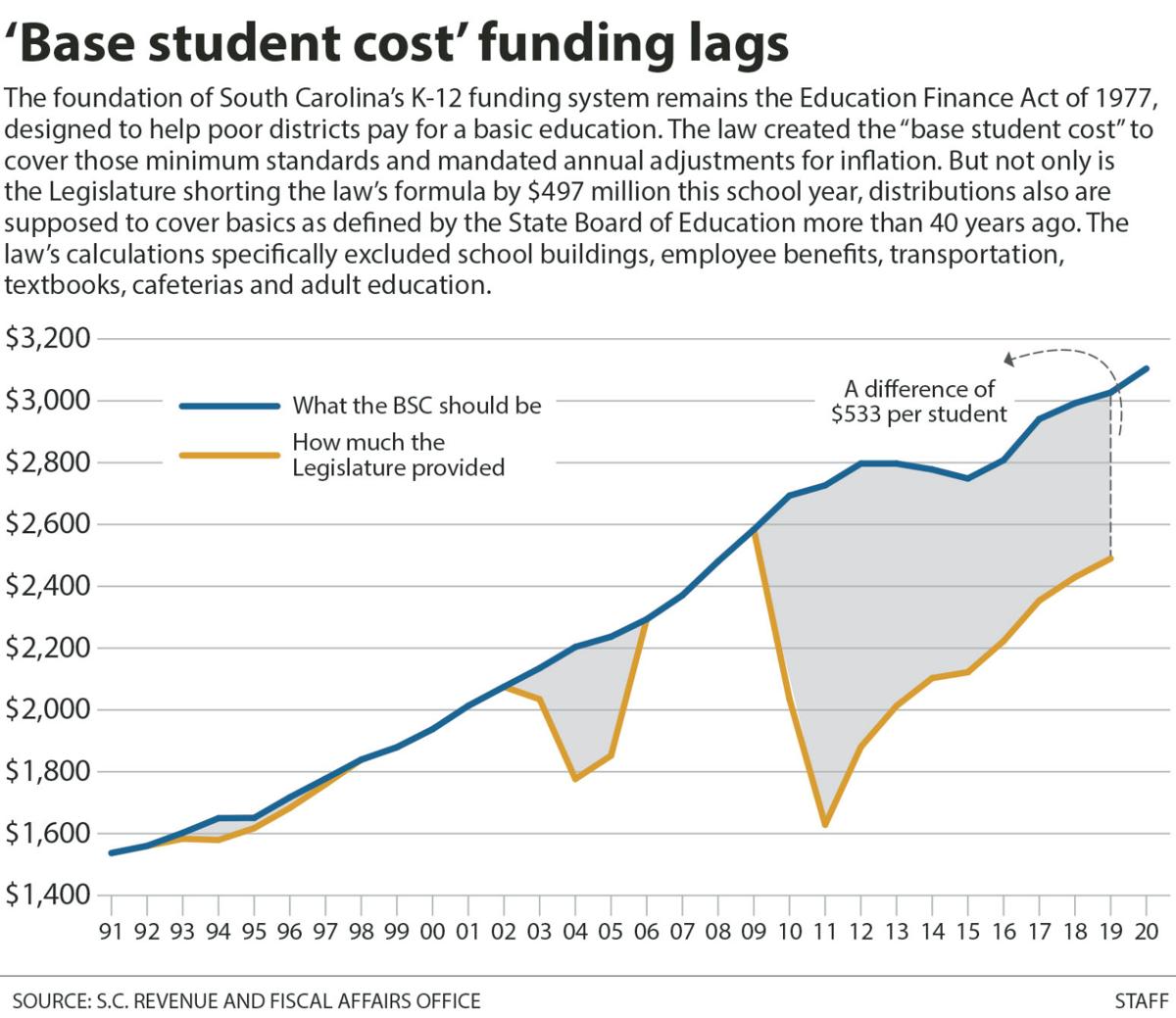
South Carolina Gov. Mark Sanford and the Republican-controlled legislature kneecapped school funding in 2006 with a tax handout to homeowners (Act 388) that routinely wrecks school revenues during economic downturns. As metropolitan school districts have grown thanks in part to an influx of workers for manufacturing concerns like Boeing, Volvo, and BMW, county governments have handed those employers massive tax incentives that cheated schools out of $2.2 billion in the last 5 years alone. And the legislature has not funded its own legally mandated Base Student Cost to districts since 2009, flagrantly violating the law every time it passes a budget — with outsize effects in our poorest rural districts.
Clearly, the leaders of the state don’t understand that their penuriousness towards the schools will hurt the next generation and the future of the state. They think in the moment. They forget about the future. They can attract corporations with a low-wage, non-union workforce, but they can’t build a thriving state unless they educate all the children.
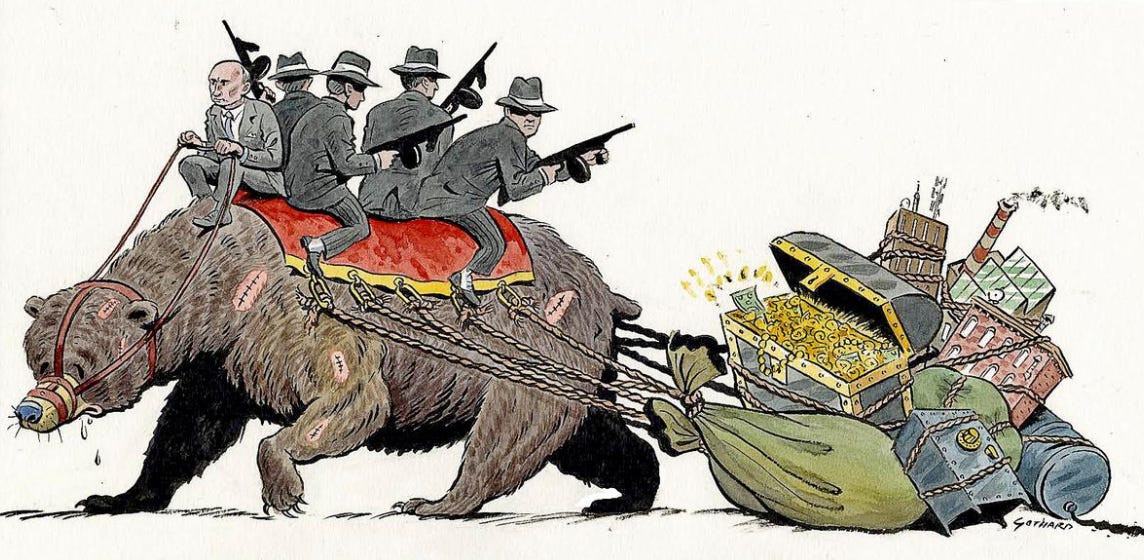
The bizarre events in Russia over the weekend provide a glimpse into the reality that the country is not a nation, but an empire with warring factions that is run by a mafia. Vladimir Putin has reigned as the “Boss” for 23 years and remained in place by enriching Russia’s thugs, bridling them, and playing one off against another. Under his rule, they have built palaces, stolen the national wealth, become warlords, amassed staggering portfolios, and lived like Czars. But on February 24, 2022, Putin decided to escalate the grift by invading Ukraine to steal more of its resources. Now this war is failing, as is Russia’s economy and Putin’s grip on power. And on June 23, Putin’s inability to control a wartime feud between warlord Yevgeny Prigozhin and Russia’s military brass turned into a full-blown armed mutiny. Prigozhin pulled his mercenaries from the frontline in Ukraine and led a “march for justice” against Putin’s military inside Russia. Putin labeled Prigozhin a “traitor” on national television, ordered his arrest, then instructed his puppet in Belarus, Aleksandr Lukashenko, to make an offer to Prigozhin that he couldn’t refuse: Stand down, charges would be scrapped, and move to Minsk. The crisis ended quickly, but Putin, the Russian Federation, and the war in Ukraine, will never again be the same.
Putin and the gangsters. David Gothard. WSJ
Prigozhin grew up in St. Petersburg, where Putin did, and went to jail as a young man for fraud and theft. He has since become a billionaire oligarch as a result of his connections to Putin and business smarts. More recently, he has become a household word in Russia because of the success of his personal army, the Wagner Group mercenaries, as well as his diatribes on social media against Russia’s generals. He has accused them of poor strategies, corruption, and of using Russian soldiers as cannon fodder. His gutsy stances have made him a populist hero even though he is also a member of the elite. But Prigozhin is different. He’s gone “native” and dons fatigues, is on the frontlines with his mercenaries in the Ukrainian war zone, and excoriates Putin’s generals for drafting young Russians from poor families and regions then sending them to their deaths by the thousands without training or proper equipment.
“The children of the elite smear themselves with creams, showing it on the internet; ordinary people’s children come in zinc, torn to pieces,” said Prigozhin, a reference to metallic coffins. “Those killed in action had tens of thousands of relatives, and society always demands justice and, if there is no justice, then revolutionary sentiments arise.”
Prigozhin warns of revolution but is not a revolutionary. He became a successful chef, then caterer and started a mercenary army that has operated for years surreptitiously around the world on Putin’s behalf. For instance, Wagner helped Putin occupy Crimea and Donbas in 2014, it fought in Syria and various African countries for Moscow for years, and has been involved in the 2022 invasion, fighting alongside Russian regulars in Ukraine. But last year he began to aggressively criticize Russia’s Minister of Defense, Sergei Shoigu, and Chief of General Staff, Gen. Valery Gerasimov and Putin never intervened. This was because he was doing Putin’s dirty work again and blaming the generals for military failures. But Shoigu and Gerasimov struck back by sabotaging the Wagner Group on the battlefield. Prigozhin claimed they withheld ammunition and provided only sub-standard equipment. Then, last month, he alleged that the two actually shelled Wagner troops.
By June, Prigozhin’s success in the battlefield and growing social media presence across Russia and abroad was becoming a threat, so Putin sided with his generals. He ordered Wagner fighters to sign contracts with the Ministry of Defense by July 1. This represented a de facto expropriation which is why Prigozhin pulled his troops from the front line in Ukraine on June 23 and marched them into Russia. That night, Putin condemned Prigozhin on state television and ordered Lukashenko to deliver the deal. Putin has not surfaced since June 24, and unconfirmed reports are that he fled Moscow.
A coup or armed conflict was avoided, but damage was done. Putin’s climb-down and capitulation to a man he had just called a “traitor” destroyed his tough-guy image. It’s obvious that he is not the “Boss”, but merely a figurehead who sits atop a rotten system of squabbling and greedy oligarchs. Prigozhin’s stunt also unveiled Russia’s vulnerability. He was able to march two-thirds of the way toward Moscow in a few hours without resistance. His troops also reportedly shot down six Russian helicopters and an IL-22 airborne command-center plane, killing 13 airmen, along the way, without consequences.
Prigozhin backed down and agreed to self-exile, but he’s not going to disappear, except physically. The generals he demanded that Putin fire still remain in power so he will continue to broadcast his criticisms from afar and plot a comeback, either from a dacha somewhere around the world or on a yacht. He will rebuild Wagner and may attract allies inside and outside Russia who want to overthrow Putin and his generals. He may aspire to be President but that is unlikely. He would be thoroughly unsuitable as President, but, unless assassinated, his ongoing crusade will be a catalyst for change inside Russia and serve the interests of Ukraine and the West. Prigozhin has already undermined Russia’s leadership, damaged frontline morale, stirred up the public, and shredded Putin’s concocted narrative that the invasion was necessary because Ukraine and NATO were a threat to Russia’s existence.
There’s little likelihood that a grassroots movement against Moscow will sprout around Prigozhin because it is a reign of terror and because he’s another thug whose forces have killed many Ukrainians and others. But his popularity was rising in polls before his armed mutiny because his rants resonated with civil society, mostly younger people. He also attracted international recognition with his condemnation of the war itself in the days leading up to the confrontation: “The war wasn’t needed to return Russian citizens to our bosom, nor to demilitarize or denazify Ukraine,” he said. “The war was needed so that a bunch of animals could simply exult in glory.”
The weekend’s events may not have brought about regime change, but Prigozhin has already dealt Putin, and Russia as currently constituted, a fatal blow. As the war continues to backfire, Ukraine and its alliance will push harder and so will separatist movements inside Russia who want autonomy or secession. Putin’s weakness is now apparent, and his tenure uncertain, which will also convince neighboring nations and Russian allies to recalibrate their relationship or forge new ones. Most significantly, Putin’s cave-in and cowardice concerning Prigozhin also means that his many “red lines” in this war are meaningless which is why many have been crossed and more should be ignored in future.
It is ironic that Prigozhin has opened a Pandora’s Box about corruption and injustice in a country run by criminals like himself. His lightning attack also raises fears internationally as to how secure Russia’s nuclear arsenal is from seizure by disgruntled factions such as Wagner or others. Experts say the events haven’t altered the security status of Russia’s nuclear weapons, and the West carefully monitors their movement and storage facilities.
But the country is run by gangsters who have upended the world order. Only “100 beneficiaries and several thousand accomplices” own everything, said Mikhail Kodorovsky, an oligarch jailed by Putin in 2005 on trumped-up charges. “Most of these people began their careers in the criminal underworld of St. Petersburg. Despite having now taken control of the Presidency, the group retains every aspect of the criminal ilk from which they came.”
Putin’s Russia is a criminal organization that must be overthrown. And finally, one of its own has told the world, and Russian people, why it must disappear.


 Diane Ravitch's blog