Archives for the month of: April, 2022

Leonie Haimson is a New York-based education activist who has two passions: reducing class size and protecting student privacy. She is co-founder of the Parent Coalition for Student Privacy. She writes today in Valerie Strauss’s “Answer Sheet” about legislation that threatens the privacy of every college student. Do your part to stop this invasion of privacy by writing your member of Congress. Use the link to contact your representatives.

Haimson writes:

With practically no public notice and no public hearings, the House of Representatives passed the College Transparency Act (CTA) on Feb. 4, 2022, by slipping it into a much larger unrelated bill called the America Competes Act, intended to better position the United States to compete with China. The bill is now slated to go to conference with the Senate…

The CTA would authorize the federal government to create a comprehensive data system that would include the personal information of every student enrolled in college or another higher education institution, and track them through their entire lives, by collecting their names, age, grades, test scores, attendance, race and ethnicity, gender, and economic status, directly from their colleges, along with other highly sensitive information pertaining to their disabilities and/or “status as a confined or incarcerated individual.”

Then, as they move through life, this data would be “matched” with their personal data from the other federal agencies, including the Census Bureau, the Department of Defense, Veterans Affairs, and the Social Security Administration.

No student would be allowed to opt out of this database, and there are no provisions for their data ever to be deleted. Instead, this bill would essentially allow the federal government to create a perpetual surveillance system, vulnerable to breaches and abuse.

This bill would overturn the legal ban on the federal government’s collection of personal student data, otherwise known as a “student unit record” system. The ban was established as a privacy safeguard in the Higher Education Opportunity Act of 2008, which “prohibits the creation or maintenance of a federal database of personally identifiable student information.”

Yet the federal creation of cradle-to-grave tracking system has been among the top priorities of the Gates Foundation and many of the groups they fund for years. In September 2016, Dan Greenstein, then the director of the foundation’s postsecondary division, told Politico that “[c]losely tracking student-level data remains at the top of the foundation’s list — something the foundation says can be accomplished by working around the federal government, which is banned from tracking students as they move through college,” although he hoped that “collective efforts could also work as a ‘lever’ to push Congress to reconsider the federal ban.”

The report that the foundation put out at the same time, entitled “Postsecondary Success Advocacy Priorities,” showed clearly that their goal was to overturn this prohibition and allow the federal government to directly collect this data for all children, starting at birth. This report has since been scrubbed from their website but is archived on the Wayback Machine here.

It says in part:


GOAL: Support the development of a comprehensive national data infrastructure that enables the secure and consistent collection and reporting of key performance metrics for all students in all institutions [emphasis theirs]. These data are essential for supporting the change needed to close persistent attainment gaps and produce an educated and diverse workforce with career-relevant credentials for the 21st century.

BACKGROUND: In this era of escalating costs and uncertain outcomes, it is important that prospective students, policymakers, and the public have answers to commonsense questions about whether and which colleges offer value: a quality education at an affordable price.

The Gates report included a chart that revealed the overarching and comprehensive nature of the infrastructure it envisioned, in which all “entities” would share their data, including “institutions/providers” before children even entered school, followed by state K-12 systems, colleges, and federal agencies such as the IRS, the Social Security Administration, the Department of Labor, the Department of Defense, etc. Together, this data would be fed into a “National Postsecondary Data System.”

The year before, the Commission on Evidence-Based Policymaking (CEP) had been established by Congress, with the stated goal to consider “whether a federal clearinghouse should be created for government survey and administrative data.” The commission first held hearings in Washington, D.C., on October 21, 2016, where many Gates-funded groups, including New America Foundation, Data Quality Campaign, Education Trust and Young Invincibles, testified in favor of weakening or overturning the ban on the federal collection of personal data.

The organization that I co-chair and co-founded, the Parent Coalition for Student Privacy, submitted comments to the commission, co-signed by the American Civil Liberties Union, the Network for Public Education, and other organizations, strongly opposing the overturning of the ban, noting that the potential risks to privacy were enormous from such a huge, centralized, comprehensive system.

According to the commission’s final report:
The Commission heard many substantive comments about the student unit record ban and received more feedback on the issue than on any other single topic within the Commission’s scope. Nearly two-thirds of the comments received in response to the Commission’s Request for Comments raised concerns about student records, with the majority of those comments in opposition to overturning the student unit record ban or otherwise enabling the Federal government to compile records about individual students.
Nevertheless, the commission recommended that the “Congress and the president should consider repealing current bans and limiting future bans on the collection and use of data for evidence building.”


In the meantime, it recommended the creation of a “National Secure Data Service to facilitate access to data for evidence building while ensuring privacy and transparency in how those data are used. … to temporarily link existing data and provide secure access to those data for exclusively statistical purposes in connection with approved projects. The National Secure Data Service will do this without creating a data clearinghouse or warehouse.”

In any case, in May 2017, a bipartisan group of senators, including Elizabeth Warren (D-Mass.) and Orrin G. Hatch (who was a Republican lawmaker from Utah at the time), introduced the College Transparency Act, which would overturn the ban on the federal collection of student data, and instead enable the government to track the employment and outcomes of college students throughout their lives.

Similar legislation was soon introduced in the House. As the reporter from Inside Higher Ed pointed out at the time: “While the bill has support from some Democrats and Republicans alike, its passage remains in doubt because opposition to a federal data system remains on the right and the left, based on privacy concerns and philosophical differences over the role of the federal government in higher ed.”

And while the CTA was resubmitted annually, there was little action by Congress during the intervening years. Nevertheless, the Gates Foundation and its allies kept pushing this idea, and last May, in yet another report, they again promoted the idea of a “federal student-level data network (SLDN) that provides disaggregated information about all students’ pathways and post-college outcomes, including employment, earnings, and loan repayment outcomes.”

With little warning, a few weeks ago, the CTA suddenly reappeared, at the last minute folded into the America Competes Act (ACA), although the ACA was an essentially unrelated bill focused on increasing the competitiveness of the United States with China. Even reporters who had in the past written about the CTA were not alerted in advance. The Parent Coalition for Student Privacy heard about it from a D.C. insider two days before its passage, and rushed out a news release the day before, with quotes from several different advocacy groups in opposition, as well as Rep. Jamaal Bowman (D-N.Y.).

As Rep. Bowman pointed out:

We have been down this road before and know how people’s personal data can be abused. Under the Trump Administration we saw this play out in the form of ICE stakeouts in our communities that put people in danger of being deported, separated from their families, and having their lives completely destroyed from one day to the next. The College Transparency Act raises serious concerns about how the data of our students can be used and abused.”

The next day, the bill passed the House by a vote of 238-193, with only a few Democrats opposed, including Bowman and two of his colleagues in the Congressional Progressive Caucus, Rep. Alexandria Ocasio-Cortez (D-N.Y.) and Cori Bush (D-Mo.).
The bill will now go to conference with the Senate. The Senate passed its version of the legislation, known as the U.S. Innovation and Competition Act (USICA), S.1260, last summer. And though the Senate version did not include the College Transparency Act, “supporters of the bill are very hopeful it will be approved by the conference committee that will review differences between the two bills,” according to a recent article.

On March 14, our student privacy coalition released a letter — co-signed by several other national privacy, consumer, education and parent groups — urging Congress not to pass this bill. As our letter pointed out, the bill would authorize the federal government to not only collect a huge amount of personal information, but also add to this nearly any other kind of data in the future, as long as the Department of Education thought it “necessary to ensure that the postsecondary data system fulfills [its] purposes,” although those purposes are not clearly defined.

And we once again emphasized how the risks of such a surveillance system outweighed the potential benefits by far:

Although the CTA’s supporters maintain that creating this massive federal system holds value for prospective students, history shows clearly how this sort of data collection has been used to target and violate the civil rights of our most vulnerable and marginalized individuals and communities. We have also learned that whatever guardrails exist to protect student privacy and anonymity in the current bill could easily be amended in the aftermath of a national crisis, like 9/11, so the CTA data could be used to target current and former students simply because they are a member of a disfavored racial, ethnic, religious, or other vulnerable group. Whatever the value of such a system in terms of promoting accountability for higher education institutions may be, such benefits must be pursued through far less invasive means that do not threaten core American rights and values.

Surely, there are many less intrusive options that could be used to analyze and evaluate higher education outcomes, by using data sampling and use of aggregate data. The existing federal College Scorecard has been enhanced via the collection of aggregate, non-personally identifiable data drawn from colleges, and could be further strengthened by including aggregate data on part-time students, as well as data related to transfer students, contributed by the National Student Clearinghouse, an independent, non-governmental group. This would obviate any need for the federal government to collect and amass personal data from students and follow them throughout their lives.

Such a data system would not only be vulnerable to breaches, but also could have unanticipated negative consequences, by discouraging colleges from accepting the highest-need students to boost their ratings, and/or cause them to discourage their students from entering into careers that have great social value, but lower than average salaries, like teaching.

Please use this link to write your members of Congress and urge them to reject this Orwellian legislation.
The following post was written by Jill Barshay and reposted by Larry Cuban on his blog. It is a response to the claim by various economists that teachers don’t improve after three to five years. This claim has been used to promote Teach for America, despite their inexperience and lack of substantive teacher education. It has also been used, as the previous post about North Carolina shows, to claim that teachers should not be paid based on their experience. It’s a pernicious idea, and I thank Larry Cuban for featuring this debunking of the conventional but wrong “wisdom.”

Jill Barshay writes:

The idea that teachers stop getting better after their first few years on the job has become widely accepted by both policymakers and the public. Philanthropist and former Microsoft CEO Bill Gates popularized the notion in a 2009 TED Talk when he said “once somebody has taught for three years, their teaching quality does not change thereafter.” He argued that teacher effectiveness should be measured and good teachers rewarded.

That teachers stop improving after three years was, perhaps, an overly simplistic exaggeration but it was based on sound research at the time. In a 2004 paper, economist Jonah Rockoff, now at Columbia Business School, tracked how teachers improved over their careers and noticed that teachers were getting better at their jobs by leaps and bounds at first, as measured by their ability to raise their students’ achievement test scores. But then, their effectiveness or productivity plateaued after three to 10 years on the job. For example, student achievement in their classrooms might increase by the same 50 points every year. The annual jump in their students’ test scores didn’t grow larger. Other researchers, including Stanford University’s Eric Hanushek, found the same.

But now, a new nonprofit organization that seeks to improve teaching, the Research Partnership for Professional Learning, says the conventional wisdom that veteran teachers stop getting better is one of several myths about teaching. The organization says that several groups of researchers have since found that teachers continue to improve, albeit at a slower rate, well into their mid careers.

“It’s not true that teachers stop improving,” said John Papay, an associate professor of education and economics at Brown University. “The science has evolved.”

Papay cited his own 2015 study with Matt Kraft, along with a 2017 study of middle school teachers in North Carolina and a 2011 study of elementary and middle school teachers. These analyses all found that teachers continue to improve beyond their first five years. Papay and Kraft calculated that teachers increased student performance by about half as much between their 5th and 15th year on the job as they did during the first five years of their career. The data are unclear after year 15.

Using test scores to measure teacher quality can be controversial. Papay also looked atother measures of how well teachers teach, such as ratings of their ability to ask probing questions, generate vibrant classroom discussions and handle students’ mistakes and confusion. Again, Papay found that more seasoned teachers were continuing to improve at their profession beyond the first five years of their career. Old dogs do appear to learn new tricks.

The debate over whether teachers get better with experience has had big implications. It has prompted the public to question union pay schedules. Why pay teachers more who’ve been on the job longer if they’re no better than a third-year teacher? It has encouraged school systems to fire “bad” teachers because ineffective teachers were thought to be unlikely to improve. It has also been a way of justifying high turnover in the field. If there’s no added value to veteran teachers, why bother to hang on to them, or invest more in them? Maybe it’s okay if thousands of teachers leave the profession every year if we can replace them with loads of new ones who learn the job fast.

So, how is it that highly regarded quantitative researchers could be coming to such different conclusions when they add up the numbers?

It turns out that it’s really complicated to calculate how much teachers improve every year. It’s simple enough to look up their students’ test scores and see how much they’ve gone up. But it’s unclear how much of the test score gain we can attribute to a teacher. Imagine a teacher who had a classroom of struggling students one year followed by a classroom of high achievers the next year. The bright, motivated students might learn more no matter who their teacher was; it would be misleading to say this teacher had improved.

What can you say when a state decides to adopt a policy that has failed again and again and has been conclusively discredited? I call such proposals “zombie policies,” because they fail and fail but never die.

Justin Parmenter, a National Board Certified Teacher in North Carolina, writes here about a plan in his state to eliminate experienced-based pay and replace it with the obsolete practice of tying teacher pay to student test scores. The leaders in North Carolina call it ”merit pay.” It is also called value-added evaluation and test-based compensation.

Whatever it is called, it is ineffective and demoralizing to tie teacher pay to test scores. Those who teach in affluent districts will be paid more than those who teach in low-income schools or who teach students with disabilities. Presumably, the folks in North Carolina never heard of the POINT study in Nashville, Tennessee, a three-year study of whether teachers would produce higher test scores if offered a big bonus. The conclusion was that the bonus (merit pay) did not make a difference.

The final evaluation concluded:

While the general trend in middle school mathematics performance was upward over the period of the project, students of teachers ran- domly assigned to the treatment group (eligible for bonuses) did not outperform students whose teachers were assigned to the control group (not eligible for bonuses). The brightest spot was a positive effect of incentives detected in fifth grade during the second and third years of the experi- ment. This finding, which is robust to a variety of alternative estimation methods, is nonetheless of limited policy significance, for this effect does not appear to persist after students leave fifth grade. Students whose fifth grade teacher was in the treatment group performed no better by the end of sixth grade than did sixth graders whose teacher the year before was in the control group.

Have the North Carolina policymakers heard about the Gates-funded program to evaluate and pay teachers based on test scores and peer evaluations, which was tried in seven sites, including Hillsborough County, Florida, Memphis, Pittsburgh, and four charter chains? The program cost hundreds of millions of dollars, and it was evaluated by the RAND Corporation and AIR. The cost of the program was shared between Gates and the local districts.

The evaluation report of the Gates program was released in 2018. It concluded that the program did not improve student achievement, did not raise graduation rates or dropout rates, and did not change the quality of teachers. In some sites, teacher turnover increased. The neediest students did not get the best teachers because teachers angled to get students who would produce higher test scores. The program planners expected that as many as 20% of the site’s teachers would be fired but only 1% were.

Furthermore, in 2017, a federal judge in Houston threw out precisely the same evaluation system that North Carolina plans to use because teachers were judged by a “secret algorithm” and had “no meaningful way” to ensure that their scores were correctly calculated. The judge wrote: “The [teacher’s] score might be erroneously calculated for any number of reasons, ranging from data-entry mistakes to glitches in the computer code itself. Algorithms are human creations, and subject to error like any other human endeavor.”

Parmenter writes:

A draft proposal coming before the State Board of Education next week (April 6) would transition all North Carolina teachers to a system of “merit pay” as soon as 2023.

The proposal represents the culmination of the work of the Professional Educator Preparation and Standards Commission, which was directed by state legislators to make recommendations on licensure reform.

The proposed change would make North Carolina the first state in the country to stop paying teachers on an experience-based scale that, at least in theory, rewards long-term commitment to a career in education and recognizes the importance of veteran educators (if adequately funded by the state–but that’s a topic for another post).

Instead, compensation would be based largely on teacher effectiveness as determined by EVAAS, a computer algorithm developed by the SAS corporation which analyzes standardized test scores. Teachers who do not have EVAAS scores would receive salaries based on principal observations, observations by colleagues, and student surveys.

This plan is problematic in a number of ways. It would increase “teaching to the test” by offering a handful of larger salaries to those educators whose students do well on tests. Competition over a limited number of larger salaries would lead to teachers working in silos rather than collaborating and sharing best practices as cohesive teams. Teachers of subjects with no standardized tests are raising concerns that observations and student surveys are highly subjective, and basing salaries on them would be unfair.

Dr. Tom Tomberlin, who serves as the North Carolina Department of Public Instruction’s Director of Educator Recruitment and Support, has justified moving away from an experience-based pay scale by claiming that teacher effectiveness plateaus after the first few years in the classroom.

It’s an argument which shows a major disconnect between DPI and those of us who actually work in schools and experience first hand how important veteran teachers are to overall school operations.

Veteran teachers often work as mentors, run athletic departments, coach sports and deliver professional development for peers.

They have long-standing relationships with school families and community members that position them to be excellent advocates for the needs of their schools.

None of that value is reflected in a veteran teacher’s EVAAS score.

Brenda Berg, CEO of pro-business education reform organization Best NC, has been a vocal proponent of scrapping the experience-based pay scale. Berg, who serves on the compensation subcommittee that helped develop the plan, said this week that it’s clear our current system isn’t working and it’s time to be “bold” about change even if it’s “scary.”

I’d like to note that anyone who claims educator pushback to this plan is centered in fear of change is completely out of touch with what it’s like to be a professional educator. We are the most flexible and resilient people on the planet, and the last two years have illustrated that fact like never before. We also know what it means to be treated fairly.

It’s true that North Carolina is facing a major pipeline crisis, with enrollment in UNC education programs down drastically over the past several years. It’s true that if we aren’t bold about change we will soon have nobody left who’s willing to work in our schools.

But we also need to be bold about acknowledging the reason for this crisis. It isn’t because the licensure process is too cumbersome. It isn’t because veteran teachers are ineffective and making too much money. It isn’t because our teachers lack accountability.

The reason North Carolina’s schools are suffering from a lack of qualified educators is because for the last 12 years our legislature’s policies have made it deeply unappealing to be a teacher in this state. Those policies include cutting master’s pay and longevity pay, taking away teacher assistants, eliminating retiree health benefits and many, many others.

The solution to North Carolina’s teacher pipeline crisis isn’t a system of merit pay which devalues long term commitment to public schools and ties salaries to standardized tests and subjective measures.

The solution to the problem is comprehensive policy change that makes a teaching career in North Carolina an attractive proposition. That’s the kind of change that will allow us to put an excellent teacher in every classroom.

This proposal ain’t it.

You can share feedback on the proposal with Dr. Thomas Tomberlin here: Thomas.Tomberlin@dpi.nc.gov

State Board of Education members will hear Dr. Tomberlin’s presentation at the April 6 board meeting. Their email addresses are:

eric.davis@dpi.nc.gov
alan.duncan@dpi.nc.gov
olivia.oxendine@dpi.nc.gov
reginald.kenan@dpi.nc.gov
amy.white@dpi.nc.gov
James.Ford@dpi.nc.gov
Jill.Camnitz@dpi.nc.gov
Donna.Tipton-Rogers@dpi.nc.gov
JWendell.Hall@dpi.nc.gov
john.blackburn@dpi.nc.gov
mark.robinson@dpi.nc.gov
dale.folwell@dpi.nc.gov

President Zelenskyy has repeatedly pleaded with every nation that would listen: Send us jets so we can protect our citizens. Thus far, President Biden has stood firm in opposition because he fears a wider war. Ukraine is not a member of NATO so NATO is not obliged to defend it.

But as awareness of the war crimes and atrocities committed by the Russian military increase, the necessity of helping Ukraine defend itself grows more compelling.

Ukraine wants MIGS. Poland wants to give them to Ukraine. Let it happen.

What is the difference between sending tanks to Ukraine and sending jets? What’s the difference between sending Stingers and Javelins and sending jets?

Putin threatened war if the West defends Ukraine. But the West is already defending Ukraine.

Putin already said that economic sanctions are a declaration of war. So in his mind, he is already at war with the West. But he sets the ground rules.

He was outraged that Ukraine bombed a fuel depot inside Russia. But he invaded Ukraine and bombed fuel depots, homes, schools, hospitals, and theaters. He has made ferocious war on civilians, trapping the people of Mariupol in their devastated city and barring access to those bringing humanitarian aid, including the International Red Cross.

We should not allow Putin to decide how much or what kind of defensive weapons the West should supply to an innocent nation that is being pulverized by Putin’s military. Putin must not be allowed to do to Ukraine what he did to Chechnya.

Send Ukraine the jets it needs to defend itself!

**************

An important historical footnote from TIME magazine:

Kaja Kallas has clear memories of the Soviet occupation. She was a teenager when Estonia became independent, and she remembers growing up before that with empty shop shelves, a passport that would not allow her to travel to countries outside the Eastern bloc, and a chilling atmosphere that kept people from speaking freely outside their homes. She also remembers the stories about the harsher deprivations—deportations, imprisonment— that her parents and grandparents faced. So now that Kallas is Estonia’s Prime Minister, it makes sense that she has become one of the most vocal advocates for taking an unyielding stance against Putin.

“If Putin wins, or if he even has the view that he has won this war, his appetite will only grow,” Kallas, 44, said in late March, sitting in the elegant neoclassical building—its salons lined with paintings of Estonian patriots—that serves as the seat of government. “And that means he will consider other countries. That’s why we have to do everything we can to stop him now.”

Like other countries in the region, Estonia has had painful experiences with Russian oppression. Occupied by the Soviet Union in the 1940s, the country’s farms were forcibly collectivized and tens of thousands of its citizens deported to Siberia. It was not until 1991, when the USSR was collapsing, that the country regained its independence. Quickly reverting to democracy, Estonia joined the European Union in 2004, and put a forward-looking emphasis on digitalization—all of its public services and much of its business is conducted online. It has since become one of the fastest-growing economies in Europe. But it has never relinquished its mistrust of its powerful neighbor to the east, with whom it shares nearly 200 miles of border.

Ohio knows charter schools. A lobbyist for the charter school industry wrote the law. Charter schools are mistakenly called “community schools.” Most charter schools in the state are failing schools, but that does not dim the enthusiasm of the GOP legislature for them. Ohio welcomes for-profit charter schools. Charters drain money from public schools.

For the first time in the history of the federal Charter Schools Program, which started in 1994, the federal U.S. Department of Education has proposed regulations to exclude for-profit management of charters that seek federal funding to expand and to require charters seeking federal funding to present a summary of their charter on the locality where they plan to open.

Jan Resseger, who lives in Ohio, sent the following appeal to her followers.

Please Support the Proposed USDOE Rule Changes for the Federal Charter Schools Program

Submit a comment supporting the Department’s new stronger regulations. You can submit your comment HERE, and you must submit the comment before April 13, 2022.

Please read Ohio Public Education Partners’ explanation of an urgently important development that requires our immediate attention. The U.S. Department of Education has published a notice in the Federal Register proposing new rules to strengthen oversight of the federal Charter Schools Program (CSP). It is urgently important for each one of us to write and submit a formal comment expressing support for stronger oversight of the Charter Schools Program.

First, even though the Elementary and Secondary Education Act forbids the allocation of federal dollars to for-profit charter schools, the owners of for-profit charter management organizations (CMOs) have learned how to get around the law. The U.S. Department of Education has proposed to stop the misallocation of federal Charter Schools Program (CSP) dollars to for-profit charter school management companies that hide behind the nonprofit charter schools they manage under sweeps contracts.

Second, when a charter school asks for Charter Schools Program startup funds, the Department has declared its intention to require a community impact statement to ensure that there is a need for a new charter school in the community and that the school won’t promote racial segregation. Neither should rapid expansion of charter schools undermine urban neighborhoods. The most serious consequence of out-of-control charter school expansion has been evident in large cities, where charter schools advertise lavishly to attract families from public schools.

Here is the language of the two urgently important rules the U.S. Department of Education proposes to add:

First — “Each charter school receiving CSP funding must provide an assurance that it has not and will not enter into a contract with a for-profit management organization, including a non-profit management organization operated by or on behalf of a for-profit entity, under which the management organization exercises full or substantial administrative control over the charter school and, thereby, the CSP project.”

Second — “Each applicant must provide a community impact analysis that demonstrates that there is sufficient demand for the proposed project and that the proposed project would serve the interests and meet the needs of students and families in the community or communities from which students are, or will be, drawn to attend the charter school, and that includes the following: (a) Descriptions of the community support and unmet demand for the charter school, including any over-enrollment of existing public schools or other information that demonstrates demand for the charter school, such as evidence of demand for specialized instructional approaches. (b) Descriptions of the targeted student and staff demographics and how the applicant plans to establish and maintain racially and socio-economically diverse student and staff populations, including proposed strategies (that are consistent with applicable legal requirements) to recruit, enroll, and retain a diverse student body and to recruit, hire, develop, and retain a diverse staff and talent pipeline at all levels (including leadership positions).”

Please submit a comment supporting the Department’s new stronger regulations. Don’t let yourself be intimidated by the complicated language and presentation of the new rules in the Federal Register. Begin your comment by thanking the Department of Education for strengthening long-needed accountability in this program. In simple prose, explain your support for each of the proposed new rules for the Charter Schools Program. In your comment, if you like, you may quote the language (above) of each rule followed by your reason for believing the new regulation is so important. Your comment may be as long or as short as you like—a few sentences or several paragraphs. Longer comments must be submitted as attached documents.

You can submit your comment HERE, and you must submit the comment before April 13, 2022.

If you are not planning to write your own comment, you may send the Network for Public Education’s action alert letter, but I urge you to personalize your letter by adding a few sentences of your own.

Jan Resseger


The federal Charter Schools Program was launched in 1994 with a few million dollars, when the Clinton administration decided to offer funding for start-ups. At the time, there were few charter schools. In the early, idealistic days, charter enthusiasts asserted that charters would set lofty goals and close their doors if they didn’t meet them. They were sure that charters would be far better than public schools because they were free to hire and fire teachers.

Right-wingers jumped on the charter bandwagon as a way to undermine public schools and to bust teachers’ unions. In short order, a gaggle of billionaires decided that charter schools would succeed because they operated with minimal or no regulation, like a business.

What no one knew back in 1994 was that the charter industry would grow to be politically powerful, with its own lobbyists. No one knew that the “most successful” charter schools were those that excluded the students who might pull down their test scores. No one knew that for-profit entrepreneurs would set up or manage charter chains and make huge profits, mainly by their real estate deals. No one knew that one of the largest charter chains would be run by a Turkish imam. No one knew that charter schools would develop a very old-fashioned militaristic discipline that prescribed every detail of a student’s life in school. No one knew that the little program of 1994 would grow to $440 million a year, with much of it bestowed on deep-pocketed chains that had no need of federal money to expand. No one knew that charter schools would become a favorite recipient of big money from Wall Street hedge-fund managers and billionaires like Bill Gates, the Walton family, Eli Broad, Michael Bloomberg, John Arnold, Betsy DeVos, Reed Hastings, and many other billionaires and multi-millionaires. No one anticipated that by 2022, there would be 3.3 million students in more than 7,400 charter schools.

Perhaps most important, no one expected that charter schools, on average, would perform no better than public schools. And in many districts and states, such as Ohio, Nevada, and Texas, charter schools perform far worse than the public schools.

School choice has been a segregationist goal ever since the Brown Decision of 1954, when southern states created segregation academies and voucher plans to help white students escape from racial integration. It should be no surprise, then, to see that the same states that are passing laws to restrict discussion of racism, to ban teaching about sexuality and gender, and to censor books abut these topics are the same states that demand more charter schools. Coincidence? Not likely. These are culture war issues that rile the Republican base.

How strange then, given this background, that the Washington Post published an editorial opposing the Department of Education’s sensible and modest effort to impose new regulations on new charter schools that seek federal funding. The education editorial writer Jo-Ann Armao very likely wrote this editorial, since she has that beat. Armao was a cheerleader for Michelle Rhee when she was chancellor of the D.C. schools and imposed a reign of terror on the district’s professional staff, based on flawed theories of reform and leadership.

In the following editorial, she makes no effort to offer two sides of the charter issue (yes, there are two, maybe three or four sides). She writes a polemic that might have been cribbed from the press releases of the National Alliance for Public Charter Schools, the amply endowed lobbyist for the industry. She gives no evidence that she has ever heard of the high closure rate (nearly 40%) of the charters that received federal funds from the Charter Schools Program. She seems unaware of the scores of scandals associated with the charter industry, or the number of charter founders who have been convicted of embezzlement. She doesn’t care about banning for-profit management from future grants. She thinks it’s just fine to set up new charters in communities where they are not needed or wanted. She seems unaware that the new regulations will not affect the 7,000 charters now in existence. Charters can still get start-up funding from Michael Bloomberg, the Waltons, or other privatizers. New charters can still be opened by for-profit entrepreneurs like Academica, but not with federal funds.

Here is the editorial, an echo of press releases written by Nina Rees of the National Alliance for Public Charter Schools (Rees previously worked at the right-wing Heritage Foundation, served as education advisor to Vice-President Dick Cheney, and worked for financier Michael Milken).

The editorial’s title is: “The Biden Administration’s Sneak Attack on Charter Schools.”

Advocates for public charter schools breathed easier last month when Congress approved $440 million for a program that helps pay for charter school start-up expenses. Unfortunately, their relief was short-lived. The Biden administration the next day proposed new rules for the program that discourage charter schools from applying for grants, a move that seems designed to squelch charter growth.


On March 11, a day after the funding passed, the Education Department issued 13 pages of proposed rules governing the 28-year-old federal Charter Schools Program, which funnels funds through state agencies to help charters with start-up expenses such as staff and technology. “Not a charter school fan” was Mr. Biden’s comment about these independent public schools during his 2020 presidential campaign, and the proposed requirements clearly reflect that antipathy.


The Biden administration claims that the proposed rules would ensure fiscal oversight and encourage collaboration between traditional public schools and charter schools. But the overwhelming view within the diverse charter school community is that the proposed rules would add onerous requirements that would be difficult, if not impossible, to meet and would scare off would-be applicants. Those most hurt would be single-site schools and schools led by rural, Black and Latino educators.


Consider, for example, the requirement that would-be applicants provide proof of community demand for charters, which hinged on whether there is over-enrollment in existing traditional public schools. Enrollment is down in many big-city school districts, which would mean likely rejection for any nonprofit seeking to open up a charter. “Traditional schools may be under-enrolled, but parents are looking for more than just a seat for their child. They want high quality seats,” said Nina Rees, president of the National Alliance for Public Charter Schools.Hence the long waiting lists for charter school spots in cities with empty classrooms in traditional schools. Also problematic is the requirement that charters get a commitment of collaboration from a traditional public school. That’s like getting Walmart to promise to partner with the five-and-dime down the street.

The Biden administration surprised the charter school community by what charter advocates called a sneak attack. There was no consultation — as is generally the case with stakeholders when regulations are being drafted — and the public comment period before the rules become final ends April 14.The norm is generally at least two months.

The proposed changes, according to a spokesperson for the Education Department, are intended to better align the Charter Schools Program with the Biden-Harris administration’s priorities. “Not a charter fan,” Mr. Biden said, and so bureaucratic rulemaking is being used to sabotage a valuable program that has helped charters give parents school choice.

If you disagree with this editorial, as I do, please send a comment thanking the Department of Education for proposing to regulate a program that has spun out of control and urging them to approve the regulations. Give your reasons.

If you think that charter schools have no need for federal funding when so many billionaires open their wallets for them, if you think that your community has enough charter schools, if you think that public schools must be strengthened and improved, if you want to stop federal funding of for-profit entrepreneurs, if you are tired of funding schools that never open, please write to support the U.S. Department of Education’s reasonable proposal to regulate the federal Charter Schools Program.

Peter Greene reports here on the battle plans of the radical rightwing “Moms for Liberty,” as revealed by its leader Tiffany Justice on the Steve Bannon show. In short, take over all the school boards, fire everybody, and replace then with conservatives who share the hateful views of Tiffany Justice.

Greene writes, and adds his comments:

BANNON: Are we going to start taking over the school boards?


JUSTICE: Absolutely. We’re going to take over the school boards, but that’s not enough. Once we replace the school boards, what we need to do is we need to have search firms, that are conservative search firms, that help us to find new educational leaders, because parents are going to get in there and they’re going to want to fire everyone. What else needs to happen? We need good school board training. We need lawyers to stand up in their communities and be advocates for parents and be advocates for school board members who are bucking the system. Right now, parents have no recourse within any public education district.

The “no recourse” talking point sits awkwardly next to a description of the recourse (democratic elections) that Justice (who was defeated when she ran for re-election to her own school board seat) plans to take, but sure. Parents will take over school boards, fire everybody, and hire The Right Sort to replace them. And while some training is needed for school board members, the main thing is to run, because

But what my message today is – get out and run for school board. It’s a part-time job. It’s not a full-time job. Anyone can do it. You do not need to have a background in education and we need more people.

Justice was on Bannon’s show War Room: Pandemic, because angling for political victories and advocacy spins is just like what folks are going on in Ukraine these days. She talked about the heroism of Ron DeSantis, and of course parental rights:

Parental rights are rights that every parent has, and the government does not give them to you, and they cannot take them away. Every parent has the fundamental right to direct the upbringing of their children, their medical care. That includes mental health, by the way, their education and their values, education, their morals, their religious and character training. All of these things lie within the responsibility of the parent. We, as parents, are happy to own those responsibilities within our rights.

It underlines the way in which the parental rights movement at its most extreme seems to have nothing at all to do with a children’s rights movement. I’m a parent, and I absolutely get the rights and responsibilities that parents have to protect and guide their children, but there’s a line past which it all starts to become creepy, as if you own this child and will engineer the tiny human to turn out to be exactly what you choose them to be, and much of the parental rights activist rhetoric lives close to that line. “I have total ownership and control of my child” is exactly how you get to the notion of “My child didn’t turn out exactly the way I demanded they turn out, so somebody else must have messed with their head.” Parental rights are a real thing, and parental responsibilities are a very real thing, but children are actual human beings and not lumps of clay to be crafted by other adult humans.

Justice and Bannon are sad that folks are lying about Florida’s bill, which is just a parental rights and anti-grooming bill and not– they interrupt themselves before they can say what it is. But Justice says she doesn’t see the big deal “We said no sexual orientation instruction or gender identity instruction in grades K through three” and many of her fans and Bannon think it should be K through twelve. Yes, why is everyone so upset that supporters of the bill equate teachers, LGBTQ persons, and pedophiles? (Also, implying that Disney only opposes the law because they are interested in sexualizing children.) As with all talk in support of the law, Justice and Bannon skip past the part where any parent can decide for themselves what constitutes “instruction” about sexual orientation or gender identity, so teachers now have to watch out for any lesson that could lead to Pat talking about having two Mommies at home. Though it would be entertaining if the first parent lawsuit under the bill is some parent arguing that boys and girls restrooms are a means of instructing about gender identity. Maybe fans of the law should just wait until we see how the court challenge turns out.

Justice throws around some numbers about public school failure, which serve mostly as a good example of why school board members and other people who want to talk about education policy should know something about it (she cites 29.8% of Kentucky third graders reading on grade level, but she appears to be talking about proficiency, which is above grade level). This, somehow, is related to talking about gender identity and sexual orientation in first grade.

Justice could be on the show because she was in DC to talk to some GOP House members. She can’t imagine why Dems don’t want to talk to her (I’m not sure, but one possible explanation that comes to mind is that she didn’t call their offices to make an appointment). Which brings us back to the point at the top– Moms For Liberty wants to talk about how to take over the states (because states rights are at the heart of all this stuff).

A friend sent this video, which appears on TikTok. The person in the video is Katie Peters, and she teaches in Toledo. Several readers gave me her name, her Twitter handle, and her website address (http://www.katiepeters.org/). I wrote a message to her on Twitter to thank her, and she replied, “I am so lucky to get to do this job everyday.”

Michael Hiltzik of the Los Angeles Times reports on the latest study of Ivermectin, a veterinary drug for animals with parasites. The study found that Ivermectin is useless as a treatment for COVID-19. It is a quack treatment that became popular among Republicans. Anything, anything at all, was acceptable to Trumpers except vacccinations developed by reputable companies.

He writes:

The final results are in, and they’re incontrovertible: Ivermectin, that nostrum assiduously promoted by anti-vaccine advocates and conspiracy-mongers, is utterly useless against COVID-19.

That’s the conclusion of a peer-reviewed studyof more than 1,350 COVID patients treated with the drug, which is customarily used to combat parasitic diseases in humans, livestock and pets.

The study was published this week in the New England Journal of Medicine, but we reported on it last August.

That’s when one of its principal investigators, Edward J. Mills of McMaster University in Hamilton, Canada, disclosed the preliminary results during a research symposium. The data he presented then are essentially the same as the final results published by the NEJM.

Mills said then that ivermectin had “no effect whatsoever” on COVID.

Half were given ivermectin for three days and half received a placebo. The goal was to find whether ivermectin reduced the prospect of hospitalization or an emergency room visit due to a worsening of COVID symptoms. The bottom line is that ivermectin had no statistically significant effect.

“We did not find a significantly or clinically meaningful lower risk of medical admission to a hospital or prolonged emergency department observation … with ivermectin,” the study says.

These findings are important because ivermectin has been so assiduously touted by anti-vaxxers and credulous, irresponsible fools such as Sen. Ron Johnson (R-Wis.), who has also used Senate hearings to promote hydroxychloroquine, another useless COVID treatment

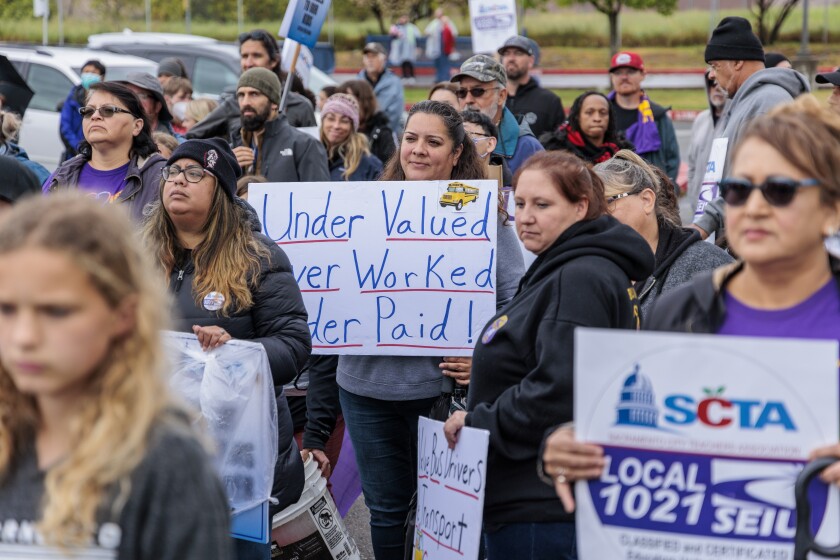
Sacramento City Unified School District teachers, school staff and supporters take part in a rally at Rosemont High School

Sacramento City Unified School District teachers, school staff and supporters take part in a rally at Rosemont High School on March 28 as they have been gone on strike due to the staffing crisis in the district . All SCUSD schools shut down and will remain closed for the duration of the strike.

I have read many articles about the shortage of teachers and school staff. I have read many that were laden with statistics. This is one of the best. It appeared in the Los Angeles Times.

BY ANITA CHABRIA COLUMNIST

A few weeks ago, Sacramento teacher Kacie Go had 56 kids for second period.

That day, there were 109 students at her eighth- through 12th-grade school who were without an instructor because of staff shortages. So she crammed the students into her room and made it work, but “it’s not sustainable,” she said.

No kidding.

Go told me the story standing with hundreds of other teachers and support staff Tuesday morning in the parking lot of an empty high school, as “We’re Not Gonna Take It” blared from speakers and the mostly female workers gathered for day five of a strike that has closed down schools in the Capitol City.

Like Go, these teachers, cafeteria workers, bus drivers and instructional aides are fed up with being asked to do more with less. It’s a problem that goes beyond the Sacramento City Unified School District, with 48,000 students in 81 schools. Frustration among teachers and school workers is rampant across California — pushed to a breaking point by the pandemic and a shortage of more than 11,000 credentialed teachers and thousands of support staff as the state tries to expand pre-kindergarten and bring 10,000 mental health counselors on campuses.

From school closure protests in Oakland to Sacramento’s all-in strike, those who work in our schools are telling us they cannot do this job under the conditions we are imposing. These include mediocre pay, sometimes vicious political blowback from COVID-19 safety measures, a witch-hunt-like scrutiny around hot-button topics, a mental health crisis, the reality of too few people doing the work, and the general disrespect of a society that swears it loves teachers and values education but does little to invest in it. Worrying about school shooters, once an urgent concern of educators and parents, doesn’t even make the top three problems anymore.

It’s the same story playing out in hundreds of other districts not just in California but across the country. Minneapolis teachers just ended a 14-day strike that shared some of the same issues of pay and support, underscored by the same teacher chagrin that we talk a good game about supporting public education but don’t always come through with actions. Minneapolis Federation of Teachers Chapter President Greta Callahan summed it up, sounding like she could be standing in Sacramento.

“We shouldn’t have had to [have] gone on strike to win any of these things, any of these critical supports for our students, but we did,” she said.

Go, who has been a teacher for 20 years and earned a master’s degree along the way — bringing her to the top of the district’s salary scale at just more than $100,000 a year — estimates she’s losing about $500 a day during the walkout.

But she’s more worried about support staff such as Katie Santora, a cafeteria worker who was also on the picket line.

Santora is the lead nutrition services worker at a high school, expected to churn out 1,500 meals a day between breakfast and lunch — with a staff of nine people (though they started the year with only five). Most are part-timers because the district doesn’t want to pay them benefits, and they make about minimum wage.

Santora, with 13 years at the district, makes $18.98 an hour for what is essentially a management role. She’s in charge of ordering, planning, receiving and keeping the joint running.

On the last day before the strike, that included making popcorn chicken bowls for lunch. What does that look like? Five 30-pound cases of chicken, oven-baked, 22 bags of potatoes, boiled and mashed, corn and gravy — all assembled after her staff finished making steak breakfast burritos and scrambled egg bowls. Did I mention every student is required to take a piece of fruit, which means washing somewhere along the lines of 1,700 apples?

Santora says high schoolers are the “most misunderstood” people on the planet, teetering between child and adult. Their well-being, she says, depends on being fed so “their bellies aren’t rumbling in class” and seeing a friendly face when they walk in her cafeteria. She loves delivering both.

“When they come through the line, I like to say, ‘Thank you for having lunch with me,’” she says.

But the money isn’t enough to pay her bills. Four or five nights a week, she gets about an hour at home before she heads to her second job loading grocery bags for delivery drivers at Whole Foods. She’s working two jobs just to pay for the privilege of doing the one she likes.

Go, the teacher, feels the hardships in other ways. One of her twin daughters recently had a “pretty severe concussion,” she said, but Go felt like she couldn’t stay home with her. If she did, one of her co-workers would likely be stuck with a jampacked classroom — and all the other unofficial jobs she has to do on a daily basis, from fill-in parent to police officer to relationship advisor when her teenage students’ hormones go into overdrive. Substitutes are hard to come by, she thinks, because the pay — $224 a day — isn’t competitive compared with other jobs with less stress.

“Subs don’t have an easy life,” Go said. “Why would you want to do that when you could go to In-N-Out and worry about if it’s animal-style or not for the same amount of money?”

The unions involved in the Sacramento strike contend that there are hundreds of open positions in the district in virtually every job. Nikki Milevsky, a school psychologist and vice president of the teachers union, puts it at 250 vacancies for teachers and 400 for classified staff — in a district with 2,069 teachers and 1,656 classified staff. That classified staff and teachers walked out together shows the depth of problems in Sacramento — it’s unusual for both to strike at the same time, and it has forced schools to shut down because there was no one left but administrators to watch kids.

Chris McCarthy, a first grade teacher in the Sacramento Unified School District, joined other teachers, parents, students and supporters, in the rain at a rally in support of their strike against the school district at Rosemont High School in Sacramento.

The teachers union says that 10,000 students lack a permanent instructor, and on some days, up to 3,000 don’t even have a substitute. About 547 kids who signed up for independent study haven’t been given a teacher yet, meaning they are learning nothing.

The district says it’s down 127 certificated staff and 293 classified positions. Take the difference as you will, but the district doesn’t dispute it’s in a staffing crisis.

Sacramento teachers want a pay raise to make the district more competitive in hiring. Right now, some surrounding districts pay more but have lesser benefit packages. (Please don’t make me tell you that healthcare is a right, not a privilege.) The teachers want the district to back off of a proposal to make current and retired teachers pay hundreds more to keep a non-HMO health plan. The district says it has made an offer of a pay increase and recruitment bonus and a one-year stipend to offset the health plan issue.

From there it turns contentious. Teachers reject the district’s offer as lowball and assert there is money available to do better, just not the will to invest it in staff. The district says the teachers need to compromise because it can’t afford all of their asks.

For days, there were no negotiations. State Supt. of Public Instruction Tony Thurmond tried to bring everyone to the table, only to be rebuffed by the district. Back home again instead of in the classroom, my eighth grader, a student in Sacramento schools, ate lots of chocolate chip pancakes and watched “Turning Red” on repeat.

There is no end in sight. Though negotiations with both unions have resumed, the shutdown is another blow to parents and families already anxious and stressed out. The last time my daughter had a normal school year, she was in fifth grade. So I understand the frustration, and even anger, of parents that schools are once again closed — and the resentment of parents across the state who are sick and tired of problems with schools, many of which predate the pandemic.

But I went to the strike line three times and I can tell you this — it’s not about the money for these teachers. You can roll your eyes at the unions all you want, but these teachers and support staff want their schools to work, for their students, for themselves, and for our collective future. Because democracy depends on an educated populace and education is a right. And because they are educators, and they’re invested in our kids.

Go doesn’t want to do anything else but teach, even if it means 56 kids sometimes. Even if it means losing $500 a day and striking. Even if it means making some people mad to make schools better.

“I freakin’ love it,” she said. “I do.”