William Gumbert has been reviewing the rapid expansion of charter schools in Texas with concern. In previous posts, he has demonstrated that they are likely to underperform the public schools with which they compete. And, worse, they take funding away from the districts in which they are located. Texas is now being flooded by corporate charter chains, replacing community-based public schools. His attached report explains why community-based schools and school districts deserve the support of all Texans.
Archives for the month of: February, 2021
Jim Swanson and John Graham, both CEOs in Arizona, wrote a stern warning against the legislature’s proposed voucher expansion, which would make almost all students in the state eligible for public funding to spend in a private or religious school. One of the authors is on the Arizona State Board for Charter Schools. Arizona is a state that likes low taxes; it does not fund its public schools adequately or equitably. Under the leadership of Governor Doug Ducey (who promised the Koch brothers a few years ago that he would drive taxes down as low as he could), the state is offering choice instead of adequate funding to its schools. Arizona has consistently underfunded its public schools and pretends to “reform” them by offering charters and vouchers.
They wrote:
The current, aggressive push to expand Empowerment Scholarship Accounts (ESAs) does nothing to address the systemic education challenges we face in Arizona.
It is a dangerous attack on our public education systems and our state’s economic future. As a business community, our priority is to ensure that all students have access to a top-quality school that meets students’ needs and interests.
Arizona leaders should focus on effectively funding public education and supporting innovative programs that improve academic outcomes.
The time is now. Public education is the single most powerful economic development tool we have as a state.
ESAs were originally designed to serve a small population of students – they were never meant to replace public education or to serve all students.
A full expansion of ESAs is nothing more than a boutique scheme to address a non-existent need for private school subsidies.
While being marketed as a solution for low-income students and students of color – the students whom data tells us need the most wide-scale, institutional support – SB1452 is the most offensive of the private school voucher bills proposed this session. The bill would make roughly 700,000 Arizona students eligible for ESAs – a 280% increase in a single move. This is nothing more than a bold attempt to privatize education.
There’s a lot wrong with this bill, but the worst is the fact that rather than focus on supporting low-income students of color, many of whom are already eligible, SB1452 will make many more middle- and high-income white students eligible for taxpayer-subsidized vouchers, exploiting the impoverished communities in favor of further subsidizing the tiny fraction (as few as approximately 5%) of Arizona families choosing to home-school, private and parochial schools.
Greater Phoenix Leadership, Southern Arizona Leadership Council and Northern Arizona Leadership Alliance, representing more than 200 CEOs across Arizona, have made it clear that they are against the expansion of vouchers in Arizona and have voiced support for our public education systems, from early childhood to higher education. Business leaders and voters are like-minded – we have consistently come together for public education with a focus on equity and access. Instead of proposing unsustainable ways to make 70% of students eligible for private school vouchers, we need to make the public schools better, stronger and more successful.
What our state needs is crystal clear – an equitable, fully funded, high-quality public education system that serves all students across Arizona, no matter the zip code or income level. We have fallen too far behind and the only way we catch up – the only way we move the needle and bring Arizona to a competitive, robust and morally conscionable state – is to focus on the public education funding formula. Programs like private school vouchers have a long history of excluding and segregating our communities rather than including and supporting them. ESAs don’t get us where we need to be.
We need to put our heads together – across the business, education and political realms – and finally execute big changes to the funding formula and other mechanisms that have proven inefficient and worse, inequitable. Now is the time to focus on what moves all our students forward – working together to properly fund the schools serving 95% of Arizona students.
Question: Will the legislature listen to Arizona business leaders or to Charles Koch and Betsy DeVos?
Two years ago, the voters of Arizona overwhelmingly rejected an expansion of vouchers, by 65% to 35%. The pro-voucher side was funded by Charles Koch, Betsy DeVos, and other enemies of public schools. The voters said a resounding NO to voucher expansion!
Yet, this week the Arizona Legislature passed legislation to expand vouchers, approving what the voters rejected. Apparently, the word “democracy” is not in the Republican legislators’ dictionary. The voters expressed their will in no uncertain terms. The legislators ignored them.
The Arizona Senate approved a massive expansion of Arizona’s school voucher program Monday, just two years after voters decisively repealed a similar expansion of school vouchers to all students.
The Senate passed the bill on a 16-14 party-line vote, with all 16 Republicans voting for the measure. It will now be sent to the House of Representatives.
Empowerment Scholarship Accounts allow parents eligible to take funds from public schools and spend them on private school. The bill would expand the program, which currently serves only 9,700 students, making it available to an exponentially larger group.
Bill sponsors contend the voucher expansion will benefit only low-income students from so-called Title I schools, which receive funding for disadvantaged students to close educational gaps.
But SB 1452 would also allow any student who lives in the boundary of a Title I school to be eligible for an empowerment scholarship account. The students would merely have to attend the school and would not need to be low-income themselves to qualify.
More than 1,300 of the 2,000 district schools in Arizona — about 65% — are Title I schools, and even wealthy districts include some Title I schools.
The proposal from Glendale Republican Sen. Paul Boyer, SB1452, would make all children attending schools with a high percentage of low-income families or who qualify for free or reduced-price lunches eligible for the state’s voucher program. The program allows parents to take state funding and pay for religious or other private education and education costs.
If the Republican-controlled House also approves the measure and it is signed by Gov. Doug Ducey, a school choice supporter, about 800,000 of Arizona’s 1.1 million K-12 students would qualify to use state money to attend private schools, up from about 256,000 currently. Despite the current eligibility, only about 9,700 children currently use state vouchers to pay for private or home schooling costs.
So, of the 256,000 students eligible for vouchers, only 9,700 use them. That’s less than 4% who want vouchers.
Dare I mention yet again that there is a sizable body of evidence showing that kids who leave public schools to use vouchers are set back in their academic achievement?
The Los Angeles Times reported on the latest FBI arrest of one of the domestic terrorists who participated in the insurrection at the U.S. Capitol:
A UCLA student who posted white supremacist views online and founded an ultra-right campus organization has been charged with federal crimes for his alleged role in the Jan. 6 U.S. Capitol insurrection.
The student, Christian Secor, was captured on video sitting in the chair that Vice President Mike Pence had hastily vacated after a pro-Trump mob broke into the Capitol, according to the FBI.
FBI agents, assisted by a SWAT team, arrested Secor, 22, at his Costa Mesa home Tuesday morning after searching the residence, said Laura Eimiller, an FBI spokeswoman.
Federal prosecutors in Washington, D.C., have charged Secor with assaulting or resisting a police officer, violent entry and remaining on restricted grounds, civil disorder and obstructing an official proceeding.
During an appearance in federal court in Orange County on Tuesday, a U.S. magistrate ordered that Secor be held without bail.
Secor was captured on both video and still images in a red Make America Great Again hat occupying the chair where Pence had sat while presiding over the Senate’s certification of electoral college votes, according to an affidavit by FBI Special Agent Benjamin Elliott.
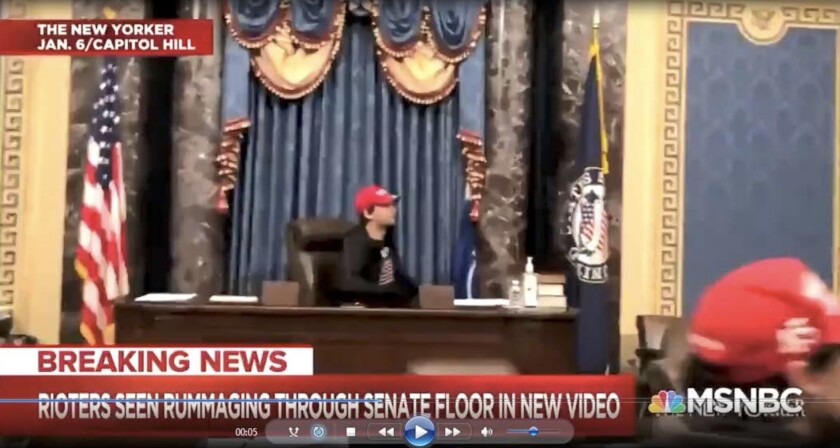
At least 11 tipsters identified Secor as the man in the video and still images either standing on the Senate floor or on the dais sitting in Pence’s chair…
After video of the scene surfaced on the New Yorker’s website, investigators obtained security camera video of Secor in the hallways, Rotunda area and Senate floor, the affidavit said.
Moments earlier, Secor was with a mob forcing his way past at least three police officers and through a set of double doors into the Capitol, Elliott said in the sworn statement.
“As a result of Secor and others pushing on the double doors … the doors opened and dozens of additional rioters flooded into the building,” Elliott wrote. “The Capitol Police officers were shoved by the crowd, at times trapped between the doors and the crowd, and eventually pushed out of the way of the oncoming mob.”
Agents also found that Secor had broadcast live from the Capitol using DLive, a videostreaming service built on blockchain technology.
In the livestream, Secor uses the moniker Scuffed Elliot Rodger, an apparent reference to the man who killed six people in Isla Vista, Calif., in 2014 and became a hero to “incels” — a fringe group of sexually frustrated men who blame women for their misery and often advocate for violence against them.
Governor Greg Abbott of Texas and a bevy of rightwing commentators blamed wind turbines, which supply 10% of the state’s energy, and “the Green New Deal, which doesn’t exist, for the failure of the state’s power supply. He learned “the Big Lie” from his hero Trump.
As millions of people across Texas struggled to stay warm Tuesday amid massive cold-weather power outages, Gov. Greg Abbott (R) directed his ire at one particular failure in the state’s independent energy grid: frozen wind turbines.
“This shows how the Green New Deal would be a deadly deal for the United States of America,” Abbott said to host Sean Hannity on Tuesday. “Our wind and our solar got shut down, and they were collectively more than 10 percent of our power grid, and that thrust Texas into a situation where it was lacking power on a statewide basis. … It just shows that fossil fuel is necessary.”
The governor’s arguments were contradicted by his own energy department, which outlined how most of Texas’s energy losses came from failures to winterize the power-generating systems, including fossil fuel pipelines, The Washington Post’s Will Englund reported. But Abbott’s debunked claims were echoed by other conservatives this week who have repeatedly blamed clean energy sources for the outages crippling the southern U.S. [The Texas grid got crushed because its operators didn’t see the need to prepare for cold weather]
In fact, typically mild winters and a lack of state regulations in Texas combined to leave electricity providers unprepared for the extreme cold that has suddenly hit the state, The Post reported. Nearly every source of energy — from wind turbines to natural gas to nuclear power — have failed to some degree following a harsh storm that covered the region with thick layers of snow and ice. Although renewable energy sources did partially fail, they only contributed to 13 percent of the power outages, while providing about a quarter of the state’s energy in winter. Thermal sources, including coal, gas and nuclear, lost almost twice as many gigawatts of power because of the cold, according to the Electric Reliability Council of Texas (ERCOT), the state’s electric grid operator.
Critics have also noted that wind turbines can operate in climates as cold as Greenland if they’re properly prepared for the weather.
Despite the much larger dip in energy from fossil fuels, Republican politicians have seized on the outages to attack the Green New Deal and Democrats’ push to address climate change by reducing the consumption of fossil fuels.
In his Fox News interview, Abbott did not address the fact that most of the state’s power comes from fossil fuels and that ERCOT had planned to produce far more power from natural gas than became available as the cold set in, contributing a stunning deficit amid the freezing weather. On Tuesday, Abbott called for a state investigation into ERCOT’s failings, saying the agency had been “anything but reliable” following the winter storm.
Abbott’s office did not immediately respond to a request for comment late Tuesday. The governor was not the only prominent Texas Republican to blame clean energy for the historic power outages. After Fox News host Tucker Carlson inaccurately told viewers that the state’s power grid had become “totally reliant on windmills,” former Texas Gov. Rick Perry, who served as energy secretary under President Donald Trump, joined Carlson in railing against the Green New Deal, which has not been enacted in Texas or nationally.
“If this Green New Deal goes forward the way that the Biden administration appears to want it to, then we’ll have more events like we’ve had in Texas all across the country,” Perry said in another Fox News segment.
Rep. Dan Crenshaw (R-Tex.) shared a detailed accounting on Twitter of how the state’s power grid failed, noted the roles that natural gas and nuclear power played — but also used the moment to attack wind turbines on Tuesday.
“Bottom line: Thank God for baseload energy made up of fossil fuels,” Crenshaw tweeted. “Had our grid been more reliant on the wind turbines that froze, the outages would have been much worse.”
Rep. Alexandria Ocasio-Cortez (D-N.Y.), who has been a strong proponent of the Green New Deal proposal, slammed Texas Republicans early Wednesday. “The infrastructure failures in Texas are quite literally what happens when you don’t pursue a Green New Deal,” she said in a tweet.
Texas Democrats also criticized Abbott in a statement Monday, calling out Republican leaders for allowing the power to go out in the state that produces the most energy in the nation. “If we had a governor open to alternative sources of energy, Texas might be in a situation in which we have energy reserves to efficiently power our state, instead of the reckless leadership we have witnessed time and time again from Greg Abbott,” the Texas Democrats said.
Wind turbines are working very well in far colder climates. Abbott probably outsourced the state’s energy needs to profit-seeking entrepreneurs who cut corners to make more money.
In another article in the Washington Post, the blame is placed where it belongs: on short-sighted politicians who didn’t plan for a worst-case scenarios.
When it gets really cold, it can be hard to produce electricity, as customers in Texas and neighboring states are finding out. But it’s not impossible. Operators in Alaska, Canada, Maine, Norway and Siberia do it all the time.
What has sent Texas reeling is not an engineering problem, nor is it the frozen wind turbines blamed by prominent Republicans. It is a financial structure for power generation that offers no incentives to power plant operators to prepare for winter. In the name of deregulation and free markets, critics say, Texas has created an electric grid that puts an emphasis on cheap prices over reliable service.
It’s a “Wild West market design based only on short-run prices,” said Matt Breidert, a portfolio manager at a firm called Ecofin.
And yet the temporary train wreck of that market Monday and Tuesday has seen the wholesale price of electricity in Houston go from $22 a megawatt-hour to about $9,000. Meanwhile, 4 million Texas households have been without power.
One utility company, Griddy, which sells power at wholesale rates to retail customers without locking in a price in advance, told its patrons Tuesday to find another provider before they get socked with tremendous bills.
The widespread failure in Texas and, to a lesser extent, Oklahoma and Louisiana in the face of a winter cold snap shines a light on what some see as the derelict state of America’s power infrastructure, a mirror reflection of the chaos that struck California last summer.
Edward Hirs, an energy fellow at the University of Houston, said the disinvestment in electricity production reminds him of the last years of the Soviet Union, or of the oil sector today in Venezuela. “They hate it when I say that,” he said.
John Thompson, retired teacher and historian in Oklahoma, reviews a book of memories written by immigrant children about their ordeals. We will long suffer the embarrassment of Trump’s cruel immigration policy, but the children will never forget.
Thompson writes:
Where the Rainbow Ends: Project VOICE Visions of Inclusion, Culture, and Empathy, edited by Jamie Hinds and Savanna Payne, is the latest book by Oklahoma City Public Schools English Language Development students. This year’s volume faced an additional challenge as the COVID-19 pandemic shut down in-person instruction. But these resilient authors have overcome far greater challenges.
The student-authors started with the reasons why they left Central America, Mexico, Africa, and Asia for the United States. Most described harrowing experiences crossing Mexico, with many facing brutal encounters with the U.S. Immigration Services. Fortunately, despite continuing obstacles, almost all have had a better experience in Oklahoma City.The stories were peer edited. The student-authors are anonymous, often not even revealing their gender. Most were forced to immigrate by climate change or the murder of family members or other threats by gangs. This post focuses on the majority who immigrated from Central America.
They begin with a description of life in their previous homes, and with the stress of departure. A 15-year old, who had “always considered myself the man of the house” left Guatemala when it became too hard to get food and water. Early in the trip, his family was starved by the “coyote.” They were crowded into a truck full of 50 people until reaching the border, and walking through the desert. Separated from his mom by Immigration, he spent three frightening days without seeing the sun. Fortunately, Texas church members accepted them and helped them travel to Oklahoma City.
A 13-year-old started the trek, alone, from Guatemala. He or she was picked up by the coyote, who charged $3,000, and was crammed into a truck with 35 people, along with the “zetas’” marijuana and cocaine. This was followed by the terrifying ride on the train called “the Beast.” After four months in detention, he or she was reunited with their mother and is now the “happiest child because I have [had] a lot of years without my mom.”
Similarly, a 12-year-old left Honduras and was crowded into the Beast. He or she saw passengers thrown off the train and killed. A 13-year old girl left Honduras after being sexually accosted and almost kidnapped. During the trip, she and others were stored in an ice cream trailer without food for three days. She learned two valuable lessons though. “There are good as well as there are bad people,” … and if molested, children should “trust their parents and do not remain silent.”
Then there was the cruelty of the American detention system. It was bad enough, said one immigrant, to be locked up in Sinaloa for 15 days, but upon arriving in the U.S., the young person was thrown into “the cooler.” Another was “put in the cooler’” and then sent to a “safehouse” for 2-1/2 months. One of 3,000 detainees described immigration officers who “were very rude to everybody,” and put them in a freezer for up to 4 days. Another spent 8 days in the cage and then was sent to foster care in New York.
Some revealed complicated endings to their story. A girl started working at 9 years-old, but kept her grades up until she had to leave Guatemala at 11. When she was put in truck and babies cried, the guide put rags in their mouths. The babies turned purple and the immigrants were afraid they’d die. They later had to sell their clothes for food and water, and escape from kidnappers. She’s since moved back and forth among family members in Oklahoma. Another Guatemalan student concluded that now, “I am half agony and half hope, although perhaps more agony.”
A Guatemalan was 5 years- old when “they” killed his grandfather, who was a father to him or her, in front of their family. He or she started to “grow up with the mentality that everything in my life would be wrong,” and has had to mature without a stable family. He or she observes, “I’m a good student, I respect who gives me roof, I have many values in my life,” but would like “a life without so many questions, that nobody answers [for] me.” The author understands that humans have to make difficult decisions, but his or her story is “so painful, so empty” and it warns about the effects of “the lack of love and feelings protected.”
Others had unambiguously happy endings to their stories. A student-author had been comfortable in Guatemala, before losing everything. In the U.S., they found a house and a job, and bought a car. So, “Now we are blessed … now I get to go to school. This is the start of a new journey.” Similarly, a Guatemalan girl helped her dad sell bananas, and had enjoyed parades. In Oklahoma, she learned “no matter who you are, if you are small, skinny, fat, pretty, ugly or colored if they are real friends, they will love you as you are.”
Another Guatemalan was threatened by police for money, locked up with 30 people for 2 weeks, and traveled across Mexico with 28 people in a van. But the story closed with a thank you for helpful Americans, concluding “If you think of Oklahoma, I hope you’ll think of Jim and Jean Dawson. …”
Read the book, and comparably profound insights will be offered from immigrants from other countries. The father of a 16-year-old from Juarez was murdered by extortionists, but now he is happy and calm in Oklahoma City, and tells the story in support of others who have endured worse. Another high school student concluded, “Mexico still calls me,” and “Oklahoma made me strong. Mexico makes me safe.”
An elementary student said her life in Mexico made her mature, but she also loves clean, beautiful streets, and stores of the U.S. Some of her Oklahoma classmates made fun of her, but others were helpful. When feeling broken, she relies on God. And she concludes, “I wanted to exceed the limits people thought I had because I was Latina.”
Three former state superintendents of education in Indiana wrote a joint letter opposing the Republican plan to expand vouchers.
Jennifer McCormick, Glenda Ritz and Suellen Reed Goddard released a letter criticizing the proposals for diverting funding away from traditional public school students.
House Bill 1005 seeks to expand the eligibility of who can receive a school voucher and would create the “education scholarship program” to allow some families funding for education services outside of public school.
The House is expected to take up the bill for final vote Tuesday.
Reed Goddard took part in a virtual event Monday with the Indiana Coalition for Public Education, a non-profit organization that opposes legislation to fund private school vouchers. Goddard urged people to call their elected officials to oppose the House bill and other legislation.
“Now is not the time to divert any of our funding from public education where about 94% of our students are educated,” she said. “We are in the throes of a pandemic which challenges technology, teaching techniques, students and parents support and workforce issues.”
Goddard and others fear Gov. Eric Holcomb’s modest increase for K-12 funding in his two-year budget proposal will be erased by legislation expanded choice options if they become law.
Here is the text of the letter signed by the three former state chiefs:
An Opposition Letter from Public School Supporters
to Members of the Indiana General Assembly and Governor Holcomb
In support of the 94% of Indiana students who attend public schools, we strongly oppose House Bill 1005, Senate Bill 412 and Senate Bill 413. Education Scholarship Accounts will divert adequate and equitable funding away from public school students and open the door to unacceptable practices. Hoosiers all lose when children are not well educated and public tax dollars are not accounted for responsibly.
In Indiana communities, public schools have been and will continue to be the hub for vital services supporting the well-being of the whole child. Passing HB 1005, SB 412 or SB 413 would divert significant monies away from public schools, enhance the opportunity for a lack of oversight related to the intended educational purpose of such funds, further exacerbate insufficiencies tied to Indiana’s teacher compensation, and increase the risk to student growth, proficiency, and well-being.
Indiana’s most vulnerable youth and families deserve a per-pupil funding level that promotes adequate and equitable funding. Unfortunately, the language of HB 1005 gives advantages to families with high incomes and adds disadvantages for our most vulnerable by shifting risks. HB 1005, if passed, will defeat the spirit of the bipartisan Every Student Succeeds Act and run counter to the initial rhetoric behind Indiana’s school choice.
Even with the amendment, HB 1005 would result in 94% of Indiana’s students receiving less than the tuition support increase of $377 million over two years that Gov. Holcomb’s proposed. Teacher compensation, support staff pay, COVID-19 academic and operational-related costs, student support service demands, constantly changing graduation and accountability requirements, and K-12 workforce development efforts certainly deserve the funding necessary to serve Hoosier students.
We firmly oppose HB 1005, SB 412 and SB 413. We firmly support the adequate and equitable funding of our Indiana’s public schools representing 94% of Hoosier students and families.
Dr. Suellen Reed Goddard
1993-2009 Indiana Superintendent of Public Instruction
Glenda Ritz
2013-2017 Indiana Superintendent of Public Instruction
Dr. Jennifer McCormick
2018-2021 Indiana Superintendent of Public Instruction.
The following organizations support this letter:
Indiana Coalition for Public Education
AFT Indiana
Indiana Association of Career and Technical Education Districts (IACTED)
Indiana Association of Colleges for Teacher Education (IACTE)
Indiana Association of Public School Superintendents
Indiana Council of Administrators of Special Education (ICASE)
Indiana Parent-Teacher Association (PTA)
Indiana Small and Rural Schools Association
Indiana State Teachers Association (ISTA)
Indiana Urban Schools Association
Can anyone explain why the Republicans in the legislature want to harm the public schools that enroll 94% of the children of the state? Did the Republicans familiarize themselves with the research on vouchers, which consistently finds a “significantly negative effect” on academic achievement for students who leave public schools for voucher schools? Why do they want to undermine the quality of their state’s public schools?
The Fort Wayne Journal-Gazette demonstrated what an absurdity the Indiana voucher program is and why it should not be expanded. Research increasingly shows the negative effects of vouchers on students (see here and here).
Its editorial explained:
Fort Wayne has a parks system, supported primarily by property taxes. Most residents appreciate the parks, whether they use them or not, recognizing the benefits they afford the entire community. There are property owners, however, who don’t use the parks and spend their own money to pay for health club memberships or country club dues.
Now, imagine some of those property owners decide the share of tax dollars they spend for city parks should instead be returned to them as a “park voucher,” available for the members-only clubs they prefer. Without an increase in the tax rate, the amount of money available for city parks would shrink.
That’s the essence of Indiana’s school voucher program, which shifts tax dollars from a public good to a private commodity under the clever name of “Choice Scholarships.” With a voucher framework firmly in place and many Indiana voters convinced “school choice” is a sacred right, the General Assembly’s Republican supermajority is prepared to make its most audacious push yet to expand the program to wealthy Hoosiers.
House Bill 1005, with an estimated cost of $202 million over the next two years alone, will be heard in the House Education Committee at 3:30 p.m. Wednesday.
The proposed bill expands the $172 million a year voucher program to allow a family of four earning as much as $145,000 a year to qualify for vouchers. Median household income in Indiana is about $60,000 a year.
Open the link and read the rest of the editorial.
Multiple studies show that students who leave public schools to enroll in voucher schools fall behind academically. Why do Indiana Republicans want to defund their public schools?
West Virginia was the first site of the Red for Ed teachers’ movement. The teachers of the state captured national attention for their statewide strike. Their strike included a number of issues, not only salaries and health care, but also charter schools. Teachers correctly saw them as a means of diverting funding from public schools. They wanted well-resourced public schools. But given the GOP dominance of the legislature, the charter supporters demanded charter legislation, and the best the teachers could was to limit their number.
Now, in the middle of the pandemic, the GOP is coming back with both charter and voucher legislation. The bills are advancing rapidly and teachers can’t mass their numbers in the Capitol due to restrictions on access.
CHARLESTON — Bills on schedule to pass the state House of Delegates this week would allow faster charter school expansion, promote online charter schools and give parents public money for non-public schooling.
It’s just the second week of the legislative session.
Fresh off their first statewide strike a year earlier, public school workers in 2019 shut down classrooms again to oppose an omnibus education bill that, among many other things, would’ve legalized charter schools and vouchers to provide public money for private- and home-schooling.
The effort staved off vouchers and limited charter schools to no more than three until July 1, 2023. County boards of education also were generally given veto power over charters.
This time, facing a Republican governor paired with Republican supermajorities in both legislative chambers, state public school worker unions are taking a more cautious approach.
“Maybe fight is not the best word, but to support our stand,” said Fred Albert, president of the state branch of the American Federation of Teachers, “and we’ve said this a million times: Elections have consequences. And we’ve always been about trying to elect friends of public education and people who support public education … [W]e know it’s going to be an uphill battle…”
Time to stop the bills appeared to be running out three days into the session. Perhaps it ran out in November.
By just Day Two of the session, House Republicans had already advanced charter school and voucher bills from the House Education Committee, which has been the graveyard of previous union-opposed legislation. The House Finance Committee passed the vouchers bill Saturday.
If the full House passes the bills, they head to the Senate, where there has historically been even more support for such legislation. A simple majority can override a gubernatorial veto...
Other factors could be affecting workers’ ability to combat the legislation. Many have borne personal tolls from the pandemic.
“People are dying,” White said. He said he confirmed Thursday five of his union members had died.
“I think people are feeling overwhelmed with the pandemic,” Albert said. “There’s a lot of fear out there for their own health and safety and for their children and classrooms.”
Teachers and others also have waged wearying battles over mandated returns to classrooms.
“I think people are exhausted from the fights over school reopening,” said Jay O’Neal, a teacher at West Side Middle who helped galvanize the 2018 and 2019 strikes.
A perfect time to sabotage public schools and their teachers, when everyone is 3xhausted.
How did this happen? Public schools in many districts and states are underfunded, unable to meet the mandates imposed by state and federal government, yet business is booming for the edupreneurs!
Peter Greene scratches the surface of the exploding education industry, where the big companies swallow the little companies, and it is difficult to identify which conglomerate is in charge.
Who is buying the junk food?

 Diane Ravitch's blog