Archives for the month of: January, 2020

It was a curious fact that when billionaire Michael Bloomberg was mayor of New York City for 12 years, he had complete control of the public schools yet did not have any fresh ideas about how to improve them.

This should not be surprising, because he was never an educator. He hired another non-educator–Joel Klein–to be his chancellor. The two of them relied heavily on McKinsey and other consultants to guide them. They hired lots of MBAs to staff top  positions. They hoped to adopt a corporate style of organization, which made sense because they had low regard for actual educators.

He adopted every aspect of No Child Left Behind: high-stakes testing, closing schools, firing teachers and principals. He loved opening small schools, and when they failed, he reopened them with a new name so they could start over.

New York City was a faithful replication of NCLB, with punishments and rewards leading the way.

His main idea was to hand schools over to private charter operators, assuming that they would have better ideas about how to run schools than he did.

Some of the charter operators made a point of excluding low-performing students, which artificially boosted their test scores.

Some closed their enrollments in the fourth grade, so they would not have to take in new students after that point.

Some kicked out kids who were in need of special services.

Bloomberg’s favorite charter chain was Eva Moskowitz’s Success Academy, which used all of these tricks to get astonishingly high test scores.

Bloomberg was obsessed with data and test scores. He even adopted Jeb Bush’s policy of letter grades for schools (which his successor Bill DeBlasio abolished).

The New York City charter industry practiced all the tricks of raising test scores by manipulating the student population.

In addition, the charter sector mastered the ability to organize mass rallies, flooding legislative halls with students and parents, pleading for more funding for new charters (which they could not attend since they were already enrolled in charters).

So pleased was Bloomberg with his charter policy that it is now the centerpiece of his national education agenda.

He doesn’t care about the nearly 90% of kids who are enrolled in public schools.

He believes in privatization.

If elected, he could retain Betsy DeVos as his Secretary of Education and maintain continuity with Trump’s education agenda.

California claims to have tightened up its charter school law, but huge loopholes remain. For example, state money goes to charters that offer religious education to home school students, as well as to private businesses.

Patrick O’Donnell, chair of the Assembly Education Committee, thinks that oversight is needed.

Private businesses and religious organizations have been getting public school dollars through charter schools that allow home-schooling parents to use state funds to pay for certain services for their children — a practice some lawmakers want to rein in.

Parents in certain home school charters get as much as $2,600 a year, money that has gone to Disneyland, religious educators, private businesses and others who provide educational, enrichment and recreational services for children.

“It was never the intent of the state legislature to pass dollars through online charter schools to private vendors or religious organizations,” said Assembly Education Committee Chair Patrick O’Donnell, D-Long Beach, in an interview. “This highlights a bigger issue that we’ve been grappling with in Sacramento for many years … that the charter school law, when it was originally written, was wide open.”

Another state legislator, Assemblywoman Cristina Garcia, D-Bell Gardens, says she plans to bring forward a bill in the new year that would require state oversight and rules for charter school vendors.

She expects the bill will have guidelines about what kinds of vendors would be allowed to receive public school funds. She said her bill was partly inspired by The San Diego Union-Tribune’s reporting on home school charters.

It’s important “to make sure we are allowing (charter schools) to have the freedom that they were given, without it being abused and without it turning into a system where we’re privatizing education and taking advantage of loopholes,” Garcia said during an interview.

“We keep going to the fact that there hasn’t been enough oversight as to how charter schools are using the dollars,” she said. “I think we’re seeing through this reporting that there’s a lot of blurred lines, and we need a lot more transparency and a lot more accountability.”

Legislators can reasonably anticipate that the powerful, well-funded California Charter Schools Association will fight relentlessly against any regulation, oversight, transparency, or accountability.

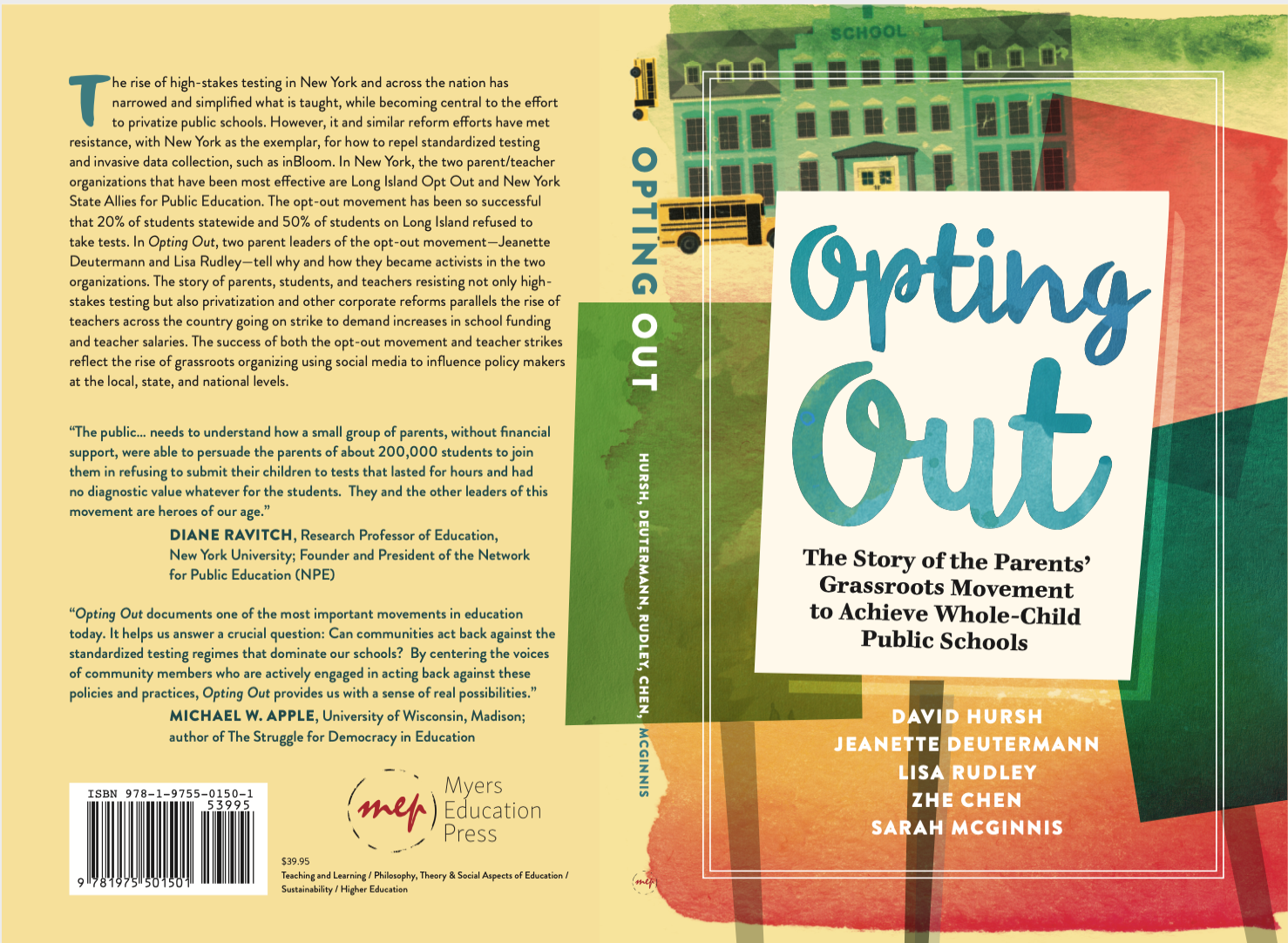
This is a book you will want to read if you are a parent, a teacher, a teacher educator.

Opting Out: The Story of the Parents’ Grassroots Movement to Achieve Whole-Child Schools is an essential addition to your bookshelf.

It was written by Professor David Hursh of the University of Rochester and parents leaders of the New York Opt Out movement Jeanette Deutermann, Lisa Rudley, and Hursh’s graduate students, Zhe Chen and Sarah McGinnis.

Together they explain the origins and development of the one of the most significant parent-led reactions against high-stakes testing and in favor of education that is devoted to the full development of children as healthy and happy human beings. The media liked to present the Opt Out movement as a “union-led” action, but that was always a false narrative. It was created and led by parent activists who volunteered their time and energy to save their children from test centric classrooms and wanted a “whole-child” education that helped their children become eager and engaged learners.

David Hursh has written and lectured about the assault on public education and the dangers of high-stakes testing.

https://www.waikato.ac.nz/wmier/news-events/prof-david-hursh-on-the-takeover-of-public-education

University of Rochester Meliora Address (2013): High-stakes testing and the decline of teaching. https://www.youtube.com/watch?v=GIQu2Hh_YkI

Keynote address: New York State as a cautionary tale (2014). New Zealand union of primary teachers and administrators. https://www.youtube.com/watch?v=hW4vZGsLiL4

The parent co-authors are leaders of the New York State Opt Out movement, primarily through their role in New York State Allies for Public Education, which has organized hundreds of thousands of parents to say no to excessive and pointless testing, whose only beneficiaries are the big testing corporations.

The parents of the Opt Out movement are a stellar example of the Resistance that is bringing an end to this current era of child abuse and test-driven miseducation.

I was happy to endorse the book and am pleased now to recommend it to you.


During the Clinton administration, Congress enacted a program called EB-5, which promised green cards to foreign investors who put their money into job-creating projects. One of those designated projects for foreign investors was charter schools. Give a lot of money, invest in charter school construction, get a green card.

The middle-men quickly figured out how to make this exchange pay off in profits.

Example: a charter school in North Carolina that won $3 million from foreign investors (six green cards), but has accumulated staggering debt.

The Center for Immigration Studies tells this sordid tale:

We have suggested in the past that the combination of the loosely run charter school movement with the loosely managed EB-5 immigrant investor program shows every sign of being a disaster for everyone involved(students, teachers, and taxpayers) — except for the middlemen.

They usually do just fine, thank you.

We have been following, among others, the case of one specific charter school in the suburbs of Charlotte, N.C., where until recently the state government has been, at the very least, more lax than most states in its supervision of charter schools.

This is a school in which six (probably Chinese) aliens have invested $500,000 each in the hopes of getting a family-sized set of green cards through the Homeland Security-managed EB-5 program. It is the Lakeside Preparatory Academy in Cornelius, N.C., sometimes known as the Lakeside Charter Academy, and as Thunderbird Preparatory Academy, Inc.

Financial Background. The struggling school opened a few years ago with four financial handicaps:

  • As we recorded in some detail, the campus had been sold, and resold and resold, apparently never at arms’ length, among Utah-based firms, some with the same postal address, so that several middlemen made major profits as its paper value moved up from $1.3 million to $9.5 million — despite a real estate assessment, for tax purposes, of $3.3 million (there was also a couple of million dollars worth of remodeling done during this time);
  • Somewhere along the way, the campus’ landlords collected $3 million from the alien investors which helped underwrite the aforementioned profits;
  • There was a falling-out among the middlemen that resulted in the school accepting a $450,000 judgment against it, a sum it had to borrow; and
  • Much of this debt remains, and is subject to a 20 percent interest rate (public school debt rarely exceeds 2 percent or 3 percent).

Bear in mind that the campus is owned by a for-profit entity in Utah, which had the advantage of the EB-5 funding; the school itself, though apparently controlled by the landlord, is a non-profit entity, and receives tax moneys for the education it provides.

In this dismal setting, a recent audit found that the school lost $103,875 in the 2017-2018 school year, and then a loss of $292,463 in the more recent 2018-2019 school year. The most recent loss occurred while the school reported a gross income of $983,091, down from a gross of $1,252,807 the prior year. So the gross was falling and the loss rising. At the end of the last school year, the cumulative loss was $363,471.

The Prospect of Bankruptcy. If one reads the audit carefully — what follows is not stressed anywhere — one finds that during the most recent school year the school paid the Utah landlords only some $23,000 in rent, and that in its current year it is obligated to pay 25 percent of its gross or, if the experience of the most recent year is to continue, $246,522, or about $223,000 more in rent than the previous year, which, if income and expenses remain the same, would suggest a loss in the current year of well over $500,000.

This would mean that the school went from about $100,000 in losses, to about $300,000 in losses the most recent school year, to more than $500,000 in losses for the current year.

Given those prospects, how in the world will the EB-5 investors get their money back?

The True Numbers. What we have reported above reflects the most recent audit by Rives & Associates, a North Carolina CPA firm. Local critics of the audit say that even these grim numbers do not reflect the dire state of the school.

We have a copy of an invoice, for example, that shows that the non-profit school owed the for-profit landlord (Lakeside Charter Holdings LLC) $1,720,503 at the end of the 2018-2019 school year; the date that debt is due is not shown, this debt is about double the school’s entire income for that year, and it apparently is not recorded in this audit. What we do see, on p. 14 of the audit is this, perhaps Delphic, statement: “Some liabilities, including bonds payable and accrued interest, are not due and payable in the current period and therefore are not reported in the funds.”

So, discounting a bit of auditing sleight of hand, the true debt of the school — with about 100 pupils — is well over $2 million!

It may well be in the interest of the landlord, and of the EB-5 middlemen, to seek to hide the true level of the school’s debt.

With all this in mind, EB-5 investors should look carefully at the proposed investments, and they should look at least twice if a charter school is involved.

The EB-5 program calls for 10 new jobs to be created by each $500,000 investment; since charter schools do not create jobs (they just take them away from the public schools), it is hard to agree with the underlying DHS decision to accept any charter school investment as appropriate in the EB-5 program.

One can only hope that the taxpayers will not be forced to bail out this little school.
Let me confess that I have a mad crush on Audrey Watters although I have never met her. I love her fearlessness, her keen intelligence, and her unapologetic humanity.

I wrote a few days ago that her recent post on the 100 Biggest Worst Ed-Tech Debacles was the best post I had read in the last decade.

She got a lot of feedback to that zinger of a post, and some readers asked her if she could name the 100 best things that happened in Ed-tech.

She answers that question boldly in this post.

I paraphrase: Ed-Tech has enough marketing, branding, shills, and paid mouthpieces. Hers is not one of them.

Ah, the burdens of the presidency!

THE PRESIDENT’S WEEK:

Monday: TRUMP will participate in a ceremony for new ambassadors to D.C., and he’ll have lunch with the vice president.

Tuesday: THE PRESIDENT will host the prime minister of Greece.

Thursday: THE PRESIDENT will have a political rally in Toledo, Ohio.

Lots of executive time for watching Fox & Friends and tweeting.

Since it is a slow week, Trump will probably head to Mar-a-Lago to get in a few rounds of golf on Friday.


In this post, Peter Greene reviews Edspeak and Doubletalk, the glossary co-written by me and Nancy Bailey.

This is the book you need, the scorecard, to identify the players in the fast-moving world of reform propaganda and over-hyped programs.

This resulting book, Edspeak and Doubletalk: A Glossary to Decipher Hypocrisy and Save Public Schooling, is exceptionally useful as a quick-reference resource. If you are a regular reader of this or other education blogs, you know that there is a forest of acronyms, a Grand Canyon’s worth of program names and purposes, and enough different edu-focused organizations to pave a road to the moon and back. This book makes for a quick and easy reference for it all, and more. Chapters are organized by general topic, such as Charter Schools and Choice, English Language Learners, Technology, and Separation of Church and State. There are guides to the various players, both in the chapter on Groups Fighting Corporate “Reform” and School Reform Groups and Terms, or “Money Talks.”

Greene writes:
The book comes with an on-line supplement–an e-book– and the promise of online updates to come. It’s enlightening to browse the book– I’ve already encountered many terms and programs and policies that I had never heard of before (Paideia Program, anyone?)– but I’ve also already used it as a substitute for my usual research assistant (Dr. Google) to look up a couple of terms and organizations. 
 
Explanations are short, clear, and to the point, which is half the battle, since eduspeak relies on a cloud of smoke and fuzz to obscure what’s really going on. Well, Bailey and Ravitch know what’s really going on in debates that have become “highly politicized.” This book will be useful to the general reader, but I’d recommend it for every teacher. Keep a copy in your desk drawer and every time a communique comes across your desk that makes you think, “What the heck is this? Who are these people anyway, and what the heck are they talking about?” just pull out your copy and start translating. 

The Legacy Prep School in Charlotte, North Carolina, closed its doors at the end of the holidays, leaving parents and students on their own to find a school.

Legacy Prep was a private school that relied on vouchers from the state.

Parents were stunned.

Yes, 100% caught off-guard,” said Jackie Davis, whose son attends Legacy Prep. 

On Friday, she and other parents whose children were enjoying holiday break, received an email from Stacey Rose, the school’s principal, that told them the school would not re-open on January 7th due to funding issues. 

It is with a heavy heart that I must inform you that Legacy Preparatory will have to close its doors and cease all operations immediately.  As such, we will not reopen for classes on January 7th (or any time thereafter) as originally planned,” Rose wrote in-part.

“It’s a burden,” Davis said. “I’m thinking I’m in a nightmare, in a dream, and I haven’t woke up from it.”

She now has just days to go through the headache of finding her son a new school to attend so he can stay on track. 

“It’s a shock,” she said. “First thing that crossed my mind was what about I going to do with my son.”

The letter that was sent to parents noted that the school could not stay open due to a lack of funding. 

Our main school investor did not deliver on his promise to provide the additional finances needed to accompany the scholarship funds that are required to run the school through June,” Rose wrote in-part. 

Davis said the private school charges $4,200 per student for the year, the cheapest she could find in the Charlotte-area when she looked for schools to send her son. 

She said she doesn’t want to send her son to CMS because she wants to ensure her son gets the one-on-one attention he needs to succeed. 

The principal offered to place them in an online cybercharter, which provides no personal contact at all.

Keung Hui, a reporter for the “News Observer’ tweeted:

Legacy Prep, which abruptly closed Friday, got $283,500 this year from NC for 135 voucher students. The private school is in same building & led by same principal when Charlotte Learning Academy was there before charter was not renewed in spring. #nced

The school was a charter that was not renewed, then a voucher school that failed.

Thats the market: Instability is a feature, not a bug.


Stuart Egan is an National Board Certified Teacher in North Carolina. He writes here about the horrible policies imposed on public schools in North Carolina since Tea Party Republicans took over the state’s General Assembly.

North Carolina was once considered the most progressive state in the South, for its dedication to improving public schools and honoring fine teachers. It had the highest proportion of National Board Certified teachers in the nation.

But then the Tea Party arrived in 2010 with an ALEC agenda of disruption and destruction.

Egan writes:

When the GOP won control of both houses in the North Carolina General Assembly in the elections of 2010, it was the first time that the Republicans had that sort of power since 1896. Add to that the election of Pat McCrory as governor in 2012, and the GOP has been able to run through multiple pieces of legislation that have literally changed a once progressive state into one of regression. From the Voter ID law to HB2 to fast tracking fracking to neglecting coal ash pools, the powers that-now-be have furthered an agenda that has simply been exclusionary, discriminatory, and narrow-minded.

And nowhere is that more evident than the treatment of public education.

Make no mistake. The GOP-led General Assembly has been using a deliberate playbook that other states have seen implemented in various ways. Look at Ohio and New Orleans and their for-profit charter school implementation. Look at New York State and the Opt-Out Movement against standardized testing.  Look at Florida and its Jeb Bush school grading system. In fact, look anywhere in the country and you will see a variety of “reform” movements that are not really meant to “reform” public schools, but rather re-form public schools in an image of a profit making enterprise that excludes the very students, teachers, and communities that rely on the public schools to help as the Rev. William Barber would say “create the public.”

North Carolina’s situation may be no different than what other states are experiencing, but how our politicians have proceeded in their attempt to dismantle public education is worth exploring.

Specifically, the last nine-year period in North Carolina has been a calculated attempt at undermining public schools with over twenty different actions that have been deliberately crafted and executed along three different fronts: actions against teachers, actions against public schools, and actions to deceive the public.

Read on to learn about the calculated and vicious attack on public schools and their teachers. This is a record of shame that undermines the public good.

Nancy Bailey is an experienced classroom teacher who is now retired. She and I co-authored a glossary to explain the duplicity of today’s phony school “reforms,” called Edspeak and Doublespeak. We discovered that we shared the same disdain for hypocrisy and hype.

Nancy posted a letter here by a teacher in a suburban school about how corporate reform is ruining education in her district.

Here is an excerpt from her essay.

Who remembers when elementary age children’s schedules included daily periods of recess, English, social studies, science & math, with a rotation of daily enriching specials, such as art, music, gym, library, etc.?

Who remembers when change was slow and steady in school districts, because they knew children needed stability and predictability?

Who remembers when there were no charter schools siphoning public school money away from public schools?

Who remembers when public schools were a valued public service for the greater good of the country?

Who remembers school before corporate education reform? Not sure what that is?

She goes on to e plain how the misguided and failed ideas of “corporate reform” have changed schools for the worse, even on the best districts.

The ever-present theme of corporate reform is DISRUPTION. Not better education: disruption. That’s why in my new book SLAYING GOLIATH, I refer to the faux reformers as DISRUPTERS. I don’t allow them to corrupt and appropriate the honorable term “reform” or to call themselves “reformers.” They are not. They are DISRUPTERS.