Archives for the month of: May, 2019


Stuart Egan has gathered some powerful graphics that demonstrate the war on public schools and their teachers in North Carolina. 

You will see, for example, that school grades are not a measure of school quality. They are quite decisively a measure of the affluence or poverty of the students who attend the school.

The schools are underfunded, teachers are underpaid, and fraudulent measures are used to assess students, teachers, and schools.

Peg Tyre, veteran journalist, needs your help. If you write her, please copy your comment here. You don’t have to, but it would be nice if you did. I know her and trust her.

Peg writes:

Japan & S. Korea Want Their Schools To Produce Innovators.
Curious About What That Looks Like? I am too!


Policy-makers and parents in Japan and S. Korea are determined to get rid of the shallow, rote learning, and high-stakes testing that characterizes their education systems. They want to adopt new models and help their public schools turn out a generation of innovators and creators. But what will that look like? Will they succeed? What does it mean for education in the U.S. where policy-makers are also facing wide-spread pushback against rote learning and testing?
 
I’m a seasoned journalist (New York Times, Scientific American, The Atlantic and others) and bestselling author dedicated to sophisticated, open-minded (and opened-hearted) inquiry. I’ll be traveling to Japan and S. Korea to learn from teachers, students, politicians and parents what is happening there. I’ll be sending what I hope will be six or so FREE newsletters to give you a first-hand look and feel of what I find. Read about it here, or read a more digested version in a major publication to be named later (that will be keeping it behind a paywall, I’m sure.)
 
You can take an active role in shaping this project. Please send me questions, observations, research, history and personal reflections about your own teaching and learning, thoughts about rote learning and your ideas about what makes an innovator. Tell me what you want to know from my reporting. Twitter: @pegtyre or email: pegtyre1@gmail.com
 
Also, if you know of someone who might be interested in being part of this project, kindly send me their email and I’ll add them to the mailing list.
 
My trip is made possible by a generous Abe Fellowship for Journalists (administered by the Social Science Research Council.) I retain full editorial control. I also appreciate the moral support of my colleagues at the EGF Accelerator, an incubator for education-related nonprofits.

There is something very funny about imagining John a Merrow as anyone’s fanboy, but in this satirical post, he admits that he is bewitched by Betsy DeVos. 

John is quite the humorist. His April Fools’ Day posts are always hilarious, the more so because so many of his readers are fooled.

Remember, friends, satire!

He begins:

Full disclosure: Although I have never met or interviewed Education Secretary Betsy DeVos, I am a huge fan.  In fact, the closest I have been to her was at the Education Writers Association’s annual conference in Baltimore recently.  Sitting maybe 75 feet from her, I was dazzled as I watched her hold off some tough questions from education reporters, a notoriously aggressive bunch. That stellar performance gave the lie to those who mock her intelligence.

In Baltimore she proved that she is smart.   Sure, she made a lot of gaffes early in her tenure, but now–after just 27 or 28 months on the job–she doesn’t get flustered.  She has learned to avoid  answering direct questions; instead, she ignores whatever she is asked and pivots back to her talking point: “Students and parents need ‘freedom’ to choose.”  Ask her anything, and she will–with a smile–talk about ‘freedom.’   She couldn’t do that if she weren’t a smart cookie.

Moreover, Secretary DeVos is a gutsy defender of minority positions.  Here’s an example: A less courageous person would fold under pressure and take the popular position that public schools are vital to our future because they enroll about 90% of students.  But, showing a backbone of steel, DeVos swims against the tide.  She is not afraid to criticize public education.  And she hasn’t just shown courage once or twice; no, she’s out there regularly–every day–taking on public education, essentially saying “Damn the consequences!”

I also admire her because she is a great friend of the American teacher, something her critics never acknowledge. In Baltimore, for example, she came out strongly in favor of paying teachers about $250,000 a year!  She cleverly suggested pegging teachers salaries to the salary of the President of the American Federation of Teachers.  Since the average teacher salary today is under $60,000 and the AFT President makes nearly $500,000, the Secretary is proposing a salary INCREASE of about $190,000 for the average teacher.   So, the next time someone says DeVos doesn’t like public school teachers, wave that in their face and tell them to zip it!

True, she has no views about pedagogy. That’s admirable too. Imagine if she were a great friend of teaching Shakespeare? Everyone would stop teaching the Bard.

While I would not call myself a fangirl of Billionaire Betsy, I have a curious admiration for what she has accomplished. She has done more to awaken the American public to the dangers of privatization than anyone else I can think of. Some of us were like voices in the wilderness during the Obama-Duncan years. We warned that the billionaires were undermining public schools for fun and profit, but we were not making much headway because no one believed that Obama would let that happen. Or stand idly by While Scott Walker and Rick Snyder and John Kasich and Rick Scott and Jeb Bush were belittling and destroying teachers’ unions. Not Obama.

The Resistance owes her its thanks.

Betsy DeVos comes right out and shows her contempt for the public schools that educated 90% of us. She despises unions. She destroys civil rights protections. She is not ashamed or embarrassed. She wants to roll back every piece of legislation or regulation that has protected the weak, the powerless, the vulnerable.

No excuses, no apologies.

She is what FDR long ago called an economic royalist.

She has stripped the mask of beneficence away from ”Reform,” baring the face of greedy billionaires who don’t want to pay taxes to underwrite the schooling of the unworthy (to them) masses.
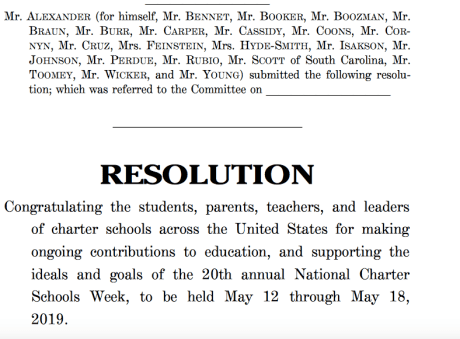
 

These are the Senators sponsoring a resolution to celebrate National Charter Schools Week. You will notice that the Democrats who signed on as sponsors include Cory Booker (NJ), Michael Bennett (CO), Dianne Feinstein (CA), and the two Senators from Delaware (Coons and Carper). Let’s hope that the Democrats who did not sponsor this resolution had a finger in the air and realized that the winds are blowing strongly against all forms of privatization, including charters and vouchers. Perhaps it occurred to the non-sponsors that only 6% of American students are enrolled in privately managed charters. Nearly 90% attend public schools. Perhaps they did not want to be associated with the Trump-DeVos agenda.

Screen Shot 2019-05-15 at 2.56.57 PM

Nancy Bailey critiques PBS for running a feature about dyslexia that misrepresents the current state of reading instruction. 

The report was presented on the PBS Newshour and co-sponsored by Education Week.

She writes:

Schools must provide adequate reading programs and reading remediation for students who need more assistance. But the recent report on dyslexia recommending intensive phonics for all children by the PBS News Hour, through Education Week, is irresponsible, short on facts, and presents biased reporting…

This report took place in Arkansas, heavily influenced by the Waltons, who seek to privatize public education. Arkansas funds Teach for America. The state is anti-teachers and does not support teachers unions.

In the report, parents claim: We absolutely know that this is the best way to teach children to read! This approach works well for all students not just those with dyslexia. We know without a doubt that reading is not a natural process.

Numerous opinion pieces and articles have flooded the media recently, often through Education Week, about reading failure. Most are entrenched in misconceptions and refer to discredited sources like the 2000 National Reading Panel, and the astroturf National Council on Teacher Quality (an organization funded by the Bill & Melinda Gates Foundation). This threatens to damage how children learn to read, how teachers learn to teach reading, and public schooling.

Bailey points out that there is nothing new about phonics. She learned it in the 1970s.

I might add that there is nothing new about the so-called “Reading Wars.” I wrote about their history in my book Left Back: A Century of Battles Over School Reform (2000).

The definitive work on the Reading Wars was written by Harvard Professor (and former kindergarten teacher) Jeanne Chall, titled Learning to Read: The Great Debate in 1967.

Nothing new has been said since then.

Chalk the latest brouhaha up to the tendency (or desire) to find a new crisis in education every other day of the week.

Arizona Republicans hate public schools. Even though 85% of the children in the state attend public schools, the Republican legislators seize every opportunity to pay for alternatives to public schools.

Now they want students who enroll in out-of-state private schools to have vouchers paid for by the taxpayers of Arizona. 

Last year, the Legislature tried to make vouchers available to every student in the state, but a grassroots coalition demanded a referendum, and the voucher plan was overwhelmingly defeated by 65%-35%.

That should be a loud signal to the GOP that controls the state. But they don’t care what the voters think. They listen only to Betsy DeVos and the Koch brothers. That is who they truly serve. They are the puppet-masters. The Republican members of the Arizona legislature are the puppets. They don’t give a hoot about the voters.

Since the defeat of vouchers last November, the Republicans have introduced three bills to expand the voucher program.

They take their orders from ALEC, DeVos, her American Federation for Children, and Charles Koch and his Americans for Prosperity. Not the public. Not the voters.

For their hatred of public schools, for their contempt for democracy, I place the Republican majority of the Arizona Legislature on the Wall ofShame.


Peter Dreier read the previous post about the billionaire Robert F. Smith giving a grant to erase the debt of the class of 2019, and he wrote to express his strong belief that government action is needed, not the generosity of philanthropists.

For college students across the nation, their student loans are a crushing burden that cause some to drop out and others to decide that they can’t afford a house, a car, or further education. Education is a right, which should be available at minimal or no cost for those who want to earn a degree.

He wrote:

I’m sure you agree that this bit of philanthropy is great for the students at Morehouse College and great PR for Mr. Smith, but this is NOT the way to reduce student debt in the U.S. There are more than 44 million student borrowers who collectively owe $1.5 trillion in student loan debt in the U.S. His gesture is getting too much and the wrong kind of publicity. We obviously shouldn’t have to depend on charity to meet basic economic and educational needs like college tuition and room-and-board. We need the federal government to erase the debt and, going forward, increase financial aid, while requiring the wealthiest universities and colleges to use their tax-exempt endowments to expand scholarship grants (not loans) to low income and middle class students. And we should end all federal financial aid to for-profit colleges, which are mostly rip-offs and a huge source of student debt, especially since so few students actually graduate, so they owe lots of money without a degree or decent job prospects.

It would have been better journalism if, in reporting the Morehouse story, reporters also noted that Elizabeth Warren and Bernie Sanders have great proposals around student debt that doesn’t depend on noblesse oblige. Access to financial aid for college students should be an entitlement, not a lottery. And billionaires like Mr. Smith should be paying much higher taxes so we can afford to give every college student a debt-free education.

My response:

i agree completely.

Investor Robert F. Smith was invited to give the commencement address at Morehouse College, an all-male historically black college in Atlanta. Smith is the wealthiest black man in America, with a fortune estimated at $4-5 billion.

Smith began his speech by talking about his good fortune, having been bused to an integrated public school in Denver. 

Smith described being bused to a high-performing, predominantly white school across town in Denver, where he grew up. He said he’ll never forget climbing onto bus No. 13 to Carson Elementary.

“Those five years drastically changed the trajectory of my life,” he said. “The teachers at Carson were extraordinary. They embraced me and challenged me to think critically and start to move toward my full potential. I, in turn, came to realize at a young age that the white kids and the black kids, the Jewish kids and the one Asian kid were all pretty much the same.”

After talking about how he achieved success, he dropped his prepared remarks and announced that he was paying all the student debt of the class of 2019, some 400 young men. The students were stunned, then broke into cheers and tears, along with their families.

This was a beautiful act of genuine philanthropy. Mr. Smith is not controlling anyone’s life, he is giving without strings or conditions. I know many readers will react by saying that higher education should be tuition-free, and I agree. But it is not. So for now, I say, thank you for this generous and kind act, Mr. Robert F. Smith.

Since the Washington Post is behind a paywall, here are other sites on which to read this heart-warming story, including a video clip.

See here, here, here.

Something tells me Robert F. Smith will have many invitations to give commencement addresses in years to come.


George Will is under the misapprehension that separation of Church and State was imposed after the Civil War by James G. Blaine, thus explaining why state constitutions have “Blaine amendments” forbidding the use of public dollars for religious schools. It is true that there was a wave of anti-Catholic bigotry before and after the Civil War, but support for separation of church and state long predates the adoption of Blaine amendments.

What Will doesn’t understand is that Americans have been asked again and again whether they want public funds to pay for religious school tuition, and they always vote no. They don’t want their taxes to pay for yeshivas where children don’t learn English; they don’t want their taxes to subsidize fundamentalist Christian schools that teach racism, homophobia, and creationism; they don’t want to pay for madrassas, or any of the dozens of other religious schools.

Americans want their tax money to pay for public schools, not religious schools.

Edd Doerr, a scholar of religious liberty, wrote in response to George Will’s column in the Washington Post:

George Will (“Children are paying for 19th century bigotry,” May 19) overlooks the fact that Jefferson and Madison installed the principle of religious liberty, church-state separation and no tax aid for religious institutions in Virginia law well before James Blaine was born. Will also fails to note that in 30 state referenda from coast to coast between 1966 and 2018 voters rejected all plans for direct or indirect tax aid to private schools by an average of 2 to 1.

Yes, there was anti-Catholic sentiment in our early history, a legacy of many years of religious wars and persecution in Europe. This was augmented by Pope Pius’s 1854 Syllabus of Errors and his 1857 public complicity in the kidnapping and forced conversion of a six year old Jewish child, Edgardo Mortara. Most Catholics today support church-state separation and public education, thanks in part to the Supreme Court’s 1962 ending of the last vestiges of Protestantism in our public schools.

Edd Doerr

Silver Spring, MD 20906


Koby Levin, reporter for Chalkbeat, tried to attend meetings of the board of 10 charter schools in Detroit. It was challenging, to say the least.

When parents have an issue with their child’s school, there’s at least one place where they’re guaranteed a hearing on anything from school finance to student discipline: a school board meeting.

Yet in Detroit, a city with an infamously troubled school landscape, dozens of charter school board meetings are hard to find or poorly attended — if they happen at all.

Even finding the meeting times can be difficult. When a Chalkbeat reporter called to inquire about the board meeting at Covenant House Academy, the person on the other end of the line said “I don’t have that information,” and quickly ended the call.

David Ellis Academy did post its meeting schedule online, but the April meeting was set for Easter Sunday. It was canceled without notice.

These schools had not broken the law. But critics view such incidents as proof that charter schools in Detroit, which bring in more than $350 million from taxpayers for the 36,000 students they serve each year, aren’t doing enough to engage the community

A reporter tried to attend 10 charter board meetings, proceeding roughly in alphabetical order. Four were canceled. When meetings took place, the reporter was the only person in the room who didn’t work for or oversee the school, except for one meeting where an advocate spoke on behalf of a student she believed had been wrongly expelled.

This is a pattern of disrespect.

As a side note, I will add that this story exemplifies why I admire Chalkbeat. Even though it is funded by billionaires including Gates, Walton, and Broad, it’s journalism is not tilted to favor the funders’ clear preference for charters. That’s why I make a small annual donation to Chalkbeat. It is informative and honest.