Curtis Cardine, former superintendent of both public and charter schools, is the preeminent expert on charter schools in Arizona. He created the Grand Canyon Institute to study education issues, and it keeps a close eye on charter malfeasance.

Cardine has written two books that are well worth reading to learn about the failures of the charter industry in Arizona. He is an expert in school finance, and he demonstrates in detail how charter operators are ripping off the public.

The first was Carpetbagging America’s Public Schools.

I quote that book extensively in my own new book SLAYING GOLIATH.

Cardine’s second book, recently published, is Schooling Alone, in which he compares the atomization of society caused by school privatization, and likens its effects to sociologist Robert Putnam’s classic study of social disintegration, Bowling Alone.

Cardine recently prepared a review of Arizona charter school closures and their relation to the bond debt incurred by charters.

Read his letter to two Arizona state senators here.

Thomas Ultican wrote a post about the billionaire-driven world of educational technology, which has nothing to do with education or learning, but everything to do with scoring profits.

The edtech industry is driven by greed.

He begins:

Anthony Kim founded Education Elements in 2010. He sold Provost Systems – which built virtual schools – to Edison Schools in 2008 and was ready for a new project. His new company sells personalized learning systems and consulting services to several school districts. Education Elements is one of more than a hundred ed tech companies being supported by venture capital organizations hoping for one big score. It is representative of the education technology startup business.

With education businesses there is opportunity for magnificent profits because of the large scale of education spending. The United States alone spends $650 billion dollar a year on public education. If businesses can convince people that learning at a digital screen is equivalent to or even better than a teacher led classroom, education technology would become America’s next great profit center minting many new billionaires. This allure of lavish profits is driving education technology.

The Venture Capital Firms

Crunchbase, which analyzes venture capital and startups, lists five venture capital companies investing in Education Elements.

Harmony is the only one of the five venture funds that does not focus specifically on education technology. They simply say, “Over the past 20 years, we have invested over $750 million in 80 companies.” They list their current investments which includes Education Elements.

NewSchools Venture Fund is the most strident in its commitment to disrupting public education. NewSchools is a non-profit that claims they are a “venture philanthropy working to reimagine public education investing in education entrepreneurs.” Their venture portfolio contains more than 150 companies.

Every year NewSchools hosts a “Summit” in Oakland, California which they state brings together more than 1,200 educators, entrepreneurs, community leaders, funders, and policy makers to share ideas on how to “reimagine learning.” The “Platinum” sponsors for the 2020 gathering are the Chan Zuckerberg Initiative and The Walton Family Foundation who are also well-known leaders in the movement to monetize and privatize public education.

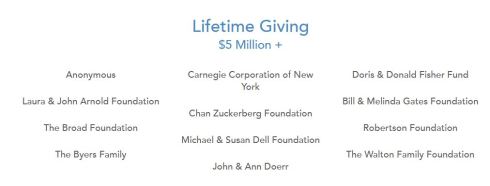
New Schools Venture Fund Donors

Twelve Organizations Contributing $5 Million Plus to NewSchools Venture Fund

Eleven of the twelve organizations listed above are known for promoting market based education reform. The twelfth, Anonymous, most likely has the same ideology.

Rethink Education is the third venture fund. It claims to focus on “Crucial Life Skills, Personalized Learning, Vocational Preparation, Curation of Workforce Learning Resources, College Dropout Prevention.” Jenny Abramson is the founder and Managing Partner of Rethink. She is a former Teach For America (TFA) corps member and a board member of the Washington DC charter school, DC Prep.

Imagine K12 is the forth fund investing in Education Elements. It was founded in 2011 as a startup accelerator for education technology companies. In 2016 Imagine merged with Y Combinator. The joint companies have invested in over 100 education technology focused companies.

Tugboat Ventures is the fifth fund invested in Education Elements which is one of its 35 listed properties.

The thread that ties together these ventures is the pursuit of profits. That is a mighty thread indeed.

He lists the members of the Board of Directors, all from the financial world.

No actual teachers in sight.

He adds:

Due to lobbying by billionaires like Bill Gates and Reed Hastings, the latest update to the national education law turned the US Department of Education (USED) into an education technology sales hub. Critically for companies like Education Elements, the federal technology pitch includes Competency Based Education (CBE). In order to have an inexpensive cyber based education system, there must be small skills that can be drilled and then tested. The USED says,

“Competency-based strategies provide flexibility in the way that credit can be earned or awarded, and provide students with personalized learning opportunities. These strategies include online and blended learning, dual enrollment and early college high schools, project-based and community-based learning, and credit recovery, among others.”

Unfortunately CBE is just an update of previous failed teaching strategies. In the 1970’s it was called Mastery Learning and in the 1990’s it was called Outcome Based Education. CBE is simply putting Mastery Leaning on a computer instead of using worksheets and paper assessments. It is still bad pedagogy. Computer based credit recovery is the fraud engendering the recent soaring graduation rates.

What is called “education reform” is a giant scam. It is not about “education” and it is not about “reform.” It is about money.

Newly elected Democratic Governor Andy Beshear kept a campaign promise and threw out the Bevin-appointed state school board. The Bevin board still has unexpired terms and they plan to sue to hold on to their seats. Their state commissioner Wayne Lewis–no friend to public schools or teachers–made clear he will hang on to his position as long as possible.

Governor Beshear named a new board. The old one is heading for the courts.

Fred Klonsky has the story here. 

Steven Singer discovered that the Pennsylvania Department of Education invited citizens to comment on the state’s charter law.

Now is your chance to be heard.

Steven has some definite ideas about what needs to change and he tells you where to send your own comments.

He writes:

This is a huge opportunity for residents fed up with the nonsense the school privatization industry has been getting away with in the Commonwealth for decades.

Pennsylvania has one of the worst charter school laws in the nation.

Charter schools are taxpayer-funded but privately operated.

Though there are about 180 of these privatized institutions throughout the state with more than 137,000 students, that represents only about 6 percent of the kids enrolled in public school.


Yet the state funding system pits authentic public schools against charter schools for the financing needed to stay open.

Charter schools siphon money from authentic public schools serving the neediest students creating a deficit spiral. Money gushes out of public districts which have to cut teachers and programs to patch budget gaps which in turn result in even more parents pulling their children out of the public schools and trying to enroll them in charters.

Though the legislature used to help authentic public schools by reimbursing them for 30% of the charter school costs, that funding has been eliminated.

Meanwhile, the charter school law has barely changed at all since it was enacted in 1997.

Gov. Tom Wolf has promised to correct that with sweeping reforms in 2020 – even if it means bypassing the gerrymandered and gridlocked legislature with executive orders.

But before he can begin, he needs to hear from commonwealth voters.


A report on a 25-year-old court case in North Carolina was released yesterday. The long-anticipated report rebukes the past decade of education policy in the state, led and directed by the Republican majority in the state’s General Assembly. The powers that be don’t like to spend money on education.

The report lays out

…an important new roadmap for ensuring that our public schools provide every child with the education they deserve.

The report – a collaborative effort from some of the nation’s leading education experts – is a comprehensive examination of North Carolina’s public school system. The report’s recommendations have the potential to fundamentally change the direction of our state by unleashing the potential of all children to become flourishing adults, ready to contribute to a healthier, happier, and more prosperous North Carolina.

What is Leandro?

Leandro is a 25-year long court case. Throughout the case, the courts have consistently found that North Carolina has been failing to meet its most fundamental obligation under our State Constitution: providing every child a meaningful opportunity to receive a sound basic education, backed by adequate funding and resources in every public school. Additional background on the case can be found here.

Where did this report come from?

In 2017, parties to the case (the state defendants and the Leandro plaintiffs) agreed that North Carolina had been failing its children for far too long, and that the state needed a clear, comprehensive roadmap to providing a sound basic education that benefits all children. The court-appointed consultants (WestEd, in collaboration with the Learning Policy Institute and NC State’s Friday Institute) initially submitted the report to the court in June of 2019. The report was confidential until its release today.

What does the report say?

The report confirms what North Carolinians have been saying for years: The state has consistently failed to give every child in this state access to the education they deserve. Specifically:

  • A new approach is needed: While North Carolina was once making progress towards meeting its constitutional responsibilities, the past decade’s actions have left our state “further away from meeting its constitutional obligation to provide every child with the opportunity for a sound basic education than it was when the Supreme Court of North Carolina issued the Leandro decision more than 20 years ago.”
  • Providing children with what they are owed requires significant new investment: Current levels of school funding (North Carolina ranks 48th in terms of school funding effort) are inadequate to ensure all students are achieving at grade level.
  • We must direct resources where they’re needed most: Our funding formulas need to do a better job of prioritizing higher-need students and under-resourced communities.
  • More needs to be done to put qualified, well-prepared and diverse teachers and principals in every school: Educators need competitive pay, early-career support programs, professional development, and opportunities to collaborate and lead.
  • Scarcity of early-learning opportunities is leaving too many students unprepared to start school: Both Smart Start and NC Pre-K are effective programs, but funding must be restored and expanded to ensure all students enter kindergarten ready to learn.
  • High-poverty schools lack the resources to help students overcome out-of-school conditions that create barriers to learning: High-poverty schools should be provided the resources necessary to expand learning opportunities and implement community school models providing health and social services, youth and community development, and community engagement. Struggling schools need state-level support similar to the District and School Support teams eliminated by the General Assembly in recent years.
  • Our testing and accountability system needlessly stigmatizes high-poverty schools, rather than providing useful information about educational effectiveness: Our accountability system should instead measure schools’ progress in providing each child a sound basic education by rewarding growth in student performance and highlighting school climate and equality of resources and learning opportunities.

The report contains significantly more detail. While the report’s recommendations may appear ambitious, it’s important to remember that these steps represent the bare minimum of what it takes to for the state to provide students with the education they deserve.

What happens next?

The judge overseeing the case might order the legislature to act.

The legislature might fail to act.


Bill Phillis posted this powerful letter on his blog for the Ohio Coalition for Equity and Adequacy of School Funding.

The Honorable Michael DeWine

77 S. High Street, Suite 30

Columbus, OH 43215


Dear Governor DeWine,

The headline of an article in the October 27, 2019 ​Youngstown Vindicator ​reads: “DeWine Says HB70 Must Be Replaced.”


We are happy to learn that you want to maintain local control of public schools, and that you are not a supporter of House Bill 70, the state legislation allowing state takeover of public schools with failing grades, as Youngstown, Lorain, and East Cleveland have experienced. However, we are concerned with your statement that a “remedial plan” or “outside consultants” may be needed, as stated in the ​Vindicator ​article.


We are the Northeastern Ohio AFT retiree chapter, NEO-AFT #279-R. We have over 1,000 members in our group, and are members of the state and national affiliates, the Ohio Federation of Teachers and the American Federation of Teachers. Our membership includes retired teachers, administrators, speech/language therapists, school psychologists, guidance counselors, librarians, and paraprofessionals from all over northeastern Ohio.


We–educators and related-service personnel–are the experts you can rely on. ​We represent a rich range of educational training, knowledge, and experience.


We know from research and experience that:


Parental income is the single most influential factor in a child’s academic performance.


Let us repeat:


The single most important influence on a child’s academic performance is their parents’ income.


Therefore, it is understandable that most children in high-income suburbs get higher test scores and better grades, and more children in poor districts get lower scores and lower grades. This is the case for the Youngstown, Lorain, and East Cleveland School Districts, where ​100% of the children enrolled are living at or below the State Poverty Level. ​However, the children’s low performance on standardized tests is not due to bad teachers, bad schools, or bad local Boards of Education.


Many children living in poor neighborhoods start school handicapped on their very first day. Poverty is a major contributing cause of frequent absenteeism, psychological trauma, health problems including mental health issues, poor nutrition, limited social skills, and much more.


What is needed to combat the effects of poverty are wrap-around school programs including tutoring, and social services including medical, dental, visual, psychological/counseling services, 
during and after the school day.

The Cincinnati Public Schools are an excellent model. They have successfully created Community Learning Centers (CLC) in all their schools. Since launching their program in 2002, their CLC model has drawn national attention for successfully engaging community partnerships in school buildings.


Another model is the Say Yes to Education program. The Cleveland Metropolitan School District is in its first year of Say Yes to Education Cleveland. This dual-approach program provides the incentive of last-dollar post-high school scholarships for students, along with the essential wrap- around social supports for students and their families from preschool through graduation.


Providing these services to struggling districts like Youngstown, Lorain, and East Cleveland would require additional school funding from the state and/or other entities, but would pay off in significant academic and social gains for these communities.


Educators can and should be involved in developing any remedial plans. They are the experts, and they know what their students and families need.


We recommend:


• End HB 70 completely;
• Add additional health and social services, such as medical, dental, vision, counseling;
• Add additional academic support services;
• Add wrap-around programs, such as robust after-school programs including tutoring and physical activities.


Our public schools are one of the last democratic institutions in America, and we do not want to lose this valuable part of our nation. Most American Nobel prize winners are graduates of their local public schools. In 1835, Alexis de Tocqueville, the French diplomat, political scientist, historian, and author, wrote in his famous book, ​Democracy in America, ​about the wisdom of local community decision-making as a unique characteristic of American towns.


We hope you use this information as a guide to ending HB70.


Sincerely,


Lois Romanoff, M.Eds., Ed.S. Retired School Psychologist, Cleveland Metropolitan School District and NEO-AFT 279-R Member
Teresa Green, President, and the Executive Council of the NEO-AFT 279-R


Rahm Emanuel is gone. The boosters of privatization are out of power in Chicago. Mayor Lori Lightfoot has committed to improving the public schools that the vast majority of students attend.

No new applications to open charter schools this year in the city of Chicago.

It is a new day in Chicago, with new leadership.

Yana Kunichoff writes in Chalkbeat:

No new charter schools are applying this year to expand or open in Chicago, a sign of the shifting environment for the independently run, publicly funded schools in Chicago and at the state level.

Last summer Illinois abolished the state agency hearing appeals of charter school denials. Chicago schools, both district- and charter-run, are experiencing an ongoing drop in enrollment, leaving schools competing for fewer students. 

A charter school operator named Destiny STREAM Academy for Girls Charter School initially applied to open a new charter, focused on math and technology education for girls, but then withdrew its application. 

Chicago has more than 120 charter schools; the school district runs more than 500 schools. The number of charter school applications has diminished by half over the past three years, according to a Chalkbeat analysis. 

After more than two decades of expansion in Chicago, charter school growth has tapered off.

Last year, the district denied three new charter proposals.

In 2017, nine schools sent in proposals. One was approved, one denied, and seven schools withdrew their applications. In 2016, there were 10 submissions, one of which was incomplete, and the rest were withdrawn. 

That’s a wildly different landscape to just a few years before, when more than 16 schools threw their hat in the ring for a new charter or expansion in 2014-2015 school year (the majority later withdrew their proposals). 

The district is also recommending that two charter schools be closed: Chicago Virtual Charter School, which offers primarily online classes for elementary and high school grades, and Frazier Preparatory Academy Charter School, a K-8 school in North Lawndale that shares a building with a district-run school.

The virtual school is under investigation by the district’s Office of Inspector General and has “the lowest School Quality Rating Policy score, used to rate how schools are performing, of any charter high school, the lowest Freshman OnTrack rate, and one of the lowest graduation rates in the district,” according to the district. Last year, it received a rating of 2, the second-lowest possible. 

Chicago Virtual Charter School has held a charter with the district since 2006. The district renewed its charter in 2015 for five years. 

The district is recommending that the board revoke the Frazier Preparatory Academy charter because it hasn’t been able to get off the academic warning list, which is for schools who received a low school rating three years in a row. During the 2017-18 school year the board proposed the school’s charter be renewed for three years, with conditions. The board approved a co-location with Theodore Herzl Elementary School in 2014. 


The York Dispatch, a newspaper in a district that has been targeted for state intervention, blasted the state with a scathing editorial. 

I hope the editorial board will forgive me for reprinting it in full. “Financial recovery” has not helped any district; it is a disaster for the students, teachers, and schools. It accomplishes nothing but disruption.

The vultures are circling, and York City School District officials would be wise to take notice.

York City is among four Pennsylvania districts placed in state-mandated financial recovery in 2012 under a new law proponents said would finally hold to account school districts that have failed taxpayers and students alike.

York City schools clearly earned the dubious designation, one it will keep after state officials in August denied the district’s request to be removed from recovery.

Its graduation rates are among the lowest in the state — among, unsurprisingly, its peers also listed on the state’s initial list of underperformers: Harrisburg, Chester Upland and Duquesne. Its financial condition has been a dumpster fire for years.

And, all the while, York City property owners never get a whiff of tax relief. 

More: Graduation rates plunged in districts under financial recovery

But one can’t help but wonder if the past few months were a harbinger of things to come for York City. And, if that’s true, the district should gird itself against an onslaught of special interests and right-wing politicians conspiring to undermine the very idea of public education itself.

The war in Harrisburg School District has been ugly for months. This past summer, the school board revolted against the state, denying state officials access to documents and information. Soon after, much of its leadership was sacked when the state took control of its operations and the state-appointed receiver hired an outside agency for most non-educational operations.

But it got worse. 

This past month, state House Speaker Mike Turzai, R-Allegheny County, rolled out legislation that would create a voucher program specifically in Harrisburg School District. The move would immediately bleed $5 million from the district’s budget just to pay for students already enrolled in private schools. And that number would only increase as more parents are paid to send their children elsewhere.

Turzia’s bill would, seemingly by design, cripple Harrisburg’s school district and potentially render it unsalvageable.

On Wednesday, officials from Chester Upland’s school district went to court fighting for their district’s survival. They are faced off against Chester Community Charter School, which is looking to seize control of all elementary education, a move that would no doubt hammer the struggling public district’s finances even more.

More: State places York City schools in financial recovery

It’s no secret that Republicans and private interests are working throughout the country to privatize education. 

But education remains a public responsibility, one that benefits society at its very core.

Sure, elderly taxpayers grumble about ever-increasing taxes. Schools in poor, minority communities struggle financially and academically. And lawmakers lack the seriousness to address the systematic failings of a property tax-based system that creates haves and have nots.

But the “school choice” red herring only serves to line investors’ pockets and rob taxpayers of accountability. And, judging by recent history, the enemies of public education are targeting Pennsylvania’s weakest districts first. 

York City School District be warned. 


Rachel Cohen writes here about the charter supporters backing Pete Buttigieg. 

Billionaire Reed Hastings held a fundraiser for Mayor Pete. Hastings, CEO of Netflix, has given millions to the California Charter Schools Association. He has said he looks forward to the day when there are no elected school boards. He likes schools run by corporate boards. He says they didn’t discuss charter schools, which is one of Hastings’ causes about which he is passionate.

Cohen writes:

Linda Lucy, who has served as the president of the South Bend teachers union since June 2018, told VICE she had never met with Pete Buttigieg, and had “nothing to add” about the union’s relationship with the mayor. “Politicians have hijacked the teaching profession in our public schools,” she said.

Buttigieg does appear to have made time for Heather Willey, one of Indiana’s top charter school lobbyists, who co-hosted a fundraiser for Buttigieg in Indianapolis on October 4, according to an invitation obtained by VICE.

Willey served on the board of the Institute for Quality Education, an Indiana school choice advocacy group, for years, and co-chairs her law firm’s “Charter School and School Innovation” group. In 2019, the Institute for Quality Education, Teach for America Indianapolis, and Charter Schools USA, Inc., a for-profit charter company, all listed Willey’s firm, Barnes & Thornburg LLP, as a hired lobbyist. According to her professional biography, Willey “has been intimately involved in the charter school and school reform movements since the inception of the laws in Indiana in 2001.” She did not return repeated requests for comment.

In Silicon Valley, meanwhile, Buttigieg has also had fundraisers with several prominent charter school supporters.

Satya Patel, a venture capitalist who formerly worked as a vice president of product at Twitter, co-hosted an event for Buttigieg in the Bay Area in late August. Between 2007 and 2017, Patel served on the board of KIPP Bay Area Schools, part of the nation’s largest charter school network, which has received tens of millions of dollars in federal grants. He did not return requests for comment.


Anu Partanen and Trevor Corson we’re living in a comfortable neighborhood in Brooklyn but worried about economic pressure and the future. When Anu got an offer of a job in her native Finland, they moved there. They wrote this article to explain that Finnish society arrived at an agreement to provide excellent public services, to pay higher taxes, to protect the health and wellness-being of their citizens, and businesses thriving. The Nordic approach to social welfare is not “socialism,” they write. It’s rational thinking. Capitalists support the system because it works.

They write:

We’ve now been living in Finland for more than a year. The difference between our lives here and in the States has been tremendous, but perhaps not in the way many Americans might imagine. What we’ve experienced is an increase in personal freedom. Our lives are just much more manageable. To be sure, our days are still full of challenges — raising a child, helping elderly parents, juggling the demands of daily logistics and work.

But in Finland, we are automatically covered, no matter what, by taxpayer-funded universal health care that equals the United States’ in quality (despite the misleading claims you hear to the contrary), all without piles of confusing paperwork or haggling over huge bills. Our child attends a fabulous, highly professional and ethnically diverse public day-care center that amazes us with its enrichment activities and professionalism. The price? About $300 a month — the maximum for public day care, because in Finland day-care fees are subsidized for all families.

And if we stay here, our daughter will be able to attend one of the world’s best K-12 education systems at no cost to us, regardless of the neighborhood we live in. College would also be tuition free. If we have another child, we will automatically get paid parental leave, funded largely through taxes, for nearly a year, which can be shared between parents. Annual paid vacations here of four, five or even six weeks are also the norm…

Finnish employers had become painfully aware of the threats socialism continued to pose to capitalism. They also found themselves under increasing pressure from politicians representing the needs of workers. Wanting to avoid further conflicts, and to protect their private property and new industries, Finnish capitalists changed tactics. Instead of exploiting workers and trying to keep them down, after World War II, Finland’s capitalists cooperated with government to map out long-term strategies and discussed these plans with unions to get workers onboard.

More astonishingly, Finnish capitalists also realized that it would be in their own long-term interests to accept steep progressive tax hikes. The taxes would help pay for new government programs to keep workers healthy and productive — and this would build a more beneficial labor market. These programs became the universal taxpayer-funded services of Finland today, including public health care, public day care and education, paid parental leaves, unemployment insurance and the like…

The Nordic nations as a whole, including a majority of their business elites, have arrived at a simple formula: Capitalism works better if employees get paid decent wages and are supported by high-quality, democratically accountable public services that enable everyone to live healthy, dignified lives and to enjoy real equality of opportunity for themselves and their children. For us, that has meant an increase in our personal freedoms and our political rights — not the other way around.

Yes, this requires capitalists and corporations to pay fairer wages and more taxes than their American counterparts currently do. Nordic citizens generally pay more taxes, too. And yes, this might sound scandalous in the United States, where business leaders and economists perpetually warn that tax increases would slow growth and reduce incentives to invest…

Here’s the funny thing, though: Over the past 50 years, if you had invested in a basket of Nordic equities, you would have earned a higher annual real return than the American stock market during the same half-century, according to global equities data published by Credit Suisse.

Nordic capitalists are not dumb. They know that they will still earn very handsome financial returns even after paying their taxes. They keep enough of their profits to live in luxury, wield influence and acquire social status. There are several dozen Nordic billionaires. Nordic citizens are not dumb, either. If you’re a member of the robust middle class in Finland, you generally get a better overall deal for your combined taxes and personal expenditures, as well as higher-quality outcomes, than your American counterparts — and with far less hassle.

Why would the wealthy in Nordic countries go along with this? Some Nordic capitalists actually believe in equality of opportunity and recognize the value of a society that invests in all of its people. But there is a more prosaic reason, too: Paying taxes is a convenient way for capitalists to outsource to the government the work of keeping workers healthy and educated…

While companies in the United States struggle to administer health plans and to find workers who are sufficiently educated, Nordic societies have demanded that their governments provide high-quality public services for all citizens. This liberates businesses to focus on what they do best: business. It’s convenient for everyone else, too. All Finnish residents, including manual laborers, legal immigrants, well-paid managers and wealthy families, benefit hugely from the same Finnish single-payer health care system and world-class public schools.

There’s a big lesson here: When capitalists perceive government as a logistical ally rather than an ideological foe and when all citizens have a stake in high-quality public institutions, it’s amazing how well government can get things done.

Ultimately, when we mislabel what goes on in Nordic nations as socialism, we blind ourselves to what the Nordic region really is: a laboratory where capitalists invest in long-term stability and human flourishing while maintaining healthy profits.

Capitalists in the United States have taken a different path. They’ve slashed taxes, weakened government, crushed unions and privatized essential services in the pursuit of excess profits. All of this leaves workers painfully vulnerable to capitalism’s dynamic disruptions. Even well-positioned Americans now struggle under debilitating pressures, and a majority inhabit a treacherous Wild West where poverty, homelessness, medical bankruptcy, addiction and incarceration can be just a bit of bad luck away. Americans are told that this is freedom and that it is the most heroic way to live…

The success of Nordic capitalism is not due to businesses doing more to help communities. In a way, it’s the opposite: Nordic capitalists do less. What Nordic businesses do is focus on business — including good-faith negotiations with their unions — while letting citizens vote for politicians who use government to deliver a set of robust universal public services…

Right now might be an opportune moment for American capitalists to pause and ask themselves what kind of long-term cost-benefit calculation makes the most sense. Business leaders focused on the long game could do a lot worse than starting with a fact-finding trip to Finland.