John Merrow writes here about the stagnant scores reported on NAEP, PISA, and every other measure. They are an indictment of the test-centric policies of Bush, Obama, and Trump, he says.

He writes:

Given the PISA results and the harsh truth that NAEP scores have been disappointing for many years, it’s time to rename NAEP. Let’s call it the National Assessment of Educational Paralysis, because paralysis accurately describes what has been going on for more than two decades of “School Reform” under the test-centric policies of George W. Bush and Barack Obama.

Unless and until we renounce these misguided “School Reform” policies developed under No Child Left Behind and Race to the Top, educational paralysis will continue, and millions of children will continue to be mis-educated and under-educated.

Right now, too many school districts over-test, which means their teachers under-teach. Too often their leaders impose curricula that restrict teachers’ ability to innovate.  At the same time, these narrow curricula have curtailed or eliminated art, music, physical education, recess, drama, and even science.  Today many districts judge teachers largely by student test scores, leading teachers to devote more and more class time to test-prep, not teaching and exploration of idea.  This is what I and others label the ‘test-and-punish’ approach to education, instead of a far more desirable ‘assess to improve’ philosophy.

The charter industry has lobbied for years to promote the idea that public schools and their teachers and teachers unions are uniquely responsible for denying educational opportunity to children of color. Ever since the propaganda film “Waiting for Superman,” produced by billionaire charter supporter (and rightwing evangelical zealot Philip Anschutz), the charter industry has promoted the claim that supporters of public schools are hostile to children of color while they—funded by billionaires like the Waltons, the Sacklers, the Koch brothers, the DeVos family, and every Republican governor—claim to be champions of civil rights.

”Malarkey!” says FAIR (Fairness and Accuracy in Reporting).

FAIR offers a “close reading” of media bias against public schools and demonstrates how the charter industry has deceptively labeled any opposition to charters as the work of teachers’ unions, never admitting that supporters of public schools include parents, grandparents, and graduates of public schools, as well as members of the public who understand the importance of public education in a democracy.

After thirty years of charter advocacy, only 6% of American students are enrolled in them.  In the only city that is all-charter, New Orleans, the only choice that is forbidden is a public school. This decision was not the result of a vote by the citizens of New Orleans, but a decision imposed by the white Republicans who control the State Legislature. Southern white Republicans are not typically perceived as concerned about the well-being of children of color.


Valerie Strauss reviews “Still Asleep at the Wheel” here.

She begins:

“More than 35 percent of charter schools funded by the federal Charter School Program (CSP) between 2006 and 2014 either never opened or were shut down, costing taxpayers more than half a billion dollars, according to a new report from an advocacy group that reviewed records of nearly 5,000 schools.

“The state with the most charter schools that never opened was Michigan, home to Education Secretary Betsy DeVos.

“The report, titled “Still Asleep at the Wheel,” said that 537 “ghost schools” never opened but received a total of more than $45.5 million in federal start-up funding. That was more than 11 percent of all the schools that received funding from CSP, which began giving grants in 1995.

”In Michigan, where the billionaire DeVos has been instrumental over several decades in creating a charter school sector, 72 charters that received CSP money never opened, at a total cost of some $7.7 million from 2006 to 2014. California was second, with 61 schools that failed to open but collectively received $8.36 million.
The Education Department did not respond to a query about the findings. DeVos has made expanding alternatives to school districts — including charters and programs that use public money for private and religious schools — her top priority as education secretary, and has said her metric for a state’s education success is how much they expand school “choice.”

”Casandra Ulbrich, president of the Michigan State Board of Education, said in an interview that she found the new report “extremely troubling.”


“It raises some very legitimate questions about a federal grant program that seems to have been operating for years and years with little oversight and very little accountability,” she said.”


Last spring, the Network for Public Education published a report on waste, fraud, and abuse in the federal Charter Schools Program. The report, called Asleep At the Wheel, documented the Department of Education’s failure to monitor the veracity or feasibility of applications for the program or to follow up on what happened to the money spent to launch new charter schools. It found that nearly $1 billion of federal dollars had been wasted on charters that either never opened or closed soon after opening.

Today, NPE released a new report that delves into what happened with federal money from the Charter Schools Program in the states. The findings were even more concerning than last spring’s report.
The new report is called Still Asleep At the Wheel.

An excerpt:

This report, Still Asleep at the Wheel: How the Federal Charter Schools Program Results in a Pileup of Fraud and Waste, takes up where our first report left off. In it, we provide detailed information, state by state, on how federal dollars were doled out to schools that no longer exist or never existed at all.

In 2015, the U.S. Department of Education (the Department) published a list of charter schools that received grants between the years of 2006 and 2014. Using that database of 4,829 schools, we meticulously determined which charters that received grants were still open, which had closed and which had never opened, resulting in state by state records of enormous waste. We examine the detailed spending records of some of Michigan’s ghost charter schools that received grants exceeding $100,000. We explain how money moves into the hands of for-profit management organizations and tell the stories of subgrantees that engaged in fraud—sometimes amounting to hundreds of millions of dollars—all beginning with funding from the federal Charter Schools Program.

Major findings of our research include the following:

Documented charter school closures and the waste of federal funds exceeds our first report’s estimations.
We believed that about 1,000 recipient charters were defunct. However, using the 2015 database (active grantees from 2006-2014), we identified 1,779 grantee schools that either never opened or had shut down. The number of non-operational recipients, across 25 years of the program is inevitably in the thousands.
In the first report, we estimated the fail- ure rate for recipient schools to be 30 percent. For schools listed in the database, however, our latest review found a failure rate of 37 percent.

It is impossible to document total waste for the entire 25 year program because the Department never required the states to report the names of funded schools until 2006. However, we have now documented $504,517,391 (28 percent of the total database amount) that was awarded to schools between 2006-2014 that never opened or that have closed. Applying that percentage to the total expenditures ($4.1 billion) of the CSP programs designed to create new schools, approximately $1.17 billion in federal funding has likely been spent on charters that either never opened, or that opened and have since shut down.

The disbursement of over one billion dollars during the program’s first decade was never monitored for its impact or results. There is no record of which schools received the funds.

From 1995 to 2005, enormous funds were pushed out to the states to distribute to schools via subgrants. Yet the Department has no complete record of which schools re- ceived funding during the program’s early years, because it never required the states to report the names of subgrantee schools or their status. The Department’s over- sight ended when the funds left Washington.

During the first decade of the program when states did not have to report where the money went, Florida, a state where nearly half of all charter schools are run by for-profit organizations, received four grants totaling $158,353,525. Michigan, where about 80 percent of all charters are run by for-profit management companies, received four grants totaling $64,608,912. California also received four grants, totaling $190,857,243.
Although the overall rate of failed charter projects was 37 percent, in some states the rate of failure was much higher.

Iowa and Kansas have the largest propor- tions of failed subgrantee charter schools. Eleven charter schools in Iowa received grants. Ten failed, wasting over $3.66 million. As of 2014, the database indicates that Kansas doled out $8.51 million to 29 schools. Twenty-two (76 percent) of those schools either never opened or are closed today–$6,389,964 of the $8.9 million was wasted.

States with a subgrantee failure rate exceeding 50 percent include: Delaware, Georgia, Hawaii, Iowa, Kansas, Maryland, Mississippi, Virginia and Washington (state). Mississippi had only one grantee and that school failed. Georgia had 75 failures, resulting in over 23 million federal dollars wasted.

The percentage of defunct charter school grantees in Florida was 37 percent ($34.2 million); the Michigan failure rate was over 44 percent ($21 million) and Lou- Asian’s failure rate was 46 percent ($25.5 million).
The most astounding loss, however, was California’s: nearly $103 million was awarded to charters that never opened or have shut down—37% failed.

Five hundred thirty-seven (537) schools list- ed in the database never opened at all. Many received over $100,000 in federal funds.

Since 2001, charter school entrepreneurs have been eligible to receive CSP grants before they have even identified an authorizer or submitted a detailed application to open a school. In total, we identified 28 states that had at least one charter school (537 schools in total) that never enrolled even one student for one day and yet had received federal funds. According to the CSP database, those schools received, or were due to receive when the database collection ended, a total of $45,546,552 million.

Topping the list was the state of Michigan where 72 never-opened schools received grants, most exceeding $100,000. Over $7.7 million was wasted. In California, we identified 61—with waste of $8.36 million.
Other states with large numbers of never- opened schools receiving CSP funds in- clude Arkansas (18), Florida (46) Illinois (20), Maryland (38), Massachusetts (17), New Jersey (23), Ohio (20), Oregon (40), Pennsylvania (41), South Carolina (34), Tennessee (43) and Wisconsin (15).

This report provides details on how several of these never-opened charters in Mi- chigan spent those federal funds.

Although Congress forbids for-profit opera- tors from directly receiving CSP grants, they still benefit by having their schools apply.

Although we could not identify every charter in the CSP database that was run by a for-profit management company, we were able to identify those run by the large for-profit chains including Academica, K12, National Heritage Academies, White Hat and Charter Schools USA. In total, we found 357 schools in the database run by major for-profit chains. These schools had received a total of $124,929,017 in federal CSP start-up funds. Unsurprisingly, most of this money flowed to for-profit run schools in Florida ($46,936,979) and Michigan ($26,452,927). Eighty-three (83) schools run by the Flor- ida-based, for-profit chain Academica received CSP grants, totaling $23,426,383.


Still Asleep at the Wheel also describes why so many charter schools fail, along with the stories of grantee schools that abruptly closed, sometimes with little or no notice to their students and families. Far too often those schools shut down due to corruption and fraud. Our report provides disturbing accounts of grifters and profiteers who took CSP and other taxpayer funds only to enrich themselves at the expense of the students they had promised to serve.

The staggering amount spent on schools that have closed or never opened, as well as those that have engaged in fraud, is nothing short of a national scandal. As public dollars are diverted from public schools, the students who attend their neighborhood schools have fewer resources. It is time to put on the brakes and chart a new course.

We were heartened that after the publication of our first report in March of 2019, the U.S. House of Representatives reduced funding for the CSP program for 2020. However, a small reduction is not sufficient to address the program’s structural flaws.

We therefore strongly recommend that Congress end appropriations for new charter school grants in the upcoming budget and continue funding only for obligated amounts to legitimate projects. Once those grants have been closed, we recommend that the CSP be ended and that charter schools continue to receive federal support only through other federal funding streams such as Title I and IDEA. Students, not charter school en- trepreneurs, should benefit from federal funds.

We also recommend thorough audits by Congress of previous grant awards, the establishment of regulations to ensure grant awards still under term are being responsibly carried out and that misspent money is returned to the federal coffers.



Some of us are old enough to remember the New York Times publication of “The Pentagon Papers,” the secret history of the war in Vietnam compiled by the Department of Defense; they were purloined by Daniel Ellsberg, who opposed the war and shared with the Times. The revelations in those papers helped to end that conflict.

Now the Washington Post is publishing government papers about the long-lasting war in Afghanistan that it obtained through the Freedom of Information Act. Its revelations are familiar and depressing. Our government lied to us. There were no realistic plans in place for success. Thousands of lives and about a trillion dollars were spent without a strategy.

The article was written by Craig Whitlock. If you want to read the story in full, subscribe to the Washington Post.

KONAR PROVINCE, 2010 (Moises Saman/Magnum Photos)

THE PENTAGON, 2003 (David Hume Kennerly/Getty Images)

A confidential trove of government documents obtained by The Washington Post reveals that senior U.S. officials failed to tell the truth about the war in Afghanistan throughout the 18-year campaign, making rosy pronouncements they knew to be false and hiding unmistakable evidence the war had become unwinnable.

The documents were generated by a federal project examining the root failures of the longest armed conflict in U.S. history. They include more than 2,000 pages of previously unpublished notes of interviews with people who played a direct role in the war, from generals and diplomats to aid workers and Afghan officials.

The U.S. government tried to shield the identities of the vast majority of those interviewed for the project and conceal nearly all of their remarks. The Post won release of the documents under the Freedom of Information Act after a three-year legal battle.

THE AFGHANISTAN PAPERS

At war with the truth

In the interviews, more than 400 insiders offered unrestrained criticism of what went wrong in Afghanistan and how the United States became mired in nearly two decades of warfare.

With a bluntness rarely expressed in public, the interviews lay bare pent-up complaints, frustrations and confessions, along with second-guessing and backbiting.

Click any underlined text in the story to see the statement in the original document

“We were devoid of a fundamental understanding of Afghanistan — we didn’t know what we were doing,” Douglas Lute, a three-star Army general who served as the White House’s Afghan war czar during the Bush and Obama administrations, told government interviewers in 2015. He added: “What are we trying to do here? We didn’t have the foggiest notion of what we were undertaking.”

“If the American people knew the magnitude of this dysfunction . . . 2,400 lives lost,” Lute added, blaming the deaths of U.S. military personnel on bureaucratic breakdowns among Congress, the Pentagon and the State Department. “Who will say this was in vain?”

Since 2001, more than 775,000 U.S. troops have deployed to Afghanistan, many repeatedly. Of those, 2,300 died there and 20,589 were wounded in action, according to Defense Department figures.

The interviews, through an extensive array of voices, bring into sharp relief the core failings of the war that persist to this day. They underscore how three presidents — George W. Bush, Barack Obama and Donald Trump — and their military commanders have been unable to deliver on their promises to prevail in Afghanistan.

THE AFGHANISTAN PAPERS

See the documents More than 2,000 pages of interviews and memos reveal a secret history of the war.

Part 2: Stranded without a strategy Conflicting objectives dogged the war from the start.

Responses to The Post from people named in The Afghanistan Papers

With most speaking on the assumption that their remarks would not become public, U.S. officials acknowledged that their warfighting strategies were fatally flawed and that Washington wasted enormous sums of money trying to remake Afghanistan into a modern nation.

The interviews also highlight the U.S. government’s botched attempts to curtail runaway corruption, build a competent Afghan army and police force, and put a dent in Afghanistan’s thriving opium trade.

The U.S. government has not carried out a comprehensive accounting of how much it has spent on the war in Afghanistan, but the costs are staggering.

Since 2001, the Defense Department, State Department and U.S. Agency for International Development have spent or appropriated between $934 billion and $978 billion, according to an inflation-adjusted estimate calculated by Neta Crawford, a political science professor and co-director of the Costs of War Project at Brown University.

Those figures do not include money spent by other agencies such as the CIA and the Department of Veterans Affairs, which is responsible for medical care for wounded veterans.

“What did we get for this $1 trillion effort? Was it worth $1 trillion?” Jeffrey Eggers, a retired Navy SEAL and White House staffer for Bush and Obama, told government interviewers. He added, “After the killing of Osama bin Laden, I said that Osama was probably laughing in his watery grave considering how much we have spent on Afghanistan.”

The documents also contradict a long chorus of public statements from U.S. presidents, military commanders and diplomats who assured Americans year after year that they were making progress in Afghanistan and the war was worth fighting.


Will Bunch, regular opinion writer for the Philadelphia Inquirer, excoriates McKinsey in this column. 

He writes:

In the last few years, McKinsey & Co.’s image as a go-to high-paying job option for the Ivy League’s best and brightest has morphed into something uniquely dark and sinister, as outstanding journalism from the New York Times and others has shed a light on arguably the world’s most secretive company, which never reveals its client list.

Nonetheless, the various scandals swirling around McKinsey have largely registered under the radar screen before last week, when journalists from ProPublica, publishing in the Times, exposed McKinsey’s work on behalf of U.S. Immigration and Customs Enforcement, or ICE. Two important things to note: a) it was the administration of Barack Obama that hired McKinsey for this task in 2015 and b) ICE officials under the Trump administration, justifiably pilloried for their cruel treatment of migrants, actually thought some of McKinsey’s ideas were inhumane.


When I worked in the first Bush Administration In 1991-92, McKinsey consultants were everywhere. Gaggles of very young, well-dressed people marched in and out of the White House with briefcases and plans. McKinsey has advised school districts, given them business plans to fix their problems. Does anyone ever check up on how their proposals turned out? Do they ever admit failure? I never figured out what they were doing or why they were there. Like Pearson, McKinsey is always there, although there is no evidence that they are education experts. What seems to mark the McKinsey brand is a sense of certainty that they know everything and know how to fix everything. To learn more about the corporate consultants who advise on how to do everything, I recommend this book, The Lords of Strategy. Education has been warped for the past 30 years by the inappropriate application of corporate strategy to schools and classrooms and children.

Their biggest disaster was their role in South Africa, where they received a huge payment to fix the state-owned power company. They didn’t but collected a huge fee for their failure.

In late 2015, over objections from at least three influential McKinsey partners, the firm decided the risk was worth taking and signed on to what would become its biggest contract ever in Africa, with a potential value of $700 million.

And a bitter irony: While McKinsey’s pay was supposed to be based entirely on its results, it is far from clear that the flailing power company is much better off than it was before.

The Eskom affair is now part of an expansive investigation by South African authorities into how the Guptas used their friendships with Jacob Zuma, then the country’s president, and his son to manipulate and control state-owned enterprises for personal gain. International corruption watchdogs call it a case of “state capture.” Lawmakers here call it a silent coup. It has already led to Mr. Zuma’s ouster and a moment of reckoning for post-apartheid South Africa.

Yet despite extensive coverage of the scandal by the local news media, one question has remained largely unanswered: How did McKinsey, with its vast influence, impeccable research credentials and record of advising companies and governments on best practices, become entangled in such an untoward affair?

McKinsey admits errors in judgment while denying any illegality. Two senior partners, the firm says, bear most of the blame for what went wrong. But an investigation by The New York Times, including interviews with 16 current and former partners, found that the roots of the problem go deeper — to a changing corporate culture that opened the way for an aggressive push into more government consulting, as well as new methods of compensation. While the changes helped McKinsey nearly double in size over the last decade, they introduced more reputational risk.

It was also the biggest mistake in McKinsey’s nine-decade history.

The contract turned out to be illegal, a violation of South African contracting law, with some of the payments channeled to an associate of an Indian-born family, the Guptas, at the center of a swirling corruption scandal. Then there was the lavish size of that payout. It did not take a Harvard Business School graduate to explain why South Africans might get angry seeing a wealthy American firm cart away so much public money in a country with the worst income inequality in the world and a youth unemployment rate over 50 percent.

Why did they do it? Greed? Arrogance?

ProPublica describes the role of McKinsey, those brilliant technocrats, in designing the practices that characterized Trump’s cruel crackdown on immigration. The problem with McKinsey is arrogance: they believe in their omniscience, absent human values.

Sadly, the McKinsey mindset (data counts more than people) has been imposed on many school districts across the nation that hired them as management consultants.

Here is the latest McKinsey disaster:

Just days after he took office in 2017, President Donald Trump set out to make good on his campaign pledge to halt illegal immigration. In a pair of executive orders, he ordered “all legally available resources” to be shifted to border detention facilities and called for hiring 10,000 new immigration officers.

The logistical challenges were daunting, but as luck would have it, Immigration and Customs Enforcement already had a partner on its payroll: McKinsey & Company, an international consulting firm brought on under the Obama administration to help engineer an “organizational transformation” in the ICE division charged with deporting migrants who are in the United States unlawfully.

ICE quickly redirected McKinsey toward helping the agency figure out how to execute the White House’s clampdown on illegal immigration.

But the money-saving recommendations the consultants came up with made some career ICE staff uncomfortable. They proposed cuts in spending on food for migrants, as well as on medical care and supervision of detainees, according to interviews with people who worked on the project for both ICE and McKinsey and 1,500 pages of documents obtained from the agency after ProPublica filed a lawsuit under the Freedom of Information Act.

McKinsey’s team also looked for ways to accelerate the deportation process, provoking worries among some ICE staff members that the recommendations risked short-circuiting due process protections for migrants fighting removal from the United States. The consultants, three people who worked on the project said, seemed focused solely on cutting costs and speeding up deportations — activities whose success could be measured in numbers — with little acknowledgment that these policies affected thousands of human beings.

In what one former official described as “heated meetings” with McKinsey consultants, agency staff members questioned whether saving pennies on food and medical care for detainees justified the potential human cost.


Over the past decade or more, policymakers have spent zillions of hours discussing governance (charters, vouchers, state takeovers, etc.), while ignoring the basic issue facing public schools: adequate and equitable funding.

Jan Resseger writes here about the dramatic and much-needed response in Massachusetts to address the need to fund its schools appropriately: The legislature passed and the Governor signed, a bill to increase funding by $1.5 billion a year.

Resseger reviews the near collapse of funding in other states after the 2008 recession, a decade in which funding in the Bay State held steady but did not grow.

And she cites the determination of state leaders to meet the needs of today’s students.

She writes:

For NPR’s Morning Edition, Max Larkin reports: “The law is projected to add about $1.5 billion in annual state aid to schools by 2026, when it is fully phased in. The increase will reach most of the state, but it will be particularly targeted at urban districts with high concentrations of low-income students and English learners, and where many district funds now flow to charter schools.”

Larkin describes the reaction of Boston’s school superintendent to the new funding bill: “Brenda Cassellius, the new superintendent of Boston Public Schools… said… that she wants ‘to spend every single dollar’ of new aid that BPS receives on the district’s ‘neediest’ students.”

Schoenberg quotes Governor Baker’s remarks at the signing ceremony: “If there’s one thing I’ve learned in 63 years, it’s that talent is evenly distributed… What’s not evenly distributed is opportunity. There’s a reason why this is the Student Opportunity Act, because this legislation is about making sure that every kid in the commonwealth of Massachusetts, regardless of where they live, where they go to school, where they’re from, has the opportunity to get the education they need to be great.”

School funding ought not to be the kind of contentious partisan issue we see today across so many states. Kudos to Massachusetts’ legislators and Governor Charlie Baker for grappling actively with the cost of our public responsibility to provide equal opportunity in the public schools. The new Massachusetts Student Opportunity Act should be held up as a challenge to legislators in the 24 states recently identified by the Center on Budget Priorities where combined state and local school funding still lags below the 2008 level when adjusted for inflation.

Three years ago, the pro-charter, pro-voucher Thomas B. Fordham Institute published a study of Ohio’s voucher program. The study, conducted by David Figlio and Krzysztof Karbownik of Northwestern University is called “Evaluation of Ohio’s EdChoice Scholarship Program: Selection, Competition, and Performance Effects.”

The study concluded that the voucher program was failing to improve student achievement.

It said in its conclusions:

There appears to be positive selection, as measured by prior academic performance and family advantage, among voucher-eligible students into private schools as part of the EdChoice program. Although a substantial majority of the students participating in the program, as well as their peers remaining in public schools, tend to be from low-income backgrounds, those students leaving for private schools under the program tend to be more advantaged and higher performing than their peers who were eligible to participate in the program but who remained in public schools…the evidence regarding the effects of EdChoice program suggests that while higher-performing students tend to leave public schools to attend private schools under the EdChoice program, the students who remain in the public schools—at least, those public schools that were comparatively high achieving—generally perform better on statewide tests as a consequence of EdChoice vouchers being available to students in a school. On the other hand, those students who leave these comparatively high-achieving public schools to go to private schools appear to perform worse than they would have had they remained in the public schools (which we estimate to have improved as a consequence of the introduction of EdChoice). Together, it appears that EdChoice has benefitted the majority of students, but the students who actually left the public schools—at least those on the margin of eligibility—perform worse on statewide tests. Although test performance is only one measure of educational success, these findings suggest that a detailed exploration of the possible causes of the negative test-score results (for instance, which private schools participate in the program, policies on school-grade retention, test-curriculum alignment, and the like) may be warranted.

Thus, the students eligible to leave with a voucher do better if they stay in public school; the students who use the voucher, who come from more advantaged backgrounds, do worse in school.

This is the only statewide evaluation of the Ohio EdChoice Program, and not what one would call a ringing endorsement since those who use the voucher do worse in school than those who stay in public school and don’t use the voucher.

Such research did not impress the Ohio legislature. Under the  prodding of State Senator Matt Huffman (R.-Lima), the state has expanded the voucher program, so that students in two-thirds of the districts across the state are now eligible to get state funding to attend a religious school.

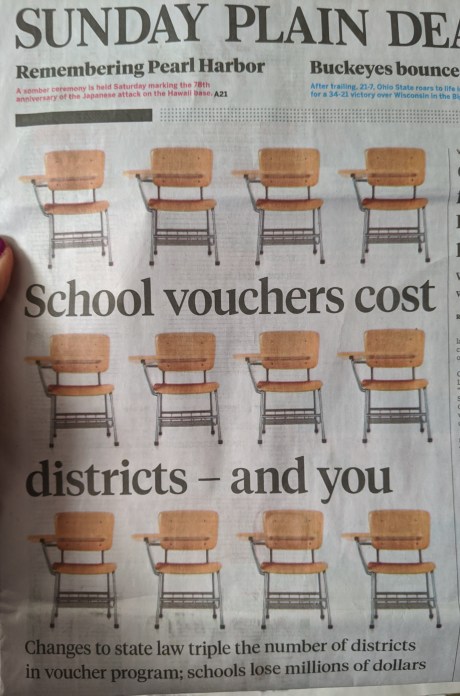
The Cleveland Plain-Dealer wrote that the voucher expansion will hit the budgets of school districts hard, districts that in the past were not part of the voucher program.

A year ago, no students in the Parma school district used Ohio’s main tuition voucher program to attend private schools.

This year, thanks to changes in state law, 359 students are using vouchers.

For families paying tuition to send their kids to Parma-area private Catholic schools like Padua or Holy Name, a $6,000 tax-funded voucher toward tuition is a huge help.

For the district, it’s a $2.1 million hit to the budget that impacts teachers, books and supplies for its schools.

Parma isn’t alone in facing new or increased costs to help students attend private schools. Changes to state law, have more than tripled the number of districts declared part of the voucher program, from 40 in 2018-19 to 139 this school year.

Next year, the program meant to help students escape being stuck in failing schools will grow further, to more than 400 districts, which represents more than two-thirds of the districts in the state.

Even Solon, always at the top of state test score rankings, has a school considered failing and whose students are now eligible for vouchers. Next year, add a school in each of the high-scoring Brecksville-Broadview Heights and Mayfield districts.

The change has school officials protesting and gathering to find ways to seek relief…

The use of vouchers within school districts is also increasing. The Cleveland Heights-University Heights schools saw 500 more students use vouchers this year than last year, mostly to attend Jewish schools. The district’s voucher bill increased by $3 million.

That change, said district Treasurer Scott Gainer, has the school board seeking a higher tax increase than planned this spring.

Shaker Heights Superintendent David Glasner, whose district is seeing a small bill this year, but faces a larger one next year, complained to the state school board last week about the hit that school district budgets are taking.

“There are school districts that are now expecting to lose millions of dollars in the course of one year as a result of the EdChoice [voucher] expansion,” Glasner said. “These are losses for which districts were unable to forecast or prepare.”

State Sen. Matt Huffman, one of the strongest supporters of vouchers in Ohio, said some of the rules are subtle and have changed a few times. But districts should have known, he said, and should be blaming themselves for not improving their schools…

Ohio has four “scholarship” or voucher programs that provide tax dollars to pay tuition at private schools, almost all of which are Christian schools. There is one program just for Cleveland, which was started in 1996, so Cleveland is not affected by the current changes.

The biggest is called EdChoice. Created in 2005 for students attending “underperforming” schools or who would be assigned to them, EdChoice has a student’s home district pay $4,650 toward tuition for kindergarten through eighth grade and $6,000 for private high schools.

Stephen Dyer, a former legislator in Ohio who writes a blog about education, called “BS” on Huffman’s claim that school districts should have known and should have been prepared.

Dyer says that the state rigged the grades and school report cards to produce failure and make more schools voucher-eligible.

This is where I call BS.

How can I do that? Simple: Over the last decade, the state report card grades upon which these new voucher building designations are being based have been deliberately and artificially deflated for the state’s school districts. And I’m increasingly convinced it was for this sole purpose: to ensure more districts and buildings are deemed “failing” by the state so more public money can be poured into private, mostly religious schools.

Don’t believe me?

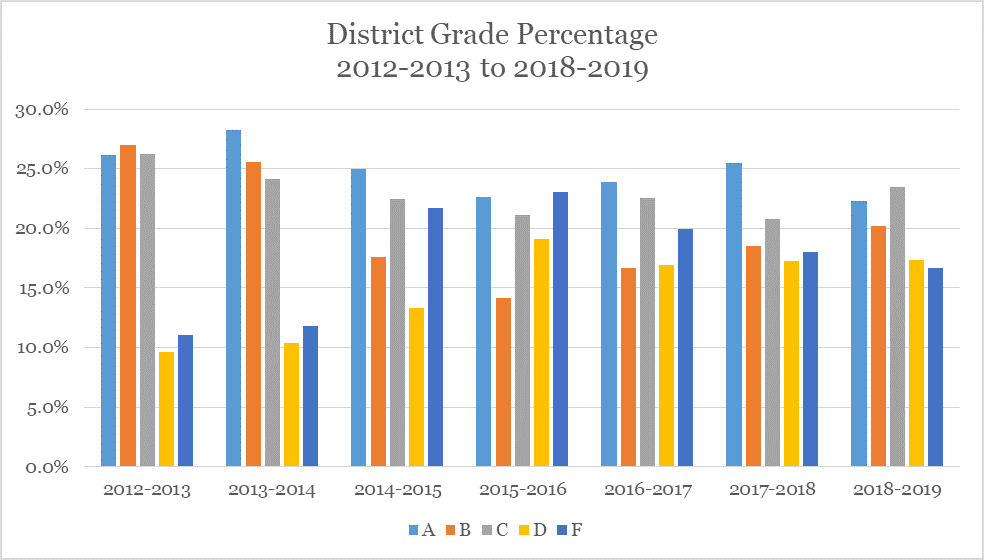
Look at school districts’ overall grade performance since the 2012-2013 school year — the first for the A-F state report card system.

Notice anything? Like a massive jump in D and F grades between 2013-2014 and 2014-2015?

Let me ask you a question: Does anyone — and I mean ANYONE — actually believe that between the 2013-2014 school year and the 2014-2015 school year school districts became more than twice as likely to “fail” kids?

Of course not.

This is a classic case of grade manipulation by state lawmakers. You’ll also notice a steady decline in the rate of Fs since the high point of 2015-2016. Why were these grades so much worse? Because the state kept changing standardized tests. So teachers and students had no idea what the testing expectations were. Since they’ve remained the same, you can see a steady and precipitous decline in the rate of F grades, though the percentages of D and F grades remain far higher than the 2012-2013 school year.

To add insult to injury, a study examing the test performance of students who take vouchers found they did worse on state tests after taking the voiucher than before … according to the pro-voucher Fordham Institute. But that doesn’t matter to Huffman, whose hero is apparently the Titanic captain who kept plowing ahead, damn the iceberg.

Anyway, here’s where Huffman struck gold for those who are taking a public subsidy to send their kids to private, mostly religious schools — only 2 out of the three years’ grades count to have your building designated “failing” from 2013-2014, 2017-2018 and 2018-2019. And once the building is eligible for vouchers, every student who gets a voucher gets to keep it forever, even if the public building becomes the highest-performing in the state…

But it’s all been a plan from the beginning:

1) Deliberately deflate district report card grades

2) Get as many buildings as possible eligible for vouchers

3) Market them like crazy to families in these districts so the rest of us taxpayers can subsidize their choices with our local tax dollars and/or fewer opportunities for our kids who remain in local school districts.

That’s not a district performance problem.

It’s Huffman’s plan.

****************************************

Last Saturday I was on Meryl Johnson’s radio show, based in Cleveland, where she was a teacher in the public schools for many years. Meryl is an elected member of the Ohio State Board of Education, and she is very concerned about the explosion of vouchers. She alerted me to this disaster. I pointed out that there is one possible silver lining. Until now, the suburban districts in Ohio could ignore vouchers and assume they affected only Ohio’s urban districts. Now the cost of vouchers will hit their school budgets and their taxes will  have to go up so that a few students can go to religious schools, where they are likely to get a worse education than the one offered in their local  public schools. Their own schools will now feel the pinch caused by vouchers. Maybe this is the wake-up call that is needed to create a statewide coalition to stop defunding the public schools that enroll the vast majority of students in the Buckeye State.

Meryl sent me a screen shot of the front page of the Cleveland Plain Dealer. Will this wake up the citizens of Ohio? Will they realize that they must raise their taxes to pay for vouchers for the small number who leave their public schools? Do they know that the students who leave for religious schools will lose ground academically?

IMG_20191208_113121