On a flight yesterday, I watched a documentary that was a biography of Roy Cohn. It is called “Where Is My Roy Cohn?,” a phrase uttered by Trump when he was disgusted by his attorney general, Jeff Sessions, who apparently had some scruples about destroying the Justice Department on behalf of the man who appointed him.

The biography is short. The story is compelling. It portrays a man who had absolutely no scruples, no ethical core, no moral values. He was willing to lie, cheat, steal, twist words, anything to win. Winning was everything. He was a closeted homosexual who gleefully collaborated with his mentor Senator Joseph McCarthy to find and expose other homosexuals. He died of AIDS, but never admitted that he had the disease (he preferred to call it “cancer of the liver”).

The loathsome Cohn was Trump’s attorney and his mentor. He defended the Trump Organization against federal charges that the Trumps excluded blacks from their federally-financed housing projects. He helped to prosecute the Rosenbergs and assure that they got the death penalty. He was the chief lawyer for the Mafia and helped many of its leaders avoid long prison sentences. He was disbarred for stealing from his clients.

It is contemporary history. If you can find it online, watch it. It explains a lot about the world we live in now.

Mike Rose opined a few years back about “grit” and its limitations.

This is one of those articles that is never dated.

Rose, one of my favorite authors, writes:


In a nutshell, I worry about the limited success of past attempts at character education and the danger in our pendulum-swing society that we will shift our attention from improving subject matter instruction. I also question the easy distinctions made between “cognitive” and “non-cognitive” skills. And I fear that we will sacrifice policies aimed at reducing poverty for interventions to change the way poor people see the world.

In this post, I would like to further explore these concerns—and a few new ones—by focusing on “grit,” for it has so captured the fancy of our policy makers, administrators, and opinion-makers….

Let me repeat here what I’ve written in every other commentary on grit. Of course, perseverance is an important characteristic. I cherish it in my friends and my students.

But at certain ages and certain times in our lives, exploration and testing new waters can also contribute to one’s development and achievement. Knowing when something is not working is important as well. Perseverance and determination as represented in the grit questionnaires could suggest a lack of flexibility, tunnel vision, an inability to learn from mistakes.

Again, my point is not to dismiss perseverance but to suggest that perseverance, or grit, or any quality works in tandem with other qualities in the well-functioning and ethical person. By focusing so heavily on grit, character education in some settings has been virtually reduced to a single quality, and probably not the best quality in the content of character. The items in the grit instruments could describe the brilliant surgeon who is a distant and absent parent, or, for that fact, the smart, ambitious, amoral people who triggered the Great Recession. (Macbeth with his “vaulting ambition” would score quite high on grit.) Education in America has to be about more than producing driven super-achievers. For that fact, a discussion of what we mean by “achievement” is long overdue.

But, of course, a good deal of the discussion of grit doesn’t really involve all students. Regardless of disclaimers, the primary audience for our era’s character education is poor kids. As I and a host of others have written, a focus on individual characteristics of low-income children can take our attention away from the structural inequalities they face. Some proponents of character education have pretty much said that an infusion of grit will achieve what social and economic interventions cannot.

Can I make a recommendation? Along with the grit survey, let us give another survey and see what the relationship is between the scores. I’m not sure what to call this new survey, but it would provide a measure of adversity, of impediments to persistence, concentration, and the like. It, too, would use a five-point response scale: “very much like me” to “not much like me.” Its items would include:

  • I always have bus fare to get to school.
  • I hear my parents talking about not having enough money for the rent.
  • Whenever I get sick, I am able to go to a doctor.
  • We always have enough food in our home.
  • I worry about getting to school safely.
  • There are times when I have to stay home to care for younger brothers or sisters.
  • My school has honors and Advanced Placement classes.
  • I have at least one teacher who cares about me.

My guess is that higher impediment scores would be linked to lower scores on the grit survey. I realize that what grit advocates want is to help young people better cope with such hardship. Anyone who has worked seriously with kids in tough circumstances spends a lot of time providing support and advice, and if grit interventions can provide an additional resource, great. But if as a society we are not also working to improve the educational and economic realities these young people face, then we are engaging in a cruel hoax, building aspiration and determination for a world that will not fulfill either…

Rose notes that the people Angela Duckworth studied were highly successful.

The foundational grit research primarily involved populations of elite high achievers—Ivy League students, West Point cadets, National Spelling Bee contestants—and people responding to a Positive Psychology website based at the University of Pennsylvania. It is from the latter population that the researchers got a wider range of ages and data on employment history…

It is hard to finish what you begin when food and housing are unstable, or when you have three or four teachers in a given year, or when there are few people around who are able to guide and direct you. It is equally hard to pursue a career with consistency when the jobs available to you are low-wage, short-term and vulnerable, and have few if any benefits or protections. This certainly doesn’t mean that people who are poor lack determination and resolve. Some of the poor people I knew growing up or work with today possess off-the-charts determination to survive, put food on the table, care for their kids. But they wouldn’t necessarily score high on the grit scale.

This is a very thoughtful article. I hope you will read it in full.

The Education Law Center is one of the nation’s pre-eminent civil rights organizations committed to improving equality of educational opportunity. It points out in the following release that the charter schools have never signed the legally required contracts to participate in court-ordered universal pre-school programs in the state’s poorest districts, the “Abbott Districts.”


December 9, 2019
ELC CALLS FOR END TO SEPARATE CHARTER SCHOOL PRE-K PROGRAMS IN ABBOTT DISTRICTS
Education Law Center is calling for the NJ Department of Education (NJDOE) to immediately end the unauthorized practice of allowing charter schools in poor urban Abbott districts to operate separate preschool programs outside the districts’ universal “Abbott Preschool Program.”
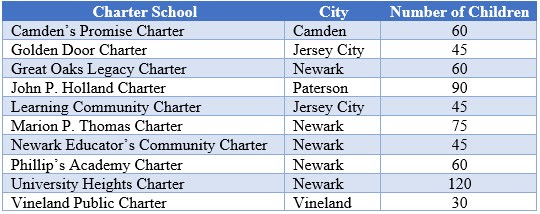
The administration of former Governor Chris Christie allowed 10 charter schools in five Abbott districts to operate their own preschool programs, despite not having a contract from the districts to participate in the districts’ universal program, as required by the landmark Abbott v. Burke rulings. In 2019-20, the 10 charter preschool programs enrolled 630 three- and four-year-olds, funded by over $8 million in state preschool aid.
ELC’s December 2019 letter to the NJDOE emphasizes that, under the NJ Supreme Court’s detailed Abbott preschool mandates, only Abbott districts are authorized to offer high quality preschool to all resident three- and four-year-olds through an NJDOE-approved universal enrollment program. While community providers and Head Start are eligible to operate preschool classrooms in Abbott districts, they can only do so under a contract with the districts. The district contract requires strict adherence to teacher quality, class size, and other Abbott preschool standards, as well as enrollment through the district’s universal outreach and recruitment process.
As the Supreme Court has made clear, these requirements are essential elements of the constitutional obligation imposed on Abbott districts to provide high quality preschool to all eligible three- and four-year old children residing in their communities. The districts are mandated to enroll at least 90 percent of the universe of those children. The requirement for community-based providers to operate only under district contracts ensures that only those providers capable of and willing to deliver high quality preschool through district coordination, support and supervision, can participate in the Abbott program.
The NJDOE’s decision to allow the 10 charter schools to operate separate preschool programs not only violates the Abbott rulings and the agency’s own regulations, but also undermines the cornerstone of the nationally-recognized success of the Abbott Preschool Program: a district-supervised, mixed delivery system of early education unifying community-based providers and district classrooms under a common set of high quality standards, backed by adequate funding. This well-established legal and policy framework does not permit any entity, including charter schools, to provide preschool wholly outside of the district-run, universal Abbott program.
“The NJDOE has no authority to permit a charter school to run a parallel preschool program that competes with the district’s Abbott program for students and funding,” said David Sciarra, ELC Executive Director and lead counsel in the Abbott litigation. “Charter schools in Abbott districts cannot operate preschool classrooms unless they enter into a contract with the district, as is required of every community-based provider and Head Start program participating in Abbott preschool.”
In 2019-20, the following charter schools are providing preschool without obtaining the legally required contract to participate in the Abbott district program:
In addition to calling for an end to the unauthorized practice of allowing charter schools to operate their own preschool programs, ELC is also demanding the NJDOE immediately notify the 10 charter schools that to continue to provide preschool in the 2020-21 school year, they must secure a contract with their district to participate in the district-wide Abbott preschool program.
Press Contact:
Sharon Krengel
Policy and Outreach Director
Education Law Center
60 Park Place, Suite 300
Newark, NJ 07102
973-624-1815, ext. 24

California Sunday Magazine published interviews with teachers about their role in striking, walking out, negotiating, bargaining.

It begins:

On February 22, 2018, some 20,000 teachers in West Virginia — many of them wearing red in solidarity — walked out of their classrooms. That April saw strikes in Arizona, Colorado, and Oklahoma, as teachers vented their collective frustration in what became known as the #RedforEd movement. In early 2019, educators picketed in Oakland and Los Angeles, in districts across Washington state and Oregon, and again in Colorado. And this fall, educators in Chicago, the nation’s third-largest school district, took to the streets.

After years of system-wide underinvestment, educators are pushing back hard. They have married concerns about pay with their ability to adequately educate students . They have made a few gains — one or two fewer students in their overcrowded classes and significant raises in some cases. But many still see a long way to go, and as another election ramps up, the public will have to decide how much these issues matter. In these pages, we hear from teachers who made the decision to walk the picket lines and others who decided to stay put.

Matt Barnum and Gabrielle LaMarr LeMee wrote a provocative article  about the way that a private school rating agency rates schools and steers patents toward white affluent schools and away from schools where children of color predominate. Larry Cuban reposted the article on his blog.

GreatSchools ratings effectively penalize schools that serve largely low-income students and those serving largely black and Hispanic students, generally giving them significantly lower ratings than schools serving more affluent and more white and Asian students, a Chalkbeat analysis found.

And yet, according to GreatSchools’ own data, many schools serving low-income, black, and Hispanic populations are doing a good job helping students learn math and English. But those schools still face long odds of getting an above-average rating on GreatSchools — likely because their students are arriving far behind.

The result is a ubiquitous, privately run school ratings system that is steering people toward whiter, more affluent schools. A recent preliminary study found that as the site rolled out an earlier version of its ratings, areas with highly rated schools saw increases in home prices and rises in the number of white, Asian, and better-educated families. After three years, the study found, property values in those areas increased by nearly $7,000, making it more difficult for low-income families to buy into the areas.

Readers of this blog will not be surprised to learn that this rating service is funded in part by rightwing foundations that want to promote school choice and destroy neighborhood schools.  Most notable among the funders is the Walton Family Foundation, which despises public schools and eagerly promote charter schools and vouchers.

Kentucky passed a law authorizing charters but never provided funding for them. The new governor of Kentucky, Democrat Andy Beshears, was elected in part because of his strong support by teachers and his commitment to public schools.

First charter school application in Kentucky rejected

NEWPORT, Ky. (AP) — The first charter school application filed in Kentucky has been unanimously denied. News outlets report Newport Independent Schools rejected the application Thursday night. The superintendent says the documents submitted by the proposed River Cities Academy lacked planning in multiple areas. A review committee says there was significant plagiarism in the application process. The committee also found a lack of authentic community support for the school. River Cities Academy can appeal the decision to the state board of education. The state approved charter schools in 2017 but a funding source for the schools hasn’t been provided

An anonymous reader left this comment about the SAT.


Once upon a time, 25 years ago, I ‘offered’ SAT tutoring (at a rather high price of $50/hr.) to denizens of a tony private school. I could charge that much because I ‘got results’. But, it was rather easy to improve scores.

First, there was the fact that almost all of my clients had scored ‘too low’ when they first took the test. The probability was, therefore, that if they simply took it again, they would ‘improve’. Secondly, most low performers had a certain level of anxiety when they took the test. Simply being familiar with the format by reviewing former tests helped those students assess the test in a more calm and analytical manner. Thirdly, despite the subtraction of ‘wrong’ answers from the score (at a rate commensurate with the number of answers), the students needed to understand that they actually knew something, if only at the subconscious level, and they needed to ‘guess’ (even randomly) because an inaccurate random guess didn’t really count against the score. They needed to trust their instincts.

The result was often (among ‘median’ scores) a 100 point increase. Were the students any ‘smarter’ after the tutoring? Well, no. Were they more ‘scholastically fit’, well, no. All they learned was how to contain their anxiety and (to some extent) ‘psyche out’ the test. Nothing more.

The test is (and always was) a scam. I say this as one who has benefited from such tests as a youth (I always did well, even qualified for MENSA on my GRE’s). These tests measure nothing of value, and I’m ever so happy to see more and more colleges relying on a body of student work and the recommendations of former teachers (sometimes in the form of ‘grades’… although ‘grades’ are only a shapshot in time, and often a narrowly forced evaluation by a particular teacher who would have much more to say, if asked).

This is a beautiful and powerful statement spoken in court by a young man on trial for “extremism” in a Russian court. It was translated by Masha Gessen and appears in The New Yorker online. it explains the power of Resistance to tyranny and the importance of individual responsibility and love.

Gessen writes:

A twenty-one-year-old university student named Yegor Zhukov stood accused of “extremism,” for posting YouTube videos in which he talked about nonviolent protest, his campaign for a seat on the Moscow City Council, and different approaches to political power. In his most recent video, recorded four months ago, he suggested that “madmen” like Vladimir Putin view power as an end in itself, while political activists view it as an instrument of common action. In many of his vlog entries, Zhukov is seated against the backdrop of the Gadsden flag—“Don’t Tread on Me”—which appears to hang in his bedroom in his parents’ apartment. The prosecutor had asked for four years of prison time for Zhukov. On Friday, a Moscow court sentenced Zhukov to three years’ probation—an unusually light punishment probably explained by the public response to Zhukov’s speech, which several Russian media outlets dared to publish. Hundreds of people gathered in front of the courthouse on the day of the sentencing. As a condition of his probation, Zhukov is banned from posting to the Internet. The judge also ordered that the flag, which was confiscated by police, be destroyed.

Instead of writing my own column, I have translated Zhukov’s final statement, delivered in court on Wednesday. I did it because it is a beautiful text that makes for instructive reading. Parts of it seem to describe American reality as accurately as the Russian one. Parts of it show what resistance can be.

Zhukov’s statement:

“This court hearing is concerned primarily with words and their meaning. We have discussed specific sentences, the subtleties of phrasing, different possible interpretations, and I hope that we have succeeded at showing to the honorable court that I am not an extremist, either from the point of view of linguistics or from the point of view of common sense. But now I would like to talk about a few things that are more basic than the meaning of words. I would like to talk about why I did the things I did, especially since the court expert offered his opinion on this. I would like to talk about my deep and true motives. The things that have motivated me to take up politics. The reasons why, among other things, I recorded videos for my blog.

“But first I want to say this. The Russian state claims to be the world’s last protector of traditional values. We are told that the state devotes a lot of resources to protecting the institution of the family, and to patriotism. We are also told that the most important traditional value is the Christian faith. Your Honor, I think this may actually be a good thing. The Christian ethic includes two values that I consider central for myself. First, responsibility. Christianity is based on the story of a person who dared to take up the burden of the world. It’s the story of a person who accepted responsibility in the greatest possible sense of that word. In essence, the central concept of the Christian religion is the concept of individual responsibility.

“The second value is love. ‘Love your neighbor as yourself’ is the most important sentence of the Christian faith. Love is trust, empathy, humanity, mutual aid, and care. A society built on such love is a strong society—probably the strongest of all possible societies.

“To understand why I’ve done what I’ve done, all you have to do is look at how the Russian state, which proudly claims to be a defender of these values, does in reality. Before we talk about responsibility, we have to consider what the ethics of a responsible person is. What are the words that a responsible individual repeats to himself throughout his life? I think these words are, ‘Remember that your path will be difficult, at times unbearably so. All your loved ones will die. All your plans will go awry. You will be betrayed and abandoned. And you cannot escape death. Life is suffering. Accept it. But once you accept it, once you accept the inevitability of suffering, you must still accept your cross and follow your dream, because otherwise things will only get worse. Be an example, be someone on whom others can depend. Do not obey despots, fight for the freedom of body and soul, and build a country in which your children can be happy.’

“Is this really what we are taught? Is this really the ethics that children absorb at school? Are these the kinds of heroes we honor? No. Our society, as currently constituted, suppresses any possibility of human development. [Fewer than] ten per cent of Russians possess ninety per cent of the country’s wealth. Some of these wealthy individuals are, of course, perfectly decent citizens, but most of this wealth is accumulated not through honest labor that benefits humanity but, plainly, through corruption.

“An impenetrable barrier divides our society in two. All the money is concentrated at the top and no one up there is going to let it go. All that’s left at the bottom—and this is no exaggeration—is despair. Knowing that they have nothing to hope for, that, no matter how hard they try, they cannot bring happiness to themselves or their families, Russian men take their aggression out on their wives, or drink themselves to death, or hang themselves. Russia has the world’s [second] highest rate of suicide among men. As a result, a third of all Russian families are single mothers with their kids. I would like to know: Is this how we are protecting the institution of the family?

“Miron Fyodorov [a rap artist who performsunder the name Oxxxymiron], who attended many of my court hearings, has observed that alcohol is cheaper than a textbook in Russian. The state is pushing Russians to make a choice between responsibility and irresponsibility, in favor of the latter.

“Now I’d like to talk about love. Love is impossible in the absence of trust. Real trust is formed of common action. Common action is a rarity in a country where few people feel responsible. And where common action does occur, the guardians of the state immediately see it as a threat. It doesn’t matter what you do—whether you are helping prison inmates, speaking up for human rights, fighting for the environment—sooner or later you’ll either be branded a ‘foreign agent’ or just locked up. The state’s message is clear: ‘Go back to your burrow and don’t take part in common action. If we see more than two people together in the street, we’ll jail you for protesting. If you work together on social issues, we’ll assign you the status of a “foreign agent.” ’ Where can trust come from in a country like this—and where can love grow? I’m speaking not of romantic love but of the love of humanity.

“The only social policy the Russian state pursues consistently is the policy of atomization. The state dehumanizes us in one another’s eyes. In the state’s own eyes, we stopped being human a long time ago. Otherwise, why would it treat its citizens the way it does? Why does it punctuate its treatment of people through daily nightstick beatings, prison torture, inaction in the face of an H.I.V. epidemic, the closure of schools and hospitals, and so on?

“Let’s look at ourselves in the mirror. We let this be done to us, and who have we become? We have become a nation that has unlearned responsibility. We have become a nation that has unlearned love. More than two hundred years ago, Alexander Radishchev [widely regarded as the first Russian political writer], as he travelled from St. Petersburg to Moscow, wrote, ‘I gazed around myself, and my soul was wounded by human suffering. I then looked inside myself, and saw that man’s troubles come from man himself.’ Where are these kinds of people today? Where are the people whose hearts ache this much for what is happening in our country? Why are hardly any people like this left?

“It turns out that the only traditional institution that the Russian state truly respects and protects is the institution of autocracy. Autocracy aims to destroy anyone who actually wants to work for the benefit of the homeland, who isn’t scared to love and take on responsibility. As a result, our long-suffering citizens have had to learn that initiative will be punished, that the boss is always right just because he is the boss, that happiness may be within reach—but not for them. And having learned this, they gradually started to disappear. According to the state statistical authority, Russians are slowly vanishing, at the rate of four hundred thousand people a year. [Deaths exceeded births by nearly two hundred thousand in the first six months of 2019.] You can’t see the people behind the statistics. But try to see them! These are the people who are drinking themselves to death from helplessness, the people freezing to death in unheated hospitals, the people murdered by others, and those who kill themselves. These are people. People like you and me.

“By this point, it’s probably clear why I did what I did. I really want to see these two qualities—responsibility and love—in my fellow-citizens. Responsibility for one’s self, for one’s neighbors, for one’s country. This wish of mine, your honor, is another reason why I could not have called for violence. Violence breeds impunity, which breeds irresponsibility. By the same token, violence does not bear love. Still, despite all obstacles, I have no doubt that my wish will come true. I am looking ahead, beyond the horizon of years, and I see a Russia full of responsible, loving people. It will be a truly happy place. I want everyone to imagine Russia like this. And I hope this image can lead you in your work, as it has led me in mine.

“In conclusion, I would like to state that if the court decides that these words are spoken by a truly dangerous criminal, the next few years of my life will be marked by deprivation and adversity. But I look at the people [who have been jailed in the latest wave of activist arrests] and I see smiles on their faces. Two people I met briefly during pretrial detention, Lyosha Minyaylo and Danya Konon, never complained. I will try to follow their example. I will endeavor to take joy in having this chance—the chance to be tested in the name of values I hold dear. In the end, Your Honor, the more frightening my future, the broader the smile with which I look at it. Thank you.”


Robin Lithgow, former director of arts education in the Los Angeles school district, is writing a history of arts education for children. This the last of her installments about the boy choirs in England, and it is enthralling.

“Let’s start with the tradition of the Boy Bishop, celebrated all over Europe, dating back to the the early years of Christianity. In English villages the Boy Bishop was traditionally elected on the 6th of December, the feast of Saint Nicholas, and and his authority lasted till December 28, the Holly Innocents’ Day. He and his entourage were usually chosen from the choir boys at the local church. During his rule the real Bishop would, symbolically, step down at the deposuit potentes de sede of the Magnificat (“he hath put down the mighty from their seat”), and the boy would take his seat at et exaltavit humiles (“and hath exalted the humble and meek”). The elected boy would be dressed in full bishop’s robes, complete with mitre and cozier, and his comrades would be dressed as priests. They would travel about the parish blessing the townsfolk and would perform all of the ceremonies at the church except for the mass. It was a solemn rite, but being boys, they most likely had some fun hamming it up. Except for a brief revival during the rule of the Catholic Mary, this custom did not survive the English Protestant Reformation; but it was still very much in evidence all over the realm early in the reign of Henry VIII. …

“It is impossible to overstate the role of the voices of boy singers, thought to be the voices of angels. Entire cathedrals were designed as huge acoustical sound boxes to capture the purity of the sound, and that sound was heard throughout the realm during the Christmas season.”

Robin Lithgow, former director of arts education for the Los Angeles public schools, has been researching the history of children’s theater, in particular, the boys’ acting companies that were popular in England.

This is Part 4 of her series. 

She begins:

If you’ve been on the edge of your seat waiting for this final post on the boys’ companies active in the Tudor Age, you are probably alone, and I need to hear from you! This is a shame, because if theatre historians Harold Newcomb Hillebrand and Charles William Wallace are correct, the Globe Theatre and Shakespeare would never have happened without them!

My first three posts on this subject covered the immense popularity at court of the Children of St. Paul’s and the Children of the Chapel (along with many others that came and went and entertained the aristocracy in the provinces) up through the last decade of Elizabeth’s reign. The third post chronicled their demise as a result of politics and the far more active men’s companies. Hillebrand and Wallace wrote their books early in the last century, and since then there has been almost total silence. Fortunately their books are exhaustive in their detail, and if you can get your hands on them, you might join me in appreciating the role that boy actors played in our rich history

The truth is, the last gasp of the boys’ companies during the reign of James I, while dazzling and controversial, was brief; and it was entirely different from what had gone before. Both the Children of the Chapel and St. Paul’s had a second flowering with the ascendance of a new monarch, but their new life was a life sustained by a different breath—the breath of commerce. Ambitious entrepreneurs banked on the nostalgia for the playful antics of the boys who cavorted through the courts of Henry VIII and Elizabeth I, and they took a huge gamble. They had investors, and they threw their money around rashly, hiring the best playwrights available. Samuel Daniel, John Day, George Chapman, Thomas Middleton, John  Marston, and Ben Johnson pocketed way more money writing for the boys than they did for the men, and their brilliant plays can still delight us; but the playful antics of the cavorting boy actors were not a good fit for them. Jacobean audiences had grown much more sophisticated, and they and demanded edgier and more dangerous fare than the children could manage.