Arthur Goldstein, veteran teacher of many decades, thinks he knows a thing or two about teaching English. The State Education Department doesn’t trust him or other English teachers. So they have distributed new mandates about how to teach “advanced literacy” to make sure that he does what he is told. And he doesn’t like it. 

Frankly, it sounds like Common Core in a new dress.

Goldstein writes:

Forget everything you’ve heard and read about education. There’s a new paradigm, and it’s called Teaching Advanced Literacy Skills. This is revolutionary, of course, because it appears clear to the authors that no English teacher in the history of the universe has ever taught advanced literacy. Also, since no one in the world will ever go into a trade, and since everyone will spend their entire lives doing academic writing, we need to start work on this right away.

No, evidently we just do the whole phonics thing, and once students are able to sound out words, we give up on them for the next eleven years or so and hope for the best. Thank goodness these brilliant writers are here to let us know that students need to be able to identify a main idea, and that this indispensable skill is actually an amalgam of other vital skills.

Not only that, but we now know that it’s important students use a variety of sources to support their arguments, as opposed to just making stuff up (like the President of the United States, for example). That’s why we, as teachers, should hand them several sources on which to base their writing, as do the geniuses in Albany when they issue the NY State ELA Regents, the final word on whether or not students have advanced literacy.

Never mind that students who’ve passed the test with high grades don’t seem to know how to read or write well. Never mind nonsense like writer voice, mentioned absolutely nowhere in the book. Never mind whether or not anyone actually wishes to read whatever writing the students produce, because that’s also mentioned absolutely nowhere in the book. The important thing is that they be able to produce academic writing. Do you go out of your way to read academic writing? Neither do I.

The book is big on synthesis, that is, using multiple sources. Like the awful English Regents exam,  students are generally provided with sources. I suppose this is some sort of training to write research papers. Here’s the thing, though–if you write research papers you will have to find your own sources. I recall being in summer classes at Queens College, in their old crappy library searching through shelves with a flashlight trying to find things to write about. No such issue for our advanced literacy-trained students. Here are texts a, b, c and d. Get out there and tell me which ones are better.

We don’t need to teach students about logical fallacy either, which is good news for politicians everywhere. Students need not recognize ad hominem or straw man arguments. No guilt by association for you. We don’t need to bother showing them why some arguments are less logical than others, as per this book at least. I suppose when Donald Trump calls whatever doesn’t suit him “fake news,” that’s okay. It’s just another academic source.

One of the most fascinating aspects of this book, to me, is that the project they spend the most time on is one in which students discuss whether or not their school should adopt uniforms. I wrote in the margins, “great topic,” Why? Because this was a topic that had a direct effect on their lives. This decision would change their behavior, and perhaps change their entire school. There was an intrinsic motivation for students to be involved in this decision.

Nowhere in the book did the writers deem this worthy of mention. I have no idea whether or not they even noticed it. I did, though, and it was hands down a better topic than some of the crap students must wade through on the English Regents exam. Don’t get me wrong–I understand that students, like us, will have to wade through a lot of crap in their academic lives. To me, though, it seems smarter to make them love reading. It seems smarter to motivate them to do so on their own. Then, when they have to read some crap to which they cannot relate, they’ll be better equipped to do so, having developed the skills this book advocates in a far more positive fashion.

One thing that makes me love writers is something called writer voice. A great example of this is Angela’s Ashes, a non-fiction work (!) by the late and brilliant Frank McCourt. They made a film out of it which faithfully told the story, but was total crap. That’s because the allure and charm of this story was all about the way McCourt told it, his humor, his deft and inspiring use of language. He had me at the first sentence about childhood, and kept me hypnotized until the last sentence. I couldn’t put the book down.

Why should students today have the same pleasure? Why do experienced teachers know about teaching anyway? Nothing, by the lights of the bureaucrats in Albany.

 

Larry Lee, native Alabaman, follows the charter confusion in his home state, where the law describes precisely how charter schools should be authorized.

But, as Lee notes, the actual process of creating new charters has proceeded with complete disregard for the law, and no one seems to care.

Public schools in Montgomery will be replaced by charter schools, but the local board did not agree (the law said it should).

The charter mess has created disruption and chaos in Montgomery.

Count on it: charters will open and close. Public schools will founder as students “choose” to go to a flailing charter.

Staff will turnover. Principals will come and go.

Disruption.

That is the  point, isn’t it?


Domingo Morel is a professor of political science at Rutgers University who has studied school takeovers across the nation. He is the author of Takeover: Race, Education, and American Democracy. 

In this post, he describes the proposed state takeover of the Houston Independent School District as a hoax. 

It is a manufactured crisis. It is a theft of political power, and it is based on race.

If the state of Texas had its way, the state would be in the process of taking overthe Houston Independent School District.

But a judge temporarily blocked the takeover on Jan. 8, with the issue now set to be decided at a trial in June.

The ruling temporarily spares Houston’s public school system from joining a list of over 100 school districts in the nation that have experienced similar state takeovers during the past 30 years.

The list includes New York City, Chicago, Boston, Philadelphia, Detroit, New Orleans, Baltimore, Oakland and Newark. Houston is the largest school district in Texas and the seventh largest in the U.S.

While the state of Texas claims the planned takeover is about school improvement, my research on state takeovers of school districts suggests that the Houston takeover, like others, is influenced by racism and political power.

States fail to deliver

State governments have used takeovers since the late 1980s to intervene in school districts they have identified as in need of improvement. While state administrations promise that takeovers will improve school systems, 30 years of evidence shows that state takeovers do not meet the states’ promised expectations. For instance, a recent report called Michigan’s 15-year management of the Detroit schools a “costly mistake” because the takeover was not able to address the school system’s major challenges, which included adequately funding the school district.

But while the takeovers don’t deliver promised results, as I show in my book, they do have significant negative political and economic consequences for communities, which overwhelmingly are communities of color. These negative consequences often include the removal of locally elected school boards. They also involve decreases in teachers and staff and the loss of local control of schools.

Despite the highly problematic history of state takeovers, states have justified the takeovers on the grounds that the entire school district is in need of improvement. However, this is not the case for the Houston takeover because by the state’s own standards, the Houston school system is not failing.

By the state’s own standards, the Houston Independent School District is not failing!

Although the state has given the Houston Independent School District a B rating, it plans to take over the Houston schools because one school, Wheatley High School, has not met state standards for seven years. According to state law, the state can take over a school district or close a school if it fails to meet standards for five years.

The Houston Independent School District has 280 schools. The district serves over 200,000 students. It employs roughly 12,000 teachers. Wheatley High School serves roughly 800 students and has roughly 50 teachers.

So why would a state take over a school district that has earned a B rating from the state? And why base the takeover on the performance of one school that represents fewer than 1% of the district’s student and teaching population?

The takeover is nothing more or less than a bald-faced attempt to strip political power from black and Hispanic communities.

No one believes that software developer Mike Morath (the current state commissioner) has a single idea about how to improve Wheatley or any other school. He has never been a teacher, a principal, or a superintendent. He is there to carry out the rightwing agenda of Governor Gregg Abbott.

Count on it. This is a bald-faced power grab.

During the Obama administration, Congress passed legislation to protect students who had been defrauded by for-profit colleges. In most cases, the “colleges” made claims about their success in placing their graduates in jobs. As a result of these misleading claims, thousands of students paid for a worthless degree. The Education Department attempted to help them get restitution. The Education Department was on the side of the victims of predatory colleges.

But times change, and now Betsy DeVos is in charge. In the past, she has invested in for-profit colleges. She has no sympathy for students who were defrauded. She thinks they are trying to get free money, and she has dragged her heels. Clearly she sides with for-profit colleges, not students.

A lawsuit was brought against the Department of Education for sending debt collectors to hound students who had been defrauded. The judge in the case, Judge Sallie Kim, fined the U.S. Department of Education $100,000 after ED admitted that it attempted to collect on debts owed by 16,000 students. For some unknown reason, the $100,000 was supposed to help those students, but each one would receive just a few dollars, maybe enough for a cup of coffee.

After the fine was imposed and DeVos was held in contempt of court, the Department announced that it had sent debt collectors to yet another 29,000 students (well, now that $100,000 fine amounts to about $2 for each defrauded student).

Despite the fine and the court order, the Department admitted that it continued to pursue students at late as last month.

Now Judge Kim must decide how to deal with the contemptuous, possibly criminal activities of the Department of Education. 

A federal judge is weighing higher fines for the Education Department after the federal agency disclosed that it pursued scores of additional borrowers for debt collection — violating a court order.

Magistrate Judge Sallie Kim of the U.S. District Court in San Francisco agreed this week to consider a request by former Corinthian Colleges students to increase the $100,000 fine she levied against the department in October. The judge imposed those sanctions and held Education Secretary Betsy DeVos in contempt for pursuing loans owed by 16,000 students from the defunct for-profit chain despite a May 2018 order halting collections.

In December, the Education Department revealed in a court filing that it identified another 29,000 people who were pursued for loan payments. The agency also informed attorneys for the students that it never fully ceased collections and went after at least 21 people for payments as recently as last month…

Attorneys for the Corinthian students have argued that the department’s continued violation of the order warrants harsher penalties. Hundreds of people lost wages or tax refunds because of the collection practice, while thousands of others were hit with negative marks on their credit reports. Some people who lost wages told attorneys that their utilities were cut off or they faced eviction.

The Education Department has collected more than $20 million from Corinthian students represented in the class-action case. It has yet to refund all of the money.

Money from the $100,000 fine was meant to provide redress for 16,000 borrowers, but because 45,000 people were affected, attorneys say far more compensation is needed….

The ongoing dispute stems from a class-action lawsuit filed in 2018 by the Project on Predatory Student Lending at Harvard University and the Housing and Economic Rights Advocates on behalf of Corinthian students. The groups alleged DeVos had illegally limited loan forgiveness due to students under a statute known as borrower defense to repayment.

Kim agreed the Trump administration violated privacy laws by using Social Security Administration data to calculate loan forgiveness. She banned the Education Department from using the earnings data to grant partial student debt relief to Corinthian students and halted collection on their loans.

DeVos has cited the ruling as the reason the department sat on nearly 300,000 borrower defense claims for more than a year. The department began clearing the backlog in December after updating its methodology with a sliding scale based on a borrower’s wages to determine loan forgiveness.

In other words, DeVos took the position that if the student was defrauded but was earning money, the student could not recover the money spent on a worthless degree.

The judge has the power to increase the fine the Department must pay, which means that we the taxpayers have to pay for DeVos’ efforts to protect the predatory colleges and persecute the defrauded students.

Peter Greene wrote about this controversy here.

G.F. Brandenburg wrote about it here. 

Brandenburg says he hopes DeVos goes to jail.

Clearly the judge will not fine her personally.

The students should be paid back.

I agree with Brandenburg: DeVos should go to jail for her ruthless indifference to the plight of students who were defrauded and were supposed to be protected.

Now is the time to register for the best conference you have ever attended! 

You will meet the bloggers you read here regularly.

You will meet leaders of the Resistance from across the country.

You will have to choose among amazing panels.

Join me in Philadelphia, March 28-29!


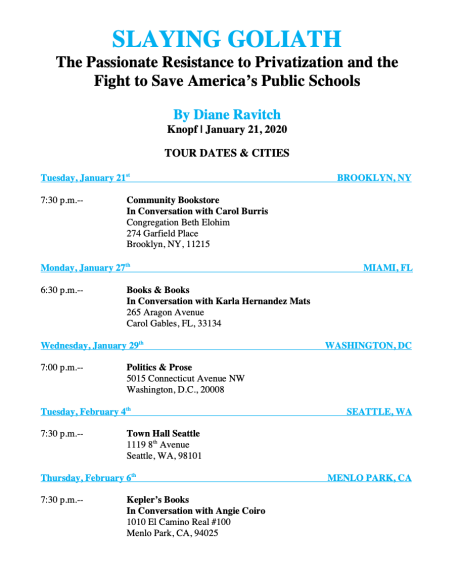
This is the current (and evolving) list of my speaking engagements in connection with the publication of my new book: SLAYING GOLIATH: THE PASSIONATE RESISTANCE TO PRIVATIZATION AND THE FIGHT TO SAVE AMERICA’S PUBLIC SCHOOLS.

I am trying not to wear myself out. Ten years ago, I hopped from city to city like a mountain goat.

But now I am 81 years old, and my knees are worn out. I have to pace myself.

Come out and say hello if you are in one of these cities.

SLAYING GOLIATH is a pro-public education, pro-teacher, pro-social justice, pro-common-good book. It is a book meant to give hope and encouragement to those who stand up to the billionaires and fight the status quo of choice and high-stakes testing. It contains inspiring stories of parents, students, teachers, and civil rights activists who took action against the powerful and won. At some of these events, the bookstore charges a modest fee to cover its expenses. Most are free.

Screen Shot 2020-01-11 at 10.07.57 PMScreen Shot 2020-01-11 at 10.08.06 PM

Nimet Eren, principal of the public Kensington Health Sciences Academy, runs a public school for 465 students that is open to all and offers four career pathways. Recently the school learned that a new charter would open nearby offering the same program. 

The principal was told that the competition would “help” her school by providing a “model” of what her school was already doing successfully.

She writes:

During the summer of 2019, the Philadelphia School Partnership (PSP), a nonprofit organization that invests in educational projects across the city, met with me to discuss the goals we had for our school. We talked extensively about what we have learned from the partnerships we have created, especially in medical settings. Then, PSP asked to visit us on Sept. 25 for the morning. It was a wonderful visit, and our teachers and students were engaged in great learning, as they are every day. The day finished with an in-depth conversation about the challenges of building partnerships with settings such as hospitals and clinics.

Then, before Thanksgiving break, I received an email from PSP stating that they had “an exciting opportunity for KHSA” and that they wanted to share it with me. I was, of course, elated and scheduled a meeting with them on Dec. 2.

The news they wanted to share was that they were giving seed money to a potential charter founder to form a health sciences charter high school in North Philly. I was confused. How was this an exciting opportunity for KHSA?

It actually felt like creating unfair competition for my school for resources that are already scarce, especially because charters can manipulate admissions and enrollment policies to their benefit, and neighborhood schools cannot.

I asked PSP how this charter school would be helpful to KHSA, and they said that my school “could learn from their charter model.” I replied that we are trying to build a model for our neighborhood students and that we need support. They then explained what I believe is the real answer as to why they were not investing in us: Because KHSA is a neighborhood school and not a charter school, they cannot control enrollment for their dream school.

Although it might appear that KHSA does not want a health sciences charter school to exist just because they copied our school’s theme, that is not the reason. The reason actually is that many charter schools create the illusion that they are educating children better than neighborhood high schools. The reality is that neighborhood high schools are serving our highest-needs children and that society should be investing the most in them.

The children who come to my school each day are the most resilient, charismatic, and loving people I have ever known. Some of my students’ reading and math levels are not as high, but that’s not their fault. It is society’s fault for not better supporting the children who are most in need. PSP’s explanation of why it is not investing in a neighborhood high school perpetuates this inequity.

I testified at the school board meeting on Dec. 12 and a charter school hearing on Dec. 20. I have had countless conversations with colleagues and opponents and have thought tirelessly about the charter vs. traditional school debate. I have heard so many arguments for both sides of the story, but the idea that I find the most compelling is one shared by one of my teachers, Jenifer Felix: Parents want what’s best for their own children. Teachers want what’s best for all children.

The problem with school choice is that it creates segregation. Choice takes away limited resources from inclusive neighborhood schools and leads to even fewer resources being spent on our students who are most in need.

A few weeks ago, Democrats in the New Hampshire legislature’s Fiscal Oversight Committee rejected $46 million from Betsy DeVos and the federal Charter Schools Program. The vote was 7-3 on partisan lines.

The grant would have doubled the number of charters in the state at a time of declining enrollment statewide.

The Republican State Commissioner of  Education, Frank Edelblut, came back to the committee with the same request, reminding the committee that the previous Democratic Governor Maggie Hassan had supported charter schools.

The Democratic-controlled committee again voted 7-3 to reject the $46 million, warning of additional costs to the state when the federal funds were expended. 

Edelblut is a home schooler who was appointed by the far-right Republican Governor Chris Sununu.

Congratulations to the wise Democrats of New Hampshire, who practiced fiscal restraint and protected the state’s public schools.

Be sure to read Peter Greene’s detailed account of this happy event. He points out that the existing New Hampshire charter schools have produced no lessons for public schools and they have empty seats.

https://www.concordmonitor.com/New-Hampshire-again-rejects-federal-money-for-charter-school-expansion-31904290

The New York State Board of Regents received a grant of $100,000 from the Gates Foundation to hire a consultant to evaluate its testing illness. The Regents hired Achieve, an organization devoted to standardized testing and it’s proliferation. In addition, Achieve was deeply involved in the development of the Common Core.

After hearing outrage from constituents, the Regents broke ties with Achieve and replaced them with California-based consultant WestEd.

Michael Kohlhaas, the blogger who has used the California Public Records Act to obtain emails among charter leaders, the California Charter Schools Association, and their enablers, reveals here what happened when protestors shut down a charter board meeting last March, accusing the charter school of taking money from the nefarious Eli Broad and the Waltons. Broad and Walton have a shell takeover corporation deceptively titled “Great Public Schools Now,” whose goal is to turn public schools into privately managed charter schools. The leader of the Extera Charter School did not directly answer the question, but Kohlhaas answers it now. Yes, the charter did take money from the Waltons and Broad.

The public is getting wise to the deceptive tactics of the charter lobby. Public schools are accountable and transparent. Charter schools are not. Public schools are audited and overseen by public officials. Charter schools answer to no one but their self-selected private boards.

Kohlhaas writes:

So you probably heard about how activists from Centro CSO and the United Teachers of Los Angeles and Eastside Padres Unidos Contra la Privatizacion protested vigorously and shut down the March 19, 2019 meeting of the Extera Charter Conspiracy Board of Directors to express their opposition to Extera’s colonial co-location at Eastman Avenue Elementary School in Boyle Heights.

And one of the key exchanges was between a protester, whose name I don’t know, and self-proclaimed doctor and supreme Extera commander Jim Kennedy, and you can watch it here.1 The backstory is that Corri Ravare had been talking previously about how Extera was getting some money from famous Walton/Broad privatizing front organization Great Public Schools Now, which, as the protester notes, is extraordinarily revealing with respect to which team Extera plays for.2

The protester called Dr. Jim Kennedy out on this and he denied that they had taken any money from GPSN: “At this point we have not …” But the truth, as the protester said, is that Corri Ravare had already “said we pretty much have the money.” And the problem with this? Well, clearly, it is that “Great Public Schools Now have declared themselves an enemy of public education. Those are the people we have to work against because they are selling out our public schools to Eli Broad and the Walton Foundation.”

She’s absolutely right about that, of course, and Doctor Jim Kennedy seems to understand that, or at least to realize that Extera’s association with GPSN doesn’t look so good. No doubt this is why he went on to tell her straight out that “[Extera has] not yet accepted that money.” But, as you may already have guessed, Doctor JK is being extraordinarily deceptive here with his mumbled half-denials. In fact Extera had been actively pursuing money from GPSN since December 2018, four months before the date of this meeting.

And the money they were pursuing was not innocuous. Not meant for important things like supplies, textbooks, instructional materials, anything at all to be used to actually educate actual children. They were seeking money from GPSN’s charter school expansion funding program for a planning grant to support their continued colonial charter conspiracy expansion, this time into the majority-Latino Montebello Unified School District. In other words, the protester’s criticism was right on target.

Things are going badly for the charter industry when their mask of beneficence is stripped away and behind it are the same voracious billionaires, eager to strip democratic control away and privatize public schools.