State Senator Mike Romano of West Virginia wrote an article about the hoax of charter schools, which will cost the state’s public schools hundreds of millions of dollars without improving education.

He wrote:

In the shadows of Covid, bills have passed during the 2021 Legislative session that will move West Virginia backwards. From the weakening or elimination of state licensing for electricians, plumbers, crane operators, elevator technicians, among others, to the weakening of drinking water standards, to creating a new layer of government with an Intermediate Court that no one wants (except insurance companies), which will cost tens of millions of tax dollars every year.

As bad as those bills are, no bill has the potential to damage our collective future or waste more of our tax dollars than charter schools. The obsession of the Republican Majority with charter schools and private school vouchers could result in the loss of nearly one-half of our public school funding.

Charter schools have mixed results around the country, at best. Ohio lost $4 billion on charters and rural states have had almost no success. In 2019, county boards of education were permitted to approve applications for and oversee charter schools preserving local control of education. The bill passed this Session eliminates local oversight by creating a new board, appointed by the governor, to approve charter schools regardless of the will of the citizens. Local control and oversight of public education have ended.

In-person charter schools are limited to 10 percent of each county’s public school population, but, as bad as that could be for public schools, the bill also authorizes two statewide virtual charter schools for up to another 10 percent of the statewide public school population. Those numbers should be alarming. If in-person and virtual charter schools take just half of the permitted public school students (10 percent), more than $200 million will be taken from public school budgets every year with little accountability. Although the charter school itself may be not-for-profit, in a clever ruse, for-profit Education Service Providers or ESPs can be hired to run it with our tax dollars.

Most important, virtual charters will receive the same amount of money (around $7,400 per student) as in-person charters, yet virtual classes are conducted over the internet without the need for school buildings, desks, cafeterias, janitors, liability insurance and all other costs of a brick and mortar school. Virtual charters won’t even hire the same number of teachers. In Florida, for example, each virtual charter teacher instructed over 250 students. Profits will be the priority and staggering. Someone’s pocket is getting lined with tax dollars and no one cared.

Amazingly, the Republican Majority did not know that more than $200 million in public school tax dollars were being shifted to private, for-profit ESPs if charters take just one-half of the students permitted under the bill. According to the State Board of Education, more than 6,000 public school teachers and service personnel would lose their jobs as a result. If the teacher/student ratio in virtual charters is like Florida, 50 teachers will replace over 3,000 public school educators and staff, most of whom will leave the state. Add the $130 million being taken from the public school system for the Republicans’ private school voucher program, and the public school system could evaporate.

As West Virginia ventures into this great unknown, the negatives have not even been acknowledged let alone considered. For example the effects on high school sports of the loss of 20 percent of the public school population would be devastating. Undoubtedly, student-athletes will go to charter or private schools and not play for their local teams. Coaches will lose their jobs or be required to take on additional responsibilities to keep their jobs. Every dollar that goes to a charter school student is eliminated from our public schools, which will reduce funds for facilities, uniforms, medical care, and other sports-related needs. The loss will be felt by every school.

While the legacy of the Republican majority has been one of voting contrary to facts, their obsession with charter schools in our state has led to a grand deception. They have underfunded public education for years. They now claim it’s broken and, in a move to defend it, preach school choice. The smart course, given the majority’s obsession for charter schools and vouchers, would be a slow march with common sense limits on in-person charter schools and, more important, on the number of students allowed to attend virtual charters. Unfortunately, those limits were eliminated under pressure from Senate Republican leadership.

Public schools are the backbone of our nation, providing a future for our children, but the Majority’s plan will make public schools a place for those not lucky enough – or rich enough – to escape. It will be a modern form of segregation, and we all will pay the price when undereducated students become unproductive adults.

David C. Berliner, one of our nation’s most honored researchers of education, shared this essay for readers of the blog.

                                             A Hug for Jennifer

          I met Jennifer for the first time at a party. She taught elementary school to mostly white, mostly middle-class kids in a suburb of San Francisco. We chatted about education for a while and she invited me to visit her class. I like visiting classes, in part, because they are always so difficult to understand. It is an enormous intellectual challenge to witness and make sense of the interaction of teachers and students with curriculum materials in a classroom setting. Sometimes, with teachers you come to admire, it is like trying to put together a recipe after  tasting  a delicious food. It’s hard to figure out the ingredients that made it so special. 

More frequently, my observations struck me as a bit like trying to study what comes out the end of a funnel–without much confidence that you know all about what went into the funnel. It’s hard to figure out the ingredients—the stuff that makes a classroom hum or fail. Some of the things that are sure to have entered the funnel are: all of society’s values; the pop culture of today, particularly as represented on television; the individual child-rearing practices of 25 or so different families; the economic, physical and mental health of the people in the neighborhood around the school; the teaching skills, content knowledge, prejudices and personal family concerns of the individual teacher; the leadership skills of the principal; the educational directives issued by the school district and the state; and so forth. After the large, open-end of the funnel receives a thousand items of this type, I wander into a classroom to observe a teacher attempting to create something sensible and unique out of whatever comes tumbling out the small end of the funnel. You really never know what you’ll see and hear when you go to observe a classroom. 

         Besides the challenge of trying to unravel what goes on in such  complex environments, I also visited classes regularly for another reason. It was because of my profound distaste for the many people who freely comment about education but spend no significant amounts of time visiting schools and classes. These education bashers regularly provide the media with false descriptions of America’s schools, inadequate critiques of the educational system, and unfeasible suggestions for school improvement. So, I took Jennifer up on her offer and I began to occasionally drop in on her class since her school was on the way to my work. On one of those visits, now many years ago, I learned a lesson about teachers and observing in classrooms that affected the rest of my career.

         Jennifer taught fourth grade. She had the self-confidence to let me drop in any time, unannounced, to observe her class. I timed one of my visits so I could avoid the taking of attendance, the principals’ announcements, and other morning housekeeping activities. As I had planned, I arrived just as reading was about to start. From the seating chart Jennifer had given me I soon identified Alec. He had caught my eye, though I was not yet sure why. Alec sat at the side of the class, his face a blank– impassive, masklike. I somehow was compelled to watch him a lot throughout the reading period.  Despite the generally upbeat lesson in which the class was involved, Alec displayed no emotions. He seemed to barely follow what was going on around him.  I was surprised that Jennifer, who usually was so equitable in her interactions with the children, seemed to be ignoring Alec. When reading was finished, and the children went out for recess, Alec remained in the class, the same blank look on his face, and with Jennifer still showing the same pleasant, but unconcerned manner. 

When the children returned from their break, no one talked to Alec. To his teacher and his classmates, Alec seemed not to exist. To me, the outside observer, it looked like a modern version of an old punishment–Alec was being shunned!  I was losing my curiosity about what was happening and, instead, began to get angry at Jennifer and the other children.

       Mathematics work began and Jennifer called small groups of children to the desk where she presented some new concepts, while most of the rest of the class did problems in their workbooks. Alec did nothing. He never took out his workbook and Jennifer never criticized him, and she never invited him to the desk, as she did the other students. I couldn’t stop myself from focussing on this situation, to the exclusion of whatever else was happening in the class. I grieved for this child, remembering my worst days as a school boy and my terror of being ostracized, even for a short time. I remembered the games we sometimes played, games in which we were so cruel to one another. My memory filled suddenly with an event from junior high school. A time when we once had “Don’t talk to Bobby day!”–a day when my classmates and I purposely set out to hurt another child. But never had I seen a teacher join in, as seemed to be the case here. As my fantasies about Alec’s plight merged with my own resurrected childhood fears and embarrassment, I began to get angrier and angrier at Jennifer. When the lunch bell finally rang, and the children filed out with Alec, still alone, but now among them, I approached Jennifer’s desk. I tried to keep the anger I felt under control and I pushed away, to the farthest reaches of my mind, the shame and the embarrassment I felt about being both perpetrator and victim of such exclusionary practices in the past. I said to Jennifer, in as controlled a manner as possible, that Alec did not seem to be participating much in classroom activities. 

         When Jennifer responded, I learned a lesson about the importance of understanding the intentions, thoughts, feelings, and beliefs of the persons you intend to study. It is difficult, of course, in any communication setting, to genuinely understand another person’s thoughts and feelings. But when you try to be a social scientist, and are not just an ordinary person chatting with others, this commonplace problem in interpersonal communication looms much larger. A lack of understanding, or a misunderstanding of another person’s intentions, can lead a social scientist to make dangerously flawed inferences about that person’s behavior.  

      Jennifer responded to me, saying that Alec’s brother had been shot and killed by the police the night before– a rarity in the middle class neighborhood the school served. And it happened at home, in front of Alec. Before I had arrived that morning Jennifer had taken Alec aside and told him how sorry she was for his whole family. She thought the day might be a tough one for him, so she told Alec that he should feel free to participate or not that day, to do whatever he felt like. She would let him decide how he wanted to use his time. She also told him how glad they all were that he was in the class and when he felt like getting involved with everything again to just start doing so. The other students had all heard about what had happened and were not shunning Alec, but giving him some breathing room. My anger, of course, was gone. In its place was a sense of wonder.

      How many incidents like this one did Jennifer have to deal with per week or per month, on top of her academic responsibilities? Who taught her to confront this awful event in such a straightforward and sensible manner? Actually, I am still not sure it was the best response to Alec’s loss and sadness, but it sure seemed to be a sensible response to me. Did she have such sensitivity to youngsters when she first started teaching, or is this part of what teachers learn as they gain experience? How could I have been so blind as to what was going on that I grew angry at Jennifer? How many other times have I observed classes and reached completely wrong conclusions about what was going on?

         After this incident, when I was working in classrooms, I was sure that I had become a better social scientist. I tried always to understand the intentions of the teachers that I studied. I spent time with them, trying to learn what they were going to teach, what special constraints they were under, and what they thought I should know before I began watching them. When I did this, I was sure that my conclusions about what occurred in their classrooms were different than before I had met Jennifer. More importantly, however, is that my views about observation in classrooms had changed. I once thought that some kind of “raw” observation was possible, that a kind of neutral, objective mirror of classroom life could be obtained. But Jennifer taught me that is just not true.

          Observations can be relatively undistorted, relatively objective, but never completely so. In fact, it is likely that observations and interpretations of classroom life without understanding teachers and their intentions, are likely to be more distorted than observations and interpretations made with such knowledge. I believe this despite the obvious loss of objectivity and neutrality that must occur as teachers and researchers get to know each other better. I’ll say it clearly: Interpretations of a teachers’ behavior without knowledge of the teachers’ intentions are either useless or, worse, inaccurate and unjust. My visit to Jennifer’s classroom that particular day, as an outsider, had led me to inaccurate and unjust conclusions about what was going on. It was sobering.

         There is also a bigger issue to which this incident is relevant. Since we cannot adequately interpret life in classrooms unless we have an insider’s understanding of that classroom, how is it possible for principals, department heads, and others who evaluate teachers, to do so when they visit a teacher’s classroom infrequently, stay for only the briefest period of time, and try to distance themselves from the teacher to maintain a goal of objectivity? The unbiased observations of the outsider may be a requirement in physics, chemistry, oncology, and other natural and biological sciences. Doing “good science” certainly requires the illusion of total objectivity, even though the best of scientists acknowledge that such a goal is impossible to achieve. But in areas of social behavior and especially those research areas concerned with classrooms and schools, such calls for objectivity are probably misplaced. Perhaps the only way to understand life in classrooms is to visit frequently, stay for a lengthy period of time, and have a shared vision with the teacher of what is intended. Evaluations of teachers that rely too heavily on formal observation instruments, notions of objectivity, and the outsider’s view of the classroom are likely to report, as I might have, that Jennifer was an insensitive, uncaring, human being. A more appropriate evaluation system would have caused the observer to hug Jennifer and give thanks that she chose to teach children rather than sell computers.

DAVID C. BERLINER is Regents Professor Emeritus at Arizona State University in Tempe, Arizona.

I thought you might want to read this. It’s a sobering story. There are about 300 million guns in the U.S.

This story appeared in The Washington Post.

This story is adapted from “Children Under Fire: An American Crisis,” which will be published March 30 by Ecco, an imprint of HarperCollins. The book examines the devastating effects of gun violence on the nation’s kids and offers a new way forward.


WEST PELZER, S.C. — The boy knew where the key to the gun safe was. He had always known.


It was a balmy evening in summer 2014, just five days after Tyler Paxton celebrated his 11th birthday with chicken nuggets and meatballs. His dad, Jonathan, kept the key atop the safe it opened, never hiding it from his only child because he trusted Tyler. An avid shooter, Jonathan had taught his son how to fire guns and how to handle them safely.


That night, as Tyler’s parents relaxed in front of the TV in the living room, the fifth-grader announced that he wanted to watch cartoons and headed to their bedroom, where he did something else instead. Tyler reached up and took the key, opened the cabinet door and pulled out a .357 magnum revolver with a snub nose. In a safe packed with rifles, it was the only loaded firearm.


Every day in America, children handle guns that they’re not supposed to touch, and every day, they hurt people with them. Kids younger than 2 have killed siblings. Older children have shot friends, parents, neighbors, classmates and, thousands of times, themselves. And yet, after two mass shootings fuel a push for universal background checks and an assault weapons ban in Congress, few of America’s political leaders are championing laws that protect children from accessing deadly weapons.


This is not a partisan issue. A 2019 poll by American Public Media found that 8 in 10 people in this country — including 7 in 10 Republicans — supported legislation mandating that guns be properly locked up when they’re not in use. Such laws are proven to save lives and have never been more essential than they are right now.


Gun sales in the United States exploded during the coronavirus pandemic, a time when kids were confined inside their homes more than ever before. An analysis of publicly reported incidents from Everytown for Gun Safety, an advocacy group, found that the number of people killed by children in unintentional shootings between March and December of 2020 spiked 33 percent, from 97 deaths to 129, compared with the same period in 2019.


Tyler had been around guns all his life, but, to his parents, he seldom seemed interested.


His mere existence was, to the conservative, evangelical Christian couple, something of a miracle. It had taken his mother, Olivia, seven years to conceive, and the pregnancy that followed proved no less fraught. A heavyset woman, she had only one kidney and high blood pressure, and after she carried him for four months, doctors told her that they didn’t believe both mother and baby would survive. A 3-D ultrasound the next day would determine whether the fetus was viable.


Distraught, Olivia and Jonathan drove to Books-A-Million, where he bought her a baby name book. After her husband fell asleep, Olivia stayed up crying and praying. At 5:30 the next morning, she reached for the book, opening it to a page that began with the name “Tyler” and a Bible verse, Matthew 21:22.
“If you believe,” she read, “you will receive whatever you ask for in prayer.”


At an appointment hours later, the doctors told her their original assessment was wrong. Both she and the baby could survive, and they did. In rural West Pelzer, population 810, her son grew into a thoughtful and intensely curious child. At an age when most of his classmates were picking out storybooks from the library, he brought home encyclopedias. He became particularly interested in dinosaurs, memorizing the taxonomic names of dozens of them, although his favorite wasn’t a fearsome carnivore. It was the Maiasaura, an herbivore whose name meant “good mother reptile.” This dinosaur took care of its children. He liked that.


Tyler was serious about the things he deemed important, and he took nothing more seriously than karate, which he earned a junior black belt in at age 10, and church, which he attended almost every Sunday, even when his mother and father didn’t. Tyler brought his devotion home with him, too, requesting that he and his parents pray together each night before they went to sleep.


“Dear Lord,” he always began when his turn came, and sometimes it took four or five minutes for him to reach “Amen.”


“An old soul,” relatives often called the boy, who named his beagle Johnny Cash. Still, Tyler was, in many ways, just a kid. He thought SpongeBob SquarePants was hilarious, and he could play Minecraft for hours.


He didn’t get in trouble often, but when he did, his parents confiscated his many electronics, because nothing irritated him more than that. In a letter to Olivia, he once tried to head off any potential punishment. “I love you mom. You are the best Mom ever,” he wrote, signing it “Love Tyler,” before adding, “P.S. I made a 61 on my math test. I’m sorry.”


A lanky kid who inherited his mother’s green eyes and freckled skin, he liked to play with her long, curly brown hair and pretend that it had special powers. At bedtime, he often fell asleep to her rendition of “La La Lu,” from Disney’s “Lady and the Tramp.” As Tyler got older, he asked her not to tell anyone that he still liked it so much.
Tyler adored Olivia, who had been a stay-at-home mom since he was an infant, but the boy most wanted to be like his dad, a bearded, thick-armed Army veteran who worked as an operations manager at an asphalt plant.


Jonathan taught him how to field and throw and hit a baseball, how to hook and clean a bass, and, as he got older, how to fire a gun. Jonathan, a competitive pistol shooter, had been enamored with firearms since childhood, and he wanted Tyler to be, too. He often suspected, though, that his boy acted interested only because he was.


Tyler got bored sitting in the tree stand when they hunted deer, and he went to gun shops with Jonathan just to keep him company. When Tyler was 10, his dad bought him a .22-caliber rifle for Christmas, but the boy cared far more about his new Amazon Fire tablet.
As his 11th birthday approached in 2014, Tyler seemed as content as he’d ever been. He had lots of friends and was excelling at karate. As they did every July, his parents took him to Isle of Palms, on South Carolina’s Atlantic Coast. As usual, they went to Coconut Joe’s, where he ordered fried shrimp and peeled off the breading before he ate them. He played in the ocean, ran on the beach with Johnny Cash, his beagle. He smiled in every photo.


Tyler Paxton, 11, plays on the beach on a family vacation to Isle of Palms, S.C., in early July 2014. (The Paxton family)
On the Sunday before he opened the safe, Tyler went to church, standing up to share prayer requests for a family friend who was having heart surgery and for his grandmother, whose husband had taken his own life, with a gun, two years earlier.
“She’s still missing my Papa,” he explained.
Then came July 25. The Paxtons picked up dinner from Taco Bell and brought it home, and after Tyler finished his nachos, he went to his parents’ room. Sprawled on the bed in blue-jean shorts and a greenish-yellow tank top, he scrolled through YouTube on his mom’s phone until the battery ran down. He briefly came out to the living room and showed Olivia a funny video of an otter trying to dig a snack out of a tool box, then he plugged her phone into a charger.
“I’m gonna go watch cartoons,” Tyler said, before he walked back to their bedroom.
[At 15, Ruben Urbina couldn’t bear his depression anymore. So he called police with a threat.]
Not long after, he reached up to the top of the free-standing gun safe in the corner of the room, got the key, opened the door. Tyler then sat on the floor and faced a mirror, gripping the pistol in his left hand. He raised the barrel to his temple. He pulled the trigger.


To Jonathan, the source of the noise didn’t register right away. He’d heard gunshots thousands of times, but never in his home. Maybe a lightbulb had popped, he thought. Worried that Tyler had shocked himself, his dad rushed down the hall and into the master bedroom. There, he found his son, who was still breathing, and screamed for his wife to call 911.
This was the sort of violence people seldom talked about, or even considered, in communities like theirs, where guns are held dear — where they’re ubiquitous in closets, dresser drawers and unsecured safes. Education, many people argued, was all that mattered, but now a boy educated on every aspect of what to do and what not to do with a gun was being cradled in the arms of his father, the pistol by his side, his blood pooling on the floor.


Tyler, then a young boy, out on a boat. (Family photo)
‘Help my son’
Bob Maxwell knew how that night would end the moment he walked into the Paxtons’ bedroom. Then one of only three police officers in all of West Pelzer, he had heard the “shots fired” call less than a minute earlier, and now he was standing over a father telling his boy how much he loved him. The smell of gunpowder still hung in the air.
“Bob, help my son,” his friend pleaded.
“Jonathan,” Maxwell said, “there’s nothing I can do.”
Jonathan had, up to that point, persuaded Olivia to stay out of the room, fearful that what Tyler looked like then would become the final, lasting image she had of her son. Her patience gone, she approached the doorway.
“Do not let my wife come in this room,” Jonathan told Maxwell, and the officer did as he asked.


“Let me in there,” Olivia demanded, but Maxwell wrapped his arms around her and held on, keeping her out until paramedics arrived and rushed past.
Soon, she and her husband were headed to the hospital.
“God, don’t take my son,” Jonathan prayed, but what he didn’t say aloud, to God or to anyone else, was that an overwhelming sense of shame had already begun to take hold. “How’s my wife gonna ever look at me the same?” he wondered, because, to him, this was his fault.
At the hospital, more than 50 people who knew Tyler from church prayed alongside his parents as they waited for an update. Then word came.
“We weren’t able to save him,” the doctor said, and the sound of wailing spread through the room. Jonathan braced for the blame.
“I deserve it,” he thought.
Police separated the couple, interviewing each of them to ensure that their stories matched and raised no suspicions. With investigators satisfied, the coroner ruled Tyler’s death a suicide, which his parents refused to accept. He had never acted depressed or been the victim of bullying, they said, and in a family that talked openly about feelings, they could not imagine that he wouldn’t have spoken up if something was bothering him.
His parents wondered if he knew the gun was loaded or if he didn’t comprehend the finality of death or if a thought about his grandfather’s suicide had suddenly made him curious. No one could convince them that Tyler understood the consequences of pulling that trigger.
What they didn’t know was that simply owning a gun significantly increased Tyler’s chances of killing himself. In fact, a 2019 study in the American Journal of Preventive Medicine found that the best predictor of a state’s youth suicide rate is the proportion of homes that contain a firearm. Remarkably, one of the study’s authors said, that single piece of data is a “far more accurate” indicator than the percentage of children in the state who have previously attempted suicide.


“There’s this mythical idea that you can teach kids not to want to handle a gun. … You can’t train or educate curiosity out of a little kid, and teenagers are impulsive, and they act without any thought to the future,” said Denise Dowd, a physician and researcher who has treated more than 500 pediatric gunshot victims. “You have to separate the guns from the kids: the thing that does harm from the thing that’s harmed.”


Bob Maxwell was the first police officer to reach the Paxtons’ house after the shooting. (Michael A. Schwarz for The Washington Post).
A survey of 153 teenagers and young adults who survived suicide attempts found that a quarter of them tried to kill themselves within five minutes of deciding to. That makes easy access to guns considerably more dangerous than easy access to, say, a rope or a knife or a bottle of pills, all of which are far less deadly. Because of firearms’ extreme lethality, they’re responsible for half the nation’s suicide deaths, and in the past two decades, nearly 10,000 children have used them to end their own lives.
To Olivia, the coroner’s ruling — why it happened and how it happened — didn’t matter much anyway.
“I don’t care what you write on that paper. It’s not going to change anything for me,” she said. “The only thing I know right now is that I’m never going to see my son again. I don’t care about anything else. Nothing else to me matters, except how am I supposed to live now? What do I do now?”
The why and how did matter to Jonathan, though, because he knew he could have prevented it. He’d gotten the revolver for Olivia back in 1997, at a time when he often worked late. She never liked guns, but Jonathan worried about her being alone at night without him, so he’d bought the pistol and kept it loaded, just in case. He hadn’t once considered hiding it from Tyler because he always assumed his son knew better than to handle it.
“It’s just something I never thought about,” he said.
Not long after Tyler’s death, Jonathan’s brother, his hunting partner since they were kids, approached him.
“Don’t get mad at me,” he said, “but can I take your guns out of the house?”
“I’m not gonna hurt myself,” Jonathan said, although as the words left his mouth, he wasn’t certain they were true. So he agreed. At the house, his brother went in without him, because Jonathan still couldn’t bear to step through the front door. Afterward, he acknowledged that he had one more gun, a 9-millimeter pistol, locked in his truck.


“You’re telling me that because you want me to take it,” his brother said.
“It’s there,” Jonathan responded. “Get it.”


Tyler sits on an all-terrain vehicle with his dad, Jonathan. (Family photo)
Keeping kids safe
So often lost in the debate about guns in America is that the most obvious and urgent step to protect kids from harm would do nothing to infringe on a person’s right to buy or own one. Demanding, by law, that a man with a dozen AR-15s must prevent his deadly weapons from falling into the hands of a child doesn’t mean the man can’t own those weapons, nor does it mean he can’t buy a dozen more. It simply means he must behave responsibly with the ones he has. If everyone in the United States locked up all their firearms today, researchers estimate, the number of gun-related accidental deaths and suicides among children and teenagers would drop by as much as a third.
And yet, a huge number of Americans don’t take that simple step, either because of ignorance, in most cases, or negligence, in some. Researchers who surveyed gun-owning families in the rural South found that a significant proportion of parents had no idea what their children knew about or had done with their firearms, according to a study in JAMA Pediatrics. Nearly 40 percent of parents who claimed that their kids didn’t know where they stored their guns were wrong; the kids said they knew. More than 20 percent of parents who claimed that their kids had never handled one of those guns were also wrong; the kids said they had. Notably, children who had been educated on gun safety were just as likely to say they’d played with the weapons. As of 2015, as many as 4.6 million children lived in homes with at least one loaded, unlocked firearm.
[A teen calmly shot 16 classmates, police say. Is his stepfather also to blame?]
Because Congress effectively banned the Centers for Disease Control and Prevention from researching gun violence for two decades, it has been exceedingly difficult to determine which gun safety measures work best. A comprehensive review of available studies by the Rand Corp., however, found that no policy was backed by stronger evidence than child access prevention laws, the most robust of which allow prosecutors to criminally charge adults who negligently store firearms where children can reach them.


Twenty-one states, including South Carolina, had no child access prevention laws as of March, the Giffords Law Center noted. Of the ones that did, only 17, and the District of Columbia, had passed the most stringent versions. But even those statutes, researchers say, are often not enforced, are too limited or carry weak penalties, rendering them far less effective than they could be.
A Washington Post review of 145 school shootings committed by children in the two decades after the Columbine High massacre in 1999 found that the weapon’s source had been publicly identified in 105 cases. In total, the guns those children used were taken from their own homes or those of relatives or friends 80 percent of the time, but in just four instances did the adult owners of the weapons face any criminal punishment for not having locked them up — and none of those prosecutions stemmed from negligent-storage laws.
“We’re looking at a class of crimes where deterrence might actually work,” said Russ Hauge, a former Washington state prosecutor and Second Amendment supporter who tried, in vain, to imprison a gun owner after a third-grader found the man’s .45-caliber semiautomatic handgun and took it to school, where it went off, leaving a bullet lodged near the spine of an 8-year-old girl. “If there was a clear law that says felony punishment will ensue if you don’t handle your weapons safely, I think we could get some people’s attention.”
Proponents of safe storage gun legislation have compared it to seat belt laws. As recently as 1984, 65 percent of Americans opposed regulations that made seat belts mandatory. But legislators ignored public opinion, and thanks to new laws, education and technology, seat belt use in this country increased from 11 percent in 1981 to nearly 85 percent in 2010. That single device, and the relentless push to make people secure it across their waists, has saved more than 250,000 lives since the 1970s.


It’s difficult to imagine a prosecutor ever going after a father like Jonathan Paxton, but what if the law Hauge described existed when Jonathan bought that revolver for his wife? What if the pistol came with a pamphlet that outlined the statute and the reasons for it? What if he saw government-sponsored ads that explained why his child’s unfettered access to a loaded firearm dramatically increased the boy’s chances of being harmed? What if he had heard one warning, one piece of data, one personal story, that led him to hide the key that opened the safe that held the gun?


Olivia and Jonathan with the urn containing the ashes of their son, Tyler. (Michael A. Schwarz for The Washington Post)
‘Mama loves you’
Eight days after their son shot himself at their home, Jonathan and Olivia moved back in, because they had to. It was Tyler’s home, too, the place where their memories of him lived and always would. In every room, around every corner, Jonathan could see his son’s face, spotted with that one freckle just above the left eye that he kissed each day. Night after night, Olivia’s mind replayed the bedtime routine she shared with her son.
“Mama loves you,” she’d say.
“Baby loves you,” he’d say, and back and forth they’d go. On quiet evenings after he was gone, Olivia would recite both parts to herself.
The Paxtons left Tyler’s bedroom just the way he had. They didn’t touch the Winnie-the-Pooh wallpaper border that they’d put up before their son was born and that he’d insisted they not take down. They didn’t remove the martial arts trophy draped in medals, or the school project about polar bears, or the other one about a local farmer who let Tyler pet his goats and sit on his John Deere tractor.


A school report Tyler wrote about his hero, Jesus. (Michael A. Schwarz for The Washington Post).
They didn’t remove his assignment from first grade that began with “I am” next to a blank line. “A good boy and a fisherman,” he answered. “I dream”: “about cookies.” “I say”: “I believe in God.” “I understand”: “my Mom is so lovely.” “I wonder”: “what Heaven looks like.” “I worry”: “everyone that gets hurt.”


In their own bedroom, Tyler’s parents kept turning the pages of the calendar that featured a different photo of him for each month. Olivia’s favorites were the ones that showed his beautifully imperfect smile, caused by what she called a “pull,” which had left one side of his bottom lip slightly higher than the other. At the end of each December, they’d start the calendar over.
For the first two years after Tyler’s death, they didn’t travel back to Isle of Palms for his birthday. On the third, they went to another beach, in Florida, where Jonathan woke up one night with such extreme chest pain that he feared his heart was about to stop. They rushed to the emergency room, but the tests showed nothing.
“You’re just having an anxiety attack,” the doctor told him.
The couple didn’t let Tyler’s death destroy their marriage, as Jonathan had worried it might. Instead, they leaned on each other, and on their faith, more than ever before. Jonathan became an ordained minister and began to preach at the church Tyler used to attend without them.


Olivia and Jonathan at Living Praise Fellowship Church in Greenville, S.C. Olivia cries listening to the bishop talk about their son, Tyler. (Michael A. Schwarz for The Washington Post).


Because they wanted people to remember his life, Olivia and Jonathan talked often of their son’s empathy, his humor, his devotion to God and to his family. As painful as it was, they didn’t shy away from talking about how he’d died, either.


“If it can happen to me, it can happen to anybody,” Jonathan would tell his friends. “You can never be too safe.”
Bob Maxwell, the police officer who first responded to the 911 call, didn’t need to hear that to be convinced. He’d followed the ambulance carrying Tyler to the hospital, and on the way, he phoned his ex-wife and asked her to put their two children on the phone. His daughter was a bit older than Tyler, his son a bit younger.


“I love you,” he told his kids, because he needed them to hear it. He stayed with Tyler’s body that night until the coroner arrived, and afterward, he returned to the Paxtons’ home and helped clean up. In their bedroom, he wiped blood from a pair of Tyler’s baby shoes.


Maxwell had come upon gruesome sights before, but what he saw that night unmoored him. He had nightmares. The smell of gunpowder made him feel nauseated. After the funeral, he sat in his patrol car, holding a radar gun as tears cascaded down his cheeks. Eventually, therapy helped him work through the trauma, but the experience had transformed him in at least one way.


For years, Maxwell had returned home from work and left his gun, strapped to a service belt, on his bedroom floor. He had told his kids many times never to touch it, but he suddenly realized that wasn’t good enough. So, he bought a gun safe, shared the code with no one and locked every weapon he owned inside it.


This story is adapted from “Children Under Fire: An American Crisis,” which will be published March 30 by Ecco, an imprint of HarperCollins.
Nancy Bailey is a retired teacher and a terrific blogger. She and I co-authored a book called EdSpeak and DoubleTalk: A Glossary to Decipher Hypocrisy and Save Public Schooling. We have never met in person but I asked her to help me revise a similar book that I published a decade earlier; it had become obsolete. Now it is the go-to book to understand education jargon and decipher hoaxes. It was a joy to work with her. Nancy wrote this post for me while I was out of commission having surgery.


Why I Write About Students and Public Schools

Democratic Public Schools

Ensuring that the public has access to good public schools after Covid-19 is more critical than ever. We cannot go back to continuous high-stakes testing and schools that punish teachers and students, especially our youngest learners. Schools should also not be allowed to continue to collect unregulated data through online assessments. Parents need stronger FERPA laws. 

I think we have also learned with this pandemic that parents and students value public schools, that technology is a tool but can never replace the classroom.      

Americans own our schools through a democratically elected school board, or at least we should. We lose that ownership when outsiders with ulterior motives to privatize or change schooling’s nature make schools more like a business. They convert the system to charter schools or change curriculums to serve companies that will make money on the school district’s new plan.

The more involved corporations become with public education, the more changes occur within public schools. Common Core, high-stakes standardized tests, the reliance on AP classes and SAT and ACT testing from the College Board, and many tech programs convert public schooling to a privatized system. 

It is crucial to protect public schools from individuals or corporations who wish to remove the “public” in public schools. Parents should be able to be involved in how their schools function. We need parents, teachers, and the community to be active participants in how public schools serve children bringing Americans together. 

School choice fans believe parents should choose their school, but this is a false argument. Most private school administrators will determine who to accept to the school. Charter schools may choose students by lottery, which is not parent choice either. Even if a student is randomly selected, charter schools can always counsel students out.

Charter schools were initially supposed to be for teachers to run. The charters doing the best jobs are likely run by or highly influenced by real teachers. But many charters are run by Educational Management Operations (EMOs) that set the rules and are prone to scandal. For years, charter schools have primarily served children of color, often with harshly run curriculum and punishing discipline. 

It is hard to see why America needs two systems of education. It further divides people, and charter schools are still substandard to a well-run public school system. Charters that work, run by real teachers, could become alternative schools in a public school system.  

Helping students work together in public schools—students with all kinds of backgrounds and students of color—will bring us together as a nation. The diversity in our country should be cherished, not destroyed by privatization. 

When public schools are valued, when school boards are elected and work with the constituents to better schooling for all children, it is the best that democracy can be. We must afford every child a chance to learn in a well-managed, excellently staffed public school. 

Teaching

I learned to be a special education teacher in the seventies when the All Handicapped Children Act of 1975 became law. It was amazing to see schools open their doors for all children, and universities begin offering specialized classes for different special education areas. I saw it as a shining moment in America.

My undergraduate degree was to teach students with emotional disabilities, with a minor in elementary education. I took challenging coursework. My student teaching took place at one of the best residential treatment centers in the nation, Hawthorn Center, along with an elementary school near Detroit where teachers worked well together, especially in reading. 

Hawthorn Center has struggled with funding since I student taught there, yet many parents desperately search for residential treatment. The elementary school where I student taught closed long ago. I struggle to understand this.  

In the meantime, Teach for America claims that you can teach with five weeks of training, or maybe it is six weeks now. Many from this group go on to lead schools in states and the nation when they never had the kind of preparation necessary to teach children! 

Writing

I write about these issues and more. It is sometimes overwhelming that public schools have so many concerns and how children and teens face such hurdles to get good schooling in America. There is no reason why this country should not have the best public school system in the world for all children!

Gary Rubinstein is well known to readers of this blog, as I have posted almost all of his blogs. He is a career high school math teacher in the New York City public schools. I met Gary about ten years ago, when I had made a complete turnaround in my views about testing and choice. I was working on an article about “miracle schools” that fudged their data and discovered that Gary was an expert on reviewing school-level data and exposing frauds. He helped me write an article (“Waiting for a Miracle School”) that appeared in the New York Times in 2011, and he has continued to be a friend ever since. Gary’s analytical skills have been invaluable in fighting off idiotic “reforms,” like evaluating teachers by their students’ test scores (known as VAM). In his multiple posts on that subject, he showed its many flaws. For example, an elementary teacher might get a high score in reading and a low score in math, posing the dilemma of whether the district could fire her in one subject while giving her a bonus in the other. I confess that I am a person of The Word, and I have never taken the time to learn how to put graphics into my posts. I can’t even reproduce charts. I only do words. So when I need to post a pdf or a graphic or anything else that is not words, I turn to Gary for help and he is always there for me. In addition to being a math and computer whiz, Gary is an author. As most of you know, Gary began his career working for Teach for America. As he explains below, he became disillusioned with the “reform” spin just as I became disillusioned with the propaganda about testing and choice. Gary writes about how strange it is to be frequently attacked on Twitter and other social media by “reformers.” My admiration for him is boundless.

Gary writes:

I got into blogging almost exactly ten years ago, just after the Teach For America 20 anniversary alumni summit.  Until that time, I was unaware of the politics of education and the emerging education reform movement.  I had seen ‘Waiting For Superman’ and knew it was propaganda, but I didn’t quite understand who was benefiting from it or what the possible negative side effects of it could be.

But at that conference it became very clear to me what was going on during a ‘Waiting For Superman’ reunion panel discussion.  I watched as Michelle Rhee, whom I had known from years earlier when we worked together at the Teach For America training institute, and Dave Levin, who I had known for a lot of years from when we were teaching in Houston around the same time.  At the end of the conference, Arne Duncan made an odd speech about how great it was that he shut down a school and fired all the teachers and now it is a charter school in which every student supposedly graduated and got into college.

It sounded fishy to me.  Having worked, by that time, at three different schools that had low standardized test scores, I knew that a school can have good teachers but still have low test scores.  I suspected that there was more to the story than Arne Duncan was saying so I did my first investigation.  Little did I know that it would lead to a ten year adventure that would give me the opportunity to be an investigative journalist and help save the world.  As an added bonus, I made a lot of friends, got a following to read my writing, appeared on NPR and also on a TV show called ‘Adam Ruins Everything.’  But there was a downside to this attention because I also became a target of various known and unknown internet personalities who have attacked, ridiculed, and slandered me.  I think that on balance the good outweighed the bad, but it is sad to me that I have had blog posts about what an awful person I am and there have been podcasts about how I don’t believe in the potential of all children.  Students of mine have googled me and located some of these smears and asked me about them.  It’s hard to explain to them that I’m embroiled in a strange war where the FOX news of education wants to vilify me for telling the truth.

Here is a recent example where Chris ‘Citizen’ Stewart, the CEO of the Education Post website, compares my views with those of Charles Murray of ‘The Bell Curve’ fame.

I suppose my story is that I was the right person at the right time and in the right place.  The small group of resistors to the misguided bipartisan teacher-bashing agenda needed someone like me.  I was a Teach For America alum so I had that whole ‘war veteran against the war’ kind of credibility.  I was very patient and able to comb through state data.  I was a math major in college so I was able to do some basic statistics and make the scatter plots that helped the cause so much.  You may or may not know that I have slowed down a lot on my blogging.  After about 7 years of intense blogging, I started to burn out.  Fortunately other bloggers came on the scene and took up the cause and have been great.  I do try to blog from time to time still, but I have also been doing other projects, like my recent effort to explain all the essentials of elementary school, middle school, and high school math in one ten hour YouTube playlist.  These efforts come from the same source — the desire to help students learn.  Whether it is by fighting off a destructive element or in providing a free resource that anyone in the world can access, I am very proud of what I’ve accomplished in the last ten years.

I want to thank the great Diane Ravitch for taking me under her wing and for being a great mentor and friend.  I wish for her a speedy recovery from her surgery.

Here is a presentation I did at Tufts University describing my journey from teacher to crusader:

Please join me and the Network for Public Education in calling for an end to the federal Charter Schools Program. For the past four years, it functional as Betsy DeVos’s personal slush fund. She handed out $440 million a year, mostly to corporate charter chains.

Two studies by the Network for Public Educatuon combed through the records of the CSP and found that nearly 40% of the schools it funded never opened or closed soon after opening. The hundreds of millions the charter industry received were never returned.

Carol Burris wrote:

It is time for a moratorium on the federal Charter Schools Program (CSP). As Congress prepares the next budget, we need to let members know enough is enough. END CSP FUNDING

Right now, there are bills in seven states that would either establish charter schools or greatly expand them. This is in addition to additional bills to expand vouchers.

Right-wing Libertarians, funded by DeVos and the Koch network, are committed to destroying public education. And while they may prefer vouchers, charter schools are certainly part of their plan.

Send your email here. 

Here is the bottom line. The federal government should not be in the business of funding new charter schools, and as our two reports on the CSP demonstrate, the CSP program is rife with waste and abuse–funding schools that do not open, those that open and shut down, and those with policies designed to exclude disadvantaged students. As our latest report on for-profits shows, the CSP has generously supported the start-up of for-profit-run schools as well.

Send your email and then call your representatives in Congress. You can find your Representative’s phone number here and your Senators’ numbers here.

Below is a script you can use.

My name is [name], and I am calling to ask [Representative] to eliminate funding for the Charter Schools Program in the 2022 budget. The program has wasted approximately one billion dollars on schools the never opened or that have shut down. 

In addition, it lacks quality control and real accountability. It has funded charter schools run by for-profits, schools that do not participate in the federal lunch program, and schools that make special education students unwelcome. The program should be defunded in 2022. Thank you.

Please act today.

You can share our newsletter with this link: https://npeaction.org/cspmoratorium/

Thanks for all you do,

Carol Burris

Network for Public Education Action Executive Director

I know this is an education blog, but I sometimes take excursions into other areas of life that interest me.

So from time to time, I will share a few things that I have learned that I want to share.

Today I am going to tell you about the best treatment for leg cramps that I have ever discovered.

After I had a total knee replacement in 2014, I started getting occasional leg cramps that were beyond painful. My thighs would start cramping, then the rest of my leg, and the pain was excruciating. It would always catch me unawares, watching television, or while sleeping at night. There was nothing I could do other than wait it out, as tears rolled down my cheeks.

A couple of years ago, my son told me about a cure for leg cramps. I am always skeptical but it was worth a try. It’s called CrampsAway. It comes as little packets in a small box of 10. I bought a box online to give it a try. There is nothing in it but vitamins. It works. It is amazing. On three occasions since I bought it, I have had leg cramps and immediately opened the packet and swallowed the couple of tablespoons within. Cramps gone.

I am not a doctor or a physical therapist. I have no credentials. This is an over-the-counter product that you can buy without a prescription. It contains no prohibited substances. It worked for me.

In case you are wondering, I wrote this post in late March before my surgery. I’m guessing that at the moment, I am totally sedated on the operating table.

Jack Schneider is a historian of education at the University of Massachusetts in Lowell. He and Jennifer Berkshire recently published a superb book, A Wolf at the Schoolhouse Door, which I recommend to you.

The “Public” in Public Schools

There are two stories that we tell over and over these days about our schools. The first is that schools are a mechanism for getting ahead in our society. In a competition of each against every, schools are the ostensibly meritocratic sorting mechanism that determines who gets what. The second story is that schools are the engine of the economy. Education builds human capital, which in turn promotes economic growth.

These aren’t entirely wrong. Despite the fact that the privileged work feverishly to tilt the playing field for their children, schools can and often do serve a leveling function. And it is impossible to imagine the American economy thriving in the same way without an educated populace. Yet this is a torturously narrow way of understanding the value of public education.

We don’t have public schools in this country so that young people can win advantage in an unequal society (and we especially don’t have public schools so that racially and economically advantaged families can launder their privilege). Nor do we publicly fund education so that the private sector can reduce the costs of training labor. Instead, we tax ourselves to pay for universal K-12 education because public schools are the bulwark of a diverse, democratic society. 

The founders knew this. As early as the 18th century, leaders were making the case that education was too important to be left to the whims of the market. If the young republic was to be governed by the people, those people needed access to schooling. Of course, education wasn’t universal from the outset; racially minoritized students were excluded and segregated, low-income students attended poorly-funded schools, and students with disabilities were refused at the door. But access to public education increased in commensuration with the recognition of other rights. Over time, our notion of “we the people” has expanded most obviously in our schools, and the benefit of this has accrued to all of us. We live in a stronger and healthier society because of our investments in public education.

And public schools weren’t merely seen as purveyors of academic content. As early advocates like Horace Mann understood, an increasingly diverse society needed a mechanism for fostering civic relationships and mutual understanding. Schools could draw young people from various walks of life together under a common roof and teach them to work in common cause. Although this inclusive vision of education has often remained an elusive ideal, integrated schools are also a reality. They have strengthened all of the communities in which they exist, and at a time of increased social fracturing it is perhaps more important than ever to heed the wisdom of Thurgood Marshall—that “unless our children begin to learn together, there is little hope that our people will learn to live together.”

As Jennifer Berkshire and I document in our new book, A Wolf at the Schoolhouse Door (which Diane wrote about in The New Republic), public education in this country is presently facing an extinction threat. Those who wish to privatize it like to make the case that the “public” part of public education isn’t so important; in fact, they argue that it’s a liability. I vehemently disagree. In the nineteenth century, we had a system much like the one envisioned by the radical right. And is essential to remember that public education was developed as a replacement for that largely-private system, which had proven insufficient at advancing the public good. There are things that all young people in this country should learn, and common destinies for which they should be prepared. Moreover, this is work that should be done in equal fashion for all, since we all stand to benefit from the education of our populace.

We’ve been so distracted by the use of schools for social mobility and economic sorting that many of us have forgotten about the essential role education plays in making and sustaining an American public. Yet what other institutions do we have for fostering the kinds of civic virtues that increasingly seem so short in supply? Shall we leave it to private entities to build that public? Do we trust that the profit motive will advance the interests of us all? Whatever the flaws in our existing system, we risk tremendous harm in unmaking it. 

Karen Francisco is the editorial page editor of the The Fort Wayne Journal-Gazette in Indiana. She is one of the few journalists who are outspoken supporters of public education. I met her when I visited Fort Wayne in 2010 after the publication of The Death and Life of the Great American School System: How Testing and Choice Are Undermining Education. She offered the following post to help me get through the period when I am in the hospital and unable to write. She is brave, thoughtful, and relentless in standing up to the powerful elites in Indiana who are dismantling a once much-admired public school system.

Why I fight to save public schools

Karen Francisco, editorial page editor, The Fort Wayne (Ind.) Journal Gazette

There’s an episode of “The Twilight Zone” in which an airplane passenger looks out the window to see a monster dismantling the aircraft engine. His terror escalates when he realizes he’s the only one who can see it happening.

There have been many occasions over the past two decades where I have felt like William Shatner’s character in that classic episode: Why don’t people realize public education is being dismantled in front of their own eyes?  

That’s my motivation for fighting for public schools.  People must understand what’s at risk.

It was as a parent that I had my first glimpse of the destruction underway. On a back-to-school night in September of 2000, I listened as a middle school math teacher complained that he would not be introducing any new material until the state’s standardized tests were administered.  He had been instructed by the administration to spend the first six weeks of the school year reviewing fifth-grade math lessons to bolster performance on the tests.  I instantly knew why my then-sixth-grader was, for the first time ever, complaining he was bored in school.

As an opinion journalist, I have opportunities other parents don’t have to question elected officials. When our editorial board met the next week with the Indiana superintendent of public instruction, I recounted how my children were spending so much time reviewing past lessons, and I asked Dr. Suellen Reed why so much emphasis was being placed on standardized testing.  

She launched into the accountability talking points I could eventually recite by heart. It was my first clue that not everyone saw the damage I sensed was beginning to occur. A costly scheme to label public schools with failing grades would help convince taxpayers and parents that children from low-income households needed vouchers to escape those schools. 

To her credit, Reed would be among the first of Indiana’s elected officials to acknowledge where high-stakes testing was headed, but her resistance cost her the position she held for four terms.  The governor wanted a superintendent supportive of his privatization agenda, so he tapped Tony Bennett, an affable high school basketball coach with a newly earned superintendent’s license. Together, they pushed through massive charter school expansion and a voucher school program. When he signed the bill, Gov. Mitch Daniels literally gave it a kiss.

I am fortunate to work for a publisher who is a strong supporter of public education, so our editorial pages became a persistent voice challenging Indiana’s unbridled rush to privatization, and I was eager to write editorials and bylined columns about what was happening all around us. The governor’s press secretary called my editor to complain after I served on a panel at a public education advocacy event. On a visit to our newsroom, Bennett told me he thought of me as one of those angry parents screaming at the coach from the stands. 

Unfortunately, our editorial voice was about as effective as one of those basketball parents. The vast majority of our readers and area lawmakers were either supportive of the far-ranging privatization effort or silent.  It would have been easy to give in to the complaints from some readers that our editorial board was wrong to oppose school vouchers, if not for the voices of educators and academics.  

“The Death and Life of the Great American School System,” by the esteemed proprietor of this blog, was a revelation. I had the opportunity to interview Diane about the book and later to meet with her when she delivered a lecture at our regional university campus. Her address energized a growing community of ed reform critics. including Phyllis Bush, a retired Fort Wayne teacher who galvanized a group of educators under the Northeast Indiana Friends of Public Education. In West Lafayette, Indiana, Superintendent Rocky Killion teamed with Steve Klink, a staunch public education supporter, to produce  “Rise Above the Mark,” a 2014 documentary that was an early warning cry about the growing obsession with testing and its detrimental effects on education. The Indiana Coalition for Public Education joined the fight. Its board now includes three of the four former Indiana state superintendents, with Bennett being the exception.

I wish I could say Indiana has seen some success in fighting off the privatization monster, but that’s far from the truth. More than $1 billion has now flowed to private and parochial schools through the voucher program, with no accountability.  A scandal involving a virtual charter school cost taxpayers at least $85 million, with seemingly no concern from lawmakers or taxpayers. In the current legislative session, the Republican supermajority is throwing everything at school choice: income limits that make vouchers available to wealthy families, ESAs, full funding for online-only schools and more.

There was a time when newspaper editorial boards could move mountains. As my industry has withered, that is no longer the case. But I’m taking heart this year in a growing number of voices questioning the support of private and parochial schools at the expense of Indiana public schools. It seems like there are now many of us aware of the destruction and determined to stop the monster before it sends public education crashing to the ground. 

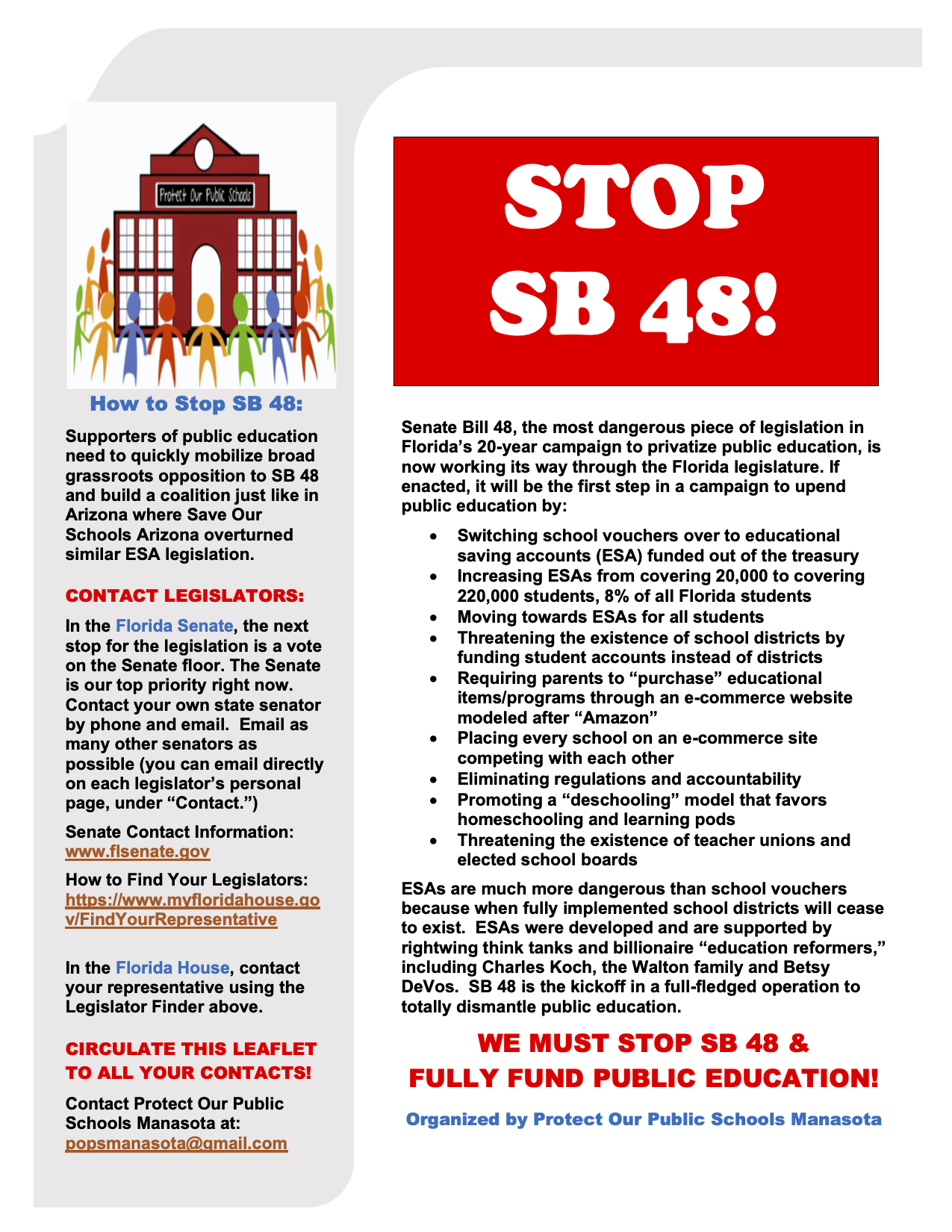
The privatizers are on the move again in Florida. They want to send billions more to unaccountable, low-quality voucher schools. They will take money away from your public schools to pay for vouchers for religious schools where students are not required to take state tests and teachers are not required to be certified. Stop the Steal of public education!