Denis Smith, a former official of the Ohio Department of Education, wrote this post in 2017, when the major concern of many was how to teach students to recognize “fake news.”

The villain of the piece is the internet, where anyone can post anything without fact-checking or any kind of filter.

He wrote about a conference on media literacy where Frank W. Baker was the keynote speaker.

Baker was the keynote speaker at the conference, whose title, “Popping the Fake News Bubble: Engaging Students in 21st Century Media and Information Literacy,” reflects the concerns librarians have in teaching students to be critical readers and viewers, consumers of what they are exposed and respond to in the modern world.

While we are now constantly hearing the term fake news, Baker said, the larger problem is a lack of critical thinking on the part of those exposed to media, whether that might be print, advertising, videos, commercial art, and other images that surround us every day. One study, for example, found that, on the average, we are exposed to more than 5,000 visual images daily, many of which have to be examined carefully because of the decisions and choices that accompany media.

The fake news bubble that Baker asked his audience of library/media specialists to address in their work with students is found in the fact that more than half of Americans now receive the majority of their news and information from Facebook and other social media. Never mind that readers of those platforms may not realize that there are usually no filters that provide discernment, and perhaps no editors or gatekeepers at work to mold the accuracy and appearance of media content, concepts, and ideas.

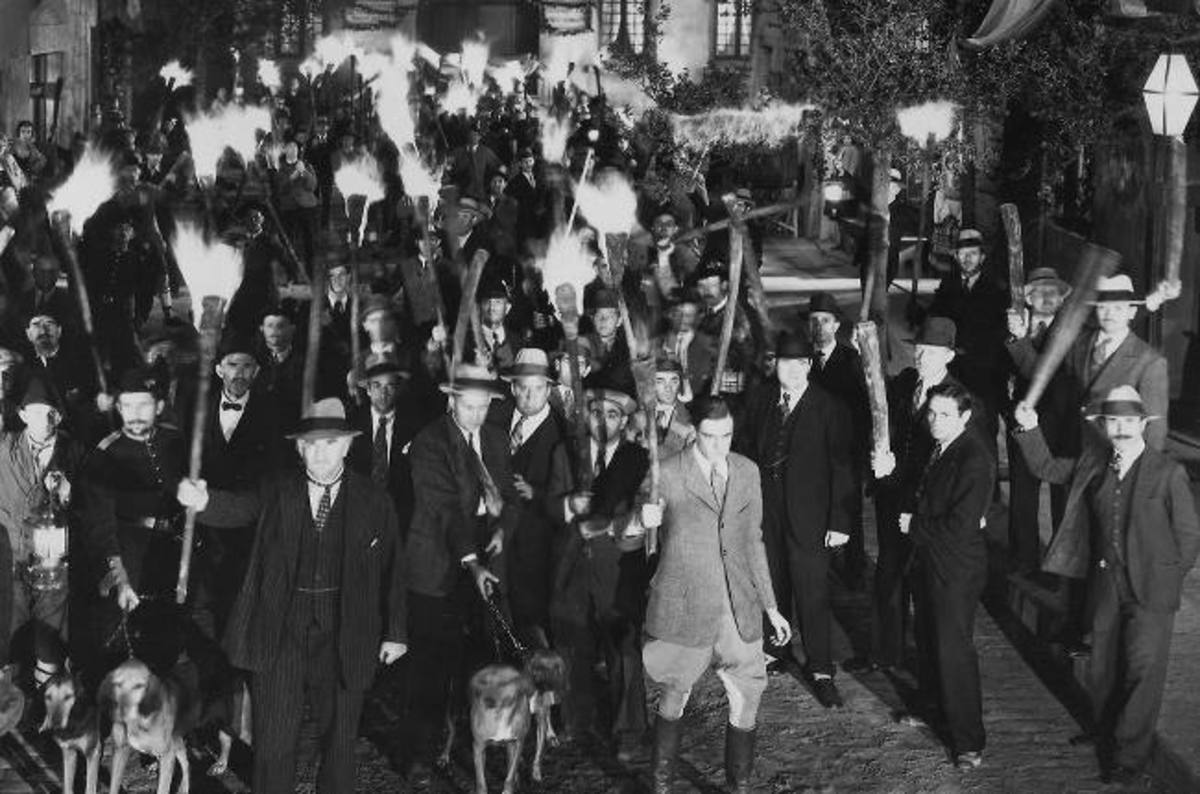
An example of “fake news” content. This meeting never happened. It is a doctored photo.

Yes, the internet is free and unfettered, in stark contrast with more traditional media. But young and old alike need to understand and accept the lack of constraints and therefore develop the critical thinking skills necessary to carefully evaluate media. As a case in point, the “Pizzagate” gunman, who brought an automatic weapon to a Washington restaurant after reading on the internet that it was part of a sex-trafficking ring with ties to Hillary Clinton, was sentenced on June 22 to four years in prison.

With Pizzagate and the manufacture of other infamous fake news products, one thing is certain: The internet is not The New York Times…

It is not an overstatement to say that in the last year, our country has experienced a digital Pearl Harbor, and all of us, particularly our elected officials and community leaders, must acknowledge the crisis we face in expanding our definition of literacy and educating all citizens to develop and expand their critical thinking skills as digital citizens, to use Baker’s term.

In spite of the arduous task ahead in getting these three players to address our national literacy crisis, Baker is optimistic that there is one group already in place to do the work at hand.

“I am excited that today’s librarians are embracing media and visual literacy themselves,” he said. “I believe the more tools and skills they have in their toolboxes, the better they will be equipped to demonstrate and justify the vital importance of their jobs.”

The sad irony, as Smith points out, is that many schools do not have librarians, whose jobs were sacrificed to cut budgets.
The authors of this article are both scientists. Arthur Camins was director of the Center for Innovation and Science Education at Stevens Institute of Technology. Paul Kalb worked for more than 40 years as an environmental engineer at Brookhaven National Laboratory. In their article, they note that science is more important than ever, yet a sizable portion of the public rejects its findings and misunderstands it.

They write:

The Covid-19 pandemic is waning in the United States yet resistance to vaccination remains a major impediment to widespread immunity. Wildfires, severe weather events, and destructive habitat change are more common place, yet almost one in five Americans still deny the clear cause — climate change. Former president Trump and his Republican allies weaponized and took science denial to an unprecedented dangerous level, equating evidentiary claims with self-serving opinion.

In light of these challenges, the mantra from politicians to, “Follow the science,” is a welcome change. However, effective vaccine distribution and necessary advances in clean energy production will take a lot more than political rhetoric. Limited public understanding of and confidence in the processes of science and technology has created a best of times and worst of times crisis.

While the public is increasingly exposed to the iterative nature of science and uncertainty analysis, too many people associate science with some of its negative technological applications such as food additives, pollution, and uncontrolled greenhouse gases.

This dynamic and its deadly and destructive impacts pose an existential challenge. Resolution depends on informed participation in democratic decision-making. We are at an inflection point and it’s up to scientists and science educators to do the heavy lifting to convey how science and engineering can contribute to improving the human condition...

Every K-12 school and college as well as science, engineering, and health institutions must be explicitly targeted to emphasize that science and technology are the basic tools needed to improve the quality life of every human being. Specifically, curriculum must stress that knowledge development is an iterative process, models and uncertainty analysis are effective predictive tools, and risk assessment/relative risk are a critical part of the overall decision-making process. Effective communication and education are key and now is the time to act swiftly and decisively.

Peter Greene writes here about the growing ferocity and viciousness of the rightwing crusade against “critical race theory.” Leave aside the fact that 99% of teachers have never heard of CRT, the crusaders are targeting teachers who are suspected of teaching about racism and social justice.

The crusaders operate on the assumption that teaching the actual history of racism, segregation, and Jim Crow is subversive and unpatriotic. Nothing negative ever happened in the U.S. It was all good.

Greene writes:

Anti-Critical Race Theory warriors are coming for schools, and for the teachers in them.

In New York City, the group Free To Learn is spending millions of dollars on ad buys to target NYC schools (including some private ones) who are accused of indoctrinating children. The group says it supports the basic principle that students should be free to ask questions, develop individual thoughts and opinions, and think critically–but not about that race stuff, apparently. It’s not obvious whose deep pockets are involved in funding this group, but it’s led by Alleigh Marre, who’s been in politics for a while, working on campaigns for Scott Walker and Scott Brown, as well as serving on Donald Trump’s transition team.

But Free To Learn is just targeting schools. Others are targeting individual teachers. I do believe there are people with reasonable, reasoned concerns about CRT and its influence on education, but they’re a small group, and their voices have been pretty much drowned out by the mob (and the GOP politicians trying hard to draw power from it).

Amy Donofrio found herself re-assigned and then held up as a target by Florida’s education commissioner. Misty Cromptom found she was being used as a campaign talking point in New Hampshire. On Twitter, a teacher reported to me that in her area, the No Left Turn group had taken screen shots of posts by teachers and administrators and used them in a presentation of evidence of indoctrination, with names highlighted and schools listed.

No Left Turn is another one of these culture warrior groups, this one spearheaded by Dr. Elana Yaron Fishbein, who pulled her children from school in Gladwyne PA because of a Cultural Proficiency Committee formed in the wake of the murder (she says “death”) of George Floyd. They set up lessons that were unlike “the wholesome teaching of MLK, Jr. The group wants to “revive” education’s fundamental discipline of “critical and active thinking which is based on facts, investigation, logic and sound reasoning,” but they also include on their list of objectives, “Restore American patriotism in the classroom, including presenting our nations as consistently forward-thinking in its elevation of individual liberty and democratizing traditional Liberalism.” 

The Central Virginia chapter, the one that went Twitter hunting, has a Facebook page headed by an MLK Jr. quote. Facebook is apparently a nexus for many of these groups, and while this may seem like it’s coming together quickly, many of the connections were already in place. The woman leading the Virginia No Left Turn crusade against CRT was, just a short while ago, leading the charge against masking and school closures.

(Open the link and keep reading.)

Billionaire charter school advocates have found a new target for their political contributions: cities where the mayor controls the schools.

The oligarchs poured millions of dollars into the New York City mayoral race. They bet on the early leaders, Andrew Yang and Eric Adams. Their goal: more charter schools. As Yang slipped in the polls, they concentrated their gifts to Adams. Adams placed first but did not win a majority so we will wait to see who won the city’s first ranked-choice election.

Now the oligarchs are giving generously in the Boston mayoral race. Boston has mayoral control of the schools, and the 1% want more charter schools. Their current favorite is Andrea Campbell. But that could change if she polls poorly.

Political science Professor Maurice Cunningham, an expert on following the money, shows that the oligarchs are mostly the same as those who contributed to the 2016 referendum on charter expansion. The oligarchs lost that one, which was financed largely by the Waltons.

It is curious to find that billionaire Reed Hastings of California is so deeply concerned about the next mayor of Boston. Hastings has said that all local school boards should be eliminated and replaced by private management. Massachusetts is a state that prizes its school committees.

Cunningham begins and ends his post with a quote from Louis Brandeis:

Brandeis once said “We must make our choice. We may have democracy, or we may have wealth concentrated in the hands of a few, but we can’t have both.”

The Hussman School of Journalism and Media at the University of North Carolina recently offered the prestigious Knight Chair in Race and Investigative Journalism to Nikole Hannah-Jones. Hannah-Jones is an alumna of the Hussman School who has received many honors for her writing. She recently won a Pulitzer Prize for “The 1619 Project,” which she organized and for which she wrote the lead essay, recasting the role of Blacks in American history.

But there was one hitch: Unlike previous winners of the Knight Chair, she would not receive tenure. This decision was made not by the faculty of the Hussman School, but by the trustees of the University. Mega donor Walter Hussman—for whom the journalism school is named— conveyed his disappointment to Board members and university officials about Hannah-Jones’ appointment. Hannah-Jones said she would not accept the offer unless it included tenure.

Black students and faculty were furious and saw the treatment of Hannah-Jones as evidence of systemic racism at UNC. The faculty of the Hussman School was outraged that the university board overrode their decision.

Yesterday the University board of trustees reversed their decision and agreed to offer tenure to Hannah-Jones. The vote was 9-4. They had to choose whether it would be more dangerous to offend the state’s Republican legislators or to offend their Black faculty and students and the faculty of the journalism school.

They chose.

I wrote the following article for the opinion section of the New York Daily News. According to Education Week, “As of June 29, 26 states have introduced bills or taken other steps that would restrict teaching critical race theory or limit how teachers can discuss racism and sexism, according to an Education Week analysis. Nine states have enacted these bans, either through legislation or other avenues.” During his last year in office, Trump denounced critical race theory and the New York Times’ Pulitzer Prize-winning “The 1619 Project” and said that anyone who taught these materials was “indoctrinating” their students and turning them against America. He called for “patriotic education.”

I wrote the following:


Republican-led states across the country, including Texas, Idaho, Oklahoma, Iowa and New Hampshire, have passed laws to ban the teaching of “critical race theory”; CRT is an academic concept that was first developed 40 years ago and has never been taught in public schools. The Tennessee legislature went so far as to pass a bill restricting discussion of racism or sexism in the classroom.

This issue is personal to me, for two reasons: I grew up in Houston in the 1940s, when it was a completely segregated city; and many years later, I was a friend of the late Derrick Bell, the founder of critical race theory.

In the Houston of my youth, every public and private facility was racially segregated: schools, mass transit, restaurants, hotels, public swimming pools and everything else. Grocery stores had two water fountains, one marked “white,” the other marked “colored.” Public buses had a movable marker with the word “colored,” which consigned Black people to the back of the bus. If whites needed more seats, the marker was pushed back, and Blacks stood. By custom, a Black person entered the house of a white person only through the back door. When a white and a Black approached each other on the sidewalk, the Black person was expected to step into the road to let the white person pass. The customs of white supremacy were well understood and seldom, if ever, violated.

In school, our history textbooks taught us about great American patriots, all of whom were white. The only person of color mentioned was George Washington Carver, who discovered many uses of peanuts. When we studied the Civil War, there were heroes on both sides (my junior high school was named for a Confederate hero, Gen. Albert Sidney Johnston), but minimal mention of slavery or its cruelty. Reconstruction following the Civil War was taught as a time when Southern whites were oppressed by federal troops, opportunistic carpetbaggers, and ignorant Black politicians who ran their states into the ground.

It was many years later that I learned that this was the Confederate view of events, and that Reconstruction was a time when able Black men served honorably in Congress, and racially integrated state legislatures wrote new and progressive constitutions. And that, when Reconstruction ended in 1877, white Southerners quickly restored the status quo, replacing slavery with Jim Crow legislation that maintained racism, segregation and unequal opportunity for Blacks.


Many whites, myself included, believed that the 1954 Brown vs. Board decision, which overturned the fiction of “separate but equal,” marked the beginning of the end for racial segregation. The Civil Rights laws passed during the Lyndon B. Johnson administration in the mid-1960s strengthened the belief that racial inequality was defeated. The federal government and the federal courts would reverse any racial discrimination, we believed. No longer would places of public accommodation or public transit or public schools be allowed to bar Blacks, nor would Blacks be denied the right to vote.

This too was misleading. In the 1980s, I became friends with Prof. Derrick Bell, the first Black person ever to receive tenure at Harvard Law School. We had long discussions about whether racial progress was assured, as I then believed, or whether the changes were superficial, as he believed. Derrick insisted that progress was minimal because racism was so deeply rooted in American institutions. He is called the founder of critical race theory, which holds that racism is systemic and that Blacks will never achieve equality until we reckon with the past and confront the systems and beliefs that allow racism and segregation to persist, blighting our society.

An example is housing patterns, which did not evolve by accident or choice, but because — as Richard Rothstein showed in his book “The Color of Law” — racially discriminatory rules were imposed by the federal, state and local governments. Segregated neighborhoods produce segregated schools.

Contrary to the Republican propaganda machine, Derrick Bell was not a Marxist. He was not anti-white. Critical race theory is not taught in schools but debated in law schools. The current furor now threatens to roll back the inclusion of Black history in the history curriculum and to criminalize teaching about racism.

That would be a shame, because a nation can’t escape the sins of its past without confronting them directly. Grade school children should learn about the heroes of all races and ethnicities who helped to build our democratic institutions. High school students should learn about the crimes committed against Black people, the treatment of them as less than human, the lynchings, the massacres. This is not harmful to students, as Republicans claim. It is a necessary reckoning with our nation’s past. Democracy and unity must be built on honesty, not lies and ignorance.

Dana Milbank is a regular columnist for the Washington Post and one of my favorites.

Read his latest column: “Even the Squad Is More Pro-Police than These Republicans”

Republican leaders have developed a new strategy for ousting Democrats from their majority in Congress: Blue Lies Matter.


House Minority Leader Kevin McCarthy (Calif.) falsely tweeted Friday: “The ‘Defund the Police’ campaign — endorsed by Democrats — has decimated our law enforcement. … When Republicans are in the majority, we will FUND the police.”


Rep. Elise Stefanik (N.Y.), who with McCarthy’s help ousted Rep. Liz Cheney (Wyo.) as Republican Conference chair, falsely tweeted Monday: “Dems’ manta [sic] ‘Defund the Police’ was one of their top policy messaging points in 2020.… GOP has always supported increasing funding for police!”


The rank and file have followed their leaders down Mendacity Lane. Rep. Jim Banks (Ind.) said on “Fox News Sunday” that “Joe Biden is being held hostage in the White House by the Squad and the radicals in the Democrat [sic] Party who control their party, who have spent the last year stigmatizing one of the most honorable professions in America, in our law enforcement.”
By midday Tuesday, a dozen House Republicans had tweeted messages about Democrats defunding the police.


How, then, to explain the latest “legislative scorecard” from the National Association of Police Officers, a group claiming to represent a quarter-million officers who endorsed President Donald Trump’s reelection?


McCarthy, Stefanik and Banks all scored 57 percent, and some of the back-benchers piling on Tuesday — Reps. Ken Buck (Colo.), Jody Hice (Ga.), Mo Brooks (Ala.) — scored a paltry 43 percent on NAPO’s pro-police scorecard.


And the Squad? Democratic Reps. Ilhan Omar (Minn.), Rashida Tlaib (Mich.) and Ayanna Pressley (Mass.) all scored 86 percent. Rep. Alexandria Ocasio-Cortez (D-N.Y.) scored 71 percent. Where it really counts, all four members of the Squad are more pro-police than their Republican critics.


The pattern continues when looking at House Speaker Nancy Pelosi of California (80 percent) and Majority Leader Steny Hoyer of Maryland (86 percent), compared with Minority Whip Steve Scalise of Louisiana (50 percent). Rep. Thomas Massie (Ky.), one of 21 House Republicans to vote against giving medals to the police heroes of Jan. 6, scored 33 percent.


Things are a bit more even in the Senate, although Sen. Bernie Sanders of Vermont (80 percent) bests Republican Sens. Tim Scott of South Carolina and Ted Cruz of Texas (both 60 percent) and Rand Paul of Kentucky (a perfect zero).


The reason is simple. Democrats, at least at the federal level, have been the ones funding the police. The 2019-2021 scorecard is based on votes on health care, pensions, covid-19 relief, bulletproof vests, victim compensation and policing reform. There’s not yet a scorecard of votes in the new Congress, but police groups favored the American Rescue Plan covid-relief legislation, which Republicans uniformly opposed, and President Biden wants to pump $300 million more into the COPS community policing program, which Republicans have long opposed.


Few Democratic voters support defunding the police. Seventy-two percent of likely Democratic voters in New York City’s mayoral primary agreed that there should be more police officers on the street, an online poll last month by NY1 with Ipsos found. Only 20 percent disagreed.


Biden himself rejected “defund” calls during the presidential campaign. Arguing for the $350 billion in aid to states and municipalities contained in the covid relief legislation this year, he warned on at least three occasions that such funds were needed because police officers were at risk of losing their jobs.


Contrast that with McCarthy, who, well before opposing this year’s relief bill, voted against funding for the COPS program in 2015, 2014, 2012, 2011 (twice) and 2009.

Or contrast it with Banks, who was challenged on “Fox News Sunday” by host Chris Wallace: “You voted against that package, against that $350 billion, just like every other Republican in the House and Senate. So can’t you make the argument that it’s you and the Republicans who are defunding the police?” Banks tried to change the subject.


Or contrast it with Stefanik, who opposed the legislation that is now funding cops in her district. The Watertown (N.Y.) Daily Times reports that the city is using funds from the American Rescue Plan to reinstate four police positions that had been cut because of a budget squeeze.


Certainly, there has been a serious spike in violent crime over the past year. Undoubtedly, the justified demands from the left for policing reform, and the popular backlash since the murder of George Floyd, have taken a toll on police morale. But for every Tlaib rashly demanding “no more policing,” there’s a Rep. Andrew Clyde (R-Ga.) refusing to shake hands with the Jan. 6 police hero who was beaten unconscious and suffered a concussion and heart attack.


Democrats ought to be saying, as Biden aide Cedric Richmond did on “Fox News Sunday,” “Republicans are very good at staying on talking points of who says defund the police, but the truth is, they defunded the police.” Unlike GOP leadership, the numbers don’t lie.

New Hampshire’s Republican legislature passed a bill banning teaching about racism, and Governor Chris Sununu signed it. The bill also included funding for vouchers and cuts for public schools.

Ten of the 17 members of the governor’s Diversity Council resigned in protest, citing censorship.

“It should not be taken lightly that nearly every member of the Council that is not part of your administration is resigning today, as we collectively see no path forward with this legislation in place,” the resigning members wrote in their letter to Sununu. The group includes the executive director of the New Hampshire ACLU, educators, doctors and children’s advocates. 

Sununu established the council in 2017, with a mission to “combat discrimination and advance the ends of diversity and inclusion.” 

Last week, he signed House Bill 2, a policy-focused “trailer bill” that passed along party lines in the GOP-controlled legislature. Among other provisions, the legislation bars public schools and government employees from teaching about systemic racism and bias. It also bans abortions beyond 24 weeks gestation, with exceptions only to save the life of the mother. Doctors who perform those abortions could face up to seven years in prison. 

State Rep. Jim Maggiore (D) told HuffPost that he voted against the bill because he “could not in good conscience support language restricting the free speech of Granite Staters.” He was one of the 10 council members who quit Tuesday. 


https://www.huffpost.com/entry/new-hampshire-governor-chris-sununu-diversity-council-protest-resign_n_60db5e93e4b0b9e497df733d

Gary Rubinstein teaches mathematics at Stuyvesant High School in New York City. Stuy is a selective admissions school. It accepts only the students with the highest score on a standardized test of math and reading that is offered on one day only.

But is Stuy a good school?

The big question for this post is “Is Stuyvesant a good school?” At a first glance this may seem like a crazy question. It’s like asking “Was Mozart a good composer?,” right? Everyone knows that Stuyvesant is not just a good school, but a great one. In the US News & World Report ratings, Stuyvesant is ranked number 1 (tied with one other school) in the country in the category ‘Math and Reading Proficiency Rank.’ There are other metrics by which Stuyvesant is highly ranked. It is the most difficult school to get into since only the highest scorers on the SHSAT are admitted. There are advanced electives offered like existentialism, forensics, and quantum mechanics. The average SAT score is nearly 1500. It is also a very beautiful building that has an Olympic sized swimming pool. Nearly 20% of the graduating class goes on to either one of the Ivy League schools or MIT, Stanford, or the University of Chicago. The school newspaper rivals most college newspapers. Four alumni have won Nobel prizes. Is Stuyvesant a good school? Does a bear SHSAT in the woods?

But do those things I listed really mean the school is great or even good? If having a big pool makes a school good, why not just install one in every school at whatever cost? And if offering courses in existentialism, forensics, and quantum mechanics makes a school good, why not just offer them in all high schools? And the SAT scores and the Ivy league acceptances? Surely 8th grade SHSAT scores will correlate with 11th grade SAT scores and since Ivy league colleges use SAT scores as an admissions criteria, it will result in a lot of Ivy league acceptances.

Of course a school can be good without any of those accolades on its Wikipedia page and even if it, like most schools, does not have a Wikipedia page. So if a school doesn’t need the accolades to be good, could a school be bad even with them?

He asks what makes a good school? Is it the students or the teachers? Of course, any school that is highly selective will have high test scores. But is that a definition of a good school? As I have learned from many parents, New York City has a large number of non-selective high schools that are excellent, where students get a solid education, and are well prepared for college. A student does not need to gain admission to a school like Stuy or Bronx Science or Brooklyn Tech or any of the other exam schools to get an excellent education and to thrive in an atmosphere that is less competitive than the exam schools. I am aware of students who went to the exam schools and cracked under the pressure. Students pay a price for the prestige of winning admission.

See the full post here.

NY Chalkbeat recounts the story of a black student who won admission to York High School in Queens, one of the most selective in New York City. Admission is based on students’ test scores on one test of mathematics and reading, offered on one day. Only those with the highest scores are admitted.

The first thing Elizabeth Yarde noticed on her first day at Queens High School for the Sciences at York College was the lack of Black students.

The daughter of Caribbean immigrants, Yarde felt intense stares from other students, their looks seemingly questioning Yarde’s place at the elite high school, and she heard racial slurs being tossed around freely. At lunch, when Yarde started up a conversation with a fellow student, he remarked that he had never had a Black friend before.

“I started to slowly realize that a lot of these kids had kind of been sheltered from other races of people to the point where they didn’t really know how to be racially sensitive,” said Yarde, 17, who graduated Monday. “It seemed like kids were either automatically intimidated by me, or they immediately undermined me.”

As one of the eight specialized public high schools in the city where admissions is determined solely by the Specialized High School Admissions Test, or the SHSAT, York High School, as Yarde’s school is sometimes called, does not have a student body that comes close to representing the nation’s largest public school system. Asian American students account for more than 80% of the student body – about 480 students – while only 3% of students are Black, even though Black students make up roughly a quarter of students in New York City’s public schools.

Over the course of her freshman year, Yarde felt her mental health deteriorate. Panic attacks became regular occurrences. She often felt overwhelmed and ran to the bathroom to cry. Racist remarks from other students – such as one student’s comment that his mother would rather he be gay than date a Black girl – wore her down.

Yarde begged her mother to let her transfer to a different school, but her mother encouraged her to stay. As the youngest of 10 children, and the first to attend a specialized high school, she felt significant pressure not only to stick it out but also to perform well academically.

And she has. She is graduating with a 3.8 GPA, and she will start college in the fall at Northeastern University in Boston. A member of student government and the school’s student leadership team, Yarde discovered at York High School that she has a strong voice and deft communication skills. She aspires to be a lawyer or a marketing executive one day.

But Yarde’s academic success has come at a cost, one that she is not sure she would be willing to pay again.

“I don’t personally think it was worth it,” she said. “I don’t think that Black children should always have to face trauma in order to be stronger. The world is already very difficult as a Black child – walking down the street, going anywhere with your friends, always having to be so racially aware at such a young age. If you can have a safe place for four years, eight hours a day, five days a week, you go there.”

The nation’s most segregated school system

New York City’s public school system is the most segregated in the country. According to a recent report released by the UCLA Civil Rights Project, about 85% of Black students and about 75% of Latino students attend segregated schools in the city. Only 11% of white students and 43% of Asian American students do.

The racial divide is especially evident in the city’s specialized high schools. This year, only eight Black students were offered a seat at Stuyvesant out of 749 seats, and only one Black student got into Staten Island Technical High School. At York High School, 10 Black students were offered seats, an increase from last year’s 8.

Black and Latino students, who together make up almost 70% of the school system, received 9% of offers to specialized schools for the coming school year – a decline from 11% the year before..

Ironically, Elizabeth Yarde chose to attend Northeastern University, where black students are only 3% of the enrollment. She knows she can handle it.