At the Network for Public Education conference in Philadelphia on May 1, I moderated a panel to discuss attacks on public schools and the groups behind those attacks. Peter Greene identified a long list of groups that claim to be protecting “parents rights.” Peter described groups such as “Moms for America,” “Moms for Liberty,” “For Kids and Country,” “Parents Defending Education,” and the “National Parents Union,” which seem to be led by women with close ties to Trumpism and funded by the usual rightwing crowd. They asserted ”parent rights” to oppose teaching about race and sex. They insisted that parents have the right to control their children.

They say they are fighting for parental rights, yet they have said nothing about the legislation in several states that sever the rights of the parents of transgender youth.

Arkansas Governor Asa Hutchinson, a conservative Republican, vetoed a bill in his state that eliminates parental rights to seek medical care for their transgender children. The legislature overrode his veto.

“The Republican Party that I grew up with believed in a restrained government that did not jump in the middle of every issue.”

He said transgender health care of young people should be limited to the patient, parents and physicians. “And we ought to yield to that decision making unless there’s a compelling state reason.”

In an attempt to provide context for the trend by Republicans in passing anti-transgender legislation across the country, Hutchinson said there is an overwhelming sense among party members that “there’s undue influence” on young people to reconsider their gender.

But he said, “This was one step way too far and I couldn’t abide by it.”

The “parent rights” groups are silent. They have nothing to say to states that take away the rights of parents of transgender children.

Medical decisions involving children should be made by parents and doctors, not politicians.

Medical decisions affecting adult women should be made by them and their doctors, not by politicians.

Medical decisions affecting adult men should be made by them and their doctors, not politicians.

James Harvey recently retired as executive director of the National Superintendents’ Roundtable. He is a member of the board of the Network for Public Education. In this post, he describes how the benchmarks used by the National Assessment of Educational Progress are misused to attack American education. The “achievement levels” were created in 1990 when Chester Finn Jr., an enemy of public schools, was chair of the National Assessment Governing Board. They were designed to make American student achievement look worse than it was. The media and the public think that “proficient” means “grade level.” It does not. It is equivalent to a solid A. Yet how many hundreds or thousands of times (e.g. the charter propaganda film “Waiting for Superman”) have you been told that most American students score “below grade level”? It’s not true. To be blunt, it’s a lie.

James Harvey wrote on Valerie Strauss’s “Answer Sheet” blog at The Washington Post:

Every couple of years, public alarm spikes over reports that only one-third of American students are performing at grade level in reading and math. No matter the grade — fourth, eighth or 12th — these reports claim that tests designed by the federal government, the National Assessment of Educational Progress (NAEP), demonstrate that our kids can’t walk and chew gum at the same time. It’s nonsense.


In fact, digging into the data on NAEP’s website reveals, for example, that 81 percent of American fourth-graders are performing at grade level in mathematics. Reading? Sixty-six percent. How could this one-third distortion come to be so widely accepted? Through a phenomenon that Humpty Dumpty described best to Alice in “Through the Looking Glass”: “When I use a word it means just what I choose it to mean.”


Here, the part of Humpty Dumpty was played by Reagan-era political appointees to a policy board overseeing NAEP. The members of the National Assessment Governing Board, most with almost no grounding in statistics, chose to define the term “proficient” as a desirable goal in the face of expert opinion that such a goal was “indefensible.”

Here’s a typical account from the New York Times in 2019 reporting on something that is accurate as far as it goes: results from NAEP indicate that only about one-third of fourth- and eighth-graders are “proficient” in reading.


But that statement quickly turns into the misleading claim that only one-third of American students are on grade level. The 74, for example, obtained $4 million from the Walton and DeVos foundations in 2015 by insisting that “less than half of our students can read or do math at grade-level.”


The claim rests on a careless conflation of NAEP’s “proficient” benchmark with grade-level performance. The NAEP assessment sorts student scores into three achievement levels — basic, proficient, and advanced. The terms are mushy and imprecise. Still, there’s no doubt that the federal test makers who designed NAEP see “proficient” as the desirable standard, what they like to describe as “aspirational.”


However, as Peggy Carr from the National Center for Education Statistics, which funds NAEP, has said repeatedly, if people want to know how many students are performing at grade level, they should be looking at the “basic” benchmark. By that logic, students at grade level would be all those at the basic level or above, which is to say that grade-level performance in reading and mathematics in grades 4, 8 and 12, is almost never below 60 percent and reaches as high as 81 percent.
And the damage doesn’t stop with NAEP. State assessments linked to NAEP’s benchmarks amplify this absurd claim annually, state by state.

While there’s plenty to be concerned about in the NAEP results, anxiety about the findings should focus on the inequities they reveal, not the proportion of students who are “proficient.”
Considering the expenditure of more than a billion dollars on NAEP over 50-odd years, one would expect that NAEP could defend its benchmarks by pointing to rock-solid studies of their validity and the science behind them. It cannot.


Instead, the department has spent the better part of 30 years fending off a scientific consensus that the benchmarks are absurd. Indeed, the science behind these benchmarks is so weak that Congress insists that every NAEP report include the following disclaimer: “[The Department of Education] has determined that NAEP achievement levels should continue to be used on a trial basis and should be interpreted with caution” (emphasis added).


Criticisms of the NAEP achievement levels
What is striking in reviewing the history of NAEP is how easily its policy board has shrugged off criticisms about the standards-setting process. The critics constitute a roll call of the statistical establishment’s heavyweights. Criticisms from the likes of the National Academy of Education, the Government Accounting Office, the National Academy of Sciences, and the Brookings Institution have issued scorching complaints that the benchmark-setting processes were “fundamentally flawed,” “indefensible,” and “of doubtful validity,” while producing “results that are not believable.”
How unbelievable? Fully half the 17-year-olds maligned as being just basic by NAEP obtained four-year college degrees. About one-third of Advanced Placement Calculus students, the crème de la crème of American high school students, failed to meet the NAEP proficiency benchmark. While only one-third of American fourth-graders are said to be proficient in reading by NAEP, international assessments of fourth-grade reading judged American students to rank as high as No. 2 in the world.

For the most part, such pointed criticism from assessment experts has been greeted with silence from NAEP’s policy board.


Proficient doesn’t mean proficient


Oddly, NAEP’s definition of proficiency has little or nothing to do with proficiency as most people understand the term. NAEP experts think of NAEP’s standard as “aspirational.” In 2001, two experts associated with NAGB made it clear that:
“[T]he proficient achievement level does not refer to “at grade” performance. Nor is performance at the Proficient level synonymous with ‘proficiency’ in the subject. That is, students who may be considered proficient in a subject, given the common usage of the term, might not satisfy the requirements for performance at the NAEP achievement level.”

Lewis Carroll’s insight into Humpty Dumpty’s hubris leads ineluctably to George Orwell’s observation that “[T]he slovenliness of our language makes it easier for us to have foolish thoughts.”

NAEP and international assessments


NAEP’s proficiency benchmark might be more convincing if most students abroad could handily meet it. That case cannot be made. Sophisticated analyses between 2007 and 2019 demonstrate that not a single nation can demonstrate that even 50 percent of its students can clear the proficiency benchmark in fourth-grade reading, while only three could do so in eighth-grade math and one in eighth-grade science. NAEP’s “aspirational” benchmark is pie-in-the-sky on a truly global scale.
What to do?

NAEP is widely understood to be the “gold standard” in large-scale assessments. That appellation applies to the technical qualities of the assessment (sampling, questionnaire development, quality control and the like) not to the benchmarks. It is important to say that the problem with NAEP doesn’t lie in the assessments themselves, the students, or the schools. The fault lies in the peculiar definition of proficiency applied after the fact to the results.

Here are three simple things that could help fix the problem:


• The Department of Education should simply rename the NAEP benchmarks as low, intermediate, high, and advanced.

• The department should insist that the congressional demand that these benchmarks are to be used on a trial basis and interpreted with caution should figure prominently, not obscurely, in NAEP publications and on its website.

• States should revisit the decision to tie their “college readiness” standards to NAEP’s proficiency or advanced benchmarks. (They should also stop pretending they can identify whether fourth-graders are “on track” to be “college ready.”)

The truth is that NAEP governing board lets down the American people by laying the foundation for this confusion. In doing so, board members help undermine faith in our government, already under attack for promoting “fake news.” The “fake news” here is that only one-third of American kids are performing at grade level.

It’s time the Department of Education made a serious effort to stamp out that falsehood.

The state of Massachusetts appears ready to take control of the Boston Public Schools at its meeting tomorrow, despite the fact that state takeovers have failed everywhere. The state does not have a special reservoir of knowledge that is lacking at the local level, and if they did, they could provide it without taking control of the school district and ending local control.

This morning, as a seeming prelude to takeover, the state released a “blistering” report about the condition of BPS.

Boston Public Schools is largely stuck in “entrenched dysfunction” and its failure to achieve systemwide change on a number of fronts is causing thousands of students to languish in their classrooms, even as school district leaders have taken initial steps to help remedy some of the problems, according to a blistering state review released Monday.

”The district has failed to effectively serve its most vulnerable students, carry out basic operational functions, and address systemic barriers to providing an equitable, quality education,” the review states. “The problems facing BPS are abundantly clear.”

And the report makes the case that state Commissioner Jeffrey Riley and the state Board of Elementary and Education will take action, although the report doesn’t state what specific steps will be taken. The state education board is scheduled to discuss the report’s findings at its monthly meeting Tuesday...

The new review paints a devastating portrait of the state of BPS, but gives outgoing Superintendent Brenda Cassellius and the school system credit for launching several new district-wide initiatives that show promising signs for boosting student achievement.

Among them: Raising high school graduation standards to align with entry requirements to the state’s public universities, adopting a new literacy curriculum and higher-quality instructional materials, and expanding the diversity of its teaching staff. But full implementation has not been realized yet, and the report raised concerns that the efforts could be thwarted by the district’s lack of a strategic approach to training staff and setting clear expectations and deadlines for schools to embrace the changes.

Despite these improvements, takeover is on the horizon.

The Boston Teachers Union plans a rally tomorrow to protest the state takeover:

As announced last week– we are attending the Board of Elementary and Secondary Education (BESE) meeting tomorrow to say NO to receivership! 

BESE just announced a location change for this meeting. The meeting will now be at 1 Ashburton Pl, Boston, MA 02108 (NOT Wellesley HS). We will meet in front of the State House at 8am and walk over to the meeting together.

You can drive and meet us there but parking is limited and expensive in that area. You can also take the T to Park Street. Or we’ll still have two buses leaving at 7:30am:

  • Boston Teachers Union in Dorchester (180 Mt. Vernon St. 02125. Be sure you go to the address in Dorchester, not downtown). Lots of free parking.
  • St. Stephen’s Youth Programs in the South End (419 Shawmut Ave, 02119). Limited parking.

If you haven’t already, RSVP here if you can join us.

If you can’t join in person, you can watch the livestream of the meeting at https://livestream.com/accounts/22459134 and take action here. Follow the conversation on Twitter by following the hashtag #OurCityOurSchools. 

Tomorrow BESE will hear from students, parents, and educators united against state takeover! 

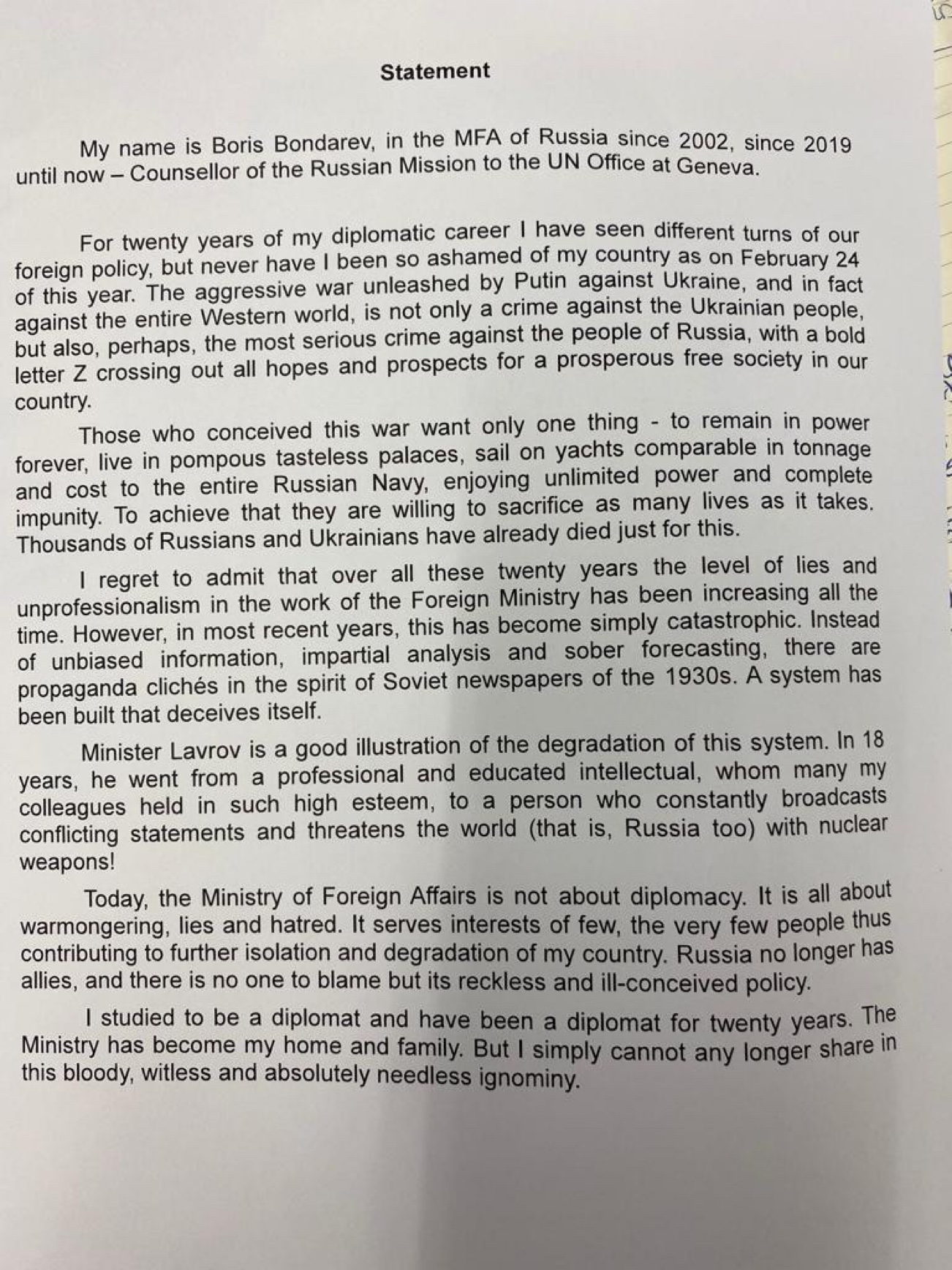
Russia’s Counselor to the United Nations in Geneva resigned. I hope that those few readers of this blog who have been stridently defending Putin and making excuses (“clear out the Nazis,” “it’s NATO’s fault,” etc.) for his brutal, unprovoked invasion of Ukraine will read this.

The New York Times authenticated the letter.

Thank goodness for independent media! Oklahoma Watch published an investigative report that detailed a secret slush fund that supplements the salary of the state Secretary of Education.

(This story was produced in partnership with the Oklahoma nonprofit newsroom The Frontier.)

Gov. Kevin Stitt vetoed legislation that would have required cabinet members to file public reports to disclose their finances.

If Stitt had signed the bill last month, Oklahomans would learn that Secretary of Education Ryan Walters makes at least $120,000 a year as executive director of a nonprofit organization that keeps its donors secret. Walters is also paid about $40,000 a year by the state, according to state payroll data.

The nonprofit, Every Kid Counts Oklahoma, has refused to disclose its largest donors.

But a joint investigation by The Frontier and Oklahoma Watch has found that much of the organization’s funds come from national school privatization and charter school expansion advocates, including the Walton Family Foundation and an education group founded by billionaire industrialist Charles Koch.

As Secretary of Education, Walters serves as Stitt’s top advisor on public education policy and is the governor’s liaison for dozens of state boards and programs.

Walters’ outside employment with a nonprofit funded by advocacy groups could be a conflict of interest, said Delaney Marsco, senior attorney for ethics at the Campaign Legal Center, a nonprofit group that focuses on government transparency and accountability.

“If you are responsible for making decisions in a certain area of the government and you are being paid by an outside organization that has an interest in that, that absolutely can be a conflict of interest,” Marsco said. “If you are a public servant, your duty is to the public, and anything that kind of calls that into question, even raises the appearance of a conflict of interest, is a problem.”

Under Walters’ leadership, Every Kid Counts Oklahoma was the public face of Stitt’s program that distributed $1,500 grants to families in 2020 funded with $8 million in federal coronavirus relief money. The money was intended to buy tutoring and educational supplies. But a lack of safeguards allowed parents to use some of the funds to buy TVs, gaming consoles and home appliances, an investigation by Oklahoma Watch and The Frontier found. Emails and other recordsshow that Walters helped secure the no-bid contract with a Florida company to distribute the money. The U.S. Department of Education’s Office of Inspector General has opened an audit into how the state used those funds.

Walters, who declined multiple interview requests, is now running for state superintendent, an elected position overseeing the state Department of Education and a budget of over $3 billion. Unlike in federal elections, candidates for state office in Oklahoma are not required to fill out financial disclosures until after they are elected.

Please open the link and read on.

Valerie Strauss is an outstanding journalist who writes “The Answer Sheet” blog about education for The Washington Post. She understands the great heist that is being foisted on American public education by privatizers and their powerful lobbyists. She knows better than the editorial boards of the nation’s leading newspapers that school choice exacerbates the problems of American education and that test scores are not a worthy measure of the worth of a school.

In this article, she offers valuable advice to President Biden about the absurd claims made by the charter industry about the regulations proposed by the Department of Education to reform the federal Charter Schools Program. That program doles out $440 million a year to underwrite new charter schools. Biden has not cut it (even though it is not necessary, since new charters are supported by many billionaires, including the Walton family, Charles Koch, Betsy DeVos, Bill Gates, Reed Hastings, John Arnold, Dan Loeb, and Michael Bloomberg.)

The Department offered modest regulations, like barring for-profit corporations from applying for federal funding and asking those who seek federal funding for new charters to do an impact analysis of why their charter is needed and whom it would serve. The charter industry and its allies reacted with lamentations, outrage, and hysterical denunciations of Biden (even though Biden said during the 2020 campaign that he would stop funding for-profit charter management organizations).

Strauss writes:

The Biden administration recently released proposed reforms to a nearly 30-year-old federal program that has provided billions of dollars in grants for charter schools, and predictably some charter supporters have launched an unrestrained attack.


The bipartisan charter lobby alleges, among other things, that President Biden wants to “gut” the Charter School Programs, is kowtowing to unions and is willfully harming marginalized students. One magazine piece has this headline: “Biden Abandons the Obama Legacy on Charter Schools” — as if that were something to behold — and this subtitle: “The Education Department chooses teachers unions over poor kids.”


That’s not what’s happening — for one thing, the administration hasn’t proposed cutting a dime from the program — but that hasn’t stopped the attacks on the proposals, which are being supported by Roberto Rodriguez, a strong charter school supporter who was an education adviser to President Barack Obama and is now Biden’s assistant education secretary for planning, evaluation and policy development.


[Biden proposes tougher rules for charter school grants]


“There is a bit of a mythology that this is an attempt to do away with charter programs or curb the programs or curb the growth of charter schools,” said Rodriguez in an interview. Sure, he could have turned against charters, but he hasn’t: “The administration supports high-quality schools, including high-quality charter schools.”


Charter schools are funded by the public but privately operated. They are not monolithic — no more than schools in traditionally operated public districts are. Each state has its own rules, some resulting in better-quality charter schools than others.


Charters enjoyed bipartisan support for years — and still do — but support within the Democratic Party has lessened because of real problems in parts of the sector that supporters don’t like to publicly address. They include repeated scandals of financial fraud and waste, mismanagement, segregation, and under-enrollment of students with special needs. Charter schools in some places also drain resources from school districts that educate most of America’s schoolchildren.


Before the coronavirus pandemic began in March 2020, about 6 to 7 percent of U.S. schoolchildren attended charter schools. Enrollment jumped during the pandemic — with most of the gain in virtual charters, which are the worst-performing schools in the sector — but new data shows the increases starting to fall.


The White House has been silent about the over-the-top protests — including an actual protest outside 1600 Pennsylvania Ave. NW with charter school students. The Education Department published tweets last week that, instead of calling out its critics for promoting falsehoods about its proposed reforms of the program, tried to explain what it was doing by saying, essentially, “It’s not as bad as you think.”


[What Biden’s proposed reforms to U.S. charter school program really say]


So here’s what Biden should have said to charter school supporters who are savaging the proposed changes to the Charter School Programs, which should be made final in the next few months after consideration of public comment:


Hey guys:


Look, I didn’t expect you to love the changes my administration is proposing to the Charter School Programs. You have never been good at accepting criticism — but really, isn’t your reaction a bit much?


A bunch of you said I want to “gut” the program. Gut the program? Charter critics would love that, but that’s not what I’m doing. I have proposed to Congress that we keep funding at the same amount as last year — $440 million. So much for gutting.


I’ll add that the Education Department, even under Education Secretary Betsy DeVos, couldn’t spend all of the money allocated to the program by Congress in 2019. That’s when more than $12 million was reallocated from the program to other federal education priorities due to a lack of demand for new charter schools in state and individual grants. During the coronavirus pandemic, some program money was allowed to be used for other purposes.


I have said my administration supports high-quality charters because it does. Charter opponents would rather we didn’t, but we do. But there are a lot of problems in the charter sector, and we can’t find any acknowledgment of that in your scorched-earth assault on us.


I expect that from Republicans — as George Will showed in a Washington Post column — that falsely said charters must “get permission” from a traditional public school to operate if our proposed reforms become official. They don’t — but let’s not let the truth get in the way.


And I expect that from the National Alliance for Public Charter Schools, which sent out missives to supporters to speak out against the proposed reforms and launched media ads that accuse my administration of proposing changes that will hurt students of color.


Unfortunately, Democrats for too long have been part of this let’s-never-admit-there’s-a-charter-school-problem chorus. I read the op-ed that Colorado Gov. Jared Polis, a Democrat who started a charter school network in 2004, wrote in The Washington Post, which alleged that our proposed reforms would “create chaos and limit public school choice by instituting new rules that would gut” the program. As we said, we haven’t proposed cutting a dime, but, legally the money has to be paid out annually, whether there are good proposals for charters or not. We know full well that some applications that don’t adhere to all of the priorities we have set out in the proposed reforms will get federal money anyway.
I also read the letter that three Democratic senators, Cory Booker (N.J.), Dianne Feinstein (Calif.) and Michael F. Bennet (Colo.) sent, along with Republicans, to my education secretary, Miguel Cardona, warning that our proposed program reforms “would make it difficult, if not impossible” for charter schools to build new facilities or expand. Love bipartisanship, but that’s just wrong.


I’ve also read editorials from charter school-supporting editorial departments. A Wall Street Journal editorial accused the Biden administration of sabotaging charter schools; a Washington Post editorial accused the administration of pandering to teachers’ unions and school district leaders. The headline of that piece calls our proposed changes to the charter funding program a “sneak attack.” A sneak attack in broad daylight?


I expect Republicans to accuse us of caving to teachers’ unions, but we’ve never understood the same from Democrats. My wife, Jill, and I, are big union supporters — she proudly belongs to the National Education Association — but let’s not kid ourselves about the power of the unions. If they had their way, do you think schools would look the way they do? Would teachers be forking out money of their own to buy basic supplies? Would we be worrying about Republicans — many of them racist — taking over Congress this fall? Would schools have broken HVAC systems and, in some places, unconscionably low teacher pay? Knock it off.


Do Democrats really think it’s a good time — with crucial midterm elections coming up — to ignore reality and falsely accuse a Democratic president of wanting to harm marginalized kids to kowtow to unions?
Your union accusations make it sound like unions are the only ones that support our changes. Far from it. House Appropriations Committee Chair Rosa L. DeLauro (Conn.) wrote a public comment letter about what she called a “well-funded misinformation campaign incorrectly claiming” that a proposed reform “would prevent federal funds from going to any charter school that uses a contractor for any discrete service” — another claim by the charter lobby. Civil rights organizations such as the Southern Education Foundation have weighed in to support the proposed program changes; the foundation wrote:


Public funds are intended for public education, so we must invest in the charter schools that will serve their communities, provide equal access to high-quality instruction, and collaborate with the public school system to share successful innovations in teaching and learning that improve outcomes and opportunity for all students.


You talk about charters as if they were all the same, and you know they aren’t. Some are great. Some are awful. In 2016, the National Alliance for Public Charter Schools, called for better regulation of virtual charter schools, a rare acknowledgment of big problems in the charter sector, but we haven’t heard much since.


Bottom line: The Charter School Programs division needs reform. I have read reports by a nonprofit advocacy group that say since 2019, up to a billion dollars of federal taxpayer money has been wasted on charter schools that did not open or were shut down — and that the Education Department failed to adequately monitor federal grants to these schools. The advocacy group, the Network for Public Education, opposes charter schools. But that doesn’t make their research any less valid. If you want to take the time, you can read about that here and here.


If you don’t care for that, you can read the report the NAACP — one of the longest-standing civil rights organizations in the country — wrote after it called for a ban on charter school expansion until the charter sector is reformed and traditional public school districts are not financially harmed by the spread of charter schools. It says in part:


“Charter schools were created with more flexibility because they were expected to innovate and infuse new ideas and creativity into the traditional public school system. However, this aspect of the promise never materialized. Many traditional inner city public schools are failing the children who attend them, thus causing parents with limited resources to search for a funded, quality educational alternative for their children. …With the expansion of charter schools and their concentration in low-income communities, concerns have been raised within the African American community about the quality, accessibility and accountability of some charters, as well as their broader effects on the funding and management of school districts that serve most students of color.”


By the way, despite some of your protestations, charter schools are draining critical funding from some school districts with policies that make little sense. In Oklahoma, for example, numerous school district leaders got furious about a funding decision made last year by the state Board of Education that forced them to share funding for school buildings with virtual charter schools that don’t have school buildings.
Meanwhile, states including New York, Pennsylvania and New Jersey public school districts must pay tuition to charter schools costing them far more than they would pay if the student stayed in the district. Districts have lost millions of dollars in funding that has been sent instead to charter schools. Pennsylvania law funds charter schools as if 16 percent of all of their students are in special education — which costs more than students not in special education — but charters aren’t required to count so nobody really knows. School districts count each special education student.


So let’s talk about what my administration is trying to do with the federal Charter School Programs and why. The changes, as Washington Post education reporter Laura Meckler wrote in a piece we read about the proposed reforms, “go a long way to fulfilling” a vow that Biden made while running for president. He said he wanted to eliminate federal funding of for-profit charter schools because that part of the charter sector has been riddled with financial scandal, private enrichment and other problems. The biggest change we are proposing would affect for-profit management companies that often run charter schools. We want those companies that run entire charter operations to be ineligible for grants.


Scandals in the for-profit sector of charters have contributed to some that disillusionment; for example, you can read here about how many for-profit management companies evade state laws banning for-profit charters — by setting up nonprofit charters and then directing the schools’ business operations to related corporations.


[The story of a charter school and its for-profit operators]


In our proposed charter program changes, we also would like to see applicants for federal grants prioritize charter schools that already have their charter school approved — yes, as it is now, applicants can get federal money without an actual school — and that would collaborate with school districts.


My education team and I know there is a great deal of discontent over our priority that charter school funding applicants show that there is some interest in the community for a new or expanded charter school — which, really, doesn’t seem unreasonable. Why should the public fund a school where there is no demand? School districts don’t do that.


The “community impact analysis” we would like to see from applicants includes a priority that the charter would not further school segregation. You say we are insisting that charters serve diverse student populations. We’d like that, but let’s be clear what the proposed reform actually says: that an application from “racially and socioeconomically segregated or isolated communities would still be eligible for funding.”


You may not realize this — or just don’t publicly admit it — but in some places, charter schools are being used as white-flight academies, like decades ago when the 1954 Brown v. Board of Education Supreme Court ruling said segregated schools were unconstitutional.


In 2018, the federal Charter School Programs awarded a grant of $26.6 million to North Carolina to support “high-quality schools focused on meeting the needs of educationally disadvantaged students.” Thirty of the 42 charter schools that received CSP grants via the North Carolina Department of Education reported demographic information — and of those schools, more than one-third have significant overrepresentation of White students or a significant underrepresentation of Black students compared with the population of the public school district in which they are located. One overwhelmingly White private school, located near a public school with mostly Black students, was turned into a charter with the help of federal funding after making a pitch to families that included: “No current law forces any diversity whether it be by age, sex, race, creed.”


[Is federal charter school funding financing white-flight academies?]


I think it makes sense to ensure that federal funding isn’t being used to create white-flight academies. Do you?


There’s a lot more we could talk about that we haven’t addressed in our regulations. For example: Charter schools are supposed to be open to all students, but many of them employ more than a dozen tactics that allow them to shape their student enrollment. And did you know charter schools can be bought and sold and people can get rich from the sale of publicly funded schools?


[13 ways charter schools restrict enrollment]


[Charter schools are publicly funded — but there’s big money in selling them]


So, finally, can we move forward and keep our eye on the prize: making sure that America’s schoolchildren all go to high-quality schools? That’s what my administration and I are trying to do.
The parents of children who were victims of a massacre at the Sandy Hook Elementary School in Newtown, Connecticut, moved a step closer to getting justice done in their legal battle with Alex Jones. Jones claimed on his broadcasts that the Sandy Hook massacre was a hoax intended to promote gun control. Many of the grieving parents were harassed by followers of Jones; some received death threats. They sued Jones and won. Jones, however, declared bankruptcy, and his case was moved to a bankruptcy court in Texas, where he lives.

What Jones did to the families of the Sandy Hook victims was unfathomable cruelty. How could anyone be so heartless?

A federal bankruptcy judge on Friday returned the Sandy Hook defamation cases to a state court in Austin, setting the stage for trials to determine how much money Austin-based conspiracy theorist Alex Jones must pay for labeling the 2012 school shooting a hoax.

Jones has been found liable for defamation and causing emotional distress to parents of several Sandy Hook Elementary School shooting victims when he and others in his InfoWars media system called the mass shooting a hoax intended to justify a government campaign to restrict gun rights.

The first of two Texas trials to determine how much money Jones owes to the parents was to begin last month in Austin.

However, shortly before jury selection was to begin, Jones sought bankruptcy protection for InfoWars, now known as InfoW LLC, and two related companies. That Chapter 11 petition was filed in Victoria and assigned to a judge in Houston.

Jones also removed the Sandy Hook cases to federal bankruptcy court in Austin, forcing the postponement of a two-week trial that was to begin April 25 before state District Judge Maya Guerra Gamble.

On Friday, U.S. Bankruptcy Judge Christopher Mott returned to the cases to Guerra Gamble, noting that the Sandy Hook families had dropped all claims against InfoW LLC and the two other Jones companies in bankruptcy, Prison Planet TV and IWHealth.

“The Sandy Hook families look forward to being back in state court and bringing Alex Jones to justice,” lawyer Avi Moshenberg said.

The families had opposed the bankruptcy move, calling it an improper attempt to limit Jones’ financial exposure to court-imposed damage awards.

During a pretrial hearing last month, lawyers for Jones argued that Guerra Gamble could take no action on the Sandy Hook cases until a bankruptcy judge ruled on their motion to remove the cases to federal court.

Guerra Gamble reluctantly canceled the trial, saying that while she believed Jones’ lawyers had “improperly filed” the bankruptcy action, federal court rules left her no choice.

But the judge also predicted that the matter would be returned to her court, and she promised fast action once that happened.

“As soon as I do get a remand, I will be resetting this case at the earliest date I can get 100 jurors seated again. We are going to go to trial as soon as I can possibly do that,” Guerra Gamble said at the pretrial hearing.

The delayed trial involved Neil Heslin and Scarlett Lewis, parents of 6-year-old Jesse Lewis. They sued after Jones alleged that the school shooting was “a giant hoax” and disputed Heslin’s claim that he had held his dead son in his arms afterward.

A second Austin trial, set for June, involves Leonard Pozner and Veronique De La Rosa, parents of 6-year-old Noah Pozner. They sued after Jones described the school shooting as a “false flag” deception meant to create a pretext to crack down on gun rights.

The two children were among 20 students and six adults who were killed in the attack at the Newtown, Conn., school.

This article originally appeared on Austin American-Statesman: Bankruptcy judge returns Sandy Hook-Alex Jones cases to Austin courthttps://d-19525011102339417401.ampproject.net/2205051832000/frame.html

A progressive media-watch organization called FAIR (Fairness and Accuracy in Reporting) criticized New York magazine writer Jonathan Chait for failing to report his wife’s role in the charter industry when writing about (and defending) charter schools and attacking teachers’ unions.

On several occasions, Chait has written about education issues, usually to defend charter schools, although he is a political journalist with no particular expertise about education policy. He claims that he doesn’t have to disclose his wife’s role in the charter industry, because he is an opinion writer. FAIR does not consider that an appropriate justification for not disclosing his conflict.

It’s strange to see a journalist who calls himself “liberal” attack teachers’ unions. As a rule, liberals are not anti-union.

Chait’s article at the center of the controversy criticized President Biden and his Department of Education for proposing regulations that would prohibit for-profit charter management organizations from receiving federal funds. For-profit charters are typically low performing and should be an embarrassment to the entire sector, yet the charter industry lobbyists have rallied round the sleaziest of the charter chains. Since Joe Biden promised during his campaign to eliminate federal funding for for-profit charters, no one should be surprised that he is following through.

The proposed regulations also ask charter operators to submit an impact analysis, summarizing the likely effect of their charter on the existing public schools and the need for the new charter, as well as spell out their plans to collaborate with the district where they would locate. The charter lobbyists consider this idea of collaboration with district schools to be abhorrent.

FAIR did not analyze the argument about the value or harm of the regulations. It did address Chait’s failure to disclose his wife’s connection to the federal Charter Schools Program.

FAIR wrote:

NPE executive director Carol Burris, in a post on fellow education expert Diane Ravitch’s blog (5/13/22), laid out a convincing case that Chait’s latest article oversteps even the limited disclosure he had put in the article’s footnote aside.

[Burris wrote]:

Now let’s talk about what Jonathan Chait failed to disclose as he opposed the CSP regulation reforms, using the same misinformation that has appeared in other op-eds.

His wife worked for Center City Charter Schools as a grant writerwhen that charter chain received two grants from the Charter School Program (CSP), the program whose loose rules he is now defending. Download the 2019 database that you can find here and match the years of dispersion to the resume of Robin Chait. But the undisclosed conflict continues to this day. Since 2018, Robin Chait has worked for WestEd, which evaluated the CSP during the Betsy De Vos era. And her employer, WestEd, once got its own $1.74 million grant from CSP.

FAIR’s research confirmed—and expanded upon—those claims.

WestEd, where Robin Chait has worked since October 2018, has received CSP funding from the Department of Education, most notably an open grant that’s already paid out $8.1 million to evaluate CSP and work with grantees. The contract, issued in September 2020, is one of a number of high-value DOE grants received by WestEd.

Also objectionable, although FAIR does not discuss it, was Chait’s characterization of the Network for Public Education as an organization funded by the teachers’ unions, which is false. That was his way of disparaging NPE, although for the life of me, I see nothing objectionable about taking funding from unions representing the nation’s teachers. It’s not like taking money from foundations of billionaires pushing privatization of the nation’s public goods, like the Waltons, Charles Koch, Michael Bloomberg, and Betsy DeVos.

Andrea Gabor is Bloomberg Professor of Business Journalism at Baruch College of the City of New York. She writes often for the Bloomberg website, where this article appears. Michael Bloomberg has written in opposition to Biden’s proposed regulations for the federal Charter School Program. Hopefully, he will read this article and change his views. The National Aliance for Public Charter Schools has been running a full-fledged panic attack in opposition to the sensible regulations, claiming falsely that they are a mortal threat to all charter schools; they are not. The lobbyists have even paid for ads on MSNBC, paid for by one of their billionaire funders, assailing the regulations.

Gabor is the author of “After the Education Wars: How Smart Schools Upend the Business of Reform.” It contains one of the best—maybe the best—analyses of what happened to New Orleans after Hurricane Katrina.

Andrea Gabor explains why the regulations will improve the charter sector.

She writes:

Forget the battle over critical race theory. The latest salvos in the public-school culture wars are being fired over the federal charter schools program and the sensible guidelines that are being proposed by the administration of President Joe Biden.

Congress extended the program in March, approving $440 million for state agencies to help charters with startup expenses such as staffing and technology. Almost immediately, the White House is received a barrage of criticism for issuing guidelines intended, most importantly, to rein in charter-school funding abuses.

In particular, the proposed regulations would prevent for-profit management companies that run nonprofit charters from accessing federal funds. Even ardent charter supporters shun for-profit charters, which significantly underperform traditional public schools, and the new guidelines would close loopholes that have fostered fraud nationwide and especially in states including Arizonawhere loose regulations have emboldened legislators to enrich themselves on the taxpayer’s dime.

That kind of common-sense rule should serve as a first step toward a truce in the decades-long conflict over the role of charters in public education. Alas, it probably won’t.

The debate about charter-school regulations has become a proxy for a wider and even higher-stakes fight over the proper role of government. Since at least the era of President Ronald Reagan, conservatives have seen privatization as a way to undermine public schools and teachers unions, rejecting guardrails and often ignoring the original mission of charters to foster educational innovation.

Meanwhile, public-school advocates have been so busy defending the traditional public-school system, which they correctly argue is essential to democracy, that they rarely focus on finding ways to improve it.

Indeed, rancor between charter and public-school proponents is so toxic that a potentially mutually beneficial Biden proposal for granting funding to charter schools — that they demonstrate collaboration with a public school or district — seems almost impossible to achieve.

That’s a shame because the new guidelines offer quite a few possibilities to find common ground; ways to strengthen the charter sector while also protecting public schools.

Consider the proposed requirement that new charters reflect the movement’s original promise of promoting teacher innovation and “robust family and community engagement.” Such an approach could rebuild public trust in charter-friendly cities like New Orleans, which dismantled its public school system and replaced it with private operators over 15 years ago following Hurricane Katrina and, in the process, alienated much of its African-American community.

Instead of engaging local families, officials began by firing the city’s mostly African-American teachers — a sizeable swath of its middle class — and replacing them with inexperienced Teach-for-Americarecruits, most of whom only lasted a year or two. At the same time, charter authorizers recruited out-of-state charter-management organizations that established a harsh-discipline schooling model that often worked against the interests of New Orleans’s poorest and most vulnerable children. The authorizers explicitly excluded even well-regarded local groups from winning charters.

Given no say in the new education system, community groups rebelled — not just in New Orleans, but in Indianapolis, Kansas City and other cities where the same model was being imposed.

New Orleans belatedly and reluctantly recognized the need for community engagement and eventually made room for a handful of independent, community-led charters like Morris Jeff, which fought an uphill battle for authorization and funding and was launched with the express intention of allowing teachers to unionize and have a say in school policies. The well-regarded school offers an international baccalaureate program and is among a minority of integrated schools, but New Orleans is still dominated by large charter management organizations.

Increasing community engagement would mean supporting more schools like Morris Jeff and inviting more family input. It should also mean giving teachers a role in school decision-making, which has been shown to improve both public and charterschools. To that end, charter schools should reserve a percentage of governing-board seats for family members elected by parent-teacher organizations, as well as teachers elected by colleagues. (Unlike public schools, which have elected boards, charters have appointed boards and sometimes exclude family members from serving.)

The new guidelines also could be used to promote racial integration. Charters “can be a great vehicle” for doing so by drawing on students from multiple neighborhoods and appealing to students of diverse backgrounds, said Halley Potter an educational researcher at the Century Foundation.

There are also important elements of the White House guidelines that predictably inflame charter advocates. For example, they might keep some charters from opening when they threaten the stability of nearby public schools as they have in the East Harlem neighborhood of New York City. There, high concentrations of charters led regular public elementary and middle schools to enroll double and sometimes triple the proportion of special-needs kids of nearby charter schools, which often discourage special-needs applicants.

Traditional public schools still educate the vast majority of American children. The hostility to almost every aspect of the Biden guidelines is sad confirmation of the animosity toward this vital institution itself. It also shows the difficulty of finding common ground that could quell the education wars and foster improvements across sectors.

Reader Christine Langhoff sent a warning that the Massachusetts Department of Elementary and Secondary Education is poised to take control of the Boston Public Schools. This would be a mistake. No state takeover has ever led to better education. The state is not wiser than the city. If anything, the state education department is far removed from daily practice, as it is simply another bureaucracy. The current board is dominated by advocates of choice. Apparently they are unaware that the root cause of low test scores is poverty. The best the board could do would be to reduce class sizes and to promote the creation of community schools, which makes the school the hub of valuable services for children and families. Such proven strategies are unfamiliar to choice advocates. They prefer a failed approach.

Christine Langhoff wrote:

It seems that MA DESE is poised to place Boston’s public schools under receivership, perhaps by a vote as soon as May 24. Doing so would fulfill the Waltons’ wet dream which has been frustrated since the defeat of ballot Question 2 in 2016, which would have eliminated the charter cap.

The board is appointed by Governor Charlie Baker, whose donors are, of course, the Waltons and the Kochs. Four members of the board have day jobs tied to the Waltons: Amanda Fernández, Latinos for Education; Martin West, Education Next; Paymon Rouhanifard, Propel America; and Jim Peyser, New Schools Venture Fund and the Pioneer Institute. Baker is a lame duck, which may explain the haste to pull this off.

No state takeover has yet been successful, and once a system enters receivership, there is no exit. BESE has pointed to low MCAS scores to say our schools are failures, but Boston’s scores, invalid as they may be during the covid pandemic, are higher that in the three districts the state runs: Lawrence, Holyoke and Southbridge.

The Boston Teachers Union has an action letter if anyone is so inclined to support public education in the city where it originated: