There was a good deal of excitement about the bipartisan deal on gun control, in which 10 Republican senators agreed to endorse proposed legislation. That’s enough to block a filibuster, if all 10 Republican senators vote for the legislation. When even one Republican agrees to any form of gun control, it’s cause for celebration.
Since the Uvalde massacre, public support for gun control has solidified along partisan lines. According to the latest NPR/PBS NewsHour/Marist poll, 59% favor curbing gun violence, while 35% do not. That includes 92% of Democrats in favor, along with 54% of independents. However, “70% of Republicans say it’s more important to protect gun rights. Notably, however, 56% of gun owners say it is more important to curb gun violence than protect gun rights.”
The proposal, which has not been written into legislative text, includes money to encourage states to pass and implement so-called “red flag” laws to remove guns from potentially dangerous people, money for school safety and mental health resources, expanded background checks for gun purchases for people between the ages of 18 and 21 and penalties for illegal straw purchases by convicted criminals.
It has been endorsed by major gun control groups, like Everytown for Gun Safety and Moms Demand Action, because it is the first such measure with a chance of passage since 1994, when Congress agreed to ban the sale of assault weapons, a ban that expired in 2004.
I say the proposed legislation is a nothing-burger. It is toothless, or to be fair, it has only one or two teeth.
It will not stop future massacres. It does not ban the sale or manufacture of AR15s or other automatic or semi-automatic weapons that have been used in massacres. It makes no attempt to buy back the 400 million weapons now owned by Americans.
It does not raise the age from 18 to 21 for buying a military-grade assault weapon, even though federal law prevents those under 21 from buying a handgun.
It does not require a waiting period of 2-3 weeks to buy an assault weapon, although there are heightened background checks for buyers under 21.
It does not ban internet sales of AR15s and other military-grade weapons.
It pours billions into mental health programs and school security, which is a good thing, but satisfies the Republican claim that guns are not the problem, mental health and school security are.
Under the terms of this bill, the Uvalde killer could still buy his weapons.
The murderer of 20 children and six school staff at the Sandy Hook massacre in 2012 would still have weapons because his mother bought them.
This is weak tea. Even the NRA could possibly endorse this bill, although it is just as likely to raise symbolic opposition to satisfy its most zealous members. The lead Republican negotiator was Texas Senator Jon Cornyn, a favorite of the NRA. He is one of the top recipients of NRA funding. The NRA gave him an A+ rating for his fidelity to its evil agenda (and he bragged about it on his website).
With this two-tooth bill, Republicans can crow that they supported “responsible” (I.e. limited) gun control. Democrats can claim victory too simply because a gun control bill was forged and might pass. Democrats will support it because a slice of bread, even a few crumbs, is better than nothing at all.
But this bill will do nothing to prevent future massacres in schools, churches, synagogues, nail salons, movie theaters, nightclubs, anywhere that people gather.
Until recently, teachers in Ohio were allowed to carry weapons to school but they had to take the same 700 hours of instruction as peace officers in the state.
The New York Times reported that a new Ohio law allows teachers to carry weapons with no more than 24 hours of training.
Teachers and other school employees in Ohio will be able to carry firearms into school with a tiny fraction of the training that has been required since last year, after Gov. Mike DeWine signed a bill into law on Monday.
While employees have for years been allowed to carry guns on school grounds with the consent of the local school board, the Ohio Supreme Court ruled in 2021 that state law required them to first undergo the same basic peace officer training as law enforcement officials or security officers who carry firearms on campus — entailing more than 700 hours of instruction.
That ruling, Mr. DeWine said on Monday, had made it largely impractical for Ohio school districts to allow staffers to carry firearms.
Under the new law, a maximum of 24 hours of training will be enough for teachers to carry guns at school, though the local board will still need to give its approval. Twenty-eight states allow people other than security personnel to carry firearms on school grounds, with laws in nine of those states explicitly mentioning school employees, according to the National Conference of State Legislatures. Polls in recent years show that a majority of Americans, and a large majority of teachers, oppose the idea of arming teachers…
The governor emphasized that local school districts would still have the ability to prohibit firearms on school campuses. “This does not require any school to arm teachers or staff,” he said. “Every school will make its own decision.”
Ohio’s new law, which moved suddenly and swiftly through the State Senate after the school shooting in Uvalde, Texas, passed on June 1 along roughly partisan lines, with two Republicans joining all Democrats in voting against it. The bill passed the House in November, also on a nearly party-line vote; one Republican joined the Democrats in voting against it.
In a speech on the Senate floor, State Senator Niraj Antani, a Republican, dismissed the “crocodile tears” of lawmakers who saw the bill as dangerous, arguing that armed teachers would deter school shootings and calling the bill “probably the most important thing we have done to prevent a school shooter in Ohio.”
A sizable opposition against the bill had grown against it during its journey through the Legislature. Hundreds packed into committee rooms for the bill’s hearings, with all but two or three speakers testifying against it. The opposition included gun control groups as well as teachers, school board members, police union representatives and police chiefs.
Robert Meader, who recently retired as commander of the Columbus, Ohio, Division of Police, called the training requirement in the bill “woefully inadequate,” arguing that it would “cause harmful accidents and potentially even needless deaths.”
The bill is the second major gun bill that Mr. DeWine, a Republican, has signed into law this year. The first, which went into effect on Monday, eliminates the requirement for a license to carry a concealed handgun.
Imagine this: a school shooter enters the building armed with an automatic assault weapon. Will teachers have equally powerful weapons? How terrifying will school be if teachers are carrying assault weapons? Terrifying not only for students, but for teachers and administrators.
Today in the New York Times, columnist Maureen Dowd reacted to Thursday’s revelations that Trump was “deadly serious about overthrowing the government,” by laying out the main points: Trump knew he had lost the election, and he was willing to see his vice president hanged in order to avoid being labeled a loser. Dowd called former president Trump an “American monster” and compared him unfavorably to Frankenstein’s monster, who at least “has self-awareness, and a reason to wreak havoc…[and] knows how to feel guilty and when to leave the stage.” Our monster, in contrast, is driven only by “pure narcissistic psychopathy—and he refuses to leave the stage or cease his vile mendacity.”
Yesterday, Politico’s Betsy Woodruff Swan and Kyle Cheney reported that on January 5, 2021, then–vice president Pence’s attorney Greg Jacob wrote a three-page memo concluding that what the president and his supporters were demanding Pence do the next day would break the 1887 Electoral College Act—that is, the law—in four different ways. The memo responded to John Eastman’s memo laying out the plan for Pence to hand the election to Trump by refusing to count a number of Biden electors. Jacob noted that Eastman himself “acknowledges that his proposal violates several provisions of statutory law.” In addition, both historical court decisions and one as recent as the day before contradicted Eastman’s plan.
A reader who signs as Quickwrit provided the following comment. Quickwrit described the Heller decision, written by conservative Justice Antonin Scalia. The decision overturned a D.C. law that prevented people from keeping handguns in their homes.
In his address to Americans on gun control, President Biden quoted from the Supreme Court’s Heller Ruling — a ruling which pro-gun advocates think was a huge victory for them…but they haven’t read the ENTIRE ruling: On pages 54-55 of their Heller decision, the CONSERVATIVE majority of the Court gave Congress and state lawmakers a guideline for presumptively constitutional gun control action.
Why hasn’t anyone previously focused on pages 54-55 of Heller on which the Supreme Court has provided lawmakers an action plan?
As President Biden noted in his address to our nation, in Heller the conservative Justices provide blanket approval for various kinds of gun control, declaring: “Like most rights, THE RIGHT SECURED BY THE SECOND AMENDMENT IS NOT UNLIMITED…” [it is] “…not a right to keep and carry any weapon whatsoever in any manner whatsoever and for whatever purpose.” Then the conservative Justices invite enactment of specific gun control laws by clearly pointing out which laws they would approve of, declaring: “Nothing in our opinion should be taken to cast doubt on longstanding prohibitions on the possession of firearms by felons and the mentally ill, or on laws forbidding the carrying of firearms in sensitive places such as schools and government buildings, or laws imposing conditions and qualifications on the commercial sale of arms.” The conservative Justices additionally state: “We also recognize another important limitation on the right to keep and carry arms. Miller [an earlier case decided by the Supreme Court] said, as we have explained, that the sorts of weapons protected were those ‘in common use at the time’ [when the 2nd Amendment was written]. We think that limitation is fairly supported by the historical tradition of prohibiting the carrying of ‘dangerous and unusual weapons’.” There were no automatic or semi-automatic guns “in common use at the time” the Second Amendment was written.
The CONSERVATIVE majority DID NOT HAVE TO write these things into their ruling — but they did in order to give lawmakers a clear path to constitutional gun control. The Court put the gun control ball into the hands of lawmakers.
[Please feel free to copy and share this information with your Friends and tell them to do the same because the more people who know about the Supreme Court’s ruling on constitutional gun control, the more likely it will happen.]
Since the massacre at Robb Elementary School in Uvalde, Texas, blame has been shifted to the school district’s police chief, Pete Arredondo, who led a force with six officers. He didn’t have a radio, he didn’t know that children in the locked classrooms were calling 911 for help, he didn’t have a key to the classrooms. More than 100 local, state, and federal law officers converged on the scene, and it was assumed that he was in charge. My own guess, from very far away, was that there was no command structure, and no one knew who was in charge. Nineteen officers congregated outside the connected classrooms where the killer was left alone for more than an hour. The Texas Tribune, a small, independent journal, got the first interview with the school district police chief.
Only a locked classroom door stood between Pete Arredondo and a chance to bring down the gunman. It was sturdily built with a steel jamb, impossible to kick in.
He wanted a key. One goddamn key and he could get through that door to the kids and the teachers. The killer was armed with an AR-15. Arredondo thought he could shoot the gunman himself or at least draw fire while another officer shot back. Without body armor, he assumed he might die.
“The only thing that was important to me at this time was to save as many teachers and children as possible,” Arredondo said.
The chief of police for the Uvalde school district spent more than an hour in the hallway of Robb Elementary School. He called for tactical gear, a sniper and keys to get inside, holding back from the doors for 40 minutes to avoid provoking sprays of gunfire. When keys arrived, he tried dozens of them, but one by one they failed to work.
“Each time I tried a key I was just praying,” Arredondo said. Finally, 77 minutes after the massacre began, officers were able to unlock the door and fatally shoot the gunman.
In his first extended comments since the May 24 massacre, the deadliest school shooting in Texas history, Arredondo gave The Texas Tribune an account of what he did inside the school during the attack. He answered questions via a phone interview and in statements provided through his lawyer, George E. Hyde.
Aside from the Texas Department of Public Safety, which did not respond to requests for comment for this article, Arredondo is the only other law enforcement official to publicly tell his account of the police response to the shooting.
Arredondo, 50, insists he took the steps he thought would best protect lives at his hometown school, one he had attended himself as a boy.
“My mind was to get there as fast as possible, eliminate any threats, and protect the students and staff,” Arredondo said. He noted that some 500 students from the school were safely evacuated during the crisis.
Arredondo’s decisions — like those of other law enforcement agencies that responded to the massacre that left 21 dead — are under intense scrutiny as federal and state officials try to decide what went wrong and what might be learned.
Whether the inability of police to quickly enter the classroom prevented the 21 victims — 19 students and two educators — from getting life-saving care is not known, and may never be. There’s evidence, including the fact that a teacher died while being transported to the hospital, that suggests taking down the shooter faster might have made a difference. On the other hand, many of the victims likely died instantly. A pediatrician who attended to the victims described small bodies “pulverized”and “decapitated.” Some children were identifiable only by their clothes and shoes.
In the maelstrom of anguish, outrage and second-guessing that immediately followed the second deadliest school shooting in American history, the time Arredondo and other officers spent outside that door — more than an hour — have become emblems of failure.
As head of the six-member police force responsible for keeping Uvalde schools safe, Arredondo has been singled out for much of the blame, particularly by state officials. They criticized him for failing to take control of the police response and said he made the “wrong decision” that delayed officers from entering the classroom.
Arredondo has faced death threats. News crews have camped outside his home, forcing him to go into hiding. He’s been called cowardly and incompetent.
The Texas Tribune thanks its sponsors. Become one.
Neither accusation is true or fair, he says.
“Not a single responding officer ever hesitated, even for a moment, to put themselves at risk to save the children,” Arredondo said. “We responded to the information that we had and had to adjust to whatever we faced. Our objective was to save as many lives as we could, and the extraction of the students from the classrooms by all that were involved saved over 500 of our Uvalde students and teachers before we gained access to the shooter and eliminated the threat.”
Arredondo’s explanations don’t fully address all the questions that have been raised. The Tribune spoke to seven law enforcement experts about Arredondo’s description of the police response. All but one said that serious lapses in judgment occurred.
Most strikingly, they said, by running into the school with no key and no radios and failing to take charge of the situation, the chief appears to have contributed to a chaotic approach in which officers deployed inappropriate tactics, adopted a defensive posture, failed to coordinate their actions, and wasted precious time as students and teachers remained trapped in two classrooms with a gunman who continued to fire his rifle.
Hyde, Arredondo’s lawyer, said those criticisms don’t reflect the realities police face when they’re under fire and trying to save lives. Uvalde is a small working-class city of about 15,000 west of San Antonio. Its small band of school police officers doesn’t have the staffing, equipment, training, or experience with mass violence that larger cities might.
His client ran straight toward danger armed with 29 years of law enforcement experience and a Glock 22 handgun. With no body armor and no second thoughts, the chief committed to stop the shooter or die trying.
77 minutes
One of Arredondo’s most consequential decisions was immediate. Within seconds of arriving at the northeast entrance of Robb Elementary around 11:35 a.m., he left his police and campus radios outside the school.
To Arredondo, the choice was logical. An armed killer was loose on the campus of the elementary school. Every second mattered. He wanted both hands free to hold his gun, ready to aim and fire quickly and accurately if he encountered the gunman.
Arredondo provided the following account of how the incident unfolded in a phone interview, in written answers, and in explanations passed through his lawyer.
He said he didn’t speak out sooner because he didn’t want to compound the community’s grief or cast blame at others.
Thinking he was the first officer to arrive and wanting to waste no time, Arredondo believed that carrying the radios would slow him down. One had a whiplike antenna that would hit him as he ran. The other had a clip that Arredondo knew would cause it to fall off his tactical belt during a long run.
Arredondo said he knew from experience that the radios did not work in some school buildings.
But that decision also meant that for the rest of the ordeal, he was not in radio contact with the scores of other officers from at least five agencies that swarmed the scene.
Almost immediately, Arredondo teamed up with a Uvalde police officer and began checking classrooms, looking for the gunman.
As they moved to the west side of the campus, a teacher pointed them to the wing the gunman had entered. As Arredondo and the Uvalde police officer ran toward it, they heard a “great deal of rounds” fired off inside. Arredondo believes that was the moment the gunman first entered adjoining classrooms 111 and 112 and started firing on the children with an AR-15 rifle.
Arredondo and the Uvalde officer entered the building’s south side and saw another group of Uvalde police officers entering from the north.
Arredondo checked to see if the door on the right, room 111, would open. Another officer tried room 112. Both doors were locked.
Arredondo remembers the gunman fired a burst of shots from inside the classroom, grazing the police officers approaching from the north. Some of the bullets pierced the classroom door, and others went through the classroom wall and lodged in the wall adjacent to the hallway, where there were other classrooms. The officers on the north end of the hallway retreated after being shot, but they weren’t seriously injured and returned shortly after to try to contain the gunman.
Because the gunman was already inside the locked classroom, some of the measures meant to protect teachers and students in mass shooting situations worked against police trying to gain entry.
Arredondo described the classroom door as reinforced with a hefty steel jamb, designed to keep an attacker on the outside from forcing their way in. But with the gunman inside the room, that took away officers’ ability to immediately kick in the door and confront the shooter.
Arredondo believed the situation had changed from that of an active shooter, to a gunman who had barricaded himself in a classroom with potential other victims.
Texas Department of Public Safety officials and news outlets have reported that the shooter fired his gun at least two more times as police waited in the hallway outside the classrooms for more than an hour. And DPS officials have said dispatchers were relaying information about 911 calls coming from children and teachers in the classrooms, begging the police for help.
Arredondo said he was not aware of the 911 callsbecause he did not have his radio and no one in the hallway relayed that information to him. Arredondo and the other officers in the hallway took great pains to remain quiet. Arredondo said they had no radio communications — and even if they’d had radios, his lawyer said, they would have turned them off in the hallway to avoid giving away their location. Instead, they passed information in whispers for fear of drawing another round of gunfire if the shooter heard them.
Finding no way to enter the room, Arredondo called police dispatch from his cellphone and asked for a SWAT team, snipers and extrication tools, like a fire hook, to open the door.
Arredondo remained in the hallway for the rest of the ordeal, waiting for a way to get into the room, and prepared to shoot the gunman if he tried to exit the classroom.
Arredondo assumed that some other officer or official had taken control of the larger response. He took on the role of a front-line responder.
He said he never considered himself the scene’s incident commander and did not give any instruction that police should not attempt to breach the building. DPS officials have described Arredondo as the incident commander and said Arredondo made the call to stand down and treat the incident as a “barricaded suspect,” which halted the attempt to enter the room and take down the shooter. “I didn’t issue any orders,” Arredondo said. “I called for assistance and asked for an extraction tool to open the door.”
Officers in the hallway had few options. At some point, Arredondo tried to talk to the gunman through the walls in an effort to establish a rapport, but the gunman did not respond.
With the gunman still firing sporadically, Arredondo realized that children and teachers in adjacent rooms remained in danger if the gunman started shooting through the walls.
The Texas Tribune thanks its sponsors. Become one.
“The ammunition was penetrating the walls at that point,” Arredondo said. “We’ve got him cornered, we’re unable to get to him. You realize you need to evacuate those classrooms while we figured out a way to get in.”
Lights in the classrooms had also been turned off, another routine lockdown measure that worked against the police. With little visibility into the classroom, they were unable to pinpoint the gunman’s location or to determine whether the children and teachers were alive.
Arredondo told officers to start breaking windows from outside other classrooms and evacuating those children and teachers. He wanted to avoid having students coming into the hallway, where he feared too much noise would attract the gunman’s attention.
While other officers outside the school evacuated children, Arredondo and the officers in the hallway held their position and waited for the tools to open the classroom and confront the gunman.
At one point, a Uvalde police officer noticed Arredondo was not wearing body armor. Worried for the chief’s safety, the Uvalde officer offered to cover for Arredondo while he ran out of the building to get it.
“I’ll be very frank. He said, ‘Fuck you. I’m not leaving this hallway,’” Hyde recounted. “He wasn’t going to leave without those kids.”
Without any way to get into the classroom, officers in the hallway waited desperately for a way to secure entry and did the best they could to otherwise advance their goal of saving lives.
“It’s not that someone said stand down,” Hyde said. “It was ‘Right now, we can’t get in until we get the tools. So we’re going to do what we can do to save lives.’ And what was that? It was to evacuate the students and the parents and the teachers out of the rooms.”
Tools that might have been useful in breaking through the door never materialized, but Arredondo had also asked for keys that could open the door. Unlike some other school district police departments, Uvalde CISD officers don’t carry master keys to the schools they visit. Instead, they request them from an available staff member when they’re needed.
Robb Elementary did not have a modern system of locks and access control. “You’re talking about a key ring that’s got to weigh 10 pounds,” Hyde said.
Eventually, a janitor provided six keys. Arredondo tried each on a door adjacent to the room where the gunman was, but it didn’t open.
Later, another key ring with between 20 and 30 keys was brought to Arredondo.
“I was praying one of them was going to open up the door each time I tried a key,” Arredondo said in an interview.
None did.
Eventually, the officers on the north side of the hallway called Arredondo’s cellphone and told him they had gotten a key that could open the door.
The officers on the north side of the hallway formed a group of mixed law enforcement agencies, including U.S. Border Patrol, to enter the classroom and take down the shooter, Arredondo said.
Ten days after the shooting, The New York Times reported that a group of U.S. Border Patrol agents ignored a directive spoken into their earpieces not to enter the room. The Times has since reported that Arredondo did not object when the team entered the room.
Hyde said if a directive delaying entry was issued, it did not come from Arredondo, but the Times reported that someone was issuing orders at the scene. Hyde said he did not know who that person was. The Border Patrol declined to comment.
At 12:50 p.m., as the officers entered the classroom, Arredondo held his position near the south classroom door in the hallway, in case the gunman tried to run out that door.
At last, the shooter, Salvador Ramos, 18, was brought down. A harrowing standoff rapidly became an effort to find the wounded and count the dead.
Once the officers cleared the room, Border Patrol agents trained to render emergency medical service assessed the wounded. Arredondo and other officers formed a line to help pass the injured children out of the hallway and to emergency medical care.
Expert analysis
A police officer intentionally ditching his radio while answering a call? “I’ve never heard anything like that in my life,” said Steve Ijames, a police tactics expert and former assistant police chief of Springfield, Missouri.
The discarded radio, the missing key and the apparent lack of an incident commander are some of questions raised by experts about the response of Arredondo and the various agencies involved.
Officers are trained never to abandon their radios, their primary communication tool during an emergency, said Ijames. That Arredondo did so the moment he arrived on scene is inexplicable, he said.
Ijames added that it is “inconceivable” that Arredondo’s officers did not have a plan to access any room or building on campus at any moment, given that the school district makes up the entirety of the tiny force’s jurisdiction.
The Texas Tribune thanks its sponsors. Become one.
The experts, which included active-shooting researchers and retired law enforcement personnel, homed in on the moment officers entered the school and found the doors to rooms 111 and 112 locked. Three said this moment afforded Arredondo a chance to step back, regroup and work with other officers to devise a new strategy.
“It takes having someone who has the wherewithal to come up with a quick, tactical plan and executing it,” said former Seguin police Chief Terry Nichols. “It may not be the best plan, but a plan executed vigorously is better than the best unexecuted plan in the world.”
Nichols, who teaches classes on active-shooter responses, said he understands the instinct for command staff to want to confront a gunman themselves. But he said commanders must not lose focus of their role in an emergency.
“We have to — as leaders, especially as a chief of police — step back and allow our men and women to go do what they do, and use our training and experience where they’re needed, to command and control a chaotic situation,” Nichols said.
Active-shooter protocols developed after the 1999 shooting at Columbine High School, where a slow police response delayed medical care that could have saved several victims, train police to confront shooters immediately, without waiting for backup and without regard for their personal safety. An active-shooting training that Uvalde school district police attended in March stressed these tactics, warning that responders likely would be required to place themselves in harm’s way.
“The training that police officers have received for more than a decade mandates that when shots are fired in an active-shooter situation, officers or an officer needs to continue through whatever obstacles they face to get to the shooter, period,” said Katherine Schweit, a retired FBI agent who co-wrote the bureau’s foundational research on mass shootings. “If that means they go through walls, or go around the back through windows, or through an adjoining classroom, they do that.”
Bruce Ure, a former Victoria police chief, said drawing conclusions about police conduct during the shooting is premature since the authorities have not completed their investigations. He said he believes Arredondo acted reasonably given the circumstances he faced.
Ure disagreed that Arredondo should have retreated into a command role once other officers arrived, since most active-shooter events last mere minutes. He argued that no amount of ad-hoc planning outside would have changed the outcome of the massacre once the shooter got inside the classrooms.
He said attempting to breach windows or open classroom doors by force were unrealistic options that would have exposed police and children to potentially fatal gunfire with little chance of success. Officers’ only choice, he said, was to wait to find a key, which he agreed should not have taken so long.
Hyde said attempting to enter through windows would have “guaranteed all the children in the rooms would be killed” along with several officers. He said this “reckless and ineffective” action, when police could not see where the shooter was, would have made officers easy targets to be picked off at will.
Ure, who as an attendee was wounded in the hand during the 2017 Las Vegas concert shooting that killed 60 people, acknowledged the post-Columbine wisdom that immediately confronting shooters is paramount. But he said the scene inside Robb Elementary presented a “perfect storm” of an active shooter barricaded with hostages.
“There’s no manual for this type of scenario,” Ure said. “If people need to be held appropriately accountable, then so be it. But I think the lynch-mob mentality right now isn’t serving any purpose, and it’s borderline reckless.”
Questions over command
The day after the shooting, Arredondo and other local officials stood behind Gov. Greg Abbott and DPS Director Steve McCraw as they held their first major news conference to address the slaughter.
Abbott lauded law enforcement agencies for their “amazing courage” and said the actions of police officers were the reason the shooting was “not worse.” McCraw said a school resource officer had “engaged” the shooter outside the building but was unable to stop him from entering.
To Arredondo, that information did not ring true. Arredondo turned to a DPS official, whom he declined to identify, and asked why state officials had been given inaccurate information.
In a stunning reversal at a news conference the next day, the DPS regional director for the area, Victor Escalon, retracted McCraw’s initial claim and said the gunman “was not confronted by anybody” before entering the school.
The Texas Tribune thanks its sponsors. Become one.
At a third news conference the following afternoon, Abbott said he was “livid” about being “misled” about the police response to the shooting. He said his incorrect remarks were merely a recitation of what officers had told him.
Hyde said the inaccurate information did not come from Arredondo, who had briefed state and law enforcement officials about the shooting before the first press conference. Abbott on Wednesday declined to identify who had misled him, saying only that the bad information had come from “public officials.”
McCraw also told reporters that Arredondo, whom he identified by his position rather than his name, treated the gunman as a “barricaded suspect” rather than an active shooter, which McCraw deemed a mistake. In the news conference, McCraw referred to Arredondo as the shooting’s “incident commander.”
Hyde said Arredondo did not issue any orders to other law enforcement agencies and had no knowledge that they considered him the incident commander.
The National Incident Management System, which guides all levels of government on how to respond to mass emergency events, says that the first person on scene is the incident commander. That incident commander remains in that charge until they relinquish it or are incapacitated.
Hyde acknowledged those guidelines but said Arredondo’s initial response to the shooting was not that of an incident commander, but of a first responder.
“Once he became engaged, intimately involved on the front line of this case, he is one of those that is in the best position to continue to resolve the incident at that time,” Hyde said. “So while it’s easy to identify him as the incident commander because of that NIMS process, in practicality, you see here he was not in the capacity to be able to run this entire organization.”
With no radio and no way to receive up-to-date information about what was happening outside of the hallway, Hyde said, another one of the local, state and federal agencies that arrived at the scene should have taken over command.
The Texas Tribune thanks its sponsors. Become one.
Nichols, the former Seguin police chief, dismissed the idea that another officer would seamlessly adopt the incident commander role simply because Arredondo never did. He said decisive commanders are especially important when multiple agencies respond to an incident and are unsure how to work together.
“You know the facility. You’re the most intimately knowledgeable about this,” Nichols said of Arredondo. “Take command and set what your priorities need to be, right now.”
On May 31, officials with DPS, which is investigating the Uvalde shooting, told news outlets that Arredondo was no longer cooperating with the agency. The agency’s investigative unit, the Texas Rangers, wanted to continue talking with the police chief, but he had not responded to the agency’s request for two days, DPS officials said.
Hyde said Arredondo participated in multiple interviews with DPS in the days following the shooting, including a law enforcement debriefing the day of the attack and a videotaped debriefing with DPS analysts and the FBI the day after.
He’d also briefed the governor and other state officials and had multiple follow-up calls with DPS for its investigation.
But after McCraw said at a press conference on May 27 that Arredondo made the “wrong decision,” the police chief “no longer participated in the investigation to avoid media interference,” Hyde said.
The Rangers had asked Arredondo to come in for another interview, but he told investigators he could not do it on the day they asked because he was covering shifts for his officers, Hyde said.
“At no time did he communicate his unwillingness to cooperate with the investigation,” Hyde said. “His phone was flooded with calls and messages from numbers he didn’t recognize, and it’s possible he missed calls from DPS but still maintained daily interaction by phone with DPS assisting with logistics as requested.”
Hyde said Arredondo is open to cooperating with the Rangers investigation but would like to see a transcript of his previous comments.
“That’s a fair thing to ask for before he has to then discuss it again because, as time goes by, all the information that he hears, it’s hard to keep straight,” Hyde said.
Children visited the memorial at Robb Elementary on May 28. Hundreds of people waited in line holding flowers and one another to pay their respects there. Credit: Kaylee Greenlee Beal for The Texas Tribune
“They loved those kids”
When the gunman was dead, police had another grim task: moving the tiny bodies of injured children out of the room and getting them emergency medical care as soon as possible.
A line was formed to gently but quickly move them out. Each child passed through Arredondo’s arms.
Later that night, Arredondo went to the Uvalde civic center, where families waited desperately for news that their loved ones had survived, or had at worst been taken to the hospital for treatment.
For Arredondo, his lawyer said, telling families that “no additional kids were coming out of the school alive was the toughest part of his career.”
The chaotic law enforcement response to the shooting by local, state and federal agencies is under investigation by the U.S. Department of Justice and the Texas Department of Public Safety. It is the subject of an investigative committee of the Texas Legislature and will be the source of months of scrutiny by public officials, survivors and the families of the deceased. Survivors and the families of victims have started contacting lawyers for potential legal action.
Arredondo’s role will be central to all of those probes.
For now, he is avoiding the public eye, having left his home temporarily because it is under constant watch by news reporters.
But he’s also been unable to mourn with his community.
Arredondo grew up in the community and attended Robb Elementary as a boy. He started his career at the Uvalde Police Department and spent 16 years there before moving to Laredo for work.
He returned to his hometown in 2020 to head up the school district’s police department. He and his police officers loved high-fiving the schoolchildren on his visits to the schools, Hyde said.
“It was the highlight of his days,” Hyde said. “They loved those kids.”
Arredondo’s ties to the shooting are also familial. One of the teachers killed by the gunman, Irma Garcia, was married to Arredondo’s second cousin, Joe Garcia. Garcia died suddenly two days after his wife’s death.
Arredondo grew up with Joe Garcia and went to school with him. But when the funeral services started, Arredondo said he opted against attending because he didn’t want his presence to distract from the Garcias’ grieving loved ones.
His small police department is also suffering.
Eva Mireles, another teacher killed by the gunman, was married to Uvalde Consolidated Independent School District police officer Ruben Ruiz.
“They lost a person that they consider family,” Hyde said.
The Texas Tribune thanks its sponsors. Become one.
To relieve his grieving officers, Arredondo has picked up extra shifts at the police department.
And he’s received death threats and negative messages from people he does not know.
“Those are people who just don’t know the whole story that are making their assumptions on what they’re hearing or reading. That’s been difficult,” he said. “The police in Uvalde, we’re like your family, your brothers and sisters. We help each other out at any cost, and we’re used to helping out the community, period, because that’s what most public servants are about.”
Arredondo said he remains proud of his response and that of his other officers that day. He believes they saved lives. He also believes that fate brought him back home for a reason.
“No one in my profession wants to ever be in anything like this,” Arredondo said. “But being raised here in Uvalde, I was proud to be here when this happened. I feel like I came back home for a reason, and this might possibly be one of the main reasons why I came back home. We’re going to keep on protecting our community at whatever cost.”
Disclosure: The New York Times has been a financial supporter of The Texas Tribune, a nonprofit, nonpartisan news organization that is funded in part by donations from members, foundations and corporate sponsors. Financial supporters play no role in the Tribune’s journalism. Find a complete list of them here.
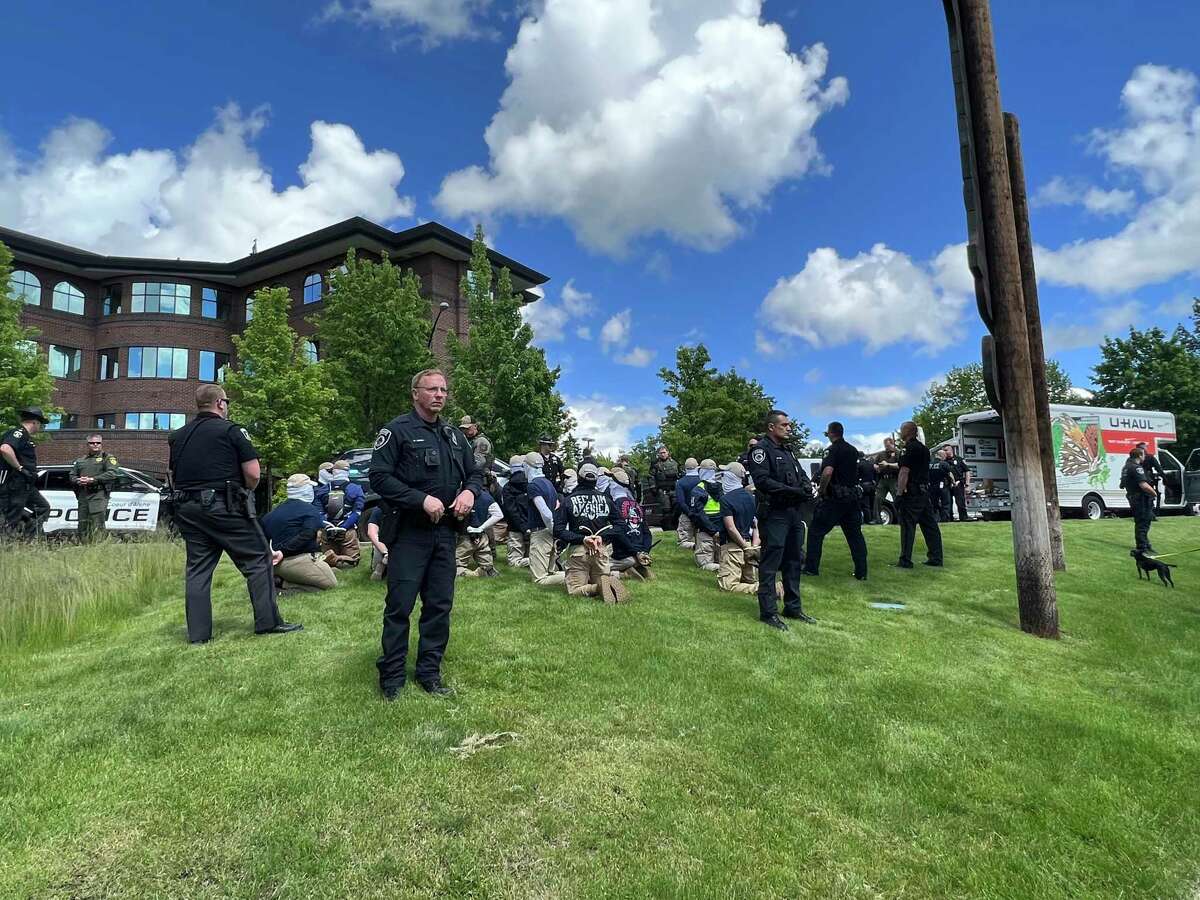
This is a strange yet unsurprising story. A truck filled with 31 individuals was stopped in Idaho. The 31 were on their way to disrupt a gay pride parade in Idaho. The men arrested came from different states. I saw the article in the Houston Chronicle but it was widely reported. When I read it before, I decided not to post it. But then I realized it has a larger significance, as it signifies the normalization of extremism, that is, extremists who wear uniforms and show their faces instead of lurking in the shadows and muttering to themselves.
Why was this group converging on gays in Idaho, not in a city in their own states? I’m guessing that they expected little resistance in a deeply conservative state. If they had rioted in a big city like Houston, Chicago, Miami, or Los Angeles, the crowd would have far outnumbered them and resisted. That’s my guess. What is truly alarming, aside from the fact that this riot was planned and might have turned violent, is that extremist groups like this are showing their faces. The emergence of QAnon, Proud Boys, Oath Keepers and other extremists as allies of one of the nation’s two dominant political parties has encouraged open violence against marginalized groups. Will we soon see open KKK marches—oh, wait, we saw that in Charlottesville in 2017, with the torches but not the hoods. Trumpism—aka, white supremacy—used to be hidden under a rock. No more. Thank God they were arrested. In Idaho.
Authorities arrest members of the white supremacist group Patriot Front near an Idaho pride event Saturday, June 11, 2022, after they were found packed into the back of a U-Haul truck with riot gear. Georji Brown/Associated Press
Texas residents were among 31 individuals affiliated with a white nationalist group arrested Saturday in Idaho on suspicion of conspiracy to riot after police there found them packed in a U-Haul truck apparently heading to a Pride celebration with riot gear and at least one smoke grenade, authorities said.
It was not clear by Saturday night how many of the individuals detained in Coeur d’Alene, a city in north Idaho about 33 miles east of Spokane, were from Texas or what part of the state they reside in. The others arrested, who were still being booked Saturday, were residents of Utah, Idaho, Colorado, South Dakota, Illinois, Arkansas, Wyoming, Washington, Oregon and Virginia, the city’s police Chief Lee White said.
A person called authorities around 1:38 p.m. after seeing some 20 people jump into a truck wearing masks and carrying shields, looking “like a little Army.” Police stopped the truck about 10 minutes later and arrested the 31 individuals, who appear to be affiliated with the group Patriot Front, White said, citing logos on their hats, similar outfits, insignia and at least one patch that said Patriot Front.
The Southern Poverty Law Center describes the group as a white nationalist hate group.
Carol Burris, executive director of the Network for Public Education, speaks out against the lawsuit that eight New York City charter schools filed against the U.S. Department of Education, seeking more money.
She writes:
Eight New York State charter schools filed a frivolous lawsuit against the U.S. Department of Education. The lawsuit claims that in 2019, the U.S. Department of Education unfairly pulled promised funds from the schools when it called back unspent funding from a 2011 Charter Schools Program grant.
Despite the claim, the 2019 clawback of funds was not only justified but also long overdue. And if there is fault, that fault lies with the schools and/or the New York State Education Department, which treated the CSP grant like a piggy bank with few, if any, rules.
Here are the details.
In 2011, the New York State Education Department (NYSED) was given more than $13 million from the federal Charter School Program (CSP) to disperse as subgrants to charter schools as start-up or expansion funds. At the same time, New York’s big charter chains like Success Academy, KIPP, and Democracy Prep were also getting federal dollars from the CSP CMO grants. There was so much CSP funding with limited demand that NYSED could not give it all away.
CSP grants to the states have a timeline of five years. That means that by 2016, NYSED should not have continued to make sub-grants. But apparently, it did not stop awarding grants and return the excess funds. It continued to give the federal dollars out.
From a dataset published in 2019, which you can find here, we know that NYSED committed $760,410 to two prospective Zeta Charter Schools and over $676,000 to Persistence Prep in Buffalo. It began dispersing funds to those schools in 2017, giving them some but not all funding. That is because these schools were not even planned to open until the fall of 2018. Other schools named in the lawsuit are not listed in the 2019 published database, which likely means that NYS continued making awards from the expired grant beyond 2018.
Incredibly, even though it had not entirely spent its prior grant, the NYSED applied for yet another CSP grant and was approved for a whopping $78,888,888 in 2018. Why the state thought it needed those funds is beyond understanding. Grants are to be used primarily to open new charter schools, and the state was bumping up against its charter cap.
The award also appears to be a violation of the federal law called ESSA (Every Students Succeeds Act), which states:
LIMITATIONS.—
‘‘(1) GRANTS.—No State entity may receive a grant under this section for use in a State in which a State entity is currently using a grant received under this section.
Even though reviewers noted that the smaller 2011 grant had not been completely spent and the state had little room for charter expansion under the cap, then Secretary of Education Betsy De Vos awarded nearly $79 million to the New York State Education Department from CSP.
Zeta charter schools, one of the plaintiffs in the lawsuit, received an additional $636,531 from that new 2018 grant, even though it had not wholly spent its prior grant before the clawback. In 2020 ,I filed a FOIA for the 2011 and 2018 grants with NYSED. I have not received the requested information. At the same time, however, I filed a FOIA with the U.S. Department of Education, which promptly provided information on CSP grants, including the 2018 grant to New York.
Once again, NYSED had trouble giving the CSP money away and therefore asked for and received a waiver to disperse 2018 CSP funds to existing charter schools as Covid relief, even as the states’ charters were getting PPP funding, not available to public schools.
Here is the bottom line. The NYSED grabbed as many federal dollars for charter schools as possible, regardless of actual need. When the U.S. DOE clawed the money back in 2019, it did exactly what it was supposed to do under the law—take back unspent funds from an expired grant. This lawsuit which claims that charter schools are still entitled to money to open schools that have been open for several years, is, in my opinion, unserious. Rather, it is one more attempt by charter schools to bully the Biden Education Department.
With all of its political muscle power, the charter industry is furious that the Biden Administration is turning a program that has been a piggy bank for frivolous spending into a responsible program that functions with sensible rules of the road. Unfortunately, the New York Post reporter who wrote about the lawsuit made little or no attempt to dig deeper and uncover relevant facts.
This is also another example that demonstrates why the federal Charter School Program needs strong oversight and reform. Since the Charter Schools Program was first launched in 1995, it has operated with minimal or no accountability. And that reform must include better supervision of states that think it is fine to apply for money they do not need and then push our federal tax dollars out the door without care. In the end, all taxpayers, including those of New York State, foot the bill.
This is an optimistic story. This is a story about the young people graduating from our public schools. They have the knowledge, insight, and skill to see the games that unscrupulous adults are playing on them and on society. They speak out. They give all of us hope.
Axel Brito was the valedictorian of Hollywood High School, the student with the highest grade point average. He might have spoken in platitudes, like so many graduation speakers, but instead he criticized the school board members who had danced on the strings of billionaire supporters. School officials tried to interfere as he spoke, but the audience insisted that he be allowed to finish. The audience chanted “Let him speak, let him speak.” The article quotes the graduation speech in full (with a few errors). Watch it!
Before I commence, let us have a moment of silence for the 19 Uvalde students who will never have the opportunity to graduate as we do today.
“Achieve the honorable.” This motto has been driven through us repeatedly at every stage of our high school career, and during this time I have come to meet dedicated teachers who embody this to a tee. Teachers of this and other schools dedicate their lives laboring for us, the students, because they want and need our generation to succeed and change the future for the better.
Yet, at times the soundness of it falters. After all, does achieving the honorable mean lying about your volunteer hours and having this deed actively encouraged by the administration? Does it mean to have your grades, including my own, artificially inflated through the lowering of standards and driving our overworked teachers up a wall because of it? Does it mean to leave students unpunished for their transgressions to save face? Does it mean to lie and keep parents out of the loop during events that put us in danger, and more so to have a security system that is in no way keeping us safe? Does it mean to blame students due to the school’s own incompetence? I’d like to think not.
Despite this, I don’t blame this school for its wrongdoings, after all this is something that is learned through example.
Nick Melvoin for one abused his position and diverted district resources for his re-election campaign. A campaign which itself is funded not by us, the parents who have children in LAUSD schools, but by external multimillion and multibillion-dollar charter-based super PACs. He is not the man of the people; he is merely a puppet for those who put him into power. Look no further than in 2019 when he provided confidential information to the California Charter School Association, one of his many donors, while the district was being sued to prevent funds from being spent to make schools more accommodating for the disabled. So much for “putting kids first.”
Further so, we have Mónica García as another instance of this charter-centric rhetoric as she too is funded heavily by charter-based organizations. Under the guise of choice and neoliberal ideals, she has ravaged this district with a heavy expansion of charter schools without taking its students into account. Rather she refers to special education students as not “our own kids” and says that “our biggest problem is that most of our kids, all of our kids, can’t read.”
Tanya Ortiz-Franklin and Kelly Gonez don’t escape scrutiny either as they too are a result of charter super PACs and as such are willing to turn a blind eye to charters which allows these pro-charter board members to outvote those that hold the interests of our students.
Therefore, it is no surprise when these board members set out to close and convert Pio Pico Middle School and Orville Wright Middle School into charter schools. Schools they deem as failing due to low enrollment rates as the charters around them owe over 13 million dollars to the district. They don’t have our interests at heart, they have those of the multimillion-dollar charter school industry instead.
Astonishingly our previous superintendents, John Deasy and Austin Beutner, were magnitudes worse as they were put into power by the late billionaire Eli Broad and his heavily charter-centered foundation. Both of these men were put there with no experience in education and left amid controversy and successfully paved the way to privatizing LAUSD. Broad disrupted our education to achieve a district half composed of charters. He, alongside The Gates Foundation and the Walton Foundation, wormed their way through this district to privatize our human right of an education.
Our district may claim higher graduation rates, and this year’s class can attest to that. But, does moving a goalpost closer and closer each year truly mean a growth in students? No, it doesn’t, it just guarantees that we graduate and are pushed into a world we are not ready for. Our students don’t know what failure is because the district and schools themselves will not allow it as they pass extensions and recovery classes time after time.
I have heard administration at different schools, like that of NOW Academy, tell teachers to teach APs like non-APs to ensure higher pass rates. Students at Hollywood entered stunted by the pandemic and can hardly manage basic arithmetic. I can only imagine how much worse it must be at other schools.
This is not about an education. This is not about college. This is not about a career. This is about a system that profits off us and because of this perpetuates the failure of its students in exchange for a gilded view of success that ensures those in power stay in power. So don’t you dare conflate my success to that of this school’s administration and much less so the district. I’m not a product of the district even if I, alongside my class are treated as such. I’m a product of my passion and the passion of my teachers.
Class of 2022, this is not yet over. This is only the beginning of a rough uphill battle that our district has left us unprepared for. Take a stance, start now, and fight back against the system that has left us to rot and fester. Vote these people out of office and keep people like them from further ruining what our teachers worked so hard to foster. Destabilize the status quo.
Meanwhile, on the other coast, in Florida, the valedictorian of his high school class had a dilemma. He had been elected class president of his class every year; he was respected and liked. He has been accepted as a freshman at Harvard University. But he had a problem. He is gay. His principal reviewed his speech and advised him not to mention the fact that he is gay. So he talked about his curly hair and how it made him different from everyone who did not have curly hair.
Valerie Strauss wrote in “The Answer Sheet” blog at the Washington Post:
Senior Class President Zander Moricz was tapped with giving a commencement speech at Pine View School in Osprey, Fla., but was given a restriction not normally attached to such an event.
An openly gay activist who is the youngest plaintiff in a lawsuit against a new state law that restricts what teachers can say in classes about gender and sexual orientation, the teenager said publicly that he had been warned by his principal not to mention his activism or say the word “gay.” If he did, Moricz said on social media, his microphone would be cut off.
So on Sunday, Moricz gave the speech without saying the word — but still managed to speak directly about who he is and why he advocates for the LGBTQ community. He used his curly hair as a metaphor.
“I used to hate my curls,” he said, after removing his graduation cap and running his hands through his hair.
“I spent morning and night embarrassed of them trying to straighten this part of who I am, but the daily damage of trying to fix myself became too much to endure,” he said. “So while having curly hair in Florida is difficulty due to the humidity, I decided to be proud of who I was and started coming to school as my authentic self.”
Pine View Principal Steve Covert did not respond to The Washington Post’s efforts to contact him. Kelsey Whealy, a spokeswoman for Sarasota County Schools, said in a May 10 email that Pine View’s principal “did meet with Zander Moricz to remind him of the ceremony expectations” but did not say he had been told not to say “gay.”
Michael Gerson, former speechwriter for President George W. Bush, describes the response of Republicans to the first day of public hearings of the January 6 commission:
The Jan. 6 committee’s riveting televised opening night might not have converted the pro-Trump revisionists, but it has left them without excuses. The evidence is overwhelming that a sitting president gathered a violent mob and charged it with intimidating members of Congress and his own vice president into illegally reversing the outcome of a presidential election on the basis of an obvious lie.
There is only one narrative about Jan. 6 that history will accept: the evidence meticulously gathered and presented by the House select committee.
In some ways, pressing the case against former president Donald Trump is not hard, because he confirms its general outlines. He still seems to regard the riot as the highest expression of MAGA loyalty to his person. He still insists he should be reinstated as president. He still seems to believe then-Vice President Mike Pence was a weak-kneed traitor for refusing to overturn the constitutional order. Because Trump can’t admit error, he often effectively admits guilt.
The response of congressional Republican leaders to Thursday’s hearing — that it is more important to focus on inflation than sedition — has demonstrated their vast political and moral shallowness. The juxtaposition of testimony by U.S. Capitol Police officer Caroline Edwards (“I was slipping in people’s blood”) and a tweet from Republicans on the House Judiciary Committee account (“All. Old. News.”) was telling.
One imagines a 20-something GOP staffer straining (and failing) to be clever. The contrast between the police officer’s sacrifice and the tweeter’s infantile partisanship raises some questions: Is anyone teaching young Republicans that public service can be honorable and costly? Why doesn’t some mature public official shake these shills and urge silence in the presence of patriotic virtues they don’t possess?
The sheer scale of Donald Trump’s depravity is unmatched in the history of the American presidency, and the Republican Party—the self-described party of law and order and “constitutional conservatives,” of morality and traditional values, of patriotism and Lee Greenwood songs—made it possible. It gave Trump cover when he needed it. It attacked his critics when he demanded it. It embraced his nihilistic ethic. It amplified his lies. When House Republican Leader Kevin McCarthy—a man who for a few fleeting hours after the January 6 insurrection dared to speak critically of Donald Trump—traveled to Mar-a-Lago a few days later to kiss his ring, it was an act of self-abasement that was representative of his party, his morally desolate party.
/https://static.texastribune.org/media/files/0b22ff1684446eb4bb16e79b520a32f4/Crosses%20Memorial%20KGB%20TT%2001.jpg)

 Diane Ravitch's blog