Dana Milbank tells the sad story of Elise Stefanik, a promising moderate who was elected to Congress from Upstate New York. But when power beckoned, she threw aside character, ethics, and principle to join the Trump brigade. For this once-moderate member of Congress, there are no bounds to her willingness to go full MAGA. She echoes the Great Donald, walking in lockstep with him and his Big Lie, even endorsing the “great replacement theory” that terrifies MAGA-Carlson voters but inspired a massacre of ten innocent Black people in Buffalo. A week after the massacre of children and teachers in Uvalde, Texas, Stefanik said she opposes gun control, but favors more funding for mental health. Anything for the base. Anything for power. Sad.
When John Bridgeland left a senior position in George W. Bush’s White House and joined Harvard’s Kennedy School of Government in the fall of 2004, an eager undergraduate got assigned to him as a student fellow and facilitator of his seminar.
“She was so excited because I was one of the few Republicans” then at the school’s Institute of Politics (IOP), Bridgeland told me this week. He remembered her as “extremely bright” and “through-and-through public-service-oriented.” She was so impressive in the seminar that he chose her to do a project with him selling Harvard students on the Peace Corps, AmeriCorps and other service opportunities. “I thought the world of her,” Bridgeland said.
The young woman’s name was Elise Stefanik.
Bridgeland secured her a job in the White House when she graduated in 2006, personally appealing to Chief of Staff Josh Bolten and other former colleagues to hire her. Bridgeland later encouraged her to run for Congress, which she did, successfully, in 2014 — and the New York Republican quickly established herself as a leading moderate. “I was so incredibly happy and proud,” Bridgeland said. “I viewed her as the bright light of her generation of leaders. She was crossing the aisle. She was focused on problem-solving. She had the highest character.”
And then, he said, “this switch went off.” Today, the world sees a much different Stefanik. This past week, after the racist massacre in Buffalo, attention turned to her articulation of “great replacement” theory, the white-supremacist conspiracy beliefs said to have propelled the alleged killer. Before that, she had been a prominent election denier, voting to overturn the 2020 results after the Jan. 6 insurrection, and then using the issue to oust and replace House Republican Conference Chairwoman Liz Cheney (Wyo.) because she refused to embrace President Donald Trump’s election lies.
Now, Stefanik has thrown her support, as the No. 3 House GOP leader, behind a proposal to “expunge” Trump’s impeachment for his role in the insurrection. She has joined a small group of extreme backbenchers as co-sponsors of the resolution, which casts doubt again on Joe Biden’s “seeming” win, citing “voting anomalies.” The resolution has no purpose (there’s no constitutional way to expunge impeachment) other than to sow further distrust of democracy.
It’s a story told a thousand times: Ambitious Republican official abandons principle to advance in Trump’s GOP. But perhaps nobody’s fall from promise, and integrity, has been as spectacular as the 37-year-old Stefanik’s. “I was just so shocked she would go down such a dark path,” said her former champion, Bridgeland. “No power, no position is worth the complete loss of your integrity. It was just completely alarming to me to watch this transformation. I got a lot of notes saying, ‘What happened to her?’ ” The answer is simple: “Quest for power,” Bridgeland said. “But power without principle is a pretty dark place to go. She wanted to climb the Republican ranks and she has, but … she’s climbed the ladder on the back of lies about the election that are undermining trust in elections, putting people’s lives at risk.”
As a candidate in 2014, Stefanik refused to sign Grover Norquist’s no-tax pledge, a Republican purity test. Then the youngest woman ever elected to Congress, she became a co-chair of the Tuesday Group of Republican moderates. She boasted about being among the most bipartisan lawmakers. She criticized Trump’s “insulting” treatment of women, his “untruthful statements,” and his proposed Muslim ban and border wall.
But Trump’s huge popularity in her upstate New York district changed all that. She became one of Trump’s most caustic defenders during his first impeachment. After Trump’s 2020 loss, she embraced the “big lie,” making a stream of false claims about voter fraud, court actions and voting machines, and urging the Supreme Court to reject the results.
When Bridgeland saw his former protegee’s lies about the election, “I was shattered. I was really heartbroken,” he told me. Alumni of Harvard’s IOP petitioned to remove Stefanik from its advisory committee, and Bridgeland signed it. “I had to,” he said, “because Constitution first.” Stefanik called her removal a “badge of honor” and a decision on the school’s part “to cower and cave to the woke left.”
Bridgeland, a career-long policy innovator who still considers himself a Republican, retains a flicker of hope that his former student might return to her early promise, recant the lies, and prove true Ralph Waldo Emerson’s belief that if a “single man plant himself indomitably on his instincts, and there abide, the huge world will come round to him.”
“People become totally ruined by their failure to stand up for the good and the true, but I do think she has the spark still and could awaken to it,” Bridgeland said. “It’s not too late.”
For our country’s sake, I wish I could believe that.
Joe Straus represented San Antonio in the Texas Legislature for fourteen years. He was Speaker of the House from 2009 to 2019.
He wrote in the Texas Monthly about the necessity of the state’s political leaders taking action against the crisis of gun violence. He believes that there is political will to take action. He believes that Texans want to see gun control. Let us hope.
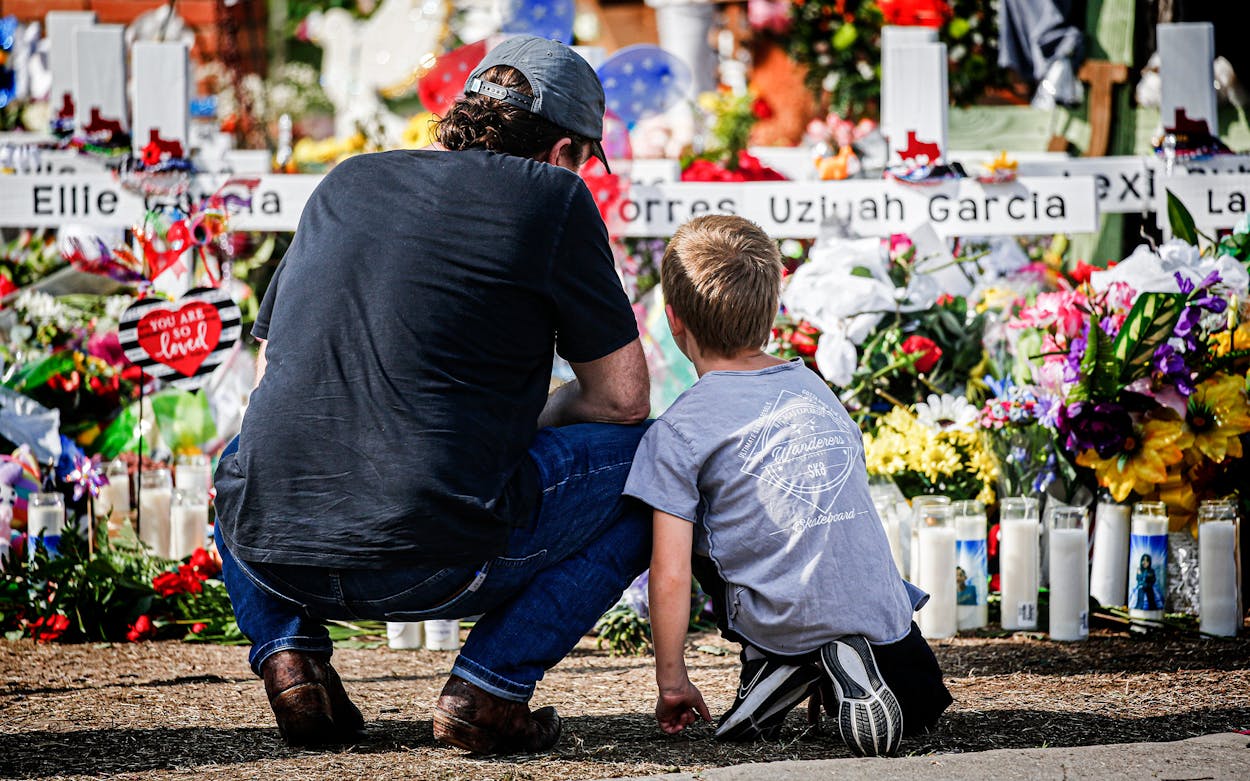
A man and a child pay their respects at a memorial outside Robb Elementary School, in Uvalde, on May 29, 2022.Dario Lopez-Mills/AP
This tragic moment in Texas—when fear is overcoming students, parents, and educators, and when so many Texans are feeling hopeless about the state’s efforts to stop the next mass shooting—demands the leadership and the political courage to finally consider any solutions that will help prevent gun violence in our schools and elsewhere.
All week, Texans’ grief over the loss of precious young lives in Uvalde has been compounded by anger and frustration that the state has not been able to stop another shooting tragedy. It’s not, I suspect, that Texans expect their government to provide absolute certainty that another mass shooting will not occur. Rather, Texans just want to see that this state is making its best efforts, regardless of political calculations.
It’s true that Texas has taken steps since the shooting at Santa Fe High School in 2018 to prevent such tragedies. The state invested hundreds of millions of dollars in threat-assessment training for educators, mental health training, additional counselors at campuses, and school infrastructure upgrades including alarm systems and metal detectors. While Texas has not historically been known for prioritizing mental health care, the state has made real progress in the past six years by investing in better care for more Texans, with one point of emphasis being early intervention for troubled children and teenagers.
However, there remains an unwillingness to give serious consideration to gun reforms that command broad-based, bipartisan support among Texans and other Americans. For example, June 2021 polling from the Texas Politics Project at the University of Texas at Austin showed that 71 percent of Texans supported background checks on all gun purchases. The project’s polling in October 2019 showed majority support for a nationwide ban on semiautomatic weapons. Many hunters and other law-abiding gun owners understand the need for restrictions as well. Sure, these provisions are less popular among the 3.3 percent of Texans who determine the outcome of Republican primaries, which basically have been proxies for the general election for the past 27 years. At some point, however, isn’t there a greater cause than assuaging primary voters? Those in public office have a duty to represent all of their constituents.
This may be the rare time when Texas would be wise to follow the lead of Florida. Since 2018, a “red flag” law in that state has been used nearly six thousand times to remove weapons from those who are deemed to be threats. Despite some encouraging talk about a red flag bill after the Santa Fe tragedy in 2018, the idea has not gained serious traction here. But it should be at the top of the list of ideas our elected leaders consider as part of a long-overdue look at meaningful gun safety. Texas should also take a long look at whether someone as young as eighteen should be allowed to purchase the types of exceptionally lethal weapons that the Uvalde shooter bought—and the requirements that ought to be met before such a purchase can be made. Is it good policy to make it harder for an eighteen-year-old to buy a beer, or get a driver’s license, than to acquire a military weapon and outgun law enforcement?
Finally, given what we have learned about the fatal mistakes made by law enforcement during the shooting, the state should undertake a comprehensive review of the speed and effectiveness of law enforcement responses during mass shootings, so that we can clarify accountability and learn from mistakes.
Even in Washington, efforts have begun to find bipartisan compromise on gun legislation. I don’t know what will come of it, but I’m encouraged to see that our U.S. senator John Cornyn will be one of the leaders of those bipartisan talks.
As I argued after the 2019 shooting in El Paso, Texas can change the status quo if our elected leaders engage in a good-faith debate over gun safety. Now, like then, it is time for our legislators and our governor to listen to the fears and the concerns of Texans, as well as the views of experts who can provide serious, sober analysis of what will work, without the taint of politics. We are back at the same point where we were in 2019, but we don’t have to make the same choices. This moment calls for leaders willing to put politics aside and objectively consider every idea that might help prevent future tragedies—and they should start during a special legislative session this summer, before parents send their children back to school in August.
It’s been said that legislators act only when facing a crisis. Well, the epidemic of gun violence is a crisis by any measure. It’s past time to treat it like one.
Joe Straus represented San Antonio in the Texas House of Representatives for fourteen years, serving as Speaker of the House from 2009 to 2019.
Colbert I. King, a columnist for the Washington Post, wrote recently about the acknowledgement by various institutions about their role in perpetuating slavery. Harvard University was the most recent example. King says that not enough attention has been paid to the sexual exploitation of slave women. As we reflect on the current Republican obsession with banning teaching about racism and accusing teachers of pedophilia, think of the following story. Who were the most dangerous pedophiles in American history?
King writes:
This soul-searching may well help the nation come to terms with its past. But an examination of racist cruelty in 18th and 19th-century America cannot stop with the failings of public and private institutions.
No probe into the corrosive effects of racial bondage can be complete without coming to grips with, besides slavery itself, the single most heinous crime against humanity committed in the annals of U.S. history: the centuries-long sexual exploitation and subjugation of Black women and girls….
How many black women and girls were sexually exploited?
The 1860 federal census provides a clue. In Southern or slaveholding states, and in Northern states respectively, 518,360 and 69,885 people were classified as “mulattoes.”
Then King refers to a relationship that was revealed almost a decade ago. I did not read about it then.
A 22-year-old White South Carolinian who impregnated a 16-year-old Black maid in his father’s house also comes to mind. He, Strom Thurmond, avowed segregationist, Dixiecrat presidential candidate and staunch opponent of civil rights legislation, went to his grave without saying a word about what he did to that teenager. As did hundreds if not thousands of White men before him.
King links to an article that tells the story of Thurmond’s never-acknowledged black daughter. It was written by journalist Mary C. Curtis and published in the Washington Post in 2013.
Essie Mae Washington-Williams lived for 87 years. But, in her own words, she was never “completely free” until she could stand before the world and say out loud that Strom Thurmond, the one-time segregationist South Carolina senator, was her father. That was in 2003, after she had spent more than 70 years being denied what we all deserve – her true name and birthright. “In a way, my life began at 78, at least my life as who I really was,” Washington-Williams wrote in her life story. She has died.
Thurmond’s oldest child — born when he was a 22-year-old man and her mother, Carrie Butler, a 16-year-old black maid in his father’s house – had kept the senator’s secret, an open one rumored about but never revealed when he was alive because, she had said, “He trusted me, and I respected him.” As in the case of Thomas Jefferson, another successful southern politician who was father to black children, stories shared among African Americans were long disbelieved until they turned out to be true….
She remained silent even as he did his best to block civil rights legislation and uphold white supremacy. She and her mother occasionally visited Thurmond’s law office. He sometimes gave her money. But he never gave her his name.
In 2003, she could finally stop holding her breath and tell her truth. The Thurmond family didn’t dispute her, and her name was added to the list of children on a monument for the senator on the grounds of the South Carolina state house, joining the Confederate flag, a monument to the contributions of African Americans and statues honoring segregationists who did their worst but could not stop Washington-Williams from achieving.
Wanda Bailey, Washington-Williams’ daughter, said in The State newspaper that her mother was an inspiration. “She was there for us,” Bailey said. “She was a very giving person. She did everything she could not only for her children, but her grandchildren and great-grandchildren.”
In that, she proved a better person than the man who spent his own life denying her. I wonder if she was smiling a few years ago when she said she would become a member of the United Daughters of the Confederacy through Thurmond’s ancestral lines.
Facing internal conflicts most could only imagine, she became a mother, wife, teacher, and a daughter that Strom Thurmond or any father could be proud of.
Michael Hiltzik is a brilliant columnist for The Los Angeles Times. This article is the single best analysis of gun control that I have read anywhere. In it, Hiltzik demonstrates the fallacies of those who oppose gun control. The Second Amendment does not give unlimited rights to own guns. Gun control is supported by majorities. Effective gun control saves lives. Why should the right to own a gun be more sacred than the right to life?
Hiltzik writes:
Another massacre, another outpouring of political balderdash, flat-out lies about gun control and cynical offers of “thoughts and prayers” for the victims.
I haven’t commented on the slaughter of 19 children and two adults in Uvalde, Texas, by an assault rifle-wielding 18-year-old before now, hoping that perhaps the passage of time would allow the event to become clarified, even a bit more explicable.
But in the week since the May 24 massacre, none of that has happened. The news has only gotten worse. It’s not merely the emerging timelines that point to the inexcusable cowardice of local law enforcement at the scene, but the ever-growing toll of firearm deaths across the country.
The right secured by the Second Amendment is not unlimited.
— Justice Antonin Scalia, District of Columbia vs Heller
There have been 17 mass shootings nationwide since Uvalde, including 12 on Memorial Day weekend alone. A mass shooting is defined by the Gun Violence Archive as one in which four people or more are killed or wounded, not including the shooter.
What is most dispiriting about this toll is the presumption that campaigning to legislate gun safety is fruitless, because gun control is unconstitutional, politically unpopular, and useless in preventing mass death.
These arguments have turned the American public into cowards about gun control. Voters seem to fear that pressing for tighter gun laws will awaken a ferocious far-right backlash, and who wants that?
Yet not a single one of these assertions is true, and repeating them, as is done after every act of mass bloodshed, doesn’t make them true. The first challenge for those of us concerned about the tide of deaths by firearms in America is to wean the public and public officials from their attitude of resignation.
We’ll skip lightly over a few of the more ludicrously stupid claims made by politicians and gun advocates about Uvalde.
For example, that the disaster could have been averted if the school had only one door, says Sen. Ted Cruz (R-Texas); apparently Cruz is ignorant of the Triangle Shirtwaist Factory disaster, in which 146 garment workers died, many because they could not escape the factory through its locked doors.
But that happened in 1911, and who can expect a Senator to remain that au courant?
Or the assertion by Texas Gov. Greg Abbott and many others that the problem leading to Uvalde isn’t the epidemic of assault weapons, but mental illness. This is nothing but an attempt to distract from the real problem.
“Little population-level evidence supports the notion that individuals diagnosed with mental illness are more likely than anyone else to commit gun crimes,” a team from Vanderbilt University reported in 2015.
Finally, there’s the argument that the aftermath of horrific killings is not the time for “politics.” In fact, it’s exactly the time for politics. Mass death by firearm is the quintessential political issue, and there’s no better time to bring it forward than when the murders of children and other innocents is still fresh in the public mind.
Let’s examine some of the other common canards about gun violence and gun laws, and start thinking about how to move the needle.
The 2nd Amendment
For 217 years after the drafting of the Bill of Rights, which included the 2nd Amendment, courts spent little effort parsing its proscription that “A well regulated militia, being necessary to the security of a free state, the right of the people to keep and bear arms, shall not be infringed.”
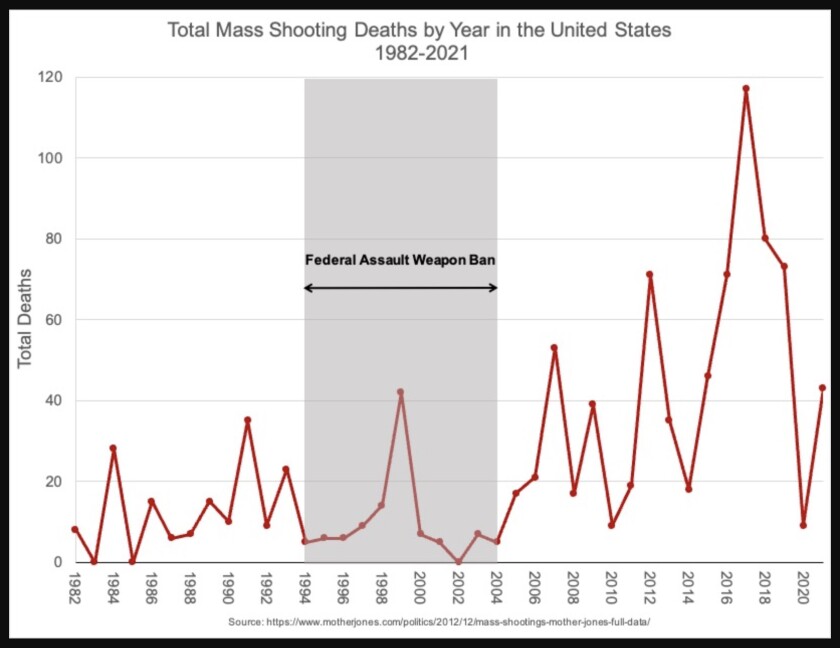
Since the federal ban on assault weapons expired in 2004, mass shootings with those weapons has climbed. An assault weapon was used in the Uvalde massacre of May 24. (Mother Jones)
That changed in 2008, with the Supreme Court’s ruling in the so-called Heller case overturning the District of Columbia’s ban on possession of handguns in the home. Since then, the impression has grown — fostered by the National Rifle Assn. and other elements of the gun lobby — that Heller rendered virtually any gun regulation unconstitutional.
But Justice Antonin Scalia’s 5-4 majority opinion said nothing of the kind. Indeed, Scalia explicitly disavowed such an interpretation. “The right secured by the Second Amendment is not unlimited,” he wrote. The Constitution does not confer “a right to keep and carry any weapon whatsoever in any manner whatsoever and for whatever purpose.”
There was, and is, no constitutional prohibition against laws prohibiting the carrying of concealed weapons, he found. Nothing in his ruling, he wrote, should “cast doubt on longstanding prohibitions on the possession of firearms by felons and the mentally ill, or … the carrying of firearms in sensitive places such as schools and government buildings,” or conditions on gun sales.
The problem with the D.C. law, Scalia wrote, was that it went too far by reaching into the home and covering handguns, which were popular weapons of defense in the home. “The Constitution leaves the District of Columbia a variety of tools” for regulating handguns, as well as other firearms, he wrote.
The federal assault weapons ban, which was enacted in 1994 and expired in 2004, repeatedly came under attack in federal courts, and prevailed in every case. Not a single one of those challenges was based on the 2nd Amendment. Since the expiration of the ban, mass shooting deaths in the United States have climbed steadily.
“Heller has been misused in important policy debates about our nation’s gun laws,” wrote former Supreme Court clerks Kate Shaw and John Bash in a recent op-ed. “Most of the obstacles to gun regulations are political and policy based, not legal.” Shaw and Bash worked on the Heller decision as clerks to Scalia and John Paul Stevens, the author of the leading dissent to the ruling, respectively.
So let’s discard the myth that gun control laws are unconstitutional.
The NRA
By any conventional accounting, the NRA is a shadow of its former self. Its leadership has been racked with internal dissension, its resources have been shrinking and it has faced a serious legal assault by New York state. Attendance at its annual convention last week in Houston drew only a few thousand members, even with former President Trump on hand to speak.
Yet the organization still carries major political weight. To some extent that’s an artifact of its political spending. Even in its straitened circumstances it’s a major political contributor, having handed out more than $29 million in the 2020 election cycle. Some of the politicians taking resolute pro-gun stands are beneficiaries of this largess, mouthing “thoughts and prayers” for the victims of gun massacres while pocketing millions from the NRA.
The NRA also has played a lasting role in blocking funds for research into gun violenceby federal agencies such as the Centers for Disease Control and Prevention, an obstacle that remained in place for some two decades until Congress restored funding in 2019. But the gap in research still hampers gun policymaking. It’s long since time to curb this organization’s blood-soaked influence on our politics.
Debate? What debate?
Part of the knee-jerk news coverage of the aftermath of gun massacres is the notion that the American public is deeply divided over gun regulations. This is a corollary of the traditional claim that American society is “polarized,” which I showed last year to be absolutely false. The truth is that large majorities of Americans favor abortion rights, more COVID-related restrictions and, yes, gun regulations.
More than 80% of Americans favor instituting universal background checks on gun buyers and barring people with mental illness from owning guns, according to a Pew Research Center poll. More than 60% favor banning assault weapons and high-capacity ammo magazines.
The poll was taken last September; it’s a reasonable bet that the majorities would be larger now. To put it another way, the “debate” is over — most Americans want to bring gun sales and ownership under greater control.
Gun regulations work
One claim popular among pro-gun politicians is that gun regulations don’t serve to quell gun violence. (A common version of this trope is that proposed regulations wouldn’t have stopped the latest newsworthy massacre.)
This is a lie, as statistics from the CDC show. States with stricter gun laws have much lower rates of firearm deaths than those with lax laws. The first category includes California (8.4 deaths per 100,000 population) and Massachusetts (3.7). The second group includes Louisiana (26.3) and Texas (14.2, and the highest total gun-related mortality in the country, at 4,164 in 2020).
Texas even loosened its gun regulations just months before the Uvalde massacre. When Missouri repealed its permit regulations for gun ownership in 2007, gun-related homicides jumped by 25% and gun-related suicides by more than 16.1%. When Connecticut enacted a licensing law in 1995, its firearm homicide rate declined by 40% and firearm suicides by 15.4%.
Make them vote
Perhaps the most inexplicable argument justifying congressional inaction over gun laws is that tough laws have no chance of passage, so it’s pointless even to try. Defeatism in the face of urgent need is inexcusable.
The resistance of Republicans to voting for gun laws is precisely the very best reason for bringing those bills to the floor. There’s no reason to give Republican obstructionists a free pass — make them stand up and take a vote.
Make them explain what it is about making Americans safer in schools and workplaces that they find objectionable, and why they think that voting against measures supported by 80% of the public is proper. Bring the fight to them, and show voters the character of the people they’ve placed in high office.
Show the pictures
Americans have become inured to gun violence in part because our culture minimizes its horrors. We’re awash in the most visceral depictions of shootings in movies and television, but at their core those depictions are unthreatening — indeed, in most cases they’re meant for entertainment.
Even our news programs revel in gore — the classic dictum of local news broadcasting has long been “If it bleeds, it leads.”
These conditions have inoculated us against the horror of firearm injuries as they occur in real life — especially those caused by assault weapons such as the AR-15. There’s a big difference between hearing the words “gunshot wound” and learning what actually happens to the organs of victims of AR-15 assaults. They don’t look anything like what we see on TV, and we need to have a true, visceral sense of the difference.
“These weapons are often employed on the battlefield to exact the maximum amount of damage possible with the strike of each bullet,” radiologist Laveil M. Allen wrote last week for the Brookings Institution. “Witnessing their devastating impact on unsuspecting school children, grocery shoppers, and churchgoers is unfathomable. The level of destruction, disfigurement, and disregard for life that a high-powered assault rifle inflicts on the human body cannot be understated. Placed into perspective, many of the tiny Uvalde victims’ bodies were so tattered and dismembered from their ballistic injuries, DNA matching was required for identification because physical/visual identification was not possible.”
You’ll hear the argument that showing photographs of real victims or the scenes of massacres will only be more traumatizing. For some people, including the victims’ families, that may be true. But that only underscores my point — we have not been sufficiently traumatized, and the creation of a truly effective mass movement for gun laws requires that we be traumatized.
Because we experience the horror of gun massacres at a remove, they tend to drift out of public consciousness in a distressingly short time span. Even after the Sandy Hook killings, which took the lives of 20 children ages 6 and 7 less than 10 years ago, there was something distancing about reportage of the event. Photos of some of the murdered children have been made public, but they are photos from life, showing the children smiling at birthday parties or gamboling about the playground.
Let’s face it — few Americans were thinking about the Sandy Hook killings until May 24, when the Uvalde massacre brought them bubbling back to public consciousness. Would our reaction be different had we seen photographs of classrooms slathered in blood, of children’s bodies ripped to pieces by Adam Lanza’s assault rifle?
You bet it would. Those images would not easily be forgotten. Every time a GOP senator or representative stood up to declare that the right to own assault weapons trumped the right of those children to live their lives, someone should have produced one of those photographs and said, “Justify this.”
Our risk is that Uvalde will be just another Sandy Hook. Soon to move off the front burner, or soon buried under the choruses of “We can’t pass this” or “This won’t work” or “This is the path we’ve chosen.” We need to change the terms of discussion, or Uvalde will just be the latest massacre of a long line, not the last massacre of its kind.
This is a letter from Robert Weissman of Public Citizen, an organization that’s trying to fix our broken nation.
There was a time — not that long ago — when America’s gun manufacturers did not advertise assault weapons to the general public.
But for the past 20 years or so, the gun industry has been aggressively marketing military-grade munitions to the American people — with ads specifically invoking race-based fear, twisted notions of masculinity, and distorted ideas about “patriotism.”
This has fed some very bad and deadly trends:
The United States is the only country on the entire planet with more guns (at least 400 million and counting) than people (335 million). No other country has even half as many guns per capita as we do.
The number of guns manufactured in America has nearly tripled over the past two decades, from 3.9 million in 2000 to 11.3 million in 2020. (And it’s not as if guns wear out like light bulbs, refrigerators, or cars.)
We endure more mass shootings than all other developed countries combined. It’s not even close.
The frequency — and body count — of mass shootings has increased as well.
13 of the 20 deadliest mass shootings since 1982 happened in just the past decade.
There were 118 school shootings in 2018, doubling the previous record of 59. Then 119 in 2019. Then 114 in 2020. Then 249 (not a typo) in 2021. And already 137 so far in 2022 (with more than half the year still to go).
The 3 deadliest years for school shootings in the past half-century are 2018, 2021, and 2022 (which, again, isn’t quite halfway over yet).
Guns have become the leading cause of death among children in our country. Not disease. Not malnutrition. Not accidents. (Auto accidents had been the leading cause of death among children for decades until overtaken by guns in 2020.)
And all the while, gun industry profits have exploded.
Look, America’s gun manufacturers may well be beyond listening to reason. There are, after all, more people to scare — and more profits to be made — no matter the carnage.
But let’s make them hear us — our pain, our fury, our disgust — anyway.
As more details emerge, the disaster at Uvalde grows ever more horrifying. The New York Times reported that more than 140 officers of the law converged on Robb Elementary School. They began to arrive only minutes after the killer started shooting children and teachers. Two officers tried to enter the classroom but were struck by gunfire. The school district’s chief of police—who commanded a force of six—decided not to storm the classroom, although the first rule in an active shooter situation is to confront the shooter immediately and disable him. Since Columbine, police training for school shootings emphasizes the importance of rushing the killer and stopping the shooting.
The chief decided that the shooter was barricaded in the classroom and that no one was in danger. He did not have a police radio. He called on a cell phone to ask for reinforcements. Children in the classroom with the killer repeatedly called 911 to plead for help. The police waited outside the door for more than an hour. When a tactical force from the Border Patrol stormed the classroom, the officer in charge told them to stay out. They disobeyed orders and killed the shooter.
The story begins:
UVALDE, Texas — Two minutes after a gunman burst through an unlocked door at Robb Elementary School and began shooting inside a pair of connected classrooms, Pete Arredondo arrived outside, one of the first police officers to reach the scene.
The gunman could still be heard firing repeatedly, and Chief Arredondo, as leader of the small school district police force in Uvalde, took charge.
But there were problems from the start.
Chief Arredondo did not have a police radio with him, according to a law enforcement official familiar with the investigation, which may have impeded his immediate ability to communicate with police dispatchers. As two supervisors from the local police department were grazed by bullets fired by the gunman, he made a decision to fall back, the official said.
Using a cellphone, the chief called a police landline with a message that set the stage for what would prove to be a disastrous delay in interrupting the attack: The gunman has an AR-15, he told them, but he is contained; we need more firepower and we need the building surrounded.
A tactical team led by Border Patrol officers ultimately ignored orders not to breach the classroom, interviews revealed, after a 10-year-old girl inside the classroom warned 911 dispatchers that one of the two teachers in the room was in urgent need of medical attention.
The story is horrifying. It is a story of missed opportunities, unnecessary deaths, fear, miscommunication, ignorance, and perhaps cowardice. The children risked their lives to call 911. Their messages were not relayed to the officer in charge at the scene. 140 police officers on hand, waiting for orders. No orders came other than to evacuate the children who were not in the classroom with the killer. The children in the classroom with the killer were on their own for over an hour while armed police waited for a key and an order.
LePage was an enthusiastic member of the Tea Party. He called himself “Trump before Trump.” He insulted immigrants, gays, anyone other that straight white people. He took his cues on education from Jeb Bush.
He was a xenophobic disaster. Keep your eye on Maine.
But now Senator Scott and the rest of the Senate Republicans are opposed to passing similar federal gun control measures.
After a teenage gunman killed 19 fourth-graders and two teachers inside a Texas elementary school Tuesday, Democrats on Capitol Hill quickly lamented Republican lawmakers’ years of intransigence on gun control.
“No matter the cause of violence and no matter the cost on the families,” Senate Majority Leader Charles E. Schumer (D-N.Y.) said Thursday, “nothing seems to move them.”
But that broadside wasn’t entirely accurate: Not long ago, GOP lawmakers bucked ferocious pressure from the National Rifle Association to pass significant new gun restrictions after a deadly school shooting, which were then signed into law by a fiercely conservative Republican.
It just didn’t happen in Washington.
Three weeks after 17 people were gunned down in 2018 inside Marjory Stoneman Douglas High School in Parkland, Fla., then-Florida Gov. Rick Scott (R) signed into law a bill that included provisions banning weapons sales to those younger than 21, imposing a three-day waiting period on most long-gun purchases, and creating a “red flag” law allowing authorities to confiscate weapons from people deemed to constitute a public threat.
The NRA’s powerful leader in the state, Marion P. Hammer, condemned Republicans backing the bill as “betrayers.” But 75 out of 99 GOP lawmakers voted for it anyway, and Scott — who was preparing to seek a U.S. Senate seat — signed it, calling the bill full of “common-sense solutions.” Other provisions of the bill included $400 million for mental health and school security programs, and an initiative, fiercely opposed by Democrats, that would allow teachers and school staff to be trained as armed “guardians…”
Interviews this week with Republican senators revealed little stomach for the sort of sprawling bill that Florida Republicans passed in 2018. None said they are open to a federal waiting period. Some are curious about “red flag” laws but skeptical about their implementation on the federal level. And asked about age limits for rifle purchases, one key GOP negotiator, Sen. Lindsey O. Graham (S.C.) said, “I don’t think that’s on the table.”
Scott himself — who went on to narrowly defeat Sen. Bill Nelson (D-Fla.) in 2018, even after his NRA rating was downgraded from an A-plus to a C — said this week that he does not favor passing a federal version of the Florida law.
“It ought to be done at the state level,” he said. “Every state’s going to be a little bit different. … It worked in Florida, and so they ought to look at that and say, could that work in their states?”
Teachers have repeatedly said that don’t want to be armed. Whatever weapon they carry will be far less powerful than an AR15 or other assault weapon that school shooters favor. They worry about accidents, crossfire, killing students or other teachers.
But Ohio teachers will be able to carry weapons and to get training, though not more than 24 hours of instruction in handling a weapon.
Schneider has questions, informed by her experience as a high school teacher:
The bill does not consider that many parents may not want their children attending a school in which one or more teachers have a loaded gun in the classroom. The bill does not require school officials to identify to parents exactly which teachers have loaded guns with them in their classrooms. The bill does not require teacher-arming districts to offer wary parents any alternative, such as immediate transfer to another school or non-packing district with transportation provided.
The bill does not require notifying parents of any safety precautions regarding having a loaded weapon in a classroom full of children.
The bill fails to consider any publicized safety protocol or any training for students or anyone else who must be in the classroom, day after day, with a loaded gun in the same room.
Is the teacher carrying a concealed weapon as that teacher works in close contact with students? Is it locked in a safe in the classroom? Who has access? Are the exact teachers “packing heat” kept a secret from parents and students? What if those teachers are discovered and publicized on social media? Do they then become marks by those who see it as a challenge to confront a teacher carrying a gun? Does it become a dangerous game to some students to try to steal the teacher’s gun? Does videoing the teacher’s gun become a social media challenge?
How will districts pay for the liability insurance? What companies will insure the 24-hour-trained, gun-toting teachers in rooms full of children?
She hopes Ohio will think some more about this decision.
Steve Dackin, who began his job as State Superintendent one month ago, has resigned. Questions were raised about his selection since he was chair of the search committee. Dackin said the controversy was a distraction from the work.

 Diane Ravitch's blog