Paul Cobaugh, a military veteran, moved to Texas in 2005. He registered as a Republican because he considers himself a principled conservative in the mold of President Dwight D. Eisenhower.

But today, he writes, the Texas Republican Party today is a party of radical extremists who trample on the rights of those who disagree with them.

He writes:

I’m deeply ashamed of the extremists running the TX Republican Party, that control our state, destroy our American/ Texas values and built their 2022 election platform on conspiracy theories and lies. Maybe it’s because I consider myself an, “Eisenhower-Republican” or just for the simple reason that I’ve worked against extremists in combat zones and beyond. There is no difference today between the TX GOP and the Taliban. Yes, please reread and remember that last sentence.

Like most Texans, I’m proud of our state and its accomplishments. Principled conservatives and liberals built much of what we’re proud of. I frankly don’t give a damn if someone is left/ right, Republican/ Democrat or liberal/ conservative. America does better when principled and well-informed “sides” debate issues. When extremism is not only present, but dominates one side, all else fails. For the record, one of my deep, professional specialties is terrorism, extremism and counter-terrorism, that include several combat deployments prior to my retirement.

We see this in TX at every level of state responsibility. I’ve seen the same in places like Iraq, Afghanistan and other less-than-hospitable parts of the world. I refuse to stay silent when extremism rears its evil head here in my home state. The nation I’ve sworn to defend is now threatened by the soul-scorching, extremism of a party with an insatiable appetite for conspiracy theories and fascist ideals. Someone must have the courage to stand up for integrity and truth. I won’t speak for the left’s dysfunction, but I can guarantee that Abbott and his party are NOT the ones to demonstrate moral courage. We all have a citizen’s duty to be well and accurately informed. It was front and center in the minds of our founders….

In plain language, TX, like most of America, the extremists controlling today’s GOP, seek more power for their own personal gain and immorally use an anti-constitutional, social agenda, to achieve it. The opposition has little to no power in TX because they cannot agree on which individual interest has priority, but collectively ignore the big picture that clearly demonstrates the potentially lethal injury, today’s GOP is causing to the soul of our nation and worse, our national values….

The word conservative in TX is a “sacred cow” of sorts. The problem is that the current TX Republican party is now, like the national party, controlled by extremists. They are not, “conservatives.” Principled conservatives have zero voice. America, just like TX 122, is now engaged in an actual war over our unique, lofty and constitutional values versus extremism. That is what’s on the ballot in a few days: Extremism vs. reality

In TX, like most of the nation, GOP candidates run for office on extremist, unconstitutional views, while claiming to be principled, conservative patriots. Nothing could be further from the truth.

Cobaugh lists issues that typify extremism in the GOP. Education is one of them:

Critical Race Theory

a. Nearly every, so-called conservative in the nation is talking CRT, Critical Race Theory. I am yet to have one of these voters or candidates state, what it is and admit that it is not part of public education, K-12

i. Yes, I know this because my wife retired from teaching TX public school last year and… I do research for a living. Anyone that can read and that has integrity knows the truth. Still, Dorazio is willing to publicly lie about this, like his other R extremists

ii. I would also like to point out, that in conjunction with this CRT dishonesty that the TX Republican party wants to put religion into public schools. Yes, it’s written into their platform. This violates some of the most basic constitutional principles of our nation and TX.

31. Prayer, Bible, and Ten Commandments in Schools: We support prayer, the Bible, and the Ten Commandments being returned to our schools, courthouses, and other government buildings”

– TX GOP Platform/ 2022

Pg. 6

iii. The effort by these nuts is in support of vouchers which would allow public funding to pay for charter schools that could indoctrinate TX kids with extreme religious and political views.

iv. The CRT insanity cascaded into the book banning and burning craze. Yes, the same party that has run TX for 27 years exclusively, all of a sudden decided to ban books that they’d already approved, while blaming it on the left who has had very little say in those years.
Preston Green, Ed.D, is the John and Maria Neag Professor of Urban Education at the University of Connecticut. He delivered these remarks as part of the Graduate Schools of Education’s annual Barbara L. Jackson, Ed.D., lecture. Green is a specialist on the subject of education and the law. He warned that charter schools without sufficient oversight may actually threaten students’ civil rights. For the protection of students, charter schools must be regulated by government.

A common refrain from education advocates is that school choice is “the civil rights issue of our time.”

Green began by acknowledging that charter schools, which are not subject to all the rules and regulations of local education departments, but are funded by taxpayer funds, are not only a fundamental part of the landscape, but are expanding.

In the United States, there are 7,500 charter schools in 45 states and the District of Columbia, serving 3.4 million students. Although the rules governing the schools vary widely across the country, there are three general areas where many of them fall short, he said.

They are the loss of civil rights, increased stress to fiscally strapped districts, and predatory contracts.

When it comes to civil rights, Green said, marginalized groups should remember one thing: “They can’t keep you out, and they can’t drum you out,” he said.

Families should know, he said, that they are protected by federal statutes that all schools, be they public, charter, or private, must follow. They include Title VI, which prohibits discrimination against a person based on their race, ethnicity, of national origin; Title IX, which protects against discrimination based on sexual orientation and gender identity; the Equal Educational Opportunities Act, which protects English Language Learners; and the Individuals with Disabilities Act and Section 504, with both protect students with disabilities.

A Key Protection That Needs Attention

To those, Green added the Equal Protection Clause of the U.S. 14th Amendment, and the Due Process Clause, which provides a student who may be suspended or expelled the right to be alerted to the charges and given an opportunity to plead their case. Although charter schools fulfill the first five, Green said it’s an open question whether they fulfill these last two, as public schools do.

As an example, he cited Peltier v. Charter Day School, an ongoing case in North Carolina that has received split rulings in federal court and may be resolved by the U.S. Supreme Court. The school has a strict dress code that says girls must wear skirts and boys must wear pants, a provision that Green said would be a clear violation of the equal protection clause because it discriminates on the basis of sex. The school argued that it is not legally a “state actor,” though, and should be exempted from the clause in the same way that private schools are.

This has major implications for Black students, he said, because some schools have policies forbidding Afrocentric hair. The good news is, he said, is that there are 27 states that prohibit charter schools from violating students’ equal protection rights.

“I would argue that all states need to adopt this type of language to ensure that the civil rights of students are provided for,” he said.

Addressing the Financial Impact of Charters

When it comes to increased stress to fiscally strapped districts, Green made the case that both urban and rural school districts often suffer financially when charter schools are established. In the Chester Upland School District, just outside of Philadelphia, he noted that the district faced a $22 million deficit at the same time that charter schools in the district were being given $40,000 a year for every special education student they admitted.

In Oklahoma, state lawmakers just this past March defeated a bill that would have dedicated $128.5 million to expanding school choice, because they was feared it would have an adverse effect on rural schools. Green applauded this, and suggested taking a page from environmental law, and mandate that districts conduct an “educational impact analysis” report before allowing charters to open.

California, Kentucky and Missouri have provisions like this in place for urban school districts, and Louisiana has one for rural areas, he noted.

“For districts with fewer than 5,000 students, the Louisiana State Department of Education actually engages in an assessment with the school district to determine whether or not a charter school should open in that rural community,” he said.

Finally he cited predatory contracts, which can often surface when charter schools are not properly regulated. In New Jersey, he said, a 2019 investigation found that some operators treated their buildings like investment vehicles instead education spaces, and non-profit educational entities often worked in tandem with for-profit partners.

Idaho, Kentucky, Ohio, Rhode Island in Texas already have laws that stipulate that real estate purchased with charter school funds belong to the state; Green suggested that in addition to that, a model statute for contracts and purchases should also include a rule that leases and related party transactions must be conducted at fair market value.

“We’re having a debate right now where we’re asking, ‘Should we go forward with charter schools or should we go forward with private school choice programs?’ I’m going to say that right now, I think that train has left the station,” he said.

“But if we’re going to go forward with this, we need to provide protections. This is my attempt really to begin to put the meat on the bones as to how we can actually do that.”

As a secular Jew, I find it hard to write about the Hasidic community at a time of rising anti-Semitism. But the way they have organized their political power in New York to protect their religious schools is a cautionary tale. They have amassed political power by voting as a bloc. They have used that political clout to gain huge amounts of public money to fund schools that don’t teach English and don’t teach most secular subjects, even though state law requires them to offer an education that is equivalent to a secular school. They ignore the law because they have friends in high places.

The New York Times told the story on Sunday. The Hasidic community is about 200,000, or 1% of the state’s population. Their first priority is to protect their schools. State law says that religious schools, which receive public funding for required services, like transportation and special education, must offer education equivalent to public schools. Recently a state court fined one of thr state’s largest yeshivas $8 million for misusing public funds. The Times previously reported that the 100 of the state’s yeshivas have received more than $1 billion in public funds in the past four years. Most don’t take the state tests but when some did recently, not one student passed the tests. Why? Because they are taught in Yiddish or Hebrew, and many never study history, science or other secular subjects.

The secret of their power was the relationships they cultivated with politicians. Andrew Yang sought their support when he ran for NYC mayor but it was too late: they had already pledged their loyalty to Eric Adams, who won. To win their support means hands off their schools but keep the money flowing. On election night, a Hasidic leader was on the dais with Eric Adams. They previously forged close relationships with Rudy Guiliani and other mayors and governors.

As the Times reported:

During last year’s mayoral primary in New York City, Andrew Yang, then a leading Democratic candidate, made a calculated investment: If he could make meaningful inroads into the Hasidic Jewish community, its bloc of votes could help carry him to victory.

He hired a Hasidic Democratic leader in Brooklyn as his Jewish outreach director. He publicly pledged not to interfere with Hasidic Jewish religious schools, which were being investigated over whether they were providing a basic education. Still, some were not persuaded.

“I told him he might be a very nice person, but I don’t know him,” said Rabbi Moishe Indig, a leader of the Satmar Hasidic group in Williamsburg, Brooklyn. “I said we have a good history with someone who is here for years; we know that he cares for the community. It’s not nice to take an old friend and throw him under the bus.”

That old friend was Eric Adams, then the Brooklyn borough president, who won the primary and became mayor in January. Mr. Adams, like Mr. Yang, has been supportive of the Jewish schools’ independence, saying on the eve of his inauguration that they generally served as the basis for a “well-rounded quality education.”

Particularly disgusting is the Orthodox takeover of school boards in communities in Rockkand County and in New Jersey where their own children do not attend the public schools. The school boards use their power to cut school budgets and to direct public funds to their yeshivas. The children in public schools in these districts suffer the cuts and lack of voice.

Politicians offer services beyond protection of the religious schools.

As mayor, Michael R. Bloomberg once drew more than 10,000 members of the Hasidic community to a rally where they filled six blocks of bleachers. In 2004, he helped bring water from the New York City drinking supply to Kiryas Joel, a village 50 miles outside the city — a project still ongoing.

Mr. de Blasio worked with Orthodox leaders to ease regulations of a circumcision ritual, metzitzah b’peh, that led to numerous babies becoming infected with herpes.

Mr. de Blasio also faced scrutiny in 2019 for acting too slowly to declare a public health emergency in Orthodox communities in Williamsburg, Brooklyn, over a measles outbreak and for not requiring vaccination sooner. The community also resisted vaccination requirements during the coronavirus pandemic, and cases were often higher in their neighborhoods.

In this year’s governor’s race, Mr. Zeldin is enthusiastically courting Hasidic leaders,many of whom are concerned over new state rules requiring private schools to prove they are teaching English and math. Mr. Zeldin, who is Jewish, has defended the schools in his visits to Hasidic areas in Brooklyn and Rockland County, and frequently mentions that his mother once taught at a yeshiva, although it is unclear if it was a Hasidic school.

Many Democratic leaders are also hesitant to criticize yeshivas, or call for greater oversight of them, including Governor Hochul, who said in response to The Times’s investigation that regulating the schools was not her responsibilit

Unfortunately, the otherwise excellent Times article did not mention one of the leading critics of the yeshivas, Naftuli Moster, who organized a group of yeshiva graduates to call attention to the failure of the yeshivas to provide a secular education. Moster was born to a Hasidic family of 17 children. He attended college and then earned a degree in social work. He was keenly aware of the limitations of his yeshiva education. He founded Young Advocates for Fair Education(Yaffed), an advocacy organization dedicated to ensuring that students at Hasidic yeshivas in New York City be given a secular education.

Like Robert Hubbell, I have been perplexed about the statements on news stories that police are trying to identify the motive of the man who broke into the Pelosi home, shouting “Where’s Nancy?” and attacked her husband.

Rightwing media and prominent figures such as Don Trump Jr. have spread lies (amplified by Elon Musk), but the law authorities know what happened and they are charging the assailant with a long list of felonies.

I’m not putting the quote into italics so that you can see Hubbell’s use of italics.

Hubbell writes:

The attempted assassination of Speaker Nancy Pelosi has struck at the heart of America’s political dysfunction and mass delusion. Major media outlets are going out of their way to caution that “the assailant’s motives are unknown” and limiting their description of what occurred to “an attack on Paul Pelosi” without acknowledging that the intended target was the person third-in-line for the presidency of the US. Right-wing media is in full conspiracy mode, trafficking in wild and baseless claims that are insulting, defamatory, and offensive to a grieving family and a severely wounded victim. Elon Musk inflamed the situation by tweeting and deleting a bogus “opinion” article from a media outlet known for peddling bizarre conspiracy theories, e.g., that Hillary Clinton died before the 2016 election and her “body double” debated Trump.

          At a time when the focus should be on the recovery of the victim, the safety of Speaker Pelosi, and the hate speech that provoked the attack, the media seems to be talking about nearly everything and anything else. It is maddening and sickening.

          First, as to the attack on Paul Pelosi: The assailant illegally entered the Pelosi home armed with a hammer, zip ties, duct tape, and a “list of people he wanted to target.” The assailant, David Depape, found Paul Pelosi asleep in an upstairs bedroom and confronted him, demanding to know “Where’s Nancy?”  Paul Pelosi engaged the unknown intruder in conversation and managed to surreptitiously dial 9-1-1. Pelosi kept the line open so an operator could hear the exchange in which Paul Pelosi signaled that the was in peril without saying those words—to avoid provoking Depape. Pelosi’s strategy worked, giving police enough time to arrive and capture Depape as he and Pelosi were struggling to gain control over Depape’s hammer.  

          Second, erroneous reporting by a local Fox News affiliate in San Francisco included details that were later retracted—but not before the falsehoods spread like wildfire on Twitter. A right-wing website in Santa Monica that frequently publishes falsehoods ran an “opinion” piece on Saturday that was clearly labeled as opinion (using the abbreviation IMHO—”in my humble opinion”). The author “opined” a wild scenario that I won’t describe (although Washington Post and New York Timesrepeated it in detail). Key details of the “opinion” piece were later explicitly refuted by prosecutors in San Francisco. For clarity, Depape illegally entered the Pelosi home with a list of “targets” and a hammer, duct tape, and zip ties. Depape was not previously known to Paul Pelosi, who was asleep in an upstairs room when Depape broke into the house. And reporting by the Fox affiliate about the state of dress of the assailant was later retracted.

          Third, many right-wing disinformation specialists immediately began claiming that the attack was a “false flag” operation designed to affect the midterms.

          Finally, Elon Musk then tweeted a link to the baseless “opinion” piece that speculated about what “might” have happened preceding the break-in. Musk deleted the tweet shortly thereafter, but not before it was exposed to his 120 million followers. The damage was done. No amount of truth-telling or retractions by reckless Fox affiliates will overcome the momentum created by Musk’s tweet. See NYTimesElon Musk, in a Tweet, Shares Link From Site Known to Publish False News and WaPoPaul Pelosi attack prompts Elon Musk and political right to spread misinformation.

          In short order, Elon Musk and a reckless Fox affiliate converted a near-miss national tragedy into a cesspool of disinformation and delusion. In the process, the Pelosi family is being subjected to a second trauma that may be greater than the original assassination attempt and injuries suffered by Paul Pelosi.

           It is vital that we speak the truth about the cause and nature of the attack.

          As to the cause, there is a direct line between the hate speech and coded incitement to violence that has become accepted in the Republican Party. Marjorie Taylor Greene said that Speaker Pelosi had committed a crime “punishable by death”—a tweet greeted by a collective yawn by GOP leadership in the House. But the dog whistle attacks on Speaker Pelosi have been occurring for decades. See VoxRepublicans demonized Nancy Pelosi long before the attack on her husband.

          Max Boot has it right in this essay in WaPoDon’t blame ‘both sides.’ The right is driving political violence. Boot writes,

There is little doubt about what is driving political violence: the ascendance of Trump. The former president and his followers use violent rhetoric of extremes: Trump calls President Biden an “enemy of the state,” attacks the FBI as “monsters,” refers to the “now Communist USA” and even wrote that Senate Minority Leader Mitch McConnell (R-Ky.) has a “DEATH WISH” for disagreeing with him. Rep. Marjorie Taylor Greene (R-Ga.) has expressed support for executing Nancy Pelosi and other leading Democrats.

          As to the nature of the attack, major media outlets are missing the point. In the main, the incident is being described as “an assault on Paul Pelosi.” That description is true, but misleading. Depape was not looking for Paul Pelosi, but for Speaker Nancy Pelosi. The fact that Nancy Pelosi was not home at the time does not change the essential nature of the attack or its intended victim, which makes it an attempted assassination. Why major media outlets seem to be minimizing the true nature of the crime is puzzling. Indeed, as many readers noted, the NYTimes reported the incident “below the fold” in its Saturday edition. Would the same low-key coverage have been given if the intended victim was a former president whose spouse was savagely beaten when the assailant could not find the former president after breaking into their home?

Also puzzling is the extraordinary caution of media outlets that make the point that Depape’s “motives are unknown.” Really? Journalists spend all day every day speculating about the outcome of the 2022 election, but they are unable to make a reasonable inference that Depape was looking to assassinate Nancy Pelosi given that he broke into her home, was calling “Where’s Nancy?”, and was armed with a hammer, duct tape, and zip ties? Oh, and there’s the fact that he posted conspiracy theories about 2020 election and the January 6thattack.

The Los Angeles Times meticulously debunked the conspiracy theories circulated by MAGA-nuts about the attack on Paul Pelosi in the family home in San Francisco.

Extremists spun a tale in which Paul Pelosi met his attacker in a gay bar, came home drunk, and quarreled with a male prostitute. The perpetrator was not a rightwing extremist, they said, but a follower of Antifa and Black Lives Matter.

The L.A. Times patiently explains that none of these claims are factual.

The Break-in:

DePape told officers in a recorded interview last week that he broke through a glass door in the home using a hammer, according to the criminal complaint. He said Paul Pelosi was in bed at the time and “appeared surprised” by him. DePape allegedly told Paul Pelosi to wake up and that he was “looking for Nancy,” to which Paul Pelosi responded that she wasn’t there.

Police body cameras showed that a glass door in the back of the house was broken.

Paul Pelosi called 911 and said there was an intruder in the house, and the man was waiting for Nancy Pelosi.

DePape told police in a separate interview that once he was inside the home, he wanted to tie up Paul Pelosi so he could sleep because he was “tired from having had to carry a backpack.” DePape allegedly took out zip ties from his pocket so he could restrain Paul Pelosi, but Pelosi moved to another part of the house. DePape allegedly stopped him and they went back into the bedroom.

Paul Pelosi went into the bathroom while they were talking and called 911 on his phone, DePape told police. DePape said he “felt like Pelosi’s actions compelled him to respond” and that there was “no way the police were going to forget about the call.” DePape said he stayed after the 911 call because “like the American founding fathers with the British, he was fighting against tyranny without the option of surrender.”

When police arrived within minutes, they encountered the two men struggling over a hammer.

DePape allegedly pulled the hammer from Paul Pelosi and swung it, hitting him in the head, authorities said. Police restrained DePape; Paul Pelosi appeared to be unconscious.

What was the attacker’s motivations?

DePape allegedly revealed in an interview with police that he “was going to hold Nancy hostage and talk to her,” according to complaint. He would “let her go” if she told the “truth” but if she “lied,” he would break “her kneecaps.” DePape told authorities that he saw Nancy as the “leader of the pack of lies told by the Democratic Party” and that by breaking her kneecaps, she would have to be wheeled into Congress.

Conspiracy theorists assert that Pelosi and his attacker knew one another, and that when the police arrived, the attacker was wearing only his undershorts.

On Sunday night, former President Donald Trump’s son, Donald Trump Jr., retweeted an image of men’s underwear and a hammer, a nod to the unfounded conspiracy.

In their investigation, however, police interviewed a witness who was working as a private security guard at a nearby address, and said that they saw someone in “all black, carrying a large black bag on his back” walking towards the Pelosis’ home. The witness also said they heard banging on the door or the car and then sirens a minute or two later.

On Monday morning, U.S. Rep. Marjorie Taylor Greene suggested in a tweet the attacker knew Pelosi, calling him, “Paul Pelosi’s friend.”

But the indictment directly contradicts several portions of this conspiracy theory.

Paul Pelosi told police while he was being transported to the San Francisco General Hospital that he had never seen DePape before that night and he was asleep when DePape broke into his bedroom, according to the complaint. He also told the dispatcher during the 911 call that he didn’t know the identity of the man who broke into his home, but that the man said his name is David.

DePape also confirmed Pelosi’s account, telling them he broke through a glass door to get access to the house.

Right wingers claim that DePape was actually tied to left wing groups like Black Lives Matter and Antifa, but the reality is that he has posted racist, anti-Semitic, QAnon rants.

DePape is unhinged, like the guy who brought an assault weapon to a pizza parlor in Washington, D.C., believing that Hillary Clinton was a pedophile and had hidden children in the basement. Pure QAnon. Loony Tunes.

But most Republicans believe that Trump won the election in 2020, ignoring the fact that Biden decisively won the electoral college and had seven million votes more than Trump. They believe this even though Trump’s Attorney General told him he lost, as did his White House Counsel.

Where did all these people come from who trash democracy and scoff at free and fair elections?

Blogger Robert Hubbell reports that Justice Any Coney Barrett has won a $2 million advance on a book that explains how her personal views don’t affect her judicial decisions. Tell me another. Must be a very short book.

Hubbell writes:

Why does this feel like a “reward” for overruling Roe v. Wade?

Justice Amy Coney Barret has secured a $2 million advance from Penguin Random House for a book that will reportedly discuss “how judges are not supposed to bring their personal feelings into how they rule.” Given the dissonance between the proposed topic and Justice Barrett’s religiously motivated ruling in Dobbs, it is possible that the book is intended to be satirical, but there is little evidence that Barrett has a sense of humor.

So, the most reasonable explanations are that Justice Barrett (a) lacks self-awareness and any sense of shame, and (b) the shocking advance is an indirect “reward” for being the final vote necessary to overrule Roe v. Wade. To be fair, Barrett secured the $2 million advance for a book that can be summarized in a sentence fragment before she overruled Roe. To be fairer, there is little evidence that the German conglomerate that owns Penguin Random House has any interest in US politics—apart from monetizing controversy. A group of publishing professionals is calling on Penguin Random House to reconsider its deal with Barrett.

I, for one, cannot wait not to read Justice Barrett’s explanation of how her deeply held faith did not influence her vote to impose Catholic dogma on 320 million Americans. Perhaps future confirmation hearings can ask nominees for the Supreme Court if they intend to accept an obscene advance for writing a book of judicial fairy tales. That will give nominees something else to lie about besides their respect for precedent.

If you read Hubbell’s post, be sure to see his critique of the blunders of the Democratic Party’s Progressive Caucus, which released a statement calling on Biden to negotiate with Putin about ending the war in Ukraine, then withdrawing their statement as a mistake. I agree with Hubbell. Any negotiation that doesn’t include Ukraine is ridiculous. Any negotiation that rewards Putin with Ukrainian territory for his aggression encourages more aggression. I fully support the heroism and courage of the Ukrainian people in resisting Putin’s naked aggression.

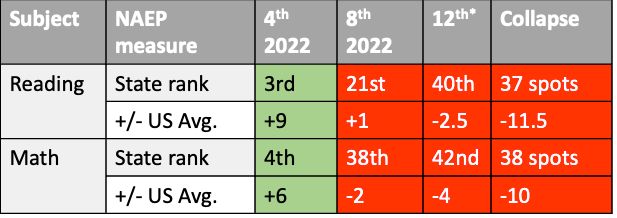
Billy Townsend, Florida blogger, has reported regularly on Florida’s gaming of NAEP scores. He writes here that Governor Ron DeSantis is carrying out Jeb Bush’s old trick to inflate 4th grade NAEP scores. He calls the governor Ron Jebsantis. The trick is third grade retention, which ensures that the lowest scoring third graders never take the fourth grade NAEP test (the kids who take the NAEP test are selected at random).

Thus, DeSantis put out a flashy press release celebrating fourth grade NAEP scores in the test scores recently released. But, as usual, DeSantis neglects to mention the collapse of eighth grade NAEP scores. Somehow the kids who were retained in third grade managed to skip fourth grade and rejoin their classmates by eighth grade.

Here are his numbers, drawn from NAEP reports:

With that in mind, here is a view of Florida’s 2022 NAEP scores peaking in elementary school and dramatically worsening with the older cohorts —- which is ALL of the red numbers after the green baseline.

I personally put no stock in the twelfth grade numbers (which Billy extrapolated) because NAEP stopped testing seniors a decade ago. Seniors know that NAEP doesn’t count and they don’t do their best. Some don’t even try. Their answer sheets had doodles, or some just picked the (A) answer to every question or some were blank.

But the stark drop from fourth grade to eighth grade says something’s fishy in Florida.

Many Twitter users are fearful for the future of the popular social media site since it was purchased by Elon Musk. He is taking the company private and will be the sole proprietor. He has said he is an absolutist on free speech, which raises questions about whether he will tolerate hate speech, lies, propaganda, anti-vaxxers, disinformation, even Donald Trump, who was permanently banned from Twitter for inciting violence.

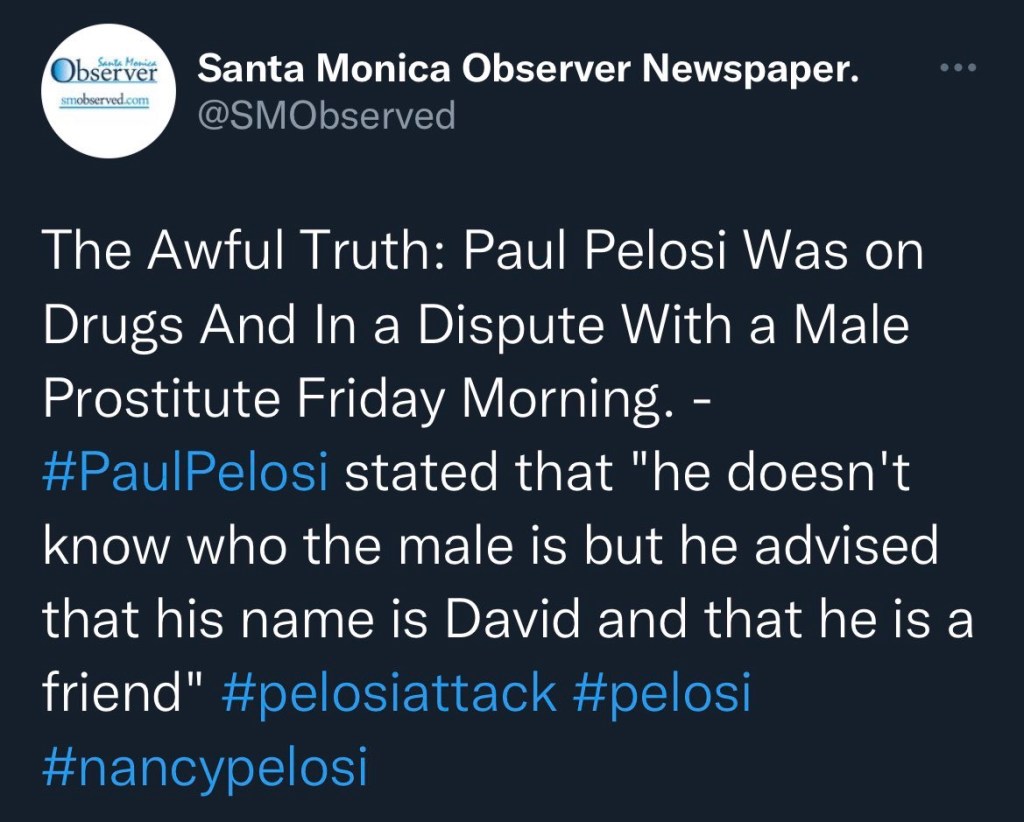
Now, the concern about Musk was stoked when he retweeted gossip from a free weekly (the Santa Monica Observer) that Paul Pelosi was drunk, high on drugs, and got into a fight with a man he picked up at a gay bar.

Musk posted that there was a “tiny possibility” that this was true. As readers began to react with incredulity that the new owner would spread unsubstantiated gossip, Musk deleted his tweet. Musk has 112 million followers on Twitter.

The San Francisco Chronicle wrote:

Musk responded Sunday at 5:15 a.m. Pacific time with a tweet that said, “There is a tiny possibility there might be more to this story than meets the eye,” and posted a link to a baseless, anti-LGBTQ article in the Santa Monica Observer. By 10:30 a.m. Sunday, the message and link had been retweeted more than 30,000 times and liked more than 110,000 times, before being deleted less than an hour later.

Last year, the Los Angeles Times reported that the Santa Monica Observer was “notorious for publishing false news,” and once claimed “that Hillary Clinton had died and that a body double had been sent to debate Donald Trump.”

Axios posted that the Santa Monica Observer is not a trustworthy site.

Why it matters: Musk linked to an article from the Santa Monica Observer, a website known for years for publishing false stories.

  • The site “is anything but trustworthy,” according to an executive at NewsGuard, a company that uses trained journalists to rate news and information sites.
  • The site has a trust score of 44.5 out of 100 points on NewsGuard’s rating scale for trustworthiness, due to repeatedly publishing numerous conspiracy theories and false claims about politics, the pandemic and more.
  • The site gets a red-rating and a warning for readers that says: “Proceed with caution: This website fails to adhere to several basic journalistic standards.”

Responsible people in the media fact-check. Musk didn’t think it was necessary. This does not bode well for the future of Twitter.

We have had our fill of conspiracy theories in the past six years.

It’s awful to think that the sole owner of Twitter will be a dupe for conspiracy theories and gossip and spread them to his millions of readers.

Just for laughs, read this article in The Intercept, which predicts that Elon Musk will regret his purchase of Twitter.

It begins:

ELON MUSK (and his consortium of much smaller investors) now owns Twitter. We need to take seriously the possibility that this will end up being one of the funniest things that’s ever happened.

That’s because as of this moment, it looks like Musk dug a big hole in the forest, carefully filled it with punji sticks and crocodiles, and then jumped in.

Our reader Jersey Joe added this postscript from The Guardian about the Republican candidate for governor of Pennsylvania:

From the guardian, 10-24-22: quote – Doug Mastriano, a retired army colonel who has enthusiastically indulged Donald Trump’s fantasy that the 2020 presidential election was stolen, is the Republican candidate. If he wins, he plans to deregister every single one of Pennsylvania’s 8.7 million voters. In future elections, Mastriano would choose who certifies – or doesn’t – the state’s election results. [snip] As a state senator in Pennsylvania, he said women who violated a proposed six-week abortion ban should be charged with murder. Mastriano frequently attacks trans people, and has said gay marriage should be illegal, and that same-sex couples should not be allowed to adopt children. end quoteThe man is a far right wing nightmare determined to end democracy in this country. According to these maniacs, elections are fair and valid only if the GOP wins.

Since the two sets of NAEP scores were released recently, commentators have gone into a panic about “learning loss” and used the declines to promote their favorite reform: more of this, less of that. DeSantis even released a press release claiming falsely that Florida’s formula of ignoring the pandemic was just right (California stuck with the CDC guidelines and did at least as well, maybe better, than Florida, but Gavin Newsom did not issue a press release).

Jan Resseger has words of perspective that I sum up as: why are we surprised that learning was disrupted by the pandemic?

My question, having served on the NAEP board for seven years, is why the media and the reform crowd thinks that NAEP scores should go up every year? Why should fourth and eighth graders this year know more than fourth and eighth graders two years ago or four years ago? Isn’t it reasonable to assume that students of the same age and grade are likely to have the same scores? Yet if they do, the media sends out loud lamentations that scores are “flat.” Oh, woe! Surely we want to see a rise in the scores of the lowest scoring students, and a narrowing of gaps, but the media assumes that everyone must increase their scores or the education system is failing. This is nuts. There is little or no relationship between the test scores of students in fourth and eighth grades and the economy of the future.

Jan Resseger writes:

Are the new National Assessment of Educational Progress scores a catastrophic indication that the U.S. public schools have fallen into decline? I don’t think so.

Early this week, the National Center for Education Statistics (NCES) released a large data set from National Assessment of Educational Progress exams administered last spring to 4th and 8th grade students in U.S. public schools. Last month, NCES released scores from tests administered to a smaller group of 4th graders. Both sets of scores show that the COVID pandemic seriously disrupted schooling for the nation’s children and adolescents.

Chalkbeat’s Matt Barnum explainswhat the National Assessment of Educational Progress (NAEP) is: “The National Assessment of Educational Progress (NAEP, pronounced nape) is a test administered by an arm of the U.S. Department of Education. It’s given periodically to a representative subset of American students in math and reading in grades four and eight. Scores are broken down by state and for a select handful of cities, too. The latest results are based on tests given between January and March 2022. The previous test was given in 2019, before the pandemic… Scores from a separate NAEP exam that has been given to 9-year-olds for many decades were previously released in September.”

The NAEP scores released this week were precipitously lower than scores on the NAEP when it was administered in 2019, before COVID—particularly in 8th grade math. The Washington Post’s Laura Meckler reports: “The portion of eighth-graders rated proficient or better in math fell to 27 percent, from 34 percent in 2019… the steepest decline in more than a half century of testing.” (The fact that every year relatively few students reach NAEP’s proficient level overall is because the NAEP “proficient” cut score is set artificially high; it marks what most people would define as “advanced.”)

Some people assume that this year’s drop in NAEP scores signals a reversal of progress, the beginning of a downward spiral. Others are using the scores as evidence for their particular reform or as evidence that their state had a better policy on school closures than other states. Meckler writes: “Partisans on all sides of the education debate seized on the results to advance competing ideas about the way ahead… The test results also offered fodder for those who argue bringing students back to campuses quickly was the right move… ‘We kept schools open in 2020, and today’s NAEP results once again prove we made the right decision,’ Florida Gov. Ron DeSantis (R) said on Twitter. But the data did not establish a connection between back-to-school policies and academic performance. In California, for instance, many public schools were closed well into the 2020-21 school year and some students never saw a classroom that year. But the declines were similar to those in Texas and Florida, where schools were ordered to reopen much sooner.”

In a blog post last month when the first set of 4th grade NAEP scores was released, I shared my own assessment of what had happened. I think the scores released last month and the scores released this week show the same thing. Here is some of what I said in that post.

***

There is no cause for panic. Schooling was utterly disrupted for the nation’s children and adolescents, just as all of our lives were interrupted in so many immeasurable ways. During COVID, while some of us have experienced the catastrophic death of loved ones, all of us have experienced less definable losses—things we cannot name.

I think this year’s NAEP scores—considerably lower than pre-pandemic scores—should be understood as a marker that helps us define the magnitude of the disruption for our children during this time of COVID. The losses are academic, emotional, and social, and they all make learning harder.

Schools shut down and began remote instruction in the spring of 2020, and many stayed online through the first half of last school year. While most public schools were up and running by last spring, there have been a lot of problems—with more absences, fighting and disruption, and overwhelming stress for educators. It is clear from the disparities in the scores released last week among high and low achievers that the disruption meant very different things to different children. It is also evident that the pandemic was a jolting shock to our society’s largest civic institution. It should be no surprise, then, that the attempt to get school back on track was so rocky all through last spring…

While the NAEP is traditionally used to gauge the trajectory of overall educational achievement over time, and while the trajectory has been moderately positive over the decades, the results released last week cannot by any means be interpreted to mean a change of the overall direction of educational achievement.

Education Week’s Sarah Schwartz asked Stanford University professor Sean Reardon (whose research tracks the connection of poverty and race to educational achievement) whether “it will take another 20 years to raise scores once again.” Reardon responded: “That’s the wrong question…. The question is: What’s going to happen for these (9-year-old) kids over the next years of their lives.” Schwartz describes more of Reardon’s response: “Children born now will, hopefully, attend school without the kinds of major, national disruptions that children who were in school during the pandemic faced. Most likely, scores for 9-year-olds, will be back to normal relatively soon, Reardon said. Instead, he said, we should look to future scores for 13-year-olds, which will present a better sense of how much ground these current students have gained.”

Schwartz reports: “Students at all levels lost ground during the past two years, but lower-performing students saw the biggest drops.” The test does not in any way measure the factors that contributed to the drop in scores for students who were already struggling, but the results shouldn’t be surprising. Some children live in families with internet access and enough computers that each of several children in the family could access online instruction simultaneously, while other children’s parents had to drive them to public library or fast food outlet parking lots to find any internet access at all. Some parents had sufficient time at home to supervise children and provide assistance during online instruction, while in other families, older siblings supervised younger siblings while trying to participate themselves in online instruction. Some children and adolescents simply checked out and neglected to log-on.