Did you see the Tony awards last night? It was a great show, celebrating Broadway, celebrating the young people who sing and dance and act, and the creative talent of all ages and kinds that create magic onstage.

It was joyful!

Watch this song from a new rendition of Cats, called The Jellicle Cats. What talent!

For years, I have thought about the contrast between The Oscars and the Tony awards. I watch both, and every year I find the Oscars slow, sometimes tedious, and the musical numbers are usually dull.

Why?

The answer is obvious. The people who do the musical numbers at the Oscars were assembled to perform, they rehearse and rehearse, and they put on a good show. But never as good as the Tony awards.

Why?

Because the musical numbers at the Tony awards are performed by singers and dancers who have performed those numbers hundreds of times, eight shows a week.

What a difference!

I loved the Tony awards 2026.

We continue to see stories about American military attacks on small boats in the Caribbean or the Pacific. We read that our planes destroyed a boat carrying drugs and drug dealers. How do we know whether the boat was carrying drugs? No evidence is presented. How do we know that the men killed were drug dealers, not fishermen? We don’t. We have to trust Pete Hegseth.

Dominic Preziosi, editor of Commonweal, says that without evidence, the attacks on small craft might be “simply murder.” Commonweal is a liberal Catholic journal that is thoughtful and definitely worth reading.

He writes:

Now that his appeals have been denied, former Philippines president Rodrigo Duterte faces trial for crimes against humanity at the International Criminal Court. Duterte is charged with killing alleged drug addicts and dealers during his terms as mayor of Davao City and as president from 2016 to 2022—about six thousand people, though some estimates put the total closer to thirty thousand. Duterte dispatched police death squads to carry out his campaign of extrajudicial executions, which was condemned at the time by rights groups around the world and by Catholic leaders in the Philippines, who called it a “reign of terror.” Duterte once bragged of having stabbed someone to death, and while president said he would “be happy to slaughter” three million drug addicts in the country if he could.

Donald Trump was an early admirer of Duterte. In April 2017, three months into his first term, Trump called Duterte to praise him for his murderous crackdown. “I just wanted to congratulate you because I am hearing of the unbelievable job on the drug problem,” he enthused. “Many countries have the problem, we have a problem, but what a great job you are doing.” Just a month before that, the U.S. State Department had criticized Duterte in its annual human-rights report, citing “apparent governmental disregard for human rights and due process.”

There are unmistakable echoes of Duterte’s “unbelievable job” in the Trump administration’s campaign of boat strikes in the Caribbean and eastern Pacific, which was launched last September under the pretext of protecting the “American homeland” from drug cartels and so-called narcoterrorists. In fifty-eight attacks by drone and aircraft—the most recent on May 26—nearly two hundred people have been killed. In at least one instance, U.S. forces returned to kill survivors clinging to the wreckage of a vessel already struck. The U.S. military has also used aircraft painted like a civilian plane to carry out some of the attacks. Both of these would qualify as war crimes. Wary of being linked to human-rights violations, allies like Canada, the United Kingdom, and the Netherlands have stopped sharing intelligence that they think could be misused by the United States to target vessels. Shortly after the attacks began, Arizona senator Mark Kelly and several other Democratic lawmakers—all of whom served in the military or intelligence community—issued a joint statement reminding service members that they do not have to obey illegal orders. 

In none of the boat strikes has the military seized drugs or produced evidence that those it killed were involved in the drug trade. Many of the victims appear to have been fishermen or other laborers. This hasn’t stopped Trump from demonizing those killed or members of his administration from releasing celebratory video clips of vessels being destroyed from high above. Vice President J. D. Vance has cracked that he “wouldn’t go fishing right now in that part of the world.” In defending the campaign, called “Operation Southern Spear,” Hegseth uses bizarre theocratic rhetoric, warning that “Christian nations, under God” cannot be led astray by “radical narco-communists.” 

Trump, meanwhile, spouts nonsense about the targeting program’s effectiveness. He has claimed that the strikes have prevented twenty-five thousand cocaine-related deaths in one year, though experts say that there have not been that many such deaths over the past fifty years in total. He has baselessly declared that “98.2% of Drugs coming into the U.S. by Ocean or Sea have STOPPED!” since the killing spree began. He has failed (repeatedly) to distinguish between cocaine and fentanyl—which has taken a deadly toll on Americans, but which enters the country via land routes and is not transported by sea. Meanwhile, traditional interdiction—stopping suspicious vessels, confiscating drugs, arresting traffickers, all while refraining from indiscriminate killing—continues to be the most effective means of disrupting shipments

But in many ways that is all beside the point. The strikes are wrong on legal, ethical, and moral grounds. The administration’s contention that the United States is at war with “narcoterrorists”—an argument that builds on the spurious reasoning of the Bush administration to justify its use of torture in the “global war on terror”—doesn’t permit it to launch lethal attacks on civilians. Even John Yoo, the former Bush official who devised that reasoning, has qualms about the Trump administration’s rationale for killing people in international waters. “Never before in the country’s history has the government asserted this type [of] power,” Seton Hall law school professor Jonathan Hafetz told The Guardian. “This is a clear example of unlawful killing by the United States.” 

The Pentagon’s internal watchdog recently announced it will investigate the boat strikes, but that it will only evaluate “the joint process for targeted vessels”—how the military conducts the attacks, leaving aside the matter of their legality. While Duterte may have to answer for his crimes, no American official involved in killing civilians at sea—from Trump and Hegseth on down—will face trial in an international court, since the United States does not recognize the jurisdiction of the ICC. The families of two Trinidadian fishermen killed by the United States have filed suit against the administration in a Massachusetts court, but it’s hard to know how their case will fare given that foreign nationals are not protected by federal law. Yet their charge seems beyond dispute: “[The attacks] were simply murder, ordered at the highest levels of government and obeyed by military officers in the chain of command.” 

Dominic Preziosi is Commonweal’s editor.

Despite appearances, the most powerful person in the Trump administration is not Donald Trump: it’s Russell Vought, Director of Office of Management and Budget. He is the brains of this administration. Vought was at the Heritage Foundation and was one of the writers of project 2025. He controls the budget and makes the decisions about which government programs should live or die. Trump has impulses, whims, and passing fancies; Vought is methodical and determined to impose his rightwing views on the entire federal government. Every federal grant, Vought believes, should align with Trump’s anti-woke, anti-DEI agenda.

Tony Romm wrote about Vought’s strategy in The New York Times:

The White House is seeking to exert more control over billions of dollars in annual government grants, aiming to restrict a vast swath of funding — in health, housing, science and transportation — so that it primarily serves the purposes and organizations politically aligned with President Trump.

While the administration says that its primary goal is to safeguard taxpayer money, its proposal amounts to a major escalation in its attempt to reimagine the nation’s spending, even as Congress and the courts continue to rebuke the president for abusing such powers.

Mr. Trump’s ambitions were made clear in a roughly 400-page blueprint that was released to little fanfare on Friday. If finalized, it would require all federal grants to be approved by the president’s political appointees, who must ensure that the money would “demonstrably advance the president’s policy priorities.”

For the agencies that issue those awards and the nonprofit groups, local governments, universities and other entities that receive the money, the Trump administration would also impose a set of highly prescriptive and political criteria.

The government could not issue grants to projects or groups that “deny the biological reality of sex or the sex binary in humans,” for example. Nor could it seek to fund initiatives that “promote anti-American values,” contribute to illegal immigration, advance diversity, equity and inclusion or assist in voter registration.

The rules would further limit the ability of grant recipients to engage in some “issue advocacy.” Those that are funded would be scrutinized for their compliance with “religious liberty laws” and their “memberships and affiliations” with outside groups. And they could face the outright termination of their grants if the Trump administration someday determines that their actions are not in the “public interest.”

The restrictions echo the string of executive orders that Mr. Trump signed shortly after returning to office, many of which have been challenged or blocked in court. This time, however, the White House has pursued its restrictions by proposing a regulation, which is expected to become final after the government solicits public comment. The result could be applied far more broadly, and perhaps in ways that are harder to fight legally or undo later, according to budget experts.

The consequences could fall hardest on health and science, a field in which Mr. Trump has pursued some of the steepest cuts in his second term.

In exchange for federal assistance, researchers would face limits on the subjects that they can explore, the foreign labs with which they may collaborate and even the conferences at which they can appear. Dr. Georges C. Benjamin, the chief executive of the American Public Health Association, a professional organization and advocacy group, said the policy could “devastate innovation, science and research” in the United States.

Those of us who live in the Northeast have to worry about the danger of Lyme disease, a very serious disease that occurs because of tick bites. If you live in a high-rise building, it’s not a problem. But if you garden or walk in the woods, you and your dog are at risk of getting a tick on your body. They burrow into your skin, and they carry diseases that can be very dangerous, even fatal. Our pets can be protected against ticks with tick collars or serums, but there’s nothing we can do to protect ourselves other than to cover up, use repellent sprays, and keep checking to see if there’s any ticks on our body or our scalp.

In the Northeast, ticks are abundant. On the island of Martha’s Vineyard, off the coastline of Massachusetts, there are 11 times as many ticks as in the rest of the state. Residents are eager to find ways to protect themselves.

Secretary of Health and Human Services Robert F. Kennedy Jr. recently traveled to New Hampshire to talk about his plans to combat Lyme disease.

Rich DiPentima, public health specialist, explained that Kennedy’s ignorance and his contempt for vaccines were evident.

He wrote in InDepthNH:

On Friday, DHHS Secretary Robert F. Kennedy Jr. visited New Hampshire to promote improved treatment, diagnostics and prevention strategies to reduce the burden of Lyme disease.  I applaud Mr. Kennedy’s efforts to improve the much needed advancements in Lyme disease diagnosis and treatment, however, his approach to prevention reflects a poor understanding of the epidemiology of Lyme disease.

In his comments, Kennedy explained that the HHS is launching a “major, new multimillion dollar” program which will see the HHS and Centers for Disease Control (CDC) partner with researchers, to develop and deploy practical strategies to eliminate ticks on wildlife before they can breed on deer.  This comment suggests that deer are the major reservoir for Lyme disease.  In fact, most cases of Lyme disease result when individuals are bitten by infected ticks that have been on rodents and other small mammals, not deer.

Lyme disease is transmitted by infected black legged, aka deer ticks. The primary reservoir for Lyme disease in the northeastern U.S., which is caused by the bacteria Borrelia burgdorferi, is the white-footed mouse. When the black legged tick bites an infected mouse it becomes infected and then can transmit the disease to humans and other mammals like deer, dogs etc.  As such, strategies to prevent deer from becoming infected would be very unproductive and have very limited value in reducing Lyme disease cases in humans.  In order to do so, you would need to greatly reduce the number of mice and other small rodents that carry Lyme disease as well as reduce the tick population. Considering the huge population of mice and other small mammals as well as ticks, this would be impossible and a waste of resources. 

What was conspicuously absent from Mr. Kennedy’s prevention strategy discussion was a vaccine.  This is not surprising considering Mr. Kennedy’s history of anti-vaccine activity.  We had a Lyme disease vaccine, LYMErix, which was voluntarily discontinued in 2002 due to low consumer demand, negative media coverage and unproven concerns regarding adverse side effects.  However, Pfizer and Valneva pharmaceutical companies have developed a promising vaccine candidate known as PF-07307405 (VLA15) which is currently in phase 3 trials and could be released in 2027.

If Mr. Kennedy was truly serious about preventing Lyme disease on a large scale, the most effective and efficient means would be by developing a safe and effective vaccine.  As was done during COVID under Mr. Trump’s Warped Speed project, the government, working with private pharmaceutical companies like Pfizer and Valneva, could greatly speed up the process and have a safe and effective  vaccine available next year.  That would be a game changer with regard to Lyme disease primary prevention.  Currently, our pet dogs get vaccinated against Lyme disease.  I look forward to the day when we can also enjoy real protection from this terrible disease.  

Rich DiPentima, RN, MPH
Former Asst. Director NH Division of Public Health Services, Deputy Public Health Director Manchester Health Dept., Retired Air Force Public Health Officer and former State Representative.
Portsmouth, NH 03801

Today is D-Day, a time to commemorate the brave Allied troops who stormed the beaches at Normandy, many knowing that they faced certain death. D-Day was the largest amphibious assault in history, the prelude to liberating Western Europe from Nazi control. Nearly 160,000 troops from the United States, Great Britain, and Canada stormed the beaches on the West coast of France, clearing the way for a massive invasion.

Presidents since the end of World War II have commemorated this day, recognizing the valor of the troops.

But not Donald Trump.

Instead, he posted a truly vain and loathsome video celebrating himself. All around the world, the AI-generated video asserts, Trump is loved, people everywhere celebrate his awesomeness. He dances his way through the video, doing that odd little dance he does with his arms.

This video should be viewed and analyzed by a panel of psychiatrists. It reeks of narcissism and clueless self-regard. Is he showing his deep need to be adored because he is not? is he hungry for admiration, so much so that he literally fakes it and advertises it? Is there a gaping hole in his heart because he didn’t get enough love when he was a child? Is he still trying to prove himself?

I’m no psychiatrist, so I hope that others who are will take up the task of analyzing this starkly narcissistic, embarrassing paean to himself.

Whatever else it is, it is not normal.

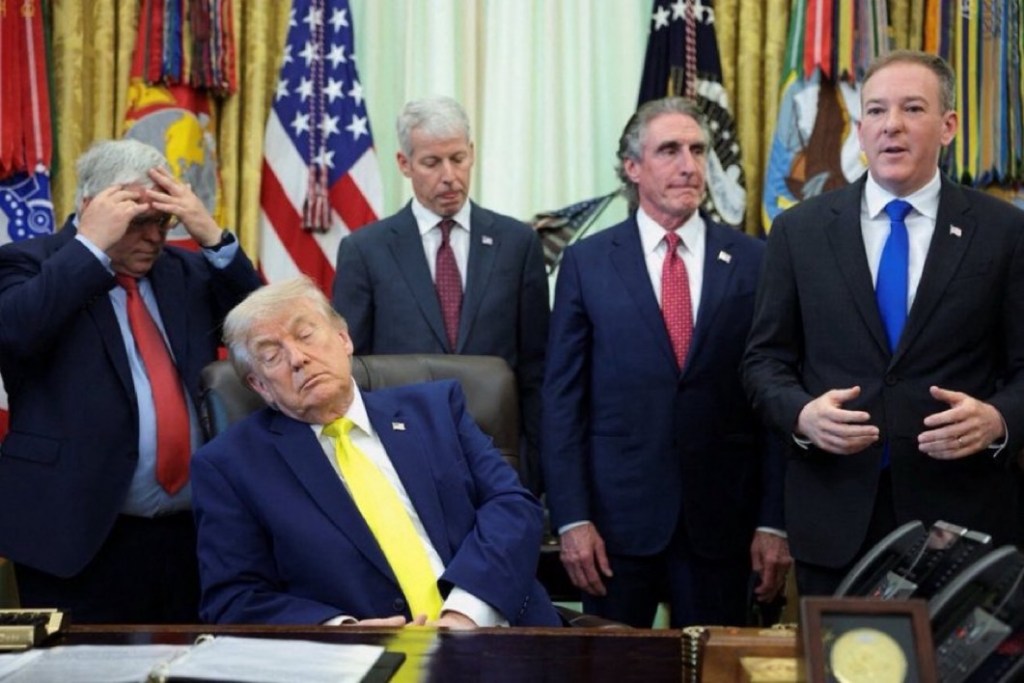
Sleepy Donald

Trump stays up all night, rage-tweeting. A guy has to get some sleep. The only things that hold his attention are his magnificent, golden ballroom. His 250-foot arch that will crowd out the view of the Arlington National Cemetery, his repainting of the reflecting pool on the Mall so that it looks like a swimming pool. His gaudy cage for the UFC match. He thinks it’s so stunning that he’s musing about not removing it.

And look what he did to Jackie Kennedy’s beautiful rose garden! He paved it over!

Yesterday he posted an image of himself as a muscle-bound athlete, instead of an overweight old man who turns 80 in 10 days. Multiple comments on Twitter saluted him for celebrating Pride Month!
And here is a before-and-after photograph of the White House lawn. On the left is the way it is supposed to look. On the right, a picture of what Trump has done to set up a cage with arena seating for the UFC fight that will be staged to celebrate the nation’s 250th birthday. he said yesterday that he might leave the cage. He compared it to the Eiffel Tower, which was supposed to be temporary but has now become an icon. Who will tell him that he has defaced the White House? It belongs to the American people, not to its current occupants.

Ivanka Trump Kushner was recently interviewed about her and her husband’s plans to develop Sazan Island, off the coast of Albania, into a major resort. Five miles of private beachfront. Thousands of hotel rooms. She says she wants it to be the kind of setting that people want. It’s clear that she has no contact with most “people.”

Sazan Island is owned by the state. The Kushners intend to privatize and develop it. The president of Albania welcomes foreign investment because Albania is poor, and he wants to bolster the economy and create jobs.

Albanians are not happy. In fact, thousands of them are rioting against the deal, due to the threat to the island’s natural beauty and biodiversity. It’s possible that their riot is intensified by their views of the Trump family.

The people in the streets may block it.

The New York Times broke a story about how tech companies have quietly pushed kids to be dependent on social media. The link takes you to a gift article, which you can open and read for free.

The article was written by Jennifer Valentino-DeVries, an investigative reporter who covers technology.

The Times opened the article with this overview: Internal documents show how tech giants grabbed children’s attention throughout the day, a strategy that schools say has undermined education.

The article begins:

Snapchat sent phone alerts to adolescents during school hours, urging them to share what was going on in their classrooms.

Meta paid “teen ambassadors” to promote Instagram and hand out swag to their friends at school.

TikTok gave the National PTA millions of dollars, in part to throw school events about online safety and provide favorable comments to journalists.

Again and again, the world’s leading social media companies have targeted students, even as complaints have mounted that they are hurting teenagers’ mental health and academic performance, according to a New York Times review of internal documents that lay bare for the first time these tactics to hook young users.

The documents emerged from lawsuits filed by more than 1,400 school districts against Meta, Snap, TikTok and YouTube amid a rising backlash against social media, with parent movements and best-selling books blaming the platforms for loneliness, bullying, eating disorders and sexual exploitation.

The outcry, long focused on social media’s harm to mental health, has now shifted to its upending of the classroom. Many school districts are banning smartphones, and some are re-evaluating their reliance on devices like Chromebooks, the inexpensive laptops made by YouTube’s parent company, Google.

The companies’ push to keep children glued to their screens has overshadowed concerns from parents, teachers and even their own trust and safety teams about interfering with school, according to the documents and interviews with dozens of parents, teachers and former tech company employees.

TikTok’s leaders decided not to disable notifications during school hours, rejecting a change that its safety teams had pushed for years. A Snapchat strategy document referred to classroom phone use as “under the desk” time. Google managers knew YouTube was recommending videos to students during the school day that had nothing to do with their lessons.

The school districts contend that the apps’ addictive designs made teachers’ jobs more difficult. “It is so constantly tempting to these kids to be on a platform that promises endless, infinite, varied entertainment rather than actually focusing on what they should be at school to do,” said Previn Warren, one of the lead lawyers for the schools.

The companies argue that the Covid pandemic and other factors have harmed adolescents’ mental health, and that parents, schools and cellphone makers bear responsibility for children’s phone habits. They also say that they have made their platforms safer with parental-control features and account restrictions for minors.

All four companies recently settled with Breathitt County Schools, a small district in rural Kentucky that served as a test case for the litigation nationwide. The district, which has about 1,500 students, had sought $3 million in damages and about $60 million that it had planned to put toward a long-term education and mental health plan. The companies agreed to pay Breathitt $27 million: $9 million from Meta, $8 million each from Snap and TikTok and $2 million from Google, according to documents released on Friday and first reported by Bloomberg.

While it’s hard to say how the ongoing litigation might ultimately affect classrooms, it poses a substantial financial risk to the companies, possibly costing billions of dollars, said Alexandra Lahav, a civil litigation professor at Cornell Law School. She noted that the companies were also facing a barrage of claims from families and state attorneys general.

Message to Big Tech: Leave our kids alone!
Sonja Shaw, a right-wing school board president, came in first in the race for State Superintendent of Public Instruction in the recent election in California. She received 25% of the vote and is heading for a run-off against Richard Berrara, also a school board president, who received about 19% of the vote.

Shaw was supported by the far-right group Moms for Liberty. She was been outspoken in opposing transgender athletes who compete against females.

Howard Blume wrote in The Los Angeles Times:

Sonja Shaw — a Trump-aligned Republican whose public profile rose as she became identified with culture-war causes, including banning transgender athletes from girls’ sports — has emerged as the leading vote-getter in the June primary for California’s superintendent of public instruction.

With all precincts at least partially reporting Wednesday, Shaw, with 24.9% of the tallied votes, was well ahead of Democrat Richard Barrera, who had 18.9% of the votes. Even with vote-counting ongoing, that lead would be difficult to surmount.

Both Shaw, 43, and Barrera, 59, are school board presidents.

Shaw heads the elected Board of Education for Chino Valley Unified in San Bernardino County, a diverse but substantially conservative inland portion of Southern California…

Among its high-profile actions, the Chino Valley board majority put forward a policy that would require parents to be notified if their child expressed gender-identity issues at school. Shaw and her allies also approved a policy that allows parents to challenge the content of library books.

In the primary, Shaw was greatly helped by a candidate field that included seven Democrats, including veteran legislators and local school district officials…

Barrera heads the school board of San Diego Unified, the state’s second-largest school district, serving an area with liberal leanings, but that is also politically diverse.

An obvious difference for Barrera was a $5-million independent campaign on his behalf from the California Teachers Assn., which he acknowledged Wednesday morning.

“The CTA campaign made all the difference and it’s based on a long track record and partnership that I’ve had with educators in San Diego,” Barrera said.

Barrera sees the teachers union support as emblematic of a positive vision he has for education that will unite most voters around his campaign in November…

Positioned in a runoff against one Democrat — in a state where Democrats dominate — makes for a challenging campaign for Shaw.
“Tonight is not the finish line,” Shaw said. “It’s the beginning of the final stretch.”

Scott Pelley worked CBS News for 37 years. Most recently, he was part of the team at “60 Minutes,” which is the most prestigious, most watched news program on television.

After CBS was sold to the Ellison family, which is close to Trump, the entire news division was shaken up. Bari Weiss, a journalist with center-right views, was hired as editor-in-chief of CBS News. The firings began. “60 Minutes” was one of the targets.

When the program’s executive producer was fired, her replacement met with the “60 Minutes” staff. Scott Pelley lambasted him, Weiss, the firings, and the undermining of the program.

The next day, he was fired.

He released this statement:
 
There has never been anything in America like 60 Minutes.
 
The Sunday tradition is the most successful program of any kind in history. For more than a decade, its innovative growth on every major online platform has extended its reach to countless millions around the world. This spring, at the end of our 58th season, 60 Minutes grew rapidly with an unheard-of 9% jump in viewers on CBS.
 
“60” has been the number-one program in America for decades because our beloved audience finds integrity, quality, and humanity in our stories. When stewardship of the program passed to my colleagues and me, our responsibility was to expand energetically into a new age of media technology while preserving the values our audience expects. Now, the new owner of our network is casting this legend aside, apparently to curry a moment of favor with the Trump administration.
 
The waste is heartbreaking.
 
Last month, 60 Minutes lost its DNA when our entire senior leadership and two of our best on-air correspondents were cruelly fired without cause. Good people were silenced because they stood up for our audience. They stood for fairness against the forces of political bias; they stood for professionalism against chaos.
 
For my part, new management has instructed me to inject falsehoods and bias into a politically sensitive story. I’ve been told to include assertions that are unverified. To date, in every case, I have managed to ignore these instructions or refuse them. Recently, politicians have been invited to choose correspondents for interviews on the broadcast. Giving politicians control over 60 Minutes interviews is not how this is done. Finally, incompetence and unprofessionalism in the new management have wreaked havoc. In a case involving one of my stories, the entire program came within 19 minutes of not getting on the air at all.
 
At 60 Minutes, we have fought harder than anyone knows to save the program that became an American icon. We owed that to our millions of viewers. I am deeply moved by the thousands of wishes we have received to “keep up the good fight.” Most of the men and women of CBS News are still in that fight. But now the collapse of values at the top has become untenable. The leadership of 60 Minutes is no longer recognizable. The principles I hold dear are gone, and so I must leave as well.
 
I depart after 37 years at CBS with one emotion—a heart brimming with gratitude for the men and women of CBS News who encouraged and enriched my work, very often at the risk of their own lives. I pray for a day when those people and their ideals are honored again—a day when sanity, competence, and courage return.
 
Scott Pelley