The world of education is continually susceptible to hoaxes, frauds, and panaceas. The media pounces on miracle schools, miraculous teachers, and methods that turn every student into a genius.

Tom Ultican, retired teacher of physics and advanced math in California, cannot tolerate scams and overblown claims.

His latest commentary is about “the science of learning,” which comes with the usual fanfare.

He writes:

On September 24, The 74 headline read“What Happens When a 48K-Student District Commits to the ‘Science of Learning’ – In Frederick County, Maryland, test scores rose, achievement gaps shrank and even veteran educators slowly embraced the decidedly not-faddish fix.” This statement is mostly baloney used to sell the “science of learning.”

The article opens with a new first grade teacher discussing her next day’s math lesson with the school’s principal, Tracy Poquette. The third paragraph says,

“Poquette recommended the whiteboards. ‘You’re going to ask them to hold them up,’ Poquette coached Able, miming holding a whiteboard in the air. Then you can see their answers, and how they got to that. Every student is responding.”’

This seems fine but it is hardly innovative. This technique comes from the 20th century or maybe even the 19th century. The next paragraph states, “The sessions are meant to accelerate student learning and take some of the guesswork out of becoming an effective teacher, part of a larger district plan to incorporate research from the fields of neuroscience, educational psychology and cognitive science — often referred together broadly as the ‘science of learning.’”

They are selling baseless malarkey. Neuroscience and cognitive science still do not provide much usable insight into how students learn or what the best teaching methods are.

The claim of rising test scores is deliberately misleading. The scores may have risen a little but this is a case in which the cause is pretty clear. In statistics, the r-value correlation has a value between o and 1 for determining the effects of different inputs on education testing results. An r = 0 means there in no relationship and an r = 1 means the input is 100% determinative. Inputs like teacher, curriculum design, class size, etc. can be evaluated. The only input ever found with more than o.3 r-value is family wealth at a 0.9 r-value. Between 2021 and 2022, Frederick County, Maryland had “the largest net positive change in total income in the state.” As indicated by statistical analysis, of course test scores raised some.

These fraudulent claims about the “science of learning” are being financed by wealthy people wanting to implement competency based education (CBE). With its concentration on developing mastery of small discrete information bites, CBE makes kids learning at screens more possible. Since 2010, the annual GSV+ASU conference, which is a big deal with tech billionaires, has been striving toward this goal. At their 2023 conference in San Diego, Carnegie and ETS announced a new partnership to create functional testing for competency based education (CBE).

GSV appears to have convinced Tim Knowles and the Carnegie Foundation to abandon the Carnegie Unit to open the way for CBE based testing and badges.

The Claims and Propaganda

Trish Jha, a research fellow at the Center for Independent Studies in Australia, just published a more than 15,000 word essay explaining why the “science of learning” is needed. She claims:

The proponents of the “science of learning” claim that Pestalozzi, Herbart and Dewey, the fathers of progressive education, were wrong. They tell us that “problem based education” is counterproductive and that discovery approaches are harming children. They claim that direct instruction and drilling small bits of information to mastery are what children need.

“Australian education needs to position the science of learning as the foundation for policy and practice.”

“Unfortunately, key pillars of Australian education policy do not reflect the science of learning, due to the far-reaching impacts of progressive educational beliefs dating back to the 18th century.

These beliefs include that:

  • Students learn best when they themselves guide their learning and it aligns with their interest;
  • Rote learning is harmful;
  • Learning should be based on projects or experiences, and that doing this will result in critical and creative thinkers.

But these beliefs are contradicted by the science of learning.”

Ms. Jha asserts, “The teaching approach best supported by the evidence is explicit instruction of a well-sequenced, knowledge-focused curriculum.” She sites E. D. Hirsh as one of her experts supporting this thinking.

It is part of a worldwide effort by wealthy people to digitized education under the cover of “science of learning”. In 2018, the Center for American Progress (CAP) wrote:

“This brief builds on the growing momentum for both the science of learning and school redesign. Last month, for instance, the XQ Institute released a policy guide for states on how best to redesign their schools. The document argued, among other things, that students should be able to learn at their own pace, progressing as they demonstrate mastery of key concepts.

And CAP went on to quote XQ:

“[Competency-based education] isn’t about replacing what goes on in the classroom with less-demanding experiences outside of it. This is about integrating innovative approaches to teaching in the classroom with opportunities for students to develop practical, concrete skills in real world settings. And it’s about awarding credit for learning—demonstrated learning—no matter where or when the learning takes place.”

The XQ institute is the creation of noted anti-public school and teacher-disparaging billionaire, Laurene Powell Jobs.

For 50 years, mastery-based education now called CBE has been a major flop. Established on the mind-numbing drill and skill approach, CBE undermines authentic learning. It has never worked.

Deans for Impact a Billionaire Created Example

The Deans for Impact Supporters Page

Teach for America (TFA) is viewed by many people as the billionaires’ army for school privatization and the New Schools Venture Fund (NSVF) is the Swiss army knife of public school privatization. Deans for Impact (DFI) was created in 2015 with personnel from TFA and NSVF.

DFI founder, Benjamin Riley, was a policy director at NSVF. Riley stepped down as executive director of DFI in August 2022 and was replaced by another NSVF alumnus, Valarie Sakimura. Francesca Forzani, the current board president, spent 4 years as a TFA teacher in Greenville, Mississippi. The list of people from public school privatization promoting organizations who have served on the DFI board of directors is extensive:

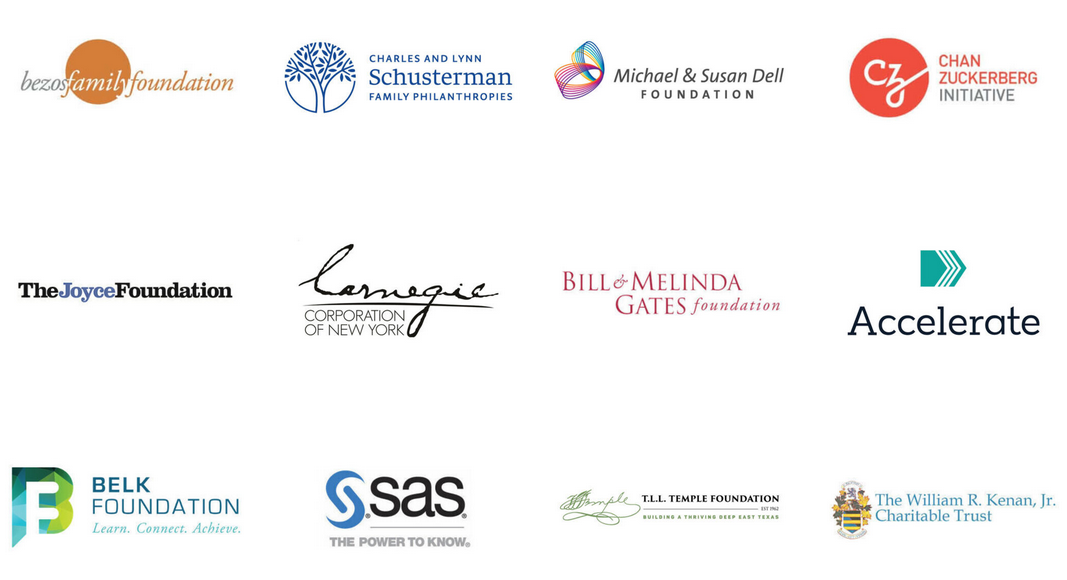
Supporters of DFI have been very generous since the founding in 2015. The last year for which tax records are available was 2022. Federal tax forms 990-PF show:

  • Bill and Melinda Gates Foundation (TIN: 56-2618866)  $3,482,504
  • Charles and Lynn Schusterman Family Foundation (TIN: 73-1312965)  $2,135,000
  • Michael & Susan Dell Foundation (TIN: 36-4336415)  $2,375,000
  • The Joyce Foundation (TIN: 36-6079185)  $2,400,000
  • Carnegie Corporation of New York (TIN: 13-1628151) $875,000

These are huge sums of money but not for billionaires. 

The Carnegie Corporation did not contribute to DFI until Timothy Knowles became president of the Carnegie Foundation for the Advancement of Teaching in 2021; probably not a coincidence.

Deans for Impact states:

“DFI believes all teacher-candidates should know the cognitive-science principles explored in The Science of Learning. And all educators, including new teachers, should be able to connect those principles to their practical implications for the classroom.”

Of course cognitive scientists do not agree on these principles and the neuroscience pitch is fantasy, but DFI is coming through with its deliverables.

Deans for Impact is just one small example of the many organizations billionaires have created to do their bidding.

Please open the link to read Tom Ultican’s conclusion.

At the recent Vice-Presidential debate, JD Vance engaged in sanewashing and normalizing Trump, falsely claiming that Trump tried to improve or salvage Obamacare. He lied, as LA Times’ Pulitzer-Prize winning columnist Michael Hiltzik shows. In fact, Trump and most other Republicans tried to kill Obamacare. Trump was also responsible for incompetent management of the federal response to COVID, which increased the death toll.

Every newspaper should either have its own Michael Hiltzik or repost his columns.

Hiltzik writes:

My favorite Lily Tomlin line is this one: “No matter how cynical you become, it’s never enough to keep up.”

I love it more today than ever, because it applies so perfectly to how we must respond to the campaign claims of Donald Trump and JD Vance. Especially Trump’s assertions about his role — heroic, in his vision — in “saving” the Affordable Care Act and fighting the COVID pandemic.

I’ve written before about the firehouse of fabrication and grift emanating from the Trump campaign like a political miasma. On these topics, he has moved beyond his habit of merely concocting a false reality about, say, immigration and crime to deliberately concocting a false reality about himself. 

Donald Trump could have destroyed [Obamacare]. Instead, he worked in a bipartisan way to ensure that Americans had access to affordable care.

— JD Vance, flagrantly lying about Trump’s management of the Affordable Care Act

To start by summarizing: Trump did everything in his power to destroy the Affordable Care Act, starting on the very first day of his term in 2017. On COVID, he did everything in his power to make America defenseless against the spreading pandemic.

Let’s take them in order. 

Here’s what Trump said about the Affordable Care Act during his Sept. 10 debate with Kamala Harris: “I had a choice to make when I was president, do I save it and make it as good as it can be? Never going to be great. Or do I let it rot? … And I saved it. I did the right thing.” 

This was the prelude to his head-scratching assertion that he has “concepts of a plan” to reform healthcare in the U.S. I examined what that might mean in a recent column, in which I explained that it would turn the U.S. healthcare system to the deadly dark ages when people with preexisting medical conditions would be either denied coverage or charged monstrous markups.

During his own debate Tuesday with Tim Walz, Vance made himself an accomplice to Trump’s crime against truth.

Here’s Vance’s version of the Trumpian fantasy: 

“Donald Trump has said that if we allow states to experiment a little bit on how to cover both the chronically ill, but the non-chronically ill … He actually implemented some of these regulations when he was president of the United States. And I think you can make a really good argument that it salvaged Obamacare. … Donald Trump could have destroyed the program. Instead, he worked in a bipartisan way to ensure that Americans had access to affordable care.”

Here’s what Trump actually did to the Affordable Care Act during his presidency. He had made repealing the ACA a core promise of his 2016 presidential campaign, stating on his website, “On day one of the Trump Administration, we will ask Congress to immediately deliver a full repeal of Obamacare.” (Thanks are due to the indispensable Jonathan Cohn of Huffpost for excavating the quote.)

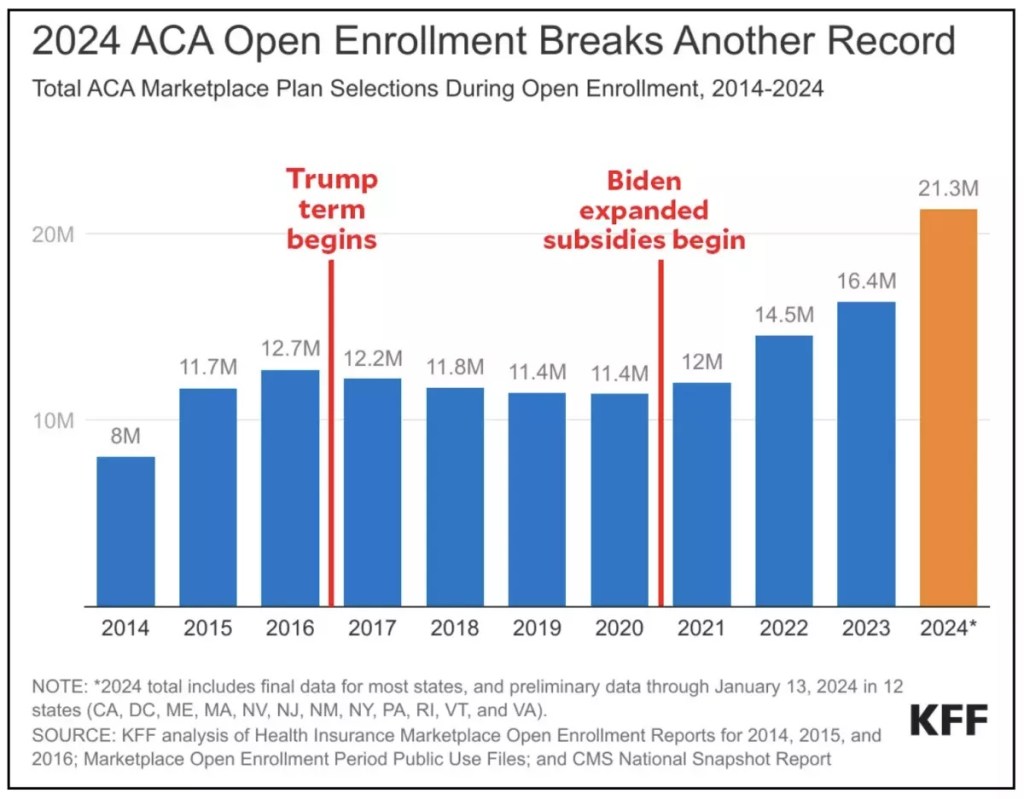
Trump drove down Obamacare enrollment every year he was in office; when Biden removed Trump’s obstacles, enrollment soared. 

(KFF / Kevin Drum)

On Inauguration Day, Trump issued an executive order instructing the entire executive branch to find ways to “waive, defer, grant exemptions from, or delay the implementation of any provision or requirement” of the ACA. 

During his presidency, he never abandoned the Republican dream of repealing Obamacare, even after July 28, 2017, when the late Sen. John McCain (R-Ariz.) strode to the Senate well and delivered a thumbs-down coup de grace to a GOP repeal bill.

Trump never ceased slandering the ACA as a “disaster.” He returned to the theme during last month’s debate: “Obamacare was lousy healthcare,” he said. “Always was. It’s not very good today.” As president, he threatened to make it “implode,” and used every tool he could get his fingers on to do so

In September 2017 he slashed the advertising budget for the upcoming open enrollment period for individual insurance policies by a stunning 90%, to $10 million from the previous year’s $100 million. He also cut funds for nonprofit groups that employ “navigators,” those who help people in the individual market understand their options and sign up, by roughly 40%, to $36.8 million from $62.5 million. 

Just after taking office, he abruptly canceled the customary last-minute advertising blitz to encourage enrollments in Obamacare plans before open enrollment ended on Jan. 31. The last minute surge in enrollments, which had occurred every previous year, vanished. The drop-off was particularly devastating because it was concentrated among the healthiest potential enrollees — those who often wait until the last minute to sign up and whose premiums generally subsidize older, less healthy patients.

The impact these policies had on enrollment was inescapable. In the three years before Trump took office, ACA marketplace plans experienced annual enrollment increases, to 12.7 million enrollees in 2016 from 8 million in 2014. During every year of the Trump administration, enrollment declined, falling to 11.4 million in 2020.

Every year since Joseph Biden took office, enrollment has increased, reaching a record 21.3 million this year — an 86% increase over Trump’s last year. 

As for Vance’s fatuous claim that Trump “worked in a bipartisan way to ensure that Americans had access to affordable care,” you have the right to ask what Vance has been smoking.

The only bipartisanship on the ACA during the Trump years, Cohn observes, were the actions of GOP senators such as McCain and Lisa Murkowski of Alaska to cooperate with Democrats to stave off their fellow Republicans’ anti-ACA vandalism.

Now onto Trump’s fantasy vision of his role in fighting the COVID pandemic. Speaking in a low-energy, exhausted monotone at a speech Tuesday in Milwaukee and reading at times from a binder, he praised himself for instituting Operation Warp Speed, which funded COVID vaccine development in record time and got them rolled out in January 2021.

“We did a great job with the pandemic. Never got the credit we deserved,” he said. He then veered into blaming China for the pandemic, a familiar topic. He said bluntly that the pandemic was “caused by the Wuhan lab. I said that from the beginning, came from Wuhan. And the Wuhan lab, it wasn’t from bats in a cave that was 2,000 miles away. … It’s really the China virus.”

As for the rest of his COVID performance, he said this: “We did a great job with the ventilators, the masks and the gowns and everything. … When we got here the cupboards, our cupboards, I used to say our cupboards were bare. … No president put anything in for a pandemic.” Then he segued into praising himself for a big tax cut, and COVID was forgotten.

A few points about this spiel:

Trump is correct that Operation Warp Speed was a significant achievement. But he didn’t follow up by advocating for its product, the COVID vaccine. Instead, he has thrown in his lot with fanatical anti-vaccine agitators such as Robert F. Kennedy. He has repeated an anti-vax mantra, promising, “I will not give one penny to any school that has a vaccine mandate or a mask mandate.” This is a formula for exposing children to vaccine-preventable diseases such as measles and even polio.

Trump’s reference to the Wuhan Institute of Virology as the source of SARS-CoV-2, the virus that causes COVID, underscores how closely the so-called lab-leak theory of COVID’s origins is tied to right-wing partisan politics. The theory originated with Trump acolytes at the State Department, who saw the accusation as a convenient weapon in Trump’s economic war with China.

To this day, not a speck of evidence has been produced to validate this claim; scientists versed in the relevant disciplines of virology and epidemiology say the evidence overwhelmingly supports the hypothesis that the virus reached humans via the wildlife trade, and that its journey may well have started with bats thousands of miles from Wuhan, China.

Trump is lying when he says his predecessors in the White House left him without resources. The truth is that Trump himself hobbled pandemic response from the start. 

In 2016, in the wake of the Ebola epidemic in Africa, President Obama had established the the Directorate for Global Health Security and Biodefense at the National Security Council “to prepare for and, if possible, prevent the next outbreak from becoming an epidemic or pandemic,” in the words of its senior director, Beth Campbell. Trump dissolved it in 2018.

During the pandemic, Trump cut off funding for the World Health Organization. He eliminated a $200-million pandemic early-warning programtraining scientists in China and elsewhere to detect and respond to such threats. He sidelined the White House Office of Science and Technology Policy, which had been established under Franklin D. Roosevelt.

Due to these steps, the U.S. was fated to sleepwalk into the pandemic. The COVID death toll in the U.S. stands at more than 1.2 million, and its reported death rate from COVID of 341.1 per 100,000 population is the highest in the developed world.

Ventilators, masks and gowns? Trump placed the procurement of this essential personal protective equipment in the hands of his son-in-law, Jared Kushner, who handled the task incompetently. Kushner turned away urgent appeals from state and local officials for those supplies.

“The notion of the federal stockpile was it’s supposed to be our stockpile, it’s not supposed to be states’ stockpiles that they then use,” Kushner said at a briefing

Following his remarks, the website of the government’s national strategic stockpile of medicines and supplies was changed from asserting that its purpose was to “support” the emergency efforts of state, local and tribal authorities by ensuring that “the right medicines and supplies get to those who need them most.” The new language redefined the stockpile’s role as “to supplement state and local supplies … as a short-term stopgap.”

Supplies of ventilators, masks and gowns remained scarce through the first months of the pandemic. A procurement official at a Massachusetts hospital system told me of having had to cut a deal with a shadowy broker offering 250,000 Chinese-made masks at an inflated price, completing the transaction for $1 million at a darkened warehouse five hours from home.

Trump made anti-science incompetence and disregard for the welfare of Americans part of our history. The same thing, or worse, looms on the horizon in a second Trump term.

My comment: who can forget that dramatic moment in 2017 when the late Senator John McCain strode down to the well of the Senate to cast the deciding vote not to repeal Obamacare by dramatically extending his good arm and showing a thumb’s down gesture? Trump forgot.

As to COVID, why didn’t Trump take credit for the vaccines produced by Iperatuon Warp Speed? If the scientists had called it “the TRUMP vaccine, he probably would have boasted about it. Instead, he threw his support to the anti-VAXX conspiracy theorists, which surely contributed to the death toll.

Veteran journalist James Fallows put up a post today on his blog comparing the front page of the New York Times on October 29, 2016 to the front page of the same newspaper on October 3, 2024.

I recommend that you open the link and see what he was comparing.

For those of us who take the law seriously, Trump’s successful evasion of accountability for the failed coup on January 6, 2021, is outrageous. Trump has used delay as his primary strategy for avoiding accountability, as well as his partisan ties to federal judges like Aileen Cannon, whom he appointed, and the rightwing majority on the Supreme Court. Judge Cannon tossed out the documents case. The only viable case right now is Special Prosecutor Jack Smith’s indictment of Trump for launching the events of that day. That case will be heard by Judge Tanya Chutman, who was appointed by Obama. It’s a sad day when the ability to get justice depends on which judge is assigned to the case.

Jordan Rubin writes about Jack Smith’s latest filing here. Smith had to rewrite his brief to acknowledge the U.S. Supreme Court’s ruling that the President has absolute immunity for any “official acts.” Should planning to overthrow the Constitution, to subvert the election, and to send a mob to storm the Capitol be considered “official acts”?

Special counsel Jack Smith’s big immunity brief is here. The 165-page (somewhat redacted) motion lays out why, in the government’s view, the Supreme Court’s immunity ruling doesn’t stop Donald Trump from standing trial in his federal election interference case.

As an example of what the motion seeks to accomplish, consider the discussion of the alleged evidence related to former Vice President Mike Pence, whom Trump pressured to subvert the 2020 presidential election.

As an example of what the motion seeks to accomplish, consider the discussion of the alleged evidence related to former Vice President Mike Pence.

To understand the Pence analysis, recall that Chief Justice John Roberts’ July 1 ruling in Trump v. United States granted absolute immunity for “core” presidential acts, presumptive immunity for all other official acts, and no immunity for unofficial acts. While the high court’s Republican-appointed majority said that it’s up to U.S. District Judge Tanya Chutkan to perform the immunity analysis in the first instance, the justices gave the Washington judge a head start in some parts, including with Pence. They said that whenever Trump and Pence discussed “their official responsibilities” — namely regarding Pence’s certification of Electoral College votes on Jan. 6, 2021 — they had engaged in “official conduct.”

That means Trump would have presumptive immunity for those alleged actions, which Smith would need to rebut. Roberts’ opinion (rather vaguely) said that can be done by showing that the prosecution wouldn’t “pose any dangers of intrusion on the authority and functions of the Executive Branch.” So that’s why Smith wrote in the motion that because that branch “has no role in the certification proceeding — and indeed, the President was purposely excluded from it by design — prosecuting the defendant for his corrupt efforts regarding Pence poses no danger to the Executive Branch’s authority or functioning.” (The vice president is involved in certification via the office’s role as president of the Senate.)

Raskin on the Jack Smith brief: ‘American carnage is Trump’s legacy’

07:00

The special counsel further wrote that Trump “sought to encroach on powers specifically assigned by the Constitution to other branches, to advance his own self-interest and perpetuate himself in power, contrary to the will of the people.” Therefore, Smith wrote, prosecuting Trump wouldn’t “pose any danger of intrusion on the authority and functions of the Executive Branch; rather, it would advance the Constitution’s structural design to prevent one Branch from usurping or impairing the performance of the constitutional responsibilities of another Branch.”

Smith’s team also made clear in the filing that prosecutors intend to introduce more evidence at trial related to Pence, who is not accused of any wrongdoing. For instance, they want to introduce evidence of what they call unofficial communications that Trump had with Pence in their capacity as candidates (not as president and vice president), including when Pence “tried to encourage” Trump “as a friend” when news networks began to call the 2020 race for Joe Biden, and later when Pence suggested that Trump should recognize the process was over and run again in 2024. Even if those communications were deemed “official,” Smith wrote, the immunity presumption would be rebutted there too, he argued.

To be sure, the Pence evidence is only part of the case that Smith wants to bring against Trump, who has pleaded not guilty.

To be sure, the Pence evidence is only part of the case that Smith wants to bring against Trump, who has pleaded not guilty. And if the former president wins next month’s presidential election, he’ll be empowered to dismiss the case entirely.

But if Trump loses, then Chutkan would have a heavy task ahead in weighing the voluminous allegations and evidence Smith presents in the monster filing and deciding whether it passes the high court’s (again, rather vague) immunity test. Ultimately, whatever the judge rules will be subject to review again by the justices before any trial can go forward. That won’t happen before the election.

The case will either be killed soon by way of a Trump victory or will linger on for months, if not years, to first determine whether the Supreme Court will even let Trump stand trial over any of these allegations.

Rachel Maddow often manages to come up with a very different take on the news as compared to other talk show hosts. She is fascinated with history, so she often takes her viewers down new paths.

When she was trying to figure out JD Vance, she discovered two of the men who influenced his views. One is a podcaster named “Jack Murphy,” whose real name is John Goldman. He is known for racism, misogyny, and his association with the alt-right. He is very big on the idea of women’s submission to men. He even wrote a book about it.

The other is a man named Curtis Yarvin, a podcaster who is known for his anti-democratic, anti-egalitarian views.

Watch this segment.

Mother Jones published an excellent article by Reverend Rob Schenck about how he became a leader of the Christian nationalist movement and why he decided to leave it. He recalls when real estate developer and playboy Donald Trump was first introduced to the world of evangelicals. And he describes his own role in connecting rich donors to Republican Supreme Court justices.

Reverend Schenck begins:

In 2014, at an elegant gala inside the Supreme Court’s gilded Great Hall, a tuxedoed Justice Clarence Thomas turned to me and voiced his approval for my work. I glanced over to where Chief Justice John Roberts and his wife, Jane, were entertaining two of my associates, trustees of the Supreme Court Historical Society, a private, nongovernmental entity for which Roberts served as honorary chair. At that moment, I knew the secretive operation I had run, aimed at emboldening Thomas and his conservative colleagues to render the strongest possible decisions in favor of our right-wing Christian agenda, had succeeded.

My organization, Faith and Action in the Nation’s Capital, had created an initiative we called “Operation Higher Court” that trained wealthy couples as “stealth missionaries,” befriending Thomas and his wife, Ginni; Samuel and Martha-Ann Alito; and Antonin and Maureen Scalia—­lavishing­ them with meals at high-end restaurants and invitations to luxurious vacation properties. Alongside these amenities, our ministry offered prayers, gift Bibles, and the assurance that millions of believers thanked God for the decisions this trio of justices rendered on abortion, health care, marriage, and gun ownership….

But Reverend Schenck began to understand that his activities and beliefs were toxic to democracy. What triggered his change? Perhaps it was his late-in-life doctoral studies, when he read about the German Christian movement in the 1930s, which supported the Nazi party. He wrote: One of the most respected Bible scholars of that period, Paul Althaus, declared Hitler’s ascent to the chancellorship to be a “gift and miracle from God.

He was shaken by his research. He began to change his views. He wondered whether Christian evangelicals in the U.S. were on the same dangerous path.

Following the insurrection of January 6, when Christian banners, Bibles, and prayers in Jesus’ name appeared in the assault on the Capitol, I felt even greater urgency in warning my fellow evangelicals of the grave danger Trump and his MAGA cult posed to Christianity and US democracy.

My change of course so late in life has been painful, disorienting, and costly. Besides losing decades-long friendships and enduring menacing threats, my wife and I have faced a significantly reduced income. I’ve even driven Uber to cover household expenses. One night, I picked up an organizer of the National Prayer Breakfast, an event in which I had once played a significant role. I was wearing a mask and said little, but then, with trepidation, I realized I would be dropping him at the home of a congressman I had worked with closely for more than 20 years. When my passenger got out, I was relieved to have gone unrecognized. Still, I’ve never questioned the decisions that brought me to that moment.

In my third conversion, I realized that when religion is placed at the service of a political party, it corrupts both. To claim that one political figure uniquely represents God’s will for the body politic is a form of anti-Christian idolatry. To elevate one set of spiritual beliefs above another and do it by force of law removes a nonnegotiable tenet of evangelical faith—free will. We are born again when we choose to believe in the Lord Jesus Christ, not when we’re forced to do so.

Because it is immoral, I believe Christian nationalism is inevitably doomed. But in the meantime, the pain, suffering, and injury it will inflict will be enormous—just consider women facing difficult pregnancies, trans children seeking care, librarians attacked for certain books. “We want to fill our culture again with the Christian spirit. We want to burn out all the recent immoral developments in literature, in the theater, and in the press—in short, we want to burn out the poison of immorality, which has entered into our whole life and culture as a result of liberal excess.” This may sound familiar—maybe some overheated Republican talking points. In fact, it’s what Adolf Hitler promised the German people in 1933.

John Thompson is a historian and retired teacher in Oklahoma. He remembers the time before George W. Bush’s “No Child Left Behind” took control of the schools away from educators. Data-driven accountability, he writes, polluted the culture of learning. After more than two decades of failure, educators and students need a better way forward.

He writes in Oklahoma Voice:

When I first walked into John Marshall High School in 1992, I was stunned by the exceptional quality of so many teachers.

It had never occurred to me that such great teaching and learning was being done in high schools. Yes, there were problems, but each year, our school would make incremental improvements.

Then, the Oklahoma City Public Schools system (OKCPS) would bow to pressure and implement disastrous policies that would wipe out those gains — or worse.

I remember when OKCPS was first forced into policies that were later dubbed “corporate school reform.”

The No Child Left Behind Act, which was signed into law in 2002 by former Republican President George W. Bush, increased the federal government’s influence in holding schools accountable for student performance.

During the first years after the passage, local and state leaders often had some success in minimizing the damage done by school “choice” and high stakes testing. But, as in the rest of the nation, that resistance angered market-driven reformers who then doubled-down on harsher, more punitive policies.

They ordered everyone to “be on the same page,” and even today press educators to “teach to the test.”

I quickly discovered that this one-size-fits-all philosophy was disastrous for schools, teachers and students. And decades later, it still remains so.

It doesn’t take into account the difference between situational and generational poverty. It ignores that some students are seriously emotionally disturbed and/or burdened by multiple traumatic experiences, now known as Adverse Childhood Experiences (ACEs). And, it fails to factor in that children, who may have reading or math disabilities, have the potential to become student leaders.

The tipping point for me was when school staffing became driven by a primitive statistical model that could not distinguish between low income students and children of situational poverty receiving free and reduced price lunches as opposed to children living in extreme poverty with multiple ACEs.

Because of the additional costs of providing services for the most emotionally disturbed students, teachers in “regular” classrooms were assigned up to 250 students.

I had classes with 60 students.

Data-driven accountability pollutes our learning cultures.

School segregation by choice combined with test-driven accountability creates a culture of competition, winners and losers, and simplistic policies that ignore poverty and Adverse Childhood Experiences.

It is a policy imposed mostly by non-educators who ignore educational and cognitive scientific research.

As these quick fixes failed — just like educators and social scientists predicted they would — the “blame game” took off, fueling an exodus of teachers and driving out the joy of teaching and learning. The change in culture particularly affected the poorest children of color.

In order to improve our learning environment and our children’s outcomes, we must first get back to building on our strengths rather than weaknesses.

For instance, if we agree on a culture where we use tests for diagnostic purposes, rather than determining winners and losers, we could go back to the time when our curriculum committees included teachers, assistant principals, and parents.

Those meetings frequently ended in compromises that brought out the best in all sides and made our schools a desired place to learn and work.

Glenn Kessler is the fact-checker for The Washington Post. He is the best in the business. The only thing he does is fact-checking.

He wrote:

In the vice-presidential debate Tuesday night, Sen. JD Vance (R-Ohio) proved he could match his running mate on the falsehood meter, though with a bit more verve and polish. Minnesota Gov. Tim Walz (D) misled on occasion, such as claiming Republicans supported a “registry for pregnancies.”

Here is a roundup of 21 claims that caught our attention, the majority by Vance. As is our practice, we do not award Pinocchios when we do a roundup of facts in debates.

“Iran, which launched this attack, has received over $100 billion in unfrozen assets, thanks to the Kamala Harris administration.”

— Vance

This is false. Vance appears to be conflating two things as he answered a question on Iran’s attack on Israel.

Iran’s crude oil production rose to 3.3 million barrels a day as of August, which is an increase since the end of the Trump administration but still lower than in 2018. According to the U.S. Energy Information Administration, Iran’s oil production in 2020 was just under 2 million barrels a day. The pandemic sent oil production and sales plummeting around the globe. Iran’s production in 2020 was the lowest in almost 40 years, the EIA said.

But experts say that even if Trump had been reelected, he would have had trouble keeping sanctions from eroding. In particular, China has become adept at evading U.S. sanctions by arranging for many buyers of Iranian oil to be small, semi-independent refineries known as “teapots.” Such entities accounted for about one-fifth of China’s worldwide oil imports, according to Reuters. “With their small size and limited business operations, teapots are hard to uncover and not exposed to the U.S. financial system,” according to a report by the advocacy group United Against Nuclear Iran.

“When Iran shot down an American aircraft in international airspace, Donald Trump tweeted, because that’s the standard diplomacy of Donald Trump. And when Iranian missiles did fall near U.S. troops and they received traumatic brain injuries, Donald Trump wrote it off as headaches.”

— Walz

This is largely accurate. Iran attacked a U.S. drone in 2019, but Trump did not hit back. He lost his nerve at the last minute, according to various news accounts. Then Iran attacked a U.S. military base in 2020 after Trump ordered the drone killing of Iranian Maj. Gen. Qasem Soleimani on Jan. 3, 2020. No one was killed, though more than 100 service members suffered from traumatic brain injuries.

Walz calls out Trump’s withdrawal from Iran nuclear deal

During the Oct. 1 vice-presidential debate, Gov. Tim Walz (D) reminded Americans that former president Donald Trump pulled out of the Iran nuclear deal. (Video: CBS News)

Trump initially bragged about the fact that no one was killed, but it emerged that a U.S. contractor suffered a serious eye injury and 110 troops had traumatic brain injuries while sheltering in place, with 35 being sent to Germany and the United States for treatment. Yet Trump has continued to say they suffered only from headaches — as he did again just hours before the debate.

“When was the last time that an American president didn’t have a major conflict break out? The only answer is during the four years that Donald Trump was president.”

— Vance

Vance could have given a shout-out to Jimmy Carter, who turned 100 on Tuesday.

Jimmy Carter, president from 1977 to 1981, not only never formally declared war or sought authorization to use force from Congress during his presidency, but military records show not a single soldier died in hostile action during his presidency. Eight military personnel died during the 1980 Iranian hostage rescue mission, but the military deems those as nonhostile deaths. (A helicopter collided with an aircraft.) A marine and an Army soldier were also killed when a mob burned the U.S. Embassy in Islamabad.

At least 65 active-duty troops died in hostile action during Trump’s presidency, the records show, as he ramped up commitments in Iraq and Syria to fight the Islamic State terrorist group while also launching airstrikes on Syria as punishment for a chemical weapons attack. Trump also escalated hostilities with Iran, including the killing of Soleimani. Trump said at the time the strike was carried out in accordance with the Authorization for Use of Military Force resolution of 2001.

“We’re the cleanest economy in the entire world.”

— Vance

This is false. The United States in 2024 ranked 17th in the world for environmental health, according to the authoritative Environmental Performance Index, a project of Yale and Columbia Universities. It ranked 27th for air quality and 9th for water and sanitation.

“What have Kamala Harris policies actually led to? More energy production in China, more manufacturing overseas, more doing business in some of the dirtiest parts of the entire world.”

— Vance

This is false. Vance has previously earned Four Pinocchios for this claim, but he keeps saying it. Harris cast the deciding vote for the 2022 Inflation Reduction Act, which was designed to foster green manufacturing jobs in the United States. The evidence shows that it’s working.

Vance’s theory, once expressed in an opinion article, is that by shifting the auto industry toward electric vehicles, the United States is going to send significant amounts of money and jobs to China. But this claim ignores what is actually in the IRA. The law was intended to help the United States catch up with China before Beijing completely takes over the EV market. The Chinese government has given huge subsidies to the EV industry in a quest to dominate it.

So the law included provisions to make sure more of the supply chain is produced in the United States, such as a consumer tax credit for EVs. The Treasury Department wrote regulations that make it harder for vehicles to qualify for the full federal EV tax credit of $7,500 if key components are sourced from China, with a grace period for some rare materials like graphite. As part of the IRA, final assembly of EV models must occur in North America to be eligible. In May, the administration also imposed a 100 percent tariff on Chinese EVs.

Vance also ignores that many provisions in the IRA have sparked a manufacturing boom in the United States — designed to counter China’s dominance in the green-energy arena. Besides EVs, the bill included tax incentives intended to spur manufacturing of solar modules, wind turbines, inverters, EV batteries and power storage, and the extraction and refining of critical minerals.

In the first year after passage of the IRA, according to an analysis by Goldman Sachs, 280 clean-energy projects were announced across 44 states, representing $282 billion of investment that would create 175,000 jobs. “What we found was that — so far at least — the reality is living up to or even exceeding expectations,” the report said.

“As you ask about family separation right now in this country, Margaret, we have 320,000 children that the Department of Homeland Security has effectively lost. Some of them have been sex trafficked. Some of them hopefully are at homes with their families. Some of them have been used as drug-trafficking mules.”

— Vance

This is false. Vance is referencing a number that applies to unaccompanied children who crossed the border and were placed with a sponsor, including during the last two years of Trump’s administration. An August Homeland Security inspector general report, which tracked data from October 2018 to September 2023, said 320,000 children were never given a date to appear in immigration court or missed an appearance, providing “no assurance” that the children were not vulnerable to trafficking. About one-quarter of the cases took place under Trump. The report recommended creating an automated system, rather than a manual one, which Homeland Security said it would implement.

Until this report was issued, Trump had been using a much lower figure of 88,000 “lost children,” but this was a different metric. As part of Health and Human Services Department protocol, case managers are supposed to try three times to check on the status of a child between 30 and 37 days after release to a sponsor, preferably by having a conversation with the child in addition to the sponsor. In 2023, the New York Times calculated that in 2020-2021, 85,000 children could not be reached.

But it’s not a legal requirement for HHS to make the calls — and it’s not required that children or the sponsor answer. Trump administration officials made that point when they came under fire from Democrats for supposedly losing track of children.

Applying the same metrics to the first three years of Trump’s term, when about 160,000 unaccompanied children were referred to HHS, we estimated that 54,000 children could not be reached. Comparable figures for the Biden-Harris administration, through last month, would be 400,000 referred and 135,000 not reached.

“Donald Trump had four years. He had four years to do this. And he promised you, America, how easy it would be. ‘I’ll build you a big, beautiful wall, and Mexico will pay for it.’ Less than 2 percent of that wall got built, and Mexico didn’t pay a dime.”

— Walz

The percentage is exaggerated. About 458 miles of a border barrier was built during Trump’s presidency, but most of it (373 miles) was replacement for existing primary or secondary barriers that were dilapidated or outdated, according to a Jan. 22, 2021, report by Customs and Border Protection. About 52 miles was new primary wall, and 33 miles was new secondary wall. Trump had promised to build 1,000 miles of barrier, so even taking the lower numbers gets Trump 8.5 percent.

Mexico did not pay for the barrier Trump erected along the southern border; American taxpayers did. The Trump administration directed $16.4 billion in funding to barrier construction along the southern border. About $10 billion was repurposed from Defense Department projects over the objections of Congress.

“We had a record number of fentanyl coming into our country.”

— Vance

This claim lacks context. Under Biden, according to Customs and Border Protection statistics, overall drug seizures have dropped, especially for marijuana, but until this year increased substantially for fentanyl — the drug most responsible for overdose deaths. Both the decrease in marijuana seizures and the increase in fentanyl seizures reflect trends that started under Trump.

As president, Trump often touted how much seizures of drugs at the southern border had increased on his watch. This is an imperfect metric. It could mean that law enforcement is doing a better job. But more seizures also might indicate that the drug flow has increased and that law enforcement is missing even more.

The amount of fentanyl seized at the border increased under Biden and Trump, though so far, the amount jumped by a larger percentage under Trump, CBP statistics show. In Trump’s four fiscal years, the number of pounds increased 586 percent, compared with 462 percent in the first three fiscal years under Biden.

The amount of fentanyl seized by border officials increased from almost 4,800 pounds in fiscal 2020 to roughly 27,000 pounds in fiscal 2023. There were about 700 pounds of fentanyl seized in fiscal 2016, the last full fiscal cycle before Trump took office.

“Look, in Springfield, Ohio, and in communities all across this country, you’ve got schools that are overwhelmed. You’ve got hospitals that are overwhelmed. You’ve got housing that is totally unaffordable because we brought in millions of illegal immigrants to compete with Americans for scarce homes.”

— Vance

It’s false to say “illegal immigrants.” In Springfield, where the city’s website says there are “12,000 to 15,000” immigrants, most of the new arrivals are from Haiti. But Vance is wrong to call them “illegal.” They are in the U.S. legally under temporary protected status (TPS), a program created in 1990 that provides deportation relief and work permits.

Vance blames ‘illegal’ Springfield migrant community

On Oct. 1, Sen. J.D. Vance (R-Ohio) alleged that “illegal” migrants in Springfield, Ohio, were burdening the local economy. (Video: CBS News)

Conservatives argue that Biden has expanded TPS and thus is providing a legal pathway for people who otherwise would be undocumented. But there is no question the Haitians are in the United States legally.

The New York Times reported that “Michelle Lee-Hall, executive director of Springfield’s housing authority, said that the affordability problem in Springfield had been aggravated by landlords pivoting to Haitians who were willing to pay higher rent.”

“So there’s an application called the CBP One app where you can go on as an illegal migrant, apply for asylum or apply for parole and be granted legal status at the wave of a Kamala Harris open border wand that is not a person coming in, applying for a green card and waiting for 10 years.”

— Vance

This is wrong. Vance suggested that the Springfield Haitians used an app for new arrivals at the border to claim asylum. As noted, the Haitians arrived through the TPS program.

Separately, there is a humanitarian parole program for citizens of four countries in the hemisphere — Cuba, Haiti, Nicaragua and Venezuela — which requires a passport and a link with a U.S.-based sponsor. But that also does not involve the app.

Walz repeats the misstatement. After saying he misspoke about when he arrived in China in 1989 on a teaching assignment, Walz says it again. Minnesota Public Radio reported this week that Walz did not arrive in China until August. But the protests in Tiananmen Square were ended by the Chinese military on June 3-4, making it impossible for him to be there “during the democracy protests.”

Vance is being disingenuous here. He backed a law that would impose a nationwide limit of 15 weeks for when women could get an abortion — which would overturn the laws of many liberal states. In 2022, Vance said: “I certainly would like abortion to be illegal nationally.” Moreover, last year, he urged the Justice Department to enforce the Comstock Act, a 151-year-old federal law that bans the mailing of abortion-related materials. The Biden administration has not invoked the law, but a more conservative one could, thus limiting abortion rights even without any new laws.

“He [Trump] gave the tax cuts that predominantly went to the top guys.”

— Walz

This is exaggerated. When both the Joint Tax Committee and the Tax Policy Center looked at the impact of the 2017 tax bill, they concluded that most people would experience an overall reduction in taxes. The Tax Policy Center found that 80.4 percent of all taxpayers would have a tax cut, compared with about 5 percent experiencing a tax increase. In the middle quintile, 91 percent would get a tax cut, averaging about $1,090, with 7.3 percent facing a tax increase averaging about $910.

In fact, Harris has pledged to keep intact tax cuts for people making less than $400,000 when the tax cut expires in 2026. That would reduce revenue by $1.35 trillion, further confirming that not just the “top guys” got a tax cut.

“And what she’s actually done instead is drive the cost of food higher by 25 percent, drive the cost of housing higher by about 60 percent.”

— Vance

The housing figure is mostly false. Median sale prices of homes have risen from $355,000 in the first quarter of 2021 to $412,300 in the second quarter of 2024. That’s a gain of 16 percent. It’s also a decline of about 2 percent from a high reached the fourth quarter of 2022.

Another measure — the consumer price index for housing — shows an increase of about 22 percent since January 2021.

It’s also a bit much to say Harris is responsible. The Federal Reserve Bank pinned much of the blame for the rise in home prices on the pandemic. But there are other factors, such as seniors staying in their homes, reducing supply, and real estate investors snapping up fixer-uppers for rental and resale.

The consumer price index for food shows an increase of 22 percent since January 2021. But, again, the pandemic played a role — as did factors beyond an administration’s control. In 48 states, nearly 101 million “wild aquatic birds, commercial poultry and backyard or hobbyist flocks” have been infected with bird flu since January 2022, according to the CDC. That has sent the price of eggs soaring.

“It [the tax bill] was passed in 2017, and you saw an American economic boom unlike we’ve seen in a generation in this country.”

— Vance

This is false. The tax cut was not responsible for a once-in-a-generation “American economic boom.” Trump inherited a growing economy from Barack Obama, which the tax cut may have extended a bit, but it was already running out of steam when the pandemic struck in 2020. In 2019, the year before the pandemic, manufacturing went into a mild recession.

Bill Clinton was president only 16 years before Trump. The gross domestic product grew at an annual rate of 2.3 percent in 2019, slipping from 2.9 percent in 2018 and 2.4 percent in 2017. But in 1997, 1998 and 1999, under Clinton, GDP grew 4.5 percent, 4.5 percent and 4.7 percent, respectively.

“Donald Trump was the guy who created the largest trade deficit in American history with China.”

— Walz

This is true. The U.S. trade deficit with China hit a peak 0f $377.7 billion in 2018, when Trump was president. In 2023, it was $252 billion, the lowest in 14 years, according to the Bureau of Economic Analysis.

“All I said on this is, I got there this summer and misspoke on this. So I will just — that’s what I’ve said. So I was in Hong Kong and China, during the democracy protests, went in. And from that, I learned a lot of what needed to be in governance.”

— Walz

“Their Project 2025 is going to have a registry of pregnancies. It’s going to make it more difficult, if not impossible, to get contraception and limit access, if not eliminate access, to infertility treatments.”

— Walz

This is false. Project 2025 does not say this. (Project 2025 is not an official campaign document. It’s a Heritage Foundation report called “Mandate for Leadership,” a 922-page manifesto filled with detailed conservative proposals that is popularly labeled Project 2025. But there are definitely Trump connections.)

Instead the document calls for better statistical tracking of abortions across the country. Claiming that liberal states have become “sanctuaries for abortion tourism,” the report says the Department of Health and Human Services “should use every available tool, including the cutting of funds, to ensure that every state reports exactly how many abortions take place within its borders, at what gestational age of the child, for what reason, the mother’s state of residence, and by what method. It should also ensure that statistics are separated by category: spontaneous miscarriage; treatments that incidentally result in the death of a child (such as chemotherapy); stillbirths; and induced abortion. In addition, CDC should require monitoring and reporting for complications due to abortion and every instance of children being born alive after an abortion.”

Walz’s state already does, leading a Heritage Foundation official to ask whether Walz is a “miscarriage monitor” after Harris made a similar claim in her debate with Trump.

“I never supported a national ban. I did during when I was running for Senate in 2020 to talk about setting some minimum national standard.”

— Vance

“The gross majority, close to 90 percent in some of the statistics I’ve seen, of the gun violence in this country is committed with illegally obtained firearms.”

— Vance

This is wrong. Vance made this comment during a discussion on mass shootings at schools. In a 2022 study, the National Institute of Justice, a research unit of the Justice Department, found that of the known mass shooting cases, the vast majority of shooters — 77 percent — bought at least some of their weapons legally. Illegal purchases were made by 13 percent of those committing mass shootings.

“Prescription drugs fell in 2018 for the first time in a very long time.”

— Vance

Vance overstates what happened to the consumer price index for prescription drugs. It fell by 0.6 percent for the 12 months ending in December 2018, the first time in 46 years. But there are other 12-month periods with index declines, including one as recently as 2013. Prices rose 3 percent in the 12-month period ending in December 2019 and then kept rising after that — until the pandemic. Then, the index fell almost every month of 2021, the first year of Biden’s presidency.

“But when Obamacare was crushing under the weight of its own regulatory burden and health-care costs, Donald Trump could have destroyed the program. Instead, he worked in a bipartisan way to ensure that Americans had access to affordable care.”

— Vance

This is false. Trump consistently tried to dismantle the Affordable Care Act, either through legislation or regulation, and he acted in a highly partisan manner. In fact, when campaigning in 2020, he falsely bragged that he had in effect killed the ACA by eliminating, in his tax bill that passed with no Democratic votes, a mandate to purchase health insurance.

Then, with the mandate effectively gone, GOP state attorneys general argued that Congress meant to have an Affordable Care Act with an individual mandate or not at all. Trump’s Justice Department, in a brief signed by Solicitor General Noel J. Francisco, agreed that “the entire ACA … must fall.”

Nearly 100 million Americans with preexisting conditions could have been denied coverage by insurers or charged prohibitively high prices as a result, and Trump had no plan to replace ACA provisions such as coverage for preexisting conditions. Then Attorney General William P. Barr, according to CNN, tried to get the White House to back off from pursuing a full rollback of the Affordable Care Act but was unsuccessful. The Supreme Court, in 2021, dismissed the case.

The Trump administration also issued rules that promote the use of low-quality, short-term plans that were prohibited under Obamacare. These plans typically didn’t have the same protections for people with existing health conditions, allowing insurance companies to deny coverage or charge higher prices. (A number of states, mainly Democratic-leaning, acted to prohibit or limit these Trump plans.)

Finally, Trump threw his support behind House and Senate bills that would have allowed states to seek waivers and consider a person’s health status when writing policies in the individual market. The theory was that removing sicker people from the markets and allowing policies with skimpier options would result in lower overall premiums.

But the Congressional Budget Office concludedthat states that took advantage of these provisions could, perversely, blow up their insurance markets, leaving people with preexisting conditions with spiraling costs. About one-sixth of the U.S. population was estimated to live in states that would face this problem.

“Look, what President Trump has said is that there were problems in 2020. And my own belief is that we should fight about those issues, debate those issues peacefully in the public square. And that’s all I’ve said, and that’s all that Donald Trump has said. Remember he said that on January the 6th, the protesters ought to protest peacefully and on January the 20th, what happened? Joe Biden became the president.”

— Vance

This is a whitewash of Trump’s actions.Trump encouraged a crowd of supporters to appear on Jan. 6, 2021, and then condemned his vice president when Mike Pence refused to halt the ceremonial counting of electoral votes. When the crowd attacked the Capitol, as documented in the House select committee report on the Jan. 6 attack and other reporting, Trump was reluctant to take action to calm the situation, even as his staff pleaded with him to tell the rioters to leave the Capitol. Trump’s tweets were so inadequate, in the view of staff members, that many resolved to resign. Even his children Ivanka and Donald Jr. found the tweets to be inappropriate. Nearly three hours passed before Trump finally told the rioters to “go home.”

Vance did not mention that, in a break with tradition, Trump refused to attend Biden’s inauguration.

Send us facts to check by filling out this form

Sign up for The Fact Checker weekly newsletter

The Fact Checker is a verified signatory to the International Fact-Checking Network code of principles
On the blog called “Public Notice,” Aaron Rupar and Noah Berlatsky wrote about Trump’s unhinged speech yesterday. He is angry and incoherent every time he speaks, so the media doesn’t find his rants to be newsworthy. As the authors point out, the media would jump all over Biden for the factual errors that Trump commits (yesterday, he confused the dictator of North Korea with the president of Iran); but Trump gets a pass because his errors, lies, and hatred are routine.

Rupar and Berlatsky write:

The vice presidential debate will be a main topic of political conversation today, but far more important (and disturbing) things happened before it took place.

This isn’t to say the debate wasn’t memorable. There were at least a couple exchanges that stood out. One came when JD Vance got upset about a moderator interjecting to fact-check racist lies he used to smear his own constituents….

But these moments pale in comparison to Donald Trump’s most troubling showing yet on the campaign trail. Across two campaign events in Wisconsin on Tuesday, the former and would-be president reiterated a truth that is much more important than who won the debate: namely, that he’s morally and intellectually unfit for office.

Both Trump events were packed with outrageous defamations and lies. His targets included troops wounded abroad while he was president, which would be unthinkable in anything resembling a normal era of politics.

Vicious as Trump’s attacks were, they also managed to be muddled in ways suggesting he isn’t up to the task of being president until he’s 82 years old. Vance’s slick lying and election denialism is even more ominous given the possibility that he may end up as the country’s leader in a second, nightmarish, Trump term.

Trump spews and spews some more

Trump’s public addresses are disjointed and disconnected from reality at the best of times. Yesterday, however, was a particularly wide-ranging journey through conspiracy theories, hatred, and nonsense.

His first speech of the day in the the Madison suburb of Waunakee featured racially coded attacks on Brittney Griner, a Black American basketball player who was held hostage in Russia. Trump also lied about opposing the Iraq War and said all sorts of strange stuff, such as accusing Democrats of supporting “water-free bathrooms.” 

The lowlight, however, came when Trump flat out defamed Kamala Harris for murder, saying of a murder victim, “She murdered him. In my opinion Kamala murdered him. Just like she had a gun in her hand.” (So much for Trump toning down the rhetoric and offering a message of unity — watch the clip below.)

Even lower depths were explored during Trump’s appearance later in the day in Milwaukee. Taking questions from the press, he told a reporter who asked him if he trusts the election process this time around that “I’ll let you know in 33 days” — the implication being that he would accept the results only if he wins. Riffing about immigration, he wandered off into a bizarre, woozy, blatantly racist rant about people in the Congo, a country that he boasted he did not know anything about. (“They come from the Congo in the Africa. Many people from the Congo. I don’t know what that is, but they come out of jails in the Congo.”) 

Then, in a moment that would’ve driven news cycles for days had Biden done it, Trump confused the dictator of North Korea, Kim Jong Un, with the president of Iran, Masoud Pezeshkian, and claimed his buddy Kim “is trying to kill me.” (Watch below.)

But all of this was just warning up to a scene during the Milwaukee event that would’ve ended anyone else’s presidential campaign.

🎤 Subscribe to Public Notice 🎤

Trump mocks troops injured in the line of duty

That debacle came when a reporter asked Trump if he should’ve been tougher in retaliation against Iran after they launched a 2020 missile attack on a US base in Iraq, which injured more than 100 US soldiers. The Iranian launch was in retaliation for a US drone strike which killed Iranian Major General Qasem Soleimani. More than 100 US soldiers suffered traumatic brain injuries.

Trump at the time lied about the incident, insisting that no soldiers were harmed and that he’d “heard that they had headaches.” The episode was mostly forgotten over the ensuing four years, but Trump reminded everyone about it during his news conference, peevishly responding to the reporter: “So first of all — injured. What does injured mean? Injured means — you mean because they had a headache? Because the bombs never hit the fort.” 

After Trump finished downplaying serious, life-changing injuries suffered by the troops, he then attacked the reporter for not being “truthful” while mixing up Iraq and Iran. (Watch below.)

Somehow, it got worse. Trump went on to characterize the Iranian attack as “a very nice thing” because Iran didn’t escalate further, which he suggested was the result of his toughness. Again, Trump praised Iran for a “nice” attack which seriously injured more than 100 US soldiers. (Walz highlighted these remarks from Trump during Tuesday’s debate, saying “when Iranian missiles did fall near US troops and they received traumatic brain injuries, Donald Trump wrote it off as headaches.”)

Trump’s self-aggrandizing, confused, pompous, cynical, cruel, insulting lies are not surprising. Again, he has even pushed this particular lie before. He’s also made misleading statements to erase or distract from the fact that soldiers died in Afghanistan during his presidency. He’s called soldiers who die in combat “suckers” and “losers.”

It’s manifestly clear that Trump thinks that soldiers killed or injured on his watch are an inconvenience. He mocks their sacrifice, mocks their injuries, and praises regimes that target them.

This post at Public Notice was followed by this one, written by Stephen Robinson. It sums up a vivid portrait of Trump as an addled old man.


Trump’s ignorance, callousness, and lies are not new. But what is novel is the way they all seem to have been slowed down these days so that he seems ever more adrift in his own fog of hate and ego. He mixes up world leaders, confuses countries, garbles pronouns, loses track of his nonsense talking points.
The remarks Trump gave in Milwaukee before he took questions from reporters were remarkably low energy by his standards. Check out the below clip of Trump praising his catastrophic covid response in a horse rasp, continually looking down to check his notes, repeating the same phrases of self-praise, getting stuck in a loop on pet words or slogans (“Wuhan … Wuhan … ”), telling subdued and meandering lies with no rhythm or applause lines. And indeed, there is no applause; the MAGA faithful are silent, wooed into a tedious fascist stupor.

It would be nice to think that such displays of grotesque ignorance, hatred, authoritarianism, and contempt for the country, for injured service members, and indeed for his own voters, would lead everyone to conclude, en masse, that Trump is disgustingly, massively, inarguably unfit to hold any office of public trust, much less president. But as we know, partisanship, racism, and institutional failures, from the media to the courts to the Justice Department, may allow Trump to win in November.

If he does, he will sit in the Oval Office. But his decrepit campaign performances suggest he will be even less capable of pretending to be anything other than a declining bigot than he was the first time around. And who’s likely to pick up the slack?

Well, as historian Kevin Kruse says, if Trump succumbs to ill health, or just sinks into his natural state of sloth and indifference, the president, de jure or de facto, would be JD Vance, “a deeply unpopular weirdo with virtually no experience, someone who won his first election less than two years ago and even then only because he’s the puppet of an insane billionaire.”

Yesterday was yet another reminder that the Republican ticket is a hideous and embarrassing blight on the American experiment and the American character. Yet, Trump continues to slump towards power, with Vance smirking and smugly lying alongside him. We’ve got about a month before we as a country either rebuke them or follow them into derp, hate, and despair.

Garry Rayno is a veteran journalist in New Hampshire who covers the legislature for inDepthNH.org. His education reporting is excellent. In this post, he describes the Republicans’ refusal to fund public schools adequately, although they have launched a voucher program that is sure to drain the state imof hundreds of millions of dollars annually.

The latest round for education funding lawsuits enters the judicial ring this week in Rockingham County Superior Court and will be argued over the next two weeks.

The second half of the Rand suit goes before judge David Ruoff and — much like the ConVal suit — hinges on whether the state is providing ample money to provide an adequate education for its students, which is essentially the same question before the courts three decades ago with the Claremont suit.

Indepth Your Inbox

Get unbiased nonprofit watchdog news sent directly to your inbox.

Under the two Claremont rulings, the state is required to provide an adequate education to its students, define what constitutes an adequate education, pay for it with constitutional taxes and ensure school districts are providing  it.

That sounds pretty simple, but you have to dig a little deeper to understand why the issue has not been settled in the intervening 30 years.

As ConVal argued, the state believes currently that $4,100 per student is the cost of an adequate education, and the state largely pays that cost with the Statewide Education Property Tax, portions of existing taxes and Sweepstakes revenues.

According to the latest figures from the Department of Education the statewide average for educating a single student is $20,322, or $24,756 when all expenditures are included such as transportation, capital expenses and interest,  out-of-district tuitions, etc.

In the ConVal ruling, which is on appeal with the other half of the Rand suit to the Supreme Court, Ruoff set the state’s obligation for the cost of an adequate education at $7,356  and said it is probably closer to $9,900 per student.

In any event the lower figure is almost double what the state pays and would cost the state an additional $500 million.

In the Rand case, the plaintiffs also want the court to determine if the additional money school districts receive for higher costs for educating special education students, or from low-income households or do not speak fluent English, for example is enough to cover those costs as well.

In their suit, the plaintiffs claim the state funding is inadequate to cover those “differentiated aid” costs as well.

When the funding formula was originally developed in the late 1990s, many of the lawmakers sitting on the committee were from the state’s largest cities like Manchester, Rochester and Nashua and weighted the formula to help their communities and that has not changed much since as communities like Manchester, Nashua, Rochester and Somersworth receive a greater percentage of state aid than most other communities.

They are larger and have larger populations of children in poverty, with disabilities and children whose native language is not English, but other communities like Claremont, Berlin, Newport, Pittsfield, Franklin and Milan have problems raising money for education as well without the same percentage of state aid.

But that is not the crux of the Rand suit, which is by failing to pay all of its constitutionally obligated cost of an adequate education, city and town taxpayers have to make up the difference with local property taxes.

As most people know by now, there are property wealthy communities like Moultonborough, Tuftonboro, Wolfeboro, New Castle, Rye, Portsmouth, Hampton, Sunapee, New London, Newbury, etc. that collect more than they need through the Statewide Education Property Tax to pay for the state’s contribution of $4,100 per student and have money left over.

Ostensively all those communities and all the other communities in New Hampshire pay the same tax rate for the Statewide Education Property Tax.

But when the statewide tax receipts in a community do not cover the $4,100 per student threshold, local property taxes have to make up the difference, and those property tax rates vary from community to community.

If the communities have to pay for an adequate education, then the state is using local property taxes to satisfy its obligation, which would mean they are really state taxes.

And the constitution requires that all state taxes be proportional and reasonable and that is the problem, because widely varying tax rates do not meet the constitutional requirement.

And the other aspect of the lawsuit is that the cost of an adequate education is much higher than $4,100 and if that is true, and Ruoff has ruled once that it is, than the state has an even greater obligation, meaning most every community is using local property taxes to pay the state’s share of an adequate education.

The state aid to education totals $817.84 million for the current school year, while the total spent on public education from kindergarten to 12th grade is estimated to be about $3.8 billion for all education related costs, not just adequate education.

The federal government sends hundreds of millions of dollars to the state but there is no simple total of federal funds going to public education in New Hampshire to be found on the Department of Education’s website.

But if the state paid even half the cost of the total amount spent on public education, its obligation, given federal funds, is considerably more than what it currently pays and may be nearly double that amount.

The stakes are extremely high for the state at a time when state revenues are declining, exacerbated by years of rate cuts and repeals.

The state has steadfastly refused to approve any new money source for education outside the statewide property tax which was moving the same dollar from the local side of the property tax ledger to the state’s side although making it more proportional across the state.

However, that did little to reduce property taxes in property poor communities or increase the educational opportunities for students in the property poor districts.

The state has argued since the two Claremont decisions were written 30 years ago that the definition of an adequate education and how to fund it is up to the legislative and executive branches, which it is, except when fundamental rights are being violated.

Recently, the Attorney General’s Office spent a great deal of time arguing what the plaintiffs seek would violate the constitutional separation of powers provision.

The question is where do you draw the line?
Does the legislature in failing to address the inequities for property taxpayers and students exercising its rights to control the purse and set policies, or is it contempt of court?

Or does the court have the final say when fundamental constitutional rights are violated?

Before pondering those questions there are two weeks of arguments by the plaintiffs and the state. The state told the court last spring the plaintiffs have failed to “meet their heavy burden of demonstrating that the current funding formula is in clear and substantial conflict with the [sic] Part II, Article 83,” in seeking a summary judgement and asked not to go forward with this week’s hearings.

The court rejected that request quickly and there will be two more weeks to parse the fundamental issue of whether the state’s children have a fundamental right to an adequate education and how the state would pay for it to be on center stage in the public arena once again.

Garry Rayno may be reached at garry.rayno@yahoo.com.